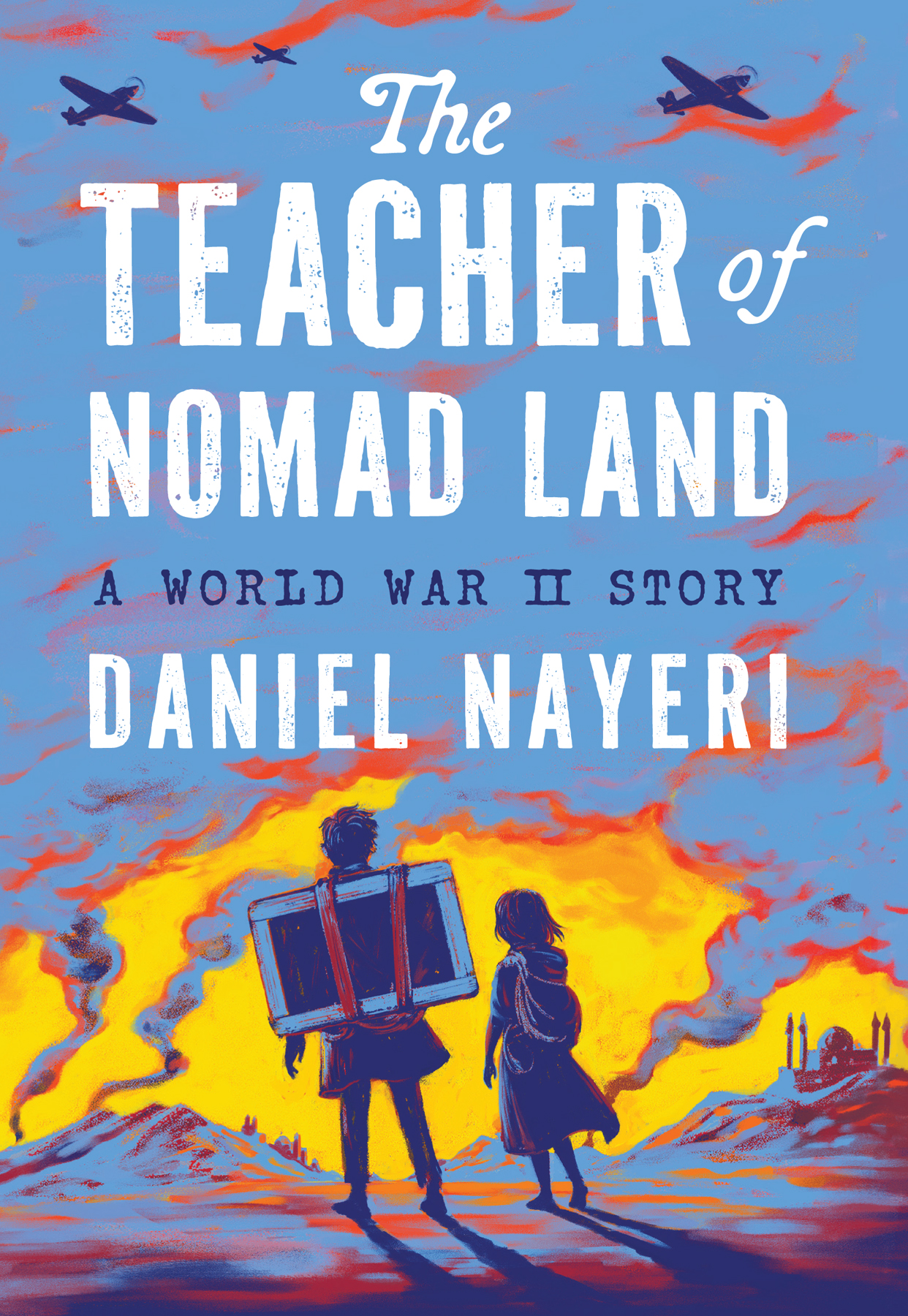
The Teacher of Nomad Land: A World War II Story
About this book
In 1941, Iran is officially neutral but occupied by British and Soviet forces. Babak and his younger sister fear separation after their father's death and decide that Babak can take over his teaching work.
They carry a chalkboard and books into the mountains, following tribes on their seasonal route. A Jewish boy hiding from a spy joins their journey, turning a plan for family survival into a wider obligation.
The novel introduces war through roads, languages, soldiers, lessons, and children making adult decisions with incomplete information. Education becomes portable shelter as well as work.
The Teacher of Nomad Land is historical fiction for younger readers, set in a less familiar Second World War theater. Adventure and danger remain grounded in sibling loyalty and the effort to keep a promise.
Read a sample
5,048 words
Plain text
From the opening
CHAPTER 1
Baba was a teacher. Dead now.
Babak sits in the courtyard of their house cradling the slab of stone that will mark his grave beside Maman, already dead. He is thirteen. Sana is eight, standing behind him. She says, “That was our last parent.”
Babak cries. He holds the stone as if it was a baby. He strokes the letters roughly chiseled onto the face of it. The war has made a cheapness of headstones. This one is barely the size of a cantaloupe.
MOHAMMAD NOORI
1901–1941
No other words. It doesn’t say that he liked peaches better than cantaloupes. That he raised Babak and Sana alone. That he taught the nomad tribes to read. He taught. He was a teacher. He was their father. It’s just a stone.
Babak thinks, “His body is somewhere in the mountains under a pile of rubble. He is buried there, not here.”
It comes out of him in sobs. He feels Sana’s hand, barely the weight of a sparrow, on his shoulder.
When the Bakhtiari tribesman—the one everyone called Traveler—had come to their door, they thought it was Baba and ran to see him again. Baba had only been gone two days. News of the invasion had come only a day before that. The British from the south, the Soviets from the north, in a joint effort, marched into Iran with tanks and brought the war with them.
A man on the radio said something in English. Another voice translated into Farsi. “The Anglo-Soviet invasion was necessary to keep British petroleum interests out of the hands of Nazis.”
Babak does not know any Nazis. He only knows Baba, who was killed—said Traveler the nomad—when British soldiers mistook a group of goatherds on a mountainside as resistance fighters crouching in wait to ambush their envoy.
The soldiers sent a few cannon shots into the hillside to roust them.
They were not resistance fighters. They were goatherds and a teacher who had come to help them retreat with their animals from the advancing army.
It was all misunderstanding.
No one spoke any language that anyone else spoke. Bakhtiari. English. Farsi. Russian.
It was all shouting and gunshot.
Babak’s father, Baba Noori, was huddled behind a juniper bush when a tank roared at him, and the rock ledge above him exploded and crashed down.
It was all some other people’s war until then.
Babak reaches into the pocket of his corduroy trousers and takes out a knife.
Sana says, “What do we do now?”
Babak sets the headstone down between his legs.
“Now that we’re orphans, I mean,” says Sana.
“We’re not orphans,” says Babak.
He unfolds the pocketknife. It’s not very big, like they would have in the military. It’s for slicing fruit. Not even big fruit. It’s for prying open a stubborn pistachio.
He sets the knife to the face of the stone. He scrapes the shape of the letter “beh,” and the letter “alef.” Together they make the sound ba. It looks like this: با.
It takes a long time. The edge of the knife grinds down into a dull, sad thing.
He does it twice. Baba. بابا. Father.
“Are you practicing your letters on our father’s grave?” asks Sana.
“No,” says Babak. “It says Baba.”
“You have to make the dots better.”
“I know,” says Babak. The knife isn’t any good on stone. The tip of it snaps off as he tries to twist it to make the dots. But Babak doesn’t care. Somewhere in this world, it should be written that Mohammad Noori was a father. A good Baba.
“Do you want me to find a stick?” asks Sana.
“No.”
“A sharp stick could help.”
“It wouldn’t. It would break.”
“Maybe a nail and a hammer. Auntie Joon might have one. I could ask.”
“No.”
“You don’t think she’ll help us?” says Sana. Her hand on his shoulder has reached for a pinch of his hair. She pulls on it the way a littler kid might suck a thumb.
“She will,” says Babak.
“That’s good,” says Sana.
Babak struggles to grind the letters deeper into the stone.
Sana thinks about it for a moment. Then she says, “That means we’re not orphans. We just don’t have a mother or father anymore.”
She pulls on his hair as if it’s a sleeve. She says, “We have Auntie and her husband, and his cousin from Tehran. We could help at the market.”
Babak lifts the stone so he can blow the dust off without leaning away from Sana’s hand. It says بابا in jagged, inconsolably broken lines. Sana sniffs back her tears and looks at it.
“Your penmanship is no good, brother.”
They walk together toward the cemetery to place Baba’s stone beside their mother’s. The mulberry trees of Isfahan are tearful the whole way there. People on the street race to board up their windows before the soldiers arrive. Babak and Sana see Mr. Kashan break the lantern hanging over the flower box beside his door. He pulls out the jasmine plant and half the dirt with it.
“Why is he wrecking his house?” says Sana.
“So they’ll think it’s abandoned,” says Babak.
“I’m keeping mine,” says Sana.
“That’s fine,” says Babak.
“If you were really abandoning your house, you’d just run away. But now, it looks like he’s hiding something, ’cause it’s the only broken flower box on the street.”
“What if he gets everyone else to do it?” asks Babak.
“Then the whole street would be ugly,” says Sana, “And you’d be no better off than before.”
Babak struggles to balance the stone in one arm so he can hold his sister’s hand.
“You could destroy the whole city before soldiers arrived,” says Sana, “and all you’ve done is half their work for them.”
Baba used to love Sana’s long walks of the imagination. He would ask open-ended questions and follow wherever her mind wandered. Babak tries it. He says, “What would happen then?”
“No. That’s not the question,” says Sana.
Babak sighs. “Why?”
“Because by then, we already made the world ugly. The trick is to go back and never do the devil’s work for him. Make them break your flowerpots with their own hands.”
“You draw the line at flowerpots?”
“I draw the line at killing my Baba. And after that, yes, flowerpots.”
They enter the cemetery and place the stone. It doesn’t have a plot of its own. It was only a kindness from Traveler to have it made. Babak sets it to rest on Maman’s stone, as if they’re forehead to forehead. They sit beside their parents and eat mulberries. Sometimes they forget and laugh at something funny, like a fat bird. They hear the growling of military planes overhead, and they remember. They wait until the sun goes down. As they walk home, Sana kneads Babak’s hand in her own.
She says, “You won’t let them separate us, will you, brother?”
“No.”
“Never?”
“Never,” says Babak. “I draw the line around the two of us together.”
Continue reading the sampleClose the sample
CHAPTER 2
The next day Auntie Joon comes and tries to separate them.
“This is wartime,” she says. “Who says you have a choice?”
She isn’t very big, but she moves like a he-goat with her head tilted down, ready to butt into everything. She charges around the house, as if she’s going to miss her bus. Babak stands in the main room. Sana stands half behind him. Auntie rushes out of the bedroom holding Baba’s winter coat. “Is this too big for you?” she says to Babak. “No matter. You’ll grow into it.”
She moves to the kitchen.
“Why can’t we stay here?” says Sana.
“Ha!” says Auntie, “A rental? In wartime? He should have moved you back right after she—” Auntie glances at Sana and revises the sentence, “—seven years ago.”
Auntie inspects the kitchenware. A stained samovar, a single pot for rice, a pan for Baba’s simple meals: cutlets, tomatoes in eggs, fried fish. Four plates. Four spoons. Nothing worth carrying.
Auntie’s oldest son—a cousin too old for Babak to have ever played with—will come by and sell everything. Auntie walks past Baba’s books and school supplies, holding the winter coat and a canvas bag with odds and ends. Two bars of soap. Soap is fast disappearing in the bazaar. Razor blades. A mirror from Baba’s bureau.
Auntie blinks at them twice.
“Come on then. Get your things.”
Sana runs to the bedroom for her locket with Maman’s picture. Babak already has his knife in his pocket, along with Baba’s watch and Maman’s ring. He approaches the small bookshelf. He packs a satchel with a language arts textbook, a workbook, prayer book, storybook, pencils, a sharpener, chalk, and a metal ruler. He slings the satchel over his shoulder and picks up the blackboard leaning against the wall. Years ago, Baba tied shoulder straps to the board so he could wear it on his back as he hiked into the Zagros Mountains with the nomads. The leather is stained with his sweat, repaired in places with a wrapping of cords. Babak thinks, “This is probably the most special item in the house.”
It’s heavy and awkward for Babak. He shifts the satchel to his hip so the blackboard can lie flat against his back. It’s wider than he is tall. When he was little, Babak saw a leaf moving along the stone courtyard and picked it up. Underneath was a surprised and irritated ant. He thinks he probably looks a lot like the ant now with the blackboard on his back.
“No no no. What are you doing? Put that down,” says Auntie.
Before he can say anything, Sana walks out of the bedroom they shared with Baba, hugging three pillows, her arms not quite reaching all the way around. “Okay,” she says, “I’m ready.”
“And what is this childishness?”
“What is?” asks Sana.
“You can’t take everything,” says Auntie.
“These are pillows,” says Sana. She stares with equal barnyard stubbornness at Auntie Joon. She takes a deep breath from the closest pillow. It still smells like Baba.
Auntie Joon is only used to sons, who will eventually break a stare with their mother, but Sana will not relent.
“All right,” she says. “All right. All right. I have a pot on the boil. We should go.”
Babak waits for her to turn and walk out before he risks any movement. And even when she’s gone, he waits for Sana, who takes her time, as if she’s trying to memorize the room. Now that the bookshelf is mostly empty, there isn’t much left. The tattered rug. The old radio. It was only ever three rooms and a courtyard. It’s the only place they ever lived with their mother. And the last place their father ever laughed. Babak says, “Come on.”
He can tell Sana’s imagination is overwhelmed. As he steps through the door, the sides of the blackboard knock on the doorframe. He says, “Oof,” and stumbles back. It’s enough to get a giggle from Sana. He turns sideways and wiggles his eyebrows at her. She laughs. He walks like a crab through the narrow doorway.
Sana waddles behind him with her pillows. Auntie Joon is already at the end of the block, waiting. When Babak approaches first, she sucks her teeth at the blackboard to let him know she doesn’t approve. Then she says, “Three blocks that way. Mr. Turani is waiting at his shop. I told him you’re coming.”
Then she turns to Sana and holds her hand out. “Come on, then. We go this way.”
“No,” says Sana. She looks at Babak.
“Granny’s waiting,” says Auntie. “She needs a young one around the house. You’ll be helpful. Come on. Come on.”
Auntie opens and closes her hand a couple times to beckon her.
Sana says, “We can be helpful together.”
“No,” says Auntie. “You have to go to school, and Granny needs help. And you”—she turns to Babak—“you can be done with school and help at the shop. Mr. Turani is Granny’s son, both related on your mother’s side. You’ll see each other on Fridays and when the family visits Granny’s other kids. That’s the best I could do. It’s wartime, you know.”
There is no earthly argument for orphans to get their way. If there was, they wouldn’t be orphans. Babak turns carefully and kneels in front of Sana.
“Don’t let her,” she whispers.
“I’ll visit every day,” says Babak.
“That’s not what you said.”
“I know.”
“You said we’d stay together.”
“I know. I just need time to figure it out.”
“We could go with the nomads. They loved Baba.”
“I don’t have anything to offer.”
Sana looks around the street, as if she might find some skill or service to offer. Her eyes start to well with tears. “You said.”
“Just a little time,” says Babak.
Auntie Joon takes Sana by the arm. “Come now. It’ll be fine,” she says.
“I’ll visit,” says Babak, and he turns so she doesn’t see his face anymore.
CHAPTER 3
Babak is an errand boy. Mr. Turani wraps a bundle of fresh tarragon, mint, parsley, and chives in brown paper. He adds it to a sack of dry goods and gives it to Babak to deliver to an old doctor who lives alone just off Four Gardens Park. Mr. Turani never leaves the presence of his radio. Even during his prayers, he turns it up just a bit, so that he can hear it from the back room of his grocery.
Babak only catches the news when he isn’t running through the streets of Isfahan, but he can feel its effect on the people. Everyone is scared, even though neither the British nor the Soviet armies ever marched into the city in a conquering motorcade. It wasn’t a conquest. It was occupation. If they hadn’t done it, Hitler would have. The soldiers only secured a network of trains called “the Persian Corridor,” from the oil fields in the south up to Tehran and past that to the Caspian Sea, where the petroleum can travel to the West.
The shah, Reza, was deposed and replaced with his son. They say neither is in power anyway. It is the British who put the son on his throne, and they will occupy Iran until the war in Europe is over.
Winston Churchill is in charge of England, Joseph Stalin is the strong man of the Soviets, and Franklin Roosevelt is king of America. They are allies against Hitler, the German emperor, and Hirohito, the Japanese emperor.
Mr. Turani is nervous that there will be nothing to sell. Babak listens to him complain as he waits for new errands. He wishes he could go back to school, but Mr. Turani says, “The world won’t be the same after this. Why learn the ideas of the old world? Better to listen to the news and hear the new ideas.” On the British radio, the ideas are all in favor of the British. On the German radio, the Germans. When they yell at each other, the newspaper men shout, “Who’s paying you? Who’s the shah in your house?” The talk is all about maps of the world. The countries are lines drawn and redrawn. Some of the lines are worth dying for. Some of them are meaningless. Everyone disagrees on which is which.
Babak thinks the new ideas are just the old ones in new trousers.
“They kicked our king out of his own country,” says Mr. Kasem, who owns the tobacconist shop next to Mr. Turani’s grocery. The two shopkeepers sit on wooden crates outside their shops and play backgammon in the afternoon, the radio always droning on in the background.
“He would have let in the Germans,” says Mr. Turani.
“Of course he’d let in the Germans!” says Mr. Kasem. “And he should. They respected our nation. The English have stolen our petroleum for thirty-two years!”
Mr. Kasem spits at the mention of the British oil company’s presence in Iran.
“So then you understand the problem,” says Mr. Turani.
“What problem?”
“The shah would have sided with the Germans to rid himself of the British.”
“Well, he declared neutrality.”
“Sure, but he would have given some preference to Germany.”
“And he should. That’s what I said. The Persians are the Aryans of the East.”
“Right. So the English and the Soviets invade to keep control of the petroleum and cut off any possible alliance with Germany.”
“You’re going in circles, Turani. We know this. They had no right.”
“Ah. There. That’s what I’m saying. Don’t you see?”
“No. I don’t see.”
“You keep saying they have no right. What right? Who made these rights that let you hold everyone to account? Okay, they have no right to invade. But it’s clearly the best action to remove your opponent’s pieces from the board. The British did it. It’s bad for my business, but they never asked me, and they did it.”
“Are you saying we would be a game piece for the Germans to use? We’re Aryan brothers.”
“They think we’re dogs, Kasem. You’re listening to Nazi propaganda again. They just want the oil too.”
“You’re belittling your own country, Turani.”
“You’re aggrandizing us in a war that we have no part in anymore.”
“We’re the Persian empire.”
“We’re Iran. The British have seized the oil and say they will only leave once the war is over. I wish it wasn’t so, but they made a good move. Admit it.”
“I won’t.”
“Then you’re not looking at the whole board.”
“The son is no shah,” grumbles Mr. Kasem. “He’s an English puppet.”
“Sss,” hisses Mr. Turani to quiet his friend, “He has spies.”
“I hope they lose,” says Kasem. “We’re a country held captive by our enemies.”
“Like Poland,” says Mr. Turani.
“Just like Poland.”
“I have not seen Iranians driven out to gulags like the Poles or the Jews or the Gypsies, Kasem. You have to consider these things. Have you heard the rumors of what they do? Have you seen anything like it here? Have you?”
Mr. Turani reads every newspaper and magazine he can get his hands on and knows the rumors of such evil the world has never seen. He only ever whispers of the horrors of the Nazi war machine. “I would rather be in the capture of the British, than the friendship of the Nazis,” says Mr. Turani.
“Ey vay!” says Mr. Kasem, disgusted with the conclusion of the conversation and his loss in the game at the same time.
They play backgammon and talk about war all day.
Babak runs past the primary school in the old neighborhood every chance he gets. Three times a day. He runs half a kilometer out of his way sometimes, but he doesn’t mind. He walks past the classroom window and does something to catch Sana’s eye. Maybe a skip jump, or a Charlie Chaplin penguin walk, or he’ll juggle the packages he’s carrying. If he’s walking back with nothing to carry, he’ll pretend to trip and fall on his face. He can hear the laughter through the glass when he does it. The teacher doesn’t know him or that he’s there to be with Sana, to keep his promise. She shouts and clatters her ruler on the window. Babak runs away.
Sometimes, he’ll take his lunch and climb a tree outside the school courtyard. He eats his flatbread, his piece of sheep’s milk cheese, a cucumber, with his legs dangling where Sana can see them.
Mr. Turani says he takes too long on his errands because he’s lazy or distracted. But he doesn’t scold too much because there aren’t enough deliveries anyway. He frets about the business. He mostly leaves Babak alone. They don’t pay Babak any money. Mrs. Turani says he eats more than he’s worth and should be paying them somehow. Babak doesn’t tell them that some customers will put a penny in his hand if he carries the parcels up their steps. Others pay him to deliver their own packages around town. He hides it all so that he can buy a life with Sana. He doesn’t know what that means. A train ticket to somewhere? Could he ever save up for a house? Not at this rate. Could he pay the nomads to adopt them?
Babak doesn’t know. But all he can do is save his money in a cannister he hides behind a loose stone in the alley behind the grocery.
He does this for a year.
Running, carrying parcels, visiting Sana every spare moment, hiding money, chores.
Mrs. Turani slaps him once for taking extra walnuts for Sana. When Sana asks about it, he says he hit his cheek on a branch on the way down from a tree.
For a year he listens to the news of Nazis in Poland, Hungary, Norway, Belgium, France. They are winning. It is best not to interact with the British soldiers he sees in the street or the ones in suits. There is word that thousands of Polish and Jewish refugees have landed at the seaside town of Bandar Pahlavi in northern Iran and will take shelter in cities all over the country. The news says they arrive looking like ghouls from the work camps in Siberia or the holding centers in Uzbekistan. Hundreds died on the way. Starvation. Disease. The children are skeletal, their eyes drawn down by grief ten times their age. The Iranians who greet them weep at the sight of them.
The refugees stay seaside so they can replenish their strength before traveling on. The Jews will stay at the Jewish orphanage in Tehran. The Polish children arrive in Isfahan and will stay at the estate of a Persian aristocrat.
Babak delivers groceries to the kitchens of the estate and sometimes hears the Polish children playing. They don’t sound unhappy, but they don’t laugh. It’s the clamor and shouting of a chasing game that is neither happy nor sad. Even their play is wartime play. If a pot lands heavy on an iron grate in the kitchen, they immediately stop and listen for danger. Babak doesn’t understand Polish, but he nods gratefully when the kitchen staff give him a little bit of change for his efforts.
Persian kids play in the back streets, behind the market. They invite him, but Babak says no. All he thinks about is saving money and rescuing Sana.
CHAPTER 4
As the year passes, fall, winter, spring to summer again, Sana becomes a quiet child. Granny is not as strict as Mrs. Turani, but her house is no more than an apartment, as cold and somber as a tomb. Granny walks around in her housecoat in the middle of the night, praying for her children. Sana says she looks like a moaning ghost. If ever Sana wakes up to see it, she hides under her blanket.
In addition to school, Sana washes the dishes, reads Granny’s letters aloud to her, brews tea every three hours, and helps Granny wash herself. Granny never has guests and seems agitated if Babak comes around unannounced, so Babak sits in the tree outside the apartment and Sana talks to him through the window.
“When can we leave?” she says first thing, every time. Every time. “When can we leave?”
“I’ve almost got the money,” says Babak.
“I hate it here.”
“Soon,” says Babak, but he doesn’t know when.
“Where will we go?”
“I don’t know.”
The war has made travel too dangerous, and unthinkable for children. There are military checkpoints on the roads. All the world is fighting, and no place is safe.
Sana says, “The nomads are going to leave soon.”
In the late summer, the Bakhtiari tribes travel from Isfahan southwest to Ahvaz, a hundred miles over the mountains, to spend winter in a warmer environment where their cattle can graze.
“We could go with them,” says Sana.
There are no military checkpoints across the Zagros Mountains.
Babak is forced to agree.
“We can offer them our money,” he says, “then make ourselves useful. Maybe they’ll let us work for them.”
“Yeah!” says Sana. “Yeah. I could read their letters. I could wash. We can learn whatever they want from us.”
When Babak sees her leaning so far out of the window, he wishes he could take her away right then and there.
“We will,” he says. “Will you be okay until then?”
“Don’t forget your promise,” says Sana. She says it every time, as if she wants to make sure her brother will come back to visit soon.
Babak gets the feeling Sana isn’t telling him how hard her life has become. And he doesn’t say anything about Mrs. Turani throwing things at him. They are both being strong for the other.
Babak climbs down from the tree. From up above, Sana whispers, “Brother. Catch.”
Babak sees the gleam of a coin falling to the sidewalk and snatches it up before anyone can see.
“Where did you get this?” he says.
“I found it,” says Sana.
He looks up at his sister’s silhouette, poking out of the second-story window. Granny cut Sana’s hair short, to her chin, so they wouldn’t have to wash it too much.
“Did you steal it?” says Babak.
Sana shakes her head. Her straight hair whips back and forth, as if dismissing the question.
“Put it with the rest,” she says.
Babak must sprint back to the grocery as the sun goes down. When he turns the corner on their street, he sees the shop is closed, the iron grate is pulled down, and the padlock is fixed. Mr. Turani has closed up by himself. The light in the second story window is on, where Mrs. Turani is probably cooking dinner.
He will be punished.
He tells himself to be strong. He is so close to having enough money. Tell them you saw some boys making a kite with butcher paper, tree branches, and twine. Tell them you were distracted and apologize.
He tries to steady his nerves as he runs behind the grocery to the alley. He thinks, “So close,” as he pulls out the loose stone in the wall. He thinks, “Just be strong.”
There’s nothing there.
His hand reaches farther into the gap, but the cannister is gone.
Babak looks around the alley.
No one around.
He leans over and peers into the black hole.
No cannister. All his money. An entire year. His promise.
He spends a half hour searching around, until he finally trudges up the back steps into the kitchen, where Mrs. Turani is cooking a lamb stew in a shiny new pot. On the counter is a tin of coffee and a sack of sugar. Mr. Turani is at the table, reading a newspaper. On his feet, new shoes. When she sees Babak enter, Mrs. Turani turns down the radio and says, “What, you thought we’d never find it?”
Babak’s mouth is agape like a caught fish. Mrs. Turani shakes her head, “Pfft. Ungrateful and naive, what a combination.”
CHAPTER 5
Babak stumbles through the street in the middle of the night carrying his blackboard on his back and his satchel on his hip. For the year of work, he has nothing to show but a bedroll he holds under one arm, a tin cup dangling from the satchel, and the few coins he earned today. He passes by the teahouses of the center city where British soldiers and Soviet soldiers listen to Polish girls sing French songs. Any of the Iranian waiters might be part of the shah’s secret police. Somewhere in the crowds are lurking German spies, but no one knows who is who. Everyone watches everyone else, but no one notices the boy walking by with a blackboard on his back.
It’s past midnight. He can’t climb the tree in front of Granny’s apartment, so he finds a pebble and flicks it at the window. Before he can find another, Sana is there. Wide awake. She opens the window. “Finally,” says Sana.
“We’re leaving,” says Babak.
“Yes!”
“They took our money,” says Babak.
“I knew they would,” says Sana.
“Why didn’t you say anything?”
“Well, I knew they could.”
“Pack your things. I’ll wait.”
Sana doesn’t need him to wait. She throws down a bag and a pillow wrapped in her bedroll and starts climbing out the window before Babak has finished his sentence.
“Hold on,” he says, rushing to set down the blackboard. “Hold on. I’ll help you.”
Babak leans the board against the tree and his bedroll beside it. He reaches up for Sana’s ankles. She hangs from the windowsill. She lets go. He sort of slows her down as she lands on the ground.
“This is great,” says Sana. She straightens her skirt and picks up her bag. “This is just so great,” she says.
“How did you know I was coming?” says Babak, as he returns to his things.
“I didn’t,” says Sana.
“Then how did you know to pack?”
“I didn’t. Come on. Let’s run.” Sana is like a cat, trying to get Babak to follow by taking three steps, halting, looking back, circling around, tilting her head as if to bend the world into rolling Babak in the direction she wants.
“Wait,” says Babak. The board is heavy, and he’s not used to slinging it over his shoulder. “Wait. If you didn’t know I was coming, how did you have all your things packed already?”
“Easy,” she says. “I never unpacked.”
They walk in the dark streets as quietly as they can, alert to every sound. The city is uneasy, as if its beds are filled with strangers. Babak walks in the street to make room for his blackboard and so Sana won’t have to walk in the drain and wet her shoes.
When they walk past the Polish children’s estate, they hear footsteps in the courtyard, the cook perhaps, making his early morning preparations. They walk to their old house, as if to start again from the last place they were together. To redraw their steps. When they reach the house, it looks like a used balloon, all its color and shape the same, but sagging somehow, less elastic, thinner. Sana doesn’t even stop.