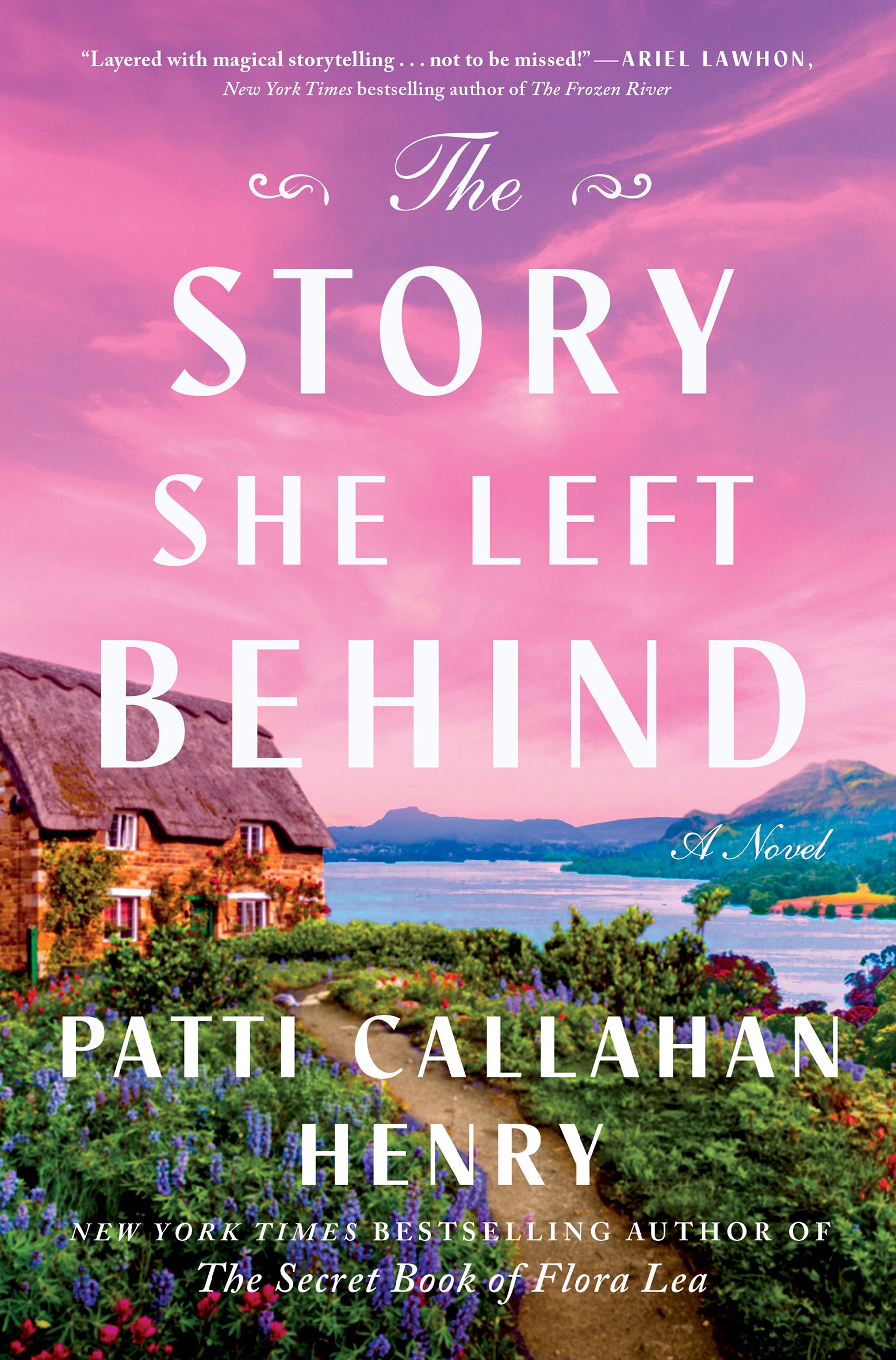
The Story She Left Behind
About this book
Bronwyn Newcastle Fordham disappears from her South Carolina home, abandoning a young daughter and a literary career already surrounded by legend. In 1952, that daughter, Clara Harrington, has become an illustrator and protective single mother who has stopped expecting an answer.
A message from London reports the discovery of Bronwyn’s lost dictionary, written in a language she created as a child. Clara travels with her own daughter to meet Charlie Jameson, the man holding the papers, and enters a family history shaped by wartime loss and guarded inheritance.
The search moves through manuscripts, translation, memory, and the Lake District rather than treating disappearance as a puzzle with one clean motive. Clara must decide what knowing her mother can repair and what it cannot restore.
The Story She Left Behind is historical fiction inspired in part by the vanished writer Barbara Newhall Follett. Patti Callahan Henry makes language both clue and relationship, connecting authorship to the people a story leaves outside its pages.
Read a sample
5,010 words
Plain text
From the opening
CHAPTER 1 BRONWYN NEWCASTLE FORDHAM
Bluffton, South Carolina
1927
It is two o’clock in the morning when she leaves everyone she loves. At the edge of the May River, she unties the ropes of the Chris-Craft from the cleats of the weathered dock and steps into the boat. In the velvet quiet, a new moon cowers behind its dark cloak; the stars flare as bright as the fire that is sending her away.
She will be long gone before the tide returns in six hours to fill the marsh and secret waterways. She knows the tides of this estuary without having to look at a nautical chart or check the battered barometer that has always hung on the screened porch of their shingled house. She has planned this escape to the minute, and she does not hesitate.
The boat rides on the outgoing tide, and the wind-puckered river pushes it gently toward the sea, catching the current more quickly than she’d anticipated. Flickering lights of Bluffton dot the coastline like fireflies. Any minute, she’ll start the engine and navigate the boat toward Tybee Island and then into Savannah.
She stares at the ink-dark sky, at Orion and the Big Dipper. She doesn’t want to witness the familiar and loved landscape disappear.
Her mind begins to form a list, a habit she’s turned to since she was a child.
First, she lists what she’s brought with her: a coat, a change of clothes, a hundred dollars in cash that she took from the envelope they kept for emergencies, a notebook and a pen, as well as a leather satchel that contains the words she’s spent her life finding and creating.
The boat bobs and sways and she stares out to the horizon, waiting to start the engine. Her thoughts tick past what she’s brought and move to all she is leaving behind: the quiet crash of the incoming tide onto the oyster shells outside their window; the gray-shingled house that has protected her for ten years now; the room where she writes and reads in a chintz chair with the stuffing blooming out of the seams; the dimming of the day when longing rises and she dives into the warm waters of the river; the midsummer’s ivory bloom of the gardenia bush that she planted with her daughter; the soft caress of a breeze when she sits on the porch; her husband reaching for her in their bed and winding his fingers through hers while the crickets seem to cry.
And: Clara.
She holds the gunwale to steady herself as she walks to the cockpit. She presses the button to drop the single engine into the water while a surge of primal need for her daughter flows through her, causing her to sway with dizziness. She draws on her strength and on the knowledge that if she returns to her house, the world will do to her in full what it’s done only until now in part.
She thinks of the beauty of this place that she will carry with her: a place where fireflies decorate the nights and pine needles gather in soft beds, where sunrise tosses diamonds onto the water, where minnows flicker silver on the river’s surface.
The losses mount and she thinks nothing of what others might say, thinks nothing of her own well-being—Bronwyn needs to move forward and away from all that will come to pass if she stays. There are things that cannot be undone.
The unseen world has always called to her. She knows what she must do—she will become unseen. This is the answer for the character that she created, and this is her answer. Their destinies were always tangled together, she knows that now.
She finds the boat’s starter and presses it; the motor purrs, the water churns behind, and she pushes the throttle forward. She places her hands on the wheel. These are her waters, and she does not have to see to know the way.
Continue reading the sampleClose the sample
CHAPTER 2 CLARA HARRINGTON
Bluffton, South Carolina
November 1952
She disappeared twenty-five years ago when I was eight years old, and still my mother appeared to me every day. It might be in a turn of phrase I used, or in the song of the rising tide behind our house, in my daughter’s creative energy as she gathered moss for a fairy house, or in the clues and messages my mother taught me to look for in the natural world. She seemed to be everywhere and nowhere all at once. She was absence, she was presence, and she was mystery.
Because of that pervasive energy, I created something in my life that was mine alone. My art was just that—my private place, my passion, my refuge from the larger world that no one else could touch.
Or so I believed.
In our blue cedar shake house on the spartina-edged waters of the May River, I disappeared into the world of a hedgehog named Harriet. I was painting her for a children’s book. I held my sable-hair brush over the canvas, readying for the whiskers’ fine lines. The lush and immersive landscape in the story made me look forward to entering the author’s imaginary world every day, despite never having met her. I was her illustrator.
I loved this little hedgehog with one ear who struggled to find her place in a land of lakes and mountains, of magical talking animals and wide spaces overflowing with wildflowers and willow trees. For me, Harriet’s spirit was an echo of my eight-year-old daughter, Wynnie, an allegory of Wynnie’s own struggle to fit in with her third-grade class, with her thick glasses and her fragile lungs.
Now, in the sunroom I used as an art studio, Harriet’s whiskers quivered under my brush when the broken ring of the doorbell’s song startled me. I dropped the paintbrush onto the tarp cloth and nearly knocked a watercolor palette from the side table.
There often was a charge of change when I moved from one world to the next, from the imaginary to the real. I always needed a moment to return. The clock on the far wall told me that four hours had passed while I worked. I’d missed lunch completely, and now Margo was here for the newspaper interview we’d arranged.
I’d planned to clean up first, to present as the professional artist who had just won a major award, but that time was gone, and Margo knew me better than that anyway. I rushed to the front door, wiping my hands along Nat’s old button-down I used as an art apron, a mosaic of paint blotches and bleach.
On my front steps, beneath the shade of a live oak spreading its gnarled arms in every direction as if searching for something it hadn’t found for the past two hundred years, Margo stood in a flowered cotton-print dress, her hair styled in the newest curly bob. I couldn’t help smiling at her obvious attempt to be polished, at how she needed me to see her as a real reporter, just as I wanted her to see me as a professional artist, even though we’d survived braces together and all those bad haircuts and the dateless high school homecoming dances in smelly gyms.
I hugged her. “Come in, come in. I’m sorry I lost time. I do that sometimes.” Always, I didn’t say.
She followed me into the house I’d grown up in and now lived in with my dad, where she’d been more times than could be counted, her high heels clicking on the hardwood floors.
“Thanks for doing this,” she said. “Mr. Farnam is so impressed that I nabbed this interview.” In her nervousness, her laugh erupted in a snort that made us both burst out as if we were thirteen again.
“It’s just me, Margo.”
“I know, but this is such a big deal, Clara. Winning a Caldecott is huge.”
“Thank you. I’m really excited.” Afternoon sunlight sifted through the east window, leaving daffodil-yellow stripes on the counters and hardwood floors, the oak kitchen table, and the far wall painted spring green. I motioned for Margo to follow me. “Let’s sit out on the back porch; it’s so warm for November. Do you want some lemonade?”
“Have anything stronger?”
“Seriously? It’s two in the afternoon.”
“Kidding. I’m kidding.” She seemed embarrassed. “Lemonade is great.”
Our house was perched on an oyster-shell outcropping at the end of a rutted road in Bluffton, South Carolina, a small coastal village curled around an estuary, a moody body of water. When the waters rippled over the shoreline, the oyster shells sang what my mother always called “their tidal song.” Margo and I sat down at the old iron table with the rusted edges with the garden stretched before us, its autumn colors bright before the silver-gray river. The pink and white camellia bushes were in late bloom; goldenrod scattered about the yard was bright against autumn’s heather-colored grasses.
I’d spent all morning in Harriet’s world, but this was mine, complete with creaky floors and old hinges, the tilted decks and briny aromas, the peeling white trim and cracked porcelain sink beneath the kitchen window. It was all perfect. It was my home.
Margo used her napkin to wipe a damp spot off the table, opened her blue notebook, and set it down.
“Looks like you’re ready,” I told her.
She smiled at me, took in a deep breath, and exhaled her first question. “Clara, did you start illustrating books because your mother wrote a famous children’s book?”
I shook my head because although I’d felt this question waiting for me from the moment she rang me requesting an interview, I’d hoped, for friendship’s sake, that she would try to protect me. “Margo,” I said, “come on. You know I don’t like to talk about her.” I took a sip of my lemonade and wished for the something stronger that she’d joked about.
She fiddled with her blue spiral notebook, bit the end of her well-chewed pencil eraser, and tried again. “I’m just asking what people will want to know. That’s not an unreasonable question. It’s my job.”
I looked away from her to the marsh grasses fading from green to brown now. It wasn’t Margo’s fault she had to steer us into uncomfortable waters. Even the Caldecott committee had summed me up this way in their recent press release: my famously lost mother and her book, my job teaching art in elementary school, and my daughter. These were the things that defined me. At least they hadn’t mentioned my divorce.
Here in Bluffton, there were very few secrets. That’s the deal you make with yourself when you marry, live, and work in the same town where you grew up. Assumptions are made that become difficult to shift. As claustrophobic as a town this size could be, there was also great comfort in the deep familiarity of place and friends like Margo.
“It’s the Caldecott,” Margo said, trying to get me to focus again. “Clara, this is a really big deal. You’re going to be famous. No one in our town has ever been famous unless they’re a war hero.”
I leaned toward Margo. “Who here even knows what a Caldecott Award is? I’m not going to be famous. I’m an elementary school art teacher. I am mostly a working stiff splattered in paint and globs of paste.”
“When the awards ceremony happens in Chicago, don’t think they won’t ask you these same questions.”
“Listen,” I said, “even in my best dreams, I didn’t dream this. When they called me last week to tell me I’d won, I couldn’t absorb the words. I don’t know what my illustrations are about—there isn’t some psychological underpinning, near as I can tell. I have just always needed to capture what I see around me. Been obsessed with art and drawing since I can remember.”
“How did the author, Eliza Walker, find you?” she asked, scribbling. “She’s such a well-known author, and you’re just getting started as an illustrator—respectively, I mean. And doesn’t she live in Maine?”
“She saw my work in some Little Golden Books I did and asked her publisher to contact me. I sent my illustrations to New York, and that was that.”
“Have you met her?”
I shook my head. “I’ve never even spoken to her. We’ve corresponded. She’s complimentary and kind, and very formal. I love bringing her Maine landscape to life as beautifully as possible,” I added, trying my best to give Margo quotes for the article. “And yet this award? I am floored. Over the moon. Honestly, I can’t really believe it. But famous? No.”
She laughed, and with that, her voice returned to normal, to the woman I knew. “Famous in this town, though, right? I’ll bet your dad is so proud. Does he still work at the same hospital in Beaufort?”
“He does, and he’s so proud of me.” He’d cried when the call came and hugged me so hard it hurt. “Wynnie, too,” I said. “She thinks I’m going to bring home a trophy. I had to explain that the prize is a coin.”
“How about…?” Margo bit her lower lip.
“Nat,” I said. “It’s okay. I’m fine talking about him. He’s very happy for me.”
This was true. He was. My ex-husband wasn’t an evil man, just one who loved gambling more than he loved us. And even that notion had some falsity built into it, because honestly, I did believe he loved us more. But his compulsions or addictions led him to other places. And that led to losing our house, and that led me to the divorce attorney who really didn’t have much work in a conservative small town like this, and then that path took me back to my childhood home.
One thing always leads to another, as they say.
Margo clicked her nails together in a nervous habit that chipped her pink polish. “I remember you drawing little pictures in the margins of all your notebooks. You were always so talented, and you deserve this award.” On the river, a shrimp boat was passing, its nets hanging like curtains on either side, while laughing gulls and terns followed in dancing loops, hoping for scraps. Suddenly her mood changed. “Clara, do you think there are things we are meant to do? That there’s such a thing as fate?”
“Fate. It’s such a big word, isn’t it?”
“Yes.” She met my gaze.
“Fate. Destiny,” I said. “They’re ours to make.” A briny breeze floated off the bay and lifted my hair, and I had the strangest sensation that this was something my mother had once said. That this voice was her voice speaking through me, an idea that both warmed and chilled me. “I believe there are many things we’re put here to do. Don’t ask me by whom, because I don’t have that answer. But I think we come with many fates built into us and we can’t fulfill all of them. We choose.”
“Many fates,” she said. “We choose. I like that.”
“And yes, maybe my art is one of mine.”
She scribbled on while I read her notebook upside down, making out the words: many fates.
“Do you need anything else? Wynnie will be home any second.” My ears were already attuned for the rumble of the school bus, for the clatter of my daughter running through the house, calling, “Mama.”
Margo closed her notebook and relaxed, leaning back in her chair. “I am so proud of you, Clara. Really.”
“Thank you. That means a lot to me. You know where to find me if you need anything else.”
“Thank you. And congratulations.”
After she left, I stayed outside waiting for Wynnie. I’d already made her a peanut butter and honey sandwich and cut off the crusts, a snack that we’d take out on Dad’s old trawler. It was part of our routine, whenever the weather held. Before Dad came home, we’d cast the net for tiny silver fish and watch the sun move lower in the sky.
Still, just below my thoughts of Wynnie, Margo’s question itched. Did you start illustrating books because your mother wrote a famous children’s book?
I hated that idea. Hated it. And yet, had I?
CHAPTER 3 CHARLIE JAMESON
St. James’s Square, London
It was a bitterly cold and damp November evening, but as Charlie stood in his father’s library, in his world of books, he felt warm. The room overflowed with everything his father once was to the world and to Charlie.
Three weeks had passed since burying his father. This day marked the first time Charlie had ever entered his father’s library without knocking and hearing the gruff but friendly Join me, Son.
The London house was dark at seven p.m., and Charlie was alone. Outside the windows, lanterns flickered on St. James’s Square, and the second-floor library was as still as the crypt they’d lowered Callum Jameson into.
Charlie had put this off long enough.
He’d canceled the Lads’ gig that night, the first time in eight years. But his Celtic band members understood. They could do without him for one night, they told him with a slap on the back.
Charlie flicked on every lamp in the library and inhaled the room’s faint aroma of charred wood. In the brick fireplace where granite quarried from his mother’s family’s land in the Lake District surrounded the grate, ash, dusty and gray, settled beneath charred logs. The Jamesons were among the fortunate few who could still use natural wood, while most of London suffered with the cheap, nutty coal that put out more smoke than heat. The spent remains of the fire had settled under the grate for three weeks now, an artifact of the moment when Charlie’s father had placed his hand over his heart, looked up at his son, and said, “Well, isn’t this odd? I do believe I’m having a heart attack. Come, Charlie.”
Those were his last words, one hand on his chest, one reaching out.
Come, Charlie.
Callum Jameson had celebrated his fifty-sixth birthday with a grand party in this very house only four months ago. He’d left his twins, Archie and Charlie, and their mother, Pippa, far too soon.
Directions were clear: The family’s finance company was to be inherited by the two brothers. Archie was to take over the investment firm, founded in 1690, built from scratch by Mother’s Burrough family and grown into a megalith of success by her Irish husband. Charlie was to remain at Burrough’s Holdings under his brother’s leadership, continue in his music career, and manage the house in the countryside.
In addition, Father had instructed Charlie to preserve and catalog his extensive library here in London.
Charlie understood the direct imperative to continue his music career: the Celtic drum he played was the last remnant of Callum’s Irish descent. His father played the round calf-skinned drum and attempted to teach both of his sons as well. Only Charlie took to it.
There was no other direct family but a second cousin surviving Callum’s passing. His mother, father, and brother had been killed in a 1916 IRA uprising in Dublin when Callum was twenty years old and off in America studying mathematics.
Archie, Charlie, and Pippa were his family. And this library—well, it was most definitely beloved, as well.
Charlie sat behind his father’s mahogany desk in the library while his mother grieved at their country home and Archie waded through paperwork at the company’s London office.
When Charlie was a young child, he sat on his father’s lap at this desk while his father pored over history books and maps. Father read wild tales of the Nordic and Celtic myths, and together they listened to Verdi’s operas and Celtic folk music. Callum knew how to speak the old Irish-Gaelic language but rarely did so, though he taught his sons a few Gaelic songs, as if the pain of all Callum lost could be imparted only through music.
This room was his father’s domain, his geography, always in perfect order. No one walked through the door without Father’s permission, but when they did enter, they gained passage to another world—or so Charlie had once thought.
Where should he begin in this room of floor-to-ceiling pine bookshelves, where oil paintings of their lands and the wildlife it contained hung? The oak walls glowed with the honey hues of aged wood; the evergreen damask curtains shielded the evening light from entering the lamp-lit room. Leather-bound volumes filled the shelves, and a tall rolling ladder stood in the middle of it all. This library was his father’s doing, his lifelong creation. Antique maps, leather volumes, and rare editions filled every crevice.
Callum Montcrest Jameson III seemed to have been a man of contrasting interests: money management and mythology. With his booming voice, his tall, imposing presence, Callum embodied both archetypes confidently. Friends and family said that Callum’s twin sons split his personality into two parts. Archie inherited the logic, and Charlie the mythos. Charlie earned a master of studies in history from Oxford, while his brother’s degree was in finance from Cambridge.
It was easy to categorize the twins this way, but they were one family, both with their own interests, both caring deeply about the family’s investment company.
On the desk, Callum’s walnut pipe bowl spilled tobacco onto a leather blotter the color of soil, exactly where he’d dropped it that evening when he’d collapsed. A silver-framed photo of Philippa and Callum on their wedding day in the country. One of Archie and Charlie sat to the right: the twins at five years old in a blue rowboat on their beloved lake, Esthwaite Water. The twins posed with a trout they’d caught and would cook for dinner, so small it would only provide a single bite for the four of them. You’d think they were whale hunters by their prideful grins.
A neat pile of papers sat stacked in the center of the blotter: a report from the bank that Charlie would need to pass along to Archie. And then, as always, there was a book of history, this one about the Vikings who invaded Ireland and brought with them the Celtic culture that endlessly fascinated Callum.
What happened to all that knowledge that Callum collected and carried in his soul? What happened to all that wit and wisdom? Where was it all now? Charlie sagged with grief.
With a deep breath, Charlie stood and walked to the phonograph. The record playing the day Father died still sat on the turntable. Charlie clicked the on button and dropped the needle onto the vinyl. La Bohème. Charlie wondered if he would ever be able to hear the opening strains of the opera without thinking of his father—without mourning his father, to be more exact. No one had read more than his father, from the prophets to the poets, from the classics to modern literature. The loss of Charlie’s father made the world feel deeply empty and unsteady, wobbling beneath his feet.
Music fueled his melancholy, and he paced the rectangular room, his eyes scanning each section: Mathematics, Fiction, Art, Antiquities, History, Maps. On the lectern that displayed whatever book, map, or illustrations Father was studying sat a 1745 map of the family’s six acres of land in the Lake District.
Halfway around the room, Charlie stopped pacing when his gaze snagged on something new. On the bottom shelf, atop a pile of leather boxes that held ancient maps, sat a brown leather satchel, worn and scratched, its brass buckles tarnished.
He crouched and slid out the heavy case. The thrill of the old hunt with his father returned. How many times he and Father had browsed through antique shops and attended auctions to find just one more map, one more book, one more…
Charlie set the satchel down on the desk. He was certain the leather bag hadn’t been in the library before. It would have caught his eye among the many piles of books and carefully boxed and labeled papers. The tarnished latch was designed as an eagle, the beak clutching the hook.
Charlie folded back the flap to glance inside, seeing nothing but papers. On top sat an envelope, and he pulled it out to read the words on it: For Clara Harrington only. Further instructions inside.
He grabbed the stack of papers, at least three inches thick, and slid them out. Reaching inside, he felt only the disintegrating silk lining. He thought about the legendary story of Hemingway’s suitcase, how early in his career his first wife, Hadley, had lost a bag carrying years of the famous author’s work on a train. It was never recovered.
These were the kinds of stories that sent Callum and Charlie on joyous hunts. Once, as they traipsed down Cecil Court, Charlie asked his father, “What if we found Hemingway’s suitcase?”
His father laughed and jostled Charlie. “What if we find the lost papers of Shakespeare?”
Point taken. Maybe it was all a dream, but it was nevertheless a dream they’d happily pursue. The joy was in the journey, not the execution—or so Father always said. Charlie wasn’t so sure.
Charlie lifted his reading glasses from the desk and slid them on. He bent over and spied a note, carefully handwritten in a near-perfect script on the top sheet. The contents of this satchel are to be given only to Clara Harrington of Bluffton, South Carolina. Then a phone number and address. She must retrieve these papers in person. They must never be mailed. The sealed letter inside is to be read only by her. Le draíocht.
The author scribbled one more note on the bottom left side: Please tell Clara that I’ve saved this language for her, Bronwyn Newcastle Fordham.
Charlie knew that name, but how?
Lifting the note from the pile, he saw foreign words with pages and pages of what appeared to be a dictionary of terms. Even as curious as he was, he would not show these papers to anyone: they were meant for one Clara Harrington in America.
Charlie’s father had soaked him in old Irish folklore as a child, and he knew enough Gaelic to know that there were mallachtai—Celtic curses and spells when breaking a draíocht, a charm or enchantment. He wouldn’t dare bring either onto his head. Charlie would heed Bronwyn’s request.
CHAPTER 4 CLARA
Bluffton, South Carolina
The second-grade students buzzed with end-of-the-day energy as they returned their crayons to their wooden boxes and folded their drawings. Billy Markman ate another glob of paste and didn’t think I noticed. I headed toward his side to gently remove the jar from his hands when the overhead speaker buzzed with static.
“Mrs. Harrington, please come to Principal Alexander’s office.”
“Ohhh,” Gina, with the pigtails and lacy dress, said. “You’re in trouble.”
I smiled at the little girl and shivered in fake fear. “Oh no!”
The class laughed and started a chant. “Mrs. Harrington is in trouble.”
I motioned to my classroom assistant—a shy student teacher finishing her elementary school internship—to take over the class for the last few minutes.
After my daily admonition to “bring your inside feelings to the outside in your art,” I left the room.
I took my time walking to the principal’s office, enjoying the hush of empty hallways, the aroma of the spaghetti and meatball lunch wafting out of the cafeteria, and the framed pictures of the hundred-year history of the Bluffton Bobcats students lining the walls.
A photo of freckled me from third grade hung askew on the wall of fame, with the caption Illustrator on a shiny brass plaque. That little eight-year-old girl knew so little, with so much pain ahead of her. I was happy to be the me of now, no matter the circumstances: divorce, living in my childhood home, confronting an unknown future.
Sure, I wasn’t the traditional 1952 housewife, the epitome of a Woman’s Day magazine cover model. I didn’t own pearls or do housework in heels. I didn’t join the PTA or the Supper Club. I didn’t wear cute headbands and dresses with cinched waists. But this was my home, and I was loved. If a few moms looked at me sideways when I picked up Wynnie from school, or if I wasn’t invited to the newly minted Tupperware parties, I was fine with that.
There weren’t a lot of options for my skill set, teaching and illustrating, and I was lucky enough to be doing both.
I opened Jim’s office door without knocking.
I stopped short.
Wynnie stood in Jim’s office, which always reeked like an ashtray.
Her face was downcast and her chin nearly rested on the neckline of her blue dress with the smocked sailboats around the collar. The front of her dress was bunched into her knotted hands.
“Wynnie?”
She looked up at my voice. Her little pink glasses were crooked on her face, her wandering left eye trying to focus on me. Then she tossed her body into mine and buried her face in my art apron, her glasses falling to the ground. “I’m sorry, Mama.”
I picked up her glasses and asked Jim, “What happened?”
“She was hiding in a broom closet so she wouldn’t have to go home with her father.”
“But she comes home with me today,” I said, placing my finger under Wynnie’s chin to lift her face to mine and slide her glasses over her tear-filled blue eyes. “Wynnie?”
“Sorry, Mama. I got confused. I thought today was Friday.”
“I teach on Tuesday and Thursday,” I said. “You know that.”
“She scared her teacher to death.” Jim reiterated his stance. “Miss Perkins thought she lost Wynnie.” He paused. “Listen, we need to know if something is happening at home with her father.”
“Nothing like that,” I said, standing tall to face him with conviction. “Wynnie just likes being at home with me. Nat is a good man.”