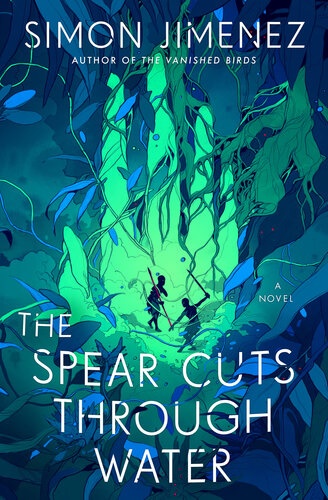
The Spear Cuts Through Water
About this book
Jun and Keema are given a task larger than either man’s allegiance: carry a captive goddess toward freedom as the Three Terrors and their armies close the roads around them.
Their journey moves through villages, battlefields, transformed bodies, and brief lives opened by the narration. The Inverted Theater allows voices from the crowd to enter the epic, refusing to make war only the experience of heroes and rulers.
Simon Jimenez shifts tense, person, and frame with unusual control. The formal movement is not ornament; it connects myth to migration, inherited memory, and the intimate ways a story survives across generations.
The Spear Cuts Through Water is a standalone fantasy about liberation and love. Its violence is substantial, but its scale remains human through the many witnesses allowed to speak.
Read a sample
5,026 words
Plain text
From the opening
Before you arrive,
you remember your lola, smoking. You remember the smell of her dried tobacco, like hay after a storm. The soft crinkle of the rolling paper. The zip of the matchstick, which she’d sometimes strike against the lizard-rough skin of her leg, to impress you. You remember the ritual of it. Her mouth was too dry to lick the paper shut so she had you do it, the twiggy pieces of tobacco sticking to your tongue like bugs’ legs as you wetted the edges. She told you it was an exchange. Your spit for her stories. Tales of the Old Country; of ruined kingdoms and tragic betrayals and old trees that drank the blood of foxes foolish enough to sleep amongst their sharp roots; any tale that could be told in the span of one quickly burning cigarette. “It was all so very different back then,” she’d begin, and you’d watch the paper curl and burn between her fingers as she described the one hundred wolves who hunted the runaway sun, and the mighty sword Jidero, so thin it could cut open the space between seconds. Her words forever married to the musk of her cigarette and her bone-rattling laughter; so much so that whenever you think of that place, long ago and far away, you cannot help but think of smoke, and death.
When did she first tell you of the Inverted Theater?
You were thirteen, you think; it was around that age that she often seemed startled by you, offended even, her lip curling whenever you came into the room, as if an untoward stranger had just tripped into her on the street. You thought her distaste was because of your body odor, your oily skin, your shy hunch, but the truth was she was just surprised by how quickly time had passed. Your youth wounded her. It made her want to protect you, and to kick you out the door.
“Sit,” she said, when she saw you passing the kitchen. “Listen. I have a tale to tell.”
The warm, breeze-blown night came in through the propped-open window, playing at the sheer curtains and the smoke from your lola’s fingers, as she told you of the theater that stood between worlds.
“Once, the Moon and the Water were in love.” She lingered on that word, love, just as the smoke lingered in the air. “You can imagine it was not the most convenient affair. One was trapped in the heavens, the other the earth. One was stillness itself, the other made only of waves and tempests. But they were happy for a time. The Moon would bathe the Water in its radiance, and the Water would dance, with its ebb and flow, to the Moon’s suggestion. And though they occupied different spheres, they were able to visit one another through less direct means, for there is no barrier in this life that love cannot overcome. The Water would send up to the skies plump storm clouds, swollen with its essence, its cool mist and salty breath kissing the Moon’s dry and cracked surface. And the Moon, when it wished to visit the Water, would cast its reflection into the Water’s surface, and in the Inverted World that lies suspended below our own, in glass and still water, they would meet, and dance, and make love.” Your lola paused, and stared at you from between curls of smoke, in study of your expression. There was a time when you would be squeamish at the mere hint of intimacy in her tales, but not this time; this time you simply sat in rapt attention—a sign of maturity that both heartened and depressed her. “Anyway,” she said, after a rasped inhalation. “It was in that world of reflection where they built the theater that is the locus of our tale.
“Being the patron gods of artists and dancers, the Moon and the Water both loved the stage, which is why they created their own: a pagoda so tall its height cuts through the heavenly bands, within which the performances of the ages would be hosted. The telling of tales beyond even my knowing.” She coughed. “Even after the Moon and the Water parted ways, the theater remained, run by their love-child, a being of immense beauty who took to inviting even mortals such as us to come visit their arena.”
You asked her how mortals could reach such a place.
“Through dreams,” she said, the cigarette butt ash in her hand. “A deep sleep, in waters deeper than your dreaming spirit has ever swum before. That’s all. Dreams, and luck. And when you arrive, you are told a tale of the Old Country; the right tale at the right time. And when you leave—when your body comes up from that deep slumber—you will feel satisfied, whole, though you will not remember why, the memory of your visit forgotten, slipped from the mind like soapy water, the way any good dream might the more one tries to recall it. You will try to remember it. With great effort.” She smiled, wistful. “But you will fail.”
Your lola began rolling another cigarette.
“Perhaps before the end,” she said, “I’ll finally remember my own time there.”
There was giggling from the other room. As your lola worked the tobacco through the rolling paper, you leaned back in your chair to better look at your brothers, who were listening to the radio in the living room. All nine of them were crowded around the radio like stray cats at a butcher’s shop—a leg draped over the arm of the couch—a head lolling off the side of the love seat—chins propped on fists on the coffee table as the weekly serial neared its climax—all of the inquisitor’s men aiming their rifles at the church windows, ready to shoot Captain Domingo dead, wondering as they aimed down their sights why the jackal dared to smile at the hour of his death—the reason clear, once the good captain revealed with a wink the detonator in his gloved hand—and as you looked at your brothers, you felt both envious that you were not sitting with them and also glad that you were apart from them. That you could see them all from your chair in the kitchen. That you could hold them all in your eye and keep them there.
Continue reading the sampleClose the sample
“We might try to go back,” your lola said, staring out the window with her large, wet eyes, “but we only get one turn. One invite. So do not waste it. If nothing else, remember that.”
The night air came in through the small kitchen window. A horn from an old car blared down the road. Your father would be home soon with the day heavy on his shoulders. The table still needed to be made. But your lola was unconcerned with time, her drags deep and unhurried. “You will not know the Inverted Theater has called for you until you are already there,” she said as she let the paper burn, and the years burn with it. “It is a place you cannot plan for.” The shutters trembled against the coastal breeze. “And when you arrive, dream-tripped and unexpectedly, in that amphitheater, the best thing you can do is sit, and watch, and listen, for you are not there by accident.”
She sucked on the paper, the tip now an orange rose. The cigarette was just about finished when the front door slammed open. Your brothers scattering from the radio as your father came inside with his mood and all the outside world—your lola gripping your wrist, before you too could go to greet him.
“The tale is for you,” she said.
The tobacco burning in her lungs.
“So let the dreaming body go.”
She exhaled.
And the smoke, blown in from the dark, envelops you until all you can see are the curls of gray matter swirling around you, the thick fog seeming to lift you, to cradle you, bearing you gently downward until you light upon a smooth, hard surface, and the smoke clears—the memory of your lola in the kitchen fading as day does to dusk, before you find yourself standing before the very place she had once spoken of, all those years ago.
Welcome to the Inverted Theater.
You step out of the smoke and you see it: the towering pagoda on a still lake at night, its reflection in the water perfect, its many levels at once rising high above you and, in its watery likeness, falling endlessly below. Lanterns hang off its curved eaves like earrings, lighting up its ornate facade against the darkness of the black-carpet sky. The structure looms, made up of an infinite stack of balconies, each one painted a different color. From a purple balcony high up a herald leans over and shouts that the performance is soon to begin, to please enter and take your seat.
A stone path begs you to cross the dark water. As you begin your crossing, you realize you do not walk alone. You walk amongst a river of other dreaming shades, who pass through you like gusts of wind, their thoughts coming in and out like radio signals. They are thinking about work. About lost loves. The hours they wasted in rooms darkly lit by stubbed tallow candles. I was keeping the books for a madman. I knew I needed a new job, but I couldn’t risk the downtime—who can risk the downtime? Some you understand, others are beyond you. They speak in languages you do not recognize, or in terms that, stripped of context, mean nothing. Thread-ripping down the runner of stars, was in the midst of my third weft, fast a-tumble in my sleeper’s mitt, when my dreaming self was coaxed here, to this dark lake shore. Shades of people from everywhere and everywhen. Faceless, out of focus, loud. And as you cross this lake, their noise comes all at once and overwhelmingly, sounding like nothing less than the vast ocean’s roar—a collective hum, breathed out by the mouths of thousands, indistinct and infinite. An infinity in which you now sit.
Eighth row, dead center.
You blink, and you are here—in this many-pewed theater space, lush in drapes and blackwood flooring. The theater is styled from an era long past and almost forgotten. You are seated on a bench that has been reserved for you. You knew this was your seat before you even laid eyes on it. Called to it. Certain of your destination.
You are less certain about other things. As the others find their own seats and the attendants run up and down the aisles with lit candles floating behind them, the tall shade sitting beside you leans over and asks you where you are from.
You struggle to answer.
This moonlit body comes to your aid. With a gentle nudge of the toe, it unfurls the parchment of your people’s history, this toe running along the battles and the treaties, the dispersals and the reunions, until it finds you here: in the time of trains and steamships, when cathedral radios crackled from the open windows of the dockside town in which you lived.
There is a war, you tell the shade.
The shade nods in grim understanding.
You are from a time of posters and propaganda. When news of the war effort fluttered down the painted walls of crooked alleys. Sun-draped and salt-scented ocean views disrupted by the silhouettes of warships in the blue distance. Wounded soldiers sometimes boated into town. The war is everywhere, but if you were awake tonight—this night, now—and you turned the dial of your radio, you would not hear the staticky voice of a slick man sharing news of the front but instead the crooning warble of Dorrado “Chilo” Semina, whose voice has captured the hearts of most lovesick listeners across the Unioned Continent—but alas! Tomorrow morning, when you wake, you will have to lie to your compatriots when they ask you if you stayed up to listen to his new single, and you will have to pretend to sing along with their delighted chorus, mouthing the words you shamefully have yet to commit to memory, because right here, right now, as the people of your town swoon to the pop signal, your body lies in deep slumber in a room once shared by you and your nine brothers.
That is you. A merchant’s child. But one of many. How old you are outside this dream is irrelevant; in this theater you are as you feel—a youth, deep in your adolescence, and, like all youths, lonely in your own unnameable way. Fearful of your father and hounded by your lola, who was uninterested in the developments of your body, or your roaming interests, as she sucked smoke from a wrinkled cigarette and explained to you the land your family had come from and the tales that had come with them. “There is no preparing for the Inverted Theater,” she had said. “It greets you when it chooses.”
All of this you say to the shade, and it nods, satisfied, before it turns away to other business. You wonder if you should ask it where it is from, but the shade seems very much done with you, so instead you look about this Inverted Theater with a lost expression, your awe for your surroundings mixed with a deep longing, and unanswerable confusion, as you try to divine for what reason you might have been summoned here.
“There is always a reason.”
You begin to suspect it might have to do with the object you only now realize you are holding in your hands.
This spear.
You know it well; the blood-red tint of the wood; the red tassel that chokes the gleaming and deadly point; the strange grooves and etchings that travel the length of the weapon in esoteric patterns. Ever since you can remember, this weapon has dutifully hung on the family room mantel, ignored by all in your house as but part of the scenery, for it was too expensive, too ancient, and too useless to interact with. You and your brothers once caught holy hell for playing with it in the courtyard when you were very young. One of the housekeepers informed your father, and your father, who never hit you but knew other ways to make you feel small, spoke to you and your brothers, one by one, in his office, and never again did you touch the weapon, much less look at it, which is why you feel an illicit thrill to hold it now, whether it be the real thing or merely a dream of it.
“It has traveled far to get here,” your lola liked to say, “with farther yet to go.”
You notice the other members of the audience, the other shades, stealing furtive glances at your weapon. We were wondering why this shadow was armed. And they are wondering why the weapon looks so familiar. Why you have brought it with you to this sacred place. And if you intended to use it.
But such questions would have to wait.
For it begins.
The performance that you have been called to witness. You hear the beat of a drum. A polished wooden stick rapping against taut, oiled skin. Thrum. The drum punches through this dark space. Thrum. It strikes you, right there, the middle of your chest. Thrum. It made us shiver to hear it. You listen to the heartbeat of this building. Thrum. The swelled, anticipatory breath of the people around you. Thrum. And you lower the family spear, you let it rest at a slant against your side, forgotten for now, while you and the other audience members all turn to the stage with not a breath released, your unblinking eyes watching the drapes begin their soft and silent lift up into the rafters, revealing, like parted wings, the stage.
Thrum.
This moonlit body stands before you. And though this is your first meeting, all of you recognize this body immediately. We had seen the renditions, the statues, the friezes. The depictions of a figure of broad back and narrow hip, with skin the color of a blue summer sky and eyes that shine like light on silver. You have seen the artists’ dreams of this moonlit body, with its sea-green hair that sways as if underwater, and as you see this body now, bowing at the head of the stage, you realize that all of the dreams of its beauty were true. Somewhere in your memory, your lola is sighing in a yearning way as she looks up through the small kitchen window at the star-rich swirl of night. “And should you one day find yourself sitting in that theater, lucky enough to watch those curtains rise, it is the child of the Moon and the Water who will greet you. That creature born of the dance between the lunar wane and ebbing tide, now cast in their role as the eternal performer of the Sleeping Sea. Forever imbued with the strength and grace of the most accomplished of dancers.”
She smiles.
“A beautiful, moonlit body.”
And you look upon this moonlit body with surprise as it breathes in through its nose so deeply its belly distends, pregnant with wind. This body’s feet braced on the boards of the stage before it releases in one long exhale all that it has taken in, the gust from its pursed lips blowing out all the braziers in this theater, whipping the fire into smoke until the room votes in favor of the dark and all that is visible to your eyes is the last of the lit braziers onstage—your pupils narrowing on this ancient and raging flame, as this moonlit body stands before it and, like a magician at some unholy font, conjures from its crackling hearth the voices of the ancient and the dead, our tale soon to be told—of that week of blood, that week of chaos, the rush of whispers filling the theater, for some tales are too large to be told by one voice alone.
This is the tale of your land, And the spear that cut through it.
You hear a charge of horses pouring over some distant hill as dancers now swarm the stage, their footsteps a chaotic syncopation. The flames leap, the walls blasted with light and shadow, and in this dreaming theater you swear that you can see the scene as it is, as this moonlit body’s movements, and those of the dancers, carve out of the air that land far away and long ago—a place once known to you only through your lola’s descriptions, now springing to life in the deep root of you, as if it had always been there. The deep valleys and old forests, the staggering black mountains that cut the clouds, and the carpets of mist that rise from the gulches between sheer cliffs. This is the land where we lived, and where we died. The Old Country, your lola called it, but there were other names too. Names etched in runes and woven in tongues long lost to your history. Tonight it is the Land of the Moonless Night. Tonight it is the land that sweats under the Endless Summer—and as the fires of this theater rage, you feel the unblinking sun on your back. You smell the dried grass. You see the dead brooks and the curling fingers of roadside corpses thick with flies that scatter as the riders gallop heedlessly past this parched landscape bearing the banner of their emperor.
This is where our tale begins, with a band of warriors performing a royal inspection of the country, the dancers’ feet stamping into the boards of the stage as might a brigade of fearsome riders across a dust-beaten land, and you see with clarity the rider at the head of this royal charge—a man who lifts his laughing face into the air and breathes deep the smells of the country, his birthright, while he leads his warrior-sons west.
“Listen,” your lola would say as she lit her cigarette.
Listen, this moonlit body says as the bloodied sun lifts into the parchment sky to the bone-snap of drums.
Listen to the Brigade of the Red Peacock.
The sound of distant thunder in the bright and cloudless day. Thunder between the ache of the rolling hills and the green burst of forests. Thunder that scared the animals into their burrows. The people turning their worried ears to the sky. We heard them before we saw them. The thunder of the royal stampede.
The villagers put away their scythes and turned over the feed buckets as the pebbles danced and the terra-cotta eaves trembled. The children held close as the horses crested the nearby rise, two score in number, their riders garbed in red; a gash on the noon horizon. Warriors vicious and without mercy, their faces tattooed with their namesake, their sharp cheeks and hungry eyes framed by red beak and feather; a sight feared by any wise traveler, by anyone who heard the stories, for of the many brigades and bands and gangs that haunted the valleys in those days, it was the Red Peacocks who were deadliest, led as they were by one of the princes of the Throne, a man who had well earned his title of the First Terror.
Across the land, the people lined up to greet them. It was the eve of the Emperor’s Holy Pilgrimage, and the brigade was charged with the sacred duty of preparing the land for His Smiling Sun’s arrival.
They did so with great pleasure.
“Soon,” the First Terror said to the weavers and the quarry workers, the fishermen and the farmers, “in but a matter of days, He will arrive, and in His generosity of spirit, He will visit you all over the course of His five-day journey to the eastern coast. You will present Him with the finest offerings of your craft or your harvest. Your pearls of rice grain, your fresh salted fish. Your richest tapestries. The spirit of your hard work. And He will take these offerings with Him, and He will cherish them, as He disembarks to visit our colonies across the Great and Unending Sea. His visitation, the greatest honor of your life. In later years, you will recall it to the children at your bedside. Squander this moment at your peril.” During these speeches the Peacocks slapped open doors and rummaged through dressers and kicked at loose floorboards, searching for evidence of dissent. Chickens were chased out of coops. Sharp knives taken to grain sacks, to linen sheets. The people listened to the ransacking of their homes but we did not dare turn to look, for we all knew the consequence of turning away from a prince. “When His caravan passes through this way, you will hear a drum heralding His arrival. You will line up, like so, across the entrance to your village, facing the road; every man, woman, and child. And you will bow. You will bow low, so He cannot see your face. Every head that does not bow for our Smiling Sun will be added to our collection,” he said, pointing at the fly-strewn cloth sacks that hung from the horse saddles, the cloth black with dried blood.
In one of the villages, there was a loud clatter—a crying girl dragged out of a small house.
“This rat was hiding under the boards, Father!” the Peacock shouted.
The villagers took in a collective breath. And we glared at the girl’s parents, who in spoiling this child had doomed us all. The girl’s bare feet trenched the hot dirt as she was brought to the prince for judgment.
One of her parents fought against those restraining her.
“She was scared!” the mother cried. “Forgive us! She was scared!”
The father quiet, his head bowed low.
The First Terror drummed his fingers against his waist. He lifted the shivering girl to her feet and then he looked into her eyes, and we could feel the wind begin to whip and rise and we were certain that this was our end, that the prince would not forgive this rudeness and all of us would be tossed into the pit of Joyrock. That we were spared that day was a fortune beyond measure. What feeling of grace prompted the Terror to send the girl gently into the crowd, into the trembling arms of her parents, would remain to them forever a mystery. The unnatural wind dying down. An easy smile on his lips. “Let it not be said that the Throne is without its mercy,” he said. “But on the day of His caravan’s arrival, should any transgress beyond their station, do not expect such forgiveness.”
Then they left. The horses rearing not long after the Terror finished his address, the people left in stunned silence, a few of them coughing in the stampede’s dust wake. The mother clutching the girl to her breast as the father looked on them helplessly, having given up his daughter for dead. And never would my wife let me forget the shame of that day. Never again could I meet my daughter’s eyes.
Never would we understand why we were spared.
The reason was a simple one. It was the same reason that the First Terror was in such high spirits during the tedium of his tasks, in those weeks of his inspections. Why he spurred his horse at a quickened pace, so eager to return to the palace without delay or incident. A reason that came vividly to his mind when he looked into that little girl’s eyes and saw they were the same color as that of his beloved son.
Of Jun.
“For six months I have been parted from his company. He serves the Throne with pride; I recognize this. And I recognize the importance of his mission. But I cannot help but wish he did not have to perform his duty. That he was riding by my side this day. It has been a great difficulty, waiting for him to be returned to us.”
The commander of Badger Gate, a small man with a smudge of hair on his chin, poured tea for the Terror, as was protocol, doing my utmost to not show the tremble in my hands; my utmost not to soil myself.
“You are a caring father,” he said with a servant’s smile, placing the polished-clean teacup before the royal prince. “May all the sons of this country be so blessed, to have a parent like you.”
Sycophantic words, nonetheless true. The First Terror wept with his sons and he laughed with them, and in turn we gave him our unwavering devotion, riding with him to the ends of the country, killing anyone who needed to be killed. But he had a favorite. And he was not shy about who that favorite was.
“To Jun,” the commander said, raising his cup, hoping to please his guest, a social tactic that played excellently, as the Terror toasted him with moist eyes.
“To Jun.”
Their cups clapped to Jun Ossa, the twenty-fifth Peacock, who had for six months been guarding the fabled Wolf Door beneath the palace mountains, the sole protector of the empress. The Terror wiped his eyes, moved by this imagined scene: Jun’s six-month rotation, spent alone in the cold and the dark of that deep mountain cavern with nothing but one’s blade, and one’s thoughts, and a locked door to protect, to keep one company. This image weighed on him for the rest of the day, until later, at camp, his other sons placed hands on him in comfort, and we told him it wouldn’t be long now, the prince then smiling at his boys, grateful for all of them.
Horse spurred onward, they journeyed west and completed their assignment, uncommon mercies spared for those they passed, the Terror’s mind split between duty and family. As he made his inspections, as he flipped through poorly kept records and questioned an endless parade of perspiring commanders, he thought of his son. Of Jun the Beautiful Knife, who slit his first throat at eight years of age. Jun the Red Shadow, who alone had tracked the infamous Dorogo Bandit Clan into the vagrant woods after their raid of Lady Panjet’s sacred vaults, none of the bandits aware they were being hunted that night, not even as they were bled dry in the dark, one by one, throughout their premature celebrations. Jun the Torchbearer, who lit swaths of grain fields on fire in search of the traitorous dogs who had ambushed the Swan Road patrols. From our houses we watched our harvests burn and the men we hid burn with them as that little demon lobbed his torches. Jun the Many Titled, these honorifics bestowed upon him by his doting father.
“I remember the last time I passed this way,” he said at Eagle Gate to a quiet crowd of sentries, “some seasons ago…my son Jun noted that there was an unacceptable level of indolence amongst your sentries. A disorderly mess hall, an unkempt barracks. Jun is quite adept at such judgments. He rightly shamed you for your lack of discipline, and at the time you had promised to tighten the loose threads of your command. We believed you.” His finger sliding all the while across the wall of the barracks, holding up to the sweating creatures who awaited his judgment a print of dirt and dust. He did not have to say anything. The sentries and even their commander fell on their knees and polished every inch of the barracks and he smiled, for though the emperor would not care about the dust, much less see it, it was good to see that the people were still well under control despite rumor of the growing rebellion.