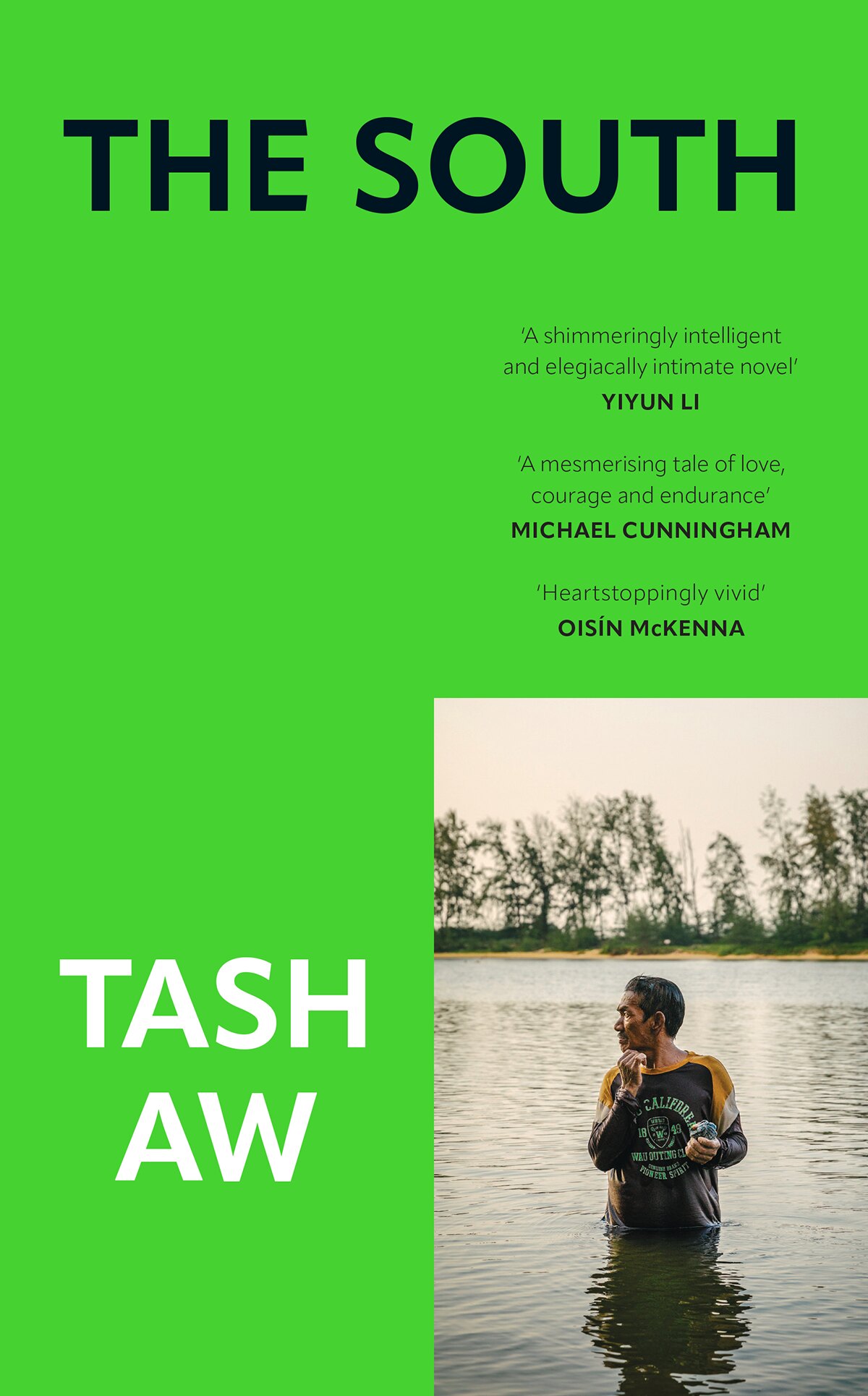
The South
About this book
In the 1990s, Jay and his older sisters leave Kuala Lumpur with their parents for the property their grandfather has left behind. The neglected farm in southern Malaysia is both an asset and an obligation the family cannot afford to understand in the same way.
Jay shares a room with Chuan, the overseer’s slightly older son, and their closeness develops across lines of class, work, and family expectation. Around them, adults calculate debt, land, and loyalty while the dry season makes every plan more urgent.
Tash Aw moves among family members so that return never has one meaning. The estate is home, burden, inheritance, and possible exit at once; sexual longing and financial ambition grow from the same desire for a life not already assigned.
The South is an intimate family novel about a changing Malaysia. It links first love to property and power, showing how nostalgia can conceal the people whose labour kept a remembered world alive.
Read a sample
5,066 words
Plain text
From the opening
Two boys walk through the scant shade of an orchard, far from the house where they are staying. It is just after midday, the sun at its fiercest, no one else around. In this light the land shimmers uncertainly before them. It hasn’t rained for months; the vegetation, usually heavy with moisture, has turned pale and brittle. These past few days the air itself has become so hot and dry that it singes the boys’ throats when they breathe.
Light a match and the whole country could go up in flames – one of the boys says. His name is Jay. He picks a path through the long coarse grass that slashes at his calves, crisscrossing them with fine, exquisite cuts that will smart when he washes himself later that day, though he has grown used to the pain, in fact barely recognises it as such. The undergrowth here is a tangle of thorns, and each evening Jay finds small wounds on his arms and legs that leave bright red stains on his towel and bedsheet, yet mostly, he isn’t even aware that his skin has been punctured.
The boys walk steadily, pushing towards the deep shadows in the middle of the orchard.
I call them boys but in truth they are no longer boys. What are they, then – because they are not yet men? Maybe it isn’t important to know at this precise moment. When they have reached the base of the biggest tree, the boys look up at the branches, forked and twisted with age. Jay reaches out and touches the trunk, his fingers tracing the shallow crevices. Soon it will be cut down, along with all the others. They are diseased, the boys have been told, and have to be destroyed.
Trees like this can live for hundreds of years, Jay says. In India there’s one that’s a thousand years old.
Did you read that in one of your books, the other boy asks, though it doesn’t sound like a question – he isn’t interested in the age of trees; he isn’t interested in the trees at all, even though they are part of the landscape he has known all his life.
Cutting down a tree is worse than killing a human being, Jay says, staring at the branches.
The boy laughs, though it is not a cheerful sound, just a low rumble in his throat. What do you know about death, he says. His name is Chuan. Have you ever killed anyone?
Jay feels him come close but he doesn’t turn around. He feels the breath on the back of his neck, though maybe it is just his heightened imagination, because he has been longing for this moment for some days now; and in his longing he has anticipated the way every second will unfold – the way he will touch and be touched, the smooth-sticky quality of Chuan’s skin, the things they will say to each other. He knows every detail before it happens. All he has to do now is wait.
He feels Chuan’s hands on his shoulders, close to the nape of his neck. ‘I hope we can save these trees,’ he says, still looking up at the leaves overhead. Jay imagines turning, slowly, to look at Chuan, until one of them – it doesn’t matter who – reaches out and touches the other’s face. But he won’t; he is seized by something between fear and indecision. What will he discover if he looks at the other boy now?
Turn around, Jay, turn around.
But he is unable to move; he finds that his body has become foreign. For so many years he has yearned for someone to touch him in this way – for the freedom he will experience. He imagined the clarity of the joy he would feel, how he would savour every gesture. Maybe he is afraid of this liberation, and what it might lead to. It is the first time he has felt his body slipping away from his control. In the future there will be other occasions in other places far from here, and he will grow accustomed to it, but for now this sensation is new.
I hope we can save these trees, he says again, looking skyward. On the lower branches he sees a large bird that he cannot identify. A tiny hawk, or an oversized cuckoo. It’s hard to tell against the light. The bird is looking back at him – studying him. He wonders if this is a good omen, or a bad one.
He feels Chuan’s hands grip his shoulders, a neutral, warm pressure at first which then begins to hurt slightly, though the pain is not unpleasant. Now, at last, he begins to turn around, but Chuan is pushing down on him hard, urging him towards the tree trunk until his face is pressed against it. The bark is rough and he knows that if he struggles his skin will be grazed and perhaps even bloodied – marked by his desire, which he will not be able to hide from the world.
With his feet, Chuan nudges Jay’s apart, and Jay feels his hands fumbling to pull his shorts down, but the Velcro buckle gets caught in the waistband and the fabric bunches up around Jay’s hips. He reaches down to untangle the mess, and now he can feel Chuan’s body, lean and taut, pressing against him as he frees himself from his shorts. Again, Jay tries to turn around; he wants to appreciate these first few minutes, stretching them out in his mind so that whatever time they have together will feel like many hours, a whole day. That was how he has imagined the first time. But Chuan is pushing against him, he is older and stronger than Jay, his forearm is lodged against Jay’s back, and Jay is momentarily startled by Chuan’s strength, even though he knows he shouldn’t be – Chuan’s body is a product of this landscape, after all, unyielding and harsh. What surprises him most is the thought that Chuan wants their first moments of closeness to be over as swiftly as possible. To accelerate each second and collapse time – the opposite of what Jay seeks.
Continue reading the sampleClose the sample
When it is over – less than two minutes later, according to Jay’s estimate – Chuan rests his head in the space between Jay’s neck and shoulder.
I want to be with you, he says. Forever.
Jay nods. In that moment, forever seems like a comforting notion. But at that age, what does either of them really know about time?
That year we went south for the holidays at the end of the school year, instead of travelling north to visit my grandmother, who was in the final stages of a disease that none of the doctors could identify, a combination of osteoporosis and old age that would eventually render her weak and docile, but which at that point had simply made her unpredictable and bad-tempered. She had been in fine health all her life and was not used to relying on other people for help with domestic chores or even, sometimes, bathing, and her sudden decline came as a shock to everyone, herself most of all. Up until she turned seventy-seven, she had been fit and capable of walking to the market and carrying the shopping back on her own, of staying out reasonably late with friends in the small town she lived in, which had become a popular destination for tourists, a development she found amusing. People driving three hours to her local coffee shop! She would laugh. Then, earlier that year, she had stumbled on the half-step down into her kitchen, broken her hip, and was immobile for many weeks. Her mood changed, she became disagreeable, and most of all she was alone.
My grandfather had died the previous year. His passing took no one by surprise; he was much older than her and had been ill for many years, and my grandmother was relieved of the burden of caring for him. It was a shame that her freedom lasted only a year before she, too, began to deteriorate, long before she should have. My parents didn’t talk much about my grandparents’ illnesses – we were not the kind of family to express pain of any kind, believing that discussing difficult matters would make them worse. But I was sixteen and understood that my grandmother wouldn’t hold out for long.
For a few months that year, my parents become moody and silent, keeping quiet even at mealtimes. My sisters, Lina and Yin, were convinced that they’d had a fight and were on the brink of divorce, whereas I saw a different reason for their introspection: my grandfather’s death and my grandmother’s subsequent struggles troubled them because they, too, were separated by a fifteen-year age gap and must have been wondering what the next two decades held for them. My father, in particular, was at the age where minor, passing health issues were starting to become permanent ones.
It was my mother who decided that we would go south that year, to give my grandmother some space to recover from her illness. Old people were easily disturbed, she explained; they liked to have their meals at exactly the same time each day and hated it when the kids messed with the TV channels. ‘All that noise isn’t good for her,’ she said. This made sense, but also raised certain questions. Why leave an ageing person when she was clearly in need of support? And why did my father, who usually made all the important decisions at home, agree? He, of all people, did not like change. He’d refused to move even as our house had become mouldy and damp due to constant leaks that could never be identified; he’d decided that I, the youngest child, should wear my sisters’ hand-me-downs. He never bought new clothes, never thought of looking for a different job despite my mother bemoaning his schoolteacher’s salary, hadn’t changed our car for as long as I’d been alive – why didn’t he protest?
The truth was that my mother had never got along with my grandmother, who believed that my father could have done better than her. He was handsome, an intellectual who came from a family that was comfortable, if not as rich as they would have liked; their social status could so easily have been improved through marriage. I think my grandmother had visions of my father marrying into the kind of old Chinese family that streets and buildings in the city were named after. What better way for a family of immigrants to ensure that they were part of the history, and future, of the country? Instead, Jack married a girl from the provinces who would always hold him back.
Sui Ching is just a country girl – my mother would sometimes mimic my grandmother saying this, though never in front of my father. Her lack of closeness to my grandmother was always passed off as a joke, but I came to see it as a deeper source of sadness for my mother. She’d been a student – his student – when she met my father, and she’d never graduated; her in-laws had held so many prejudices against her that she knew she would spend a lifetime trying to overcome them.
Still, my mother played at being the dutiful daughter-in-law, cooking meals whenever we stayed with our grandmother, cleaning her house, bringing her expensive presents of abalone and dried mushrooms from the city – all the things that she was supposed to do. Perhaps she thought that she would wear my grandmother down, but even when it was clear that her efforts were failing, she maintained appearances – if only to keep the peace with my father, I think, whose fidelity to his mother was unshakeable. When my mother was just about to give birth to Yin, and Lina was just two years old, my father left my mother alone in the hospital and drove three hours to see my grandmother, who had fallen ill – with what turned out to be a cold. He didn’t make it back in time for Yin’s birth. (This was a tale my mother repeated over the years, as proof of my father’s loyalties.)
My mother had liked my grandfather. He was a benign presence who often seemed trapped in his own world, long before dementia took hold. He was already in his eighties when I was old enough to be conscious of his presence, and I remember only a tall, slender man who walked without assistance despite his increasing fragility. He didn’t speak much and spent a lot of time dozing in front of the TV, removed from the rest of the family, his head tucked deeply so that it rested on his collarbone. ‘Look at that poor man,’ my mother would say. ‘Fifty years with your grandmother . . .’
Our departure to the south felt like a form of revenge for my mother after all these years, particularly at a time when my grandmother was very sick. At least that’s how I saw it.
‘They’re about to divorce,’ Lina insisted. As long as I could remember, she had been hoping that my parents would split up. ‘Men and women aren’t made to live with each other,’ she said as we packed our bags. ‘It’ll be the best thing they’ve ever done.’ She was four years older than me and spoke with a wisdom that I felt was beyond reproach, so for a long time, I also believed that our parents would break up sooner or later.
There was another, more pressing reason behind my mother’s wish to go south. After my grandfather’s death, there had been some talk about inheritance, and about how little he possessed, seeing as he had once run a business that distributed spare parts for cars throughout the far northeast. There was a shop-house in K., a village not far from where my grandmother lived, rented out to a pawnbroker for a miserly sum; a barren piece of land in the south that my grandfather had bought just after the war; and a small amount of cash held in the bank, intended for nursing-home bills but ultimately unnecessary, seeing as he refused to leave home even in his final weeks. When my grandfather passed, my father was dispatched to review the will with a lawyer; his two brothers, who had good jobs and lived abroad, couldn’t be bothered. At that meeting, my father discovered that this modest fortune would be divided equally between him and his brothers, except for one item: the piece of land in the south, twenty hectares of scrubby jungle and farmland, which would be left solely to my mother.
‘It’s worth nothing,’ she said, trying her best to sound casual, even a bit burdened by the news. ‘But we still have to go and check up on it.’
In the weeks leading up to our departure, my mother was filled with energy, preparing bags of clothing and parcels of food as if we’d be gone for months, with the possibility of no return. My sisters chuckled at these elaborate preparations. ‘For God’s sake, I looked at the map, it’s only four or five hours’ drive,’ Lina said. ‘Why’s she behaving like we’re moving to a different country?’
‘How long are we going for?’ I asked my mother as I watched her carefully folding some towels and easing them into a raffia bag.
She shrugged. ‘Depends.’
‘Depends on what?’
‘On what it’s like down there.’
Lina woke me before dawn on the day we were due to leave. ‘Hurry up, the crazy old people are going to get mad if you don’t get up and have breakfast soon. They’ve already loaded everything into the car.’
During that period I was always tired. A late growth spurt, explained a neighbour when my mother complained. My bones were stretching, the neighbour explained, all the muscles were being pulled in different directions, so even in sleep I was being worn out by the effort of growing. I hated the idea of my body changing in my sleep, beyond my control. I was also troubled about the lateness of this change – I was just a few months away from my seventeenth birthday – which I took to be a sign of abnormality. But it was true, I was always exhausted, and that morning it was a particular struggle to get out of bed. The last thing I wanted was to get in a car to travel to a place I didn’t know. I drank a glass of water and forced down a piece of bread. ‘Better eat something,’ my mother said. ‘It’s going to be a long drive.’
Fong waits outside the house, scanning the line of trees in the distance for an approaching car, but none comes. They are late, this family arriving from the capital. Perhaps he has written the wrong date on the calendar that hangs on the kitchen wall. He rang them in the morning to confirm, but all he heard was the eerie hollow tone, ringing out. He hates phones, and is glad that the one in the house rarely rings these days.
From where he stands on the veranda, he notes the shrinking patch of lawn in front of the house. Why does he insist on calling the veranda the veranda, and the lawn the lawn? Neither is what it used to be; those words are vestiges of the past. A few years ago, some of the timber pillars that held up the roof of the veranda were smashed when a lorry backed into it, the wooden platform splintering under the collapsed beams. Fong had thought of calling Jack immediately, to tell him what had happened, but it was the middle of the night and Jack was not known for his patience. He was curt at the best of times, with a notoriously quick temper. There were stories of: how, following an argument with his ageing father, he abandoned him alone at a roadside stop, miles from home; how he shut his five-year-old son in the bathroom for a whole day for wetting his bed; how he locked the front gates to their house because his fifteen-year-old daughter still hadn’t returned home a few minutes past the ten o’clock curfew he’d set (she appeared rattling the iron grilles not long afterwards).
Fong hadn’t wanted to test Jack’s temper that late at night, and by the morning, when he’d had the chance to survey the damage, he decided that pulling down the rickety structure and replacing it with something modern and solid would be the best solution. There was just enough in the farm cashbox for him to do that; he wouldn’t need to ask Jack for more. The fact that the new concrete structure didn’t at all resemble the old veranda would be forgiven because Fong hadn’t requested new funds. ‘You’re the farm manager – that means you have to manage things,’ Jack once told him, when Fong had called with news of a flood, as if Fong could control the weather. Jack hadn’t been concerned by the failure of the harvest, only by the resulting cost of repairing the damage to the land.
Indeed, money has always been the source of Fong’s tensions with Jack. He understands the greasy workings of money, appreciates its ability to reduce everyone to the same level, even a man like Jack Lim, who spends his life wrestling with mathematical problems. ‘We can understand everything in the world using maths,’ Jack said to Fong when he visited the farm many years ago. Jack had been working on a pile of papers spread all over the kitchen table, so that everyone else had to eat their dinner crouching on low stools, the food laid out before them on pieces of newspaper spread on the floor. No one complained, they were happy to clear the space for Jack’s work, which was more important than their meals. When Fong looked at the papers he was captivated by the pictures, the beautiful bulbous shapes and perfect variations of squares, which didn’t look to him like mathematics at all, but the products of hallucination, a dream.
Jack had noticed Fong’s fascination with his work, and started to elaborate, taking every opportunity to display his scholarship. ‘They’re called fractals,’ he said, but after a sentence or two he trailed off, retreating into his calculations. Fong would never be able to grasp even the basics of Jack’s work; every word of explanation was like the quick cut of a blade, an insult that articulated the divide between them.
Still, both men understood money. They knew what it could achieve, and how it could maintain the hierarchy that separated them. The mathematical equation was easy: Jack’s money + status = Fong’s dependency + perpetual labour. How would it look if you deducted Jack’s money and added it to Fong’s labour?
(It hadn’t helped that Fong had been the person driving the lorry that crashed into the veranda. Friends, drinking in Kota Tinggi: the usual story.)
As he waits, he remembers how the lawn used to extend to the stream, before the dam was built upriver when the water levels were higher. Its neat delineations made the house seem more civilised, even attractive. The old man had planted it in the Sixties, when there were still sufficient farmworkers for such frivolous tasks as mowing. Now the scrubby bushes have encroached on the grass, making it seem like an accidental clearing in a forest rather than a lawn. No matter how often he trims the undergrowth, he can’t stop its progress. Fong knows that Jack will have something to say about it, a passing comment to show that nothing escapes his censure, even though he professes not to care about the running of the farm. The last few months of drought have dried up the stream, which is now merely a deep ditch carpeted with weeds.
The stream the lawn the veranda.
Vestiges.
We stood on the top step of the porch and argued about what to call the place – the right name seemed important.
‘A dried-out swamp,’ Lina said. ‘A wasteland, that’s what it is.’
During the drive my parents had been calling it the farm, even the family farm, making it sound both expansive and a part of our heritage, even though we had never been there. The idea of being landowners seemed preposterous, more so given the untamed and neglected land before us. It was true that there were trees in the distance, arranged in a more or less orderly fashion, but to call the place a farm was an exaggeration – where were the machines, the workers, the division of the land?
‘I hate this place,’ Yin said, fanning herself with a folded newspaper. ‘It’s so hot and creepy.’ She swept her hair back from her face. That year, on the verge of leaving for college, she had grown it out. She’d started to wear different clothes – light, flowing blouses, cotton trousers, a few skirts – nothing too radical, and certainly not enough to incite comments from my father. She was good at judging how far to push him, and knew when to pull back. Her new way of dressing made her look increasingly like my mother; maybe that was why my father approved of it.
*
Yin and Lina would share a room with two narrow beds. I’d sleep in a room down the corridor, separated from the other bedrooms by a store-room filled with boxes covered with a blue tarpaulin. On the floor beside the bed, a thin mattress had been laid out. Although no one had said so, I knew that I was meant to take the bed, and that someone else would sleep beneath me. I felt like an interloper from the start.
The room was painted a shade of green that had faded over the years to become almost white, and the walls were unadorned except for a calendar that showed a picture of a young woman in a bathing suit sitting on a rock by a waterfall opened to July, though it was December.
When I went downstairs, the others were gathered in the kitchen having a mid-afternoon snack. On the table there was a plate of biscuits and a dish of freshly sliced purple dragon fruit that had left drops of brightly coloured juice on the table.
‘Your bed’s okay?’ Fong, the farm manager, asked. I gathered that he had lived on the property for many years. He was sorry that it was so hot, he hadn’t known weather like this since 1984, or was it 1985, he couldn’t remember. Still, it was better than the storms they’d had the previous year, or even worse, twenty years ago when the farm flooded and the electricity went out for weeks.
‘You’re not responsible for the weather,’ my mother said, stirring a spoonful of instant coffee into a mug of hot water for my father. He was reading a newspaper and reached for the coffee without looking up.
Fong continued to apologise for things that were wrong with the house: he’d meant to change the stools we were sitting on, they were so old, probably older than us; the windows didn’t close properly; some of the steps on the staircase were uneven; there wasn’t enough ventilation. It must be hard for us, coming from the city where we were used to air-conditioning and high-speed modern fans.
As he spoke, he ran a damp cloth over the counters. ‘I thought I’d cleaned the house but there’s dust everywhere. This damn weather . . .’
‘Stop it, Fong,’ my mother said. Her sudden interjection made my father look up momentarily before returning to his paper. I couldn’t tell if her tone was authoritative or sympathetic. Fong paused, rinsed the cloth under the tap, moving more slowly. It was as if my mother’s command was familiar – comforting, even. ‘Come, sit and have something to eat with us,’ she said, more gently now.
‘I’m not hungry,’ he said, settling on a stool next to me that creaked as he moved. Without being asked, he gave us news of the farm – he had hired three Indonesian workers earlier that year, hardworking guys who lived in the store-house right next to the harvested crops, so for a while there was never any theft, no fear of losing any of the tools or machinery, the men keeping an eye on everything; but then, earlier that year, with the start of the drought, there wasn’t enough work, so one of them left – you know what they’re like, they can just disappear overnight – and the other two found work nearby. Sometimes they came and helped when there was enough to do, otherwise it was just him – and Chuan, when he was around, which wasn’t so often.
‘How’s Chuan doing?’ my mother said.
Fong shrugged. ‘The same as always.’
‘What does that mean? You forget, we haven’t seen him for ten years. I don’t even know how old he is.’ My mother stood up to boil water again.
‘Nineteen. Totally out of control these days. He does exactly what he wants – never listens to anything I say.’
My mother laughed. ‘At that age they’re all like that. It’s normal.’
‘Sui Ching is right,’ my father said, taking a sip of coffee. ‘Look at what we have to put up with these days.’
Lina took a handful of biscuits and headed for the door. ‘I’m going for a walk. If I get eaten by tigers don’t bother salvaging my remains.’
‘There aren’t any tigers left. Leopards, maybe, not tigers,’ my father said – perhaps the most he had spoken to Lina in many months. She had come back from her first semester at university in Penang exactly a year before with her hair shaved short on the sides, and a tiny jewelled nose stud. My mother was the first to express shock, for Lina, like Yin, had inherited my mother’s thick, glossy hair, much admired by friends. She also had a tattoo on her wrist – ‘Just a stick-on,’ she’d confided in me, ‘but don’t tell them! I want them to think it’s permanent’ – that showed every time she lit a cigarette, a new habit I suspected she’d adopted largely to challenge my father’s patience.
Once Lina had left, my father folded his paper neatly and asked Fong exactly what Chuan was up to. He adopted his schoolteacher’s expression, leaning forward and resting his elbows on the table. Chuan had found a part-time job at the 7-Eleven in town, Fong said, about 5 miles away, which wasn’t wonderful, but without qualifications, it was hard for him to find anything better. He would start low and work his way up. Problem was, now he was totally independent, Fong couldn’t really be sure what he was doing. One day a friend of Fong’s saw him at a seaside restaurant near Tanjung S. – an hour away – with a girl, in the middle of the afternoon when he was supposed to be at work. Sometimes he would stay out overnight, even two nights, without letting Fong know. At first Fong was worried, and once even called the police, who weren’t interested – why would they be? A Chinese kid who didn’t come home for a couple of days, who cares? When he asked Chuan why he hadn’t called or texted, guess what he said? No more credit. That was his excuse. Yet he was always texting, always making calls to God knows who.
‘It’ll be fine,’ my mother said over the whistling of the kettle. ‘He’s young, he has plenty of time ahead of him.’
‘Plenty of time – huh.’ Fong laughed, a soft deflated noise. ‘That’s exactly what he says. He’s young. Why should he have to get serious now? That’s the problem when you fail all your subjects and leave school at seventeen. All those years ahead of you but no idea what to do with them.’
Fong reached for a biscuit and broke it in half. Chuan had always been independent, even as a small boy, he said. With only Fong to look after him, he had to be, but now he didn’t answer to Fong or anyone else. He had his own money now, he could do what the hell he liked – that’s what he told Fong every time they had an argument.