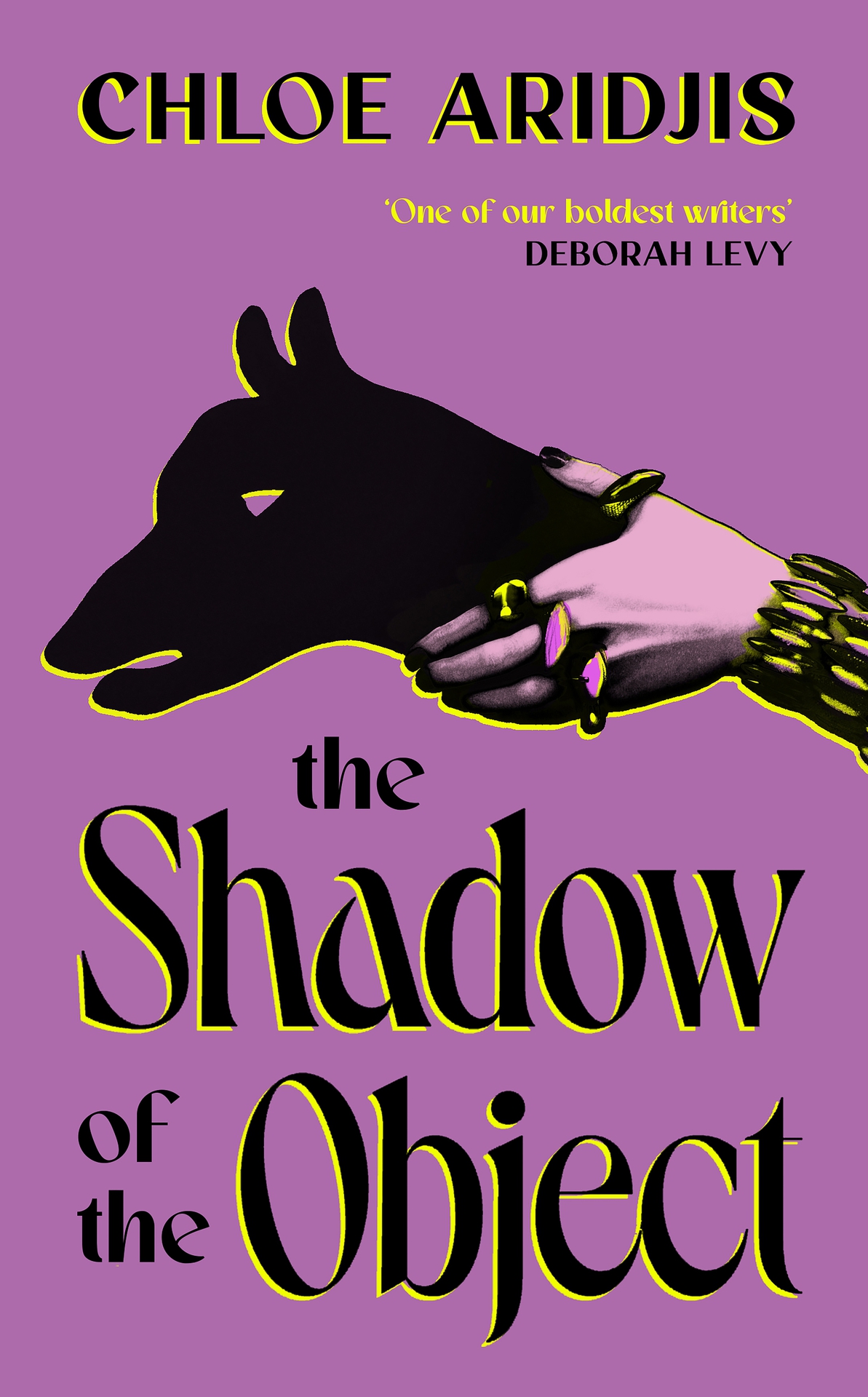
The Shadow of the Object
About this book
While visiting family in Mexico, Flora is bitten by the family dog and undergoes several operations. In hospital she meets Wilhelmina, an elderly German woman whose collection of pre-cinema instruments includes a magic lantern.
Their corridor conversations and Wilhelmina's projection show draw Flora into a world of images that appear before cinema but already possess its power to rearrange attention. An unexpected turn entrusts Flora with a task connected to the older woman.
Back in London, Flora resumes polishing silver in a jewelry shop and develops an unusual friendship with Wilhelmina's son Max. Objects, reflections, memory, and desire begin to project upon one another until perception itself feels less stable.
The Shadow of the Object is a compact standalone novel about metamorphosis, mortality, and the technologies through which people cast images. Chloe Aridjis keeps its dreamlike movement attached to precise rooms, surfaces, and acts of looking.
Read a sample
5,161 words
Plain text
From the opening
I
The fewer the props the greater the magic, a famous magician once said, although in my case it wasn’t the flourish of a wand but the wave of my own hand. My own hand made certain things vanish and conjured others into existence. Yes, its mere movement brought about more change, more transformation, than any magic trick. On night three of my visit home, after watching a film with my parents in their bedroom, I’d risen from my chair and waved goodnight. The mistake, we later concluded, had been to wave. All the dog saw, we concluded, had been a disembodied hand.
A hand – floating, beckoning, threatening – mid-air.
He had watched over our home for eleven years, this dog, been taken for daily walks and given the run of the garden, slept pressed against my parents’ door each night, a magnificent Alsatian with a coal-black face and golden eyebrows, occasionally he growled but for the most part he remained composed, his inner life and ours mysteriously, harmoniously, aligned. Until that moment when he was possessed by an unknown force, his eyes glowing amber, teeth sinking into my hand.
One second a searing pain, the next nothing, the pain too new, too vast, to identify. My mother threw the television control and missed. My stepfather reached for the cane by his bed, until then never used on anyone, and after receiving a blow on his hind legs, there was no choice, the dog released me, but not without difficulty since one of his canines snagged on a bone and had to unhook at just the right angle.
At night he turns wolf, my mother would say, and it was true his mood grew feral after dusk. But until then, the wolf had protected us.
The elderly taxi driver who took us to the hospital seemed lost in thought as he wound through the sinister scrublands of Chapultepec Park. Please hurry, it’s an emergency, we urged, but the man took a meandering route via the tercera sección, deserted apart from the packs of hounds that were the spirit of its wilderness and ravines.
We arrived at the hospital after thirty minutes, or perhaps it was forty or forty-five, time marked only by increments of pain, followed by limbo in a waiting room inhabited by a silenced television and a howling boy. Old episodes of El Chapulín Colorado played across the screen, the sight of a grown man dressed as a red grasshopper even more absurd on mute, my stepfather kept laughing and my mother now and then too, how could they laugh when I had just been bitten by our dog, well, how could they laugh full stop, and as the pain shot up my arm I wondered how much more I could endure.
The clock on the wall read 2:25 when the hand surgeon arrived, bathed and perfumed, in a black leather jacket. I followed the man to a cubicle, where he drew the curtain, and in that snug space he unwrapped the provisional bandage my mother had thrown on and poured alcohol and iodine into my wounds, my hand on fire as he set to work removing some of the debris. Eight deep bites, he counted, on the front and the back and in the fold of my thumb, but I couldn’t bring myself to look.
From that moment to the hospital bed, only a few memories survive:
The surgeon speaking into the phone as he booked the operating room for dawn, his delivery as straight as a hospital corridor, a professional urgency that didn’t allow for nuance or digression. I attempted, unsuccessfully, to read my fate in his words.
The anaesthetist’s customary question – Vodka, rum or tequila? – before administering the jab.
Tejido necrótico. The first words heard upon waking. Not a punk rock band, not necromancy or necropolis, but necrosis. Local dead tissue, a necrotic citadel, a small cemetery of cells, in my hand.
Square room, low ceiling.
Remedies descending in a drip, bed fitted with contraptions.
A greyish light at the windows.
Anaesthesia on the ebb: edges and angles acquiring definition.
Fastened to the corner of the ceiling, an enormous television.
Fastened to the wall by the door, a pump with disinfectant gel.
And, pasted onto the scene like a collage, my mother and stepfather.
How long had they been there, side by side on the sofa?
I hadn’t visited home in three years and now, here we were.
How is Diogenes? I asked. The voice that emerged from my chest was hoarse and peculiar and I had to repeat my question.
His name was Diogenes. Diego for short. Two or three syllables suit a dog much better than four, and from puppyhood onwards we used his full name in conversation but Diego when addressing him, not an exact diminutive of Diogenes but he didn’t seem to mind. And anyway, as he grew older he often wouldn’t respond when called, he’d lift his head and then drop it back down, the gravity of the years stronger than any impulse towards obedience or curiosity.
Diogenes was sulking and ashamed and keeping to the corners of the house, my mother said. Aware he’d done something wrong, uncertain what.
Put him down, a chorus had begun, put him down. Our neighbours were insisting, and a few relatives too. You will never feel safe again with him in your midst. But no, how could we? He was part of the family. Ignore the chorus, we agreed. Our only action would be to follow the veterinarian’s advice and neuter him, in case an excess of testosterone was to blame.
Continue reading the sampleClose the sample
The issue had been laid to rest, the dog would be snipped and the story would end there, when the surgeon entered the room. The door was open but he knocked to announce his presence, then helped himself to some gel and rubbed his hands together as he approached. This time he was accompanied by another man. Bald, pockmarked, with glasses. The infectólogo. Grave-faced, they explained they couldn’t seal my hand just yet, there was still too much splintered bone inside, and therefore too much risk of infection. And with the risk of infection, they wielded a new word. Osteomyelitis. I would need at least one more surgery, possibly two, and for the time being should remain in hospital. The antibiotics I was receiving were too strong to take orally and had to enter through a drip, and my hand should remain protected from the dangers of the outside world.
The outside world. Everything familiar belonged there, not here.
As they spoke, each man reiterating what his colleague had said, I saw the remaining days of my visit home spiralling down the drain. Old friends whose numbers I wouldn’t be dialling. Neighbourhoods I’d have to wait another couple of years to wander. Fewer hours conversing with the past in charged spaces of the house. Not to mention ten months saving for the plane ticket. All because of Diogenes, a dog that’d been fed three times a day every day of his life, wet food and dry food and water, along with countless treats and vitamins and supplements to keep his joints in action. How little had been expected of him in return, apart from to be a good dog and defend the house from intruders. And in this case the intruder had been my hand, at least that’s what we had to conclude since any other explanation would have been too unthinkable. Night blindness and cataracts, is what the vet later said, adding that Alsatians grew skittish with age. His words corroborated my mother’s theory: the dog had seen nothing but a disembodied hand.
A hand out of context, unattached to a body, was indeed an unsettling sight. A hand gone rogue, no longer following orders from headquarters. I’d seen a few myself, and every now and then one crept back into memory, particularly the spirit rapping hand in an exhibition about the occult, a life-sized model of a female hand with a lace cuff and manicured nails. It sat very still yet I could feel the tension, fingers alert for any message coming its way, poised to reply with one rap for ‘yes’, two for ‘no’, and three for ‘doubtful or unknown’. Nearly as macabre was the wax hand of a saint in a reliquary in a Mexican church, the nails painted blood red, a thick gemstone on the ring finger. An individual, parcelled out. So much intention is loaded into one lone hand, inevitably more perturbing than two, and if Diogenes saw a disembodied hand that night in the sanctuary of my parents’ bedroom I couldn’t blame him for leaping to conclusions.
My visitors were restless. Repetitive motions gave them away. My stepfather flipped through the pages of a magazine, even from a distance I could see he wasn’t pausing for more than adverts and headlines, while my mother kept stepping out to scan the corridor as if awaiting some mysterious annunciation. I had flown over to see them yet the ocean remained between us. At six o’clock they rose to leave; it was time for dinner. Before departing my stepfather went over to the television and switched it on, flicking through the channels until coming upon the antics of the Chapulín Colorado once again, and I couldn’t help wondering whether this character roamed the entrails of the hospital, waiting to resurface through whatever portal he was granted.
I bade the nurse who came in shortly afterwards to turn it off, and as she readied the thermometer I asked her to tell me what exactly held this television looming dangerously over my bed in place. It’s fastened to the ceiling with massive screws, she said, and then, as if reading my mind, added, During our recent earthquake many things went rolling off and some patients were even severed from their drips but the televisions stayed put, she explained, as she held the thermometer up to the light (no fever) and rearranged the pillows into a snowy stack.
The next afternoon my mother came by on her own. After setting down a tote bag overflowing with snacks – my stepfather worked for Sabritas – she took a seat on the sofa and sighed. What to say, she said, I hope your hand mends quickly. Today her face was a map of worry and I knew what she was thinking. Whenever something went wrong in life, though never anything as dramatic as this, we would think about how different it would be if my father were still here. He’d been gone for many years, vanished one Sunday into the labyrinth of the city, after going to play chess with a colleague. At first we thought something catastrophic had happened, perhaps he’d been struck by a bullet intended for someone else, but the truth was delivered three days later in the form of a letter: my father had left us. He would, it seemed, never be back. Too young to fully accept this fact, for years I convinced myself that the man who was my father had been dispatched in a game of chess, that he’d become a pawn and been captured by his opponent, and the person who’d posted that letter was his double. Not entirely off the mark, I later discovered, since through cousins it was revealed he had another family up north, and had been leading a double life. Everything he’d established with us – rituals, confidences, intimacies – had its replica elsewhere. Nothing had been unique, nothing sacred. My mother didn’t mention him, I didn’t mention him, but there he sat in the room with us.
The light seemed concentrated in their faces, the shadow in their buns. That night the nurses lowered the dose of painkillers and my stupor was replaced by a blissful headiness that skirted sleep, abandoning me on the same shore each time. My body clock was completely askew – I had flown from London to Mexico only a few days before and shortly afterwards landed in hospital, where the passage of hours acquired an even stranger aspect and my irregular patterns of sleep produced a bizarre quality of thought. Every now and then a sharp pain pierced my hand and ran up my arm, testing the network of communication. My desire for a sleeping pill grew and grew, anything would do, zolpidem or zopiclone or temazepam, but when I asked the nurse she shook her head. Controlled substances must be approved by the doctor on duty and said doctor was in the midst of an emergency. Not even half a pill? I hadn’t experienced such a craving in a while; usually, either I had my pills at hand and took one straight away or else I didn’t have any anywhere, in which case I wouldn’t allow the thought to possess me.
I listened to sounds distanced from their sources, seconds pooling into minutes, minutes into the purrs of machines, purring in a different language from my machine at work, and now and again these machines would merge with the sound of elevator doors stuttering open and closed, until into this mechanical soundscape entered the voice of a woman, an elderly woman, calling out for a nurse, a doctor, anyone. Her pleas grew louder, more desperate, her voice cracking in despair, could no one hear her but me, I wondered, as I slipped out of bed and started down the corridor with my drip.
A few metres away a group of nurses huddled round a magazine. One of them looked up and asked what I needed, why I was up and about. The rest of the nurses reluctantly tore their eyes away from the page. A woman is calling out, I said, she sounds old and forlorn. Yes, we are aware of her, but she wants water and isn’t allowed any fluids until tomorrow, they said, then asked whether there was anything further before refusing my second request for a pill.
Disappointed with the expedition and in no hurry to return to bed, I chose a more circuitous route to my room. Instead of heading back in the direction I’d come from I turned here and there at random. The corridors wrapped around an inner court, you could peer down three floors and into the lobby with its striped sofas and raucous gift shop, a jamboree of colour before the mood turned clinical. To my left ran a sequence of open doors exuding a bluish tint and I hurried past, more fearful of an infectious emptiness than of disrupting the sleep of any patient, and then took the first right, my drip nearly catching on the corner, and it was then that I saw her, a strange figure in a wheelchair, a hybrid of woman and chair, her gaze burning a path down the corridor, one moment flaring towards me and the next completely still, yes, that was my first impression of her, an intriguing silhouette at the end of the corridor. There may have been a blanket thrown over her shoulders, I no longer recall. Her hair may have been loose or pinned up. At that moment she wasn’t operating any of her illusions, she was separated from her milieu, no dissolving views no spinning no slits no slats no pages of books read backwards to reveal a hidden design, indeed no hidden design, simply a figure in the darkness projecting her gaze, nothing but a gaze, yet that gaze had the steady force of a beam of light. I turned around, unnerved, and hurried back to my room and again rang for the nurse, who called the doctor. Now freed from his emergency, he handed me a glass of water and a zopiclone.
Sometimes an animal leaves its mark on you for life.
When it comes to dog breeds and the force of their bites, Alsatians come after mastiffs and Rottweilers. Breeds such as pit bulls are more tenacious, that’s what makes encounters with them so gruesome, but the Alsatian’s bite is actually more powerful, with a 238-measure bite force in its jaws, calculated in pounds per square inch … Let me put it into context, lions have a 650 bite force, jaguars 1,500. A polar bear’s is 1,200, a gorilla’s 1,300, a hippo’s 1,800 … As for the Nile crocodile, its bite force is around 5,000 …
That’s enough, my mother interrupted, aware the hand surgeon was getting carried away.
I’m just saying why your daughter must remain here for a while longer … We can’t take any chances.
The only chances being taken were with my sanity, I should have said, although I would’ve found it hard to explain exactly why, especially since part of me was starting to enjoy this hospital stay. After all, hospital stays offer a rare occasion to check out – during the rest of life you are checked in and accountable, but as a patient you are absolved of most responsibility, nothing expected of you except to mend. On the contrary, you can make demands on others, even extravagant demands every now and then, and thanks to my travel insurance I was at the fanciest hospital in Mexico City, in my own room with an adjustable bed and people waiting on me night and day, a situation I had never found myself in before. The outside world may forget about you while you’re in hospital but to be forgotten, temporarily, isn’t such a bad thing.
On my stroll that evening I avoided the nurses’ station and took a left down a stretch of corridor with a hissing light, our wing more desolate than ever as though the other patients slept more deeply, more medicated, even further removed from our suspended present, apart from one face that appeared briefly at a door, wide-eyed and ashen; uncertain whether it was man, woman or spectre, I quickly hurried on. Such a stark sense of corridor desolation hadn’t hit me since adolescence, on one of the first occasions I’d spent hours at a hospital, not as a patient but as a visitor, and not as a visitor paying her respects, but as a reveller.
The rave had been held in a huge building in Mexico City, soon to be the first AIDS hospital in Latin America. Shortly afterwards, beds would be delivered and the space transformed into a place of intensive care, but before that a charity had decided to raise money for incoming patients. The promoters had papered bars, clubs and record shops with flyers, and by eleven the party had reached full capacity and the bouncers began turning people away at the door. Wild and reckless we ran through the strobe-lit rooms, each one powered by a different DJ and his or her techno anthems, and at moments it felt like heresy to be dancing and cavorting in a space that would soon be marked by suffering but I convinced myself we were infusing the place with life, with a life force to be administered to future patients in doses small enough to guarantee there was enough for everyone, and with that idea in mind I was able to plunge freely into the night.
The only conversation I remember having was with a young European, possibly Belgian, wearing LED gloves that glowed at the tips, and after I’d paid him a compliment he mentioned he’d worn them recently to a rave near Zurich, one of the best parties he’d ever been to, he said, except that at around four in the morning the DJ had suddenly stopped the music and asked everyone to hold a minute of silence for a dead raver, drawing thousands of people to a standstill, not an easy feat when most were soaring on Ecstasy and impatient to carry on with their night, but the DJ’s voice was so solemn he managed to press the pause button for an entire minute, lording over everyone like an urban warlock, and then gradually, very gradually, after that long minute of silence was achieved, he introduced a mournful track with a foghorn in it, and the Belgian or wherever he was from said he would never forget that moment as the tune crept into the stilled space and life re-entered, reanimating everything. In fact he’d written a short story, ‘A Minute of Silence for the Dead Raver’, he’d never published anything in his life, he said, but two days after the party he sat down and wrote it, and ever since our conversation I’d wondered whether someday I would open a magazine and there it would be, and though the young man’s face and voice and everything about him but his gloves had vanished from memory, the story of the dead raver survived.
As I continued my stroll the corridors began to feel less welcoming, the floor oddly aslant, the fluorescent lights bright enough to X-ray our interiors, the doors devoid of the earlier symmetry that helped fit them into doorways, now impossible to wedge shut. The result was so disorienting I nearly bumped into an elderly patient in her hospital gown being led by her maid in a pink-and-white uniform. Caked in make-up, the woman looked like an ageing actress who’d strayed from her dressing room, and she gripped her maid’s arm as though this were the only person she trusted in the world, the person to whom, unbeknownst to her family, she would be leaving her fortune.
Moments after encountering this pair – the woman’s eyes searched mine as we crossed paths and she smiled faintly – I came upon what I realised I’d been looking for, albeit at a distance: the figure in the wheelchair. A nurse stood by her side and, upon seeing me, waved me over. I glanced around to confirm I was the person she was addressing and walked towards them, there at the end of the corridor beside a potted palm tree and its serrated shadow, and once I was within hearing range the nurse asked whether I spoke any English, to which I replied yes, yes I did, while taking in the face that had come into focus: sharp eyes, stern mouth, heavy brow, shoulder-length hair in coppery red.
Thank heavens for that, said the patient in a German accent. Please tell the nurse I want to go outside for a cigarette, only one, I’ve been imprisoned here for days and I’m losing my mind, they must grant me five minutes of fresh air, five minutes with a cigarette, I don’t even have to smoke the entire one, half will do.
Word for word, I translated.
But she’s in here for pneumonia.
Yes, yes, the woman dismissed the nurse’s words, I’ve had pulmonía many times, it’s nothing to worry about.
She can’t go out. She has to stay indoors. Hospital rules. And she definitely cannot smoke.
I translated back, aware of my own desire for one now.
The woman stomped her feet, large and slippered, on the metal ledge of the wheelchair and glowered up at us both as though we were equally to blame.
Voices. Hastening steps. A gurney hurtling down the corridor. Elsewhere in the wing, an emergency. Here there was no emergency, not even urgency, simply an urge that sought satisfaction.
The woman was now staring down at the floor. An impasse had been reached. She’d shut me out. I murmured goodnight in English and then Spanish. Only the nurse replied.
What was a German woman with pneumonia, or perhaps she was Swiss or Austrian, doing in a hospital in Mexico City all on her own, I wondered the following morning. Had she disembarked from a cruise ship or recently moved to Mexico or been abandoned while on holiday? That evening once the doctor on call had finished her rounds I set out on another stroll, this time heading straight for the corridor, my impatience reined in only by the drip. And very soon I glimpsed her, hunched in her wheelchair, a blanket over her shoulders. Tonight she was alone, there was no hovering nurse, though I sensed she was still under the command of a green uniform, unable to dispel its cloud of NO. As I approached I heard another mumbled request for a cigarette, and found myself asking whether she even had any with her at the hospital. Of course she did, she always travelled with a carton, she’d left it at the hotel but had a pack in the coat she’d been wearing when they’d brought her in, and by the way, her lungs were much stronger than yesterday, couldn’t I hear, no more crinkling no more rattling, she could breathe in deeply and inhale more air, yes, the air travelled farther down than it had only twenty-four hours ago.
She fixed me with her gaze, its severity intensified by the dark eyes and prominent brow, and again I had to deny her what she most wanted and tell her I couldn’t be of help, I too was a patient and had no influence, no authority, in fact the nurses hardly paid any attention to me.
From where I stood I had a good view of her hair, the silvery roots tapering into copper, and speculated as to when it had last been dyed.
I commented on her English, how exceptional it was (heavily accented but error-free), to which she replied with a note of exasperation that she’d been living in London for many years. I live in London too, I replied. She looked surprised, I thought, yet didn’t comment on the fact. We then established that we both lived in the north-east of the city, in fact within walking distance of one another, less than four bus stops apart.
That’s the thing, she said, you can live round the corner from someone for years and yet your paths never cross, unless thrown together by unusual circumstance.
Prompted by this coincidence, she told me her name: Wilhelmina.
And revealed she was staying on the floor above, reserved for heart and lung ailments. She preferred my floor, which focused on recovery, you felt its optimism as soon as you emerged from the lift, whereas her floor cultivated a near deathly silence. Glancing at my bandaged hand, she asked why I was there.
Two fractures, one in the thumb and one in a metacarpal, and lots of splintered bone. My parents’ Alsatian had bitten me. And then, coming to his defence: Alsatians are fiercely intelligent and therefore grow skittish with age.
Enlightenment comes at a cost, she laughed, her laughter gruff and cavernous before mutating into a prolonged cough. Well, trips take unforeseen turns, she said once she’d stopped coughing, yours with your dog bite and mine with my lungs, although the pneumonia is less of a surprise.
She rarely travelled beyond Europe, she explained, hesitant to journey so far, but had always wanted to visit Mexico. An invitation to a convention was her chance. From the airplane the city looked monstrous, sprawling voraciously in every direction, nothing like the map of the Aztec capital of Tenochtitlán Dürer had admired in a woodcut in Vienna in 1524, declaring it afterwards the perfect metropolis (yet by the time he’d seen this woodcut, I could have told her, the city it depicted had been razed).
After giving her talk to a half-empty auditorium she had slipped away to the Museum of Anthropology, the place of her dreams. And it lived up to them. The museum was as violent and magisterial as she’d always imagined, bristling with skulls and snakes and jaguars. But the most extraordinary sculpture of all was a human heart carved from green stone, unlike the mineral grey of the others: it had a face, eyes, eyebrows and fangs, and emitted as much malice as the most sanguinary gods. Pulled into its orbit she stood pressed up to the glass and only after a few minutes managed to tear herself away. Next she went to stand in front of the Aztec stone calendar, where a group of young Italians took turns posing with a camera, and then on to Coatlicue, she of the serpent skirt. It was there that the tightness in her chest began to set in, from one moment to the next it was as though an obsidian dagger had been plunged into her lungs and the stone calendar marked the last of her days, and with difficulty she dragged herself into the main courtyard, resting for several minutes on the edge of the pond by a giant conch shell she’d never have the strength to blow into, and finally towards the exit, the fine spray from the indoor waterfall reminding her she was still in the land of the living. A taxi brought her back to her hotel, where she arrived so shaky and feverish the people at reception immediately called an ambulance.
After this breathless monologue Wilhelmina paused for a moment and produced two bread rolls from under her robe, she’d asked for extras since the hospital portions were so small and how could they expect one to go for so many hours between meals, she said, before tearing off a chunk with her teeth. She was driven by an insatiable appetite, a nurse later told me, and would insist on two trays at mealtimes, a rare thing for pneumonia patients but not the German woman in room 423, who seemed to eat more than all the other patients combined. I watched her eat, her manners an unusual blend of savagery and etiquette. The first roll, then the second.
Once done, she resumed.
My son, on the other hand, he hardly eats a thing, he’s a bit scatty and adrift, it’s nothing to worry about, only the occasional gloomy spell that ails him, he hasn’t found his path but I tell myself it’s only a matter of time. He’s now in his mid-thirties and still waiting for a bit of direction. He offered to fly out here but I told him absolutely not, he’d probably get lost on his way to the airport. Today the doctors mentioned some sort of surgical intervention but under no circumstances am I going to let anyone come near me, someone must convince them they are holding me here against my will, please tell them I need to return home, my son is alone in the house and that makes me nervous, I never know what he will get up to, and furthermore my feet will wither if I stay here much longer, they need movement, and my lungs will recover only once I leave this polluted city. Pneumonia’s a frequent guest in my house and really nothing to be alarmed about, all I need is to be home again with someone who knows the ritual: flood my bedroom with eucalyptus oil, grant me fresh air and two cigs a day, and I’ll mend in no time.