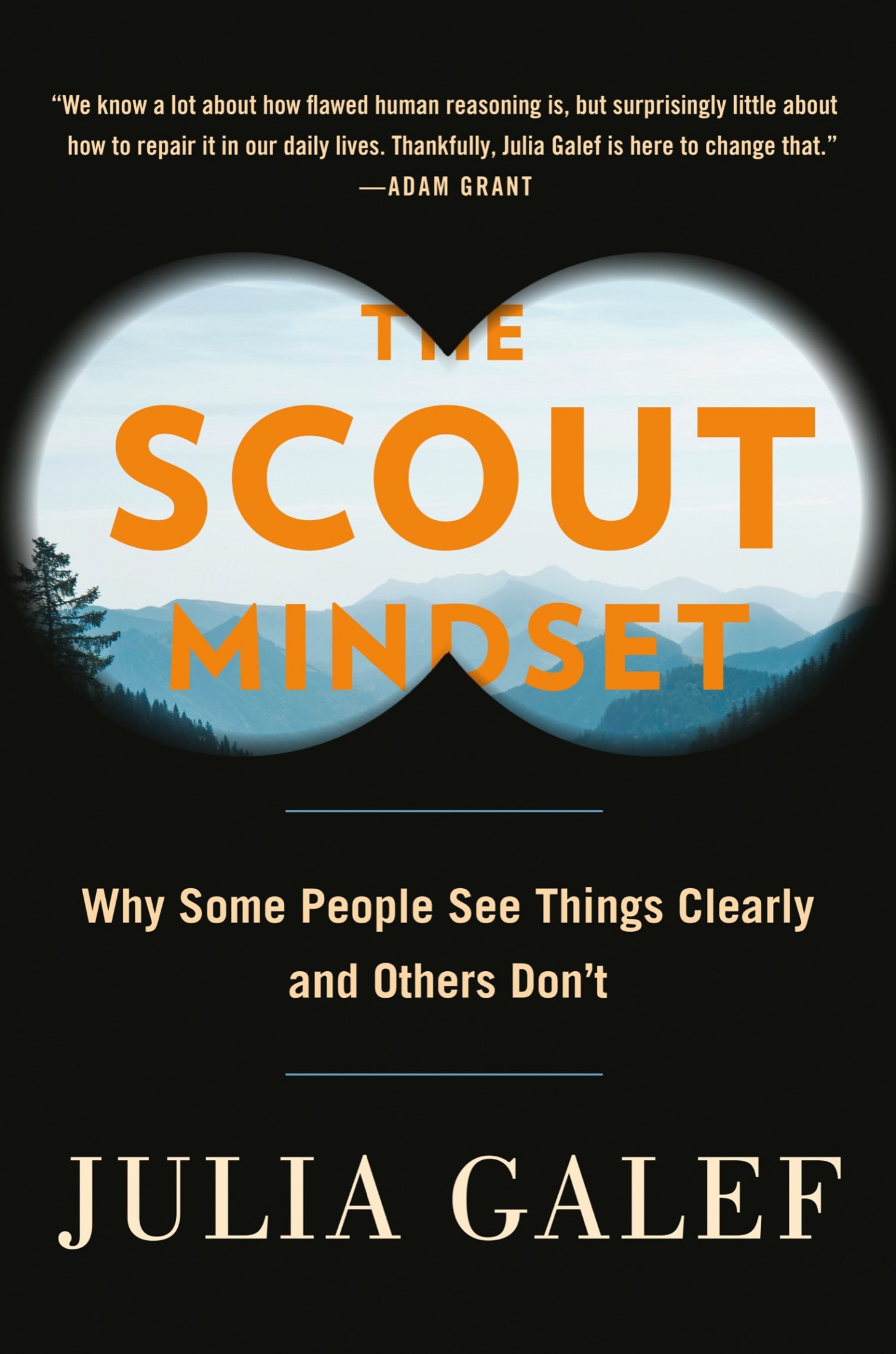
The Scout Mindset: Why Some People See Things Clearly and Others Don't
About this book
Motivated reasoning does not usually feel dishonest. People select evidence, standards, and explanations in ways that protect identity or belonging while experiencing the result as ordinary judgment.
The scout alternative is not detached neutrality. It involves noticing what would change your mind, calibrating confidence, testing identity labels, and learning to treat correction as useful information rather than defeat.
Examples from history, business, science, and personal decisions show how emotional rewards can support accuracy too. Curiosity, admiration, and the relief of dropping a bad defense can compete with the comfort of certainty.
The Scout Mindset is a practical book about intellectual habits. It avoids promising freedom from bias and instead focuses on conditions that make honest updating easier.
Read a sample
5,066 words
Plain text
From the opening
INTRODUCTION
When you think of someone with excellent judgment, what traits come to mind? Maybe you think of things like intelligence, cleverness, courage, or patience. Those are all admirable virtues, but there’s one trait that belongs at the top of the list that is so overlooked, it doesn’t even have an official name.
So I’ve given it one. I call it scout mindset: the motivation to see things as they are, not as you wish they were.
Scout mindset is what allows you to recognize when you are wrong, to seek out your blind spots, to test your assumptions and change course. It’s what prompts you to honestly ask yourself questions like “Was I at fault in that argument?” or “Is this risk worth it?” or “How would I react if someone from the other political party did the same thing?” As the late physicist Richard Feynman once said, “The first principle is that you must not fool yourself—and you are the easiest person to fool.”
Our capacity to fool ourselves was a hot topic throughout the 2000s and 2010s. Popular media and bestselling books like How We Know What Isn’t So, Predictably Irrational, Why People Believe Weird Things, Mistakes Were Made (But Not by Me), You Are Not So Smart, Denialism, Why Everyone (Else) Is a Hypocrite, and Thinking, Fast and Slow painted an unflattering picture of a human brain hardwired for self-deception: We rationalize away our flaws and mistakes. We indulge in wishful thinking. We cherry-pick evidence that confirms our prejudices and supports our political tribe.
That picture isn’t wrong, but it is missing something.
Yes, we often rationalize away our mistakes—but we sometimes acknowledge them, too. We change our minds less often than we should but more often than we could. We’re complex creatures who sometimes hide the truth from ourselves and sometimes confront it. This book is about the less explored side of that coin, the times we succeed in not fooling ourselves, and what we can learn from those successes.
My path to this book began in 2009, after I quit graduate school and threw myself into a passion project that became a new career: helping people reason out tough questions in their personal and professional lives. At first, I imagined that this would involve teaching people about things like probability, logic, and cognitive biases, and showing them how those subjects applied to everyday life. But after several years of running workshops, reading studies, doing consulting, and interviewing people, I finally came to accept that knowing how to reason wasn’t the cure-all I thought it was.
Knowing that you should test your assumptions doesn’t automatically improve your judgment, any more than knowing you should exercise automatically improves your health. Being able to rattle off a list of biases and fallacies doesn’t help you unless you’re willing to acknowledge those biases and fallacies in your own thinking. The biggest lesson I learned is something that’s since been corroborated by researchers, as we’ll see in this book: our judgment isn’t limited by knowledge nearly as much as it’s limited by attitude.
None of which is to say that I’m a perfect exemplar of scout mindset, by the way. I rationalize away mistakes; I avoid thinking about problems; I get defensive in response to criticism. More than once during my research for this book, I realized I had essentially wasted an interview because I spent it trying to convince my interviewee that my thesis was correct, instead of trying to understand their point of view. (The irony of my being closed-minded during an interview about open-mindedness is not lost on me.)
But I’m better than I used to be, and you can be, too—that’s the aim of this book. My approach has three prongs.
1. REALIZE THAT TRUTH ISN’T IN CONFLICT WITH YOUR OTHER GOALS
Many people actively resist viewing reality accurately because they believe that accuracy is a hindrance to their goals—that if they want to be happy, successful, and influential, it’s better to view themselves and the world through a distorted lens.
Part of my goal in writing this book was to set the record straight. There are a lot of myths out there about self-deception, some of which have even been promoted by prestigious scientists. For example, maybe you’ve seen one of the many articles and books claiming that “studies show” that self-deception is part of mental health, and that seeing the world realistically only leads to depression. In chapter 7, we’ll examine the questionable research behind those claims, and discover how psychologists fooled themselves about the benefits of positive thinking.
Or maybe you hold the common belief that when you’re doing something hard, like starting a company, you need to be delusionally overconfident. You might be surprised to learn that some of the world’s most famous entrepreneurs expected their companies to fail. Jeff Bezos put Amazon’s probability of success at about 30 percent. Elon Musk estimated a 10 percent chance of success for each of his companies, Tesla and SpaceX. In chapter 8, we’ll come to understand their reasoning and why it’s valuable to have a clear-eyed picture of the odds you’re facing.
Or perhaps you share this widespread sentiment: “Sure, being objective is a good thing if you’re a scientist or a judge. But if you’re an activist trying to change the world, you don’t need objectivity—you need passion.” In fact, as we’ll see in chapter 14, scout mindset complements passion. We’ll travel back to the height of the AIDS crisis in the 1990s, and discover why scout mindset was so crucial to activists’ success in stopping the epidemic.
Continue reading the sampleClose the sample
2. LEARN TOOLS THAT MAKE IT EASIER TO SEE CLEARLY
I’ve packed this book with concrete tools you can use to get better at scout mindset. For example, how can you tell when your own reasoning is biased? It’s not as simple as just asking yourself, “Am I biased?” In chapter 5, we’ll learn thought experiments like the outsider test, the selective skeptic test, and the conformity test to examine your reasoning about what you believe and what you want.
How do you decide how certain you are about a particular belief? In chapter 6, we’ll practice some introspection techniques that will help you pin down your level of certainty from 0 to 100 percent, and train you to recognize what it feels like when you’re making a claim you don’t really believe.
Do you ever try to listen to the “other side” of an issue, and find yourself getting frustrated or angry? That might be because you’re approaching it the wrong way. In chapter 12, I’ll share some pointers that make it much easier to learn from opposing perspectives.
3. APPRECIATE THE EMOTIONAL REWARDS OF SCOUT MINDSET
Concrete tools are important, but I’m also hoping to leave you with something more. Facing reality with all its uncertainty and disappointments might seem bleak. But as you peruse this book’s examples of “scouts” (my term for people who are especially good at some aspects of scout mindset, even though nobody is perfect), you’ll notice that they don’t seem depressed. For the most part, they’re calm, cheerful, playful, and resolute.
That’s because even though it may not be obvious from the outside, scout mindset is emotionally rewarding. It’s empowering to be able to resist the temptation to self-deceive, and to know that you can face reality even when it’s unpleasant. There’s an equanimity that results from understanding risk and coming to terms with the odds you’re facing. And there’s a refreshing lightness in the feeling of being free to explore ideas and follow the evidence wherever it leads, unconstrained by what you’re “supposed to” think.
Learning to appreciate these emotional rewards is what makes scout mindset stick. To that end, I’ve woven into this book some of my favorite inspiring examples of scouts who have helped me and others cultivate scout mindset over the years.
Our journey will take us through the worlds of science, business, activism, politics, sports, cryptocurrency, and survivalism. We’ll dip our toes in the Culture Wars, the Mommy Wars, and the Probability Wars. Along the way, we’ll unlock the answers to puzzles such as: Why did the sight of a peacock’s tail make Charles Darwin sick? What made a professional climate change skeptic switch sides? Why do some victims of cultlike pyramid schemes manage to extract themselves while others stay stuck?
This book is not a rant about how irrational people are. Nor is it an attempt to scold you into thinking “correctly.” It’s a tour of a different way of being, one that’s rooted in an appetite for truth, and one that’s both useful and fulfilling—and, in my opinion, woefully underappreciated. I’m excited to share it with you.
PART I The Case for Scout Mindset
Chapter 1
Two Types of Thinking
In 1894, a cleaning lady in the German embassy in France found something in a wastebasket that would throw the entire country into chaos. It was a torn-up memorandum—and the cleaning lady was a French spy.1 She passed the memo on to senior staff in the French army, who read it and realized with alarm that someone in their ranks had been selling valuable military secrets to Germany.
The memo was unsigned, but suspicion quickly fell on an officer named Alfred Dreyfus, the only Jewish member of the army’s general staff. Dreyfus was one of a small number of officers who was of high enough rank to have access to the sensitive information mentioned in the memo. He was not well liked. His fellow officers considered him cold, arrogant, and boastful.
As the army investigated Dreyfus, suspicious anecdotes began to pile up. One man reported seeing Dreyfus loitering somewhere, asking probing questions. Another reported having heard Dreyfus praising the German Empire.2 Dreyfus had been spotted at least once in a gambling establishment. Rumor had it that he kept mistresses, despite being married. Hardly signs of a trustworthy character!
Feeling increasingly confident that Dreyfus was the spy, French army officers managed to obtain a sample of his handwriting to compare with the memo. It was a match! Well, at least it looked similar. There were admittedly a few inconsistencies, but surely it couldn’t be a coincidence that the handwriting was so much alike. They wanted to make sure, so they sent the memorandum and the sample of Dreyfus’s writing to two experts for evaluation.
Expert Number 1 declared it to be a match! The officers felt vindicated. Expert Number 2, however, was not convinced. It was quite possible that the two writing samples came from different sources, he told the officers.
A mixed verdict wasn’t what the officers were hoping for. But then they remembered that Expert Number 2 worked with the Bank of France. The world of finance was full of powerful Jewish men. And Dreyfus was Jewish. How could they trust the judgment of someone with such conflicts of interest? The officers made up their minds. Dreyfus was their man.
Dreyfus insisted he was innocent, but to no avail. He was arrested, and a military court found him guilty of treason on December 22, 1894. He was sentenced to solitary confinement for life on the aptly named Devil’s Island, a former leper colony off the coast of French Guiana, far across the Atlantic Ocean.
When Dreyfus heard the decision, he was in shock. After being dragged back to prison, he considered suicide, but eventually decided that such an act would only prove his guilt.
The final ritual before sending Dreyfus away was to strip him of his army insignia in public, an event dubbed “the degradation of Dreyfus.” As an army captain tore the braid from Dreyfus’s uniform, one officer cracked an anti-Semitic joke: “He’s a Jew, remember. He’s probably calculating the value of that gold braid.”
As Dreyfus was paraded past his fellow troops, journalists, and crowds of onlookers, he shouted, “I am innocent!” The crowd, meanwhile, spat insults and yelled, “Death to Jews!”
Once he arrived on Devil’s Island, he was kept in a small stone hut with no human contact except for his guards, who refused to speak to him. At night, he was shackled to his bed. During the day, he wrote letters begging the government to reopen his case. But as far as France was concerned, the matter was settled.
“CAN I BELIEVE IT?” VS. “MUST I BELIEVE IT?”
It might not look this way, but the officers who arrested Dreyfus had not set out to frame an innocent man. From their perspective, they were conducting an objective investigation of the evidence, and the evidence pointed to Dreyfus.*
But although their investigation felt objective to them, it was clearly colored by their motives. They were under pressure to find the spy quickly, and they were already inclined to distrust Dreyfus. Then, once the wheels of the investigation had been set in motion, another motive was born: they had to prove themselves right or risk losing face, and potentially their jobs as well.
The investigation of Dreyfus is an example of an aspect of human psychology called directionally motivated reasoning—or, more often, just motivated reasoning—in which our unconscious motives affect the conclusions we draw.3 The best description of motivated reasoning I’ve ever seen comes from psychologist Tom Gilovich. When we want something to be true, he said, we ask ourselves, “Can I believe this?,” searching for an excuse to accept it. When we don’t want something to be true, we instead ask ourselves, “Must I believe this?,” searching for an excuse to reject it.4
When the officers first began investigating Dreyfus, they evaluated rumors and circumstantial evidence through the lens of “Can I accept this as evidence of guilt?,” erring more on the side of credulity than they would have if they weren’t already motivated to suspect him.
When Expert Number 2 told them that Dreyfus’s handwriting didn’t match the memo, the officers asked themselves, “Must I believe it?” and came up with a reason not to: Expert Number 2’s supposed conflict of interest due to his Jewish faith.
The officers had even searched Dreyfus’s home for incriminating evidence and failed to find any. So they asked themselves, “Can we still believe Dreyfus is guilty?” and were able to come up with a reason to: “He probably got rid of the evidence before we got here!”
Even if you’ve never heard the phrase motivated reasoning, I’m sure you’re already familiar with the phenomenon. It’s all around you under different names—denial, wishful thinking, confirmation bias, rationalization, tribalism, self-justification, overconfidence, delusion. Motivated reasoning is so fundamental to the way our minds work that it’s almost strange to have a special name for it; perhaps it should just be called reasoning.
You can see it in the way people happily share news stories that support their narratives about America or capitalism or “kids today,” while ignoring stories that don’t. You can see it in the way we rationalize away red flags in an exciting new relationship, and always think we’re doing more than our fair share of the work. When a coworker screws up, it’s because they’re incompetent, but when we screw up, it’s because we were under a lot of pressure. When a politician from the rival party breaks the law, it proves how corrupt that whole party is, but when one of our politicians breaks the law, he’s just a corrupt individual.
Even two thousand years ago, Greek historian Thucydides described the motivated reasoning of the cities that believed they could overthrow their Athenian rulers: “[Their] judgment was based more upon blind wishing than upon any sound prediction; for it is a habit of mankind . . . to use sovereign reason to thrust aside what they do not desire.”5 Thucydides’s is the earliest account of the phenomenon I’ve found so far. But I have no doubt humans have been irritated and amused by each other’s motivated reasoning for many thousands of years before that. Perhaps if our Paleolithic ancestors had developed a written language, we would have found a complaint scrawled on the cave walls of Lascaux: “Og crazy if he think he best mammoth hunter.”
REASONING AS DEFENSIVE COMBAT
The tricky thing about motivated reasoning is that even though it’s easy to spot in other people, it doesn’t feel like motivated reasoning from the inside. When we reason, it feels like we’re being objective. Fair-minded. Dispassionately evaluating the facts.
Beneath the surface of our conscious awareness, however, it’s as if we’re soldiers, defending our beliefs against threatening evidence. In fact, the metaphor of reasoning as a kind of defensive combat is baked right into the English language, so much so that it’s difficult to speak about reasoning at all without using militaristic language.6
We talk about our beliefs as if they’re military positions, or even fortresses, built to resist attack. Beliefs can be deep-rooted, well-grounded, built on fact, and backed up by arguments. They rest on solid foundations. We might hold a firm conviction or a strong opinion, be secure in our beliefs or have unshakeable faith in something.
Arguments are either forms of attack or forms of defense. If we’re not careful, someone might poke holes in our logic or shoot down our ideas. We might encounter a knock-down argument against something we believe. Our positions might get challenged, destroyed, undermined, or weakened. So we look for evidence to support, bolster, or buttress our position. Over time, our views become reinforced, fortified, and cemented. And we become entrenched in our beliefs, like soldiers holed up in a trench, safe from the enemy’s volleys.
And if we do change our minds? That’s surrender. If a fact is inescapable, we might admit, grant, or allow it, as if we’re letting it inside our walls. If we realize our position is indefensible, we might abandon it, give it up, or concede a point, as if we’re ceding ground in a battle.*
Throughout the next few chapters, we’ll learn more about motivated reasoning, or as I call it, soldier mindset—Why are our minds built this way? Does motivated reasoning help us or hurt us?—but first, I’m happy to inform you that this isn’t the end of the line for poor Dreyfus. His story continues, as a new character steps onto the scene.
PICQUART REOPENS THE CASE
Meet Colonel Georges Picquart: by all appearances, a conventional man, not the sort you’d expect to rock the boat.
Picquart was born in 1854 in Strasbourg, France, to a family of government officers and soldiers, and rose to a position of prominence in the French army at a young age. Like most of his countrymen, he was patriotic. Like most of his countrymen, he was Catholic. And—again, like most of his countrymen—Picquart was anti-Semitic. Not aggressively so, mind you. He was a refined man and considered propaganda against Jews, such as the tirades being printed in France’s nationalistic newspapers, to be in bad taste. But anti-Semitism was in the air he breathed, and he grew up with a reflexively disdainful attitude toward Jewish people.
Therefore, Picquart had no difficulty believing it when, in 1894, he was told that the only Jewish member of the French general staff had turned out to be a spy. When Dreyfus professed his innocence during his trial, Picquart observed him closely and concluded that it was an act. And during the “degradation,” as Dreyfus’s insignia was stripped away, it was Picquart who cracked that anti-Semitic joke (“He’s a Jew, remember. He’s probably calculating the value of that gold braid”).
Shortly after Dreyfus was shipped off to Devil’s Island, Colonel Picquart was promoted and put in charge of the counterespionage department that had led the investigation of Dreyfus. He was tasked with accumulating additional evidence against Dreyfus, in case the conviction was questioned. Picquart began searching, but failed to find anything.
However, a more urgent matter soon took precedence—there was another spy! More torn-up letters to the Germans had been discovered. This time, the culprit seemed to be a French officer named Ferdinand Walsin Esterhazy. Esterhazy had a drinking problem and a gambling problem and was deeply in debt, thus giving him ample motive to sell information to Germany.
But as Picquart studied Esterhazy’s letters, he started to notice something. The precise, slanted handwriting was uncannily familiar . . . It reminded him of the original memo attributed to Dreyfus. Was he imagining things? Picquart retrieved the original memo and set it next to Esterhazy’s. His heart jumped into his throat. The handwriting was identical.
Picquart showed Esterhazy’s letters to the army’s in-house handwriting analyst, the one who had testified that Dreyfus’s handwriting was a match for the original memo. “Yes, these letters match the memo,” the analyst agreed.
“And what if I told you these letters were written quite recently?” Picquart asked. The analyst shrugged. In that case, he said, the Jews must have trained the new spy to imitate Dreyfus’s handwriting. Picquart did not find this argument plausible. Increasingly, with dread, he began to face the inevitable conclusion that they had convicted an innocent man.
He had one last hope: the sealed file of evidence used in Dreyfus’s trial. His fellow officers had assured him that he need only consult it to be convinced of Dreyfus’s guilt. So Picquart retrieved it and scoured its contents. But he was disappointed once again. As far as he could tell, the file he had been led to believe was so damning contained no hard evidence, only speculation.
Picquart was indignant at his fellow officers’ rationalizations and their disinterest in the question of whether they had condemned an innocent man to rot in prison. He pressed on with his investigation, even as the resistance he met from the army grew into outright enmity. His superiors sent him off on a dangerous mission in hopes that he would never come back. When that ploy failed, they had him arrested on charges of leaking sensitive information.
But after ten years, a stint in jail, and multiple additional trials, Picquart succeeded. Dreyfus was fully pardoned and reinstated in the army.
Dreyfus lived for another thirty years after his reinstatement. His family remembers him as being stoic about the whole ordeal, although his health was never the same after his years on Devil’s Island. The real spy, Esterhazy, fled the country and died in poverty. And Picquart continued to be harassed by the enemies he had made in the army, but in 1906 was appointed minister of war by the French prime minister, Georges Clemenceau, who had admired Picquart’s work during what came to be known as the “Dreyfus affair.”
Whenever anyone asked Picquart why he’d done it—why he had worked so tirelessly to uncover the truth that exonerated Dreyfus, risking his own career and his freedom in the process—his response was simple, and always the same: “Because it was my duty.”
“IS IT TRUE?”
The Dreyfus affair polarized a nation and stunned the world. But to me, its most intriguing aspect is the psychology of its unlikely hero, Colonel Picquart. Like his colleagues, Picquart had plenty of motives to believe Dreyfus was guilty. He didn’t trust Jews, and he disliked Dreyfus as a person. Plus, he knew that if he discovered Dreyfus was innocent, it would have significant costs: a massive scandal for the army and a blow to his own career for causing that scandal. But unlike in the case of his colleagues, those motives didn’t distort Picquart’s ability to discern true from false, plausible from implausible.
Picquart’s process of coming to realize that Dreyfus was innocent is a striking example of what cognitive scientists sometimes call accuracy motivated reasoning. In contrast to directionally motivated reasoning, which evaluates ideas through the lenses of “Can I believe it?” and “Must I believe it?,” accuracy motivated reasoning evaluates ideas through the lens of “Is it true?”
When Picquart went searching for additional evidence against Dreyfus, expecting and hoping to discover it, he couldn’t find anything that seemed convincing. When he examined Esterhazy’s handwriting, he was able to recognize its resemblance to the memo supposedly written by Dreyfus. When he was offered a convenient excuse to explain away the new evidence (“The new spy was probably just trained to imitate Dreyfus’s handwriting”), he was unable to find it plausible enough to accept. And when he studied the folder of evidence against Dreyfus, which he had always assumed was damning, he was able to see that it was not damning at all.
If directionally motivated reasoning is like being a soldier fighting off threatening evidence, accuracy motivated reasoning is like being a scout forming a map of the strategic landscape. What’s beyond that next hill? Is that a bridge over the river or are my eyes deceiving me? Where are the dangers, the shortcuts, the opportunities? What areas do I need more information about? How reliable is my intel?
The scout isn’t indifferent. A scout might hope to learn that the path is safe, that the other side is weak, or that there’s a bridge conveniently located where his forces need to cross the river. But above all, he wants to learn what’s really there, not fool himself into drawing a bridge on his map where there isn’t one in real life. Being in scout mindset means wanting your “map”—your perception of yourself and the world—to be as accurate as possible.
Of course, all maps are imperfect simplifications of reality, as a scout well knows. Striving for an accurate map means being aware of the limits of your understanding, keeping track of the regions of your map that are especially sketchy or possibly wrong. And it means always being open to changing your mind in response to new information. In scout mindset, there’s no such thing as a “threat” to your beliefs. If you find out you were wrong about something, great—you’ve improved your map, and that can only help you.
YOUR MINDSET CAN MAKE OR BREAK YOUR JUDGMENT
Life is made up of judgment calls, and the more you can avoid distorting your perception of reality, the better your judgment will be.
Scout mindset is what keeps you from fooling yourself on tough questions that people tend to rationalize about, such as: Do I need to get tested for that medical condition? Is it time to cut my losses or would that be giving up too early? Is this relationship ever going to get better? How likely is it that my partner will change their mind about wanting children?
At work, those tough questions might include: Do I really have to fire that employee? How much do I need to prepare for that presentation tomorrow? Is it best for my company to raise a lot of funding now or am I just tempted by the instant validation that raising funds would give me? Do I really need to keep improving this product before releasing it or am I just looking for reasons to put off taking the plunge?
Scout mindset is what prompts us to question our assumptions and stress-test our plans. Whether you’re proposing a new product feature or a military maneuver, asking yourself, “What are the most likely ways this could fail?” allows you to strengthen your plan against those possibilities in advance. If you’re a doctor, that means considering alternate diagnoses before settling on your initial guess. As one master clinician used to ask himself—if he suspected a patient had pneumonia, for example—“If this could not be pneumonia, what else would it be?”7
Even jobs that don’t seem to depend on scout mindset usually do once you look closer. Most people associate being a lawyer with arguing for a side, which sounds like soldier mindset. But when a lawyer is choosing cases and preparing for trial, they need to be able to form an accurate picture of the strengths and weaknesses of their case. Overestimate your own side and you’re setting yourself up for a rude awakening in the courtroom. That’s why experienced lawyers often cite objectivity and self-skepticism as among the most important skills they had to learn over their career. As one leading lawyer says: “When you’re young, you want to help your client so badly you tell yourself, ‘There’s really not an elephant in the room, there’s really not a big gray elephant over there with a pink ribbon on it . . .’”8
In our relationships with other people, we construct self-contained narratives that feel, from the inside, as if they’re simply objective fact. One person’s “My partner is coldly ignoring me” can be another person’s “I’m respectfully giving him space.” One person’s “authentic” can be another person’s “rude.” To be willing to consider other interpretations—to even believe that there could be other reasonable interpretations besides your own—requires scout mindset.
Being the kind of person who welcomes the truth, even if it’s painful, is what makes other people willing to be honest with you. You can say that you want your partner to tell you about any problems in your relationship, or that you want your employees to tell you about any problems in the company, but if you get defensive or combative when you hear the truth, you’re not likely to hear it very often. No one wants to be the messenger that gets shot.
Soldier Mindset
Scout Mindset
Reasoning is like defensive combat.
Reasoning is like mapmaking.
Decide what to believe by asking either “Can I believe this?” or “Must I believe this?” depending on your motives.
Decide what to believe by asking, “Is this true?”
Finding out you’re wrong means suffering a defeat.
Finding out you’re wrong means revising your map.
Seek out evidence to fortify and defend your beliefs.
Seek out evidence that will make your map more accurate.
Related concepts: Directionally motivated reasoning, rationalizing, denial, self-deception, wishful thinking
Related concepts: Accuracy motivated reasoning, truth-seeking, discovery, objectivity, intellectual honesty
The scout and the soldier are archetypes. In reality, nobody is a perfect scout, just as nobody is a pure soldier. We fluctuate between mindsets from day to day, and from one context to the next.
A trader might be especially scoutlike at work, happy to test their own assumptions and discover they were wrong about the market . . . and then come home and be a soldier in their personal life, unwilling to acknowledge problems in their marriage or consider the possibility that they might be wrong. An entrepreneur could be in scout mindset while talking to a friend about her company, wondering aloud whether her current plan is a mistake . . . and then shift into soldier mindset the next day at the office, defending her plan reflexively when her cofounder criticizes it.