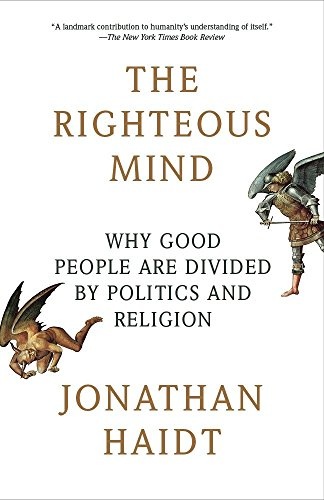
The Righteous Mind: Why Good People Are Divided by Politics and Religion
About this book
Haidt describes the mind as an elephant and rider: intuition supplies most of the movement while conscious reasoning explains, redirects, or occasionally restrains it. Moral argument therefore fails when it addresses reasons without first understanding intuitions.
Moral Foundations Theory proposes several recurring concerns, including care, fairness, loyalty, authority, sanctity, and liberty. People and political cultures weight these concerns differently rather than dividing simply into moral and immoral camps.
The book then considers how humans become groupish through shared practices, identities, and sacred values. Cooperation can produce extraordinary trust inside a group while making disagreement from outside feel like contamination or betrayal.
The Righteous Mind is a work of moral psychology with a conciliatory political purpose. Readers may dispute the framework, but its practical invitation is clear: describe the moral world another person inhabits before assuming argument alone will move them.
Read a sample
5,053 words
Plain text
From the opening
Introduction
“Can we all get along?” That appeal was made famous on May 1, 1992, by Rodney King, a black man who had been beaten nearly to death by four Los Angeles police officers a year earlier. The entire nation had seen a videotape of the beating, so when a jury failed to convict the officers, their acquittal triggered widespread outrage and six days of rioting in Los Angeles. Fifty-three people were killed and more than seven thousand buildings were torched. Much of the mayhem was carried live; news cameras tracked the action from helicopters circling overhead. After a particularly horrific act of violence against a white truck driver, King was moved to make his appeal for peace.
King’s appeal is now so overused that it has become cultural kitsch, a catchphrase1 more often said for laughs than as a serious plea for mutual understanding. I therefore hesitated to use King’s words as the opening line of this book, but I decided to go ahead, for two reasons. The first is because most Americans nowadays are asking King’s question not about race relations but about political relations and the collapse of cooperation across party lines. Many Americans feel as though the nightly news from Washington is being sent to us from helicopters circling over the city, delivering dispatches from the war zone.
The second reason I decided to open this book with an overused phrase is because King followed it up with something lovely, something rarely quoted. As he stumbled through his television interview, fighting back tears and often repeating himself, he found these words: “Please, we can get along here. We all can get along. I mean, we’re all stuck here for a while. Let’s try to work it out.”
This book is about why it’s so hard for us to get along. We are indeed all stuck here for a while, so let’s at least do what we can to understand why we are so easily divided into hostile groups, each one certain of its righteousness.
People who devote their lives to studying something often come to believe that the object of their fascination is the key to understanding everything. Books have been published in recent years on the transformative role in human history played by cooking, mothering, war … even salt. This is one of those books. I study moral psychology, and I’m going to make the case that morality is the extraordinary human capacity that made civilization possible. I don’t mean to imply that cooking, mothering, war, and salt were not also necessary, but in this book I’m going to take you on a tour of human nature and history from the perspective of moral psychology.
By the end of the tour, I hope to have given you a new way to think about two of the most important, vexing, and divisive topics in human life: politics and religion. Etiquette books tell us not to discuss these topics in polite company, but I say go ahead. Politics and religion are both expressions of our underlying moral psychology, and an understanding of that psychology can help to bring people together. My goal in this book is to drain some of the heat, anger, and divisiveness out of these topics and replace them with awe, wonder, and curiosity. We are downright lucky that we evolved this complex moral psychology that allowed our species to burst out of the forests and savannas and into the delights, comforts, and extraordinary peacefulness of modern societies in just a few thousand years.2 My hope is that this book will make conversations about morality, politics, and religion more common, more civil, and more fun, even in mixed company. My hope is that it will help us to get along.
BORN TO BE RIGHTEOUS
I could have titled this book The Moral Mind to convey the sense that the human mind is designed to “do” morality, just as it’s designed to do language, sexuality, music, and many other things described in popular books reporting the latest scientific findings. But I chose the title The Righteous Mind to convey the sense that human nature is not just intrinsically moral, it’s also intrinsically moralistic, critical, and judgmental.
The word righteous comes from the old Norse word rettviss and the old English word rihtwis, both of which mean “just, upright, virtuous.”3 This meaning has been carried into the modern English words righteous and righteousness, although nowadays those words have strong religious connotations because they are usually used to translate the Hebrew word tzedek. Tzedek is a common word in the Hebrew Bible, often used to describe people who act in accordance with God’s wishes, but it is also an attribute of God and of God’s judgment of people (which is often harsh but always thought to be just).
The linkage of righteousness and judgmentalism is captured in some modern definitions of righteous, such as “arising from an outraged sense of justice, morality, or fair play.”4 The link also appears in the term self-righteous, which means “convinced of one’s own righteousness, especially in contrast with the actions and beliefs of others; narrowly moralistic and intolerant.”5 I want to show you that an obsession with righteousness (leading inevitably to self-righteousness) is the normal human condition. It is a feature of our evolutionary design, not a bug or error that crept into minds that would otherwise be objective and rational.6
Continue reading the sampleClose the sample
Our righteous minds made it possible for human beings—but no other animals—to produce large cooperative groups, tribes, and nations without the glue of kinship. But at the same time, our righteous minds guarantee that our cooperative groups will always be cursed by moralistic strife. Some degree of conflict among groups may even be necessary for the health and development of any society. When I was a teenager I wished for world peace, but now I yearn for a world in which competing ideologies are kept in balance, systems of accountability keep us all from getting away with too much, and fewer people believe that righteous ends justify violent means. Not a very romantic wish, but one that we might actually achieve.
WHAT LIES AHEAD
This book has three parts, which you can think of as three separate books—except that each one depends on the one before it. Each part presents one major principle of moral psychology.
Part I is about the first principle: Intuitions come first, strategic reasoning second.7 Moral intuitions arise automatically and almost instantaneously, long before moral reasoning has a chance to get started, and those first intuitions tend to drive our later reasoning. If you think that moral reasoning is something we do to figure out the truth, you’ll be constantly frustrated by how foolish, biased, and illogical people become when they disagree with you. But if you think about moral reasoning as a skill we humans evolved to further our social agendas—to justify our own actions and to defend the teams we belong to—then things will make a lot more sense. Keep your eye on the intuitions, and don’t take people’s moral arguments at face value. They’re mostly post hoc constructions made up on the fly, crafted to advance one or more strategic objectives.
The central metaphor of these four chapters is that the mind is divided, like a rider on an elephant, and the rider’s job is to serve the elephant. The rider is our conscious reasoning—the stream of words and images of which we are fully aware. The elephant is the other 99 percent of mental processes—the ones that occur outside of awareness but that actually govern most of our behavior.8 I developed this metaphor in my last book, The Happiness Hypothesis, where I described how the rider and elephant work together, sometimes poorly, as we stumble through life in search of meaning and connection. In this book I’ll use the metaphor to solve puzzles such as why it seems like everyone (else) is a hypocrite9 and why political partisans are so willing to believe outrageous lies and conspiracy theories. I’ll also use the metaphor to show you how you can better persuade people who seem unresponsive to reason.
Part II is about the second principle of moral psychology, which is that there’s more to morality than harm and fairness. The central metaphor of these four chapters is that the righteous mind is like a tongue with six taste receptors. Secular Western moralities are like cuisines that try to activate just one or two of these receptors—either concerns about harm and suffering, or concerns about fairness and injustice. But people have so many other powerful moral intuitions, such as those related to liberty, loyalty, authority, and sanctity. I’ll explain where these six taste receptors come from, how they form the basis of the world’s many moral cuisines, and why politicians on the right have a built-in advantage when it comes to cooking meals that voters like.
Part III is about the third principle: Morality binds and blinds. The central metaphor of these four chapters is that human beings are 90 percent chimp and 10 percent bee. Human nature was produced by natural selection working at two levels simultaneously. Individuals compete with individuals within every group, and we are the descendants of primates who excelled at that competition. This gives us the ugly side of our nature, the one that is usually featured in books about our evolutionary origins. We are indeed selfish hypocrites so skilled at putting on a show of virtue that we fool even ourselves.
But human nature was also shaped as groups competed with other groups. As Darwin said long ago, the most cohesive and cooperative groups generally beat the groups of selfish individualists. Darwin’s ideas about group selection fell out of favor in the 1960s, but recent discoveries are putting his ideas back into play, and the implications are profound. We’re not always selfish hypocrites. We also have the ability, under special circumstances, to shut down our petty selves and become like cells in a larger body, or like bees in a hive, working for the good of the group. These experiences are often among the most cherished of our lives, although our hivishness can blind us to other moral concerns. Our bee-like nature facilitates altruism, heroism, war, and genocide.
Once you see our righteous minds as primate minds with a hivish overlay, you get a whole new perspective on morality, politics, and religion. I’ll show that our “higher nature” allows us to be profoundly altruistic, but that altruism is mostly aimed at members of our own groups. I’ll show that religion is (probably) an evolutionary adaptation for binding groups together and helping them to create communities with a shared morality. It is not a virus or a parasite, as some scientists (the “New Atheists”) have argued in recent years. And I’ll use this perspective to explain why some people are conservative, others are liberal (or progressive), and still others become libertarians. People bind themselves into political teams that share moral narratives. Once they accept a particular narrative, they become blind to alternative moral worlds.
(A note on terminology: In the United States, the word liberal refers to progressive or left-wing politics, and I will use the word in this sense. But in Europe and elsewhere, the word liberal is truer to its original meaning—valuing liberty above all else, including in economic activities. When Europeans use the word liberal, they often mean something more like the American term libertarian, which cannot be placed easily on the left-right spectrum.10 Readers from outside the United States may want to swap in the words progressive or left-wing whenever I say liberal.)
In the coming chapters I’ll draw on the latest research in neuroscience, genetics, social psychology, and evolutionary modeling, but the take-home message of the book is ancient. It is the realization that we are all self-righteous hypocrites:
Why do you see the speck in your neighbor’s eye, but do not notice the log in your own eye?… You hypocrite, first take the log out of your own eye, and then you will see clearly to take the speck out of your neighbor’s eye. (MATTHEW 7:3–5)
Enlightenment (or wisdom, if you prefer) requires us all to take the logs out of our own eyes and then escape from our ceaseless, petty, and divisive moralism. As the eighth-century Chinese Zen master Sen-ts’an wrote:
The Perfect Way is only difficult
for those who pick and choose;
Do not like, do not dislike;
all will then be clear.
Make a hairbreadth difference,
and Heaven and Earth are set apart;
If you want the truth to stand clear before you,
never be for or against.
The struggle between “for” and “against”
is the mind’s worst disease.11
I’m not saying we should live our lives like Sen-ts’an. In fact, I believe that a world without moralism, gossip, and judgment would quickly decay into chaos. But if we want to understand ourselves, our divisions, our limits, and our potentials, we need to step back, drop the moralism, apply some moral psychology, and analyze the game we’re all playing.
Let us now examine the psychology of this struggle between “for” and “against.” It is a struggle that plays out in each of our righteous minds, and among all of our righteous groups.
PART IIntuitions Come First,Strategic Reasoning Second
Central Metaphor
The mind is divided, like a rider on an elephant, and the rider’s job is to serve the elephant.
ONEWhere Does Morality Come From?
I’m going to tell you a brief story. Pause after you read it and decide whether the people in the story did anything morally wrong.
A family’s dog was killed by a car in front of their house. They had heard that dog meat was delicious, so they cut up the dog’s body and cooked it and ate it for dinner. Nobody saw them do this.
If you are like most of the well-educated people in my studies, you felt an initial flash of disgust, but you hesitated before saying the family had done anything morally wrong. After all, the dog was dead already, so they didn’t hurt it, right? And it was their dog, so they had a right to do what they wanted with the carcass, no? If I pushed you to make a judgment, odds are you’d give me a nuanced answer, something like “Well, I think it’s disgusting, and I think they should have just buried the dog, but I wouldn’t say it was morally wrong.”
OK, here’s a more challenging story:
A man goes to the supermarket once a week and buys a chicken. But before cooking the chicken, he has sexual intercourse with it. Then he cooks it and eats it.
Once again, no harm, nobody else knows, and, like the dog-eating family, it involves a kind of recycling that is—as some of my research subjects pointed out—an efficient use of natural resources. But now the disgust is so much stronger, and the action just seems so … degrading. Does that make it wrong? If you’re an educated and politically liberal Westerner, you’ll probably give another nuanced answer, one that acknowledges the man’s right to do what he wants, as long as he doesn’t hurt anyone.
But if you are not a liberal or libertarian Westerner, you probably think it’s wrong—morally wrong—for someone to have sex with a chicken carcass and then eat it. For you, as for most people on the planet, morality is broad. Some actions are wrong even though they don’t hurt anyone. Understanding the simple fact that morality differs around the world, and even within societies, is the first step toward understanding your righteous mind. The next step is to understand where these many moralities came from in the first place.
THE ORIGIN OF MORALITY (TAKE 1)
I studied philosophy in college, hoping to figure out the meaning of life. After watching too many Woody Allen movies, I had the mistaken impression that philosophy would be of some help.1 But I had taken some psychology courses too, and I loved them, so I chose to continue. In 1987 I was admitted to the graduate program in psychology at the University of Pennsylvania. I had a vague plan to conduct experiments on the psychology of humor. I thought it might be fun to do research that let me hang out in comedy clubs.
A week after arriving in Philadelphia, I sat down to talk with Jonathan Baron, a professor who studies how people think and make decisions. With my (minimal) background in philosophy, we had a good discussion about ethics. Baron asked me point-blank: “Is moral thinking any different from other kinds of thinking?” I said that thinking about moral issues (such as whether abortion is wrong) seemed different from thinking about other kinds of questions (such as where to go to dinner tonight), because of the much greater need to provide reasons justifying your moral judgments to other people. Baron responded enthusiastically, and we talked about some ways one might compare moral thinking to other kinds of thinking in the lab. The next day, on the basis of little more than a feeling of encouragement, I asked him to be my advisor and I set off to study moral psychology.
In 1987, moral psychology was a part of developmental psychology. Researchers focused on questions such as how children develop in their thinking about rules, especially rules of fairness. The big question behind this research was: How do children come to know right from wrong? Where does morality come from?
There are two obvious answers to this question: nature or nurture. If you pick nature, then you’re a nativist. You believe that moral knowledge is native in our minds. It comes preloaded, perhaps in our God-inscribed hearts (as the Bible says), or in our evolved moral emotions (as Darwin argued).2
But if you believe that moral knowledge comes from nurture, then you are an empiricist.3 You believe that children are more or less blank slates at birth (as John Locke said).4 If morality varies around the world and across the centuries, then how could it be innate? Whatever morals we have as adults must have been learned during childhood from our own experience, which includes adults telling us what’s right and wrong. (Empirical means “from observation or experience.”)
But this is a false choice, and in 1987 moral psychology was mostly focused on a third answer: rationalism, which says that kids figure out morality for themselves. Jean Piaget, the greatest developmental psychologist of all time, began his career as a zoologist studying mollusks and insects in his native Switzerland. He was fascinated by the stages that animals went through as they transformed themselves from, say, caterpillars to butterflies. Later, when his attention turned to children, he brought with him this interest in stages of development. Piaget wanted to know how the extraordinary sophistication of adult thinking (a cognitive butterfly) emerges from the limited abilities of young children (lowly caterpillars).
Piaget focused on the kinds of errors kids make. For example, he’d put water into two identical drinking glasses and ask kids to tell him if the glasses held the same amount of water. (Yes.) Then he’d pour the contents of one of the glasses into a tall skinny glass and ask the child to compare the new glass to the one that had not been touched. Kids younger than six or seven usually say that the tall skinny glass now holds more water, because the level is higher. They don’t understand that the total volume of water is conserved when it moves from glass to glass. He also found that it’s pointless for adults to explain the conservation of volume to kids. The kids won’t get it until they reach an age (and cognitive stage) when their minds are ready for it. And when they are ready, they’ll figure it out for themselves just by playing with cups of water.
In other words, the understanding of the conservation of volume wasn’t innate, and it wasn’t learned from adults. Kids figure it out for themselves, but only when their minds are ready and they are given the right kinds of experiences.
Piaget applied this cognitive-developmental approach to the study of children’s moral thinking as well.5 He got down on his hands and knees to play marbles with children, and sometimes he deliberately broke rules and played dumb. The children then responded to his mistakes, and in so doing, they revealed their growing ability to respect rules, change rules, take turns, and resolve disputes. This growing knowledge came in orderly stages, as children’s cognitive abilities matured.
Piaget argued that children’s understanding of morality is like their understanding of those water glasses: we can’t say that it is innate, and we can’t say that kids learn it directly from adults.6 It is, rather, self-constructed as kids play with other kids. Taking turns in a game is like pouring water back and forth between glasses. No matter how often you do it with three-year-olds, they’re just not ready to get the concept of fairness,7 any more than they can understand the conservation of volume. But once they’ve reached the age of five or six, then playing games, having arguments, and working things out together will help them learn about fairness far more effectively than any sermon from adults.
This is the essence of psychological rationalism: We grow into our rationality as caterpillars grow into butterflies. If the caterpillar eats enough leaves, it will (eventually) grow wings. And if the child gets enough experiences of turn taking, sharing, and playground justice, it will (eventually) become a moral creature, able to use its rational capacities to solve ever harder problems. Rationality is our nature, and good moral reasoning is the end point of development.
Rationalism has a long and complex history in philosophy. In this book I’ll use the word rationalist to describe anyone who believes that reasoning is the most important and reliable way to obtain moral knowledge.8
Piaget’s insights were extended by Lawrence Kohlberg, who revolutionized the study of morality in the 1960s with two key innovations.9 First, he developed a way to quantify Piaget’s observation that children’s moral reasoning changed over time. He created a set of moral dilemmas that he presented to children of various ages, and he recorded and coded their responses. For example, should a man named Heinz break into a drugstore to steal a drug that would save his dying wife? Should a girl named Louise reveal to her mother that her younger sister had lied to the mother? It didn’t much matter whether the child said yes or no; what mattered were the reasons children gave when they tried to explain their answers.
Kohlberg found a six-stage progression in children’s reasoning about the social world, and this progression matched up well with the stages Piaget had found in children’s reasoning about the physical world. Young children judged right and wrong by very superficial features, such as whether a person was punished for an action. (If an adult punished the act, then the act must have been wrong.) Kohlberg called the first two stages the “pre-conventional” level of moral judgment, and they correspond to the Piagetian stage at which kids judge the physical world by superficial features (if a glass is taller, then it has more water in it).
But during elementary school, most children move on to the two “conventional” stages, becoming adept at understanding and even manipulating rules and social conventions. This is the age of petty legalism that most of us who grew up with siblings remember well (“I’m not hitting you. I’m using your hand to hit you. Stop hitting yourself!”). Kids at this stage generally care a lot about conformity, and they have great respect for authority—in word, if not always in deed. They rarely question the legitimacy of authority, even as they learn to maneuver within and around the constraints that adults impose on them.
After puberty, right when Piaget said that children become capable of abstract thought, Kohlberg found that some children begin to think for themselves about the nature of authority, the meaning of justice, and the reasons behind rules and laws. In the two “post-conventional” stages, adolescents still value honesty and respect rules and laws, but now they sometimes justify dishonesty or law-breaking in pursuit of still higher goods, particularly justice. Kohlberg painted an inspiring rationalist image of children as “moral philosophers” trying to work out coherent ethical systems for themselves.10 In the post-conventional stages, they finally get good at it. Kohlberg’s dilemmas were a tool for measuring these dramatic advances in moral reasoning.
THE LIBERAL CONSENSUS
Mark Twain once said that “to a man with a hammer, everything looks like a nail.” Once Kohlberg developed his moral dilemmas and his scoring techniques, the psychological community had a new hammer, and a thousand graduate students used it to pound out dissertations on moral reasoning. But there’s a deeper reason so many young psychologists began to study morality from a rationalist perspective, and this was Kohlberg’s second great innovation: he used his research to build a scientific justification for a secular liberal moral order.
Kohlberg’s most influential finding was that the most morally advanced kids (according to his scoring technique) were those who had frequent opportunities for role taking—for putting themselves into another person’s shoes and looking at a problem from that person’s perspective. Egalitarian relationships (such as with peers) invite role taking, but hierarchical relationships (such as with teachers and parents) do not. It’s really hard for a child to see things from the teacher’s point of view, because the child has never been a teacher. Piaget and Kohlberg both thought that parents and other authorities were obstacles to moral development. If you want your kids to learn about the physical world, let them play with cups and water; don’t lecture them about the conservation of volume. And if you want your kids to learn about the social world, let them play with other kids and resolve disputes; don’t lecture them about the Ten Commandments. And, for heaven’s sake, don’t force them to obey God or their teachers or you. That will only freeze them at the conventional level.
Kohlberg’s timing was perfect. Just as the first wave of baby boomers was entering graduate school, he transformed moral psychology into a boomer-friendly ode to justice, and he gave them a tool to measure children’s progress toward the liberal ideal. For the next twenty-five years, from the 1970s through the 1990s, moral psychologists mostly just interviewed young people about moral dilemmas and analyzed their justifications.11 Most of this work was not politically motivated—it was careful and honest scientific research. But by using a framework that predefined morality as justice while denigrating authority, hierarchy, and tradition, it was inevitable that the research would support worldviews that were secular, questioning, and egalitarian.
AN EASIER TEST
If you force kids to explain complex notions, such as how to balance competing concerns about rights and justice, you’re guaranteed to find age trends because kids get so much more articulate with each passing year. But if you are searching for the first appearance of a moral concept, then you’d better find a technique that doesn’t require much verbal skill. Kohlberg’s former student Elliot Turiel developed such a technique. His innovation was to tell children short stories about other kids who break rules and then give them a series of simple yes-or-no probe questions. For example, you tell a story about a child who goes to school wearing regular clothes, even though his school requires students to wear a uniform. You start by getting an overall judgment: “Is that OK, what the boy did?” Most kids say no. You ask if there’s a rule about what to wear. (“Yes.”) Then you probe to find out what kind of rule it is: “What if the teacher said it was OK for the boy to wear his regular clothes, then would it be OK?” and “What if this happened in another school, where they don’t have any rules about uniforms, then would it be OK?”
Turiel discovered that children as young as five usually say that the boy was wrong to break the rule, but that it would be OK if the teacher gave permission or if it happened in another school where there was no such rule. Children recognize that rules about clothing, food, and many other aspects of life are social conventions, which are arbitrary and changeable to some extent.12
But if you ask kids about actions that hurt other people, such as a girl who pushes a boy off a swing because she wants to use it, you get a very different set of responses. Nearly all kids say that the girl was wrong and that she’d be wrong even if the teacher said it was OK, and even if this happened in another school where there were no rules about pushing kids off swings. Children recognize that rules that prevent harm are moral rules, which Turiel defined as rules related to “justice, rights, and welfare pertaining to how people ought to relate to each other.”13
In other words, young children don’t treat all rules the same, as Piaget and Kohlberg had supposed. Kids can’t talk like moral philosophers, but they are busy sorting social information in a sophisticated way. They seem to grasp early on that rules that prevent harm are special, important, unalterable, and universal. And this realization, Turiel said, was the foundation of all moral development. Children construct their moral understanding on the bedrock of the absolute moral truth that harm is wrong. Specific rules may vary across cultures, but in all of the cultures Turiel examined, children still made a distinction between moral rules and conventional rules.14
Turiel’s account of moral development differed in many ways from Kohlberg’s, but the political implications were similar: morality is about treating individuals well. It’s about harm and fairness (not loyalty, respect, duty, piety, patriotism, or tradition). Hierarchy and authority are generally bad things (so it’s best to let kids figure things out for themselves). Schools and families should therefore embody progressive principles of equality and autonomy (not authoritarian principles that enable elders to train and constrain children).