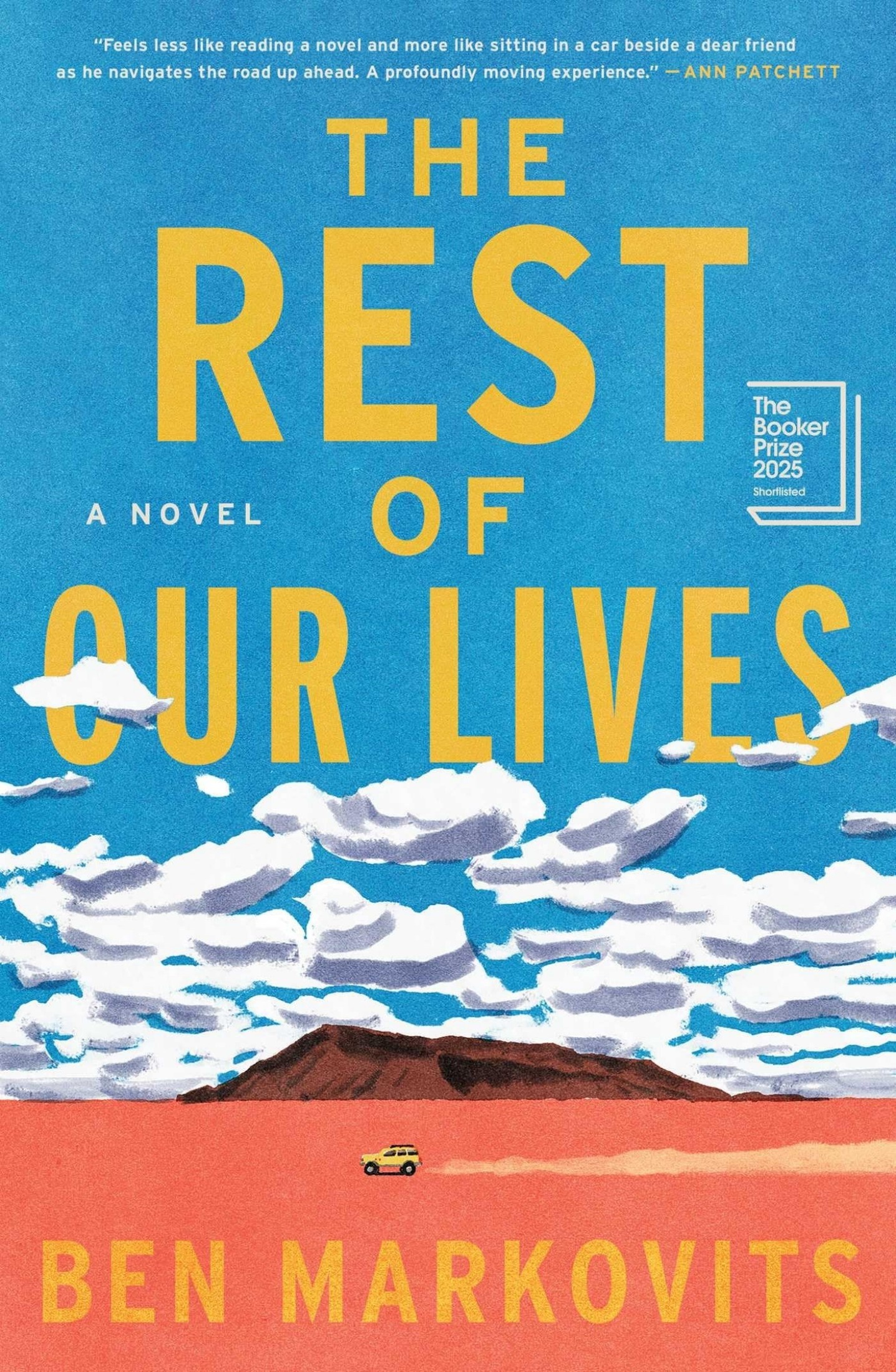
The Rest of Our Lives
About this book
Tom Layward has spent years inside a marriage marked by his wife’s earlier affair and by the ordinary responsibilities that made an immediate ending impossible. The date he privately chose for departure arrives when the family is older and the grievance is no longer simple.
His trip moves through reunions, friends, relatives, accidents, and places that return his American past in inconvenient forms. Freedom becomes less a decisive break than a series of encounters with the person he has been while waiting for it.
The novel is attentive to money, ageing, parenthood, illness, and the comic failures of self-knowledge. Tom can explain his dissatisfaction fluently, but movement keeps revealing obligations that explanation alone has not settled.
The Rest of Our Lives is a road novel and a late-middle-age marriage story by Ben Markovits. It asks what remains of a long-promised second act after the first act has become an entire shared life.
Read a sample
5,000 words
Plain text
From the opening
I
When our son was twelve years old, my wife had an affair with a guy called Zach Zirsky, whom she knew from synagogue. He was a little younger, three or four years, had three boys, all younger than our two kids, but was in some sense in the same position as my wife—they both had partners who made good money, which meant they didn’t have to do much and got bored and restless and maybe even depressed. Zach’s wife was head of oncology at Westchester County. I saw Zach touch Amy’s hand under the foldout table at the Purim food bank drive, under the paper cloth. He was short, about five-eight, broad-shouldered and dark. He wore linen shirts open at the chest; his chest hair had started going gray. On Sundays, he played guitar for the kids at Temple Beth and taught them Jewish songs, like “Spin Spin Sevivon”—very pro-Israel, in a tree-planting, happy-clappy way. He was the kind of guy who danced with all the old ladies and little pigtailed girls at a bar mitzvah, so he could also put his arm around the pretty mothers and nobody would complain. Even before I saw them holding hands I didn’t like him.
My parents are Catholic but my dad thought religion was just a big fancy dress party, and he hated fancy dress. Maybe 2this is why I never got involved in the synagogue, which meant Amy had a whole social network where she had an identity and I didn’t.
She told me about Zach after I already knew and after it was already over. Amy had highly developed guilt feelings, which were so strong she couldn’t help being mad at whoever she felt guilty toward. Which was often me. She said she wanted to make me mad, too; she just wanted some kind of reaction, that’s all she was looking for, but that’s not really my style. If there’s something you can do to fix something, I try to do it. But in this case, I wasn’t sure what. She said, you don’t feel anything about anything. I said, everything I do I do for you and the kids. Nothing else matters to me.
So what do you want to do? I asked her. Do you want a divorce?
But she didn’t want that. At least, not until the kids had left home—the home and the kids were all she had to show for the last twelve years of her life. The thing with Zach didn’t mean anything. It was more like a kind of self-harm. (She knew that I knew that when she was a teenager she used to cut herself on the thigh.) A bid for attention. But Amy’s a person who tells stories about her motives and actions, which are very persuasive, to her as well, so it’s sometimes hard to talk about or even work out what’s really going on.
You fall in love with somebody when you’re twenty-six, and you see them in all kinds of different lights and according to their potential, but after years and years of marriage and shared parenting and all the other shared decisions you have 3to make just to get through the days, you accumulate a lot of data about that person that after a while just seems … more or less accurate. If you continue to have illusions, that’s your fault. So if you stay married it’s because you’ve accepted that this is what they’re like, and what your life with them is like, and you stop expecting them to do or give you things you know perfectly well they’re unlikely to do or give you. It’s like being a Knicks fan.
But I also made a deal with myself. When Miriam goes to college, you can leave, too. Maybe this was just another one of those illusions, but it helped me get through the first few months after Amy told me about Zach, and for the sake of the kids we had to pretend that everything was fine. When in fact what we obviously had, even when things smoothed over, was a C-minus marriage, which makes it pretty hard to score much higher than a B overall on the rest of your life.
*
Twelve years later, Miriam turned eighteen. We spent the first few weeks of August on Cape Cod. Amy’s family had a house in Wellfleet, which you had to book a year in advance; and even then there was a lot of overlapping and arguing about beds. It had a studio in the yard where you could potentially sleep as many people as you had mattresses for, and for that reason, in one corner there was a pile of old mattresses under the eaves. If you didn’t mind sharing a bathroom or walking out in the morning to take a leak off the deck. Normally I stayed in the city and came up only on the weekends, but it was Miriam’s last summer at home, so I took two weeks off.4
Amy’s big brother Richard had the main house with his new wife—they had a new baby. His other two kids were in their thirties, one of them had a baby of her own. That’s why they got the house and we got the studio, which seemed reasonable to me, although Amy thought it was just another example of how her family prioritized Richard. Her dad, whom she idolized, had died years ago, when Amy was still in high school. Her relationship with her mother was more complicated. Anyway, one of the funny little things that happened is that Esther (Amy’s mother) let Richard and Kelsey stay in the master bedroom, which had the only en suite, even though in the past when we shared the house with Esther, she insisted on sleeping in her own room. That’s because Tom only came for the weekend, she explained. (I’m Tom.)
Continue reading the sampleClose the sample
So on some level of course it was my fault.
But there are too many Naftalis to keep track of them all, and most of them don’t matter to this story.
*
I met Amy in grad school in Boston. She was doing her Master’s in Education, while I was in my third year of a PhD on the sixties American novel—just at the point where you have to start writing, so I fantasized about dropping out and going to law school. Amy was actually dating a friend of mine, Ethan Konchar, until he won a fellowship to the Max Planck Institute in Göttingen. The farewell party was at his apartment in Somerville, which he shared with another grad-school buddy, Sam Tierney. 5
Amy was an unusually beautiful woman but also nice about it. Her strategy was just to like, keep still, so she didn’t give off false flares; but naturally it meant she also drew a lot of attention. People at the party kept commiserating with her, because Ethan was going away, and she’s the kind of person who wants to please people by acting and feeling what they expect her to feel. That night she got stuck in the kitchen, where the drinks were, and people came up to her and said things like, When are you going to see him again? At that point it still wasn’t clear if they were staying together. She’s about five-ten, with terrific posture—for most of her childhood she wanted to be a ballerina, but then got too big. Amy doesn’t actually look particularly Jewish. She has long brown curly hair, which she wears past her shoulders, and a strong handsome Waspy face. She even modeled for a wristwatch company in college; she looks like the kind of woman who can ride a horse, which she actually can. For her last two years of high school she went to Brearley, after her dad died and they moved back to New York.
I got her number from Ethan and called a few weeks after the party to see how she was doing. He said they’d split up, but even when we started dating she felt like she was cheating on him, which made the first few months much more intense than with anybody else I ever went out with. It was a big deal for her, when she invited me to the Cape before Christmas.
In those days I still felt like the older guy—I was twenty-six, she was twenty-three. I had a car, a Toyota Corolla I bought by working as a customer service agent for Alaska 6Airlines. I used to spend weekends out at Logan: from curb to cabin, that was my responsibility. We drove out on Route 6, while the continent narrowed around us, and even though it was about twenty degrees outside (but bright, icy winter sunshine), she made me stop at the Wellfleet Dairy Bar and Mini-Golf. Though of course it was closed, out of season; she just wanted to show me. Every summer before they went up to the house, her dad pulled over to buy them ice creams. This was my first real contact with the little childish rituals rich people have toward some of the blessings in their lives.
So when we got to the house, before unpacking, we had to walk down to the beach. You reached it from a steep wooden staircase, then stumbled across the marram grass to the water. Like I said, it was twenty degrees, about three in the afternoon. This was on the Bay side, though I didn’t really understand the geography. There was a little old snow on the dunes, but not much wind—the sea looked like a sea.
Amy was very very happy to be there. In schoolgirl mode, but very very happy. The house itself, when I was finally allowed to look around, turned out to be totally charming. The Naftalis first moved there in the thirties. Amy’s grandfather knew Hayden Walling, who built a lot of the houses in Wellfleet, and extended theirs, which started out as a traditional Cape Cod. Walling added a wing and a second floor. None of it matched, but everything blended together. You know the kind of thing, old rugs, Shaker furniture … I didn’t at the time. I thought, this is the kind of life I want to inherit. 7
The basic style was utilitarian chic. In the kitchen, instead of using cupboards, pots and pans hung from hooks on the wall. The sink was under the window, with a view of the Bay. Boards creaked underfoot. There weren’t any curtains downstairs, so you got big slabs of light lying at odd angles over the floor and leaning on the walls, from the low sun. But there was also a lot of accumulated family history, including a strange little birdman painting by Max Ernst. Amy pointed it out. “The one thing that’s actually worth something,” she said. “Dad met him.” On the wall over the dining-room table hung a row of head shots, of Amy’s grandfather and his three brothers—black-and-white studio portraits. All of them turned out to be highly successful people in different fields. Two of them made real money.
But there were also things like … one of Amy’s kindergarten pictures, glued bits of sea glass, and real sand and grass, and the sea painted in Crayola green. Framed and hung up at the foot of the stairs.
Amy was a late sleeper, until we had kids. I got up early to work but really just wandered around. The house had no central heating—they used rusty old gas-canister heaters, which had wheels and that you had to light with a match. I didn’t trust myself so made coffee and warmed my hands on that. Some of the sofas and chairs had wool blankets draped over them. The big wall of glass in the living room faced west, so in the morning it was all in shade.
We stayed a week, before her brother came with his first wife. But there was no overlap. It snowed heavily halfway 8through and the roads only just cleared in time for us to drive back to Boston, where I dropped her off at her apartment and then drove on to Trenton, where my mother lived. On her own, so I always spent Christmas with her. Over the break I started studying for my LSATs and formally dropped out of grad school a few months later. By that point I was already in love with Amy and figured that for the kind of life we might want to have together I needed to make more money. But I didn’t want to write the book anyway.
*
Miri’s boyfriend came up for the weekend. His arrival provoked a lot of family discussion, I mean, among the Naftalis generally. For most of the year, they never called or wrote each other, but still, whenever they got together they had this sense of a shared culture or tradition to uphold, which made them seem closer than they were. Part of it was an old-fashioned prudish streak, which Amy had too, even though she sometimes rebelled against it.
In the end, Jim brought a tent and set it up in the yard, and we let Miri sneak out to join him even though officially she was still sleeping in the studio with us.
The weekend was not a total success. Jim was going to Harvard—he’d spent the summer interning at Apple Park, which meant that Miri basically thought of them as broken-up. She was happy to see him again to say goodbye but wanted to start her own college life (at Carnegie Mellon) with a clear deck. Anyway, he told a lot of stories about Cupertino. Everybody you met was relaxed but also 9incredibly smart and hardworking. That kind of thing, which annoyed Miri, though maybe there were other tensions going on; they bickered a lot. Amy hated this kind of public display, especially in front of her brother.
“Miriam,” she said, in her let’s-be-a-good-girl voice. “Play nicely.”
Once, she even apologized to Jim. “I’m sorry, Jim,” she said. “She gets it from her father. No, let me explain,” because she realized how that came across. “I mean, the Laywards don’t think you have to be polite to people you care about. Isn’t that true? That’s what you always say to me.”
“That’s true,” I said. And she was right, I didn’t mind.
Jim was actually a nice kid. He was only about five-eight but clean-cut and good-looking, and one of five finalists for Westchester/Putnam High School Wrestler of the Year. He didn’t win and took it all with good grace. (There was some kind of poll on social media, sponsored by the local paper, in which he came fourth.) It didn’t matter, you could tell where he was headed: Harvard, then San Francisco or Wall Street … by the end of his twenties he’d be making seven figures. I liked him, but I also thought, in high school there’s no way I’m friends with this kid. He always had a respectful attitude toward me, but I don’t think he saw law professor as his first-choice career.
One afternoon, there was a big family party at the Brinkmans’, old friends of Amy’s parents who had a house overlooking Slough Pond. This party was an end-of-summer tradition. People brought potluck, and there was a 10twenty-foot wooden table in the yard, with benches on either side, where everybody sat down to eat. The water was close enough you could almost jump in from the decking. Kids ran around, there was a dock and a boathouse, and Miri and Jim took some of the grandchildren out in a couple of canoes. Anyway, Jim started horsing around—he wanted Amy to race him, but then he pulled too hard and the canoe tipped over. The little Brinkman in his boat was only nine years old, but the water wasn’t cold and the kid could swim.
It wasn’t a big deal. They were only twenty feet from the shore, but for some reason Miri got upset with him, and they had a fight on the beach in front of everybody.
Amy said, “Tom, you have to step in.”
“Why me?”
“Because she resents me whenever I try to tell her anything.” Which was true.
“What do you want me to do?”
“I don’t know, but this can’t go on anymore.”
That kind of language always gets my back up, but I stood up anyway. “Hey, Miri. Hey, Jim,” I said, walking down the rotten wooden stairs. “Let’s keep it down a little, hey.”
“Butt out,” Miri said.
“I’m sorry, Mr. Layward. It was my fault—I used too much torque.”
“You were showing off.”
“Walk with me,” I said to Miri.
“I told you to butt out,” but in the end she came along, and Jim went back to the house to get changed.11
“Did Mom send you?” she asked.
“What does it matter?”
“She only cares about what it looks like.”
“It looks like you guys aren’t having much fun.”
There isn’t any path along the water, but you can walk into the trees and through the trees back up to the road, which is a very pretty road, with a few houses on it, mostly hidden by trees.
My daughter (I’m fairly convinced) is going to be a competent, reasonable adult, but at this stage she was caught up in her own concerns, which made her seem more selfish than she is. “He always has to win at everything,” she said. “Even if it’s not a competition, for him, it’s a competition. Which is fine, it’s what he’s like. But he thinks he can like, win me. Like, if we disagree about something, he just has to be more persuasive. I’m sorry,” she said. “I’ve probably told you this before.”
“That’s fine. People repeat themselves when they’re trying to work something out.”
But that was the wrong thing to say. “That’s not at all what’s going on. I told him, I love you, but you don’t want me hanging around your neck when you get to Harvard.”
“What’d he say to that?”
“I don’t know.”
“What’d he say?”
“I don’t know, Dad. Something like, that’s not how I think about it, or it doesn’t have to be like that … I don’t want to talk about it anymore.”12
It was about eighty degrees, just perfect coastal summer weather, the kind only rich people can afford. In the shade of the trees you almost felt chilly, but then you walked into a patch of sun. One of the things in life that I’m grateful for is that my daughter believes I totally adore her; that even when she screws up or gets something wrong, she has no real faults; that she has nothing to prove with me, which is not how she feels around her mother. But maybe this is what fathers always tell themselves. Amy says to me, “You think she opens up with you, but she doesn’t; she just tells you what she knows you want to hear.”
What do I want to hear? Not the stuff she tells me, but Amy thinks I have no idea what girls are like. The way they design their personalities to please other people, which is what she says she did. But Miri doesn’t actually care that much about other people; she’s more like me.
“There’s another way of looking at this,” I said to her. “Which is, that he’s not very good at paddling and fell in the water.”
“We have to fight about something. Otherwise it’ll be too hard on Monday.”
Monday he was driving back to New York so he could pack for Harvard.
“You don’t have to break up with him. People stick it out.”
“I’m not worried it’s the wrong decision or anything. I just have to make it through the next few days.”
Even before we returned to the Brinkmans’, she started texting Jim. Or texting somebody—that part of the Cape 13has very poor reception, so whenever we went anywhere with a signal, Miri pulled out her phone. I figured we had talked enough anyway; you could hear party sounds drifting through the trees. It was about four in the afternoon and just windy enough for the sun to dazzle a little when it hit the water. Apart from the phone, we might have been in any decade of the last fifty years. Sometimes around seaside resorts I get this half-remembered sense of myself as a young man who doesn’t know what’s going to happen with the rest of his life and doesn’t much care.
Lunch had been cleared away when we got back. At some point, Leslie Brinkman brought out two large apple strudels, which she had made herself, and cut them up on the long table. There were paper plates and a bowl of sour cream so people could help themselves. Then it was five o’clock, and Danny Brinkman, who was in his seventies, decided to make cocktails. His son carried the bar cart from the living room onto the deck, so he could wheel it around … sea breezes, old-fashioneds, he even put on an apron. What can I get you, sir? He had large, dry, arthritic hands that trembled when he tried to pick up ice from the bucket with rubber tongs.
I figured I might as well get drunk. Aside from other reasons, so Amy would have to stay sober enough to drive. These are the games you play. At parties we’re always quietly aware of each other but don’t interact much. Sometimes I see her talking to strangers, or people I don’t know, and she’s so … hemmed in by her … poise that she has nothing new or interesting to say. Even though she is still the most 14handsome woman at the party, people find excuses to get away from her, which is maybe why she started drinking more, although she usually regrets it afterward.
The first time Zach Zirsky talked to her, at someone’s bar mitzvah, or the first time I noticed them talking, I remember being pleased for Amy, because it gave her a buzz to be flirted with. He has a manner that people sometimes get praised for, of treating you like you’re the only person in the room, which always seems creepy to me. But fine, what do I care. It’s nice for her to get a little attention.
Later, I asked her how it started. Who made the first move. She said, I invited him to lunch. Zach was a freelance filmmaker, which can mean almost anything. Amy, after she gave up teaching, had a lot of ideas about educational documentaries, where you basically have a captive audience, which is why the standard is often so low. So he offered to talk her through these ideas. He said he could put her in touch with a few people. Have you ever done any acting? Oh, no, I can’t be on camera, I’m much too self-conscious, etc. This is how I imagine their conversations. Amy said, he was always very supportive of me. He was very supportive of your adultery, I said. Don’t turn it all into something like that. Even after it was over … he thought I had something to offer, that I wasn’t getting the chance … to use all of myself …
But she knows I hate it when people talk like that.
It used to be when I drank I talked more, now I talk less. Miri had one of the babies in her arms, I couldn’t tell them apart, maybe Uncle Richard’s kid. She was trying to get him 15to sleep, which was also a strategy for preoccupying herself so Jim had to leave her alone. At a certain stage, if you’re not talking, and are feeling generally out of the picture, you become sensitive to things like that. I felt sad for my kid, who had to learn to protect herself because Jim was going away. Of course, she was going away too, and I hadn’t protected myself against that.
Later, I found myself in a group with Danny Brinkman and his son Jeffrey, who teaches economics at Rindge and Latin, and my impression is has a pretty nice life. He works as a public high school teacher but lives in a big house off Porter Square and spends his summers in places like this. Anyway, he was telling stories about one of his students, who was sometimes a she and sometimes a he, and Jeffrey couldn’t work out if this was supposed to be apparent to him, because they sometimes wore short skirts to class and sometimes big jeans, big shirt, etc.
“For which we used to have a very good word, which nobody uses anymore,” I said.
“Which is what?” Jeffrey asked. “The truth is, I like this kid a lot. They seem free from some of the stupid stuff I had to wrestle with at their age. Part of me is just jealous.”
“Transvestite.”
“Come on, Dad,” Miri said. It was around seven o’clock, and the sun was going down across the water and in my eyes.
“You know they’ve … we’re supposed to add a line under our university emails, which says like, he/his/him, which I refuse to do. So I got an email from the compliance officer.”16
“There’s no such thing as a compliance officer,” Miri said.
“Anyway, I started signing off with he/I/mine. So I get another email and have to explain myself. I don’t like being referred to in the accusative. It literally objectifies I.”
“He didn’t say this. He didn’t do any of these things.”
“How do you know?” I said, putting my arm around Miri. “How do you know what I get up to when you’re not around?”
But Amy had joined us now—we were heading home.
“What’s he getting up to?” she said.
“Nothing, Dad’s just talking.”
“I never talk when I’m drunk, I become very observant.”
“Angry white male,” Miri said. This is what she calls me, when she thinks I’m trying to be controversial.
Jim was there, too. He was wearing someone else’s clothes, which were too big for him and made him look like a different person. Not like a Harvard guy at all.
“How come you never hear me raise my voice,” I said. “If I’m so angry? Explain that—how come I’m always the mildest-mannered guy in the room?”
“Come on, Dad.”
“Thank you for the shirt, Mr. Brinkman,” Jim said. “I’m sorry about the boat.”
“Don’t worry about it,” Jeffrey said. “These things happen.”
It was quiet in the car on the way home—the drive only takes ten minutes. When we got in, Miri went straight to the fridge to see what she could eat. “Didn’t you have anything at the party?” Amy said. 17
“That was like, three hours ago …”
“I’m so full I have to lie down.”
“Fine, lie down. Does that mean there are literally no plans for dinner?”
Richard was already back, helping to put the baby to bed; so all of these conversations took place while several other things were going on. Vicky, his daughter from the first marriage, who now edited a political blog in D.C., said, “We thought we’d order pizza.”
“There is no good pizza around here,” Steve said. Steve was married to Lisa, Richard’s other daughter. They had a baby to deal with, too; Lisa was giving him a bath. You could hear the water running, even from the kitchen.
“What about JBs?”
“They closed last year. And they weren’t good.”
“Don’t be such a snob …”
And so on. Vicky and Steve had their own independent relationship; he worked for the ACLU. They liked to talk politics together.
Eventually Amy said, “Well, I’m so full from all that strudel, I don’t think I can eat anything else.”
“We can go to CShore, but that means somebody has to drive.”
“I can drive,” I said, but Miri told me, “You’re drunk.”
In the end, they ordered Papa Gino’s and sat around the dining table playing Bullshit, just the four of them—Jim and Miri and Steve and Vicky. Amy lay down and I went for a walk around the block, with a beer. Sometimes just your presence as 18a slightly sadder older guy changes the dynamic. But it was nice to see Miri sitting around with her cousins. By the time I came back, Lisa was downstairs too, eating cold pizza; Miri and Jim seemed to be getting along. I left them to it.
Later, back in the studio, when Miri came in to get her stuff before sneaking out to the tent, Amy said to her, “Do you know about the freshman fifteen?”
“What do you mean, do I know?”
“It’s just something you have to watch out for, that’s all. You’re not biologically a child anymore, where it doesn’t matter what you eat because you’re still growing.”
“Is this supposed to be some kind of coded conversation?”
“I just want to make sure you can look out for yourself,” Amy said, “before we let you go.”
For some reason she was close to tears.
“Is that your big maternal advice? Don’t get fat?”
“That’s not what I’m saying at all. Tom, do you want to say something?”
“Everybody else was eating pizza too.”
“What do you want me to say?” I said.
“Not Lisa.”
“What do you mean, not Lisa? She came down and had three slices.”
“Well, she’s breastfeeding,” Amy said. “I was like that too. You can eat anything and still lose weight.”
“Oh my God.” Miri stared at me, making a face. “Am I fat?”
“You look good to me,” I said.19
The truth is, she had put on a few pounds over the summer, but I didn’t think it mattered.