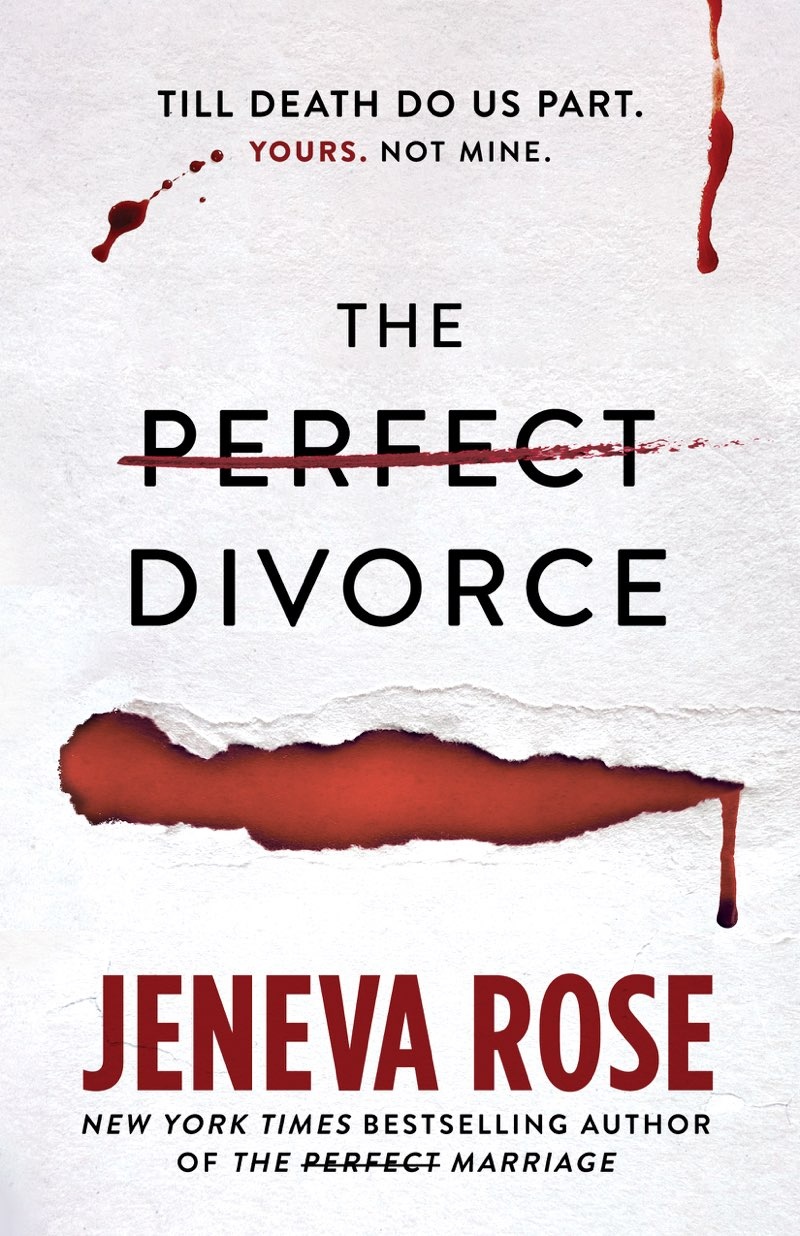
The Perfect Divorce
About this book
Sarah Morgan and Adam’s marriage ended under circumstances that already attracted scrutiny. Years later, a development in the old case and a fresh disappearance force lawyers, investigators, and former partners to reconsider what each person concealed.
Divorce has given the pair distance but not freedom from the record they created together. Messages, testimony, and strategic omissions can be read as self-protection or premeditation depending on who controls the sequence.
Jeneva Rose uses alternating suspicion to keep legal performance and private motive aligned. The characters know how a convincing story is constructed, which makes every apparent confession another opportunity to manipulate the audience.
The Perfect Divorce continues the story begun in The Perfect Marriage. It is best read as a sequel, since its reversals depend on the earlier trial, the marriage, and what readers believed about both.
Read a sample
5,026 words
Plain text
From the opening
ONE
SARAH MORGAN
I knew when I married Bob, I would divorce him one day, because men are like lawyers. They can’t be trusted. And I would know because I am one . . . and so is he. My husband sits across from me at a conference table made for twenty, but there are only four of us in this room today: myself, Bob, and our respective lawyers. I’m trying not to look at the man I spent the last twelve years with. However, I can feel his dark eyes on me, so I meet his gaze just to make him look away. The top two buttons on his starched white shirt are undone, and his tie hangs loosely around his neck. Despite the cool temperature of the room, droplets of sweat cling to his hairline.
“My client is interested in reconciliation.” Brad pushes up the sleeve of his jacket, showing off a solid-gold Rolex Day-Date. It’s like he’s trying to say, Look how good of a lawyer I am. He sports slick blond hair and a clean-shaven face, the complete opposite of my husband’s dark locks and five-o’clock shadow. Brad is Bob’s lawyer, longtime friend, and full-time slimeball. He’s known for cutting corners to get the results he wants, which is fine because so am I.
“That’s out of the question,” Jess says firmly. She cocks her head and sits up a little taller in her chair. Jess is my lawyer, and she does everything by the book. The yin to my yang.
“Sarah, it was one time.” Bob clenches his jaw and rubs harshly at his brow as though he’s trying to wake himself from a bad dream. But this is our life now, our reality, and he’s the one that put us here. “I promise,” he adds. “It was just one time.”
Isn’t that what they all say? It was only one time. It was an accident, an error of judgment, something completely out of character, something they’ll never do again. It didn’t mean anything. She didn’t mean anything. Yeah, that is what they all say, but only once they get caught. They’re not sorry for what they’ve done. They’re sorry that you know what they’ve done. And Bob’s no different. He’s just like the rest of them.
Brad gives him a knowing look and slightly shakes his head, signaling for him to stop talking. I can tell it’s hard for Bob to be the client and not the lawyer, but he concedes—letting out a deep sigh as he leans back in his chair and folds his arms over his chest.
“I’d like to reiterate that my client accepts full responsibility for his major error in judgment and has agreed to attend six counseling sessions in order to move forward with reconciliation,” Brad says, steepling his hands in front of his face. Streaks of sunlight pierce through the partially open blinds, glinting off his Rolex, making a kaleidoscope of light dance across the wall each time he tilts his wrist.
“Your client should have attended counseling sessions before his infidelity.” Jess purses her lips and slowly slides a piece of paper across the table. “These are Ms. Morgan’s demands.”
Bob uncrosses his arms and leans forward, snapping up the paper before his lawyer can. He narrows his eyes and puckers his forehead as he scans the page. I can tell he’s not liking what he’s reading, which is exactly the point.
“Absolutely not,” Bob scoffs, flinging the paper. Brad catches it as it’s still floating in the air and smooths the sheet out on the table.
“We believe it’s a fair offer,” Jess says.
Brad lifts his head and stares back at her. “My client is not giving up custody of his daughter. He’s also not relinquishing his seat on the Morgan Foundation board, nor his stake in the charity.”
“I’m not giving up on us . . . period,” Bob pleads. He extends his hand toward me, hoping I’ll meet him halfway, but I don’t reach for it. Instead, I remove my hands from the table and fold them in my lap.
“Sarah, please,” he adds.
I bite my tongue to stop myself from responding because I know silence hurts him more than any quip I could ever possibly make. And I want to hurt him as much as he’s hurt me.
“My client has no interest in reconciling the marriage,” Jess clarifies.
Brad leans over to Bob and speaks in hushed whispers. Bob’s face grows more upset with each word. His skin flushes, and his sharp jawline becomes even more prominent as he grinds his teeth.
When they finish with their little chat, Brad clears his throat and straightens in his chair. “Since we don’t seem to be making any progress, I think we should reconvene at a later date.”
“These meetings are not intended to repair the marriage, nor will they, Brad. The only progress we should be making is coming to an agreement on the division of assets and custody of Summer. I’d like to reiterate that Ms. Morgan requested a clean, quick, and private divorce. We do not wish for this to be dragged out, nor for it to be disputed in court, but we will if we have to,” Jess says, her mouth forming into a hard line.
And with that, I stand from my seat, smoothing out my skirt and rebuttoning my blazer.
“Noted,” Brad says, packing up his briefcase, an ostentatious and garish orange Hermès piece. “I’ll have my assistant reach out to set up another meeting.”
Continue reading the sampleClose the sample
Bob rises to his feet and meets my gaze. He’s a foot taller than me with wide shoulders and a toned physique. The salt-and-pepper look really works on him, same with the stress wrinkles lightly etched into his forehead. He appears wise and distinguished even though he doesn’t act like it.
“I’ll give you a call later, Sarah,” Jess says as I start toward the door.
I pause and acknowledge her before leaving the room.
“Sarah, wait,” Bob calls out, trailing close behind me.
I keep walking, ignoring him entirely—but then, all of a sudden, a hand is on my shoulder, stopping me in my tracks. My heart hammers against my rib cage.
“Please,” he adds.
I let out a heavy sigh and turn to face my husband. I can barely even see him standing in front of me because he’s already a part of my past. He just doesn’t realize it yet, and I don’t know how I can make it any clearer.
“What?” I ask.
There’s no emotion in my voice because anything I felt for my husband vanished the instant I learned of his infidelity.
“Please don’t do this,” Bob says in a strained whisper.
His eyes frantically search mine, like they’re trying to lock us back in place. But there’s no place in the world for us anymore because I can’t be married to someone I don’t trust. To me trust is like glass. Once you break it, you can’t put it back together—and even if you tried, you’d end up cutting yourself in the process. So, you may as well just throw it away.
“You’re lucky the worst thing I’m doing to you is divorcing you.” My words come out soft, almost soothing.
“Is that a threat?” he asks, his face turning incredulous.
“You know I don’t make threats, Bob.”
He furrows his brow and starts to puff out his chest, challenging me, but I’ve seen enough. I shake my head as I turn on my heel and walk toward the elevator. He calls out my name several times, his voice growing quieter as I put more distance between us—or maybe it’s just losing its conviction. Good. I hope that’s the case.
Bob is really testing my patience. All I wanted was a quick and quiet divorce—kind of like his affair, I suppose. But no, he has to fight me every step of the way because he thinks this is something we’ll be able to work through. It’s not, and deep down, Bob knows that too. I’ve tried to remain civil; I really have—for the sake of our daughter, who’s still blissfully unaware of our imminent divorce. I’ve put off telling her, wanting to wait until it’s a done deal and raw emotions have waned, so the focus can be on her and only her. I seem to be the only one that cares about our daughter’s feelings and well-being.
At the elevator, I press the Down button and wait for it to appear. I can still feel Bob’s presence, but I don’t look back. I truly wish things were different. They were supposed to be different. Parenthood is supposed to make you want to be a better person, or at the very least, make you think you’re a better person. Motherhood changed me just like I knew it would. But apparently, becoming a father did nothing for Bob. He didn’t only cheat on me. He cheated on our family. And he pretended to be something he’s not capable of being—decent.
The elevator dings and opens. I step inside, hit the Lobby button, and raise my chin, staring back at Bob. He stands at the end of the hallway, his eyes fixed on mine like we’re in the midst of a showdown. His face is a mixture of resentment and sorrow, but there’s a glimmer of something else, something I’ve seen before. I just can’t place it. Neither of us breaks eye contact until we’re forced to by the closing doors.
The elevator hums as it begins its descent, putting even more distance between us. We’ve been together for more than a decade but married for a little over a year. Bob’s lucky I’m not the same woman I was when I was with Adam, my first husband. If I had had children with Adam, maybe he’d still be around. Because, as I said, becoming a mother changed me, and I know they say people can’t change. They can though. At the core, we are who we are—but that doesn’t mean parts of us can’t soften or harden over time.
TWO
UNKNOWN
The room is so dark, not even shadows exist here. That’s the first thought I have when my body suddenly jerks and my eyes spring open. I blink several times, hoping they’ll adjust and find something familiar—but without light, there’s nothing. I hold my hand in front of my face, just inches from my nose, but it’s barely even visible, a gray figment that my mind hardly recognizes. The air is thick and damp, reeking of mildew and wet socks. I pull myself into a sitting position and press my hands down at my sides, feeling the slight give of a spring mattress. The coils sink under the pressure before rising back into place.
My head throbs, and a harsh wave of dizziness washes over me. I feel sick, like I could throw up at any moment. I rub my fingers against my temples, willing the memories to come back. But they won’t. They’re gone—maybe for now, maybe forever. What happened last night? Did I drink too much? Did I get my hands on some LSD or E again?
“Hello?” I call out into the void as I shift my weight and stand shakily.
The pads of my feet leave the thin mattress and settle onto a cold, hard surface. I take a cautious step forward, and that’s when I hear it—the sound of metal dragging across concrete. I try to move farther into the darkness, but my leg is jerked back abruptly. A sharp pain pricks at my ankle, the metal cuff digging into my skin.
“What the fuck?” I reach down and feel the cold shackle. The realization that it’s clamped around my ankle, locking me in place, brings on a sudden panic attack. My pulse races and my breaths come out quick and hard. I shiver despite sweat oozing from my pores. “No, no, no . . . help! Somebody help! Please!” The tears fall fast, and I scream until my throat is raw and all the air is out of my lungs.
Collapsing onto the mattress, I grab at the chain and yank and tug as hard as I can, shredding the skin on my hands in the process. “Come on, you piece of shit, let me go!” I scream, hoping there’s a weak link or that it’ll pull free from whatever it’s fastened to.
I crawl forward, following the chain to its source—a thick metal pole cemented into the concrete floor. Standing, I run my hands up the pole as high as I can. It must be a support beam that extends to the ceiling because I can’t reach the top of it. I return my attention to the chain, feeling my way along the length of it. Tethered like a satellite in orbit, I only have about six feet of slack to move in any direction.
With my hands out in front of me, I start to explore my surroundings. A wall appears, and I place a palm against it, following the coarse concrete until the chain cuffed around my ankle is pulled taut.
“Shit!” I grumble as my shin smacks into something hard. I lean down until the tips of my fingers touch it, feeling a smooth circular rim. It’s a bucket, a heavy-duty plastic one you’d pick up at a hardware store. I continue my search. My hands skim across a rough, grainy surface—wood, I think. Something nicks my palm, and I jerk away. Wincing in pain, I bring the wound to my mouth and suck on it until the pain subsides. The tinge of blood leaves a metallic taste in my mouth.
I return to the mattress and pull my knees into my chest and cry, rocking back and forth as I weep. My hand grazes a blanket—no, a sleeping bag. I grab it and cocoon it around my body, shielding me from the dark hell I’ve woken up in.
THREE
SARAH MORGAN
My heels click across the tile floor, sending echoes throughout the old building, continuing even after I’ve left. I pull a pair of sunglasses from my purse and slide them on, shielding my eyes from the climbing sun. My office is just a short walk away in Old Town Manassas. A lot of things in my life have changed, not just me. I’m no longer a named partner at Williamson & Morgan in DC. My choice, not anyone else’s. I was tired of having a man’s name in front of mine and equally tired of defending depraved individuals with far too much wealth. You can truly get away with anything if you have the means. I’m proof of that, and so are my former clients.
I didn’t give up practicing law though. I just gave up who I was practicing it for. My work now is all pro bono—which I prefer because it’s more of a challenge. I’m the founder and executive director of a charity called the Morgan Foundation. The words charity and Morgan in the same sentence must sound odd, an oxymoron of sorts, but they shouldn’t. There are a lot of perks in charity work—tax benefits, a polished public image, political influence, and so much more. All of it wrapped up in a sweet bow disguised as goodwill. And the name Morgan? I’m sure you have questions about that. Why keep it? Why name my charity after it? Well, funny enough, Morgan is my maiden name. I never took Adam’s, and he never cared. His mother did, but not him. When Adam got his first book deal, he decided to use Morgan as his pseudonym—Rumple just didn’t have the same air of sophistication. His mother was livid, but what she hated even more was when Adam made it official by legally changing his last name. So, that’s why it’s called the Morgan Foundation: because Morgan is mine, and it always has been.
Bob still works at Williamson & Morgan, except now it’s Williamson, Miller & Associates, as he made named partner earlier this year. It took me leaving the firm for him to achieve my position, and even then, it was Williamson & Associates for a long time. It appears that we were never a match to begin with because I outmatched him.
Arriving at a brick building a few blocks away, I take the elevator to the top floor. It opens to a waiting area and a large desk shaped like a crescent moon, where Natalie, the foundation’s receptionist, sits. A glass partition wall is positioned behind the desk, separating the atrium from the rest of the office. The foundation’s name is etched into the frosted glass, the letters capitalized and bolded.
“Good morning, Sarah,” Natalie says, standing from her chair with a smile. She’s young and driven, with a can-do attitude and an eagerness to please—ideal traits for someone in her position. Her auburn hair is pulled back in a low bun, and she wears a sleek all-black outfit.
“I set up your nine o’clock in the conference room,” she quickly adds.
I furrow my brow and eye my Cartier watch, noting the time. It’s twenty past nine. Natalie won’t point out that I’m late, but I am late—and that’s not like me at all. I respect time more than anything as it’s our most valuable resource. Money comes and goes, but time only goes. Not a lot of people realize that. When you give someone your time, what you’re really giving them is a piece of you, and that’s why you have to be careful with it.
“Alejandro Perez, our fiftieth reformer,” Natalie says, thumbing through a stack of papers wedged in a folder before handing it to me.
I scan the pages, familiarizing myself with the content.
“Sarah, I know you have a lot going on.” She pauses and gives me a sympathetic look. “So, if you want, I can . . .”
“No, I got it,” I say, cutting her off.
“Okay . . . Oh, and your coffee.” She plucks a large to-go cup from her desk and extends it to me.
I thank her and round the corner of the glass partition, walking farther into the Morgan Foundation. It’s airy with high ceilings, exposed beams, and large arched windows. It’s modern meets rustic with a touch of minimalism. There aren’t any cubicles because I’ve never liked them. Who wants to work in a box? That’s something we get buried in, not something we should spend our life in.
The floor plan is open concept—save for two corner offices and a large conference room set in between them. The bigger office is mine, and the other one belongs to Anne. Yes, I kept Anne around. She’s a great asset because she does what she’s told and doesn’t ask questions. Plus, it’s hard to find someone you can trust these days. Everyone has an angle, something they want and something they’re willing to give up to get it. But Anne’s not like that. Her role here is much larger than it was at Williamson & Morgan. She’s no longer my assistant. She’s the office manager and serves on the board of trustees.
Several employees take notice of my presence and pause their work, greeting me with smiles and hellos. I exchange brief pleasantries with each of them. They’re proud to work here because we make a difference. I have a staff of twenty, half of which are lawyers and paralegals. The other half supports the reform side of the Morgan Foundation, which is what really put us on the map, and it’s why we have so many patrons. Our donors are not just investing in the futures of those selected for the reform program, they’re investing in their own futures—because every criminal we reform is one less criminal that’s a drain on our system and a detriment to our society. So far, we have a perfect track record, and I hope Alejandro will continue that streak. Through the opaque glass, I can only see the back of his head as he’s seated in a conference chair facing the window.
I again flip open the folder to a mug shot of “Case Fifty.” He wears no expression, despite sporting a strong jaw and sharp, angled features. His eyes are the color of fresh sage plucked from a garden, a stark contrast to his jet-black hair. A canvas of tattoos adorns his neck, continuing underneath the opening of his shirt. I can’t help but wonder how far down they go. In another life, Alejandro could have been a model. Maybe he still can be with the help of my foundation. I skim through the rest of his file, reviewing his criminal record, work history, and application to the program, complete with a written essay.
“Hey, how’d the meeting go?” a voice calls out.
I look up from the folder to find Anne walking toward me. Her shiny bob bounces, and her A-line navy-blue dress sways with each step.
“It went as well as the last one,” I say in a hushed voice.
My personal life isn’t something I like to talk about with my employees, but Anne’s more than an employee. She’s a friend, so she knows what’s going on with me. I think Natalie does too, but that info was learned from her snooping since I certainly didn’t confide in her.
Anne shakes her head in dismay and follows me into my office, which is basically a carbon copy of what I had at my old firm. There’s a treadmill in the corner, a plush sitting area off to the side, and an oversized, overfilled bookshelf lining an entire wall. I set my stuff down and pull open a set of blinds. The view is of Baldwin Park and the Manassas Museum, half blocked by a large parking garage. It would have bothered me years ago, but it doesn’t anymore. A view is only a view until you stop appreciating it, and eventually, we all do.
“So, what happened?” Anne asks. “Is Bob still groveling?”
I swiftly pull the cord on the last set of blinds, making them snap against the window frame.
“Yeah, and he still thinks we can reconcile,” I say, turning to face Anne. “We’re making no progress because he’s treating these divorce proceedings like they’re counseling sessions.”
She rolls her eyes. “What is wrong with him?”
“Well, for starters, he’s a man.”
“True.” Anne tilts her head, giving me an amused look. “Why are men?”
I squint, waiting for her to finish.
“That’s it. That’s the whole question. Why are men?” She chuckles.
I crack a smile and shake my head. My gaze catches Alejandro’s folder lying on my desk—a reminder of where I’m supposed to be and what I’m supposed to be doing.
“I’ve got to go onboard Case Fifty.”
“I can take care of that.”
“No,” I say, retrieving the folder. “You know I like being hands-on. As the founder, it’s important that I show how invested we are in each and every case.”
“Have you seen him?” Anne takes a step back, leaning her head out my door, pretending to peer in his direction. She pulls her head back in and says, “I’m invested.”
“Anne,” I warn, half joking, half serious.
“What? I’m kidding . . . mostly. But don’t tell Jamie I said that,” she says with a laugh, referring to her partner.
“Your secret is safe with me,” I say as I exit my office and make for the conference room.
“Let me know if you need any assistance.” Anne winks as she splits from me, heading toward her own office.
I pause outside the room where Case Fifty is waiting. My hand rests on the handle for a moment, and I let out a heavy sigh before I enter. Alejandro is on his feet in an instant with his hands clasped together in front of him.
“Sorry to keep you waiting,” I say, closing the door behind me.
“Not a problem. I’m used to waiting.” He softly smiles.
I don’t return it. Instead, I extend my hand out for a shake. I expect his to be firm and hard, but it matches mine. Clearly, he’s trying to show me respect.
“I’m Sarah Morgan, founder and executive director of the Morgan Foundation.”
“Alejandro Perez, inmate number . . .” He stops himself midsentence, and his cheeks flush. “Sorry, force of habit . . . Umm, it’s nice to meet you.”
I politely smile to put him at ease. “Well, we’re here to kick that habit and ensure you never have to refer to yourself as a number again,” I say as I round the table and pull out a chair.
He nods, and I notice he doesn’t sit until I’m seated. I lay out his case file as well as a stack of brochures and a large manila envelope before meeting his gaze. The light reflecting through the window catches his eyes, making them appear even brighter than they were in his mug shot.
“First, I want to congratulate you, Alejandro, on being selected for our reform program.”
“Thank you. I’m really grateful for this opportunity, and please call me Alex. The only ones that call me Alejandro are the police and my mother.”
“I’ll keep that in mind, Alejandro.”
He tilts his head, squinting for a moment, before relaxing his face into a neutral position. Boundaries are important, especially in cases like this when you’re working with people who don’t respect boundaries. The law is a boundary, and Alejandro has pushed a lot of them in his life.
“Now, let’s review how the program works. Everything you need is in here,” I say, sliding the thick manila envelope across the table. “Go ahead and open it.”
Alejandro undoes the clasp and slips his hand inside, pulling out a set of keys.
“That goes to your mailbox, apartment, and vehicle, which will be covered by the foundation for the next six months. The apartment comes fully furnished with a washer and dryer in unit, plus a stocked fridge and all your basic necessities to get you started.”
His hand disappears into the envelope again, and he pulls out a debit card.
“There’s one thousand dollars loaded on there to assist with any additional expenses. It should cover you until you’re able to secure employment.”
Alejandro nods and flips through the stack of brochures.
“Those are all the resources available to you, as well as information on what’s required of you to stay in the program. You must actively look for work. In your file it says you’re not a drug user, but you will submit to a drug test every three weeks. If you fail even one test, you’re kicked out of the program. If you get into any legal trouble above a simple traffic violation, you’re kicked out of the program. You’re also required to attend a therapy session every week. Your first one has already been scheduled for you, and it’s noted in your agenda.”
He retrieves the planner from inside the manila envelope and lays it on the table, examining it.
“Do you have any questions so far?” I ask.
His eyes skim over the keys, agenda, brochures, and debit card, but his expression remains unchanged, like he’s not sure what to make of this.
“This is too much,” Alejandro says, gesturing to everything on the table. “How can you afford this? And I’m your fiftieth case?” He pulls his head back like he can’t believe the good fortune he’s just fallen into.
“It’s not too much. There are a lot of people in this world that want to help.”
“Whose apartment am I staying in, and whose car am I driving?”
“The Morgan Foundation owns a fleet of used vehicles and a large number of properties, so it doesn’t belong to a single person. Since our program is six months, we cycle our reformers in and out,” I explain.
“Reformers . . .” He smiles. “Makes me think of Transformers.”
“Yeah, well, that was already trademarked.” My mouth starts to curve into a grin, but I quickly extinguish it. As I clear my throat, my gaze falls to his chest and biceps. The tight white T-shirt he’s wearing leaves very little to the imagination, and it’s obvious he spent his time in prison working out.
“What happens after the six months is up?” he asks.
“You’ll be financially responsible for yourself, but the Morgan Foundation’s resources will continue to be available to you for as long as you need.”
Alejandro tilts his head to the side. “And this is how you fix a bad person?”
His question catches me off guard, and I find myself locking eyes with him again, just for a moment—but in that moment, it feels like we can see into each other’s souls. I wonder what he sees in mine.
“No. This is how we give a person who did bad things a second chance to do some good ones.”
My cell phone vibrates against the table. Unknown is displayed across the caller ID, which is not uncommon in my line of work. A fair number of incoming calls come from prisons, jails, police officers, and burner phones—all of which share the same inviting caller ID.
“I have to take this,” I say, picking up my phone and turning my chair slightly away from him. I hit Accept on the screen and press it against my ear. “Sarah Morgan speaking.”
A heavy breath vibrates through the receiver, and I can almost feel the exhale, as though the person on the other end were in the room with me. Looking over my shoulder at Case Fifty, I notice he hasn’t taken his eyes off me.
Turning away, I say, “Hello,” into the phone.
“Sarah.” A husky voice comes through, one I immediately recognize. It’s lost the authority it once held. Life can do that to you. For most, we break down slowly over years and decades—but for some, it happens all at once. He falls into the latter group.