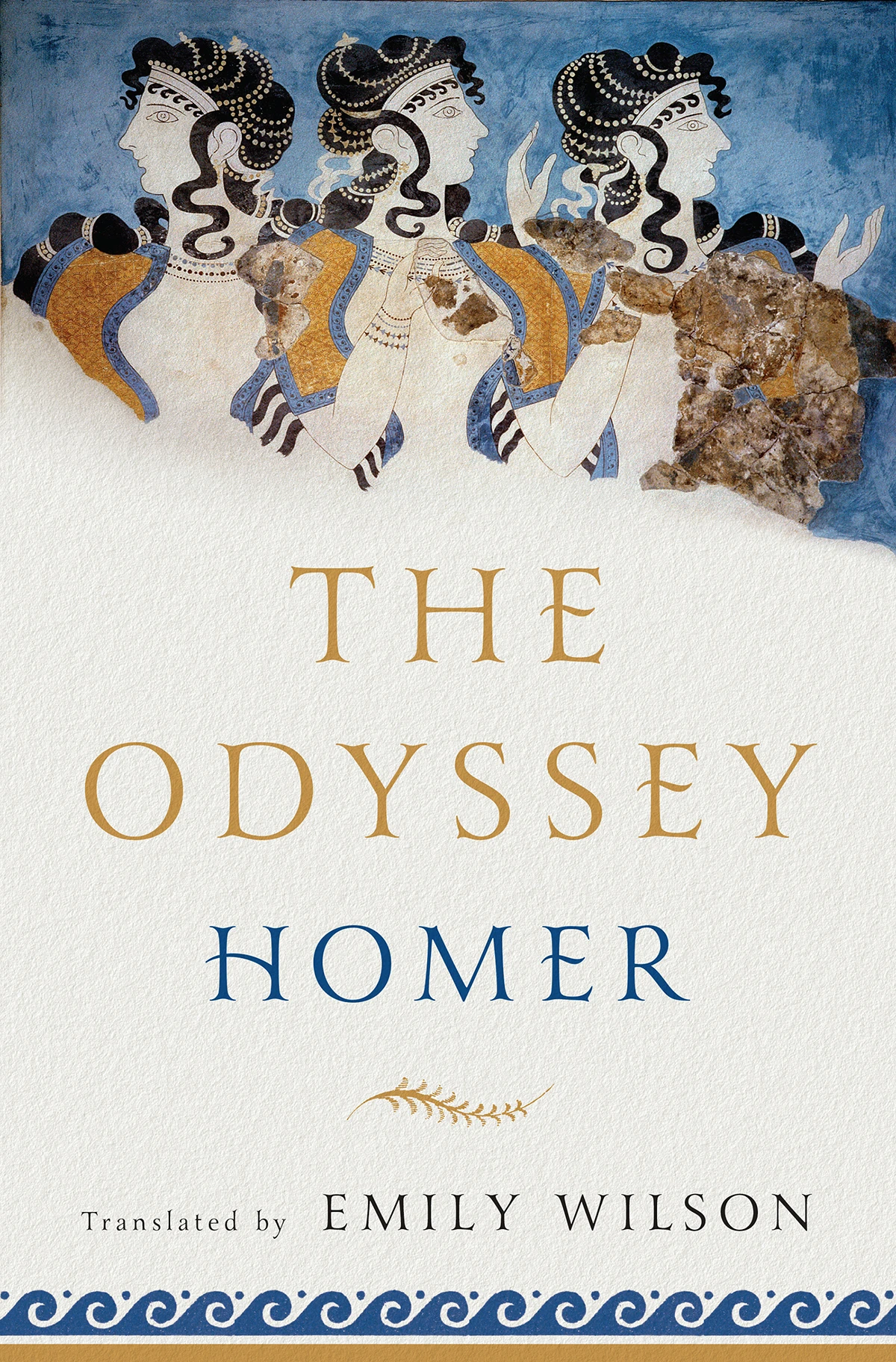
The Odyssey
About this book
The Odyssey begins after Troy has fallen, with its most resourceful survivor still absent from home. Odysseus is held on Calypso's island while the gods debate his release; in Ithaca, suitors consume his estate and press Penelope to choose a new husband. Telemachus, no longer a child but not yet secure in his authority, sets out to learn whether his father lives.
The journey moves through storms, enchantments, monsters, and stories within stories. Odysseus recounts the Cyclops, Circe, the dead, the Sirens, and the loss of every companion, but the poem keeps returning to questions of recognition and disguise: who sees the man beneath the stranger, and what proof can restore a damaged household?
Emily Wilson's translation uses a regular, swift-moving line and direct contemporary English while retaining the poem's formal repetitions and moral unease. Her introduction, notes, maps, and glossary frame an epic in which cleverness can save a life, but victory never erases its cost.
Read a sample
5,003 words
Plain text
From the opening
BOOK 1
The Boy and the Goddess
Tell me about a complicated man.
Muse, tell me how he wandered and was lost
when he had wrecked the holy town of Troy,
and where he went, and who he met, the pain
he suffered in the storms at sea, and how
he worked to save his life and bring his men
back home. He failed to keep them safe; poor fools,
they ate the Sun God’s cattle, and the god
kept them from home. Now goddess, child of Zeus,
tell the old story for our modern times.10
Find the beginning.
All the other Greeks
who had survived the brutal sack of Troy
sailed safely home to their own wives—except
this man alone. Calypso, a great goddess,
had trapped him in her cave; she wanted him
to be her husband. When the year rolled round
in which the gods decreed he should go home
to Ithaca, his troubles still went on.
The man was friendless. All the gods took pity,
except Poseidon’s anger never ended20
until Odysseus was back at home.
But now the distant Ethiopians,
who live between the sunset and the dawn,
were worshipping the Sea God with a feast,
a hundred cattle and a hundred rams.
There sat the god, delighting in his banquet.
The other gods were gathered on Olympus,
in Father Zeus’ palace. He was thinking
of fine, well-born Aegisthus, who was killed
by Agamemnon’s famous son Orestes.30
He told the deathless gods,
“This is absurd,
that mortals blame the gods! They say we cause
their suffering, but they themselves increase it
by folly. So Aegisthus overstepped:
he took the legal wife of Agamemnon,
then killed the husband when he came back home,
although he knew that it would doom them all.
We gods had warned Aegisthus; we sent down
perceptive Hermes, who flashed into sight
and told him not to murder Agamemnon 40
or court his wife; Orestes would grow up
and come back to his home to take revenge.
Aegisthus would not hear that good advice.
But now his death has paid all debts.”
Athena
looked at him steadily and answered, “Father,
he did deserve to die. Bring death to all
who act like him! But I am agonizing
about Odysseus and his bad luck.
For too long he has suffered, with no friends,
sea all around him, sea on every side,50
out on an island where a goddess lives,
daughter of fearful Atlas, who holds up
the pillars of the sea, and knows its depths—
those pillars keep the heaven and earth apart.
His daughter holds that poor unhappy man,
and tries beguiling him with gentle words
to cease all thoughts of Ithaca; but he
longs to see even just the smoke that rises
from his own homeland, and he wants to die.
You do not even care, Olympian!60
Remember how he sacrificed to you
on the broad plain of Troy beside his ships?
So why do you dismiss Odysseus?”
“Daughter!” the Cloud God said, “You must be joking,
since how could I forget Odysseus?
He is more sensible than other humans,
and makes more sacrifices to the gods.
But Lord Poseidon rages, unrelenting,
because Odysseus destroyed the eye
of godlike Polyphemus, his own son,70
the strongest of the Cyclopes—whose mother,
Thoösa, is a sea-nymph, child of Phorcys,
the sea king; and she lay beside Poseidon
inside a hollow cave. So now Poseidon
prevents Odysseus from reaching home
but does not kill him. Come then, we must plan:
how can he get back home? Poseidon must
give up his anger, since he cannot fight
alone against the will of all the gods.”
Athena’s eyes lit up and she replied,80
“Great Father, if the blessed gods at last
will let Odysseus return back home,
then hurry, we must send our messenger,
Hermes the giant-slayer. He must swoop
down to Ogygia right away and tell
the beautiful Calypso we have formed
a firm decision that Odysseus
has waited long enough. He must go home.
And I will go to Ithaca to rouse
the courage of his son, and make him call90
a meeting, and speak out against the suitors
who kill his flocks of sheep and longhorn cattle
unstoppably. Then I will send him off
to Pylos and to Sparta, to seek news
about his father’s journey home, and gain
a noble reputation for himself.”
With that, she tied her sandals on her feet,
the marvelous golden sandals that she wears
to travel sea and land, as fast as wind.
She took the heavy bronze-tipped spear she uses100
to tame the ranks of warriors with whom
she is enraged. Then from the mountain down
she sped to Ithaca, and stopped outside
Odysseus’ court, bronze spear in hand.
She looked like Mentes now, the Taphian leader,
a guest-friend. There she found the lordly suitors
sitting on hides—they killed the cows themselves—
and playing checkers. Quick, attentive house slaves
were waiting on them. Some were mixing wine
with water in the bowls, and others brought110
the tables out and wiped them off with sponges,
and others carved up heaping plates of meat.
Telemachus was sitting with them, feeling
dejected. In his mind he saw his father
coming from somewhere, scattering the suitors,
and gaining back his honor, and control
of all his property. With this in mind,
he was the first to see Athena there.
Continue reading the sampleClose the sample
He disapproved of leaving strangers stranded,
so he went straight to meet her at the gate,120
and shook her hand, and took her spear of bronze,
and let his words fly out to her.
“Good evening,
stranger, and welcome. Be our guest, come share
our dinner, and then tell us what you need.”
He led her in, and Pallas followed him.
Inside the high-roofed hall, he set her spear
beside a pillar in a polished stand,
in which Odysseus kept stores of weapons.
And then he led her to a chair and spread
a smooth embroidered cloth across the seat,130
and pulled a footstool up to it. He sat
beside her on a chair of inlaid wood,
a distance from the suitors, so their shouting
would not upset the stranger during dinner;
also to ask about his absent father.
A girl brought washing water in a jug
of gold, and poured it on their hands and into
a silver bowl, and set a table by them.
A deferential slave brought bread and laid
a wide array of food, a generous spread.140
The carver set beside them plates of meat
of every kind, and gave them golden cups.
The cup boy kept on topping up the wine.
The suitors sauntered in and sat on chairs,
observing proper order, and the slaves
poured water on their hands. The house girls brought
baskets of bread and heaped it up beside them,
and house boys filled their wine-bowls up with drink.
They reached to take the good things set before them.
Once they were satisfied with food and drink,150
the suitors turned their minds to other things—
singing and dancing, glories of the feast.
A slave brought out a well-tuned lyre and gave it
to Phemius, the man the suitors forced
to sing for them. He struck the chords to start
his lovely song.
Telemachus leaned in
close to Athena, so they would not hear,
and said,
“Dear guest—excuse my saying this—
these men are only interested in music,
a life of ease. They make no contribution.160
This food belongs to someone else, a man
whose white bones may be lying in the rain
or sunk beneath the waves. If they saw him
return to Ithaca, they would all pray
for faster feet, instead of wealth and gold
and fancy clothes. In fact, he must have died.
We have no hope. He will not come back home.
If someone says so, we do not believe it.
But come now, tell me this and tell the truth.
Who are you? From what city, and what parents?170
What kind of ship did you arrive here on?
What sailors brought you here, and by what route?
You surely did not travel here on foot!
Here is the thing I really want to know:
have you been here before? Are you a friend
who visited my father? Many men
came to his house. He traveled many places.”
Athena’s clear bright eyes met his. She said,
“Yes, I will tell you everything. I am
Mentes, the son of wise Anchialus,180
lord of the Taphians, who love the oar.
I traveled with my ship and my companions
over the wine-dark sea to foreign lands,
with iron that I hope to trade for copper
in Temese. My ship is in the harbor
far from the town, beneath the woody hill.
And you and I are guest-friends through our fathers,
from long ago—Laertes can confirm it.
I hear that fine old man no longer comes
to town, but lives out in the countryside,190
stricken by grief, with only one old slave,
who gives him food and drink when he trails back
leg-weary from his orchard, rich in vines.
I came because they told me that your father
was here—but now it seems that gods have blocked
his path back home. But I am sure that he
is not yet dead. The wide sea keeps him trapped
upon some island, captured by fierce men
who will not let him go. Now I will make
a prophecy the gods have given me,200
and I think it will all come true, although
I am no prophet. He will not be gone
much longer from his own dear native land,
even if chains of iron hold him fast.
He will devise a means of getting home.
He is resourceful. Tell me now—are you
Odysseus’ son? You are so tall!
Your handsome face and eyes resemble his.
We often met and knew each other well,
before he went to Troy, where all the best210
leaders of Argos sailed in hollow ships.
From that time on, we have not seen each other.”
Telemachus was careful as he answered.
“Dear guest, I will be frank with you. My mother
says that I am his son, but I cannot
be sure, since no one knows his own begetting.
I wish I were the son of someone lucky,
who could grow old at home with all his wealth.
Instead, the most unlucky man alive
is said to be my father—since you ask.”220
Athena looked at him with sparkling eyes.
“Son of Penelope, you and your sons
will make a name in history, since you are
so clever. But now tell me this. Who are
these banqueters? And what is the occasion?
A drinking party, or a wedding feast?
They look so arrogant and self-indulgent,
making themselves at home. A wise observer
would surely disapprove of how they act.”
Telemachus said moodily, “My friend, 230
since you have raised the subject, there was once
a time when this house here was doing well,
our future bright, when he was still at home.
But now the gods have changed their plans and cursed us,
and cast my father into utter darkness.
If he had died it would not be this bad—
if he had fallen with his friends at Troy,
or in his loved ones’ arms, when he had wound
the threads of war to end. The Greeks would then
have built a tomb for him; he would have won240
fame for his son. But now, the winds have seized him,
and he is nameless and unknown. He left
nothing but tears for me. I do not weep
only for him. The gods have given me
so many other troubles. All the chiefs
of Same, Zacynthus, Dulichium,
and local lords from rocky Ithaca,
are courting Mother, wasting our whole house.
She does not turn these awful suitors down,
nor can she end the courting. They keep eating,250
spoiling my house—and soon, they will kill me!”
Athena said in outrage, “This is monstrous!
You need Odysseus to come back home
and lay his hands on all those shameless suitors!
If only he would come here now and stand
right at the gates, with two spears in his hands,
in shield and helmet, as when I first saw him!
Odysseus was visiting our house,
drinking and having fun on his way back
from sailing in swift ships to Ephyra 260
to visit Ilus. He had gone there looking
for deadly poison to anoint his arrows.
Ilus refused, because he feared the gods.
My father gave Odysseus the poison,
loving him blindly. May Odysseus
come meet the suitors with that urge to kill!
A bitter courtship and short life for them!
But whether he comes home to take revenge,
or not, is with the gods. You must consider
how best to drive these suitors from your house.270
Come, listen carefully to what I say.
Tomorrow call the Achaean chiefs to meeting,
and tell the suitors—let the gods be witness—
‘All of you, go away! To your own homes!’
As for your mother, if she wants to marry,
let her return to her great father’s home.
They will make her a wedding and prepare
abundant gifts to show her father’s love.
Now here is some advice from me for you.
Fit out a ship with twenty oars, the best,280
and go find out about your long-lost father.
Someone may tell you news, or you may hear
a voice from Zeus, best source of information.
First go to Pylos, question godlike Nestor;
from there, to Sparta; visit Menelaus.
He came home last of all the Achaean heroes.
If you should hear that he is still alive
and coming home, put up with this abuse
for one more year. But if you hear that he
is dead, go home, and build a tomb for him,290
and hold a lavish funeral to show
the honor he deserves, and give your mother
in marriage to a man. When this is done,
consider deeply how you might be able
to kill the suitors in your halls—by tricks
or openly. You must not stick to childhood;
you are no longer just a little boy.
You surely heard how everybody praised
Orestes when he killed the man who killed
his famous father—devious Aegisthus? 300
Dear boy, I see how big and tall you are.
Be brave, and win yourself a lasting name.
But I must go now, on my speedy ship;
my friends are getting tired of waiting for me.
Remember what I said and heed my words.”
Telemachus was brooding on her words,
and said, “Dear guest, you were so kind to give me
this fatherly advice. I will remember.
I know that you are eager to be off,
but please enjoy a bath before you go,310
and take a gift with you. I want to give you
a precious, pretty treasure as a keepsake
to mark our special friendship.”
But the goddess
Athena met his gaze and said, “Do not
hold me back now. I must be on my way.
As for the gift you feel inspired to give me,
save it for when I come on my way home
and let me give you presents then as well
in fair exchange.”
With that, the owl-eyed goddess
flew away like a bird, up through the smoke.320
She left him feeling braver, more determined,
and with his father even more in mind.
Watching her go, he was amazed and saw
she was a god. Then godlike, he went off
to meet the suitors.
They were sitting calmly,
listening to the poet, who sang how
Athena cursed the journey of the Greeks
as they were sailing home from Troy. Upstairs,
Penelope had heard the marvelous song.
She clambered down the steep steps of her house,330
not by herself—two slave girls came with her.
She reached the suitors looking like a goddess,
then stopped and stood beside a sturdy pillar,
holding a gauzy veil before her face.
Her slave girls stood, one on each side of her.
In tears, she told the holy singer,
“Stop,
please, Phemius! You know so many songs,
enchanting tales of things that gods and men
have done, the deeds that singers publicize.
Sing something else, and let them drink in peace. 340
Stop this upsetting song that always breaks
my heart, so I can hardly bear my grief.
I miss him all the time—that man, my husband,
whose story is so famous throughout Greece.”
Sullen Telemachus said, “Mother, no,
you must not criticize the loyal bard
for singing as it pleases him to sing.
Poets are not to blame for how things are;
Zeus is; he gives to each as is his will.
Do not blame Phemius because he told350
about the Greek disasters. You must know
the newest song is always praised the most.
So steel your heart and listen to the song.
Odysseus was not the only one
who did not come back home again from Troy.
Many were lost. Go in and do your work.
Stick to the loom and distaff. Tell your slaves
to do their chores as well. It is for men
to talk, especially me. I am the master.”
That startled her. She went back to her room,360
and took her son’s uneasy words to heart.
She went upstairs, along with both her slaves,
and wept there for her dear Odysseus,
until Athena gave her eyes sweet sleep.
Throughout the shadowy hall the suitors clamored,
praying to lie beside her in her bed.
Telemachus inhaled, then started speaking.
“You suitors, you are taking this too far.
Let us enjoy the feast in peace. It is
a lovely thing to listen to a bard,370
especially one with such a godlike voice.
At dawn, let us assemble in the square.
I have to tell you this—it is an order.
You have to leave my halls. Go dine elsewhere!
Eat your own food, or share between your houses.
Or if you think it easier and better
to ruin one man’s wealth, and if you think
that you can get away with it—go on!
I call upon the gods; Zeus will grant vengeance.
You will be punished and destroyed, right here!”380
He spoke, and they began to bite their lips,
shocked that Telemachus would dare to speak
so boldly. But Antinous replied,
“Telemachus, the gods themselves have taught you
such pride, to talk so big and brash in public!
May Zeus the son of Cronus never grant you
your true inheritance, which is the throne
of Ithaca.”
His mind alert and focused,
Telemachus replied, “Antinous,
you will not like this, but I have to say,390
I hope Zeus does give me the throne. Do you
deny it is an honorable thing
to be a king? It brings the household wealth,
and honor to the man. But there are many
other great chiefs in sea-girt Ithaca,
both old and young. I know that. One of them
may seize the throne, now that Odysseus
has died. But I shall be at least the lord
of my own house and of the slaves that he
seized for my benefit.”
Eurymachus400
replied, “Telemachus, the gods must choose
which of us will be king of Ithaca.
But still, I hope you keep your own possessions,
and rule your house. May no man drive you out,
and seize your wealth, while Ithaca survives.
Now, friend, I want to ask about the stranger.
Where was he from, what country? Did he say?
Where is his place of birth, his native soil?
Does he bring news your father will come home?
Or did he come here for some other purpose?410
How suddenly he darted off, not waiting
for us to meet him. Yet he looked important.”
The boy said soberly, “Eurymachus,
my father is not ever coming home.
I do not listen now to any gossip,
or forecasts from the psychics whom my mother
invites to visit us. The stranger was
my father’s guest-friend Mentes, son of wise
Anchialus, who rules the Taphians,
the people of the oar.”
Those were his words,420
but in his mind he knew she was a god.
They danced to music and enjoyed themselves
till evening, then they went back home to sleep.
Telemachus’ bedroom had been built
above the courtyard, so it had a view.
He went upstairs, preoccupied by thought.
A loyal slave went with him, Eurycleia,
daughter of Ops; she brought the burning torches.
Laertes bought her many years before
when she was very young, for twenty oxen.430
He gave her status in the household, equal
to his own wife, but never slept with her,
avoiding bitter feelings in his marriage.
She brought the torches now; she was the slave
who loved him most, since she had cared for him
when he was tiny. Entering the room,
he sat down on the bed, took off his tunic,
and gave it to the vigilant old woman.
She smoothed it out and folded it, then hung it
up on a hook beside his wooden bed,440
and left the room. She used the silver latch
to close the door; the strap pulled tight the bolt.
He slept the night there, wrapped in woolen blankets,
planning the journey told him by Athena.
BOOK 2
A Dangerous Journey
The early Dawn was born; her fingers bloomed.
Odysseus’ well-beloved son
jumped up, put on his clothes, and strapped his sword
across his back, and tied his handsome sandals
onto his well-oiled feet. He left the room
looking just like a god.
He quickly told
the clear-voiced heralds they must call the Greeks
to council. Soon the men, their long hair flowing,
were gathered all together in the square.
Telemachus arrived, bronze sword in hand,10
not by himself—two swift dogs came with him.
Athena poured a heavenly grace upon him.
The elders let him join them, and he sat
upon his father’s throne. The first to speak
was wise Aegyptius, a bent old soldier.
His darling son, the spear-man Antiphus,
had sailed with Lord Odysseus to Troy;
the Cyclops killed him in his cave and made him
his final course at dinner. This old father
had three sons left. One teamed up with the suitors—20
Eurynomus. The others spent their time
working the farm. But still the father mourned
the son whom he had lost. He spoke in tears.
“People of Ithaca, now hear my words.
We have not met in council since the day
Odysseus departed with his ships.
Who called us? Someone old or young? And why?
Has he found out an army is approaching?
Or does he have some other piece of news
which he would like to share with all of us? 30
I think he is a helpful, decent man.
I hope that Zeus rewards his good intentions!”
Odysseus’ loving son felt glad,
and eagerly got up to speak and stood
among them, in the center of the group.
The competent official, named Pisenor,
passed him the speaking-stick; he held it up,
and first addressed Aegyptius.
“Here, sir!
Now look no further for the man you seek.
I called the meeting. I am in deep trouble.40
I have no information of an army
that might attack us, nor do I have news
of any other danger to our people.
I need help for myself. My family
has suffered two disasters. First I lost
my father, who was kind to you as if
you also were his sons. Now, even worse,
my house is being ripped apart; my wealth
will soon be gone! The sons of all the nobles
have shoved inside my house to court my mother,50
against her wishes. They should go and ask
Icarius her father to provide
a dowry, and choose who should be her husband.
They are too scared. Instead, they haunt our house
day after day, and kill our cows and pigs
and good fat goats. They feast and drink red wine,
not caring if they waste it all. There is
no man to save the house—no man like him,
Odysseus. I cannot fight against them;
I would be useless. I have had no training.60
But if I had the power, I would do it!
It is unbearable, what they have done!
They ruined my whole house! It is not fair!
You suitors all should feel ashamed! Consider
what others in the neighborhood will think!
And also be afraid! The angry gods
will turn on you in rage; they will be shocked
at all this criminal behavior!
I beg you, by Olympian Zeus, and by
the goddess who presides in human meetings:70
Justice! But never mind. Friends, leave me be,
and let me cry and suffer by myself.
Or did Odysseus, my warlike father,
deliberately do harm to our own side?
Is that why you seem set on hurting me,
encouraging these suitors? Oh, if only
you Ithacans would eat my stock yourselves!
If you did that, I soon would get revenge;
I would come through the town and keep demanding,
until it all got given back. But now,80
you make me so unhappy! This is pointless!”
He stopped, frustrated, flung the scepter down,
and burst out crying. Everyone was seized
by pity. No one spoke; they hesitated
to answer him unkindly. Then at last
Antinous began.
“Telemachus,
you stuck-up, wilful little boy! How dare you
try to embarrass us and put the blame
on us? We suitors have not done you wrong.
Go blame your precious mother! She is cunning.90
It is the third year, soon it will be four,
that she has cheated us of what we want.
She offers hope to all, sends notes to each,
but all the while her mind moves somewhere else.
She came up with a special trick: she fixed
a mighty loom inside the palace hall.
Weaving her fine long cloth, she said to us,
‘Young men, you are my suitors. Since my husband,
the brave Odysseus, is dead, I know
you want to marry me. You must be patient;100
I have worked hard to weave this winding-sheet
to bury good Laertes when he dies.
He gained such wealth, the women would reproach me
if he were buried with no shroud. Please let me
finish it!’ And her words made sense to us.
So every day she wove the mighty cloth,
and then at night by torchlight, she unwove it.
For three long years her trick beguiled the Greeks.
But when the fourth year’s seasons rolled around,
a woman slave who knew the truth told us. 110
We caught her there, unraveling the cloth,
and made her finish it. This is our answer,
so you and all the Greeks may understand.
Dismiss your mother, let her father tell her
to marry anyone his heart desires.
Athena blessed her with intelligence,
great artistry and skill, a finer mind
than anyone has ever had before,
even the braided girls of ancient Greece,
Tyro, Alcmene, garlanded Mycene—120
none of them had Penelope’s understanding.
But if she wants to go on hurting us,
her plans are contrary to destiny.
We suitors will keep eating up your wealth,
and livelihood, as long as she pursues
this plan the gods have put inside her heart.
For her it may be glory, but for you,
pure loss. We will not go back to our farms
or anywhere, until she picks a husband.”
Telemachus insisted, breathing hard,130
“Antinous, I cannot force my mother
out of the house. She gave me birth and raised me.
My father is elsewhere—alive or dead.
If I insist my mother has to leave,
Icarius will make me pay the price,
and gods will send more trouble; if she goes,
Mother will rouse up Furies full of hate
to take revenge, and everyone will curse me.
I will not. If you feel upset, you go!
Out of my house! Stop eating all my food!140
Devour each other’s property, not mine!
Or do you really think it right to waste
one person’s means of life, and go scot-free?
Then try it! I will call the deathless gods!
May Zeus give recompense some day for this!
You will die here, and nobody will care!”
Then Zeus, whose voice resounds around the world,
sent down two eagles from the mountain peak.
At first they hovered on the breath of wind,
close by each other, balanced on their wings.150
Reaching the noisy middle of the crowd,
they wheeled and whirred and flapped their mighty wings,
swooping at each man’s head with eyes like death,
and with their talons ripped each face and neck.
Then to the right they flew, across the town.
Everyone was astonished at the sight;
they wondered in their hearts what this could mean.
Old Halitherses, son of Mastor, spoke.
More than the other elders, this old leader
excelled at prophecy and knew the birds.160
He gave them good advice.
“Now Ithacans,
listen! I speak especially for the suitors.
Disaster rolls their way! Odysseus
will not be absent from his friends for long;
already he is near and sows the seeds
of death for all of them, and more disaster
for many others in bright Ithaca.
We have to form a plan to make them stop.
That would be best for them as well by far.
I am experienced at prophecy;170
my words came true for him, that mastermind,
Odysseus. I told him when he left
for Troy with all the Argives, he would suffer
most terribly, and all his men would die,
but in the twentieth year he would come home,
unrecognized. Now it is coming true.”
Eurymachus, the son of Polybus,
replied, “Old man, be off! Go home and spout