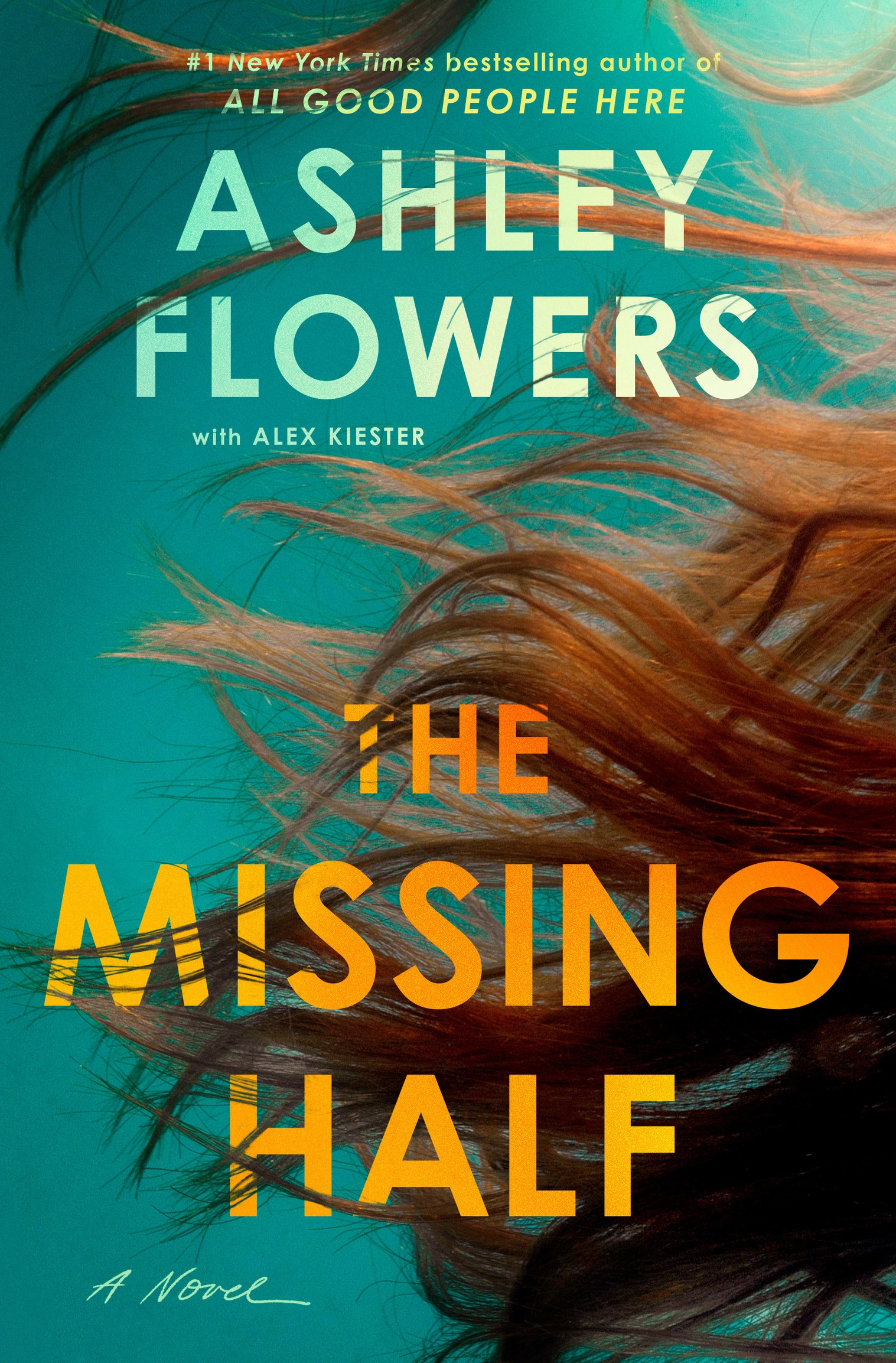
The Missing Half
About this book
Nicole has lived for years with the disappearance of her sister and with the suspicion that every ordinary decision made afterward is a form of leaving her behind. When another woman presents a similar loss, coincidence becomes difficult to accept.
Their search revisits timelines, relationships, and local assumptions that once kept the investigations apart. The partnership offers access to facts neither family had, but it also means trusting someone whose grief has produced a different idea of proof.
Ashley Flowers builds the mystery around the long aftermath of an unsolved disappearance. Public attention moves on quickly; families remain inside the unanswered questions, collecting small contradictions that authorities may no longer consider actionable.
The Missing Half is a suspense novel about sisterhood, unresolved cases, and the moment private persistence becomes a joint investigation. The emotional stakes remain with the missing women rather than reducing them to clues.
Read a sample
5,002 words
Plain text
From the opening
Chapter One
2019
I’m mopping up vomit by the claw machine when I notice her watching me.
She’s sitting in a booth where the tables end and the arcade begins, near the old pinball machines no one uses anymore. In her early to mid-thirties, with the slightly haggard look of a parent, she fits our customer mold here at Funland, the go-to birthday destination for every preteen in Mishawaka, Indiana. But there’s none of the usual evidence of kids around her table, no gnawed-on cheese sticks or packet of wet wipes or discarded action figures. Just a half-drunk soda. When she notices me looking, she nods, then turns away.
There’s something off about the gesture that makes me think she’s nervous, like a bad PI going for casual. I keep watching to see if she’s checking up on a kid in the throng of the arcade, but she just stares at the side of her drink, rubbing her thumb against the glass. Our dinner options are greasy pizza or rubbery burgers, the undersides of the tables are speckled with wads of gum, and the background noise is the shouting voices of children. If she doesn’t have kids, what the hell is she doing here?
The woman flicks her gaze in my direction and then away again. The hair on the back of my neck rises.
I do a last few rushed swipes at the puddle of yellow sick, rinse out the mop and bucket so I can stow them back in the cleaning supplies closet, then scan the place for my manager, Brad. I spot the back of his head as he makes his way over to the computer where we ring up customer bills and half walk, half jog to catch up with him. “Hey, Brad?”
He turns, an affable smile spreading across his face. “Nic, hey. What’s up?”
Brad Andrews gave me my job at Funland eight years ago, back when I was working summers in high school, out of sheer nepotism. He was the best man in my parents’ wedding, and growing up, our families vacationed together every summer. He and his wife, Sandy, are more of an uncle and aunt to me than those related by blood. Neither of us could have foreseen how long I’d be here though, and sometimes our relationship shows the wear.
“That woman.” I nod in her direction. “I think she’s here alone. We may want to keep an eye on her.”
“What woman?” Brad peers over my head. “That one in the blue?”
“She doesn’t have any kids here.” I don’t need to elaborate. We get a certain kind at Funland every once in a while—childless middle-aged men whose eyes linger too long. We usually ask those people to leave.
“She looks pretty harmless to me. A little lonely, maybe, but harmless. Don’t you think?”
I roll my eyes. Brad’s brand of sexism manifests as an unwavering faith in the fairness of the fairer sex. He probably thinks his wife, Sandy, doesn’t masturbate when he’s away, or ever fantasize about a one-night stand with the young cashier at the grocery store. The idea of a female with actual bad intentions would gobsmack him.
“She was watching me.” I regret the words before I finish saying them.
He glances over in the woman’s direction again, but she’s looking at her drink. “Are you sure?”
“You know what, never mind. I’m probably just…” The end of my sentence hangs in the air between us. Brad doesn’t need me to tell him my paranoia and suspicion are habit. He was there seven years ago when my life flipped upside down, and he’s seen me almost every day since.
“You sure? I can go and check it out if you—”
“No,” I say. “It’s fine.” I know he’s just offering for the brownie points anyway.
Brad studies my face. “You doing okay, Nic?”
“I’m fine.”
“It’s just—I know you have a lot on your plate right now, what with the…program and all that.”
At first, I tried to keep the details of my “program” quiet, but my hometown is small, and a DWI is a juicy piece of gossip. Plus, I never had a shot of keeping it from Brad. He and my dad have a beer together every week. “I’m fine,” I say again.
“Good. Good.” Brad bobs his head. “Well, listen. You’ll let me know if you need anything, yeah? If you ever want to talk…”
I soften a little at this, but we both know I won’t take him up on it. Between working this job to pay off the state fine, going to my weekly AA meeting, preparing for my appearance in court, and fulfilling my mandatory community service at the local animal shelter, I don’t exactly have the emotional bandwidth for a heart-to-heart. But more than that, I learned years ago that numbness is better than pain. I’ve been not talking for so long, I’m not sure I’d even know how to start.
My gaze flicks to the woman in blue, but she’s gone, her table empty, her drink still half-full. Did she see me talking to the manager and leave before we could kick her out? Stop, I tell my churning mind. You’re being paranoid.
“I should probably get back to it,” I say to Brad.
He claps my shoulder. “You should come over for dinner soon. Sandy would love to see you.”
Continue reading the sampleClose the sample
As he turns to walk away, I scan the place one last time for the woman, but she’s nowhere to be found.
We close an hour later, and I walk out the double doors of Funland into the Indiana summer night. The near-empty parking lot sprawls before me, telephone wires crisscrossing the black sky above. The heat is a muggy slap. I unlock my bike from the rack, then slip the lock into my backpack.
“Nicole! Nicole Monroe.”
I turn and see the woman in blue emerge from the shadow of a tree on the edge of the parking lot. My fingers tighten around my bike handles. Most people’s reaction when they’re confronted is fight or flight. I freeze. And I hate myself for it.
“I just wanna talk.” She lifts her hands as if she’s approaching a wild animal. “About Kasey.”
My sister’s name is a fist in my gut, and I want to smack it out of this stranger’s mouth. Although no one has showed up at my work like this in years, there have been countless like her in my life. Reporters, podcasters, bloggers. People who expect my eager participation as they turn my tragedy into their dollars. “Unbelievable,” I mutter, turning to leave.
“Wait!” There’s a flicker of desperation in her voice. She probably has a tight deadline, and I feel a stab of cruelness. Good, I think. Let her squirm. “I just want a minute of your time. Please.”
“I have to catch a bus.” My lawyer petitioned the court for an occupational license to drive to work, but until it goes through, I’m stuck like this. Hauling my bike onto the bus, riding five miles to the stop nearest my apartment, then biking the remaining two miles to my door. This bus is the last one of the night. If I miss it, I’ll have to bike the entire trip in the dark.
I’ve already started to walk away when she says, “I know it hurts to talk about—”
I whirl around. “You know?” I don’t have time for self-righteousness right now, but this is my button. People thinking they can empathize with my pain because they listened to a fifty-five-minute episode about it once.
“I…”
“Go on,” I say. “Really. I’d love to know how you, a perfect fucking stranger, could know how it feels to talk about my sister.” Over time, my grief has morphed to anger. Now it lives just beneath my skin. Prick it and I bleed. “Are you some sort of psychic? Or wait, no, let me guess. You’re an empath. Right? You just feel everything so deeply?”
“No, I—”
“You don’t know what it feels like. You couldn’t. So please just leave me the fuck alone.”
This time I’ve already hopped onto my bike and am pedaling off when she calls after me. I didn’t think there was a single thing this woman could say that would make me stop, but I was wrong.
Chapter Two
It feels as if I’ve been plunged into water. The air is viscous around me, the sounds muffled. Everything is blotted out by the woman’s words echoing in my mind.
“My sister disappeared too. Just like Kasey.”
I so rarely say my sister’s name aloud anymore—my life is a little less painful that way—the syllables thrum through me like rushing blood. Ka-sey, Ka-sey, Ka-sey. It tugs me backwards into the past, and though I try to resist, it’s like trying to hold on to a wet, writhing fish. Then suddenly, for the first time in years, I’m back in 2012. It’s the summer after my junior year of high school and Kasey is still alive.
I woke around nine-thirty with a dull sort of hangover. My mouth tasted like beer, and when I looked in the mirror, my eyes were black. Like I had so many times before, I’d forgotten to wash my face when I got home. My day stretched before me like all the rest that summer—a mind-numbing shift at Funland during the day, then whatever diversion Kasey and I could come up with at night.
I padded barefoot down the hall to her room, knocked softly on the door. “Kase? You up?”
I wanted to sprawl at the foot of her bed like I’d done so often these past few months, chat about the night before. It was an irregular tradition of ours, something we did whenever we had time. We’d lie together, Kasey under the blankets, me on top, our voices still thick with sleep, and we’d talk until we were both laughing so hard we couldn’t stop. It was our most beloved competition: who could make the other laugh harder. My favorite Kasey stories were the ones where she did impressions of the clumsy, fumbling guys who’d hit on her that summer. “They’re such boys,” she always said in her placid voice. “I need a man, Nic. A real fucking man.”
But it was quiet in her room today. “Kase?” I said again. When she didn’t respond, I cracked her door. Her room was empty.
At the end of the hall, our parents’ bedroom door was open a few inches, which meant they weren’t in it. The door to the bathroom I shared with Kasey was flung wide, the light off. I walked into the kitchen. Empty.
Mom and Dad had always had a hands-off parenting style. As kids, Kasey and I were downright feral, spending summers perpetually barefoot and skinned-kneed, sleeping in the same bathing suit for days on end so we didn’t have to change to go to the pool. That summer, our parents’ already long leash had been effectively cut. I guessed, because Kasey was in college now and living most of the year hundreds of miles away, they figured what was the point and then just lumped me in too. Even with both of us working nearly full-time, Kasey and I lived a little like nomads, sleeping at friends’ houses and staying out all night.
And unlike a lot of kids in town, our mom and dad both worked, Dad at the fish hatchery, Mom selling vitamin supplements from a phone bank in South Bend. They both left in the morning before we got up.
Which was all to say that waking up to a house with no one in it was not unusual.
I got ready for my shift at Funland, washing my face and pulling my hair into a ponytail. I changed into my uniform, which smelled like pizza grease, and chugged a glass of orange juice. I kept expecting Kasey to walk through the door. We both worked on Grape Road, a commercial strip home to over a hundred different businesses rife with summer jobs, places like Olive Garden, Best Buy, Payless. Kasey worked at an old record shop called Rosie’s Records about a quarter mile south of Funland. And because we shared a car, we usually drove to work together. But by the time we needed to leave, she still hadn’t come home. I checked my phone. No messages.
“Thanks, Kase,” I muttered. I was guessing she spent the night at her friend Lauren’s and was planning to get a ride from her. Lauren worked at the record shop too, and they did this often, but a heads-up would’ve been nice.
I walked into the kitchen to grab the car keys from the counter, where we were supposed to leave them, but they weren’t there, and I couldn’t remember who’d had the car last. A group of us had taken a case of beer to one of the cornfields outside town last night, but I’d gotten a ride from a friend, and Kasey had stayed in.
I searched the house. My room, her room, the living room, the bathroom. Finally, I went outside, thinking maybe one of us left the keys in the car, but when I got out there, the car was gone.
“Are you fucking kidding me.” I tugged my cell from my pocket and called Kasey. It rang through to voicemail, so I called again. Voicemail, voicemail. I shot off a text: You planning on picking me up or what?? And another: I have a job too you know. Then: Kase, wtf? I’m gonna have to run to the bus. Are you gonna pick me up tonight or are you planning on ditching me again?
I ran to the bus stop, making it to work twenty minutes late and sweating. I told Brad what happened and he gave me a grudging smile. “I understand,” he said. “Just try not to let it happen again.” Then, my attention was swallowed by balancing trays of food, exchanging arcade tickets for animal-shaped erasers, and singing Funland’s noncopyrighted birthday song. I didn’t think about Kasey again until I got off nine hours later. But when I called her, it still just rang through to voicemail. I disconnected before she could tell me to leave a message at the beep.
I felt a tick of worry, like a gear cranking one notch tighter in my chest. There was an explanation for it all, I was sure. Something had come up and she had her phone on silent. And yet, Kasey was the responsible one. Forgetfulness, spontaneity—those were my territory, not hers. I slung on my backpack and started the quarter-mile walk to the record store.
The shop air smelled like old books, and when I walked in, it was pulsing with the sound of some obscure band I’d heard Kasey play before but couldn’t remember the name of. The rows of records were overflowing, and when I walked by, I ran my hand over their edges, reminded why Kasey loved being here so much—it was like disappearing into music.
But when I looked to the front of the store, she wasn’t there. Lauren seemed to be working alone.
“Hey, Lauren. Where’s Kasey?”
She shrugged. “I don’t know. She’s not here.”
“She already left?” I said. “She’s supposed to give me a ride.”
“No.” Lauren shook her head. “She didn’t leave. I haven’t seen Kasey all day.”
Chapter Three
“Nicole?”
My head snaps up to see the woman in blue. She’s standing beside me now. I’m in the Funland parking lot, straddling my bike.
For the first time in years, I let my mind slip into the past, and it’s just as painful as I always imagined it would be. Knowing everything I know now—that right around the time I was writing those angry texts to my sister was more or less the time she was in unspeakable danger—makes the little flame of self-loathing that lives inside my chest grow.
“Are you okay?” the woman says.
“Who are you?” I ask. By now I already know, but I need to hear her say it to make it real.
“My name’s Jenna Connor. My sister was Jules.”
I begin to see it in her face: the pieces of Jules Connor reorganized—the upturned nose, small blue eyes. This woman, Jenna, has the same hair too, dark ruddy blond. Maybe this sounds shitty, but there was nothing particularly memorable about Jules Connor. I can’t think of a single superlative you would stick in front of her name. She wasn’t the smartest or dumbest, prettiest or ugliest, funniest, boldest, meanest. She was average, in her early twenties, from Mishawaka, working as a bartender in the next town over. Yet I will know her name and face forever. Because she was one of two branded the “Missing Mishawaka Girls”: her and Kasey Monroe.
“Sorry to show up at your work like this, Nicole,” Jenna says. “But I had to talk to you.”
“It’s Nic.”
“Right—Nic. Sorry. I just need an hour, tops. I’ll buy you a drink.”
“No,” I say quickly. “And I don’t understand. What do you even want to talk about?”
“Well.” She hesitates. “Our sisters’ cases are connected.”
You wouldn’t have to read even a single article about the disappearances to know that. It’s common knowledge—at least around these parts—and it strikes me suddenly how odd it is that we’ve never met. The Connors have held a lot of real estate in my mind over the years, but no one in either family—hers or ours—has ever gotten in touch with anyone in the other.
And because our sisters went missing from different towns, their cases were handled by separate jurisdictions. I’ve spoken with the detective on her sister’s case, and I’m sure she’s spoken with the one on mine, but we’ve never overlapped. Until now.
“And?” I say.
“No one knows why. After all this time. Why the two of them?”
What does she expect me to say? Does she not think the police explored that question? Or that every journalist and podcast host hasn’t gone down that road a dozen times? I don’t know the answer because no one does. And if she thinks the two of us are going to figure out in an hour what no one has in almost a decade, she’s delusional.
“I know it sounds…farfetched,” she says. “But talking to you is the only thing I haven’t done. If there’s any similarity between their lives—”
“The police looked into all of that.”
“I know. I know. But no one knows them like us. The police missed something, and I think we have a shot at figuring it out.”
“They’re not coming back,” I say slowly. “Kasey and Jules are dead.”
I’m nervous for a second that Jenna is still holding on to the hope that I gave up long ago—the hope that because the bodies of our sisters were never found, they could still be out there, alive. But she just says, “I know.”
“Then why are you doing this? What’s the point?”
“It’s…complicated.”
There’s something in her eyes, something she’s not telling me, but according to my phone, I now have two minutes to get to the bus stop. “Right. Well, I’m sorry. But I have to go.”
“Nic, please. Just give me an hour. I promise I’ll leave you alone after that.”
“Look,” I say. “I’ve spent seven years trying not to think about everything I lost when Kasey disappeared. Seven years getting over the fact that my sister is never coming back.” Although the truth is I haven’t been getting over anything. I’ve been methodically numbing myself to it. And even so, any semblance of peace I have feels as if it’s balancing on the edge of a knife. One breath and it would all tip over. “I’m not about to undo that for the sake of some stranger.”
I turn again to leave, but Jenna grabs my forearm. “Wait! Wait. I get it. I do. But there’s something I haven’t told you. The reason I’m doing this—the real reason. I found something the police didn’t have during their original investigation.”
Her words hit me in the knees. And for the briefest moment, a millisecond in time that makes me hate myself, I don’t want to ask what she found because I’m too scared to know.
“Jules’s old diary,” Jenna blurts out before I can say anything at all. “She, um, wrote something about that summer that the police didn’t know. And if our sisters’ cases are connected like we think they are, information about hers is information about Kasey’s too.”
I stare at her in silence, but inside I’m screaming. Screaming for her to go away, for my body to run, for something—anything—to get rid of this new ache in my chest. When I open my mouth though, all I can say is, “What did she write?”
“First, talk to me about Kasey’s disappearance.”
“Are you serious?” I say. “You’re not gonna tell me?”
“I’ll tell you, I promise. But only after you tell me about your sister’s case.”
“That’s insane. I have a right to know.”
“Look,” Jenna says, “you just made it very clear that you don’t want to talk about your sister or her disappearance. So if I tell you what I found out, how do I know you’re not just gonna walk away? Think of it as collateral. I’ll talk when you do.”
I glance at my phone. My bus will be arriving any moment now. “Do you have a car?” I say.
“A—what?”
“A car, Jenna. Do you have a car?”
“I have a truck,” she says.
“Good. I’m gonna need a ride.”
“So, you’ll talk?”
I give her a look. “You just told me you know something new about my sister’s case. Of course I’m gonna fucking talk.”
We make awkward small talk on the drive and walk into my apartment fifteen minutes later. I try to refuse to be embarrassed by it, but it doesn’t work. My rent is necessarily cheap and my place depressing, one of those prefabricated apartments with a soulless interior—low ceilings, beige paint, wooden cabinets made in the nineties that swing unevenly on loose hinges. And right now, it’s a disaster.
Dishes fill the kitchen sink, smears of food hardened on their surfaces. In one of the corners of the living room, the leaves of an old houseplant have withered on the stalk. Next to it is a litter box that hasn’t been used for over six months now. Last year during a fit of optimism, I adopted an underfed tuxedo cat, bought a handful of toys from Goodwill, and told myself I was “turning my life around.” I named him Slink, and soon I’d fallen deeply in love. But a month in, I realized he deserved someone better. Someone who’d feed him properly, not just leftovers, someone who could afford to take him to the vet, someone who didn’t use wine to fall asleep. I took him back to the shelter and tried to forget he was ever mine. The litter box catches my eye and I seethe with embarrassment. The proof of my inability to see things through.
“So,” I say to Jenna. “What d’you want to know?”
She glances around. We’re standing across from each other in the middle of the small living room. “I was sort of thinking we could have a conversation. You know, sit down, maybe have a glass of water?”
I’m not an inherently inhospitable person, but I want to know what her sister wrote in that diary. Still. We made a deal. “Fine,” I say. “You sit. I’ll get the waters.”
I fill two glasses from the tap in the kitchen and bring one to Jenna, who’s now sitting on the couch. I take the other with me to the small table where I eat my meals and make a show of taking a sip. “What do you want to know?”
“I thought you could just start by telling me what Kasey was like. I mean, I know what was on the news, but it’s not the same.”
My stomach lurches, a knee-jerk horse’s hoof in the gut. Her question sounds like a softball, I know, but it isn’t. When someone dies, most people’s reaction is to slap some reductive, feel-good label on their legacy. Her smile could light up a room. He was the life of the party. The claims are so blanketed, they leave no room for nuance, for reality. Even I, who’ve spent years learning better, still do it. Hadn’t I, just a few minutes earlier, searched for some superlative to stick in front of Jules’s name? As if prettiest, smartest, or funniest was the only thing that could give her life meaning. Hypocrite, I think acidly.
“Kasey and I were kind of opposites,” I say. “She was…steady, I guess? Responsible. That summer was her first summer back from college, and even though she was going out and seeing friends and working, she was also taking summer classes online.”
“What college was she at again?” Jenna has gotten out a little notebook and a pen.
“Arizona State. She was basically the only one in her high school graduating class to leave Indiana.”
“What was she studying?”
“Nursing. She wanted to be a nurse.” A hook tugs in my chest. She would’ve been a good one.
“So she liked medicine.”
“Not really. I mean, yeah, she liked it fine, but I think it was more about helping people.” And there I go, making Kasey sound like some kind of angel. Which she was and wasn’t. “Our parents weren’t around often, so Kasey sort of took care of me. You know, fixing me dinner and making sure I did my homework.”
“Where were your parents?” Jenna says.
“Dad worked a lot. Mom drank a lot.”
“So, Kasey was older than you?”
I nod. “Two years.”
A memory fills my mind from over a decade earlier. I was probably eleven or twelve, Kasey thirteen or fourteen. It was the peak of summer and our AC had broken, our house turned sweltering. Dad said he’d called the repair company, but they were in high demand and the earliest they’d be able to come out was in three days. That first night, Kasey and I made a pallet in the enclosed front porch to sleep. We flung the windows wide and turned the fan on full tilt. But even so, the temperature was oppressive, and my long hair stuck to my sweaty back. I flipped around on top of the blankets until finally I couldn’t take it anymore. The house was quiet as I tiptoed into the bathroom Kasey and I shared, grabbed a pair of scissors with one hand, a hank of my hair with the other, and cut.
It wasn’t until the next morning when I looked in the mirror that I realized the damage I’d done. My hair hung in uneven chunks around my ears, a few uncut strands whispering against my collarbone. Kasey woke to the sound of me crying, and when she saw me her eyes widened, but only for a second. “It’s okay,” she said. “We’ll fix it.” She dragged one of our kitchen chairs out onto the back lawn and wrapped a towel around my shoulders, pretending like we were in some high-end salon. I remember she took such care wetting my hair and combing through it, her fingertips confident and gentle on my scalp. Eventually my hiccupping sobs faded.
“It must’ve been hard for her,” Jenna says. “Being a kid and being responsible for a sibling.”
I don’t respond. I’ve guilt-tripped myself enough for this over the years. I don’t need a reminder.
“I didn’t mean it like—” Jenna cuts herself off. “She was your big sister. That’s what they do.”
I can tell by the way she says it that Jules was younger than her. So, she lost her little sister, I lost my big one. Suddenly, I want a glass of red wine so badly it hums inside my limbs. This is why I didn’t want to talk about the past. My emotions get too heavy to hold. I stand up and walk to the kitchen. Cutting back on alcohol feels like something someone in my position is supposed to do, so I’ve been trying. But I think there may be a bottle of wine somewhere. I bang through my kitchen cabinets, look in the fridge, rearrange the items beneath my sink, and still I can’t find it. I was doing better before tonight. I grab a bag of peanut M&M’s instead. Some woman named Ilana from AA recommended candy as a booze replacement, and even though I’m not trying to quit drinking altogether, I tried it once and then again, and realized somewhere along the way that I was hooked.
I offer some to Jenna, but she shakes her head. She’s flipped to a new page in her notebook, her pen poised above it, like it’s a scalpel and she a surgeon.
“Can you tell me about that day?” she says. “The day Kasey went missing.”
That’s when I see it, the old familiar scene, the one that has haunted both my sleeping and waking mind for years. It’s something I’ve never actually seen, but rather constructed to fit the police report on Kasey’s disappearance: It’s a country road at night, dark and quiet. Trees loom black against the night sky. The only car in sight is the one I share with my sister, and it’s pulled over where the pavement meets grass. The car’s interior light flickers with an almost inaudible tick, tick, ticking. Her door is wide open. She is gone.