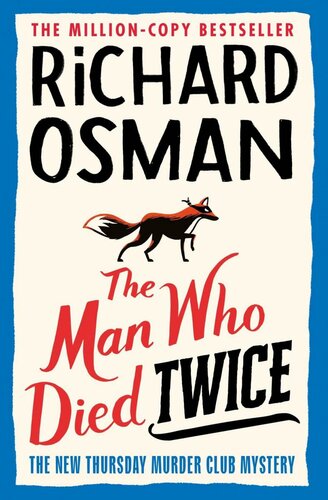
The Man Who Died Twice
About this book
Elizabeth receives a letter from a man who should be dead. He is a former colleague from her intelligence career, now hiding nearby after stealing diamonds from people who will kill to recover them.
The request gives Joyce, Ibrahim, and Ron a new investigation with unusually immediate danger. Their quiet retirement village becomes a meeting point for spies, criminals, police officers, and people who underestimate the four friends at their own expense.
The diamonds are only part of the trouble. A violent assault close to the club turns the case personal, while competing stories about betrayal make it difficult to know which endangered person is also lying.
The Man Who Died Twice is the second Thursday Murder Club novel. Richard Osman keeps the puzzle brisk and funny without treating friendship, age, injury, or grief lightly; the club's greatest advantage remains the different life each member has already lived.
Read a sample
5,015 words
Plain text
From the opening
Sylvia Finch wonders how much longer she can do this.
One foot in front of the other, her suede shoes darkening in the autumn puddles.
Death hangs about her like a fine mist. It is in her hair and in her clothes. Surely everyone she passes can tell?
Will she ever be rid of it? Sylvia hopes so, and she also hopes not.
When was the last time something truly good happened? Something that gave her some hope?
As Sylvia keys in the security code for the door, the sun breaks through the clouds.
In she goes.
Part One
YOUR FRIENDS ARE SURE TO VISIT
1
The following Thursday …
‘I was talking to a woman in Ruskin Court and she said she’s on a diet,’ says Joyce, finishing her glass of wine. ‘She’s eighty-two!’
‘Zimmer frames make you look fat,’ says Ron. ‘It’s the thin legs.’
‘Why diet at eighty-two?’ says Joyce. ‘What’s a sausage roll going to do to you? Kill you? Well, join the queue.’
The Thursday Murder Club has concluded its latest meeting. This week they have been looking at the cold case of a Hastings newsagent who murdered an intruder with a crossbow. He’d been arrested, but then the media had got involved, and the consensus was that a man should be allowed to protect his own shop with a crossbow, for goodness’ sake. He walked free, head held high.
A month or so later police had discovered that the intruder was dating the newsagent’s teenage daughter, and the newsagent had a long record of GBH, but at that point everybody had moved on. It was 1975, after all. No CCTV, and no one wanting to make a fuss.
‘Do you think a dog might be good company?’ asks Joyce. ‘I thought I might either get a dog or join Instagram.’
‘I would advise against it,’ says Ibrahim.
‘Oh, you’d advise against everything,’ says Ron.
‘Broadly, yes,’ agrees Ibrahim.
‘Not a big dog, of course,’ says Joyce. ‘I haven’t got the hoover for a big dog.’
Joyce, Ron, Ibrahim and Elizabeth are enjoying lunch at the restaurant that sits at the heart of the Coopers Chase community. There is a bottle of red and a bottle of white on their table. It is around a quarter to twelve.
‘Don’t get a small dog though, Joyce,’ says Ron. ‘Small dogs are like small men: always got a point to prove. Yapping it up, barking at cars.’
Joyce nods. ‘Perhaps a medium dog, then? Elizabeth?’
‘Mmm, good idea,’ replies Elizabeth, though she is not really listening. How could she be, after the letter she has just received?
She’s picking up the main points, of course. Elizabeth always stays alert, because you never know what might fall into your lap. She has heard all sorts over the years. A snippet of conversation in a Berlin bar, a loose-lipped Russian sailor on shore leave in Tripoli. In this instance, on a Thursday lunchtime in a sleepy Kent retirement village, it seems that Joyce wants a dog, there is a discussion about sizes and Ibrahim has doubts. But her mind is elsewhere.
The letter was slipped under Elizabeth’s door, by unseen hand.
Dear Elizabeth,
I wonder if you remember me? Perhaps you don’t, but without blowing my own trumpet, I imagine you might.
Life has worked its magic once more, and I discover, upon moving in this week, that we are now neighbours. What company I keep! You must be thinking they let in any old riff-raff these days.
I know it has been some while since you last saw me, but I think it would be wonderful to renew our acquaintance after all these years.
Would you like to join me at 14 Ruskin Court for a drink? A little housewarming? If so, how would 3 p.m. tomorrow suit? No need to reply, I shall await with a bottle of wine regardless.
It really would be lovely to see you. So much to catch up on. An awful lot of water under the bridge and so on.
I do hope you remember me, and I do hope to see you tomorrow.
Your old friend,
Marcus Carmichael
Elizabeth has been mulling it over ever since.
The last time she had seen Marcus Carmichael would have been late November 1981, a very dark, very cold night by Lambeth Bridge, the Thames at low tide, her breath clouding in the freezing air. There had been a team of them, each one a specialist, and Elizabeth was in charge. They arrived in a white Transit van, shabby on the outside, seemingly owned by ‘G. Procter – Windows, Gutters, All Jobs Considered’, but, on the inside, gleaming, full of buttons and screens. A young constable had cordoned off an area of the foreshore and the pavement on the Albert Embankment had been closed.
Elizabeth and her team clambered down a flight of stone steps, lethal with slick moss. The low tide had left behind a corpse, propped, almost sitting, against the nearest stone pillar under the bridge. Everything had been done properly, Elizabeth had made sure of that. One of her team had examined the clothing and rifled through the pockets of his heavy overcoat, a young woman from Highgate had taken photographs and the doctor had recorded the death. It was clear the man had jumped into the Thames further upstream, or been pushed. That was for the coroner to decide. It would all be typed into a report by somebody or other and Elizabeth would simply add her initials at the bottom. Neat and tidy.
Continue reading the sampleClose the sample
The journey back up those slick steps with the corpse on a military stretcher had taken some time. The young constable, thrilled to have been called to help, had fallen and broken an ankle, which was all they needed. They explained they wouldn’t be able to call an ambulance for the time being, and he took it in fairly good part. He received an unwarranted promotion several months later, so no lasting harm was done.
Her little unit eventually reached the Embankment, and the body was loaded into the white Transit van. ‘All jobs considered’.
The team dispersed, save for Elizabeth and the doctor, who stayed in the van with the corpse as it was driven to a morgue in Hampshire. She hadn’t worked with this particular doctor before – broad, red-faced, a dark moustache turning grey – but he was interesting enough. A man you would remember. They’d discussed euthanasia and cricket until the doctor had dozed off.
Ibrahim is making a point with his wine glass. ‘I’m afraid I would advise against a dog altogether, Joyce, small, medium, or large. At your time in life.’
‘Oh, here he comes,’ says Ron.
‘A medium dog,’ says Ibrahim, ‘say a terrier, or a Jack Russell perhaps, would have a life expectancy of around fourteen years.’
‘Says who?’ asks Ron.
‘Says the Kennel Club, in case you want to take it up with them, Ron. Would you like to take it up with them?’
‘No, you’re all right.’
‘Now, Joyce,’ Ibrahim continues, ‘you are seventy-seven years old?’
Joyce nods, ‘Seventy-eight next year.’
‘Well, that goes without saying, yes,’ agrees Ibrahim. ‘So, at seventy-seven years old, we have to take a look at your life expectancy.’
‘Ooh, yes!’ says Joyce. ‘I love this sort of thing. I had my Tarot done on the pier once. She said I was going to come into money.’
‘Specifically, we have to look at the chances of your life expectancy exceeding the life expectancy of a medium dog.’
‘It’s a mystery to me why you never got married, old son,’ says Ron to Ibrahim, and takes the bottle of white wine from the cooler on the table. ‘With that silver tongue of yours. Top-up, anyone?’
‘Thank you, Ron,’ says Joyce. ‘Fill it to the brim to save having to do it again.’
Ibrahim continues. ‘A woman of seventy-seven has a fifty-one per cent chance of living for another fifteen years.’
‘This is jolly,’ says Joyce. ‘I didn’t come into money, by the way.’
‘So if you were to get a dog now, Joyce, would you outlive it? That’s the question.’
‘I’d outlive a dog through pure spite,’ says Ron. ‘We’d just sit in opposite corners of the room, staring each other out, and see who went first. Not me. It’s like when we were negotiating with British Leyland in ’seventy-eight. The moment one of their lot went to the loo first, I knew we had ’em.’ Ron knocks back more wine. ‘Never go to the loo first. Tie a knot in it if you have to.’
‘The truth is, Joyce,’ says Ibrahim. ‘Maybe you would, and maybe you wouldn’t. Fifty-one per cent. It’s the toss of a coin, and I don’t believe that is a risk worth taking. You must never die before your dog.’
‘And is that an old Egyptian saying, or an old psychiatrist’s saying?’ asks Joyce. ‘Or something you just made up?’
Ibrahim tips his glass towards Joyce again, an indication of more wisdom to come. ‘You must die before your children, of course, because you have taught them to live without you. But not your dog. You teach your dog only to live with you.’
‘Well, that is certainly food for thought, Ibrahim; thank you,’ says Joyce. ‘A bit soulless perhaps. Don’t you think, Elizabeth?’
Elizabeth hears, but her mind is still in the back of the speeding Transit van, with the corpse and the doctor with the moustache. Not the only such occasion in Elizabeth’s career, but unusual enough to be memorable – anyone who knew Marcus Carmichael would have known that.
‘Beat Ibrahim’s system,’ Elizabeth says. ‘Get a dog that’s old already.’
And here was Carmichael again, years later. Looking for what? A friendly chat? Cosy reminiscence by an open fire? Who knew?
Their bill is brought to the table by a new member of the serving staff. Her name is Poppy and she has a tattoo of a daisy on her forearm. Poppy has been at the restaurant for nearly two weeks now and, thus far, the reviews have not been good.
‘You’ve brought us table twelve, Poppy,’ says Ron.
Poppy nods. ‘Oh, yes, that’s … silly me … what table is this?’
‘Fifteen,’ says Ron. ‘You can tell because of the big number fifteen written on the candle.’
‘Sorry,’ says Poppy. ‘It’s just remembering the food, and carrying it, and then the numbers. I’ll get the hang of it eventually.’ She walks back to the kitchens.
‘She is very well meaning,’ says Ibrahim. ‘But ill suited to this role.’
‘She has lovely nails, though,’ says Joyce. ‘Immaculate. Immaculate, aren’t they, Elizabeth?’
Elizabeth nods. ‘Immaculate.’ Not the only thing she has noticed about Poppy, who seems to have sprung from nowhere, with her nails and her incompetence. But she has other things on her mind for now, and the mystery of Poppy can wait for another day.
She is going through the text of the letter again in her head. I wonder if you remember me? An awful lot of water under the bridge …
Did Elizabeth remember Marcus Carmichael? What a ridiculous question. She had found Marcus Carmichael’s dead body slumped against a Thames bridge at low tide. She had helped to carry that body up those slick stone steps in the dead of night. She had sat feet away from his corpse in a white Transit van advertising window-cleaning services. She had broken the news of his death to his young wife and she had stood beside the grave at his funeral, as an appropriate mark of respect.
So, yes, Elizabeth remembers Marcus Carmichael very well indeed. Time to be back in the room though. One thing at a time.
Elizabeth reaches for the white wine. ‘Ibrahim, not everything is about numbers. Ron, you would die long before the dog, male life expectancy is far lower than female life expectancy, and you know what your GP has said about your blood sugar. And Joyce, we both know you’ve already made up your mind. You’ll get a rescue dog. It’ll be sitting somewhere right now, all alone with big eyes, just waiting for you. You will be powerless, and, besides, it’ll be fun for all of us, so let’s stop even discussing it.’
Job done.
‘And how about Instagram?’ says Joyce.
‘I don’t even know what that is, so feel free,’ says Elizabeth, and finishes her wine.
An invitation from a dead man? On reflection, she will be accepting.
2
‘We were watching Antiques Roadshow the other night,’ says DCI Chris Hudson, drumming his fingers on the steering wheel. ‘And this woman comes on, and she’s got these jugs, and your mum leans over to me and says –’
PC Donna De Freitas slams her head against the dashboard. ‘Sir, I am begging you. I am literally begging you. Please stop talking about my mum for ten minutes.’
Chris Hudson is supposed to be mentoring her, smoothing her eventual path into CID, but you wouldn’t know it from the almost total disrespect with which they treat each other, or, indeed, from their friendship, which had blossomed the moment they met.
Donna had recently introduced Chris, her boss, to Patrice, her mum. She thought they might get along. As it turned out, they are getting along a little bit too well for her liking.
Stakeouts with Chris Hudson used to be more fun. There would be crisps, there would be quizzes, there would be gossip about the new DS who’d just started at Fairhaven and had accidentally sent a picture of his penis to a local shopkeeper who was asking for advice on security grilles.
They’d laugh, they’d eat, they’d put the world to rights.
But now? Sitting in Chris’s Ford Focus on a late-autumn evening, keeping a watchful eye on Connie Johnson’s lock-up? Now Chris has a Tupperware container filled with olives, carrot batons and hummus. The Tupperware container bought by her mum, the hummus made by her mum and the carrot batons sliced by her mum. When Donna had suggested buying a KitKat he’d looked at her and said ‘empty calories’.
Connie Johnson was their friendly local drug dealer. Well, Connie was more a drug wholesaler these days. The two Antonio brothers from St Leonards had controlled the local drug trade for some years, but they had gone missing around a year ago and Connie Johnson had stepped into the breach. Whether she was just a drug wholesaler, or whether she was a murderer too, was open to question, but, either way, that’s why they were spending their week sitting in a Ford Focus, training binoculars on a Fairhaven lock-up.
Chris has lost a bit of weight, he has had a nice haircut, and is now wearing a pair of age-appropriate trainers – everything Donna had ever told him to do. She had used all the tricks in the book to encourage him, to convince him, to cajole him into looking after himself. But it turned out that, all along, the only real motivation he needed to change was to start having sex with her mum. You have to be so careful what you wish for.
Donna sinks back into her seat and puffs out her cheeks. She would kill for a KitKat.
‘Fair enough, fair enough,’ says Chris. ‘OK, I spy, with my little eye, something beginning with Y.’
Donna looks out of the window. Far below she sees the line of lock-up garages, one of which belongs to Connie Johnson, the new drugs kingpin of Fairhaven. Queenpin? Beyond the lock-ups is the sea. The English Channel, inky black, moonlight picking out gentle waves. There is a light on the horizon, far out to sea.
‘Yacht?’ says Donna.
‘Nope,’ says Chris, shaking his head.
Donna stretches and looks back towards the row of garages. A hooded figure on a BMX bike rides up to Connie’s lock-up and bangs on the door. They can hear the faint metallic thunder even up on the hill.
‘Youth on bicycle?’ says Donna.
‘Nope,’ says Chris.
Donna watches as the door opens and the boy walks inside. All day, every day, this was happening. Couriers in and out. Leaving with coke, Es and hash, coming back with cash. It was non-stop. Donna knows they could raid the place right now and find a nice little haul of drugs, a bored middleman sitting at a table and a youth on a bicycle. But, instead, the team were biding their time, taking photographs of whoever walked in or out, following them wherever they were going, trying to build up a full picture of Connie Johnson’s operation. Gathering enough evidence to take the whole thing down in one go. With any luck there would be a series of dawn raids. With a bit more luck they would have a tactical support group armed with pneumatic battering rams to smash a few doors down and one of the tactical support officers would be single.
‘Yellow jacket?’ says Donna, seeing a woman walking along the high path towards the car park.
‘Nope,’ says Chris.
The big prize was Connie Johnson herself. That’s why she and Chris were there. Had Connie murdered two rivals and got away with it?
Occasionally, among the youths on bicycles they would see more familiar faces. Senior figures from the Fairhaven drug scene. Every name was noted. If Connie had murdered the Antonio brothers, then she hadn’t done it by herself. She was no fool. Sooner or later, in fact, she would notice she was being watched. Then things would become less blatant, harder to track. So they were getting all their evidence lined up while they could.
Donna jumps as a knuckle raps on her side window. She turns and sees the yellow jacket of the woman who had been walking along the path. A smiling face appears at the window and holds up two cups of coffee. Donna registers the shock of blonde hair and the smear of red lipstick. She winds down her window.
The woman crouches, then smiles. ‘Now, we haven’t been introduced, but I think you’re Donna and Chris. I bought you coffees from the garage.’
She hands the coffees over, and Donna and Chris look at each other and take them.
‘I’m Connie Johnson, but I think you know that,’ says the woman. She pats the pockets of her jacket. ‘I also bought sausage rolls, if you’d like one?’
‘No, thank you,’ says Chris.
‘Yes, please,’ says Donna.
Connie hands Donna a sausage roll in a paper bag. ‘I’m afraid I didn’t buy anything for the policewoman hiding behind the bins, taking all the photographs.’
‘She’s vegan anyway,’ says Donna. ‘From Brighton.’
‘Anyway, just wanted to introduce myself,’ says Connie. ‘Feel free to arrest me any time.’
‘We will,’ says Chris.
‘What’s your eye-shadow?’ Connie asks Donna.
‘Pat McGrath, Gold Standard,’ says Donna.
‘It’s lush,’ says Connie. ‘Anyway, business all done for today if you wanted to go home. And you haven’t seen anything I didn’t want you to see for the last two weeks.’
Chris sips his coffee. ‘Is this really from the garage? It’s very good.’
‘They’ve got a new machine,’ says Connie. She reaches into an inside pocket, takes out an envelope and hands it to Donna. ‘You can have these. There’s photographs of you in there, photographs of all the other officers you’ve had crawling around, too. Two can play at that game. Bet you didn’t see anyone take them, eh? Followed a few of you home too. They took a nice one of you on a date the other day, Donna. You can do better, that’s my opinion.’
‘Yep,’ says Donna.
‘I’ll be on my way, but nice to finally say hello in person. I’ve been dying to meet you.’ Connie blows them a kiss. ‘Don’t be strangers.’
Connie straightens up and walks away from the Ford Focus. Behind them a Range Rover appears. The passenger door is opened and Connie climbs in and is driven away.
‘Well,’ says Chris.
‘Well,’ agrees Donna. ‘What now?’
Chris shrugs.
‘Great plan, boss,’ says Donna. ‘What was your I spy? Something beginning with Y?’
Chris turns his key in the ignition and puts on his seatbelt. ‘It was your mother’s beautiful face. I see it every time I close my eyes.’
‘Oh, Christ,’ says Donna. ‘I’m asking for a transfer.’
‘Good idea,’ says Chris. ‘Not until we’ve nicked Connie Johnson though, eh?’
3
Joyce
I do wish something exciting would happen again. I don’t mind what.
Perhaps a fire, but where no one gets hurt? Just flames and fire engines. We can all stand around watching, with flasks, and Ron can shout advice to the firefighters. Or an affair, that would be fun. Preferably mine, but I’m not greedy, so long as there’s a bit of scandal, like a big age difference, or someone suddenly needing a replacement hip. Perhaps a gay affair? We haven’t had one of those at Coopers Chase yet, and I think everyone would enjoy it. Maybe someone’s grandson could go to prison? Or a flood that doesn’t affect us? You know the sort of thing I mean.
When you think of how many people have died around here recently, it is quite hard to just go back to pottering around the garden centre and watching old episodes of Taggart. Although I do like Taggart.
When I was a nurse, patients would die all the time. They were popping off left, right and centre. Don’t get the wrong idea, I never killed anyone, although it would have been very easy to. Easier than a doctor. They used to check up on doctors a lot. They probably check up on everyone these days, but I bet you could still do it if the mood took you.
Ibrahim doesn’t want me to get a dog, but I am sure I can change his mind. Before you know it, he’ll be dog this and dog that. You can bet he’ll be first in line to walk it, too. I wish I’d got my hands on Ibrahim thirty years ago.
There is an animal rescue centre just across the border in Sussex, and they have all sorts there. The usual cats and dogs, but then also donkeys and rabbits and guinea pigs. I’ve never thought that a guinea pig might need rescuing before, but I suppose they do. We all need it once in a while, and I don’t see why guinea pigs would be any different. They eat guinea pigs in Peru, did you know? It was on MasterChef the other day. They just mentioned it, they didn’t actually eat one.
Lots of the dogs are from Romania; they save them and bring them over. I don’t know how they bring them over, that’s something I will ask. I don’t imagine they have a plane full of dogs. In a big van? They will have worked out a way. Ron says they will bark in a foreign accent, but that’s Ron.
We looked on the rescue centre website and you should see the dogs, honestly. There is one called Alan I have got my eye on. ‘Indeterminate terrier’, according to his profile. You and me both, I thought when I saw that. Alan is six years old, and they say you mustn’t change their names, because they get used to them, but I won’t call a dog Alan, whatever pressure I am put under.
Maybe I can persuade Ibrahim to drive me over next week. He’s gone car mad recently. He’s even driving into Fairhaven tomorrow. He has really come out of his shell since everyone started getting murdered. Driving here, there and everywhere like he’s Murray Walker.
I’m still wondering why Elizabeth was in a funny mood at lunch. Listening but not listening. Perhaps something is wrong with Stephen? You remember, her husband? Or perhaps she’s still not over Penny. Either way, she has something on her mind, and she walked away from lunch with a purpose. That’s always bad news for someone. Your only real hope is that it’s not you.
I am also knitting. I know, can you imagine?
I got talking to Deirdre at Knit & Natter. Her husband was French but died some time ago – I think he fell off a ladder, but it might have been cancer, I can’t remember. Deirdre has been knitting little friendship bracelets for charity and has given me the pattern. You make them in different colours, depending on who you make them for. People pay you whatever they choose and all the money goes to charity. I also put sequins on mine. The pattern doesn’t say to put sequins on, but I’ve had some in a drawer for ages.
I made a red, white and blue bracelet for Elizabeth. It was my first go and was rather ragged but she was very good about it. I asked her what charity she wanted the money to go to and she said Living With Dementia and that’s the closest we have got to talking about Stephen. I don’t think she can keep him to herself for much longer, though; dementia just ploughs on through the woods and never turns back. Poor Elizabeth. Poor Stephen as well, obviously.
I also made a friendship bracelet for Bogdan. It was yellow and blue, which I had mistakenly thought were the colours of the Polish flag. According to Bogdan, the colours of the Polish flag are red and white, and, to give him his due, he would know. He thought that perhaps I had been thinking of Sweden, and perhaps I had. Gerry would have put me right. Like all good husbands, Gerry knew all the flags.
I saw Bogdan wearing his bracelet the other day. He was on his way up to work at the building site at the top of the hill, and he gave me a little wave and there it was on his wrist, wrapped around his tattoos of goodness knows what. I know it’s silly, but I couldn’t stop smiling. The sequins were sparkling in the sunshine and so was I.
Elizabeth hasn’t worn hers yet, and I can’t say I blame her. I am getting better at it though, and, besides, Elizabeth and I don’t need a bracelet to show we are friends.
Last night I dreamt of the house Gerry and I lived in when we were first married. We opened a door and found a new room we hadn’t ever seen before, and we were full of schemes as to what to do with it.
I don’t know what age Gerry was, he was just Gerry, but I was me now. Two people who never met, touching and laughing and making plans. A pot plant here, a coffee table there. The stuff of love.
When I woke up, and realized Gerry had gone, my heart broke once again, and I sobbed and sobbed. I imagine if you could hear all the morning tears in this place it would sound like birdsong.
4
It is another glorious autumn day, but there is a bite in the air that tells you there won’t be too many left. Winter is waiting impatiently round the corner.
It is 3 p.m., and Elizabeth is carrying flowers for Marcus Carmichael. The dead man. That drowned body, suddenly alive as you like and living at 14 Ruskin Court. The man she saw lowered into a grave in a Hampshire churchyard, now unpacking boxes and struggling with his new Wi-Fi.
She walks past Willows, the nursing home at the heart of Coopers Chase. The place Elizabeth would visit every day while Penny was there, just to sit and chat to her old friend, to plot and to gossip, not knowing whether Penny could hear her or not.
No more Penny now, of course.
The nights are beginning to draw in a little, and the sun is sinking behind the trees on top of the hill as Elizabeth reaches Ruskin Court and rings the bell for number 14. Here goes nothing. There is a brief wait and she is buzzed up.
There are lifts in all the buildings, but Elizabeth will use the stairs while she still can. Stairs are good for hip and knee flexibility. Also, it is very easy to kill someone in a lift when the doors open. Nowhere to run, nowhere to hide, and a ping to announce you’re about to appear. Not that she’s worried about being killed, it doesn’t feel to her like that’s what is happening here, but it’s always important to remember best practice. Elizabeth has never killed anyone in a lift. She once saw someone pushed down an empty lift shaft in Essen, but that was different.
She turns left at the top of the stairs, transfers the flowers to her left hand and knocks on the door of number 14. Who will answer the door? What is the story here? Should she be worried?
The door opens, and she sees a very familiar face.
It’s not Marcus Carmichael, how could it have been? But it is certainly someone who knew the name Marcus Carmichael. And who knew it would get her attention.
And it turns out that, yes, she should be worried.
The man is handsome and tanned, strands of sandy grey hair still gamely holding on. She might have known he would never go bald.
How to play this one?
‘Marcus Carmichael, I assume?’ says Elizabeth.
‘Well, I assume so, too,’ says the man. ‘Good to see you, Elizabeth. Are those flowers for me?’
‘No, I have taken to carrying flowers around with me as an affectation,’ says Elizabeth, handing them over as she is ushered in.
‘Quite right, quite right, I’ll put them in water, nonetheless. Come in, sit down, make yourself at home.’ He disappears into the kitchen.
Elizabeth takes in the flat: bare, not a picture, not an ornament, not a single frill to be seen. No sign of anyone ‘moving in’. Two armchairs, both ready for the skip, a pile of books on the floor, a reading lamp.