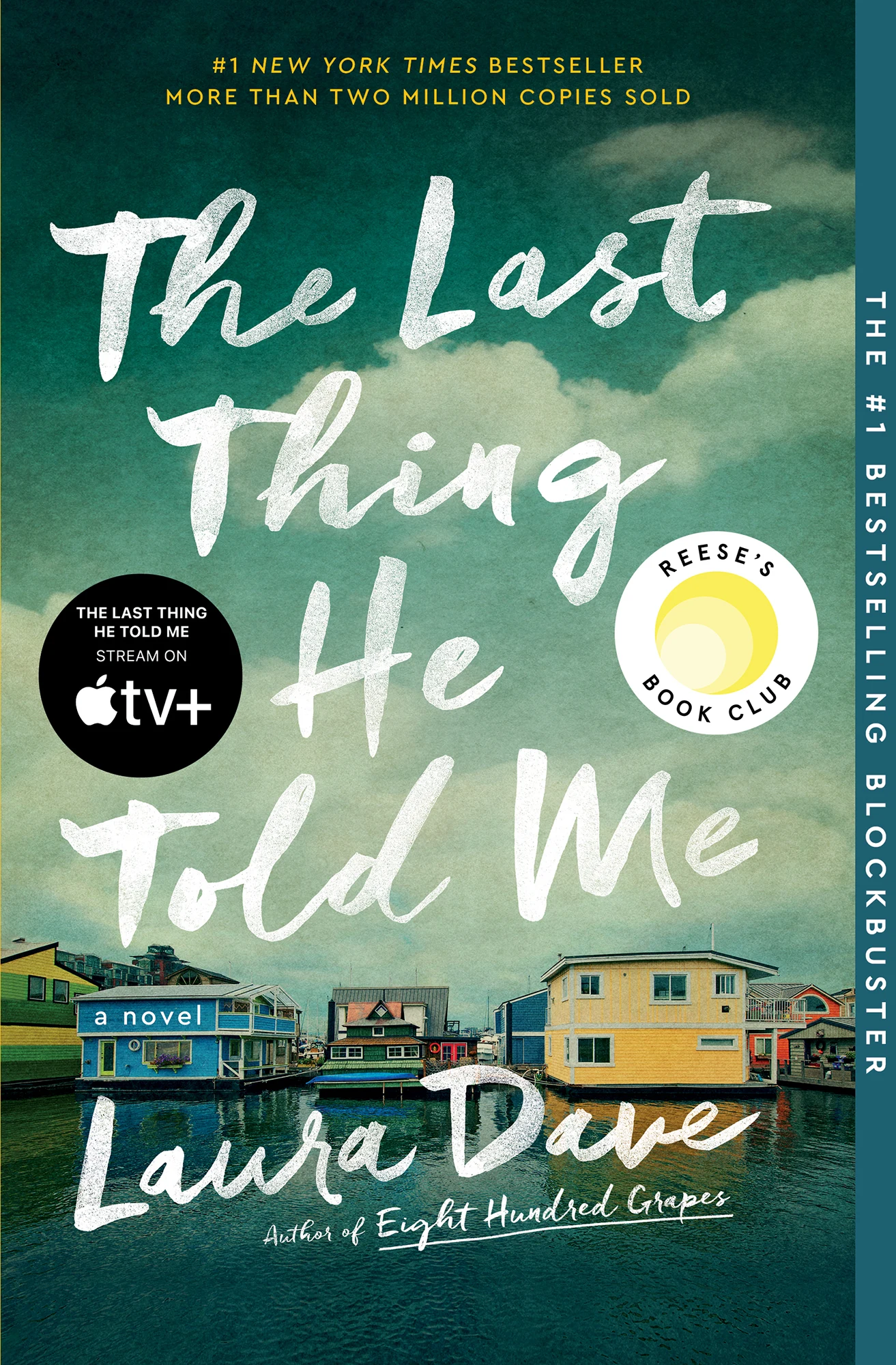
The Last Thing He Told Me
About this book
Hannah Hall has been married to Owen Michaels for a little more than a year when a child delivers his note: Protect her. By evening Owen is missing, his company is under federal investigation, and a bag of cash has appeared in his sixteen-year-old daughter's school locker.
Bailey has never welcomed Hannah into the family, but she is the person the message names. Their shared search begins with the discovery that basic facts Owen told them about his past do not survive examination.
A memory of a football game leads Hannah and Bailey to Austin, where fragments of recognition point toward another name and a danger Owen may have spent years avoiding. The closer they come to an answer, the less likely it is that finding him will restore their former life.
The Last Thing He Told Me is a domestic mystery organized around an improvised alliance between stepmother and daughter. Laura Dave treats protection not as secrecy alone, but as the difficult choice to build a family from what remains after the secret breaks.
Read a sample
5,006 words
Plain text
From the opening
Prologue
Owen used to like to tease me about how I lose everything, about how, in my own way, I have raised losing things to an art form. Sunglasses, keys, mittens, baseball hats, stamps, cameras, cell phones, Coke bottles, pens, shoelaces. Socks. Lightbulbs. Ice trays. He isn’t exactly wrong. I did used to have a tendency to misplace things. To get distracted. To forget.
On our second date, I lost the ticket stub for the parking garage where we’d left the cars during dinner. We’d each taken our own car. Owen would later joke about this—would love joking about how I insisted on driving myself to that second date. Even on our wedding night he joked about it. And I joked about how he’d grilled me that night, asking endless questions about my past—about the men I’d left behind, the men who had left me.
He’d called them the could-have-been boys. He raised a glass to them and said, wherever they were, he was grateful to them for not being what I needed, so he got to be the one sitting across from me.
You barely know me, I’d said.
He smiled. It doesn’t feel that way, does it?
He wasn’t wrong. It was overwhelming, what seemed to live between us, right from the start. I like to think that’s why I was distracted. Why I lost the parking ticket.
We parked in the Ritz-Carlton parking garage in downtown San Francisco. And the parking attendant shouted that it didn’t matter if I claimed I’d only been there for dinner.
The fee for a lost parking ticket was a hundred dollars. “You could have kept the car here for weeks,” the parking attendant said. “How do I know you’re not trying to pull a fast one? A hundred dollars plus tax for every lost stub. Read the sign.” A hundred dollars plus tax to go home.
“Are you sure that it’s lost?” Owen asked me. But he was smiling as he said it, as if this were the best piece of news about me that he’d gotten all night.
I was sure. I searched every inch of my rented Volvo anyway and of Owen’s fancy sports car (even though I’d never been in it) and of that gray, impossible parking garage floor. No stub. Not anywhere.
The week after Owen disappeared, I had a dream of him standing in that parking lot. He was wearing the same suit—the same charmed smile. In the dream he was taking off his wedding ring.
Look, Hannah, he said. Now you’ve lost me too.
— Part 1 —
I have little patience with scientists who take a board of wood, look for its thinnest part, and drill a great number of holes where drilling is easy.
—Albert Einstein
If You Answer the Door for Strangers…
You see it all the time on television. There’s a knock at the front door. And, on the other side, someone is waiting to tell you the news that changes everything. On television, it’s usually a police chaplain or a firefighter, maybe a uniformed officer from the armed forces. But when I open the door—when I learn that everything is about to change for me—the messenger isn’t a cop or a federal investigator in starched pants. It’s a twelve-year-old girl, in a soccer uniform. Shin guards and all.
“Mrs. Michaels?” she says.
I hesitate before answering—the way I often do when someone asks me if that is who I am. I am and I’m not. I haven’t changed my name. I was Hannah Hall for the thirty-eight years before I met Owen, and I didn’t see a reason to become someone else after. But Owen and I have been married for a little over a year. And, in that time, I’ve learned not to correct people either way. Because what they really want to know is whether I’m Owen’s wife.
It’s certainly what the twelve-year-old wants to know, which leads me to explain how I can be so certain that she is twelve, having spent most of my life seeing people in two broad categories: child and adult. This change is a result of the last year and a half, a result of my husband’s daughter, Bailey, being the stunningly disinviting age of sixteen. It’s a result of my mistake, upon first meeting the guarded Bailey, of telling her that she looked younger than she was. It was the worst thing I could have done.
Maybe it was the second worst. The worst thing was probably my attempt to make it better by cracking a joke about how I wished someone would age me down. Bailey has barely stomached me since, despite the fact that I now know better than to try to crack a joke of any kind with a sixteen-year-old. Or, really, to try and talk too much at all.
But back to my twelve-year-old friend standing in the doorway, shifting from dirty cleat to dirty cleat.
“Mr. Michaels wanted me to give you this,” she says.
Then she thrusts out her hand, a folded piece of yellow legal paper inside her palm. HANNAH is written on the front in Owen’s writing.
I take the folded note, hold her eyes. “I’m sorry,” I say. “I’m missing something. Are you a friend of Bailey’s?”
“Who’s Bailey?”
I didn’t expect the answer to be yes. There is an ocean between twelve and sixteen. But I can’t piece this together. Why hasn’t Owen just called me? Why is he involving this girl? My first guess would be that something has happened to Bailey, and Owen couldn’t break away. But Bailey is at home, avoiding me as she usually does, her blasting music (today’s selection: Beautiful: The Carole King Musical) pulsing all the way down the stairs, its own looping reminder that I’m not welcome in her room.
Continue reading the sampleClose the sample
“I’m sorry. I’m a little confused… where did you see him?”
“He ran past me in the hall,” she says.
For a minute I think she means our hall, the space right behind us. But that doesn’t make sense. We live in a floating home on the bay, a houseboat as they are commonly called, except here in Sausalito, where there’s a community of them. Four hundred of them. Here they are floating homes—all glass and views. Our sidewalk is a dock, our hallway is a living room.
“So you saw Mr. Michaels at school?”
“That’s what I just said.” She gives me a look, like where else? “Me and my friend Claire were on our way to practice. And he asked us to drop this off. I said I couldn’t come until after practice and he said, fine. He gave us your address.”
She holds up a second piece of paper, like proof.
“He also gave us twenty bucks,” she adds.
The money she doesn’t hold up. Maybe she thinks I’ll take it back.
“His phone was broken or something and he couldn’t reach you. I don’t know. He barely slowed down.”
“So… he said his phone was broken?”
“How else would I know?” she says.
Then her phone rings—or I think it’s a phone until she picks it off her waist and it looks more like a high-tech beeper. Are beepers back?
Carole King show tunes. High-tech beepers. Another reason Bailey probably doesn’t have patience for me. There’s a world of teen things I know absolutely nothing about.
The girl taps away on her device, already putting Owen and her twenty-dollar mission behind her. I’m reluctant to let her go, still unsure about what is going on. Maybe this is some kind of weird joke. Maybe Owen thinks this is funny. I don’t think it’s funny. Not yet, anyway.
“See you,” she says.
She starts walking away, heading down the docks. I watch her get smaller and smaller, the sun down over the bay, a handful of early evening stars lighting her way.
Then I step outside myself. I half expect Owen (my lovely and silly Owen) to jump out from the side of the dock, the rest of the soccer team giggling behind him, the lot of them letting me in on the prank I’m apparently not getting. But he isn’t there. No one is.
So I close our front door. And I look down at the piece of yellow legal paper still folded in my hand. I haven’t opened it yet.
It occurs to me, in the quiet, how much I don’t want to open it. I don’t want to know what the note says. Part of me still wants to hold on to this one last moment—the moment where you still get to believe this is a joke, an error, a big nothing; the moment before you know for sure that something has started that you can no longer stop.
I unfold the paper.
Owen’s note is short. One line, its own puzzle.
Protect her.
Greene Street Before It Was Greene Street
I met Owen a little over two years ago.
I was still living in New York City then. I was living three thousand miles from Sausalito, the small Northern California town that I now call home. Sausalito is on the other side of the Golden Gate from San Francisco, but a world away from city life. Quiet, charming. Sleepy. It’s the place that Owen and Bailey have called home for more than a decade. It is also the polar opposite of my previous life, which kept me squarely in Manhattan, in a lofted storefront on Greene Street in SoHo—a small space with an astronomical rent I never quite believed I could afford. I used it as both my workshop and my showroom.
I turn wood. That’s what I do for work. People usually make a face when I tell them this is my job (however I try to describe it), images of their high school woodshop class coming to mind. Being a woodturner is a little like that, and nothing like that. I like to describe it as sculpting, but instead of sculpting clay, I sculpt wood.
I come by the profession naturally. My grandfather was a woodturner—an excellent one, at that—and his work was at the center of my life for as far back as I can remember. He was at the center of my life for as far back as I can remember, having raised me mostly on his own.
My father, Jack, and my mother, Carole (who preferred that I refer to her as Carole), were largely uninterested in doing any childrearing. They were largely uninterested in anything except my father’s photography career. My grandfather encouraged my mother to make an effort with me when I was young, but I barely knew my father, who traveled for work 280 days a year. When he did have time off, he hunkered down at his family’s ranch in Sewanee, Tennessee, as opposed to driving the two hours to my grandfather’s house in Franklin to spend time with me. And, shortly after my sixth birthday, when my father left my mother for his assistant—a woman named Gwendolyn who was newly twenty-one—my mother stopped coming home as well. She chased my father down until he took her back. Then she left me with my grandfather full-time.
If it sounds like a sob story, it isn’t. Of course, it isn’t ideal to have your mother all but disappear. It certainly didn’t feel good to be on the receiving end of that choice. But, when I look back now, I think my mother did me a favor exiting the way she did—without apology, without vacillation. At least she made it clear: There was nothing I could have done to make her want to stay.
And, on the other side of her exit, I was happier. My grandfather was stable and kind and he made me dinner every night and waited for me to finish dinner before he announced it was time to get up and read me stories before we went to sleep. And he always let me watch him work.
I loved watching him work. He’d start with an impossibly enormous piece of wood, moving it over a lathe, turning it into something magical. Or, if it was less than magical, he would figure out how to start over again.
That was probably my favorite part of watching him work: when he would throw up his hands and say, “Well, we’ve got to do this different, don’t we?” Then he’d go about finding a new way into what he wanted to create. I’m guessing any psychologist worth her salt would say that it must have given me hope—that I must have thought my grandfather would help me do the same thing for myself. To start again.
But, if anything, I think I took comfort in the opposite. Watching my grandfather work taught me that not everything was fluid. There were certain things that you hit from different angles, but you never gave up on. You did the work that was needed, wherever that work took you.
I never expected to be successful at woodturning—or at my foray from there into making furniture. I half expected I wouldn’t be able to make a living out of it. My grandfather regularly supplemented his income by picking up construction work. But early on, when one of my more impressive dining room tables was featured in Architectural Digest, I developed a niche among a subset of downtown New York City residents. As one of my favorite interior designers explained it, my clients wanted to spend a lot of money decorating their homes in a way that made it look like they weren’t spending any money at all. My rustic wood pieces helped with their mission.
Over time, this devoted clientele turned into a somewhat larger clientele in other coastal cities and resort towns: Los Angeles, Aspen, East Hampton, Park City, San Francisco.
This was how Owen and I met. Avett Thompson—the CEO of the tech firm where Owen worked—was a client. Avett and his wife, the ridiculously gorgeous Belle, were among my most loyal clients.
Belle liked to joke that she was Avett’s trophy wife, which may have been funnier if it also wasn’t so on point. She was a former model, ten years younger than his grown children, born and raised in Australia. My pieces were in every room of her town house in San Francisco (where she and Avett lived together) and her newly constructed country house in St. Helena, a small town on the northern end of Napa Valley where Belle tended to retreat alone.
I had met Avett only a handful of times before he and Owen showed up at my workshop. They were in New York for an investor meeting and Belle wanted them to stop by to check on a rolled-edge side table she’d asked me to make for their bedroom. Avett wasn’t sure what he should be checking for, something about how the table would look with the bed frame—the bed frame that would hold their ten-thousand-dollar organic mattress.
Avett couldn’t have cared less, honestly. When he and Owen walked in, he was in a sharp blue suit, his graying hair crunchy with hair gel, the phone glued to his ear. He was in the middle of a phone call. He took one look at the side table and briefly covered the mouthpiece.
“Looks fine to me,” he said. “We good here?”
Then, before I answered, he headed outside.
Owen, on the other hand, was mesmerized. He did a slow sweep of the whole workshop, stopping to study each piece.
I watched him as he walked around. He was such a confusing picture: This long-limbed guy with shaggy blond hair and sun-drenched skin, in worn-out Converse sneakers. All of which seemed at odds with his fancy sports jacket. It was almost like he fell off a surfboard into the jacket, the starched shirt beneath it.
I realized I was staring and started to turn away just as Owen stopped in front of my favorite piece—a farm table that I used as a desk.
My computer and newspapers and small tools covered most of it. You could only make out the table beneath if you were really looking. He was. He took in the stiff redwood that I had chiseled down, gently yellowing the corners, welding rough metal to each edge.
Was Owen the first customer to notice the table? No, of course not. But he was the first to bend down, just like I’d often do, running his fingers along the sharp metal and holding the table there.
He turned his head and looked up at me. “Ouch,” he said.
“Try bumping up against it in the middle of the night,” I said.
Owen stood back up, giving the table a tap goodbye. Then he walked over to me. He walked over to me until somehow we were standing close to each other—too close, really, for me not to wonder how we’d gotten there. I probably should have felt self-conscious about my tank top and paint-splattered jeans, the messy bun on top of my head, my unwashed curls falling out of it. I felt something else though, watching him look at me.
“So,” he said, “what’s the asking price?”
“Actually, the table is the only piece in the showroom that’s not for sale,” I said.
“Because it could cause injury?” he said.
“Exactly,” I said.
This was when he smiled. When Owen smiled. It was like the title of a bad pop song. To be clear, it wasn’t that his smile lit up his face. It wasn’t anything as sentimental or explosive as that. It was more that his smile—this generous, childlike smile—made him seem kind. It made him seem kind in a way I wasn’t used to running into on Greene Street in downtown Manhattan. It was expansive in a way I’d started to doubt I’d ever run into on Greene Street in downtown Manhattan.
“So, no negotiating on the table then?” he said.
“Afraid not, but I could show you some different pieces?”
“How about a lesson instead? You could show me how to make a similar table for myself, but maybe with slightly kinder edges…” he said. “I’ll sign a waiver. Any injuries acquired would be at my own risk.”
I was still smiling, but I felt confused. Because all of a sudden I didn’t think we were talking about the table. I felt fairly confident that we weren’t. I felt as confident as a woman could who had spent the last two years engaged to a man whom she’d realized she couldn’t marry. Two weeks before their wedding.
“Look, Ethan…” I said.
“Owen,” he corrected.
“Owen. That’s nice of you to ask,” I said, “but I kind of have a no-dating policy with clients.”
“Well, it’s a good thing I can’t afford to buy anything you’re selling then,” he said.
But that stopped him. He shrugged, as if to say some other time, and headed toward the door and Avett, who was pacing back and forth on the sidewalk, still on his phone call, yelling at the person on the other end.
He was almost out the door. He was almost gone. But I felt instantly—and strongly—the need to reach out and stop him from leaving, to say that I hadn’t meant it. I’d meant something else. I’d meant he should stay.
I’m not saying it was love at first sight. What I’m saying is that a part of me wanted to do something to stop him from walking away. I wanted to be around that stretched-out smile a little longer.
“Wait,” I said. I looked around, searching for something to hold him there, zeroing in on a textile that belonged to another client, holding it up. “This is for Belle.”
It was not my finest moment. And, as my former fiancé would tell you, it was also completely out of character for me to reach out to someone as opposed to pulling away.
“I’ll make sure she gets it,” he said.
He took it from me, avoiding my eyes.
“For the record, I have one too. A no-dating policy. I’m a single father, and it goes with the territory…” He paused. “But my daughter’s a theater junkie. And I’ll lose serious points if I don’t see a play while I’m in New York.”
He motioned toward an angry Avett, screaming on the sidewalk.
“A play’s not exactly Avett’s thing, as surprising as that sounds…”
“Very,” I said.
“So… what do you think? Do you want to come?”
He didn’t move closer, but he did look up. He looked up and met my eyes.
“Let’s not consider it a date,” he said. “It will be a onetime thing. We’ll agree on that going in. Just dinner and a play. Nice to meet you.”
“Because of our policies?” I said.
His smile returned, open and generous. “Yes,” he said. “Because of them.”
“What’s that smell?” Bailey asks.
I’m pulled from my memory to find Bailey standing in the kitchen doorway. She looks irritated standing there in a chunky sweater—a messenger bag slung over her shoulder, her purple-streaked hair caught beneath its strap.
I smile at her, my phone cradled under my chin. I have been trying to reach Owen, unsuccessfully, the phone going to voice mail. Again. And again.
“Sorry, I didn’t see you there,” I say.
She doesn’t respond, her mouth pinched. I put my phone away, ignoring her perma-scowl. She’s a beauty, despite it. She’s a beauty in a way that I’ve noticed strikes people when she walks into a room. She doesn’t look much like Owen—her purple hair naturally a chestnut brown, her eyes dark and fierce. They’re intense—those eyes. They pull you in. Owen says that they’re just like her grandfather’s (her mother’s father), which is why they named her after him. A girl named Bailey. Just Bailey.
“Where’s my dad?” she says. “He’s supposed to drive me to rehearsal.”
My body tenses as I feel Owen’s note in my pocket, like a weight.
Protect her.
“I’m sure he’s on his way,” I say. “Let’s eat some dinner.”
“Is that what smells?” she says.
She wrinkles her nose, just in case it isn’t clear that the smell to which she is referring isn’t one she likes.
“It’s the linguine that you had at Poggio,” I say.
She gives me a blank look, as though Poggio isn’t her favorite local restaurant, as though we weren’t there for dinner just a few weeks before to celebrate her sixteenth birthday. Bailey ordered that night’s special—a homemade multigrain linguini in a brown butter sauce. And Owen gave her a little taste of his glass of Malbec to go with it. I thought she loved the pasta. But maybe what she loved was drinking wine with her father.
I put a heaping portion on a plate and place it on the kitchen island.
“Try a little,” I say. “You’re going to like it.”
Bailey stares at me, trying to decide if she is in the mood for a showdown—if she’s in the mood for her father’s disappointment, should I snitch to him about her fast, dinnerless exit. Deciding against it, she bites back her annoyance and hops onto her barstool.
“Fine,” she says. “I’ll have a little.”
Bailey almost tries with me. That’s the worst part. She isn’t a bad kid or a menace. She’s a good kid in a situation she hates. I just happen to be that situation.
There are the obvious reasons why a teenage girl would be averse to her father’s new wife, especially Bailey, who had a good thing going when it was just the two of them together, best friends, Owen her biggest fan. Though, those reasons don’t cover the totality of Bailey’s dislike for me. It isn’t just that I got her age wrong when we first met. It comes down to an afternoon shortly after I moved to Sausalito. I was supposed to pick her up at school, but I got stuck on a call with a client—and I arrived five minutes late. Not ten minutes. Five. 5:05 P.M. That was what the clock said when I pulled up to her friend’s house. But it may as well have been an hour. Bailey is an exacting girl. Owen will tell you that this is a quality we have in common. Both his wife and his daughter can decipher everything about someone else in five minutes. That’s all it takes. And in the five minutes Bailey was making her decision about me I was on a telephone call I shouldn’t have taken.
Bailey twirls some pasta onto her fork, studying it. “This looks different than Poggio.”
“Well, it’s not. I convinced the sous chef to give me the recipe. He even sent me to the Ferry Building to pick up the garlic bread he serves with it.”
“You drove into San Francisco to get a loaf of bread?” she says.
It’s possible that I try too hard with her. There is that.
She leans in and puts the whole bite in her mouth. I bite my lip, anticipating her approval—a small yum escaping her lips, in spite of herself.
Which is when she gags on it. She actually gags, reaching for a glass of water.
“What did you put in that?” she says. “It tastes like… charcoal.”
“But I tasted it,” I say. “It’s perfect.”
I take another bite myself. She’s not wrong. In my confusion over my twelve-year-old visitor and Owen’s note, the butter sauce had transformed from its slightly malted, foamy richness into actually just being burnt. And bitter. Not unlike eating a campfire.
“I gotta go anyway,” she says. “Especially if I want to get a ride from Suz.”
Bailey stands up. And I picture Owen standing behind me, leaning down to whisper in my ear, Wait it out. That’s what he says when Bailey is dismissive of me. Wait it out. Meaning—she’ll come around one day. Also meaning—she’s leaving for college in two and a half short years. But Owen doesn’t understand that this doesn’t comfort me. To me, this just means I’m running out of time to make her want to move toward me.
And I do want her to move toward me. I want us to have a relationship, and not just because of Owen. It’s more than that—what draws me toward Bailey even as she pushes me away. Part of it is that I recognize in her that thing that happens when you lose your mother. My mother left by choice, Bailey’s by tragedy, but it leaves a similar imprint on you either way. It leaves you in the same strange place, trying to figure out how to navigate the world without the most important person watching.
“I’ll walk over to Suz’s,” she says. “She’ll drive me.”
Suz, her friend Suz, who is also in the play. Suz who lives on the docks too. Suz who is safe, isn’t she?
Protect her.
“Let me take you,” I say.
“No.” She pulls her purple hair behind her ears, checks her tone. “That’s okay. Suz is going anyway…”
“If your father isn’t back yet,” I say, “I’ll come and pick you up. One of us will be waiting for you out front.”
She drills me with a look. “Why wouldn’t he be back?” she says.
“He will. I’m sure he will. I just meant… if I come get you, then you can drive home.”
Bailey just got her learner’s permit. It’ll be a year of her driving with an adult until she can drive alone. And Owen doesn’t like her driving at night, even when she’s with him, which I try to utilize as an opportunity.
“Sure,” Bailey says. “Thanks.”
She walks toward the door. She wants out of the conversation and into the Sausalito air. She would say anything to get there, but I take it as a date.
“So I’ll see you in a few hours?”
“See ya,” she says.
And I feel happy, for just a second. Then the front door is slamming behind her. And I’m alone again with Owen’s note, the inimitable silence of the kitchen, and enough burnt pasta to feed a family of ten.
Don’t Ask a Question You Don’t Want the Answer To
At 8 P.M., Owen still hasn’t called.
I take a left into the parking lot at Bailey’s school and pull into a spot by the front exit.
I turn down the radio and try him again. My heartbeat picks up when his phone goes straight to voice mail. It’s been twelve hours since he left for work, two hours since the visit from the soccer star, eighteen messages to my husband that have gone unreturned.
“Hey,” I say after the beep. “I don’t know what’s going on, but you need to call me as soon as you get this. Owen? I love you. But I’m going to kill you if I don’t hear from you soon.”
I end the call and look down at my phone, willing it to buzz immediately. Owen, calling back, with a good explanation. It’s one of the reasons I love him. He always has a good explanation. He always brings calmness and reason to whatever is going on. I want to believe that will be true even now. Even if I can’t see it.
I slide over so Bailey can jump into the driver’s seat. And I close my eyes, running through different scenarios as to what could possibly be going on. Innocuous, reasonable scenarios. He is stuck in an epic work meeting. He lost his phone. He is surprising Bailey with a crazy present. He is surprising me with some sort of trip. He thinks this is funny. He isn’t thinking, at all.
This is when I hear the name of Owen’s tech firm—The Shop—coming from my car radio.