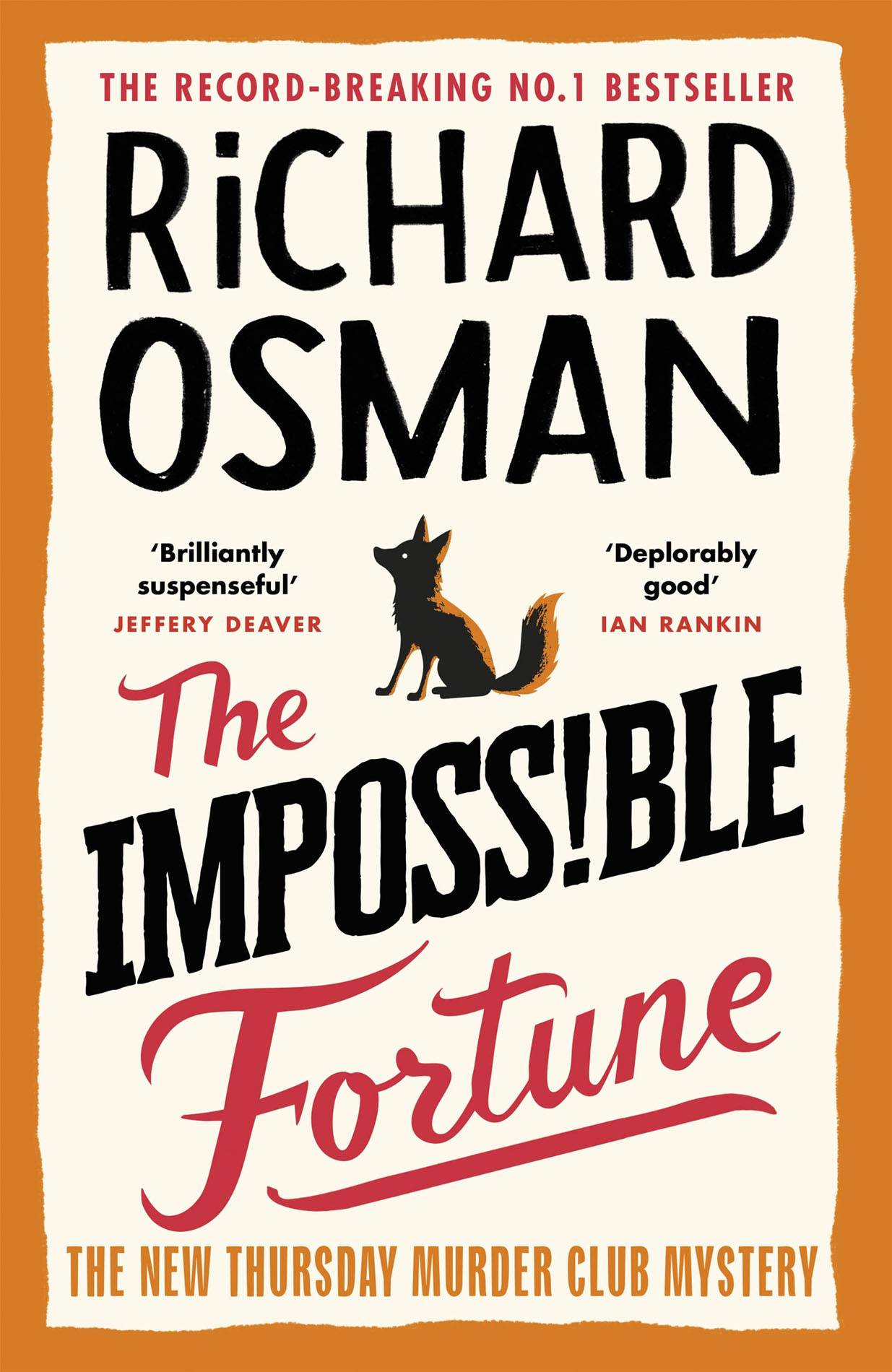
The Impossible Fortune
About this book
A quiet year has changed the rhythms of the Thursday Murder Club. Joyce is occupied by table plans and first dances, Elizabeth is grieving, Ron has family trouble, and Ibrahim continues to counsel his favorite criminal.
At the wedding, Elizabeth meets a guest who believes someone is going to kill him. His fear leads to a code that powerful people want and are prepared to pursue through anyone standing between them and it.
The club returns to work with the same mixed toolkit of police contacts, old intelligence, social access, patience, and well-timed impropriety. A celebration provides the gathering point, but the investigation quickly reaches beyond it.
The Impossible Fortune is the fifth Thursday Murder Club novel. Richard Osman brings the friends back after a period of loss and asks how a group resumes its familiar work when none of its members is quite returning to the life they had before.
Read a sample
5,036 words
Plain text
From the opening
They show you how to make bombs on the internet. If you know where to look.
What to buy, where to buy it from. How to fit the whole thing together. There are even videos. Men in balaclavas with screwdrivers. Soldering wires on tidy workbenches in breeze-block garages.
They don’t really tell you about the risks. But the risks stand to reason. Be careful with explosives, that doesn’t need to be spelled out to anyone, surely? No one needs to say, ‘Don’t try this at home,’ do they?
There are instructions for big bombs, small bombs, nail bombs, chemical bombs, all the bombs you could ever want to make.
Small to medium was the right choice here. Stable enough to carry around, powerful enough to kill.
In the end the easiest thing to do was go to one of the websites that does all the work for you. Custom-make the bomb to your specifications, deliver it, even help you to place the thing if that’s what you need. This particular company had received very good reviews. They even offered a money-back guarantee if the bomb failed to go off. They’re called ‘Boom or Bust’.
It’s not cheap, when you add up the expertise, the manufacturing costs, the delivery and, most expensive of all, the secrecy of the whole thing. If you want to know the actual cost of a human life, it’s somewhere around twenty-seven thousand pounds. But no tax or VAT. For the obvious reasons.
Worth the extra few quid though. When the bomb finally goes off, money is not going to be an issue, is it?
It’s not all about money, of course. Quite the opposite in some ways.
Okay, then, no time to waste.
Time is ticking, and it’s not the only thing.
1
Joyce
It’s been a while since I wrote, I know that. I’m ever so sorry.
You must have been wondering where I’d got to? Run away to the Bahamas with a police dog handler perhaps? That is actually a dream I had the other night. Then I woke up because Alan was barking at a squirrel he’d seen out of the window.
It’s just that I’ve been so busy with the wedding, I haven’t had time to think. It’s been a whirlwind.
There was the florist, there was the cake – how can a cake be that expensive? It’s just eggs and sugar and a bit of marge, isn’t it? I know it’s decorated, but still. Then there was the dress, that was quite a fun bit, we all had a Buck’s Fizz. I even went to a nail bar – I’d seen nail bars, of course, but I’d always been too shy to go in. They were very nice, and perhaps I’ll go again if somebody else gets married.
Tomorrow is the day. A Thursday wedding? I know. What is it with us and Thursdays?
It’s not every day your only child gets married, is it? Some people around here, they have grandchildren getting married, but not Joanna, she took her time, and I think that was probably for the best. Whatever I might have said to the contrary over the years. To think this time last year she was still with the football chairman?
Before Paul.
Joanna and Paul met online. People – well, Ron – often tell me I should do online dating, but I worry that everyone would just be after my credit card details. Ibrahim told me I must never tell people Alan’s name in the park because they can use the information to steal your password. I said that I don’t use Alan’s name in any of my passwords, but he was insistent. So if people ask me Alan’s name I say he’s called Joyce. And if they then ask me my name, I bid them a polite goodbye.
I mentioned the florist and the cake and the dress and so on, but I didn’t mention that Joanna and I have rowed about all of them, and plenty of other things besides. For example, there are to be no hymns, just ‘Backstreet Boys’. It got to the point where I had to say, ‘If you don’t want me to help, just tell me,’ and Joanna said, ‘I don’t want you to help, Mum,’ and that set me off crying, and then that set Joanna off crying, and she said of course she wanted me to help, and I said I know I interfere, I know, and poor Ibrahim walked into the middle of this whole scene, and then backed slowly out of the room. I’ve said it before, Ibrahim is no fool, except when it comes to dogs and passwords.
Joanna and I have different ideas about weddings, that’s to be expected. If we have different ideas about gluten, we’re going to have different ideas about most things. There’s my way of doing things (honed over a long and happy lifetime) and then there’s Joanna’s way of doing things. What Ron calls ‘the London way’.
The very first row was about forty-five seconds after she and Paul told me they were getting married. I was thrilled. I mean, it was fairly soon after they’d met, and you hear all sorts of stories on Netflix, don’t you, but I was thrilled nonetheless. Paul is lovely, not at all like the people Joanna usually dates, who seem to be, largely, millionaires or Americans. Now I have nothing against either millionaires or Americans, far from it, look at George Clooney, for example, but variety is the spice of life, and Paul is a professor at a university (only Middlesex, but even so). And being a professor is a job for life in the way that being a football chairman or a millionaire isn’t.
Continue reading the sampleClose the sample
So, the first row.
I’d given Joanna a hug, and I’d given Paul a hug, and I asked Joanna if it was going to be a big wedding, and she said absolutely not, no, she wanted a small, intimate wedding, and I said, I can’t remember the words precisely, but something like, ‘Oh, that’s a shame, but never mind,’ something very neutral, you know me, and she said, ‘What’s a shame?’ She said that very politely, because Paul was there, but I could tell that trouble was brewing, so I thought, well, I’ll just defuse this, and I said, ‘Oh, don’t listen to me, I just thought, as an older bride, there might be lots of people who would want to come,’ and she said, again, keeping her cool, ‘An older bride?’ and I thought, you’ve done it now, Joyce, and I said, ‘No, not older, it’s just a lot of people, if they get married at your time of life, it’s a second wedding, after a divorce,’ and, again, I could tell that hadn’t helped. Paul said something at this point, but neither of us was listening because we knew we were at a very delicate stage in our argument. Joanna smiled (not with her eyes though, that’s how you can tell, isn’t it?) and said a small wedding suited her, and it was her wedding, so that’s what was going to happen. I saw her point, but you know me, my head was full of bridesmaids, and handsome ushers, and bouquets, and dancing. Something like Bridgerton, if you’ve seen it. I could see a big crowd of happy friends, all wiping away tears and complimenting my hat. I could see Elizabeth, Ron and Ibrahim with me. I’d be on the front row; they could sit behind. They could lean forward and tell me how beautiful I looked. This was all going around my head, when I said, ‘I’m sure you know best. You always do, don’t you?’ At this point Joanna asked Paul to go and make us all a cup of tea.
Written down like this, I do see I might have handled it differently.
Joanna came in very close and told me she wasn’t going to lose her temper, because Paul had never seen her really lose her temper, and she thought it was probably best to get eighteen months or so into the actual marriage before he saw her in full flight (it wasn’t the time, but I wanted to say she was absolutely right about this. By the time Gerry first saw me really unleash, we were living in a three-bed in Haywards Heath, and I was pregnant, so it was far too late for him to get cold feet). Then she said she was having a small wedding, with no fuss but a lot of love, and I said, and I’m aware I shouldn’t have said anything at all, that a big wedding isn’t a fuss, and that perhaps she wasn’t thinking straight, and Paul walked back in and asked where the milk was, and we both said, ‘Fridge,’ without taking our eyes off each other.
I knew she was right, by the way, I really did. But I’ve been excited about her wedding since before she was born, and I’ve played it through in my head so many times, and that’s why I was being unreasonable. I see all that now, but I didn’t see it then. When Gerry and I were married, we couldn’t afford a big wedding. It was a lovely day, but it was small. Just our parents, our neighbours from Number 17 (but not from Number 13, due to an incident with a hedge trimmer), Gerry’s best man from work, a few of my nurse friends and two cousins who wouldn’t take no for an answer. We had sandwiches in the pub (private room) afterwards and we were both back at work the next day.
So, anyway, I told Joanna all this. I knew I was on the back foot, and thought that if I mentioned Gerry it might buy me some time. And then she leaned in and hugged me, and she said, ‘I keep imagining Dad walking me down the aisle,’ and, well, I didn’t have to imagine that, because I’ve imagined it so many times it’s become real to me, and I hugged her back, and I realized that life can’t always be Bridgerton.
So Joanna was crying, thinking about her dad, and I was crying, thinking about him too, and Paul walked back in with two cups of tea and said, ‘I couldn’t find the sugar either, but I was too scared to ask,’ which is just what Gerry would have said, and then I realized I didn’t care about a big wedding or a small wedding, I only cared about my beautiful daughter and this lovely man. Though, small or not, Joanna couldn’t stop me buying a new hat.
Paul gave us both our teas, and a tissue each, and I told Joanna I loved her, and she told me she loved me, and Paul said, ‘For future reference, where is the sugar?’ and I said the cupboard above the microwave, and Joanna asked if there were any jewels or cocaine in my microwave, or a gun perhaps, and I said no. It’s been a quiet year in that regard.
We still meet every Thursday, of course, Elizabeth, Ron, Ibrahim and I, and we’re in and out of each other’s flats on a daily basis (less so with Elizabeth – she still needs a bit of time), but we’ve managed to stay out of any real trouble for a while now.
I told Joanna that Elizabeth, Ron and Ibrahim would be so excited for her, and that they would understand it was a small wedding, so there wouldn’t be invitations for them, and Joanna said that of course they were invited, and I said, ‘That’s too much, a small wedding is a small wedding, and there must be other people who should be invited first,’ and then Joanna said, ‘Mum, when you say you want a “big wedding”, how many people do you mean?’ and I said, ‘Well, about two hundred, that’s the number in my head,’ and she laughed. She said that her friend Jessica (Jacinta? Jemima?) had eight hundred people at her wedding, in Morocco.
And so I asked Joanna what she thought a small wedding was and she said, ‘About two hundred, Mum.’
And so there we have it. Joanna is having the small wedding she has always wanted, and I am having the big wedding I have always wanted. Sometimes it pays to be different from your children.
I then asked if Bogdan and Donna could come, or perhaps Chris and Patrice, and Joanna told me not to push my luck, and that they could come to the evening do, which would be four hundred-odd. That’s some small wedding, Joanna.
Anyway, my wedding clothes are ironed and laid out on the spare bed. I keep going in and looking at them. My new hat is in a box. Mark from Robertsbridge Taxis has got hold of a minibus to take us all to the venue tomorrow. It’s not a church, which, again, in my dreams it had been, but a lovely house in the Sussex countryside, which is actually much more beautiful than a church would have been, and has taught me you mustn’t always trust your dreams. Or that you must allow others to have their dreams instead.
So next time you hear from me I will be a mother-in-law. Also, Paul’s dad, Archie, is a widower, early eighties, with a moustache and the air of someone who needs to be looked after. I can see from the table plan that I am sat next to him on the top table.
Because if trouble has been in short supply, so has love.
So here’s to tomorrow, and here’s to love, and to no trouble.
THURSDAY
2
Elizabeth is starting to feel again. Precisely what she is starting to feel, she couldn’t say. But there’s something there, and it’s not just the brandy. She’s on alert, but, as yet, with no idea why.
To her left, Ron raises a pint to the Sussex sunset. ‘I’ve been to a lot of weddings, mainly my own, but that was the best yet. To Joanna.’
‘To Joanna,’ says Ibrahim, raising a whisky. During the ceremony he had cried even more than Joyce.
‘And to Paul,’ says Joyce. ‘Don’t forget Paul.’
‘Hell of a speech his best man made,’ says Ron.
The best man. Elizabeth has been thinking about him.
‘He was nervous,’ says Joyce.
‘Either way,’ says Ron, ‘you don’t throw up. It’s not your wedding, mate.’
‘He pulled focus,’ agrees Ibrahim.
Even before the unfortunate vomiting, there was something off about the man. Was that what Elizabeth has been feeling? She could have sworn he looked at her at one point. Just a glance but a deliberate one.
‘What did you make of it all, Elizabeth?’ Ibrahim asks.
Elizabeth thinks for a while, and musters a small smile. The smile is real, she knows that, and she knows that one day it will be bigger. ‘It was wonderful – they looked very happy. And Joyce looks very happy.’
‘She’s half a bottle of Champagne to the good,’ says Ron.
Joyce gives a slight hiccup. The four friends watch the sunset in silence, the stone terrace of the grand house all to themselves. From inside, the sound of music and laughing.
Elizabeth looks at her friends, and thinks about Stephen. Joyce spots it – Joyce spots everything – and puts her hand on Elizabeth’s arm.
‘Thank you for coming though, Elizabeth,’ says Joyce. ‘I know it’s still hard.’
‘Nonsense,’ says Elizabeth, ready to launch into a lecture about self-reliance. But Joyce is right: it is still hard. Almost impossible, in fact. She takes another sip of brandy and looks down. ‘Nonsense.’
Elizabeth turns as Joanna steps through a set of double doors onto the terrace. ‘Well, I wondered where you’d all crept off to. What are you doing? Shooting up?’
Ron stands and hugs her. ‘Just looking for five minutes’ peace. How’s the best man?’
‘Nick?’ says Joanna. ‘He’s rehydrating.’
Nick, that was the name. Nick Silver.
‘And the tablecloth?’ Ibrahim asks.
‘Ruined,’ says Joanna. ‘That’ll be coming out of the deposit. Now who’s coming for a dance? Mum? Everyone wants to dance with you. They seem to find you charming.’
‘I am charming,’ says Joyce, then hiccups again. ‘That’s where you get it from.’
Ron helps Joyce to her feet. ‘Perhaps Paul’s dad might like a dance, Joyce?’
‘Not interested,’ says Joyce.
‘I mean,’ says Ibrahim, ‘you did have your hand on his knee for the entire meal.’
‘I was welcoming him to the family,’ says Joyce.
‘Never heard it called that before,’ says Ron, and downs his pint.
‘And, Ibrahim,’ says Joanna, ‘I wonder if you would like to dance with me?’
‘Well, that would be my pleasure,’ says Ibrahim, standing. ‘What will it be? A foxtrot? A quickstep?’
‘Whatever you can manage to “Like a Prayer” by Madonna,’ says Joanna.
Ibrahim nods. ‘We shall improvise.’
Everyone is standing now, and they begin to head to the door. But Elizabeth stays where she is. Joyce puts her hand on her friend’s shoulder.
‘Are you coming?’
‘Ten minutes,’ says Elizabeth. ‘You go and have fun.’
Joyce gives her shoulder a squeeze. How gentle Joyce has been with her since Stephen died. No lectures, no homilies, no empty words. Presence when she sensed it was needed; absence when she knew Elizabeth needed some time. Ron has been there with hugs; Ibrahim, the great psychiatrist, would try to nudge her this way and that, thinking she wouldn’t notice. But Joyce? Elizabeth had always known that Joyce possessed an emotional intelligence she lacked, but the sheer grace with which she had conducted herself this last year was extraordinary. The gang disappear through the doors, and Elizabeth is alone again.
Again? Elizabeth is always alone now. Always alone, and never alone: that was grief.
The sun has disappeared behind the South Downs. Always alone, but never alone. Elizabeth feels her senses awakening again. But what is it?
From an avenue of trees beneath the terrace to her left, Elizabeth hears a noise. A man steps out from behind a tall oak and begins to walk towards her.
So that was it: someone was out there in the half-light. That was the sense that was reawakening. As he starts walking up the stone steps onto the terrace, the now familiar figure of Nick Silver, the best man, comes into the light. He nods at the chair next to Elizabeth.
‘D’you mind?’
‘Of course,’ says Elizabeth. She hears whooping from inside the house. That will be Ibrahim dancing, no doubt. Nick sits.
‘You’re Elizabeth,’ says Nick. ‘I know you know that.’
‘Afraid so,’ says Elizabeth. She notices, with relief, that Nick has changed his shirt. ‘Do you have something on your mind, Mr Silver?’
Nick nods. He looks up at the sky, and then back at Elizabeth. ‘Thing is, somebody tried to kill me this morning.’
‘I see,’ says Elizabeth. Something jump-starts inside her. For the last year her heartbeat has felt like a machine, a mechanical pump keeping her alive against her will, but now it feels flesh. ‘You’re sure?’
‘Certain,’ says Nick. ‘When you know, you know, right?’
‘And you have proof?’ Elizabeth asks. ‘A lot of your generation can be overdramatic.’
Nick holds up his phone. ‘I’ve got proof.’
Elizabeth feels a familiar gravity begin to pull her in. Should she leap clear while she still can?
‘Does someone have a good reason to kill you?’ asks Elizabeth. She is not leaping clear. Of course she is not leaping clear. Where on earth would she leap to? She is all out of solid ground.
Nick nods. ‘Yep. A very good reason. To be fair.’
A path clears in Elizabeth’s mind: it’s an old track overgrown with weeds, but there it is. ‘And do you know who?’
‘This is just between you and me?’ says Nick. ‘I can trust you?’
‘That’s a question for you, Mr Silver,’ says Elizabeth. ‘Not for me.’
The man is shaking, on a warm evening. ‘I can give you some names, yep.’
‘More than one person wants to kill you?’ says Elizabeth, eyebrow raised. ‘And yet you seem fairly harmless?’
‘Thank you,’ says Nick.
‘Why have you come to me?’ Elizabeth asks. ‘And not, say, our good friends in the police force?’
‘I just …’ Nick starts. ‘I don’t want to tell the police, for all sorts of reasons, and I’d heard about you from Paul. Your reputation.’
‘I’m sure he has exaggerated it,’ says Elizabeth. One can forget that one has a reputation.
‘I just wondered,’ says Nick, looking at her with a fear she has seen so many times over the years. The fear of a man with a single foot over a cliff edge. ‘If I tell you everything, do you know someone who could help me?’
Elizabeth had been ready to say no to this wedding. To stay at home and read. To look over at Stephen’s chair. To punish herself. But she’d said yes instead. Something told her it was time to start again. She thought perhaps it was the prospect of seeing love at first hand, but, no, it was far better than that. It was a best man with a death threat.
Trouble is much like love: when the time is ready, it will find you. And so here she was at the wedding.
Does she know someone who could help him? Elizabeth looks at Nick, nods and takes his hand.
‘Mr Silver, I do.’
3
‘And if there’s security?’ Connie Johnson asks, taking a bite from her pain au chocolat.
‘Then you kill them?’ asks Tia.
Connie nods, thoughtfully. I mean, that doesn’t sound unreasonable. Not what she would do, but you can’t accuse Tia of not thinking things through. She’s trying to impress.
‘Or hold their family hostage?’ Tia adds, clearly hopeful she’s got the answer right.
This whole thing had been Ibrahim’s idea. Perhaps it hadn’t worked out exactly as he’d planned, but Connie could hardly be blamed for that now, could she?
While she was still in Darwell Prison, before the ‘unfortunate’ mistrial and her subsequent release, Ibrahim had made her a proposition. ‘You must give something back to society, Connie,’ he had said. There was then a brief argument, during which Ibrahim had had to clarify that he didn’t mean giving back any actual money, or other property she might have come across in her long and fruitful career. He had meant helping someone less fortunate than herself – ‘Again, not with money, don’t panic’ – and explained why he believed that Connie would make an excellent mentor to some of the younger inmates at Darwell. ‘Pass on some wisdom,’ Ibrahim said, ‘some life lessons.’ He promised it would do her good.
She knew Tia Malone from art class, where the youngster had been caught stealing glue. She approached her one lunchtime, and soon they were chatting. Ibrahim had been delighted at this development and predicted that Connie would find the relationship very rewarding.
‘Fifty grand for you,’ says Tia. ‘And fifty for me.’
Connie sips on her flat white. All in all she had done seven months on remand at Darwell, after that unfortunate business on Fairhaven Pier with the cocaine and the dead guys whose names she has forgotten. It wasn’t as bad as it might have been. As a result of her outside connections, she was the only woman in the whole prison with a Pilates machine and a Netflix subscription.
‘I could make fifty grand with one phone call,’ says Connie. ‘I don’t need to get involved in this.’
‘Please,’ says Tia, ‘I promise it’ll be fun. And you told me I had to dream my dream.’
True enough, she had told Tia that. In their very first session. She liked Tia very much, liked her ambition. Tia had started her life of crime stealing Rolexes from rich tourists in the West End. There would be four of them on bicycles, weaving in and out of traffic, picking off targets. Once threats had been made, and the Rolex stolen, they would disappear down side streets, and be back in the safety of Vauxhall before the first siren was heard. Tia was the only girl in the gang, and always kept her mouth shut during the robberies to hide that fact. Eventually the whole gang was caught after a Deliveroo driver, who must have been after a medal or something, followed them back to the estate and led the cops to their lock-up. Even then, they rounded up three boys, and gave up their search after the fourth boy was nowhere to be seen.
‘A hundred grand though, Tia,’ says Connie. ‘What have I taught you? Surely you can dream bigger than that?’
Connie had to admit it, she was enjoying being a mentor. Tia continued the bike robberies for a while, three new boys in tow now, her human shield reassembled, but she soon had a revelation. The sort of revelation Connie admired.
That’s why they still meet up once a week, usually in Fairhaven’s newest vegan café, Mad about the Soy. There are now more vegan cafés in Fairhaven than there are non-vegan cafés, but, relentless though the gentrification of the town is, Connie is delighted that the demand for cocaine remains robust.
‘Bigger than a hundred grand?’ Tia asks. In front of her, a coconut flapjack.
‘Tell me what you worked out,’ says Connie. ‘When you were doing the bike robberies?’
‘You know what I worked out,’ says Tia.
‘I know,’ says Connie. ‘But tell me.’
This was a technique she had stolen from Ibrahim. Ibrahim would get Connie to listen to herself. He knew where he wanted her to go, but she had to find her own way there. If you find your own way somewhere, you can go back whenever you choose. That was Ibrahim’s idea anyway, probably nonsense.
‘Someone would buy a Rolex in a shop,’ says Tia. ‘A jeweller’s in Knightsbridge that we kept an eye on. And then me and my friends would follow them, steal the watch and then sell it.’
‘And?’ says Connie, looking for more. It was annoying when Ibrahim did this, but it wasn’t annoying when she did it. Ibrahim is at a wedding today. He sent her a photo. Connie would love to get married. Perhaps she should do something about that? What she really needs is a Tinder for criminals. Everyone could use their most recent mugshot.
‘And,’ says Tia, ‘we maybe did this fifteen, twenty times. Cycle up there, identify a target, rob them, take the risk, cycle back. Fifteen or twenty different robberies, fifteen or twenty different chances to get caught. Great cardio but high risk.’
‘So you thought?’ Ibrahim’s best mate, Ron, was in the photograph. Connie has promised not to kill him, despite his part in her arrest. We’ll see about that. Connie doesn’t let grudges go lightly. Sometimes she thinks that without the weight of all her grudges she might simply blow away.
Tia finishes off her coconut flapjack. ‘So I thought, well, they’ve all bought these watches from the same shop. So why don’t we just rob the shop instead? Rob all fifteen watches at once. The same reward but only one opportunity to get caught.’
Connie is nodding. There is a lot of rubbish talked about young people, but Tia is a clear and intelligent thinker. She is a doer, a grafter. She still has to make the final step though. Has to work it out for herself.
‘And the downsides to that approach?’ Honestly, sometimes she actually sounds like Ibrahim. She was in a meeting last Tuesday where a cocaine importer had been shot in the leg, and Connie had found herself saying, ‘The pain is temporary, but the lesson the pain teaches you is forever.’ She hasn’t told Ibrahim this, because, although he would be proud to be quoted, he still disapproves of her business affairs.
‘More planning to do, better security to beat, a more thorough investigation after you’ve done it,’ says Tia. ‘But I like that. I like the planning. That’s the bit I enjoy.’
‘And it worked? The new plan?’
‘Like a dream,’ says Tia. ‘Until we got caught.’
‘But you would have got caught anyway?’ says Connie. ‘For something. At some point. Occupational hazard. Might as well get caught for something big. So go on. What have you learned? What’s your new plan?’
‘I’ve learned my lesson,’ says Tia. ‘This time, when the alarm goes off, I’ve got two minutes. Not a second more. Doesn’t matter if the crown jewels are in the next case, when the two minutes are up, I go.’
Connie nods. ‘That’s what you’ve learned?’
Tia looks at her, the same way that Connie has looked at Ibrahim countless times. Tia knows it’s a trick question. She knows that she should have learned something else, and she is bright enough to try to work out what.
‘So,’ says Tia, thinking on her feet. Or, actually thinking while sitting on an uncomfortable artisan stool. ‘I used to steal Rolexes one by one.’
‘Mmm hmm,’ says Connie.
‘And then I realized that they were all bought from the same shop, so I could just go to the shop and steal fifteen in one go.’
‘And so?’ A mother pushes a buggy past the window of the café and glances in. What does she see, Connie wonders. A blonde woman in an expensive tracksuit, sitting with a black teenager, both just shooting the breeze. She doesn’t know that Connie is actually changing Tia’s life, right here, right now.
‘And so …’ Tia plays for time.
‘I told you, Tia,’ says Connie, ‘dream your dream. A hundred grand is nothing.’
‘And so …’ says Tia again, her mind scrolling through answers, until, finally, it finds the right one. ‘Where do the shops get their Rolexes from?’
Bingo.
Tia is thinking this through. ‘The shop in Fairhaven I want to rob has fifteen Rolexes. But there’ll be a shop in Lewes with another fifteen. And a shop in Brighton with another fifteen. And they all came from somewhere.’