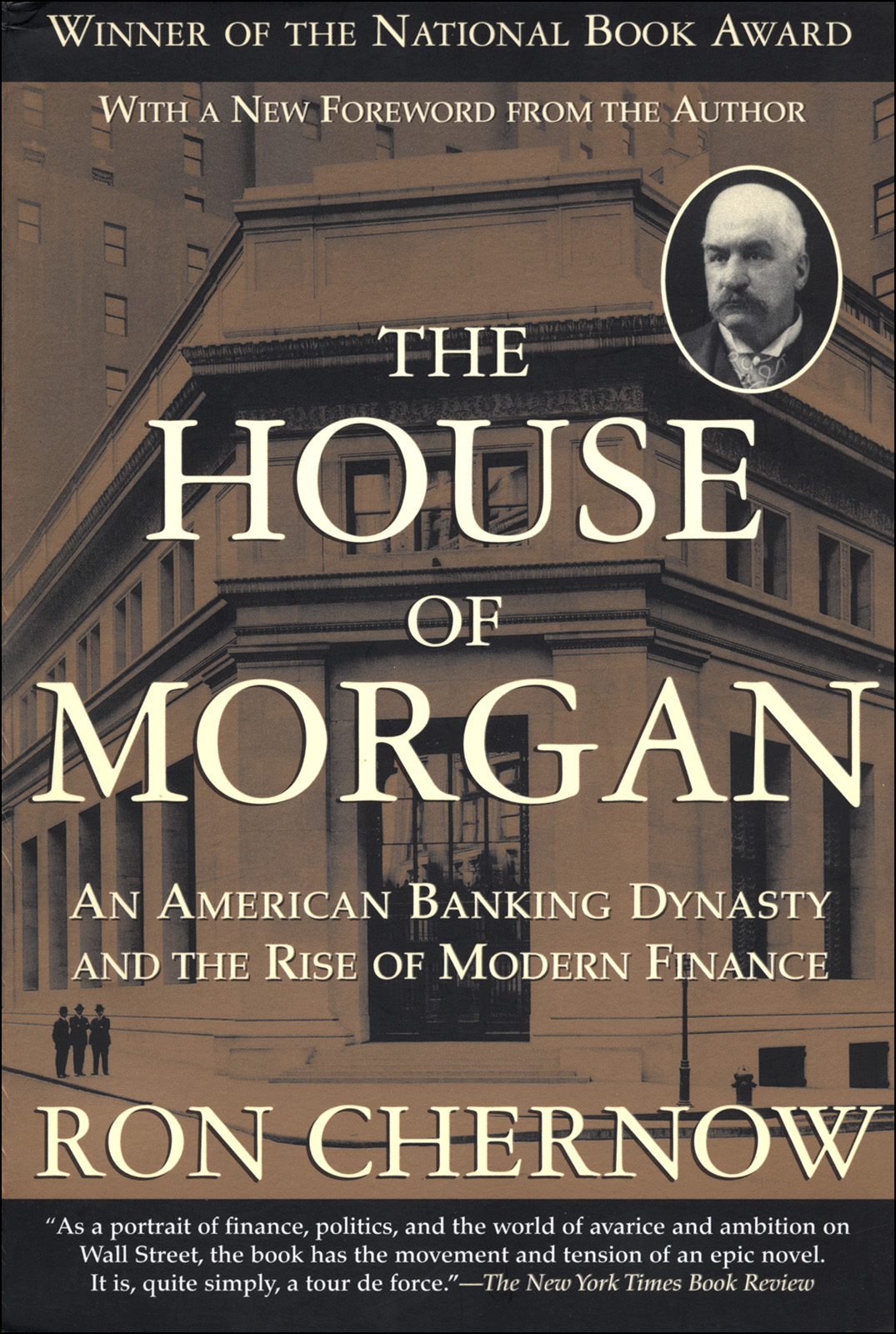
The House of Morgan: An American Banking Dynasty and the Rise of Modern Finance
About this book
Ron Chernow begins with George Peabody in nineteenth-century London and follows Junius and J. Pierpont Morgan as their houses gain extraordinary influence over capital and government. Banking relationships become family relationships and instruments of national policy.
The story passes through railroad consolidation, the gold rescue, two world wars, Glass-Steagall, and the separation of commercial and investment banking. Later generations adapt old names and networks to a less private, more competitive financial world.
The House of Morgan is institutional history told through bankers, clients, politicians, and rival firms. This twentieth-anniversary edition includes a new foreword looking back on the dynasty after the financial crisis.
Read a sample
5,101 words
Plain text
From the opening
“THE HOUSE OF MORGAN” 20th ANNIVERSARY EDITION
Like many first books, The House of Morgan was something of a happy accident in the author’s life when it was published twenty years ago. After years toiling in the vineyard of freelance magazine work, I decided to take a breather from that hectic world in the mid 1980s and landed a job in a public policy foundation called The Twentieth Century Fund, where I was put in charge of financial policy studies. During this heyday of the bull market that roared through Ronald Reagan’s presidency, huge numbers of people were swept into the financial world for the first time, whether as foot soldiers in investment banks or small investors dabbling in common stocks, and they had little historic perspective on the new world they inhabited.
As I dipped into the rich literature of financial history, I was struck that the old Wall Street—elite, clubby, and dominated by small, mysterious partnerships—bore scant resemblance to the universe of faceless conglomerates springing up across the globe. It dawned on me that the hordes of financial novices might be ripe for a history that would chronicle how the old Wall Street evolved into the new. A straight history, I knew, would be a tedious task for readers and do small justice to the turbulent pageant of heroes and scoundrels I was unearthing. So I posed the question: was there a single family or firm whose saga could serve as a prism through which to view the panoramic saga of Anglo-American finance? There were relatively few dynasties in financial history and, hence, few suitable candidates. Some names, such as Rothschild, had long since passed the zenith of their glory, while others had a contemporary resonance with only shallow roots in the past. Only one firm, one family, one name rather gloriously spanned the entire century and a half that I wanted to cover: J.P. Morgan. To reconstruct the Morgan story, I realized, would be a daunting enterprise, for I would have to narrate the intricate stories of four interlocking firms: J.P. Morgan and Morgan Stanley in New York, Morgan Grenfell in London, and Morgan et Compagnie in Paris.
As an old English major and novelist manque, I had no training in historical methods, nobody to steer me in the right direction, as I bumbled about in my early research. I had naively assumed that, within its august walls, J.P. Morgan & Co. housed a comprehensive set of historical papers and that it would be my task to lay my hands on it. For six months, I lunched with two affable bank representatives as they and their associates debated whether to cooperate with my project. Then one day, I made a startling discovery: the papers of Thomas W. Lamont, senior partner of the Morgan bank during the inter-war years, resided at the Harvard Business School Library. During my first day of research there, I pored over correspondence between Lamont and Franklin Roosevelt, Benito Mussolini, Charles Lindbergh, and Nancy Astor. These papers threw open a window on the hermetically sealed world of Morgan partners.
Aside from the grace and clarity of these letters—old-school bankers tended to be surprisingly literate—they were detailed and gripping beyond my wildest imaginings. When Lamont spoke on the telephone with President Herbert Hoover, for instance, a dutiful amanuensis took down a verbatim transcript. Suddenly, the opaque Morgan world had turned transparent. Soon I uncovered papers of other Morgan partners at Amherst, Yale, Columbia, the University of Virginia, and, of course, the Morgan Library in New York. Sometimes I felt as if I could trail the Morgan partners around the bank on an almost hourly basis. Curiously enough, nobody at J.P. Morgan & Co. had ever noticed the disappearance of tens, perhaps hundreds, of thousands of internal documents. So much for the vaunted Morgan reputation for secrecy!
When I signed the contract for The House of Morgan, I had worried about a shortage of original documents and now had to contend with the embarrassment of riches. My advance, if generous for a first book, could scarcely cover years of leisurely research, so I had to cram a gigantic amount of work into a brief span. Somehow I managed to research and write an eight hundred-page book in two-and-a-half years—a feat I could never duplicate today. I was sustained by the sheer excitement of my findings, the knowledge that I had luckily stumbled upon the foremost drama in financial history. I also coasted on the pent-up energy of a young writer who had finally secured his first book contract after many failed efforts. Whenever I think of the time spent on the book, I remember the headlong pace, the frantic reading into the night, the exhausting attempt to squeeze the epic story of finance between two covers. It is therefore with a sense of miraculous good fortune that I now open the book and find lucid, coherent prose that shows, at least to my eyes, little of the sweat and haste of its creation.
R.C.
BROOKLYN, NEW YORK
SEPTEMBER 2009
Continue reading the sampleClose the sample
PROLOGUE
This book is about the rise, fall, and resurrection of an American banking empire—the House of Morgan. Perhaps no other institution has been so encrusted with legend, so ripe with mystery, or exposed to such bitter polemics. Until 1989, J. P. Morgan and Company solemnly presided over American finance from the “Corner” of Broad and Wall. Flanked by the New York Stock Exchange and Federal Hall, the short building at 23 Wall Street, with its unmarked, catercorner entrance, exhibited a patrician aloofness. Much of our story revolves around this chiseled marble building and the presidents and prime ministers, moguls and millionaires who marched up its steps. With the records now available, we can follow them inside the world’s most secretive bank.
The old pre-1935 House of Morgan was probably the most formidable financial combine in history. Started by an American banker, George Peabody, in London in 1838, it was inherited by the Morgan family and transplanted to New York to famous effect. In the popular mind, the two most familiar Morgans—J. P. Morgan, Sr. (1837-1913), and J. P. Morgan, Jr. (1867-1943)—are rolled into a composite beast, J. P. Morgan, that somehow endured for more than a century. Their striking physical resemblance—the bald pate, the bulbous nose, the pear-shaped frame—has only fed confusion. For admirers, these two J. P. Morgans typified the sound, old-fashioned banker whose word was his bond and who sealed his deals with a handshake. Detractors saw them as hypocritical tyrants who bullied companies, conspired with foreign powers, and coaxed America into war for profit. Nobody was ever neutral about the Morgans.
Before the Depression, 23 Wall was headquarters of an empire with several foreign outposts. Seated behind rolltop desks on the Broad Street side, the New York partners were allied with three other partnerships—Morgan Grenfell in London, Morgan et Compagnie in Paris, and Drexel and Company, the so-called Philadelphia branch of J. P. Morgan. Of these, Morgan Grenfell was easily the most powerful, forming the central London-New York axis of the Morgan empire. It was a transatlantic post office for British and American state secrets. Before the New Deal, the term “House of Morgan” applied either to J. P. Morgan and Company in New York or, more broadly, to the whole shadowy web of partnerships.
The old House of Morgan spawned a thousand conspiracy theories and busied generations of muckrakers. As the most mandarin of banks, it catered to many prominent families, including the Astors, Guggenheims, du Ponts, and Vanderbilts. It shunned dealings with lesser mortals, thus breeding popular suspicion. Since it financed many industrial giants, including U.S. Steel, General Electric, General Motors, Du Pont, and American Telephone and Telegraph, it entered into their councils and aroused fear of undue banker power. The early House of Morgan was something of a cross between a central bank and a private bank. It stopped panics, saved the gold standard, rescued New York City three times, and arbitrated financial disputes. If its concerns transcended an exclusive desire for profit, it also had a peculiar knack for making good works pay.
What gave the House of Morgan its tantalizing mystery was its government links. Much like the old Rothschilds and Barings, it seemed insinuated into the power structure of many countries, especially the United States, England, and France, and, to a lesser degree, Italy, Belgium, and Japan. As an instrument of U.S. power abroad, its actions were often endowed with broad significance in terms of foreign policy. At a time when a parochial America looked inward, the bank’s ties abroad, especially those with the British Crown, gave it an ambiguous character and raised questions about its national loyalties. The old Morgan partners were financial ambassadors whose daily business was often closely intertwined with affairs of state. Even today, J. P. Morgan and Company is probably closer to the world’s central banks than any other bank.
This empire was shattered by the Glass-Steagall Act of 1933, which erected a high wall between commercial banking (making loans and accepting deposits) and investment banking (issuing stocks and bonds). In 1935, J. P. Morgan and Company chose to remain a commercial bank and spun off Morgan Stanley, an investment house. Seeded with J. P. Morgan capital and personnel, Morgan Stanley for decades clearly exhibited common ancestry with its Morgan brother down the block. They shared many clients and kept alive a family feeling no less potent for its informality. Glass-Steagall didn’t bar J. P. Morgan from holding a minority stake in an overseas securities house, however. Until 1981, it kept a one-third interest in Morgan Grenfell. As our story will show, the three Morgan houses functioned as a de facto House of Morgan long after the New Deal ended and in the early 1970s even contemplated reunion. Today for the first time, the three houses lack formal links and are engaged in fierce rivalry. As deregulation in London and New York has dismantled old regulatory barriers, the three increasingly clash as they sell competing services.
While people know the Morgan houses by name, they are often mystified by their business. They practice a brand of banking that has little resemblance to standard retail banking. These banks have no teller cages, issue no consumer loans, and grant no mortgages. Rather, they perpetuate an ancient European tradition of wholesale banking, serving governments, large corporations, and rich individuals. As practitioners of high finance, they cultivate a discreet style. They avoid branches, seldom hang out signposts, and (until recently) wouldn’t advertise. Their strategy was to make clients feel accepted into a private club, as if a Morgan account were a membership card to the aristocracy.
The truest heir to the old House of Morgan is J. P. Morgan and Company, also known by the name of its bank subsidiary, Morgan Guaranty Trust. A universe away from the coarse bustle of Chase Manhattan or Citibank, it seduces the rich with leather armchairs, grandfather clocks, and polished brass lamps. In private dining rooms, anniversaries of accounts are celebrated, with customers receiving engraved menus as souvenirs. The bank won’t soil its white gloves with just anybody’s cash, and many depositors bring along corporate connections. Although the bank is bashful about revealing precise figures, it prefers personal accounts of at least $5 million and will occasionally stoop as low as $2 million—as a favor. The Morgan bank is the foremost repository of old American money.
While private accounts give Morgan its glamorous cachet, they generate only a small fraction of the profits. The bank concentrates on blue-chip corporations and governments, organizing large credits and securities issues and trading foreign exchange and other instruments. The Morgan bank used to boast that ninety-six of America’s one hundred largest corporations were clients and hinted that in two of the remaining cases, it had blackballed the companies as unfit. As with personal accounts, it never wanted to appear too eager for business. Instead of setting up offices hither and yon, it preferred to have clients make pilgrimages to it. This rule applied to its outposts abroad as well: a Lyons businessman would travel to Paris, a Midlands businessman to London, to see his Morgan banker. Even in today’s far more competitive world, there is seldom more than one J. P. Morgan office in a country.
For more than a century, this traditional formula, reworked many times, has paid off handsomely. On the eve of the 1987 crash, J. P. Morgan and Company was America’s most expensive bank, even though only the fourth largest. Based on its share price, it would have cost $8.5 billion to buy, or more than Citicorp. Although beleaguered by over $4 billion of Latin American debt, J. P. Morgan’s subsidiary bank, Morgan Guaranty, was America’s only major bank to boast a triple-A rating. For most of the 1980s, it had the highest return on equity of any bank, often ranking second in profits only to Citicorp and with only half its assets. As the nation’s premier trust bank, it managed $65 billion in securities on Black Monday 1987. It has been praised as “first in quality by about any measure you can think of” and “for many the perfect bank.”1 Although a fair share of blunders and isolated scandals have undercut the hyperbole, the judgments remain generally valid.
At least until it swept into hostile takeovers in the late 1980s, Morgan Guaranty best retained the historic Morgan culture of gentlemanly propriety and conservative dealings. As confidant of the Federal Reserve and other central banks, it still exhibits vestiges of its old statesman’s role. Morgan Stanley, in contrast, has wandered furthest from its roots. From 1935 through the 1970s, it enjoyed a reign such as no investment bank will ever match. Its clients included six of the seven-sister oil companies (Gulf Oil being the exception) and seven of America’s ten largest companies. Such success led to storied arrogance, a comic vanity. When one partner left for First Boston in the mid-1970s, he was congratulated by another: “That’s really exciting. Now you’ll be dealing with the second-best list of clients.”2 Indeed, the client rosters of any two competitors together couldn’t have touched Morgan Stanley’s. When the firm started advertising in the 1970s, an agency created a sketch of a thunderbolt piercing a cloud, with the caption, “IF GOD WANTED TO DO A FINANCING, HE WOULD CALL MORGAN STANLEY.” For Morgan Stanley partners, this neatly summarized their place in the cosmos. Asked at the 1988 annual meeting about the firm’s policy of serving on nonclient boards, Chairman S. Parker Gilbert paused thoughtfully and replied, “We have no non-clients.”3
Once nicknamed the house of Blood, Brains, and Money, Morgan Stanley fussily demanded exclusive relations with companies. If clients dared to consult another house, they were advised to look elsewhere for a banker. Wall Street grumbled about these “golden handcuffs,” but neither it nor the Justice Department could ever break the shackles; far from feeling imprisoned, companies craved this association with the Morgan mystique and gloried in their servitude. In floating stocks or bonds, Morgan Stanley insisted on being sole manager, its name engraved in solitary splendor atop the “tombstone ads” that announce offerings. This pomposity was clever advertising, helping to make Morgan Stanley the “Rolls Royce of investment bankers.”4
Today Morgan Stanley occupies sixteen floors of the Exxon Building in New York City. Its odyssey from a small, genteel underwriting house to a razzle-dazzle financial conglomerate traces the rise of modern Wall Street itself. It has been the perfect bellwether of postwar finance. Long regarded as uncommonly successful but stuffy, it underwent a startling metamorphosis in the 1970s, from which it emerged in unrecognizably aggressive form. Once Wall Street’s most conservative firm, it violated taboos it had conscientiously upheld and made respectable a far rougher style of finance. In 1974, it carried out the first hostile raid of the modern era, then dominated that rambunctious world. (In early 1989, it was still America’s top merger adviser, claiming $60 billion in deals during the year’s first half.) In the 1980s, it gentrified junk bonds and amassed a huge two-billion-dollar war chest for leveraged buyouts, the decade’s riskiest innovation. After shocking Wall Street by siding with corporate raiders, it became a raider itself, acquiring stakes in forty companies. For more than a decade, an incredulous business press has exclaimed, “This is Morgan Stanley?” All the while, with its 30-percent return on equity, it has consistently rated as the most profitable of publicly traded securities firms. It has had unerring strategic judgment.
To complete the family album, we note Morgan Grenfell, one of London’s most prestigious merchant banks. Throughout its history, it has exuded an aura of Eton, country houses, gentleman’s clubs, and Savile Row tailoring. Tucked away at an angle on L-shaped Great Winchester Street in the City—London’s equivalent of Wall Street—it stands unmarked behind a tall, pedimented portal and gauzy curtains. Inside, it has the winding, intimate passageways of a private mansion, lined with small conference rooms named after deceased partners.
In the early postwar years, Morgan Grenfell was run by a clutch of rather tired, apathetic old peers and was derisively termed the House of Lords by Morgan Guaranty people. (It still has several knights and lords on its blue-ribbon board.) Through much of the 1950s and 1960s, it mostly issued securities for venerable industrial clients and battled against a lethargy bred by success. Then, like Morgan Stanley, it cast off its sloth and turned into the City’s most marauding firm, specializing in aggressive takeovers. Like Morgan Stanley, it used its prestige to stretch the limits of acceptable behavior and became the gentleman pirate of the City. As the star of London’s takeover scene in the 1980s, it shattered the sedate world of British finance it had once exemplified. Throughout the decade, it regularly ranked first in London takeovers and by 1985 was managing four of the six largest acquisitions in the City. Then its dandified raiders, with their swaggering style, led the firm straight into the share-price manipulation of the Guinness scandal. Prime Minister Margaret Thatcher would personally demand the heads of two Morgan Grenfell executives in what was regarded as the City’s worst scandal of the century.
The story of the three Morgan banks is nothing less than the history of Anglo-American finance itself. For 150 years, they have stood at the center of every panic, boom, and crash on Wall Street or in the City. They have weathered wars and depressions, scandals and hearings, bomb blasts and attempted assassinations. No other financial dynasty in modern times has so steadily maintained its preeminence. Its chronicle holds up a mirror in which we can study the changes in the style, ethics, and etiquette of high finance. To order this vast panorama, we will divide our saga into three periods. This framework applies principally to the Morgan houses but also has, I think, more general relevance to other banks.
During the pre-1913 Baronial Age of Pierpont Morgan, bankers were masters of the economy, or “lords of creation,” in author Frederick Lewis Allen’s phrase. They financed canals and railroads, steel mills and shipping lines, supplying the capital for a nascent industrial society. In this age of savagely unruly competition, bankers settled disputes among companies and organized trusts to tame competition. As the major intermediaries between users and providers of capital, they oversaw massive industrial development. Because they rationed scarce capital, they were often more powerful than the companies they financed and acquired increasing control over them. This produced a generation of headstrong bankers who rolled up fabled fortunes, aroused terror in the populace, and finally prompted a political campaign to curb their hypertrophied influence.
In the Diplomatic Age of J. P. Morgan, Jr., bounded by the two world wars, private bankers served as adjuncts of government, performing covert missions and operating as co-equals of central banks. Morgan bankers were now power brokers and unofficial representatives of governments at global conferences. As confidants of kings, presidents, and popes, they operated under the close supervision of Washington or Whitehall in foreign dealings. To the outside world, they often seemed the visible face of government policy. At home, they remained “traditional banker” to companies that, if still loyal, decreasingly needed the patronage of a strong banker. Maintaining exclusive relations with clients, the Morgan partners enjoyed the luxury of a world that seems enviably graceful and unhurried by modern standards.
In the postwar Casino Age, bankers have lost control over clients in the fierce, anonymous competition of global markets. Multinational corporations now tower over bankers and rival them in terms of capital and financial expertise. Institutional investors, such as insurance companies, mutual funds, and pension funds, present new countervailing sources of power. With companies and governments able to raise money in many currencies and countries, the power balance has tilted dramatically away from the bankers. This sounds paradoxical in an age dominated by daily news stories of flashy billion-dollar deals. Yet as the Morgan story shows, this new style of financial aggression is really a symptom of the bankers’ weakness. As their old clients have been liberated, gentleman bankers have had to hustle for business and search for new niches. They have found these niches in a ruthless world of corporate takeovers that has rescued them but endangered the economy. In this bruising new age of finance, bankers have jettisoned traditions that had ruled Anglo-American finance since Victorian times.
This book’s thesis is that there will never be another bank as powerful, mysterious, or opulent as the old House of Morgan. What the Rothschilds represented in the nineteenth century and the Morgans in the twentieth won’t be replicated by any firm in the next century. The banker no longer enjoys a monopoly on large pools of money. As world finance has matured, power has become dispersed among many institutions and financial centers. So our story looks back at a banking world fast vanishing from sight—one of vast estates, art collections, and oceangoing yachts, of bankers who hobnobbed with heads of state and fancied themselves ersatz royalty. Contrary to the usual law of perspective, the Morgans seem to grow larger as they recede in time.
BROOKLYN, NEW YORK
JULY 1989
CHAPTER ONE SCROOGE
WHEN Baltimore merchant George Peabody sailed for London in 1835, the world was in the throes of a debt crisis. The defaulting governments weren’t obscure Balkan nations or South American republics but American states. The United States had succumbed to a craze for building railroads, canals, and turnpikes, all backed by state credit. Now Maryland legislators, with the bravado of the ruined, threatened to join other states in skipping interest payments on their bonds, which were largely marketed in London. As one of three state commissioners assigned to renegotiate the debt, Peabody urged officials to tone down their rhetoric and placate British bankers. But American legislators found it easier to pander to the hatred of foreign bankers rather than to raise new taxes to service debt.
London was the sun in the financial solar system. Only Britain had a huge surplus of funds in a capital-short world, and sterling was the currency of world trade; its official use dated back to William the Conqueror. In the afterglow of the Napoleonic Wars, bankers of the City—London’s financial district—were self-styled potentates, often with access to more money than the governments and companies they financed. Firms such as Barings and Rothschilds maintained an imperial reserve, omitting their names from doorways and letterheads, refusing to solicit business or open branches, and demanding exclusive client relations. Statesmen from Europe and Latin America trooped humbly to their doorsteps. One observer remarked, “to be asked for lunch was like being received in audience by a king.”1
Though intensely patriotic, the forty-year-old Peabody identified with the British creditors. When the other Maryland commissioners returned home in despair, Peabody threw a glittering dinner for a dozen bankers to persuade them that Americans weren’t all rustic swindlers. He argued that only new loans could guarantee repayment of the old—a convenient line to be echoed by many future debtor states. Far from cutting off Maryland’s credit, the bankers advanced another $8 million. As his friend the English political leader George Owen said of Peabody, “He borrowed the money on his face.”2 To mitigate British prejudice against “venal” Americans, he boldly waived his $60,000 commission from Maryland.
Peabody, a good talker, was not prepossessing. Over six feet tall with light blue eyes and dark brown hair, he had a rumpled face, with knobby chin, bulbous nose, side whiskers, and heavy-lidded eyes. That this homely man would found the House of Morgan—later a white-glove affair with high-society partners famous for good looks and stylish dress—is ironic. He carried the scars of early poverty and was quick to feel slights and perceive enemies. Like many who have overcome early hardship by brute force, he was proud but insecure, always at war with the world and counting his injuries.
Born in Danvers, Massachusetts, he had only a few years of schooling. When he was a teenager, his father died, and Peabody worked in his brother’s shop to support his widowed mother and six siblings. When he later prospered in a Baltimore dry-goods business with a rich older partner, Elisha Riggs, he remained haunted by his past. “I have never forgotten and never can forget the great privations of my early years,” he later said.3 He hoarded his money, worked incessantly, and retained a lonely air.
In 1837, Peabody moved to London. A year later he opened a merchant house at 31 Moorgate in London, furnishing it with a mahogany counter, a safe, and some desks. He joined a select group of merchant bankers who traded in dry goods and also financed such trade; hence, their businesses became known as merchant banks. They developed a form of wholesale banking remote from the prosaic world of bank books, teller windows, and checking accounts. Their specialty was “high finance”—serving only governments, large companies, and rich individuals. They financed overseas trade, issued stocks and bonds, and dealt in commodities. Ordinary people could no more do business with George Peabody than they can today place a deposit with Morgan Guaranty, Morgan Grenfell, or Morgan Stanley.
In setting up in London, Peabody planted the American flag in alien territory. The United States relied on British capital to finance development and often resented that its economic fate was decided abroad. As one congressman said in 1833, “the barometer of the American money market hangs up at the stock exchange in London.”4 Peabody, hoping to tap this transatlantic money flow, became a leading dealer of American state bonds in London, reversing a contemporary trend in which London banks sent representatives to America. The House of Baring—which bankrolled the Louisiana Purchase and always had an American on its board—employed Thomas Ward as its American agent, while the Rothschilds, who were ambivalent about America, posted August Belmont, Sr., to New York.
Instead of blending into his British milieu, Peabody shrewdly flaunted his Americanism, wrapping himself in the flag and boosting American products. He declared that George Peabody and Company would be “an American house,” and that he wanted to give it “an American atmosphere—to furnish it with American journals—to make it a centre for American news, and an agreeable place for my American friends visiting London.”5 Yet amid the patriotic pride lurked a colonial mentality, possibly a sense of his own inferiority, a constant need to impress the British. He hoped to refute what had “almost become a byword among the English. hat no American House in London could long sustain their credit.”6
Beneath a genial air, Peabody was a solitary miser. He lived in furnished rooms in a Regent Street hotel and aside from taking occasional fishing trips, worked nonstop. During one twelve-year period, he never took off two consecutive days and spent an average of ten hours per day at work. Notwithstanding his stirring speeches about America’s destiny, he didn’t return home for twenty years, and during that time his personality darkened along with the dismal performance of American state bonds. During the severe depression of the early 1840s—a decade dubbed the Hungry Forties—state debt plunged to fifty cents on the dollar. The worst came when five American states—Pennsylvania, Mississippi, Indiana, Arkansas, and Michigan—and the Florida territory defaulted on their interest payments. In an early debtors’ cartel, some American governors banded together to favor debt repudiation. To this day, the reprobate Mississippi remains in unashamed default.
British investors cursed America as a land of cheats, rascals, and ingrates. State defaults also tainted federal credit, and when Washington sent Treasury agents to Europe in 1842, James de Rothschild thundered, “Tell them you have seen the man who is at the head of the finances of Europe, and that he has told you that they cannot borrow a dollar. Not a dollar.”7 Clergyman Sydney Smith sneered at the American “mob” and said that whenever he met a Pennsylvanian at a London dinner, he felt “a disposition to seize and divide him. . . . How such a man can set himself down at an English table without feeling that he owes two or three pounds to every man in the company, I am at a loss to conceive; he has no more right to eat with honest men than a leper has to eat with clean men.”8 Even Charles Dickens couldn’t resist a jab, portraying a nightmare in which Scrooge’s solid British assets are transformed into “a mere United States’ security.”9
When his beloved Maryland defaulted, Peabody’s own nightmare was complete. Whenever he met a British investor, he said, he felt shame. The British were especially incensed over Maryland and Pennsylvania because those states were settled by Anglo-Saxon stock and therefore should have known better. Having marketed about half of Maryland’s securities to individual investors in Europe, Peabody was victimized by his own success. The brouhaha had direct repercussions, and he became persona non grata around London. The London Times noted that while Peabody was an “American gentleman of the most unblemished character,” the Reform Club had blackballed him for being a citizen of a country that reneged on its debts.10 Gloomily he wrote a friend, “You and I will, I trust, see that happy day, when as formerly, we can own ourselves Americans in Europe, without a blush for the character of our Country.”11