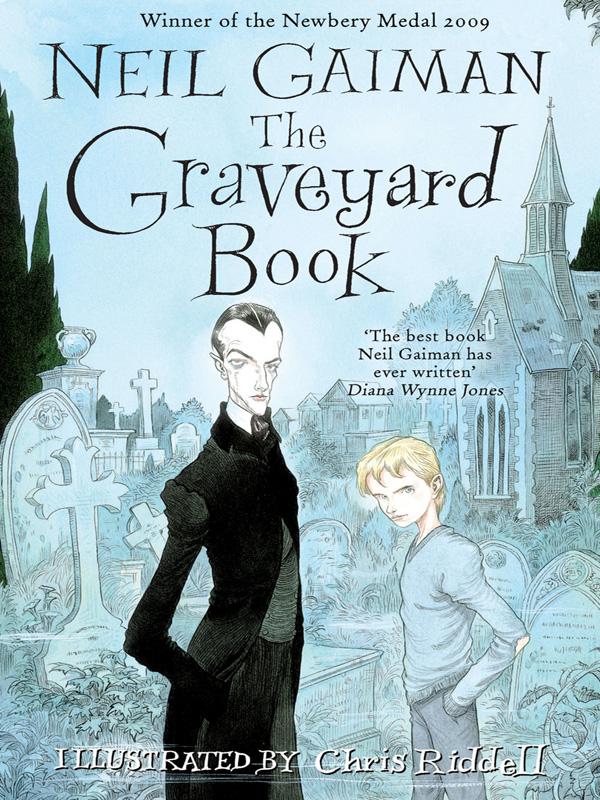
The Graveyard Book
About this book
Nobody Owens arrives in a graveyard as a toddler after escaping the man Jack. The dead grant him protection, a name, and the Freedom of the Graveyard; Silas, who belongs fully to neither living nor dead, becomes his guardian.
Each chapter brings Bod into a different part of his unusual childhood: lessons, ghouls, a witch, a dangerous school, and friendships with living people who cannot remain where he is safest.
The Graveyard Book follows Bod toward the confrontation his protectors have delayed and the life they cannot share. This edition includes the novel's illustrations.
Read a sample
5,012 words
Plain text
From the opening
CHAPTER 1
How Nobody Came to the Graveyard
There was a hand in the darkness, and it held a knife. The knife had a handle of polished black bone, and a blade finer and sharper than any razor. If it sliced you, you might not even know you had been cut, not immediately.
The knife had done almost everything it was brought to that house to do, and both the blade and the handle were wet.
The street door was still open, just a little, where the knife and the man who held it had slipped in, and wisps of night-time mist slithered and twined into the house through the open door.
The man Jack paused on the landing. With his left hand he pulled a large white handkerchief from the pocket of his black coat, and with it he wiped off the knife and his gloved right hand which had been holding it; then he put the handkerchief away. The hunt was almost over. He had left the woman in her bed, the man on the bedroom floor, the older child in her brightly coloured bedroom, surrounded by toys and half-finished models. That only left the little one, a baby barely a toddler, to take care of. One more and his task would be done.
He flexed his fingers. The man Jack was, above all things, a professional, or so he told himself, and he would not allow himself to smile until the job was completed.
His hair was dark and his eyes were dark and he wore black leather gloves of the thinnest lambskin.
The toddler’s room was at the very top of the house. The man Jack walked up the stairs, his feet silent on the carpeting. Then he pushed open the attic door, and he walked in. His shoes were black leather, and they were polished to such a shine that they looked like dark mirrors: you could see the moon reflected in them, tiny and half full.
The real moon shone through the casement window. Its light was not bright, and it was diffused by the mist, but the man Jack would not need much light. The moonlight was enough. It would do.
He could make out the shape of the child in the cot, head and limbs and torso.
The cot had high, slatted sides, to prevent the child from getting out. Jack leaned over, raised his right hand, the one holding the knife, and he aimed for the chest . . .
. . . and then he lowered his hand. The shape in the cot was a teddy bear. There was no child.
The man Jack’s eyes were accustomed to the dim moonlight, so he had no desire to turn on an electric light. And light was not that important, after all. He had other skills.
The man Jack sniffed the air. He ignored the scents that had come into the room with him, dismissed the scents that he could safely ignore, honed in on the smell of the thing he had come to find. He could smell the child: a milky smell, like chocolate chip cookies, and the sour tang of a wet, disposable, night-time nappy. He could smell the baby shampoo in its hair, and something small and rubbery – a toy, he thought, and then, no, something to suck – that the child had been carrying.
The child had been here. It was here no longer. The man Jack followed his nose down the stairs through the middle of the tall, thin house. He inspected the bathroom, the kitchen, the airing cupboard, and, finally, the downstairs hall, in which there was nothing to be seen but the family’s bicycles, a pile of empty shopping bags, a fallen nappy and the stray tendrils of fog that had insinuated themselves into the hall from the open door to the street.
The man Jack made a small noise then, a grunt that contained in it both frustration and also satisfaction. He slipped the knife into its sheath in the inside pocket of his long coat, and he stepped out into the street. There was moonlight, and there were street lights, but the fog stifled everything, muted light and muffled sound and made the night shadowy and treacherous. He looked down the hill towards the light of the closed shops, then up the street, where the last high houses wound up the hill on their way to the darkness of the old graveyard.
The man Jack sniffed the air. Then, without hurrying, he began to walk up the hill.
Ever since the child had learned to walk he had been his mother and father’s despair and delight, for there never was such a boy for wandering, for climbing up things, for getting into and out of things. That night, he had been woken by the sound of something on the floor beneath him falling with a crash. Awake, he soon became bored, and had begun looking for a way out of his cot. It had high sides, like the walls of his playpen downstairs, but he was convinced that he could scale it. All he needed was a step . . .
He pulled his large, golden teddy bear into the corner of the cot, then, holding the railings in his tiny hands, he put his foot on to the bear’s lap, the other foot up on the bear’s head and he pulled himself up into a standing position, and then he half climbed, half toppled over the railing and out of the cot.
Continue reading the sampleClose the sample
He landed with a muffled thump on a small mound of furry, fuzzy toys, some of them presents from relations from his first birthday, not six months gone, some of them inherited from his older sister. He was surprised when he hit the floor, but he did not cry out: if you cried they came and put you back in your cot.
He crawled out of the room.
Stairs that went up were tricky things, and he had not yet entirely mastered them. Stairs that went down however, he had discovered, were fairly simple. He did them sitting down, bumping from step to step on his well-padded bottom.
He sucked on his dummy, which his mother had just begun to tell him that he was getting too old for.
His nappy had worked itself loose on his journey on his bottom down the stairs, and when he reached the last step, when he reached the little hall and stood up, the nappy fell off. He stepped out of it. He was only wearing a child’s nightshirt. The stairs that led back up to his room and his family were steep and forbidding, but the door to the street was open and inviting . . .
The child stepped out of the house a little hesitantly. The fog wreathed around him like a long-lost friend. And, uncertainly at first, then with increasing speed and confidence, the boy tottered up the hill.
The fog was thinner as you approached the top of the hill. The half-moon shone, not as bright as day, not by any means, but enough to see the graveyard, enough for that.
Look.
You could see the abandoned funeral chapel, iron doors padlocked, ivy on the sides of the spire, a small tree growing out of the guttering at roof level.
You could see stones and tombs and vaults and memorial plaques. You could see the occasional dash or scuttle of a rabbit or a vole or a weasel as it slipped out of the undergrowth and across the path.
You would have seen these things, in the moonlight, if you had been there that night.
You might not have seen a pale, plump woman, who walked the path near the front gates, and if you had seen her, with a second, more careful glance you would have realised that she was only moonlight, mist and shadow. The plump, pale woman was there, though. She walked the path that led through a clutch of half-fallen tombstones towards the front gates.
The gates were locked. They were always locked at four in the afternoon in winter, at eight at night in summer. A spike-topped iron railing ran around part of the cemetery, a high brick wall around the rest of it. The bars of the gates were closely spaced: they would have stopped a grown man from getting through, even stopped a ten-year-old child . . .
‘Owens!’ called the pale woman, in a voice that might have been the rustle of the wind through the long grass. ‘Owens! Come and look at this!’
She crouched down and peered at something on the ground, as a patch of shadow moved into the moonlight, revealing itself to be a grizzled man in his mid-forties. He looked down at his wife, and then looked at what she was looking at, and he scratched his head.
‘Mistress Owens?’ he said, for he came from a more formal age than our own. ‘Is that what I think it is?’
And at that moment the thing he was inspecting seemed to catch sight of Mrs Owens, for it opened its mouth, letting the rubber nipple it was sucking fall to the ground, and it reached out a small, chubby fist, as if it were trying for all the world to hold on to Mrs Owens’ pale finger.
‘Strike me silly,’ said Mr Owens, ‘if that isn’t a baby.’
‘Of course it’s a baby,’ said his wife. ‘And the question is, what is to be done with it?’
‘I dare say that is a question, Mistress Owens,’ said her husband. ‘And yet, it is not our question. For this here baby is unquestionably alive, and as such is nothing to do with us, and is no part of our world.’
‘Look at him smile!’ said Mrs Owens. ‘He has the sweetest of smiles,’ and with one insubstantial hand she stroked the child’s sparse blond hair. The little boy giggled with delight.
A chilly breeze blew across the graveyard, scattering the fog in the lower slopes of the place (for the graveyard covered the whole of the top of the hill, and its paths wound up the hill and down and back upon themselves). A rattling: someone at the main gate of the graveyard was pulling and shaking it, rattling the old gates and the heavy padlock and chain that held them.
‘There now,’ said Owens, ‘it’s the babe’s family, come to bring him back to the loving bosom. Leave the little man be,’ he added, because Mrs Owens was putting her insubstantial arms around the toddler, smoothing, stroking.
Mrs Owens said, ‘He dun’t look like nobody’s family, that one.’ The man in the dark coat had given up on rattling the main gates and was now examining the smaller side gate. It, too, was well locked. There had been some vandalism in the graveyard the previous year, and the council had Taken Steps.
‘Come on, Mistress Owens. Leave it be. There’s a dear,’ said Mr Owens, when he saw a ghost, and his mouth dropped open, and he found himself unable to think of anything to say.
You might think – and if you did, you would be right – that Mr Owens should not have taken on so at seeing a ghost, given that Mr and Mrs Owens were themselves dead and had been for a few hundred years now, and given that the entirety of their social life, or very nearly, was spent with those who were also dead. But there was a difference between the folk of the graveyard and this: a raw, flickering, startling shape the grey colour of television static, all panic and naked emotion which flooded the Owenses as if it were their own. Three figures, two large, one smaller, but only one of them was in focus, was more than an outline or a shimmer. And the figure said, My baby! He is trying to harm my baby!
A clattering. The man outside was hauling a heavy metal rubbish bin across the alley to the high brick wall that ran around that part of the graveyard.
‘Protect my son!’ said the ghost, and Mrs Owens thought it was a woman. Of course, the babe’s mother.
‘What did he do to you?’ asked Mrs Owens, but she was not certain that the ghost could hear her. Recently dead, poor love, she thought. It’s always easier to die gently, to wake in due time in the place you were buried, to come to terms with your death and to get acquainted with the other inhabitants. This creature was nothing but alarm and fear for her child, and her panic, which felt to the Owenses like a low-pitched screaming, was now attracting attention, for other pale figures were coming from all over the graveyard.
‘Who are you?’ Caius Pompeius asked the figure. His headstone was now only a weathered lump of rock, but two thousand years earlier he had asked to be laid to rest on the mound beside the marble shrine, rather than to have his body sent back to Rome, and he was one of the most senior citizens of the graveyard. He took his responsibilities extremely seriously. ‘Are you buried here?’
‘Of course she’s not! Freshly dead by the look of her.’ Mrs Owens put an arm around the woman-shape and spoke to it privately, in a low voice, calm and sensible.
There was a thump and a crash from the high wall beside the alley. The rubbish bin had fallen. A man clambered up on to the top of the wall, a dark outline against the mist-smudged street lights. He paused for a moment, then climbed down the other side, holding on to the top of the wall, legs dangling, then let himself fall the last few feet, down into the graveyard.
‘But my dear,’ Mrs Owens said to the shape, now all that was left of the three shapes that had appeared in the graveyard. ‘He’s living. We’re not. Can you imagine . . .’
The child was looking up at them, puzzled. It reached for one of them, then the other, finding nothing but air. The woman-shape was fading fast.
‘Yes,’ said Mrs Owens, in response to something that no one else had heard. ‘If we can, then we will.’ Then she turned to the man beside her. ‘And you, Owens? Will you be a father to this little lad?’
‘Will I what?’ said Owens, his brow crinkling.
‘We never had a child,’ said his wife. ‘And his mother wants us to protect him. Will you say yes?’
The man in the black coat had tripped in the tangle of ivy and half-broken headstones. Now he got to his feet and walked forward more carefully, startling an owl, which rose on silent wings. He could see the baby and there was triumph in his eyes.
Owens knew what his wife was thinking when she used that tone of voice. They had not, in life and in death, been married for over two hundred and fifty years for nothing. ‘Are you certain?’ he asked. ‘Are you sure?’
‘Sure as I ever have been of anything,’ said Mrs Owens.
‘Then yes. If you’ll be its mother, I’ll be its father.’
‘Did you hear that?’ Mrs Owens asked the flickering shape in the graveyard, now little more than an outline, like distant summer lightning in the shape of a woman. It said something to her that no one else could hear, and then it was gone.
‘She’ll not come here again,’ said Mr Owens. ‘Next time she wakes it’ll be in her own graveyard, or wherever it is she’s going.’
Mrs Owens bent down to the baby and extended her arms. ‘Come now,’ she said, warmly. ‘Come to mama.’
To the man Jack, walking through the graveyard towards them on a path, his knife already in his hand, it seemed as if a swirl of mist had curled around the child, in the moonlight, and that the boy was no longer there: just damp mist and moonlight and swaying grass.
He blinked and sniffed the air. Something had happened, but he had no idea what it was. He growled in the back of his throat, like a beast of prey, angry and frustrated.
‘Hullo?’ called the man Jack, wondering if perhaps the child had stepped behind something. His voice was dark and rough, and there was an odd edge to it, as if of surprise or puzzlement at hearing himself speak.
The graveyard kept its secrets.
‘Hello?’ he called again. He hoped to hear a baby cry or utter a half-word, or to hear it move. He did not expect what he actually heard, a voice, silky smooth, saying:
‘Can I help you?’
The man Jack was tall. This man was taller. The man Jack wore dark clothes. This man’s clothes were darker. People who noticed the man Jack when he went about his business – and he did not like to be noticed – were troubled, or made uncomfortable, or found themselves unaccountably scared. The man Jack looked up at the stranger, and it was the man Jack who was troubled.
‘I was looking for someone,’ said the man Jack, slipping his right hand back into his coat pocket, so the knife was hidden, but there if he needed it.
‘In a locked graveyard, at night?’ said the stranger drily.
‘It was just a baby,’ said the man Jack. ‘I was just passing, when I heard a baby cry, and I looked through the gates and I saw him. Well, what would anyone do?’
‘I applaud your public-spiritedness,’ said the stranger. ‘Yet if you managed to find this child, how were you planning to get out of here with it? You can’t climb back over the wall holding a baby.’
‘I would have called until someone let me out,’ said the man Jack.
A heavy jingling of keys. ‘Well, that would have been me, then,’ said the stranger. ‘I would have had to let you out.’ He selected one large key from the key ring, and said, ‘Follow me.’
The man Jack walked behind the stranger. He took his knife from his pocket. ‘Are you the caretaker, then?’
‘Am I? Certainly, in a manner of speaking,’ said the stranger. They were walking towards the gates and, the man Jack was certain, away from the baby. But the caretaker had the keys. A knife in the dark, that was all it would take, and then he could search for the child all through the night, if he needed to.
He raised the knife.
‘If there was a baby,’ said the stranger, without looking back, ‘it wouldn’t have been here in the graveyard. Perhaps you were mistaken. It’s unlikely that a child would have come in here, after all. Much more likely that you heard a nightbird, and saw a cat, perhaps, or a fox. They declared this place an official nature reserve, you know, thirty years ago, around the time of the last funeral. Now think carefully, and tell me you are certain that it was a child that you saw.’
The man Jack thought.
The stranger unlocked the side gate. ‘A fox,’ he said. ‘They make the most uncommon noises, not unlike a person crying. No, your visit to this graveyard was a misstep, sir. Somewhere the child you seek awaits you, but he is not here.’ And he let the thought sit there, in the man Jack’s head for a moment before he opened the gate with a flourish. ‘Delighted to have made your acquaintance,’ he said. ‘And I trust that you will find everything you need out there.’
The man Jack stood outside the gates to the graveyard. The stranger stood inside the gate, and he locked it again, and put the key away.
‘Where are you going?’ asked the man Jack.
‘There are other gates than this,’ said the stranger. ‘My car is on the other side of the hill. Don’t mind me. You don’t even have to remember this conversation.’
‘No,’ said the man Jack, agreeably. ‘I don’t.’ He remembered wandering up the hill, that what he had thought to be a child had turned out to be a fox, that a helpful caretaker had escorted him back out to the street. He slipped his knife into its sheath. ‘Well,’ he said. ‘Goodnight.’
‘A goodnight to you,’ said the stranger, whom Jack had taken for a caretaker.
The man Jack set off down the hill, in pursuit of the infant.
From the shadows, the stranger watched Jack until he was out of sight. Then he moved through the night, up and up, to the flat place below the brow of the hill, a place dominated by an obelisk and a flat stone set into the ground dedicated to the memory of Josiah Worthington, local brewer, politician and later baronet, who had, almost three hundred years before, bought the old cemetery and the land around it, and given it to the city in perpetuity. He had reserved himself the best location on the hill – a natural amphitheatre, with a view of the whole city and beyond – and had ensured that the graveyard endured as a graveyard, for which the inhabitants of the graveyard were grateful, although never quite as grateful as Josiah Worthington, Bart, felt they should have been.
There were, all told, some ten thousand souls in the graveyard, but most of them slept deep, or took no interest in the night-to-night affairs of the place, and there were less than three hundred of them up there, in the amphitheatre, in the moonlight.
The stranger reached them as silently as the fog itself, and he watched the proceedings unfold, from the shadows, and he said nothing.
Josiah Worthington was speaking. He said, ‘My dear madam. Your obduracy is quite, is . . . well, can’t you see how ridiculous this is?’
‘No,’ said Mrs Owens. ‘I can’t.’
She was sitting, cross-legged, on the ground, and the living child was sleeping in her lap. She cradled its head with her pale hands.
‘What Mistress Owens is trying to say, sir, begging Your Honour’s pardon,’ said Mr Owens, standing beside her, ‘is that she dun’t see it that way. She sees it as doing her duty.’
Mr Owens had seen Josiah Worthington in the flesh back when they were both alive, had in fact made several pieces of fine furniture for the Worthingtons’ manor house, out near Inglesham, and was still in awe of him.
‘Her duty?’ Josiah Worthington, Bart, shook his head, as if to dislodge a strand of cobweb. ‘Your duty, ma’am, is to the graveyard, and to the commonality of those who form this population of discarnate spirits, revenants and suchlike wights, and your duty thus is to return the creature as soon as possible to its natural home – which is not here.’
‘His mama gave the boy to me,’ said Mrs Owens, as if that was all that needed to be said.
‘My dear woman . . .’
‘I am not your dear woman,’ said Mrs Owens, getting to her feet. ‘Truth to tell, I don’t even see why I am even here, talking to you fiddle-pated old dunderheads, when this lad is going to wake up hungry soon enough – and where am I going to find food for him in this graveyard, I should like to know?’
‘Which,’ said Caius Pompeius, stiffly, ‘is precisely the point. What will you feed him? How can you care for him?’
Mrs Owens’ eyes burned. ‘I can look after him,’ she said. ‘As well as his own mama. She already gave him to me. Look – I’m holding him, aren’t I? I’m touching him.’
‘Now, see reason, Betsy,’ said Mother Slaughter, a tiny old thing, in the huge bonnet and cape that she had worn in life and been buried wearing. ‘Where would he live?’
‘Here,’ said Mrs Owens. ‘We could give him the Freedom of the Graveyard.’
Mother Slaughter’s mouth became a tiny ‘O’. ‘But,’ she said. Then she said, ‘But I never.’
‘Well, why not? It en’t the first time we’d’ve given the Freedom of the Graveyard to an outsider.’
‘That is true,’ said Caius Pompeius. ‘But he wasn’t alive.’
And with that, the stranger realised that he was being drawn, like it or not, into the conversation and, reluctantly, he stepped out of the shadows, detaching from them like a patch of darkness. ‘No,’ he agreed. ‘I am not. But I take Mrs Owens’ point.’
Josiah Worthington said, ‘You do, Silas?’
‘I do. For good or for evil – and I firmly believe that it is for good – Mrs Owens and her husband have taken this child under their protection. It is going to take more than just a couple of good-hearted souls to raise this child. It will,’ said Silas, ‘take a graveyard.’
‘And what of food, and the rest of it?’
‘I can leave the graveyard and return. I can bring him food,’ said Silas.
‘That’s all very well you saying that,’ said Mother Slaughter. ‘But you comes and you goes and nobody keeps track of you. If you went off for a week, the boy could die.’
‘You are a wise woman,’ said Silas. ‘I see why they speak so highly of you.’ He couldn’t push the minds of the dead as he could the living, but he could use all the tools of flattery and persuasion he possessed, for the dead are not immune to either. Then he came to a decision. ‘Very well. If Mr and Mrs Owens will be his parents, I shall be his guardian. I shall remain here, and if I need to leave I shall ensure that someone takes my place, bringing the child food and looking after him. We can use the crypt of the chapel,’ he added.
‘But,’ expostulated Josiah Worthington. ‘But . . . A human child. A living child. I mean. I mean, I mean. This is a graveyard, not a nursery, blast it.’
‘Exactly,’ said Silas, nodding. ‘A very good point, Sir Josiah. I couldn’t have put it better myself. And for that reason, if for no other, it is vital that the child be raised with as little disruption as possible to the, if you’ll forgive the expression, the life of the graveyard.’ With that he strolled over to Mrs Owens, and he looked down at the infant asleep in her arms. He raised an eyebrow. ‘Does he have a name, Mrs Owens?’
‘Not that his mother told me,’ she said.
‘Well, then,’ said Silas. ‘His old name won’t be of much use to him now, anyway. There are those out there who mean him harm. Suppose we pick a name for him, eh?’
Caius Pompeius stepped over and eyed the child. ‘He looks a little like my proconsul, Marcus. We could call him Marcus.’
Josiah Worthington said, ‘He looks more like my head gardener, Stebbins. Not that I’m suggesting Stebbins as a name. The man drank like a fish.’
‘He looks like my nephew, Harry,’ said Mother Slaughter, and it seemed then as if the whole graveyard were about to join in, each inhabitant offering his or her own comparisons between the infant and someone long forgotten, when Mrs Owens broke in.
‘He looks like nobody but himself,’ said Mrs Owens, firmly. ‘He looks like nobody.’
‘Then Nobody it is,’ said Silas. ‘Nobody Owens.’
It was then that, as if responding to the name, the child opened its eyes wide in wakefulness. It stared around it, taking in the faces of the dead, and the mist, and the moon. Then it looked at Silas. Its gaze did not flinch. It looked grave.
‘And what kind of a name is Nobody?’ asked Mother Slaughter, scandalised.
‘His name. And a good name,’ Silas told her. ‘It will help to keep him safe.’
‘I don’t want trouble,’ said Josiah Worthington. The infant looked up at him and then, hungry or tired or simply missing his home, his family, his world, he screwed up his tiny face and began to cry.
‘Leave us,’ said Caius Pompeius to Mrs Owens. ‘We will discuss this further without you.’
Mrs Owens waited outside the chapel. It had been decreed over forty years before that the building, in appearance a small church with a spire, was a listed building of historical interest. The town council had decided that it would cost too much to renovate it, a little chapel in an overgrown graveyard that had already become unfashionable, so they had padlocked it, and waited for it to fall down. Ivy covered it, but it was solidly built, and it would not fall down this century.
The child had fallen asleep in Mrs Owens’ arms. She rocked it gently, sang to it an old song, one her mother had sung to her when she was a baby herself, back in the days when men had first started to wear powdered wigs. The song went:
Sleep my little babby-oh
Sleep until you waken
When you’re grown you’ll see the world
If I’m not mistaken.
Kiss a lover,
Dance a measure,
Find your name
and buried treasure . .
And Mrs Owens sang all that before she discovered that she had forgotten how the song ended. She had a feeling that the final line was something in the way of ‘and some hairy bacon’, but that might have been another song altogether, so she stopped and instead she sang him the one about the Man in the Moon who came down too soon, and after that she sang, in her warm country voice, a more recent song about a lad who put in his thumb and pulled out a plum, and she had just started a long ballad about a young country gentleman whose girlfriend had, for no particular reason, poisoned him with a dish of spotted eels, when Silas came around the side of the chapel, carrying a cardboard box.
‘Here we go, Mistress Owens,’ he said. ‘Lots of good things for a growing boy. We can keep it in the crypt, eh?’