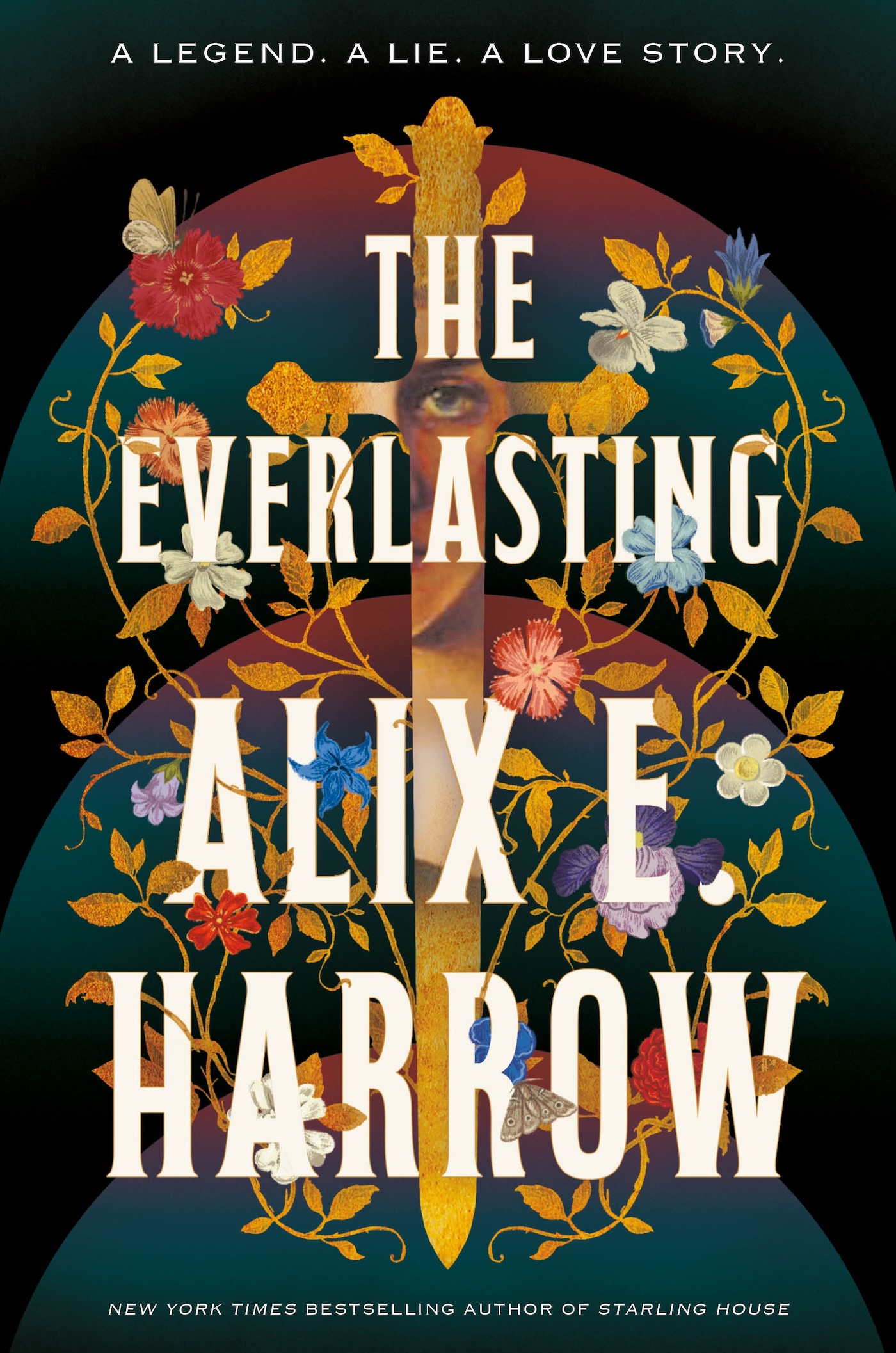
The Everlasting
About this book
Sir Una Everlasting is remembered as the orphan who became Dominion's perfect knight and died for queen and country. Centuries later, historian Owen Mallory has built his life around that legend despite his own failures in war and scholarship.
Owen is drawn into the past and bound to Una's story as it repeats. The archives promised a clean heroic arc; the living woman confronts him with fear, desire, political use, and details that the official version removed.
Their attachment makes historical accuracy and personal loyalty impossible to separate. Changing Una's ending might save her, but it may also undo the story that organized Owen's world and legitimized a nation.
The Everlasting is a standalone time-crossed fantasy about propaganda, authorship, and love inside a repeated history. Alix E. Harrow treats the familiar heroic legend as a mechanism people can enter, enforce, and perhaps rewrite.
Read a sample
5,059 words
Plain text
From the opening
UNA AND THE YEW
It begins where it ends: beneath the yew tree.
The yew stands in the wood like a great queen grown old, limbs wracked with age, head bowed by the weight of her crown. In the gnarled grain of her trunk there is a woman’s face, with weeping cankers for eyes, and in her heartwood there is a sword driven so deep that only the hilt is still visible. You already know the name of that sword, I think; who doesn’t?
They say time runs strangely, beneath the yew. They say many things are lost there, among the tangled roots: years, hearts, lives. But they say, too, that some things are found: fates and fortunes, beginnings and endings.
And, once, a child. You know her name, too, or at least one of them.
She was still pink and toothless when the woodcutter found her, and he fretted. He needn’t have; she grew quickly and well, as wild things do.
As a child she was all mischief, her fingertips stained with yewberries, her hair light and fey as dandelion down. As a girl she turned solemn, studying the woods as a saint would study the word. From them, she learned everything.
She learned to run as the stag runs and to be still as the goshawk is still; to stalk and to swim, to wrestle and to whistle; to vanish so thoroughly her own father could not find her and to kill so cleanly she left nothing but a tuft of fur, the metal scent of entrails.
She was strong, and arrogant in her strength. She was a young lion, a child-king, a lord of the wild woods.
And yet, she was no one at all. She was nothing, daughter of nothing, heir to nothing. Just another of the numberless, featureless small folk of Dominion, whose name would not be forgotten only because no one ever learned it in the first place. She would die a heathen death, unchristened and unshriven, so that even God would not remember her.
But then came her twelfth winter, and the Brigand Prince.
She was away when it happened. Perhaps she was stealing feathers for her fletching or pulling the hide from a hare. What matters is that she was far enough from her father’s cottage that she did not hear the ring of iron-shod hooves, or the screams.
When she returned to the cottage the fire was cold, and her father was dead.
They had taken everything—the sow, the salt box, the pair of axes her father kept above the hearth—so she went to the yew.
She wrapped her hands around the hilt of the sword that had waited there for so long that the bark had boiled and knotted around the blade.
There were whispers about that sword, even then, but she hadn’t heard them. She hadn’t heard the tales of an ancient blade that neither dulled nor shattered nor rusted but remained whole and shining. She hadn’t heard the prophecy that said it would be drawn only in the country’s darkest hour, by her rightwise champion.
She only knew that her father was dead, and that the hilt in her hand felt like the clasp of an old friend.
And so—full of grief and fresh-born fury—she drew the sword from the yew.
She overtook the Brigand Prince and his men that very night, tracking them through new-fallen snow, and found them while they sat sated and dozing around their fire, beards shining with pig fat. She might have slit their throats in silence—she had learned to be silent as the fox is silent—but she was arrogant, and she was angry, so she called out to them first. She allowed them to scrabble blades from sheaths, spears from saddles.
And then she fell among them: a wolf now, a shrike, a terrible reaping.
When she was through, and the woods were quiet, the snow was no longer white.
That is how the queen—who was not yet the queen but only a king’s daughter taken captive by the Brigand Prince—first saw her: a wet, red girl in the center of a wet, red circle, her wrists bent beneath the weight of a blade that had not been borne in a hundred years and a hundred more.
The queen-who-was-not-yet-queen rose and went to her, and the girl trembled, because the woman was so beautiful and gentle, and because the girl had killed those men so easily, almost joyfully. Her own body felt sharp and unwieldy, like a knife without a hilt.
The queen asked, ‘Who are you?’
And the girl answered, ‘No one.’
The queen asked, ‘To whom do you belong?’
And the girl answered, with grief, ‘No one.’
The queen knelt low. She stroked the girl’s hair, heedless of the stain it left on her palm, and the girl felt her terror washed away beneath that touch. She thought she would not mind being a knife, so long as it was this hand that wielded her.
‘Then,’ said the queen-who-was-not-yet-queen, ‘will you be mine?’
‘Yes,’ the girl whispered, and meant it with all her young and shattered heart.
So the woman—who would be queen very soon, for what is a queen but an ambition pursued—took the sword from the girl’s hand and bid her kneel. She asked the girl if she would swear by her good right arm, and by her left, and by her life and death to serve no master save her queen, and she touched the blade once to each of the girl’s shoulders and to the back of her bowed head.
The girl said, three times, ‘I swear it.’
‘Then rise, Sir Una,’ said the queen, because the name meant only, and already she could tell there would never be another like her.
Over the years Una gathered more names. She became the Queen’s Champion, the Red Knight, the Virgin Saint, the Drawn Blade of Dominion. She became Sir Una Everlasting, hero and paragon, arcing through history like a bright-tailed comet.
She became a legend.
Most legends are lies, pretty stories meant to keep the children quiet on long winter evenings. But I, who rode so many miles at her side and slept so many nights at her feet—I, who was her shadow while she lived and her echo ever after—am no liar.
I will not waste too much time with those stories that have already been told and retold, traded like coins in every hall and tavern. Everyone has heard the tale of Una and the False Kings, and the Winning of the Crown, and the First Crusade, which brought all of Dominion into the light of the Savior. Everyone knows how her legend began, beneath the yew.
But gather close, all true hearts of Dominion—
And I will tell you how it ends.
—Excerpted from The Death of Una Everlasting, translated by Owen Mallory
Received 8–17
Attn: Prof Owen Mallory
WOULD BE THE FIND OF THE CENTURY WERE IT NOT A CROCK OF SHIT WHICH OF COURSE IT IS
Prof Gilda Sawbridge
Sent 8–17
Attn: Prof Gilda Sawbridge
ANALYSIS SUGGESTS IT IS AT LEAST A VERY OLD CROCK OF SHIT MAAM
Owen Mallory
Received 8–17
Attn: Prof Owen Mallory
DONT MAAM ME YOU [REDACTED] I PAID A PENNY FOR THAT WORD THE [REDACTED] FASCISTS BETTER NOT CENSOR IT MEET ME AT THE STATION TOMORROW
Prof Gilda Sawbridge
Received 8–18
Attn: Prof Owen Mallory
WHERE THE [REDACTED] ARE YOU MALLORY? IF IT WAS MY COMMENT ABOUT THE FASCISTS I WAS ONLY JOKING GOD SAVE OUR BOYS IN RED ETC
Prof Gilda Sawbridge
Received 8–20
Attn: Mallory
WELL GOOD LUCK OUT THERE BOY TAKE GOOD NOTES FOR ME DONT KNOW WHERE YOUVE GONE OR WHY BUT I KNOW YOULL COME BACK EVENTUALLY AS YOU HAVE SIX OVERDUE BOOKS
Gil
Continue reading the sampleClose the sample
1
SEVERAL YEARS AFTER the war, during the mid-afternoon hour I generally put aside to fantasize about setting fire to my manuscript and disappearing into the countryside to raise goats, I received a book in the post.
This was not, in itself, remarkable; most members of the Cantford College Department of History received so many books in the post that their offices had been overtaken by a series of architecturally unsound towers, which would collapse if anyone exhaled too aggressively in their presence.
But this particular book was different, because this particular book did not—according to every archaeologist, historian, medievalist, linguist, antiquarian, archivist, and even most of the conspiracy theorists I had ever consulted—exist.
True, I may have harbored certain fantasies that I would one day prove them all wrong. I may have pictured myself unlocking a long-lost vault or descending into a catacomb, perhaps holding a torch aloft and whispering, to no one in particular, By Jove, I’ve found it.
But I was not in a vault or a catacomb.
I was sitting at my very ordinary desk in my very ordinary office, which the department had granted me only last term, in the manner of people who have been feeding a stray for so long they might as well name it. Outside the sky was a very ordinary late-summer blue.
And I was holding in my hands the single greatest historical discovery of the century, or possibly the millennium.
I wanted to weep. I wanted to laugh. I wanted most of all to open the book and run the tips of my fingers over the pages, to prove that it was real and so was I. (I was prevented by a vestigial but powerful fear of the college archivist, who kept thumbscrews in her desk specifically for people who touched old paper without washing their hands first.)
Instead, I whispered, somewhat hysterically, “By Jove, I’ve—”
“Mallory, old boy?”
A moneyed, overloud voice, a tread like a parade march: This could only be Jeremy Harrison, the other lecturer in my subfield.
As was my long custom in every stressful situation, I panicked. I wrapped the parcel paper back around the book, fumbled with the top drawer of my desk, which always jammed when it was damp, which it always was, and, in the end, stuffed the book down my shirtfront and hunched my shoulders to hide the lump.
This was sheer professional avarice, I’m afraid: There was only one endowed faculty position in Middle Dominion Studies. Harrison wanted it with the indefatigable passion of someone who thought admiration and wealth were his birthright; I wanted it with the indefatigable passion of someone who had never experienced either and would eat bullets for a taste.
Whoever discovered this book—the book whose corners were presently digging into my ribs—would have more than a taste.
“There you are.” Harrison rounded the corner and slouched against the doorframe, looking as usual like an escapee from a painting of a fox hunt. “How’s the book coming?” He asked this question two or three times a week, because he was at heart a bastard who reveled in the suffering of others.
“Fine. Wonderful.” My voice was a thin rasp, unpleasantly high. I tried not to resent it; the field surgeon had told me I was lucky I had a voice at all, or, indeed, a pulse. “But I was just leaving, actually, excuse me.” I stood, still hunched, scuttling around my desk in the manner of an arthritic crab.
“Of course, of course. Far be it from me to stand between a war hero and his duty,” Harrison said, solicitously and hatefully. The Everlasting Medal of Valor was the only thing I had ever achieved that Harrison hadn’t. I longed to rub his face in it but, as the whole thing was a complete fucking farce, never quite could.
I produced a hoarse ha, ha and ran for it, like the coward I always was and always would be.
I waited until I was on the train back to my flat—still bent nearly in half, as if I were smuggling an infant or suffering from an intestinal complaint—before extracting the parcel from my shirt.
There was no return address on the wrapping, no stamp of origin. Just my name, Owen Mallory, and the address of the campus mail room written in an unremarkable hand. I should have been at least mildly concerned that the entire thing was an elaborate hoax designed by Harrison to embarrass me, but all I felt was a rising, heady relief. As if the whole of my life up till now had been a sort of dreary, shameful churning, like dog-paddling, which would be redeemed by everything that happened next.
I peeled back the paper.
The book was bound in rich red heartwood, cut against the grain so that the rings of the tree were visible, rippling outward. The spine was affixed by a series of clever bronze hinges, cerulean with age, and a familiar, circular symbol had been burned deeply into the wood, stained with soot or wineroot. I traced it with one shaking fingertip.
An underfed boy of seven or eight was seated beside me, watching me in the frank, unashamed way that young people watch the unwell. He had an extravagance of eyelashes, which gave him the wistful, sleepy look of someone woken mid-dream.
I found myself opening the book, pointing to the title page. “Can you read this?”
The boy recoiled a little from the sound of my voice. Then, warily, as if I were mad or, worse, intending to teach him something: “No, sir.”
“Don’t worry, few people could.” Middle Mothertongue bore a frustratingly faint resemblance to our modern language, but it had always come easily to me, like a childhood dialect I’d not quite forgotten. I closed the book and tapped the cover. “And what does this look like to you? This symbol?”
He bent to study it obediently. His hair—an unfortunate, Gallish shade of red—was still fine enough to form a babyish snarl at the nape of his neck.
“A lizard,” he declared, eventually. “Or a dragon, maybe, chewing up its own tail.” He spent the rest of the ride offering suggestions for the improvement of the design (blood, teeth, blood dripping from teeth, et cetera), gesturing enthusiastically. His wrists were spattered with hot pink scars, as from welding sparks or ash. The munitions factories ran on twenty-four-hour shifts these days, and there weren’t enough grown men and women to work them.
The train dinged. I stood, and the boy nodded amiably at the book. “What’s it called?”
I swayed, teetering on the edge of the thing that would transform me from no one into someone. It felt momentous, fateful, even. As if you had watched over me—haunted me, guided me, saved me thrice over—solely so that I could be here, now, with your name on my tongue.
The boy was waiting with his long dreamer’s lashes tipped up to me. Would there be another war by the time he was old enough to enlist? Would it be your story—newly published, perhaps leatherbound, with my name in small print on the title page—that sent him to the front? Something swelled painfully in my chest at the thought; pride, I decided.
I leaned closer and told the boy the five words he couldn’t read, that I could, as easily as if I’d written them myself: “The Death of Una Everlasting.”
Before I stepped off the train, I dug a coin from my wallet and tossed it to him. He caught it in one small, scarred hand.
2
I WAS BORN not quite ten centuries after your death; the first time you saved my life, I was nine.
It was between the wars, when my father and I lived in a narrow gray row house in the narrow gray village of Queenswald, in the part of the country that had once been a fathomless green wood but was now nothing but bald hills and pit mines.
I woke that morning and listened, as I did every morning, for the gentle engine of my father’s snoring. The house was silent, so I laced up my boots and slipped out the door.
It wasn’t far to the tavern, but it was dark and cold, and I did not like the dark or the cold. I also did not like locked doors, large dogs, the sound of gunfire, or the sight of blood. I was aware that these were girlish, humiliating tendencies that made the other boys laugh at me, but they would have laughed anyway, I think. Partly it was my looks—my hair and eyes were nearly black, and my skin had a suspiciously Hinterlander undercurrent, beery gold even in winter—and partly it was everything else about me.
I had slim shoulders, thick spectacles, a fine singing voice, neat handwriting, a subscription to the lending library, and the best marks in class; my shins were always a little too long for my trousers and I cried easily, sometimes for no reason. I was a walking flinch. An open invitation for other boys—bolder, louder boys, with ruddy pink cheeks and trousers that fit—to knock their shoulders purposefully against mine as they passed.
But those boys were still sleeping at this hour. Everyone was, save the barkeep, and she was inexplicably fond of my father and me. By the time I knocked she was wiping down tables with her youngest daughter propped on one hip.
“By the fire,” she said, and I nodded.
My father was slumped over the hearth like laundry that had fallen from the drying rack. It took several minutes to get him conscious, and another several to get him vertical. He mumbled things to me as we navigated the empty chairs, nice things, like there’s my boy and thank you and sorry, sorry. I knew my father often behaved shamefully—knew he drank too much and said too much and refused to sing the anthem on national holidays—but he was never unkind, so I’d decided I didn’t mind the rest.
The barkeep set a basket on the counter as we passed. She was always slipping me things, leftover pies and hand-me-down sweaters. I knew this, too, was shameful, but her pies were very good and my father was always between jobs or about to be, so I’d decided it was another thing I didn’t mind.
I took the basket. My father stumbled.
The barkeep’s daughter looked at him with her big blue eyes and her perfect yellow curls—like an advertisement for Dominion’s Own soap, like my exact opposite—and said, with the eerie mimicry of a child repeating words they’ve heard but don’t understand, “Fucking coward.”
I’d heard it before, along with words like turncoat, traitor, and sometimes deserter, although Queenswald was awfully far from the desert.
But that morning I felt my father cringe away from the word and understood for the first time that it was true. That my father was something even more shameful than being a drunk or a radical, something so awful that the stink of it followed him everywhere and sank into everything he loved, including—and this I saw in the mute pity of the barkeep’s face, the way she scolded her daughter—me.
And so I left my father there in the tavern, still drunk, still saying nice things, and ran away.
It still wasn’t fully light, and the muddy streets had frozen overnight into alien figurations, which reached for my ankles and twisted. I tripped and crashed into a woman wearing a fine wool coat. She was very nice about it, bending to help gather the scattered contents of the barkeep’s basket while I fumbled for my spectacles. She smelled like summer, sweet and flowery.
“Poor thing,” she said, as she handed me back the basket, and I thanked her, hot-faced with shame.
Running away, I decided, was more of a spiritual state than a specific speed, so I walked. I walked until the hunched shoulders of the houses gave way to sheepfolds and frostbitten hills, and the street became a narrow track that became nothing at all.
I walked until I reached the grove.
No one much liked the grove. Later I would learn that it was the last remnant of the Queen’s Wood, the great green shroud that had once run all the way to the sea. But most of the trees had been turned into ships a century ago, the last time we’d gone to war against the Hinterlands, and now all that remained were a few ghostly acres.
It seemed larger, to me. The air beneath the trees was very still, and the branches seemed to catch all the ordinary sounds of Queenswald—the coal trains and carts, the lambs and schoolchildren and the bitter wet wind that blew all winter—and turn them away, so that stepping into the woods was like slipping under the surface of a lake.
Every now and then someone would announce that it was high time they cleared the land, and the young men would be hassled outside with axes and saws. They only ever made it through the slender new growth at the edges; any farther and the men would begin to complain that their blades, freshly sharpened, were going dull, and their good ash handles were turning spongy with rot. They would return home, defeated, and no one would mention the woods again for a year or two.
For this, I was grateful. Everywhere I went I was plagued by the sweaty sense that I was in the way or underfoot, unwanted, ill-fitting, missish—but not here. Here, I was neither my father’s son nor a foreigner but only myself.
The only other person I’d ever met in the woods was a girl a little older than me, a proud and feral creature I’d met one day after I’d fallen and scraped both knees bloody. She was my superior in every subject that mattered—climbing, running, spitting, rock-throwing, fighting with sticks—but I didn’t mind. She liked to win, and I liked to watch her, and afterward I liked to lie next to her among the tiny white flowers that covered the grove every summer.
Last winter she’d stopped coming. I asked after her everywhere, but no one seemed to know where she’d gone, or even to have heard of a girl by the name of Ulla, and eventually I had concluded, with a new and grown-up sadness, that I’d made her up.
I headed now to the very middle of the woods. She used to wait for me there, beneath an old yew so vast and so misshapen it no longer looked much like a tree, but like some secret organ of the earth itself, exposed. We liked to find patterns in the grain of the trunk: a dragon, a crown, a woman’s tortured face. In spring the sap would run from her eyes like tears.
It was even quieter than usual, beneath the yew. So quiet I thought maybe I wouldn’t run away, after all. Maybe I would just tuck myself down among the roots, cradled by dead needles and worms, and disappear.
They wouldn’t look for me for very long. My father would want to, but he wouldn’t go this far into the grove, being a fucking coward, and in a few months those little white flowers would cover me over, and the name Owen Mallory would be wiped clean from the world, as if it had never been.
That sounded rather grand and tragic, so I settled myself between the roots and waited to disappear.
It was hungry work, I found. By the time the sun had fully risen I’d decided maybe I ought to eat whatever the barkeep had slipped me, as a last meal. I opened the basket.
That’s when I first saw the book.
Not the book, of course, but a book: thin pages, already brittle; a cloth cover, moth-chewed; illustrations printed so cheaply the colors didn’t line up properly with the drawings, so that each figure appeared to be haunted by his own merry ghost. None of the barkeep’s baskets had ever included a book before.
The title was written in an elaborate, curlicued font that was supposed to look medieval: The Legend of Una Everlasting. And then, in smaller serif print: A Children’s Retelling of the Classic Tragedy! And, even smaller: Look inside for a complete listing of titles in the Little Soldiers National Heritage Series.
I sat there beneath the yew and read your story for the first time.
It was not, I would realize only when I was much older, a particularly good adaptation. The author had sprinkled thous and forsooths with a criminal disregard for syntax, and the illustrator had an unwholesome fascination with decapitation. All the messy loose ends of the Everlasting Cycle—the result of centuries of iterations and variations—had been pruned away in favor of a morality tale with all the subtlety and nuance of a nursery rhyme.
But the story itself shone through the prose like sunlight: a nameless child who became a knight; a knight who went to war and became a champion; a champion who slew the last dragon and found the lost grail and became a legend. It was a story of chivalry and courage, where good and evil were neatly labeled, and one always vanquished the other.
And when I turned the final page, there you were: Sir Una Everlasting.
They’d laid you out in full armor but for a helm, mailed fists still curled around your hilt, as if you kept some vigil even in death. Your hair was a startling, fluorescent yellow, which spilled like melted butter over the edge of your bier, and your face was the pure white of the page beneath. There were flowers tucked all around you: tiny, colorless roses, I thought, though the artist had no particular botanical skill.
I thought you were the saddest and most beautiful thing I had ever seen, like a dead angel. I looked for a long time at the bright line of the sword along your sternum, at the solemn shape of your mouth.
I looked at you for so long and so well that I felt something inside me shifting, irrevocably. It was like dying or being born, or being hit very hard on the head. It was like falling in love. (This was another thing I would only realize when I was much older.)
The longer I looked, the more ashamed I felt.
Sir Una Everlasting—you—had never run from anything. You hadn’t disappeared from the world—you had burned your name into its surface, carved it so deeply into the stone of history that it was still legible a thousand years later. You had died, yes, but only because you had found something worth dying for. You had been born poor, but no one had ever called you a poor thing.
If I turned the book sideways, I could read the letters inscribed on your blade: Erxa Dominus.
For Dominion.
Perhaps if my father had read your stories as a boy, he would not have grown up to be a traitor and a turncoat; perhaps he would have served with honor and come home with a pension instead of just a bad hip and a motherless child.
And perhaps—despite my reservations about gunfire and bloodshed—it was not too late for me.
Here I was visited by a somewhat confused daydream of myself returning to Queenswald in triumph—being swept up, adored, admired. The ruddy-cheeked boys would clap me on the back and my father would sober up and you would be there, somehow, glowing faintly with holy light. You would take my hand and guide me down to lie beside you on your bier.
I repacked the basket, fingers clumsy with cold, and went straight home.
My father didn’t even look up when the door closed behind me. He behaved, in fact, as if no time had passed at all, as if the whole world had held its breath while I sat beneath the yew in the heart of the grove that was all that was left of the deep wild woods.
I lingered, wanting him to ask where I’d gone and why I’d come back. If he had, I would have answered, somewhat theatrically: For Dominion.
But I would have meant: For you.
The second time you saved me, I was twenty-three, and we were losing the war.
The Sunday papers printed fresh maps each week, with squiggly red lines to show how far our troops had retreated, how much territory was still held by the Hinterlanders. They used to list the casualties by name over the wireless, but they’d stopped after a group of dissidents broke into Chancellor Gladwell’s bedroom and wrote the names of the dead on his walls in gory red paint (I’d told myself the red spatters on my father’s cuffs were coincidental).
Now the evening radio hour was reserved for the Minister of War. Every night she addressed the nation, begging every concerned citizen to tighten their belts, every able hand to take up arms. She recalled our past triumphs against worse odds: Were we not the sons and daughters of Queen Yvanne the First, who united the whole of Dominion and brought the Savior’s light to every hollow and dale? Had we not stood against the Hinterlands for centuries, bloodied but never beaten? Surely our nerve would not fail now, on the very cusp of peace?
There had been murmurs and jokes and a run of extremely nasty cartoons when the Chancellor had named a woman as Minister of War, but her speeches were very good, and they left me restless and guilty.
Now, as I walked toward campus, I caught edged looks and suspicious glances, blond heads bent together, muttering. People wondered, perhaps, where I had gotten my dark eyes and hair, and why I hadn’t been detained with the other enemy aliens and foreign suspects. Or perhaps they only wondered why a healthy young man was walking down the street with library books tucked under one arm while their own sons were bleeding or killing or rotting in the Hinterlands.