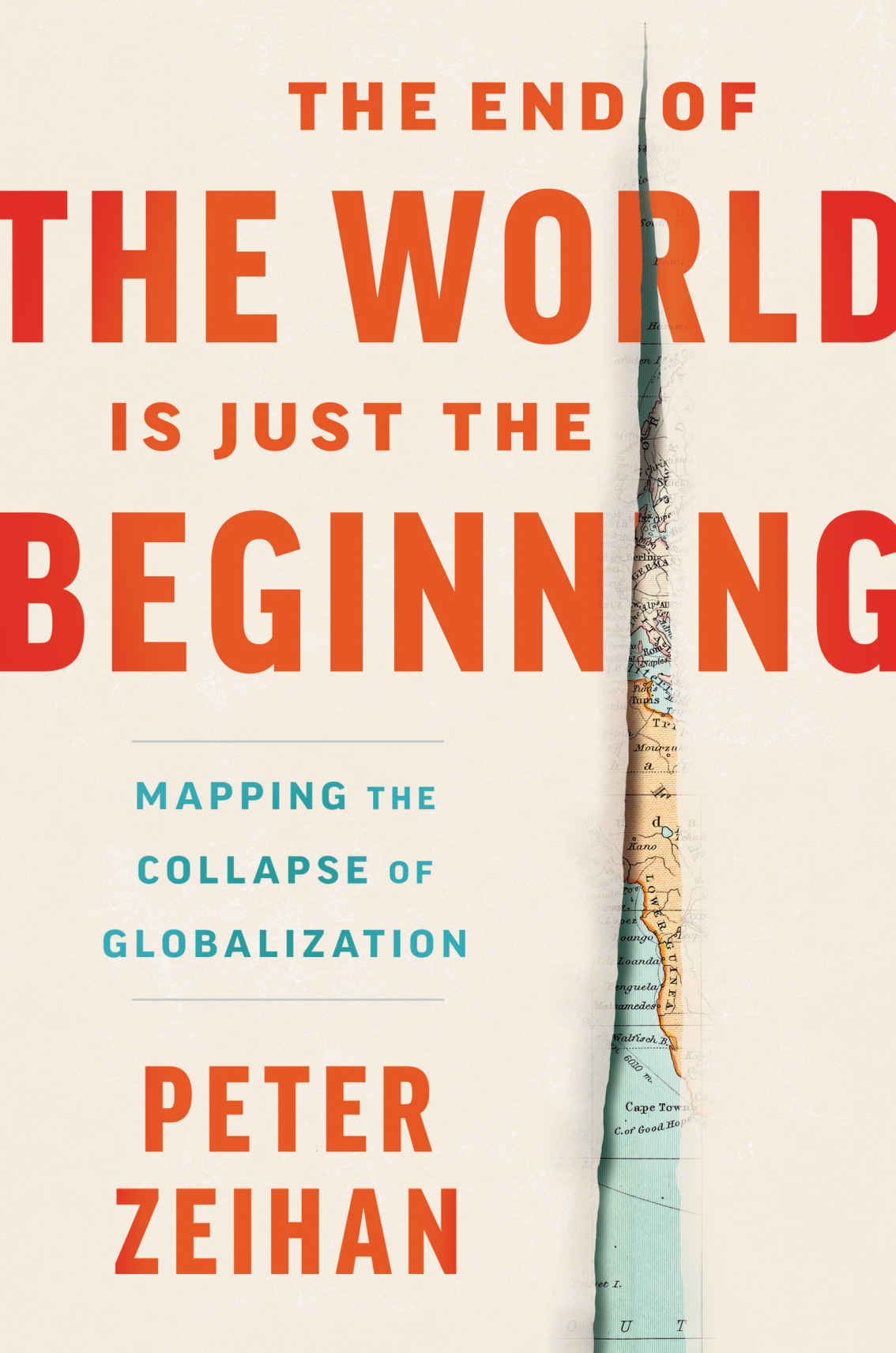
The End of the World Is Just the Beginning: Mapping the Collapse of Globalization
About this book
The book describes the post-Second World War order as an unusual system in which secure sea lanes, American power, abundant energy, and expanding workforces allowed production to spread across long international supply chains.
Zeihan then examines transport, finance, energy, industrial materials, manufacturing, and agriculture under a less integrated future. Geography and age structure become constraints on which countries can supply essentials domestically or maintain complex imports.
The analysis is intentionally sweeping and predictive. Its scenarios depend on assumptions about American withdrawal, demographic trajectories, and states' inability to adapt, so readers should separate the book's factual descriptions from the outcomes the author forecasts.
The End of the World Is Just the Beginning is geopolitical nonfiction about deglobalization. It offers a sector-by-sector framework for thinking about systemic dependence rather than a date-certain prediction of literal planetary collapse.
Read a sample
5,029 words
Plain text
From the opening
Introduction
The past century or so has been a bit of a blitzkrieg of progress. From horse-and-buggy to passenger trains to the family car to everyday air travel. From the abacus to adding machines to desktop calculators to smartphones. From iron to stainless steel to silicon-laced aluminum to touch-sensitive glass. From waiting for wheat to reaching for citrus to being handed chocolate to on-demand guacamole.
Our world has gotten cheaper. And certainly better. And most definitely faster. And in recent decades the paces of change and achievement have accelerated further. We’ve witnessed the release of more than thirty ever-more-sophisticated versions of the iPhone in just fifteen years. We’re attempting to shift wholesale to electronic vehicles at ten times the pace we adopted traditional combustion engines. The laptop I’m tapping this down on has more memory than the combined total of all computers globally in the late 1960s. Not long ago I was able to refinance my home at a rate of 2.5 percent. (It was stupidly awesome.)
It isn’t simply about stuff and speed and money. The human condition has similarly improved. During the past seven decades, as a percent of the population, fewer people have died in fewer wars and fewer occupations and fewer famines and fewer disease outbreaks than since the dawn of recorded history. Historically speaking, we live in an embarrassment of riches and peace. All of these evolutions and more are tightly interwoven. Inseparable. But there is a simple fact that is often overlooked.
They are artificial. We have been living in a perfect moment.
And it is passing.
The world of the past few decades has been the best it will ever be in our lifetime. Instead of cheap and better and faster, we’re rapidly transitioning into a world that’s pricier and worse and slower. Because the world—our world—is breaking apart.
I’m getting ahead of myself.
In many ways this book is the most quintessentially “me” project I’ve done. My work lands me squarely at the intersection of geopolitics and demography. Geopolitics is the study of place, exploring how everything about us is an outcome of where we are. Demography is the study of population structures. Teens act different from thirty-somethings versus fifty-somethings versus seventy-somethings. I weave together these two disparate themes to forecast the future. My first three books were about nothing less than the fall and rise of nations. About exploring the “big picture” of the world to come.
But you can only speak at Langley so many times. To pay the bills I do something else.
My real job is a sort of hybrid public speaker/consultant (the fancy marketing term is geopolitical strategist).
When groups bring me in, it’s rare that they want to ruminate over the future of Angola or Uzbekistan. Their needs and questions are closer to home and their pocketbooks, wrapped up in a series of economic questions about trade and markets and access. What I do is apply geopolitics and demography to their problems. Their dreams. Their fears. I peel out the appropriate parts of my “big picture” and apply them to questions of electricity demand in the Southeast, or precision manufacturing in Wisconsin, or financial liquidity in South Africa, or the nexus of security and trade in the Mexico border region, or transport options in the Midwest, or energy policy during the turn of American administrations, or heavy industry in Korea, or tree fruits in Washington State.
This book is all that and more. So much more. I’m once again using my trusty tools of geopolitics and demography to forecast the future of global economic structures, or, to be more accurate, their soon-to-be lack thereof. To showcase the shape of the world just past the horizon.
The crux of the problem we all face is that, geopolitically and demographically speaking, for most of the last seventy-five years we have been living in that perfect moment.
At the end of World War II, the Americans created history’s greatest military alliance to arrest, contain, and beat back the Soviet Union. That we know. That’s no surprise. What is often forgotten, however, is that this alliance was only half the plan. In order to cement their new coalition, the Americans also fostered an environment of global security so that any partner could go anywhere, anytime, interface with anyone, in any economic manner, participate in any supply chain and access any material input—all without needing a military escort. This butter side of the Americans’ guns-and-butter deal created what we today recognize as free trade. Globalization.
Globalization brought development and industrialization to a wide swath of the planet for the first time, generating the mass consumption societies and the blizzard of trade and the juggernaut of technological progress we all find so familiar. And that reshaped global demographics. Mass development and industrialization extended life spans, while simultaneously encouraging urbanization. For decades that meant more and more workers and consumers, the people who give economies some serious go. One outcome among many was the fastest economic growth humanity has ever seen. Decades of it.
The Americans’ postwar Order triggered a change in condition. By shifting the rules of the game, economics transformed on a global basis. A national basis. A local basis. Every local basis. That change of condition generated the world that we know. The world of advanced transport and finance, of ever-present food and energy, of never-ending improvements and mind-bending speed.
Continue reading the sampleClose the sample
But all things must pass. We now face a new change in condition.
Thirty years on from the Cold War’s end, the Americans have gone home. No one else has the military capacity to support global security, and from that, global trade. The American-led Order is giving way to Disorder. Global aging didn’t stop once we reached that perfect moment of growth. Aging continued. It’s still continuing. The global worker and consumer base is aging into mass retirement. In our rush to urbanize, no replacement generation was ever born.
Since 1945 the world has been the best it has ever been. The best it will ever be. Which is a poetic way of saying this era, this world—our world—is doomed. The 2020s will see a collapse of consumption and production and investment and trade almost everywhere. Globalization will shatter into pieces. Some regional. Some national. Some smaller. It will be costly. It will make life slower. And above all, worse. No economic system yet imagined can function in the sort of future we face.
This devolution will be jarring, to say the least. It’s taken us decades of peace to suss out this world of ours. To think that we will adapt easily or quickly to such titanic unravelings is to showcase more optimism than I’m capable of generating.
But that’s not the same as saying I don’t have a few guideposts.
First comes something I call the “Geography of Success.” Place matters. Hugely. The Egyptian cities are where they are because they had the perfect mix of water and desert buffer for the preindustrial age. Somewhat similarly, the Spanish and Portuguese rose to dominance not simply because of their early mastery of deepwater technologies, but because their location on a peninsula somewhat freed them from the general melee of the European continent.
Toss industrial technologies into the mix and the story shifts. Applying coal and concrete and railways and rebar en masse takes a lot of money, and the only places that could self-fund were those with a plethora of capital-generating navigable waterways. Germany has more than anyone in Europe, making the German rise inevitable. But the Americans have more than anyone in the world—than everyone else in the world—making the German fall just as inevitable.
Second, and you may have figured this out for yourself already, Geographies of Success are not immutable. As technologies evolve, the lists of winners and losers shift with them. Advances in harnessing water and wind eroded what made Egypt special into history, providing room for a new slate of major powers. The Industrial Revolution reduced Spain to a backwater, while heralding the beginning of the English Imperium. The coming global Disorder and demographic collapse will do more than condemn a multitude of countries to the past; it will herald the rise of others.
Third, shifting the parameters of the possible impacts . . . pretty much everything. Our globalized world is, well, global. A globalized world has one economic geography: the geography of the whole. Regardless of trade or product, nearly every process crosses at least one international border. Some of the more complex cross thousands. In the world we are (d)evolving into, that is relentlessly unwise. A deglobalized world doesn’t simply have a different economic geography, it has thousands of different and separate geographies. Economically speaking, the whole was stronger for the inclusion of all its parts. It is where we have gotten our wealth and pace of improvement and speed. Now the parts will be weaker for their separation.
Fourth, not only despite the global churn and degradation, but also in many cases because of it, the United States will largely escape the carnage to come. That probably triggered your BS detector. How can I assert that the United States will waltz through something this tumultuous? What with its ever-rising economic inequality, ever-fraying social fabric, and ever-more bitter and self-destructive political scene?
I understand the reflexive disbelief. I grew up during the age of duck-and-cover. I find it galling that issues such as “safe spaces” in colleges devoid of divergent viewpoints, transgender bathroom policy, and vaccine benefits have even crossed into the proverbial town square, much less all but crowded-out issues such as nuclear proliferation or America’s place in the world. Sometimes it feels as though American policy is pasted together from the random thoughts of the four-year-old product of a biker rally tryst between Bernie Sanders and Marjorie Taylor Greene.
My answer? That’s easy: it isn’t about them. It has never been about them. And by “them” I don’t simply mean the unfettered wackadoos of contemporary America’s radicalized Left and Right, I mean America’s political players in general. The 2020s are not the first time the United States has gone through a complete restructuring of its political system. This is round seven for those of you with minds of historical bents. Americans survived and thrived before because their geography is insulated from, while their demographic profile is starkly younger than, the bulk of the world. They will survive and thrive now and into the future for similar reasons. America’s strengths allow her debates to be petty, while those debates barely affect her strengths.
Perhaps the oddest thing of our soon-to-be present is that while the Americans revel in their petty, internal squabbles, they will barely notice that elsewhere the world is ending!!! Lights will flicker and go dark. Famine’s leathery claws will dig deep and hold tight. Access to the inputs—financial and material and labor—that define the modern world will cease existing in sufficient quantity to make modernity possible. The story will be different everywhere, but the overarching theme will be unmistakable: the last seventy-five years long will be remembered as a golden age, and one that didn’t last nearly long enough at that.
The center point of this book is not simply about the depth and breadth of changes in store for every aspect of every economic sector that makes our world our world. It is not simply about history once again lurching forward. It is not simply about how our world ends. The real focus is to map out what everything looks like on the other side of this change in condition. What are the new parameters of the possible? In a world deglobalized, what are the new Geographies of Success?
What comes next?
After all, the end of the world really is just the beginning. So, it’s best if we start there.
At the beginning.
How the Beginning Began
In the beginning we were wanderers.
We didn’t wander because we were trying to find ourselves; we wandered because we were HONGRY. We wandered with the seasons to places with more abundant roots, nuts, and berries. We wandered up and down elevation bands to forage for different plants. We followed the animal migrations because that’s where the steaks were. What passed for shelter was what you could find when you needed it. Typically, we would not stay in the same place for more than a few weeks because we’d forage and hunt the yard to nothing in no time. Our stomachs would force us to start wandering anew.
The limitations of it all were pretty, well, limiting. The only power source an unaided human has are muscles, first our own and later that of the handful of animals that we could tame. Starvation, disease, and injury were common and had the unfortunately high likelihood of proving lethal. And any provided-by-nature root or rabbit that you ate was one that someone else would not be eating. So, sure, we lived in “harmony with nature” . . . which is another way of saying we tended to beat the crap out of our neighbors whenever we saw them.
Odds are, whoever won the fight ate the loser.
Pretty exciting, eh?
Then, one miraculous day, we started something new and wondrous that made life less violent and less precarious and our world fundamentally changed:
We started gardening in our poo.
THE SEDENTARY FARMING REVOLUTION
Human poo is an odd thing. Since humans are omnivores, their poo boasts among the densest concentrations of nutrients in the natural world. Since humans know where their poo gets, er, deposited . . . let’s call it “inventorying” and “securing fresh supplies” was a simple process.*
Human poo proved to be one of the best fertilizer and growth mediums not just in the pre-civilized world, but right up until the mass introduction of chemical fertilizers in the mid-nineteenth century—and in some parts of the world, even today. Managing poo introduced us to some of our first class-based distinctions. After all, no one really wanted to gather and inventory and distribute and . . . apply the stuff. It is part of why India’s Untouchables were/are so . . . untouchable—they did the messy work of collecting and distributing “night soil.”*
The Great Poo Breakthrough—more commonly referred to as humanity’s first true technological suite, sedentary agriculture—also introduced humans to the first rule of geopolitics: location matters, and which locations matter more changes with the technology of the day.
The first Geography of Success, that of the hunter/gatherer era, was all about range and variety. Good nutrition meant being able to tap multiple types of plants and animals. No one likes moving house, so we wouldn’t relocate until an area had been picked clean. Since we tended to clear out an area pretty quickly, and because hunger would mercilessly nudge us to greener pastures, we needed to be able to easily relocate. We tended to concentrate, therefore, in areas with a great deal of climatic variety in a fairly dense footprint. Mountain foothills proved particularly popular because we could access several different climatic zones in a relatively short amount of horizontal distance. Another popular choice was where the tropics bled into the savanna so we could tap game-rich savannas in the wet season, and the plant-rich rain forests in the dry.
Ethiopia was particularly favored by hunter/gatherers as it blended savanna, rain forest, and vertical striations into a single neat package. But that was utter crap for (poo) farming.
Getting all the food you needed from one place required a single large-ish chunk of flattish ground—not the sort of spread or variety that could sustain hunter/gatherers. The seasonality of movement of the hunter/gatherer diet was largely incompatible with the constant attention requirements of crops, while the seasonal nature of harvesting crops was largely incompatible with the needs of humans’ desires to eat year-round. And just because you were staying put and farming didn’t mean your neighbors were. Without proper disincentives, they’d tend to forage right through your garden and you’d be out months of work and back into starvation mode. Many tribes started farming only to abandon it as unworkable.
Squaring these particular circles not only required that we learn a different way of feeding ourselves, it also forced us to find a different sort of geography from which we could source the food.
We needed a climate with a sufficient lack of seasonality so crops could be grown and harvested year-round, thus eliminating the starving season. We needed consistent water flows so that those crops could be relied upon to sustain us year-in, year-out. We needed places where nature provided good, sturdy natural fences so that the neighbors couldn’t just walk in and help themselves to our labor-fruits. We needed a different Geography of Success.
THE WATER REVOLUTION
The only places on Earth that sport all three criteria are rivers that flow through low-latitude and low-altitude deserts.
Some parts of this are obvious.
»As any farmer or gardener knows, if it doesn’t rain, you’re screwed. Yet if you set up shop on the banks of a river, you’ll never run out of water for irrigation unless some bearded dude starts writing a Bible.
»Low-latitude regions get long, sun-filled days all year; the lack of seasonal variation enables multi-cropping. More crops at more times means less hunger, and hunger sucks.
»High-elevation rivers flow fast and straight and cut canyons in the landscape as they go. In contrast, low-altitude rivers are more likely to meander through flat zones, bringing their water into contact with more potential farmland. As an added bonus, when a braided river overflows its banks with the spring floods, it leaves behind a nice thick layer of nutrient-rich sediment. Silt is a great poo enhancer.
»Being in a desert region keeps those pesky foraging neighbors at bay. No sane hunter/gatherer is going to get to the edge of a desert, gaze into the endless mass of heat ripples, and dreamily opine, “I bet there are some awesome rabbits and rutabagas that-a-way.” Especially in an era when loose sandals were the most durable footwear available.
Rivers also hold a couple of less obvious advantages that are just as critical.
The first of them is transport. Moving stuff around isn’t all that easy. Assuming you have access to an asphalt or concrete road—the sort of road that didn’t even exist until the early twentieth century—it takes about twelve times as much energy to move things on land as compared to water. In the early years of the first millennia BCE, when a top-notch road was gravel, that energy disconnect was more likely in the neighborhood of 100 to 1.*
Having a slow-moving desert river running through the hearts of our first homelands enabled humans to relocate everything from where it was in surplus to where it was in demand. Labor distribution enabled early humans to exploit more fields and so increase plantings and food supplies, and to do so in places that didn’t need to be within a short walk of where we lived. Such advantages were often the difference between spectacular success (that is, everybody doesn’t starve) and equally spectacular failure (everybody does starve). There was also the not-even-remotely-insignificant issue of security: soldier distribution via the waterways enabled us to fend off those neighbors dumb enough to cross our desert lawns.
This transport issue, all by itself, separated the early agriculturalists from everyone else. More lands under more secure production meant more food produced, which meant larger and more stable populations, which meant more lands under more secure production, and so on. We were no longer wandering tribes, we were established communities.
The second issue rivers solve is one of . . . digestion.
Just because something is edible does not mean that it is edible right off the plant. Things like raw wheat can certainly be chewed, but they tend to be hard on every part of the digestive system, contributing to bloody mouths, bloody stomachs, and bloody poo. Not good things in any age.
Raw grains can be boiled to make a gruel that is disgusting in taste, appearance, and texture, but boiling both wrecks the grains’ nutrient profile and anyway requires substantial fuel. Boiling might work as a supplementary food stream for a tribe that wanders from place to place and often has a supply of fresh firewood and only a few mouths to feed, but it’s a complete nonstarter in a terminal desert valley. Deserts never have many trees in the first place. Where deserts and trees overlap would of course be along rivers, putting fuel sourcing in direct competition with farmlands. Anywho, the point is that successful riverine agriculture generates big local populations. Boiling food for a lot of people—for a community—every day simply isn’t feasible in a world before coal or electricity.
Bottom line? Clearing land, digging irrigation trenches, planting seed, tending crops, and harvesting and threshing grain are the easy parts of early agriculture. The really brutal work is getting two pieces of rock and grinding your harvest—a few grains at a time—into a coarse powder that can then be prepared into easily digestible porridge (without needing heat), or, if you lived with a foodie, baked into bread. Our only available power was muscle power—both humans and our critters—and the sad physics of the grinding process required so much labor that it kept humanity in a technological rut.
Rivers helped us flush this problem. Waterwheels enabled us to transfer a bit of a river’s kinetic energy to a milling apparatus. So long as the water flowed, the wheel would turn, one big rock would grind against another, and we just needed to dump our grain into the grinding bowl. A bit later, presto! Flour.
Waterwheels were the original labor saver. At first nearly all that savings was simply folded back into the backbreaking work of irrigated agriculture, bringing more land under cultivation, enabling larger and more reliable yields. But with the farm-to-table process becoming somewhat less labor intensive, we started generating food surpluses for the first time. That too freed up a bit of labor, and we had inadvertently come up with something for them to do: manage the food surpluses. Bam! Now we have pottery and numbers. Now we need some way to store our urns and keep track of the math. Bam! Now we have basic engineering and writing. Now we need a way to distribute our stored food. Bam! Roads. All our stuff needed to be kept, managed, and guarded in a centralized location, while all our skills needed to be passed on to future generations. Bam! Urbanization and education.*
At each stage, we pulled a bit of labor out of agriculture and into new industries that managed, leveraged, or improved the very agriculture the labor had originally come from. The steadily increasing levels of labor specialization and urbanization first gave us towns, then city-states, then kingdoms, and eventually empires. Sedentary agriculture may have given us more calories while deserts provided better security, but it took the power of rivers to put us on the road to civilization.
During these early millennia, there . . . wasn’t much traffic.
River-driven agricultural systems could—and did—pop up all along the world’s many rivers, but cultures enjoying that crunchy desert coating were rare birds. Our first good choices for sedentary agriculture-based civilizations were the Lower Tigris, Euphrates, and Nile, the mid-Indus (today’s Pakistan), and to a lesser degree, the Upper Yellow (that’s today’s north-central China), and . . . that’s about it.
Cultures may have been able to carve out niches—or kingdoms, or even empires—for themselves along the Missouri or Seine or Yangtze or Ganges or Kwanza—but none of them would have enough insulation from the neighbors to persevere. Other groups—whether civilized or barbarous—would wear these echo cultures down with unrelenting competition. Even the biggest and most badass of all those echo empires—the Romans—“Only” survived for five centuries in the dog-eat-dog world of early history. In contrast, Mesopotamia and Egypt both lasted multiple millennia.
The real kicker is that the next technological change didn’t make human cultures more durable by insulating them, but instead less durable by ratcheting up the competition.
THE WIND REVOLUTION
In the seventh century CE, humanity’s milling technologies finally ground through a series of technical barriers and married the milling wheel to a new power source. Instead of using paddle wheels to reach below a structure to tap the power of moving water, we used fins and sails to reach above and tap the power of moving air. The rest of the apparatus—a crankshaft and a pair of grinding surfaces—stayed more or less the same, but shifting the power source shifted the geography of where human development was possible.
In the water era, the only places that enjoyed surplus labor and labor specialization were those anchored into river systems. Everyone else had to reserve a chunk of their labor force for the grueling work of grinding. By tapping the wind, however, almost anyone could use a windmill to mill flour. Labor specialization—and from it, urbanization—could occur anywhere with rainfall and the occasional stiff breeze. It wasn’t so much that these newer cultures were more stable or secure. They weren’t. On the whole they suffered from far less strategic insulation than their pre-wind peers. But wind power expanded the zones where farming could generate surplus labor by a factor of one hundred.
This widespread spamming of new cultures had a rapid-fire series of consequences.
First, civilized life may have become far more common as the straitjacket terms for the Geographies of Success loosened somewhat, but life became far less secure. With cities popping up anywhere the rain fell and the wind blew, cultures found themselves in each other’s faces all the time. Wars involved players with better food supplies and increasingly capable technologies, meaning that war didn’t simply become more common, it also became more destructive. For the first time, the existence of a human population was linked to specific pieces of infrastructure. Destroy the windmills and you could starve an opposing population.
Second, just as how in the jump to sedentary agriculture the geography of what generated success shifted from varied elevations to low-lying desert river valleys, the shift from water power to wind power favored different sorts of lands. The trick was to have as big an internal frontier as possible with easy distribution. Rivers were still great, of course, but any sort of large, open flatlands would work. Balancing that would be good, crunchy external barriers. Deserts would still work, but anything that did not allow agriculture would suffice. Armies had to walk, and walkers could only carry so much food. In this era most armies tended to loot their way through their invasions, so if your borderlands didn’t have anything to loot you tended to get invaded less often and less . . . thoroughly.
Too open a frontier and groups like the Mongols tended to ruin your life. The Chinas and Russias of the world tended to do pretty badly. Too rugged an interior and you could never achieve enough cultural unification to put everyone on the same side. No one wanted to be Persia or Ireland, constantly struggling with internal discord. The goldilocks geographies were those with solid, crunchy outsides and gooey centers: England, Japan, the Ottoman Empire, Sweden.
Third, these new wind-dependent cultures didn’t necessarily last any longer—in fact, most of them were just pan flashes—but there were so many more of them that the absolute supply of skilled labor that humanity could generate exploded, kicking the pace of technological advancement into a higher gear.
The first phase of sedentary agriculture kicked in with people more or less parking around 11,000 BCE. Another roughly three millennia and we figured out how to domesticate both animals and wheat. The jump to watermilling finally happened in the last couple of centuries BCE (and was popularized thanks to the Greeks and Romans). The grinding windmill took several additional centuries, not becoming common until the seventh and eighth centuries CE.
But now history sped up. Tens of thousands of proto-engineers found themselves constantly tinkering with dozens of windmill designs for the benefit of thousands of populated areas. All that nerdwork naturally had spin-off effects on a host of related wind-dependent technologies.
One of the oldest wind technologies is the simple, square-rigged sail. Sure, it will generate a bit of forward motion, but you can only sail in the direction the wind is going—a big limitation if you don’t want to go in the direction the wind is blowing, or if there are ever, well, waves. A bigger sail doesn’t really help (in fact, a bigger square of fabric tends to just make you almost certain to capsize).
All this new experimentation with windmills, however, meant bit-by-bit improvements in our understanding of air dynamics. Single-masted, single-square sailing vessels gave way to multi-masted vessels with a dizzying array of unique sail shapes designed for different water and wind conditions. The improved locomotion, maneuverability, and stability capacities sparked innovation in everything from ship construction methods (out with pegs, in with nails) to navigation techniques (out with staring at the sun, in with the compass) to weaponization (out with bows and arrows, in with gun ports and cannons).
In a “mere” eight centuries humanity’s experience on the sea transformed utterly. The quantity of cargo that a single vessel could ship increased from a few hundred pounds to a few hundred tons—not counting weapons or supplies for the crew. Trips north to south across the Mediterranean—once so dangerous as to be considered borderline suicidal—simply became the first, small hop on multi-month, transoceanic and circumcontinental voyages.
The result was its own flotilla of consequences for the human condition.
Political entities that could leverage the new technologies gained an Olympic track of legs up over the competition. They could generate massive income flows, which were in turn used to fortify defenses, educate their populations, and pay for expanded civil services and military forces. The city-states of northern Italy became full-fledged independent regional powers on par with the empires of the era.