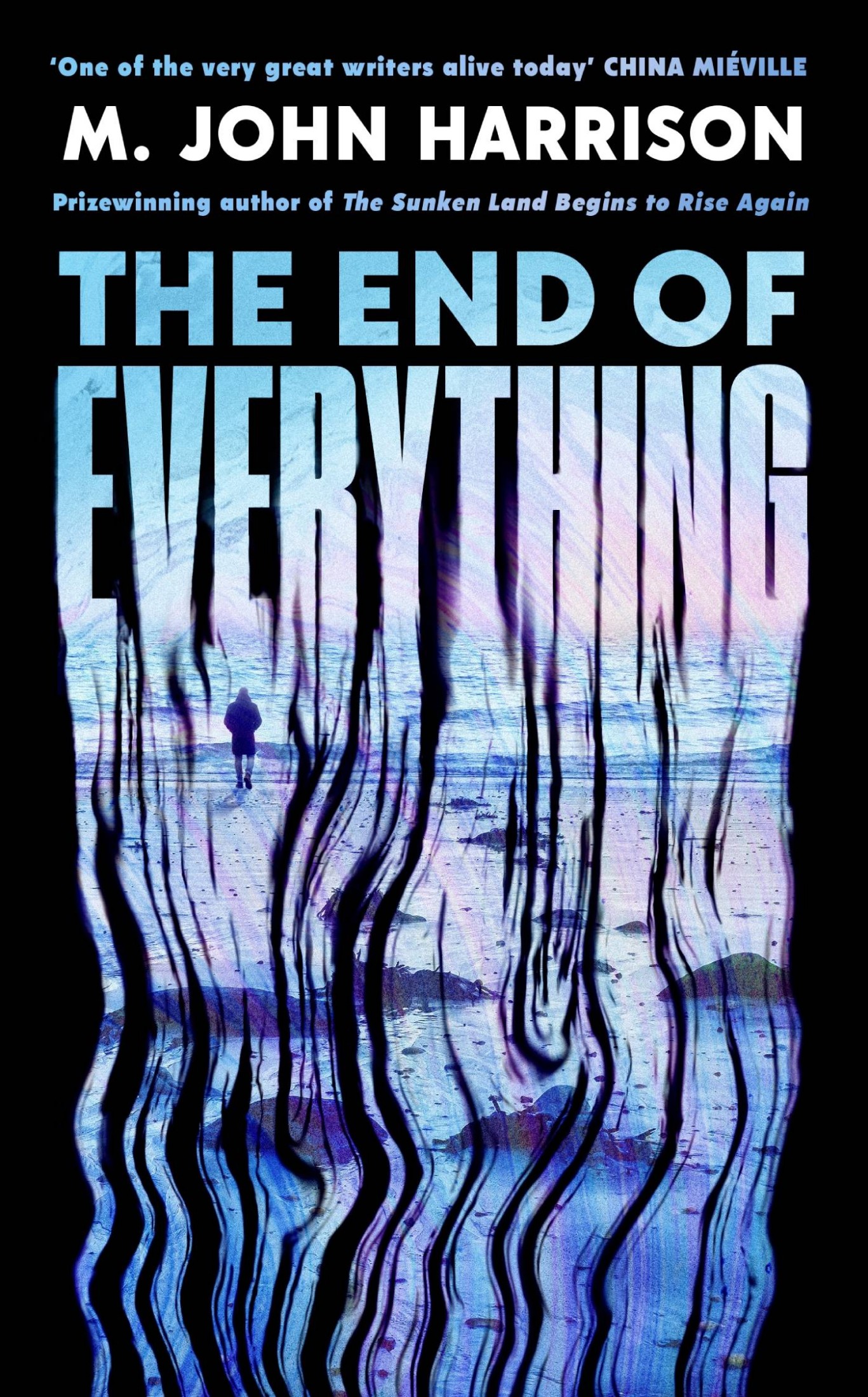
The End of Everything
About this book
Phillip Tennent makes a living collecting artifacts washed onto the Channel coast. Years after an obscure crisis, government barely functions, Europe has somehow been mislaid, and unfamiliar forms of life move through the sea.
One object cannot be sold or safely kept. It behaves like a creature and changes as Phillip observes it, forcing him away from the tideline and into an interior whose rules are no more reliable.
The journey treats apocalypse less as a single historical event than as a condition people have learned to narrate around. Institutions persist as fragments, language supplies provisional categories, and every explanation may be another effect of the thing being explained.
The End of Everything is a standalone post-apocalyptic novel with satirical and surreal edges. M. John Harrison keeps its adventure deliberately unstable, asking how much reality can be understood before description begins to alter it.
Read a sample
5,020 words
Plain text
From the opening
Tidelines —
FOR YEARS PHILLIP TENNENT LIVED at the edge of the sea, where artefacts were washed up every day. Scavengers, professional and otherwise, came and went. Turnover was higher than you’d expect given the relaxed lifestyle, the constant good weather, the ease with which some sort of existence could be pursued.
Most of the beachcombers took away the first item they could easily carry and sold it on elsewhere. If you had contacts in the hinterland, there was no doubt about how slickly that could be done. But the hard core like Tennent hung on, out there dawn and dusk, shine or shine, throwing the small ones back, waiting for an item that would give them pause for thought. They were committed. They could be seen from orbit. Their living structures glowed at night a hundred miles up and down the coast. By day you saw that temporary qualities had defined over the decades a permanent aesthetic: bothies and benders made of whitened sticks; mirrors and bits of rag; almost anything the tide left, although to incorporate an artefact would have been considered bad taste as much as bad luck. The beachcombers had their limits. Their superstitions gave the tideline its social structures and distinctive quality on the palate.
Further back from the shore, the hinterland was dark, a little more threatening, with its flattened hashmark of streets and its differing sets of rules. There was a lot of poured cement and half-functioning neon, a lot of territoriality; you had to talk your way through the bars, blockhouses and abandoned car parks to get your item out to market.
Coming up from the intertidal, out of the dusty salt wind with his latest find under one arm, Tennent met a woman on her way down. She looked at the object – which was at that time about the size of a baby, and which he had wrapped in some bleached-out rags – and nodded with a kind of measured approval. They studied the horizon together for a moment, and she asked him what condition the sea was in down there that day.
‘Eventually it’ll turn into speech,’ Tennent said, without knowing why.
They both laughed.
She was carrying a week’s groceries in a bag for life with a broken handle. No one was eating much down there. He thought he’d seen her before, living mostly on her own in a hut a hundred or so metres south of his.
‘I’m off,’ he said. ‘Take anything you want of mine. If you need anything, it’s yours.’
Loose white sand blew into the air and whirled around at the edge of the sea like a fog. They turned to face it with similar body language – expectant, alert, anxiety tempered with what could only be described as longing. For a moment Tennent had a sense that something huge was approaching over the water; something fast, which hadn’t been there – or indeed anywhere – a minute or two before. But it never arrived, and the woman shrugged.
‘You’ll be back,’ she predicted.
‘No, I won’t.’
They laughed again and she walked away towards the tide across the perfect sand, the sound her feet made reminding him suddenly of the sound of feet on snow. She waved without looking back.
A house on the borderland —
THE STRIP WAS ANOTHER KIND of tideline, facing both the ocean and the dry land, the way they always do.
Tennent had a relative there, an aunt of his called Marnie, a painter who occupied an old terraced townhouse on an elbow of raised ground at the outer edge of the town, where the cross streets turned to dirt tracks and fused themselves into the dissected chalk plateau inland. By day, you could look out to sea from the top floor of the house, or, landward, across the curve of a narrow little estuary, at mudbanks, a bridge, an island, levels of water according to the state of the tide, and on the far bank, ruderal scrub from which emerged the remains of buildings. At night, you chose between the faltering neon messages of the Strip, or, in the other direction, darkness.
Marnie had washed up there from London a generation ago, when the Strip was still a thriving arts community, before the crashed airliner raised its buckled starboard wing like a temporary modernist shelter across the gardens on the other side of the road. Seventy years old now, still in some way the repository of Tennent’s adolescence and the social structures which had supported it, she seemed lively and determined one minute, precarious the next. Fragility had set in behind the skin of her cheekbones, but she still made art. Her eyes remained clear and she retained an unimpatient sense of her own worth.
‘It’s sad to think,’ he remembered her saying when he was seventeen or eighteen, ‘that people have stopped making full use of you as a human being. You feel as if you’ve let them down by somehow not being persuasive enough.’
Now she stood stiffly at the door and for a moment it seemed to Tennent as if she might not invite him in.
‘What’s that you have with you?’ she said.
In the confusion following the arrival of the iGhetti, he had found his way to her along the coast as if blindfold, relying on some internal compass of nostalgia. As they emerged from the months of collective trauma that blunted the country’s understanding of what had happened, unsure where – or perhaps even who – they were, the two of them had been able to do little but sit and talk. It had been a comfort to rehearse their memories of his childhood holidays in Marnie’s house when the world was still good, still intact – ‘Still blown,’ as she had put it, ‘like a stream of bubbles, by all that money.’ But in the years since he went to live on the tideline, things had changed between them. For him, the house’s value lay in its proximity to the sea, and in its basement – essentially a garage, with good lighting and an inspection pit – which connected to the coast road along a short steep concrete ramp. He kept some of his belongings there, and called in only rarely to check on their condition.
Continue reading the sampleClose the sample
‘It’s nothing,’ he said. ‘It’s just something I picked up.’
‘But now it’s in my house.’
‘You haven’t even seen it,’ he said. ‘All you’ve seen is a pile of rags.’
‘We agreed you wouldn’t bring anything here. It’s more than what you see: it’s growing. It’s grown in the minutes you’ve been standing at my door wondering whether to knock.’ They stared at one another, both rendered uncertain by the strength of her feelings. Eventually she stood away to let him enter, adding: ‘I never go near the sea. I know what you do down there.’
‘It’s just some kind of flotsam,’ Tennent reassured her. ‘Or is it jetsam? I can never remember which is which, can you?’
‘You’re not a teenager any more, Phillip.’
Later, she gave him baked beans on toast. Squalls swung in across the north bank and obscured the river. They sat looking out of the window, listening to the rain and talking in low voices. Evening came on; behind the remains of the summer house, the tide could be heard rushing up the estuary. The artefact lay under its wraps in a corner, shifting occasionally as they talked. Every so often, Marnie glanced at it and shuddered, but after a while, appearing to lose interest, she closed her eyes and fell silent. Tennent got to his feet.
‘I’m just going down to the garage,’ he said.
At that, she clutched his arm. ‘One of the things I find myself thinking about,’ she whispered, ‘is how wonderful it would be to fly.’
He stared down at her. He wasn’t sure if she was actually awake.
‘This morning,’ she went on, ‘my kitchen doorway was crawling with ants. A bird came in to eat them. It was – what? – one of those little birds with a red breast. Such an opportunist!’ The creature had whirred in and out of the kitchen all morning, she said, making itself quite at home. It was on the doormat, on the refrigerator, on the back of a chair, cocking its dark little eye sidewise at everything. ‘Sharp as its own beak! Now, tell me: what kind of bird is that?’ Memory loss was both a curse and a blessing to her. Sometimes she offered it with a smile – not as an explanation but as a habitation, the place she was speaking from – at others, it simply left her impatient.
‘A robin, Marnie. You’ve always had robins in the garden.’
She nodded thoughtfully; then, after a pause, said in a completely different tone of voice: ‘I have my own problems, Phillip. I’ve had to work quite hard to keep this place. I’ve sometimes had to be tougher than I wanted.’
Down in the garage he pulled the dust cover off the bonnet of the vehicle he kept there. Its patchy, matt grey bodywork absorbed the strip light and didn’t give much back. Everything still seemed dry and good. Tennent smiled. He fetched the escape kit he kept in a tarpaulin duffle under some carefully curated rubbish in the corner; while he was stowing the bag in the boot of the car, he thought he heard the front door open. ‘Marnie?’ he called. ‘Marnie!’ When no answer came, he went back up into the house to collect the artefact. ‘Marnie? I’m going now.’
He thought she had fallen asleep again, but she was waiting for him in the hall by the front door. The door hung open. Damp night air was blowing in.
‘I set it free,’ she said. ‘It didn’t want to stay and – Phillip? – I didn’t want it here.’
‘Christ!’ said Tennent. ‘Free? What are you talking about?’ And when she looked away from him: ‘Which direction did it go? Did you see?’
She shrugged. ‘I know what you’re doing down there.’
She wouldn’t say what she meant by that, and he returned to the basement, where he got into the car and started it. It wasn’t until much later that he discovered that the tarpaulin bag had been opened since his last visit, and one of his pistols was missing.
Marnie dreams of a holiday —
MARNIE, WHO, BEFORE PHILLIP ARRIVED, had been in the kitchen eating cold porridge without sugar to save her teeth, took up the bowl again and sat at the window. She watched him back the car angrily up the ramp and out on to the empty street, revving the engine then taking his foot off the pedal so that the turbo anti-lag rattled and banged and flared orange in the twilight. He had never been very patient, always unsure what direction to go in.
Later, she slept restlessly, and woke thinking that her doorbell had been ringing. Someone had been calling out too: ringing the bell and calling out. Marnie was so convinced of this she went and opened the front door. Nothing for a moment but the smell of the Strip – salt, fuel oil, rubbish – and the distant sound of the tide. The street was empty. Then a fox began barking in the garden at the rear of the house – three syllables, a pause, three syllables, a pause – and she realised that’s what she’d been hearing all along. It was so simple and so eerie.
She got back into bed, pulled the covers up and thought, I’m old and my nerves are bad. My nerves are bad. I’m old and my nerves are bad, until she went back to sleep.
Had something come and gone, some blip, some glitch in things? Had something passed right through her, a whole lifetime or universe, disguised as her neighbour, a bell and a fox? Since the crisis, everyone’s life was full of moments like these. It had been a long time since anyone could make sense of anything. She was glad of Phillip’s pistol, which she took everywhere in her shopping bag. She hadn’t expected to see him again, and she hadn’t liked the way the artefact lay under its wraps, or the way, when she released it outside her front door, it had learned to crawl so quickly and made its way so confidently off along the street. It was a good deal bigger than it had been when it came into the house.
I didn’t want that thing in here, she told herself. I didn’t like anything about it. And then, later: You can’t waste food just because it’s gone cold.
Perhaps fifty years before the crisis, someone had added a two-storey, two-room wooden extension on to the back of the house. By now it needed repair. It was uninsulated and creaked alarmingly in offshore winds. Marnie used the lower room to store her work, but in the summer she slept in the upper one, which had a good-sized balcony that benefitted from the early light. Next morning, still a little slow from the night’s insomnia, she lay out there trying to catch the last of the sun before the shadows moved round. She had been dozing for half an hour when she was disturbed by something falling on her, some kind of liquid, a few drops at first, then a sudden steady splatter. It smelled like urine. When she opened her eyes, she saw, a few feet above her, tottering on the edge of the extension roof, weird and foreshortened, one of the Baker twins, flies open, penis out.
‘Golden shower!’ the boy shouted. ‘How do you like that? Golden shower!’
He turned to run away and put his foot through the extension roof. Rotten plaster pattered down inside. His left leg dangled into the room beneath, scrabbling for purchase. He began to call out in a high voice.
‘I have you now, you little bastard,’ Marnie told him.
She wiped herself off and went inside, where she rummaged about in the kitchen until she found a metre or two of old electrical flex. This she fastened round the boy’s ankle, anchoring the other end to the heaviest object she could find, which happened to be the bed, to limit the movement of the leg. Once she was satisfied, she went outside again and pulled herself up on the edge of the extension roof until she could look at him.
‘How do you feel about this now?’ she said.
The boy was in a half-sitting, half-kneeling position, his visible leg quivering with the strain of supporting him.
‘Hey,’ he said. ‘My fucking knackers are trapped.’ He was about fourteen, with no talent for anything, and up to this moment too big to control. Marnie went back inside. After some consideration, she grasped the tethered leg in both hands and hung from it.
‘No one in this street likes you,’ she shouted. ‘Do you hear?’
Then she found a knife in a cupboard, cut into the boy’s femoral artery and stepped quickly away from the spray of blood. She stood there for a moment watching the leg flail and spurt. She went out on to the balcony again. ‘What do you say now?’ she called. ‘Want to piss on someone now?’ No answer. She watched for a minute or two as the boy lost energy, then turned away and leaned on the balcony rail, looking up and down the row at the overgrown gardens. The boy was humming sleepily to himself. In his confusion he had taken off his shirt and thrown it on to the balcony. Marnie used it to wipe her stomach again, then dropped it over the rail into the garden and lay back down. She was too late. At this time of year, the airliner’s shadow fell across the whole house, tailfin first, and blocked out the sun from eleven o’clock onwards.
‘Damn,’ she said.
She went and talked to the boy’s father, who lived a couple of doors down. They sorted things out between them, and the father sent someone to lever his dead son out of her extension roof.
Rain fell briefly during the next night, to be breathed away by warm air from the southern counties. Marnie dreamed of a holiday she had once spent walking in the Alpes-Maritimes, and the next morning made her way carefully up the long, easy slope of the airliner’s unbroken starboard wing, from the highest point of which she could stare out north and east into the bright grey light. There was nothing new. Across the river she thought she could detect faint smudges of smoke from artillery airbursts above the north edge of the Weald. Attack helicopters went to and fro at the limits of vision, nose down against the cloud base.
Closer to, someone was at work on one of the houses at the end of the street. Rubble had been cleared from around its base, scaffolding erected. From a pulley at the top stage of the scaffold, a thick, Victorian-looking rope swung in the wind. Figures were already at work, propping up the bulging facade with timber, putting in rolled steel joists to replace broken lintels. The house looked exhausted. There was no one to live in it anyway. Building projects like these had been a defining feature of the late phases of the crisis, evidence of an aimless energy, the rush to be active that achieves nothing but can’t be argued against. All projects, the iGhetti believe, are inherently good. They are good because they are projects.
Later, her neighbour Giovana, who had taught baroque violin before the world changed, and still sometimes spent an hour or two working with the more difficult elements of the chaconne from Partita No. 2 in D minor, came to the front door wondering if Marnie had heard noises in the night. Marnie said she had.
‘It’s the foxes,’ she said. ‘Would you like breakfast?’
Giovana looked past her into the house. For a moment she seemed to be lost for something to say. Then she shook her head.
‘Not while you continue to misappropriate yourself like this,’ she said.
At three in the morning, admitting finally that she couldn’t sleep, Marnie had descended to the garden, retrieved the dead boy’s shirt, and stuck it to her hallway wall with the last of a tube of superglue. Underneath it she had written, ‘When you take your clothes to the laundrette, you are reaffirming or celebrating your identity. Some of its components, at least, dance, spin, enumerate themselves in front of your eyes. You are able to renew your acquaintance with them. The distinctive kinds of wear and tear your personality is prone to become apparent – fading, fraying, a loss of colour.’ Versions of this conceit, written and rewritten, had expanded to cover most of the wall.
After breakfast the boy’s father called, with a delegation comprised of half a dozen other people who lived along the street. ‘Some of us feel you went too far,’ he said, implying perhaps that he didn’t.
One of the women – she was a Norwegian, whose name sounded something like ‘Seattle’ – pushed in front of him and added: ‘He was only twelve.’
Marnie could see the justice of that.
‘I thought he was older,’ she said. ‘Would anyone like some instant coffee?’
‘Thanks,’ the woman said contemptuously. ‘But I never do.’
The general feeling, the father said, the feeling of everyone there, was that Marnie should leave.
‘I can see why you might say that,’ she said, although she couldn’t. She stared along the street trying to remember how long she had lived there before the crisis changed everything, then up at the tailfin of the airliner in the grainy light. Generally, she spent the hour after breakfast reading, or vacuuming the carpets. ‘I’ve lived here longer than any of you, but I can see why you might say that.’
‘He was only twelve,’ the woman repeated.
Limit case —
AS SOON AS THEY LEFT her alone, Marnie went out to shop. Bread was hard to find after nine o’clock. In response, everyone was making their own, buying up all the flour, with the result that, week on week, it became harder still.
After their quarrel, she assumed, Phillip would have driven back to the beach, where even as a teenager he had found it easier to control his fits of temper. While she was at the Strip, she decided, it wouldn’t hurt to break with her habit, go down to the tideline, and see if she could find him. She made her way through the dusty car parks, between the deserted gyms and the low, bunker-like concrete structures of the pawnbrokers and artefact-assayers with their steel-shuttered doors and windows. Music blared out of the bars as if there were still holidaymakers on the Strip. Indeed, in the parallelogram of side streets known as Dalston-on-Sea, there may well have been puzzled long-weekenders down from the London enclaves, where, drifting in patches like a kind of weak metaphysical fog, the disaster had failed as yet to make headway. What these academics and middle-scale arts entrepreneurs expected to find, as they ushered their families past the endless trays of common artefacts mudlarked from the intertidal zone, was difficult to guess.
Marnie sat down outside one of the bars, where daily they arranged a cluster of Italianate metal tables among the seakale colonies at the top of the storm beach, and asked for a cup of chocolate. The tables were filmed with a coarse whitish powder blown out of the interior on the previous night’s offshore winds. As soon as she sat down, two men arrived and took the very next table to hers.
It was already hot in the bay. A crowd of local children scoured the shingle, restless, unassuaged as gulls, shouting and grunting, uprooting clumps of chamomile and yellow horned poppy and throwing them at one another for something to do. There was a faint compound smell – fish and salt, perfume and fried food. For a moment it seemed like a language, with a shifting, impermanent syntax: but when she listened it had nothing to say. Further out, the beachcombers, fatigued and lethargic-looking, hunched against the wind and shuffled between their wilfully graceless shelters. Mirrors and wind chimes flickered and swung.
The chocolate, when it came, tasted of something else, she couldn’t say what. One of the men watched her pulling pieces off the sourdough and dipping them in her cup, and after a moment said:
‘Do you always eat like that?’
‘Teeth,’ Marnie said loudly, opening her mouth to show him. ‘Teeth.’ When he failed to respond, she pointed at the beach. ‘I hate the way these people live, don’t you? It’s so infantile.’ Then confided: ‘I came down here to find my nephew, but I haven’t seen him or his special car.’
He stared at her for a moment longer, then turned to his companion, who murmured something and laughed.
They were both wearing silk suits without shirts, drinking soft drinks the colour of fruit in an advertisement two generations old. She couldn’t place them well enough to understand what they were talking about. She opened her mouth again and made energetic chewing motions. After that, they got up and moved to a table further away, and the rest of their conversation became even more garbled. She thought she heard one of them spell out the word ‘toes’, then recite, ‘House. Louse. Mouse. Yes, mouth. But touch.’
Meanwhile, the children had stopped shouting and were looking intently at the water. A hundred yards out, where the shallows fell away and the light hardened up, the sea shone like metal. Just beneath the surface there – so that it appeared as a system of wind-driven ripples in the flicker and dazzle – something was racing towards the shore. It might have been an object or an animal, it might have been some change in the medium itself. Whatever was happening, a corresponding ripple of motion took place along the beach: soon everyone except Marnie was on their feet, shading their eyes, pointing at the water.
‘It won’t be anything,’ she informed the people nearest her. ‘It never is.’ She licked her finger, dipped it into the substance on the table and took it to her tongue. It was flour. ‘I’ve been coming here all my life,’ she added.
She remembered mornings when everything was like high-definition TV, wrapped in the documentary sublime. No horizon line. Distant objects – hikers on the cliffs, seabirds on the harbour mole – seemed too large. Light, silhouettes, perfect saturated colour, all at once. In those days, her paintings had been quite the opposite, barely processed or so she believed, domestic interiors and still lifes of all the traditional subjects. ‘Whole worlds,’ she had once written to her brother, Phillip’s father, ‘trapped in a few daisies, some grapes in a bowl.’ In those days, she had done out everything in the feathery greys of degreased paint, which made any object look tranquil but also raw and deliberately unfinished – unseen or as-yet-unseen, and yet as if a kind of indoor weathering had taken place on every surface.
‘In those days,’ she felt bound to tell the people staring out to sea, ‘Anne Redpath was my model.’
Easy jets —
LATE AFTERNOON. A HYBRID SMELL on the wind, like hyacinth and eucalyptus, as Marnie returned home. Children skateboarding in the street stopped to watch an old bomber descending towards London, its variable-plan wing enamelled briefly by the strong light.
Her neighbours, she found, had developed further thoughts about the Baker boy’s death: Giovana was addressing them from the front doorstep of the house, keeping her dressing gown carefully closed with one hand. In the other she held by the neck one of her favourite violins, a Thomas Smith circa 1768 with its original boxwood pegs intact. This she displayed as if she were thinking of performing for them, or as if the violin were in itself an explanation of something. In the face of such complex body language, they seemed, for the moment, uncertain.
Before any of them could catch sight of her, Marnie made her way quietly out of the street, pushed through some rotten garden fences and climbed on to the asbestos roof of a neighbouring garage. From there, obscure in the deep shadow of the crashed airliner’s tailfin, she could keep an eye on the situation while she decided what to do.
Some people missed one thing from the pre-disaster world, some people another. Everyone had their favourite. Marnie missed air travel. Where she couldn’t remember people’s names, and facts often confused her, she still had a good memory for every flight she had ever made. The orange and white tailfin belonged to an Airbus A330-200 which, before the disaster brought it down, had daily navigated the trade routes between Heathrow and Mediterranean Europe. On its upper wing, she knew, she would be able to find two small, solid-looking eye bolts painted a refreshing yellow: staring out of the window during a holiday flight, short or long haul, she had always been reassured by those bolts, although she had no idea what they were for.
The only thing she hadn’t liked about air travel was the food. Something about the smell of it in the confined fuselage, she thought, often made you feel sick. That was before you ate it. The smell would saturate the cabin via the air conditioning, half like food, half like some kind of dishwasher residue, while on the tiny screens above the seats, James Bond made silent grimaces intended to convey irony, puzzlement or pleasure. But Marnie thought she would be willing, like most people, to forgive all that now, and take the jet once more to the vanished havens of Zakynthos, Mexico, Sri Lanka.
Outside her house the argument continued. There was some shouting, but Marnie could make sense of nothing except her own name, and for a minute or two this caused her to feel she no longer existed except as a story people were telling each other. By now, Giovana had retreated a step or two into the hall, from which position she seemed to be trying to explain Marnie’s collage of the night before. She reached up abruptly and pulled the boy’s shirt from the wall, as if to emphasise some critical point. Marnie, seeing that the situation would remain unresolved unless she made some contribution, stood up and shouted, ‘Hey!’ Once she was certain she had their attention, she took the pistol out of her shopping bag and began firing. At that range – it was nearly a hundred yards – she didn’t expect to hit anything, but two of them fell down. The others first milled helplessly about, then, unsure perhaps whether they were running away from the shots or towards Giovana, surged up the front steps and into Marnie’s house. The violinist was knocked over and trodden underfoot along with her instrument. Quite clearly above the sounds of shouting, Marnie heard the Thomas Smith’s final plangent chord.
She waited until it had died away, put the pistol back in her shopping bag and ran off down the road, full of an energy she didn’t yet understand. Before she left the house that morning, in case Tennent returned before her, she had written him this note –
‘My problem has always been that I couldn’t quite believe that groups of people could be so predictably crass. Who knows what we’ve done to one another here. Before the disaster or since, it’s been one tainted project after another. We’re all exhausted from trying to find the thin slice of territory we don’t affect, somewhere that will allow us to occupy it without leaving an impression.’ She wasn’t quite sure what she meant by this, except that all anyone wanted to know was, had they drawn the iGhetti to Earth? ‘It’s always seemed important to know if we’re their victims or our own.’ Then: ‘You will look after yourself, won’t you?’ And, finally, addressing herself, perhaps, rather than Phillip: ‘Age is an immense sadness that seems to be folded into everything.’