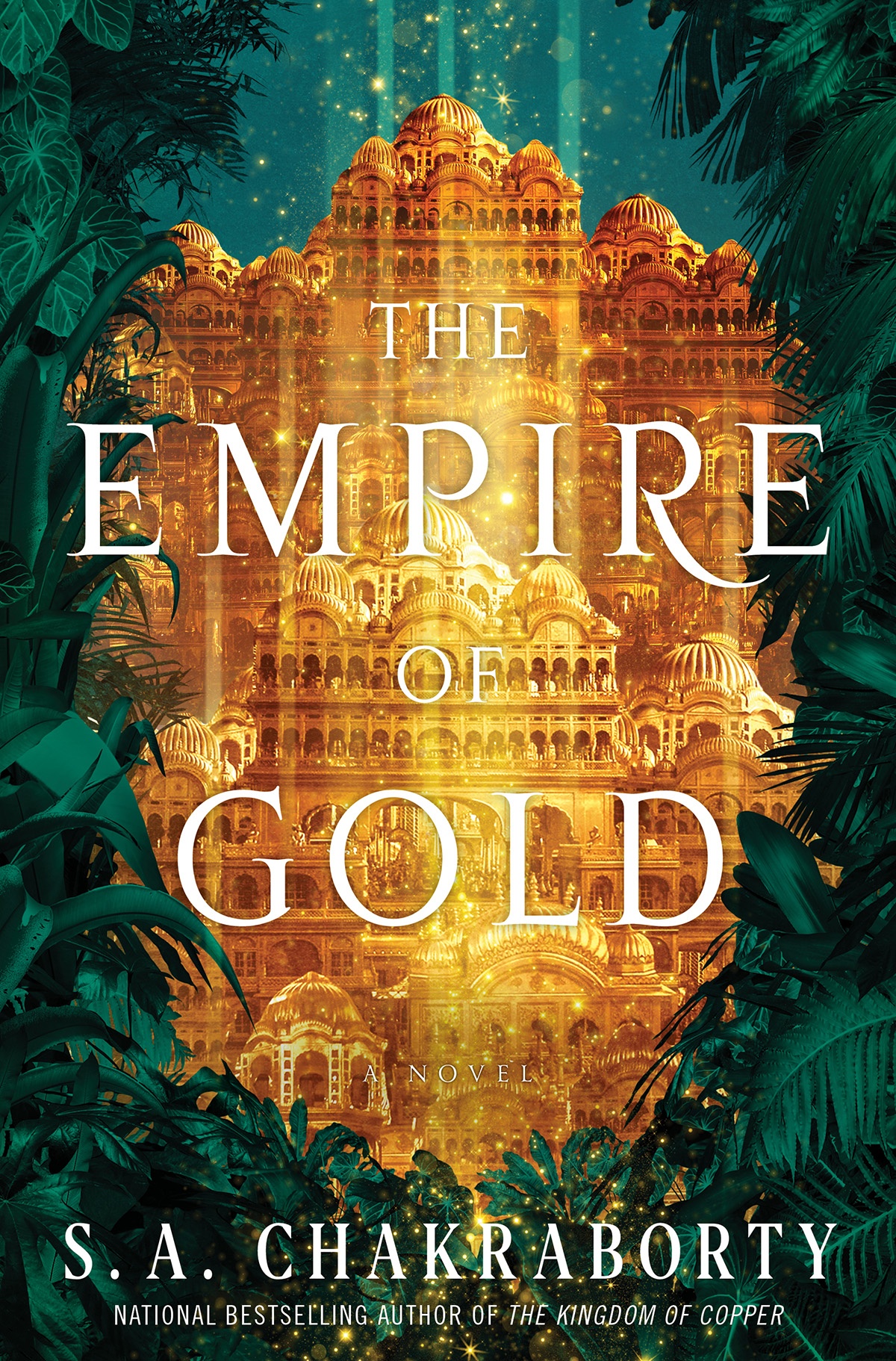
The Empire of Gold
About this book
Nahri and Ali are separated from the city after the invasion, carrying knowledge that may help them return but no guarantee that the people they left behind want another royal solution. Dara remains bound to a campaign whose promised liberation has become increasingly costly.
The search for allies crosses human and magical worlds and forces buried histories into public consequence. Healing, water, and ancestral power can all be used as instruments of rule, making recovery inseparable from the design of a different political settlement.
Chakraborty gives the trilogy’s battles scale without allowing victory to erase accountability. Characters must answer for what they did under coercion as well as for the systems they hoped personal loyalty could reform.
The Empire of Gold concludes the Daevabad Trilogy. Read it after The Kingdom of Copper for the full arc of Nahri, Ali, Dara, and the city they have each tried to claim.
Read a sample
5,015 words
Plain text
From the opening
PROLOGUE
MANIZHEH
Behind the battlements of the palace that had always been hers, Banu Manizheh e-Nahid gazed at her family’s city.
Bathed in starlight, Daevabad was beautiful—the jagged lines of towers and minarets, domes and pyramids—astonishing from this height, like a jumble of jeweled toys. Beyond the sliver of white beach, the dappled lake shimmered with movement against the black embrace of mountains.
She spread her hands on the stone parapet. This was not a view Manizheh had been permitted while a prisoner of the Qahtanis. Even as a child, her defiance had made them uneasy; the palace magic’s public embrace of the young Nahid prodigy and her obvious talent curbing her life before she was old enough to realize the guards that surrounded her day and night weren’t for her protection. The only other time she’d been up here had been as Ghassan’s guest—a trip he’d arranged shortly after he became king. Manizheh could still remember how he’d taken her hand as they’d gazed at the city their families had killed each other for, speaking dreamy words about uniting their peoples and putting the past behind them. About how he’d loved her since they were children, and about how sad and helpless he’d felt all those times his father had beaten and terrorized her and her brother. Surely she must have understood that Ghassan had had no choice but to stay silent.
In her mind’s eye, Manizheh could still see his face that night, the moon shining upon his hopeful expression. They’d been younger; he’d been handsome. Charming. What a match, people would have said. Who wouldn’t want to be the beloved queen of a powerful djinn king? And indeed, she’d laced her fingers between his and smiled—for she still wore such an expression in those days—her eyes locked on the mark of Suleiman’s seal, new upon his face.
And then she’d closed off his throat.
It hadn’t lasted. Ghassan had been quicker with the seal than she’d anticipated, and as her powers fell away, so did the pressure on his throat. He’d been enraged, his face red with betrayal and lack of air, and Manizheh remembered thinking that he would hit her. That he’d do worse. That it wouldn’t matter if she screamed—for he was king now and no one would cross him.
But Ghassan hadn’t done that. He hadn’t needed to. Manizheh had gone for his heart and so Ghassan did the same with ruthless effectiveness: having Rustam beaten within a hair of his life as she was forced to watch, breaking her brother’s bones, letting them heal and then doing it again, torturing him until Rustam was a howling mess and Manizheh had fallen to her knees, begging Ghassan for mercy.
When he finally granted it, he’d been even angrier at her tears than he’d been at her initial refusal. I wanted things to be different between us, he’d said accusingly. You shouldn’t have humiliated me.
She took in a sharp breath at the memory. He’s dead, she reminded herself. Manizheh had stared at Ghassan’s bloody corpse, committing the sight to memory, trying to assure herself that her tormentor was truly gone. But she wouldn’t have him burned, not yet. She intended to examine his body further, hoping for clues as to how he’d possessed Suleiman’s seal. Manizheh hadn’t missed that his heart had been removed—carved from his chest with surgical precision and making it clear who’d done the removing. Part of her was grateful. Despite what she’d told Nahri, Manizheh knew almost nothing about how the seal ring was passed to another.
And now, because of Nahri, Manizheh knew the first step after finding them would be to cut out the heart of Nahri’s djinn prince.
Manizheh returned her gaze to the city. It was startlingly quiet, adding an eerie facade to the entire experience. Daevabad might have been a kingdom at peace in the dead of night, safe and still under the helm of its rightful guardians.
A lie a distant wail betrayed. The cries were otherwise fading, the violence of the night giving way to sheer shock and terror. Frightened people—hunted people—didn’t scream. They hid, hunkering down with their loved ones in whatever shelter they could find, praying the darkness might pass them by. Everyone in Daevabad knew what happened when cities fell. They were raised on stories of vengeance and their enemy’s rapacity; depending on their roots, they were told hair-raising tales of Zaydi al Qahtani’s violent conquest of Daevabad, Darayavahoush e-Afshin’s scourging of Qui-zi, or the innumerable sacks of human cities. No, there wouldn’t be screaming. Daevabad’s people would be hiding, weeping silently as they clutched their children close, the sudden loss of their magic only one more tragedy this night.
They are going to think another Suleiman has come. It was the conclusion any sensible person would arrive at. Had Suleiman’s great judgment not started with the stripping of their ancestors’ magic? They probably expected to see their lives shattered and their families torn apart as they were forced to toil for another human master, powerless to fight back.
Powerless. Manizheh pressed her palms harder against the cold stone, aching to feel the palace’s magic. To conjure dancing flames or the shimmer of smoke. It seemed impossible that her abilities were gone, and she could only imagine the injuries piling up in the infirmary, injuries she now couldn’t heal. For a woman who’d endured the ripping away of everything she loved—the shy country noble she might have married, the dark-eyed infant whose weight in her arms she’d yearned to feel again, the brother she’d betrayed, her very dignity as she bowed before the Qahtanis year after year—the loss of her abilities was the worst. Her magic was her life, her soul—the power beneath the strength that had enabled her to survive everything else.
Continue reading the sampleClose the sample
Perhaps an apt price to pay, then, for using healing magic to kill, a voice whispered in her head. Manizheh pushed it away. Such doubt wouldn’t help her or her people right now. Instead she’d lean on anger, the fury that coursed in her when she watched years of planning be upended by a quick-fingered shafit girl.
Nahri. The defiance in her dark eyes. The slight, almost rueful shrug as she shoved their family’s most cherished treasure onto the finger of an unworthy sand fly.
I would have given you everything, child. Everything you could have possibly wanted. Everything I never had.
“Enjoying your victory?”
Aeshma’s mocking voice set her teeth on edge, but Manizheh didn’t so much as twitch. She’d been dealing with the ifrit long enough to know how to handle him—how to handle everyone, really. You simply offered no target—no weaknesses, no doubt. No allies or loved ones. She kept her gaze forward as he joined her at the wall.
“A long time I’ve waited to look upon Anahid’s city.” There was cruel triumph in his voice. “But it’s not quite the paradise of the songs. Where are the shedu rumored to patrol the skies and the gardens of jeweled trees and rivers of wine? The fawning marid servants conjuring rainbows of waterfalls and a library teeming with the secrets of creation?”
Manizheh’s stomach twisted. Gone for centuries. She’d immersed herself in the great stories of her ancestors, and they painted an utterly unfamiliar Daevabad from what she saw now. “We will bring them back.”
A glance revealed cold pleasure rippling across Aeshma’s fiery visage. “She loved this place,” he continued. “A sanctuary for the people she dragged back together, her carefully tended paradise that allowed no sinners.”
“You sound jealous.”
“Jealous? Three thousand years I dwelled in the land of the two rivers with Anahid, watching the floods recede and the humans rise. We warred with the marid and traveled the desert winds together. All of that forgotten because of some human’s ultimatum.”
“You chose different paths in dealing with Suleiman.”
“She chose to betray her people and closest friends.”
She saved her people. I intend to do the same. “And here I thought we were finally setting that aside and making peace.”
Aeshma scoffed. “How do you propose to do that, Banu Nahida? Do you think I don’t know what’s happened to your abilities? I doubt right now you could even summon a spark, let alone hope to fulfill your bargain with me.” He raised a palm, a tendril of fire swirling between his fingers. “A shame your people haven’t had three millennia to learn other ways of magic.”
It took everything Manizheh had not to stare at the flame, hunger eating through her soul. “Then how fortunate I have you to teach me.”
The ifrit laughed. “Why should I? I have been helping you for years already, and I’ve yet to gain a thing.”
“You’ve gained a glimpse of Anahid’s city.”
Aeshma grinned. “There is that, I suppose.” His smile widened, his razor-sharp teeth gleaming. “I could gain even more right now. I could throw you from this wall and kill her most promising descendant.”
Manizheh didn’t flinch; she was too accustomed to men threatening her. “You would never escape Darayavahoush. He would track down every ifrit left, torture and slaughter them before your eyes, and then spend a century killing you in the most painful way he could imagine. You would die at the hands of the magic you desire most.”
That seemed to land, a scowl replacing Aeshma’s mocking grin. It always did; Manizheh knew the ifrit’s weaknesses as well as he knew her secrets.
“Your Afshin does not deserve such abilities,” he snapped. “The first daeva freed from Suleiman’s curse in thousands of years, and he’s an ill-tempered, overly armed fool. You might as well have given such abilities to a rabid dog.”
That wasn’t an analogy Manizheh liked—there was already a bit too much defiance simmering below the absolute loyalty she typically enjoyed with Dara.
But she pressed on. “If you desire Dara’s abilities, you should stop issuing worthless threats and help me get Suleiman’s seal back. I cannot free you from the curse without it.”
“How very convenient.”
“Excuse me?”
He dropped his gaze to stare at her. “I said it is convenient,” he repeated. “For decades now, I have been at your side, awaiting your help, and you keep coming up with excuses. It is all very distressing, Banu Nahida. It’s making me wonder if you’re even capable of freeing us from Suleiman’s curse.”
Manizheh kept her face carefully blank. “You were the one who came to me,” she reminded him. “I’ve always made clear that I would need the ring. And I would think you’ve seen enough to know what I’m capable of.”
“Indeed I have. Enough that I’m not particularly eager to see you master my kind of magic as well. Especially for the mere promise of some future freedom. If you want me to teach you blood magic, I’m going to need something more tangible in return.”
More tangible. Manizheh’s stomach knotted. She had already lost so much. The little she had left was precious. “What do you want?”
The ifrit’s cold smile curled again as his gaze drifted over Daevabad, the eagerness in it sending a hundred warnings through her mind. “I think of that morning every day, you know. That raw power scorching the air, screaming in my thoughts. I hadn’t felt something like that since Anahid pulled this island from the lake.” He ran his fingers along the parapet in a caress. “There’s nothing quite like Nahid magic, is there? Nahid hands raised this city and have brought back untold masses from the brink of death. A mere drop of their blood is enough to kill an ifrit. A Nahid life … well, imagine all the things that could do.” Aeshma twisted the knife deeper. “The things it already has done.”
Now Manizheh did flinch. How quickly it all came back. The smell of burned flesh and the sticky blood coating her skin. The twinkling city seemed to disappear, replaced by a scorched plain and smoky sky—the dull color reflected in her brother’s vacant, unseeing eyes. Rustam had died with an expression of faint shock on his face, and seeing that had broken what was left of Manizheh’s heart, reminding her of the little boy he’d once been. The Nahid siblings who’d lost their innocence too soon, who’d stuck together through everything only to be ripped apart at the end.
“Speak plainly.”
“I want your daughter.” Aeshma was brusque now, any coyness gone. “And since she’s proven herself a traitor, you need her gone.”
A traitor. How simple it was for the ifrit to declare such a thing. He hadn’t seen a trembling young woman in a torn, bloodied dress. He hadn’t stared into frightened, achingly familiar eyes.
She betrayed you. Indeed, Nahri had done worse, tricking her with a sleight of hand more appropriate for a low-born shafit thief than a Nahid healer. But Manizheh could have forgiven that, would have forgiven that, had Nahri taken the ring for herself. Creator knew she could not judge another woman’s ambitions.
But Nahri hadn’t. No, she’d given it to—of all people—a Qahtani. To the son of the king who’d tormented her, the king who’d stolen any chance Manizheh had at a happy life and driven the final wedge between her and her brother.
Manizheh couldn’t forgive that.
Aeshma spoke again, perhaps seeing the doubt in her long silence. “You need to make some choices, Manizheh,” he warned, his voice dangerous and low. “Your Scourge is obsessed with that girl. If she was clever enough to deceive you, how do you imagine that lovesick fool would fare if she made a play for his heart? But the things I could teach you, that Vizaresh could teach you …” Aeshma leaned closer. “You would never again have to worry about Darayavahoush’s loyalty. About anyone’s loyalty.
“But only for a price.”
A glimmer caught Manizheh’s eye—a fiery shard of sun emerging from behind the eastern mountains, its brilliance taking her aback. Sunrise wasn’t usually that bright in Daevabad, the protective magic veiling the city off from the true sky. But it wasn’t just the sun’s brightness that felt wrong.
It was the silence accompanying that brightness. There was no drumming from the Grand Temple or djinn adhan, and the quiet failure to welcome the sun’s arrival sent more dread into her heart than all the blood that had dripped from her unhealed finger. Nothing stopped the drums and the call to prayer; they were part of the very fabric of time in Daevabad.
Until Manizheh’s conquest ripped that fabric to shreds. Daevabad was her home, her duty, and she’d torn out its heart. Which meant it was her responsibility to mend it.
No matter the cost.
She closed her eyes. Manizheh had not prayed since she’d watched two djinn scouts bleed out in the icy mud of northern Daevastana, dead at the hands of the poison she’d designed. She’d defended her plan to Dara; she’d gone forward with bringing an even worse wave of death to Daevabad. But she had not prayed through any of that. It felt like a link she had broken.
And she knew the Creator would not help her now. She saw no alternative, only the path she’d forged and had to keep walking—even if there was nothing left of her by the time she finished.
She made sure her voice was steady; Manizheh would not show the ifrit the wound he’d struck. “I can offer you her name. Her true one.
“The name her father gave her.”
PART ONE
1
NAHRI
When Nahri was a very little girl, in the last orphans’ home that would take her, she met a storyteller.
It had been Eid, a hot, chaotic day, but one of the few pleasant ones for children like her when Cairo’s better off were most inclined to look after the orphans whose welfare their faith preached. After she had feasted on sweets and stuffed butter cookies in new clothes—a pretty dress embroidered with blue lilies—the storyteller had appeared in the haze of sugar crashes and afternoon heat, and it wasn’t long before the children gathered around him had passed out, lulled into dreams of faraway lands and dashing adventures by his smooth voice.
Nahri had not been lulled, however; she had been mesmerized, for tales of magical kingdoms and lost royal heirs were the exact fragile hopes a young girl with no name and no family might nurse in the hiddenmost corner of her heart. But the way the storyteller phrased it was confusing. Kan wa ma kan, he kept repeating when describing fantastical cities, mysterious djinn, and clever heroines. It was and it wasn’t. The tales seemed to exist between this world and another, between truth and lies, and it had driven Nahri mad with longing. She needed to know that they were real. To know that there might be a better place for her, a world in which the quiet things she did with her hands were normal.
And so, she had pressed him. But was it real? she demanded. Did all that really happen?
The storyteller had shrugged. Nahri could remember the rise of his shoulders, the twinkling of his eyes, no doubt amused by the young girl’s pluck. Maybe it was and maybe it wasn’t.
Nahri had persisted, reaching for the closest example she could find. Is it like the thing in your chest, then? The thing that looks like a crab around your lungs, that’s making you cough blood?
His mouth had fallen open. God preserve me, he’d whispered in horror, while gasps rose from those who were listening. Tears filled his eyes. You cannot know that.
She hadn’t been able to reply. The other adults had swiftly intervened, yanking her up by the arms so roughly they tore the sleeve of her new dress. It had been the last straw for the little girl who said such unnerving things, the girl who cried in her sleep in a language no one had ever heard and who showed no bruises or scrapes after being beaten by the other children. Nahri had been dragged out of the crumbling building still begging to know what she’d done wrong, stumbling to the dust in her holiday clothes and rising alone in the street as people celebrated with their families inside the kind of warm homes she’d never known.
When the orphans’ home slammed its door behind her, Nahri had stopped believing in magic. Until years later, anyway, when a Daeva warrior came crashing to her feet among a tangle of tombs. But as Nahri stared now in utter incomprehension at Cairo’s familiar skyline, the Arabic words ran back through her memory.
Kan wa ma kan.
It was and it wasn’t.
The storybook world of Daevabad was gone, replaced, and Cairo’s mosques and fortresses and old brick buildings were hazy in the distance, heat shimmering off the surrounding desert and flooded fields. She blinked and rubbed her eyes. The city was still there, as were the Pyramids, standing proud against the pale sky across the wide blue Nile.
Egypt. I’m in Egypt. Nahri found herself pressing her knuckles against her temple, hard enough to hurt. Was this a dream?
Or maybe Daevabad had been the dream. The nightmare. For surely it was more likely she was a human back in Cairo, a poor thief, a con artist taken in by her own scheme rather than someone who had lived the past six years as the future queen of a hidden kingdom of djinn.
And that might have been a possibility, were it not for the wheezing, sweating, and still slightly glowing prince who stepped between Nahri and her view of the countryside. Not a dream, then—not unless she’d brought a piece of it back with her.
“Nahri,” Ali whispered. His eyes were bloodshot and desperate, water beading down his face. “Nahri, please tell me I’m seeing things. Please tell me this isn’t what it looks like.”
Still numb, Nahri glanced past his shoulder. She couldn’t look away from the Egyptian countryside, not after aching for it for so long. A warm breeze played through her hair, and a pair of sunbirds twittered as they climbed through a patch of thick brush that had swallowed a crumbling mudbrick building. It was flood season, a thing the inundated banks and water lapping at the roots of the palms made clear to any Egyptian in a moment.
“It looks like home.” Her throat was horribly strained, her healing magic still blocked by Suleiman’s seal blazing on Ali’s cheek. “It looks like Egypt.”
“We cannot be in Egypt!” Ali stepped back, falling heavily against the minaret’s crumbling inner wall. There was a feverish flush to his face, and hazy heat rose from his skin. “W-we were just in Daevabad. You pulled me off the wall … did you mean to—?”
“No! I just wanted to get away from Manizheh. You said the curse was off the lake. I figured we’d swim back to shore, not rematerialize on the other side of the world!”
“The other side of the world.” Ali’s voice was hollow. “Oh my God. Oh my God. We need to go back. We need to—” His words slipped into a pained hiss, one hand flying to his chest.
“Ali?” She grabbed him by the shoulder. Closer now, Nahri could see that he didn’t just look upset—he looked sick, shivering and sweating more than a human in the death throes of tuberculosis.
Her training took over. “Sit,” she ordered, helping him to the ground.
Ali squeezed his eyes shut, pressing the back of his head into the wall. It looked like it was taking all his strength not to scream. “I think it’s the ring,” he gasped, pressing a fist to his chest—or to his heart rather, where Suleiman’s ring should now be resting, courtesy of Nahri’s sleight of hand back in Daevabad. “It burns.”
“Let me see.” Nahri grabbed his hand—it was so hot it felt like plunging her own into a simmering kettle—and pried it away from his chest. The skin beneath looked completely normal. And without her magic, there was no examining further—Suleiman’s eight-pointed mark still blazed on Ali’s cheek, blocking her powers.
Nahri swallowed back her fear. “It’s going to be okay,” she insisted. “Lift the seal. I’ll take the pain away and be able to better examine you.”
Ali opened his eyes, bewilderment swirling into the pain in his expression. “Lift the seal?”
“Yes, the seal, Ali,” Nahri repeated, fighting panic. “Suleiman’s seal. I can’t do any magic with it glowing on your face like that!”
He took a deep breath, looking worse by the minute. “I … okay.” He glanced back at her, seeming to struggle to focus on her face. “How do I do that?”
Nahri stared at him. “What do you mean, how? Your family has held the seal for centuries. Don’t you know?”
“No. Only the emir is allowed—” Fresh grief ripped across Ali’s expression. “Oh God, Dhiru …”
“Ali, please.”
But already dazed as he was, the reminder of his brother’s death seemed too much. Ali slumped against the wall, weeping in Geziriyya. Tears rolled down his cheeks, cutting paths through the dust and dried blood on his skin.
The sound of birdsong came, a breeze rattling through the bristling palms towering over the broken mosque. Her own heart wanted to burst, the sweet relief of being home warring with the nightmarish events that had ended in the two of them appearing here.
She sat back on her heels. Think, Nahri, think. She had to have a plan.
But Nahri couldn’t think. Not when she could still smell the poisoned edge of Muntadhir’s blood and hear Manizheh cracking Ali’s bones.
Not when she could see Dara’s green gaze, pleading from across the ruined palace corridor.
Nahri took a deep breath. Magic. Just get your magic back, and this will all be better. She felt horribly vulnerable without her abilities, weak in a way she’d never been. Her entire body ached, the metallic smell of blood thick in her nose.
“Ali.” She took his face in her hands, trying not to worry at the frighteningly unnatural—even for a djinn—heat in his clammy skin. She brushed the tears from his cheeks, forcing his bloodshot eyes to meet hers. “Just breathe. We’ll grieve him, we’ll grieve them all, I promise. But right now, we need to focus.” The wind had picked up, whipping her hair into her face. “Muntadhir told me it could take a few days to recover from possessing the ring,” she remembered. “Maybe this is normal.”
Ali was shivering so hard it looked like he was seizing. His skin had taken on a grayish tone, his lips cracking. “I don’t think this is normal.” Steam was rising from his body in a humid cloud. “It wants you,” he whispered. “I can feel it.”
“I-I couldn’t,” she stammered. “I couldn’t take it. You heard what Manizheh said about me being a shafit. If the ring had killed me, she would have murdered you and then taken it for herself. I couldn’t risk that!”
As if in angry response, the seal blazed against his cheek. Where Ghassan’s mark had resembled a tattoo, blacker than night against his skin, Ali’s looked like it had been painted in quick-silver, the mercury color reflecting the sun’s light.
He cried out as it flashed brighter. “Oh, God,” he gasped, fumbling for the blades at his waist—miraculously, Ali’s khanjar and zulfiqar had come through, belted at his stomach. “I need to get this out of me.”
Nahri ripped the weapons away. “Are you mad? You can’t cut into your heart!”
Ali didn’t respond. He suddenly didn’t look capable of responding. There was a vacant, lost glaze in his eyes that terrified her. It was a look Nahri associated with the infirmary, with patients brought to her too late.
“Ali.” It was killing Nahri not to be able to simply lay hands upon him and take away his pain. “Please,” she begged. “Just try to lift the seal. I can’t help you like this!”
His gaze briefly fixed on hers, and her heart dropped—Ali’s eyes were now so dilated the pupils had nearly overtaken the gray. He blinked, but there was nothing in his face that even indicated he’d understood her plea. God, why hadn’t she asked Muntadhir more about the seal? All he’d said was that it had to be cut out of Ghassan’s heart and burned, that it might take the new ringbearer a couple of days to recover, and that …
And that it couldn’t leave Daevabad.
Cold fear stole through her even as a hot breeze rushed across her skin. No, please, no. That couldn’t be why this was happening. It couldn’t be. Nahri hadn’t even asked Ali’s permission—he’d tried to jerk away, and she’d shoved the ring on his finger anyway. Too desperate to save him, she hadn’t cared what he thought.
And now you might have killed him.
A scorching wind blew her hair straight back, sand whipping past her face. One of the swaying trees across from the ruined mosque suddenly crashed to the ground, and Nahri jumped, realizing only then that the air had grown hotter, the wind picking up to howl around her.
She glanced up.
In the desert beyond the Nile, orange and green clouds were roiling across the pale sky. As Nahri watched, the river’s glistening brightness vanished, turning a dull gray as clouds overtook the gentle dawn. Sand swirled over the rocky ground, branches and leaves cartwheeling through the air.
It looked like the storm that brought Dara. Once, that might have given Nahri comfort. Now she was terrified, shaking as she rose to her feet, Ali’s zulfiqar in her grip.
With a howl, the sandy wind rushed forward. Nahri cried out, raising an arm to protect her face. But she needn’t have. Far from being lashed and torn to pieces, she blinked to find herself and Ali inside a churning funnel of sand, an eye of protection inside the storm.
They weren’t alone.
A darker shadow lurked, vanishing and reappearing with the movement of the wind before it landed on the edge of the broken minaret, like a predator who’d caught a mouse in a hole. The creature came to her in unbelievable pieces. A tawny, lithe body, muscles rippling beneath amber fur. Clawed paws the size of her head and a tail that cut the air like a scythe. Silver eyes set in a leonine face.
And wings. Dazzling, iridescent wings in what seemed all the colors in the world. Nahri nearly dropped the zulfiqar, a startled gasp leaving her mouth. She’d seen renderings of the beast too many times to deny what was before her eyes.
It was a shedu. The near-mythical winged lion her ancestors were said to have ridden into battle against the ifrit, one that remained their symbol long after the mysterious creatures themselves had vanished.
Or so everyone thought. Because feline eyes were fixed on her now, seeming to search her face and size her up. She’d swear she saw a flicker of what might have been confusion. But also intelligence. Deep, undeniable intelligence.
“Help me,” she begged, feeling half mad. “Please.”
The shedu’s eyes narrowed. They were a silver so pale it edged on clear—the color of glittering ice—and they traveled over Nahri’s skin, taking in the zulfiqar in her hands and the injured prince at her feet. The mark on Ali’s temple.
The creature ruffled its wings like a discontented bird, a rumbling growl coming from its throat.
Nahri instantly tightened her grip on the zulfiqar, not that it would do much to protect them against such a magnificent beast.
“Please,” she tried again. “I’m a Nahid. My magic isn’t working, and we need to get back to—”