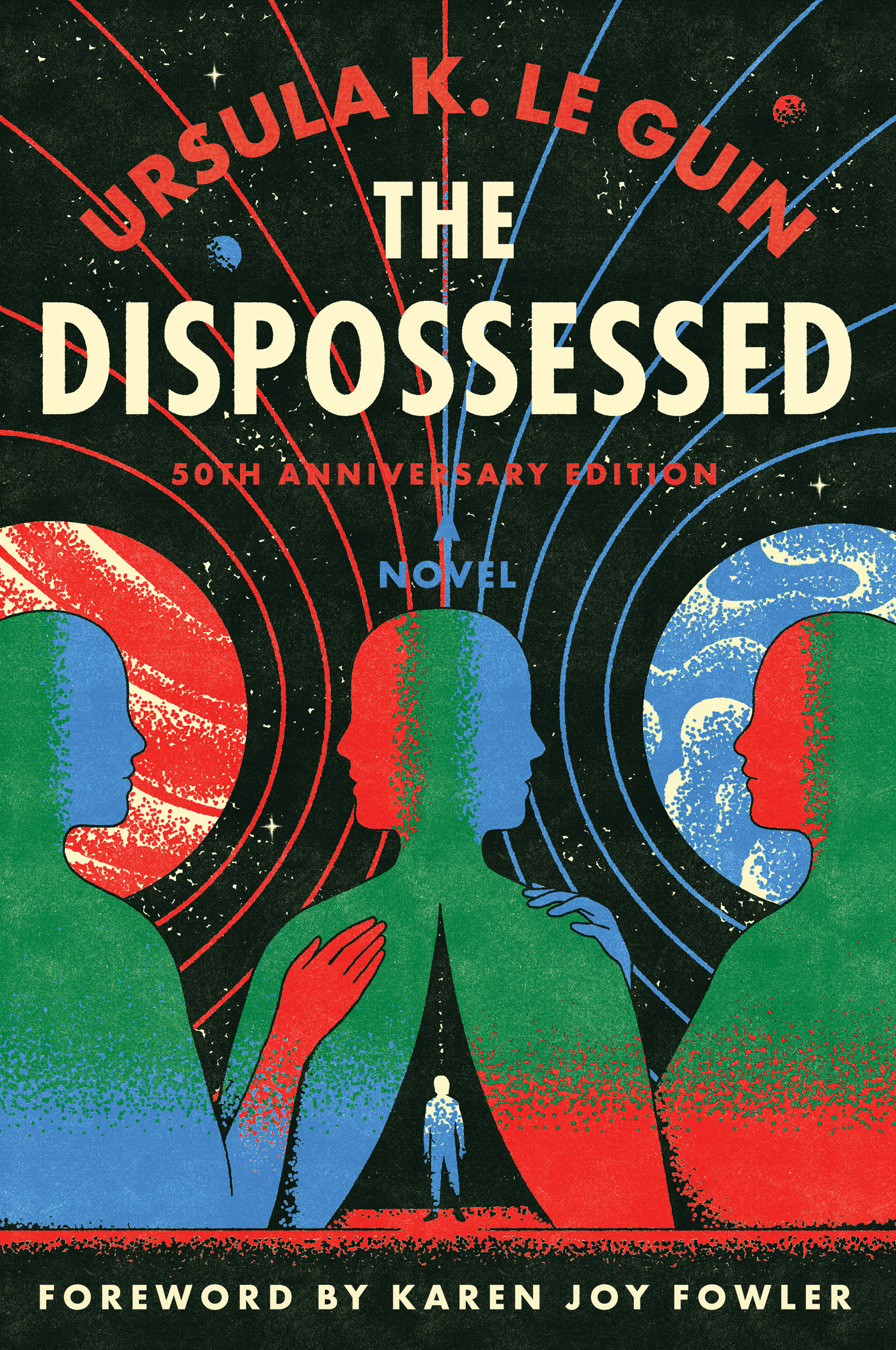
The Dispossessed
About this book
Shevek grows up on Anarres, a society founded without property or formal government. Its ideals shape his work and conscience, yet custom and institutional habit can harden into barriers even where no ruling class is supposed to exist.
He travels to Urras, whose abundance rests beside hierarchy, poverty, and political violence. Each world uses the other as proof of its own virtue, while Shevek looks for a way to share knowledge without letting either possess it.
The Dispossessed is subtitled An Ambiguous Utopia. Its alternating chronology makes political theory intimate by following friendship, partnership, work, and the loneliness required to cross a wall.
Read a sample
5,068 words
Plain text
From the opening
Foreword to the Fiftieth Anniversary Edition
The Terran scientist, Albert Einstein (Ainsetain, if you prefer), famously puzzled through problems by visualizing them. He called these visualizations his thought experiments. Thought experiments in prose form are a thing the literature of science fiction excels at, and Ursula Le Guin was arguably our most brilliant practitioner. The Dispossessed is one such thought experiment. It asks:
Could a successful society be based on the principles of anarchism?
Le Guin wrote The Dispossessed during the late sixties and early seventies, a time erroneously, but conveniently referred to as “the sixties.” She wrote a number of other thought experiments during those same years: The Left Hand of Darkness, The Lathe of Heaven, The Word for World Is Forest as well as her most famous short story, “The Ones Who Walk Away from Omelas.” This period in her career is truly astonishing in terms of her output and creativity. And achievement. And acclaim. During these years, she won four Hugo awards, three Nebulas, and three Locus awards. Although magnificent books like Always Coming Home, Tehanu, and Lavinia would come later, it is still the works of this period that form the heart of Le Guin’s legacy.
It is a truism that stories set in the future are nevertheless always about current events. The current events of the sixties included the Cold War, the war in Vietnam, second wave feminism, Black power, flower power, Stonewall, student protests, experiments in communal living, numerous assassinations, the proliferation of hallucinogenic drugs, the Native American occupation of Alcatraz, the invasion of Czechoslovakia, Woodstock, Watergate, the Cultural Revolution, financial and governmental corruption (but that one is evergreen), and the first man on the Moon. Salvador Allende died in 1973 and Pinochet seized power with the help of the CIA. Nixon was in the White House. Franco was still alive and so was Mao. The ghosts of all these things can be found in Le Guin’s stories. Susan Sontag has defined a writer partly as a person who pays attention to the world. Le Guin paid attention.
When The Dispossessed was first published, I was twenty-four years old. I read it immediately. I had just completed a master’s degree in political philosophy with an emphasis on Chinese studies, so this book was right in my sweet spot, posing with such clarity the big political questions: What is a good society? Can better, less selfish, more altruistic human beings be intentionally created? And if so, which must come first, the creation of the better society or the creation of the better human?
Half of The Dispossessed takes place on Anarres, where an intentional community has been established on a barely habitable moon. The tenets of this community, a sort of Taoist anarchy, were first articulated generations ago on the planet Urras by an imprisoned revolutionary named Odo. (Odo is the protagonist of “The Day Before the Revolution,” a short story written soon after The Dispossessed but taking place two hundred years before. One of the many ways Le Guin plays with time throughout this saga—the prequel as sequel.) The other half takes place on Urras in the nation of A-Io. A-Io is a profit-driven society, rapaciously capitalistic. The problems there are familiar ones to us—enormous wealth inequality, an oppressed underclass, patriarchy, achievement measured in status and property rather than in the value of the work itself.
For many of us, I imagine the word utopia conjures a sort of Eden, something like “the green country” Le Guin associated with fantasy. We picture abundance; we picture natural beauty. Urras has all of that. Anarres has none. Yet Anarres is the utopia referred to back when The Dispossessed carried the subtitle, An Ambiguous Utopia.
Anarres has minerals and oceans; the oceans teem with life. But the land is arid, a world of inhospitable dust. No nonhuman mammals, no birds, live on this moon as the ecosystem will not sustain them. “Think of it,” one Anarresti says, imagining life on Urras. “Everywhere you looked animals, other creatures, sharing the earth and air with you. You’d feel so much more a part.” (here) This is utopia defined entirely by human interaction.
In the middle of the book, the community faces an ecological crisis resulting in a period of desperate food shortage. We see the sacrifices life here demands, as well as the difficult decisions about who gets fed first.
Thought experiment number two: We are used to thinking that scarcity breeds conflict, people squabbling to get some share of the not-enough. But could the opposite be true: that at a certain level of poverty, communal cooperation becomes a prerequisite for survival, and that, under these extreme circumstances, cooperation is more likely than conflict? Are these, perhaps, the only conditions under which cooperation is more likely than conflict?
“The Day Before the Revolution” shows the exultation and optimism, particularly among young revolutionaries, of a long struggle ending in victory. The victory has come in Thu, one of the other nations on the planet Urras. Two things have happened in the fictional period between the short story and the novel. One is that the revolution in Thu stopped short of achieving the radical changes hoped for and became instead an authoritarian socialist state. The other is that the community of Anarres, a truly radical system without money or property, has settled on the moon.
The creation of Anarres represents a deliberate and absolute break from Urras, even including the creation of a whole new language so that the next generation of Anarresti will have no words with which to express possession or hierarchy.
Continue reading the sampleClose the sample
Thought experiment number three: What is the relationship between language and society? Can a successful revolution occur only by breaking so completely with the past that the very words must change?
The followers of Odo, the Odonians, have been granted this moon colony partly to keep their beliefs from contaminating the societies on Urras. But the fear of contagion goes both ways. Revolutionaries from the nation of Benbili, where a war similar to the war in Vietnam is underway, request the opportunity to relocate to Anarres, but are refused by the Anarresti. There is little communication between Anarres and Urras and what there is is tightly restricted.
Thought experiment number four: How necessary is the condition of isolation to utopia? How real is the fear of contamination? Is keeping some people out a necessary condition of the good society?
In the opening pages of Le Guin’s The Dispossessed, a man is murdered. He is never named, nor is the murderer. If there were repercussions for this murder, they are not shown. The dead man was not the intended victim, just an unfortunate in the wrong place, and he will not be mentioned again. It is a startling and intriguing choice on Le Guin’s part to introduce her anarchistic, cooperative, peaceful utopians to us first as a murderous mob.
The protagonist of the book is Shevek; The Dispossessed is essentially the story of his life. Shevek is the actual target of the mob’s fury. His crime is that he, an Anarresti born and bred, is leaving Anarres for Urras. He is free to do this, as anyone on Anarres is largely free to do whatever they like. But there is an understood prohibition against it, a sense that contact with Urras might imperil the entire utopian experiment. To some, his departure is treason.
Behavior on Anarres is constrained by the individual conscience—Le Guin refers to this as “internalized preaching” (here)—but also by “the social conscience” (here), meaning the opinion of others. This latter constraint brings to mind the way Quakers make choices through a sense of consensus, but also, and more troublingly, the neighborhood committees of the Cultural Revolution. At the time Le Guin was writing The Dispossessed the horrors of the social engineering of the Cultural Revolution were only beginning to leak out in the West.
Though what actually happens on Anarres tends to be more informal, more like peer pressure.
Thought experiment number five: Can neighbors be trusted to police neighbors? Can the inevitable petty jealousies and animosities, corrupting ambitions, factions, and personal power plays be mitigated? Can opposing opinions still be heard and considered, or do the demands of reciprocity beget conformity?
Shevek is a physicist, an exceptional man, a genius. As a child, his abilities occasioned criticism. He was accused of egoism and self-aggrandizement simply because he was smarter than everyone else. As an adult, his work is thwarted by the jealousies of an older, less able but more powerful physicist. Shevek is fully committed to the vision and principles of Odo. He has personal ties to Anarres as well, a partner, a child. But he wants to achieve the most he can achieve. He wants “to assert, by his talent, the rights of any citizen in any society: the right to work, to be maintained while working, and to share the product with all who wanted it.” (here)
Time is the subject of Shevek’s great work, and Le Guin has fun structuring the novel in ways that unsequence the narrative. Shevek is trying to find the elusive unified field theory, a reconciliation of the principles of sequentiality and simultaneity. Einstein, in translation, is one source of inspiration, because The Dispossessed is part of Le Guin’s Hainish cycle and we Terrans have an embassy in A-Io.
A-Io is eager to support Shevek’s work, seeing that it may bring them profit and status. They wish to demonstrate the superiority of their world to the many peoples of other worlds. They do not see Shevek’s work as political, although it happens to dovetail nicely with Odonian philosophy, and it seems possible that only an Odonian could achieve it.
Anarres, on the other hand, does not seem to care at all whether Shevek finishes this galaxy-transforming work or not.
Thought experiment number six: How does a society that values equality above all else deal with exceptional talents, exceptional abilities? How is personal achievement to be balanced with societal obligations? How is freedom to be balanced with order?
As is so often the case, Shevek never loves his home more than when he is living somewhere else. For all its faults and failures, Anarres remains the book’s utopia, not A-Io with its riches, its comforts, its natural advantages. But here is a famous quote from Le Guin’s The Lathe of Heaven: “Love doesn’t just sit there, like a stone, it has to be made, like bread; remade all the time, made new.” Substitute the word revolution for love. A revolution cannot simply be established and then left to function. It must be remade all the time.
In 2014 Le Guin won the National Book Foundation Medal for Distinguished Contribution to American Letters. She gave a powerful, searing acceptance speech. She warned us that hard times were coming. She told us that we would need artists capable of imagining other ways of being, artists who could find real grounds for hope.
Fifty years have passed since I first read The Dispossessed, and I have, astonishingly, turned seventy-four. I love the book as much as I ever did; it still sits smack in the middle of my sweet spot. All the questions it poses about society, about human nature, about power and justice and goodness, are as trenchant to me today as when I met Shevek for the first time. The book has not changed and, in the most substantial ways, despite the years, I have not changed. The world has.
Many things have gotten better over the last fifty years and many things have not. The perils of climate change had already arrived in 1974, but I didn’t notice them the way Le Guin did. Now I see them everywhere, not just in the weather and extinctions, but also in accelerating clashes over resources, increasing wealth inequality, increasing tribalism, the obsession over borders and immigrants, the rise, again, of fascism, our old foe. A meanness seems to have swept over the world. Hard times have indeed come upon us.
In her speech, Le Guin also said this: “We live in capitalism. Its power seems inescapable. So did the divine right of kings.”
When The Dispossessed was first published, the community on Anarres was about the age of the American experiment I live inside. Now the American experiment is older and like Anarres, faults and failures are showing. Without a serious, insistent recommitment to the idea that no man is above the law, we will soon see the experiment end.
No man is above the law.
This, the most fundamental, foundational American doctrine, has been clearly shown to be untrue in practice and is now even contested in principle. Among the judges who sit in the highest court of the nation are some who have their doubts. We are not as finished with the divine right of kings as we had hoped.
In many of the stories from Le Guin’s Hainish cycle, including The Dispossessed, some alien intervention is required to save the situation. We here, alone on earth, are still waiting for that. And while we wait, now bereft of Le Guin’s necessary voice, other artists must take up the challenge of showing us different ways to be.
Perhaps suggestions can be found in “Utopiyin, Utopiyang” (2015), an essay containing some of Le Guin’s final musings on the subject of utopia. In it she used, in true Einsteinian fashion, the yin-yang symbol to visualize her thought experiment. The symbol illustrates two equally powerful forces in balance, but also in constant transformation, one to the other. Like the yin-yang symbol, she wrote, every utopia contains dystopia within it and vice versa.
But we seldom get the balance part right. We tip toward yang. In 1985, Le Guin published Always Coming Home, an attempt, after the rationality and intentionality of Anarres, to create a more yin-like utopia in a distant-future California. No aliens required.
In “Utopiyin, Utopiyang,” she wrote that we must, and perhaps we are beginning to, “change the goals of human domination and unlimited growth to those of human adaptability and long-term survival.” She suggested that we learn to accept “impermanence and imperfection, a patience with uncertainty and the makeshift” in our ambiguous utopias.
There must be more yin in our thinking. Her essay ends with a beautiful, poetic encouragement to make “a friendship with water, darkness, and earth.”
A friendship with water, darkness, and earth.
I always like to give Le Guin the last word.
“There is no last word,” Le Guin says.
KAREN JOY FOWLER
MAY 2024
Chapter One
There was a wall. It did not look important. It was built of uncut rocks roughly mortared. An adult could look right over it, and even a child could climb it. Where it crossed the roadway, instead of having a gate it degenerated into mere geometry, a line, an idea of boundary. But the idea was real. It was important. For seven generations there had been nothing in the world more important than that wall.
Like all walls it was ambiguous, two-faced. What was inside it and what was outside it depended upon which side of it you were on.
Looked at from one side, the wall enclosed a barren sixty-acre field called the Port of Anarres. On the field there were a couple of large gantry cranes, a rocket pad, three warehouses, a truck garage, and a dormitory. The dormitory looked durable, grimy, and mournful; it had no gardens, no children; plainly nobody lived there or was even meant to stay there long. It was in fact a quarantine. The wall shut in not only the landing field but also the ships that came down out of space, and the men that came on the ships, and the worlds they came from, and the rest of the universe. It enclosed the universe, leaving Anarres outside, free.
Looked at from the other side, the wall enclosed Anarres: the whole planet was inside it, a great prison camp, cut off from other worlds and other men, in quarantine.
A number of people were coming along the road towards the landing field, or standing around where the road cut through the wall.
People often came out from the nearby city of Abbenay in hopes of seeing a spaceship, or simply to see the wall. After all, it was the only boundary wall on their world. Nowhere else could they see a sign that said No Trespassing. Adolescents, particularly, were drawn to it. They came up to the wall; they sat on it. There might be a gang to watch, offloading crates from track trucks at the warehouses. There might even be a freighter on the pad. Freighters came down only eight times a year, unannounced except to syndics actually working at the Port, so when the spectators were lucky enough to see one they were excited, at first. But there they sat, and there it sat, a squat black tower in a mess of movable cranes, away off across the field. And then a woman came over from one of the warehouse crews and said, “We’re shutting down for today, brothers.” She was wearing the Defense armband, a sight almost as rare as a spaceship. That was a bit of a thrill. But though her tone was mild, it was final. She was the foreman of this gang, and if provoked would be backed up by her syndics. And anyhow there wasn’t anything to see. The aliens, the off-worlders, stayed hiding in their ship. No show.
It was a dull show for the Defense crew, too. Sometimes the foreman wished that somebody would just try to cross the wall, an alien crewman jumping ship, or a kid from Abbenay trying to sneak in for a closer look at the freighter. But it never happened. Nothing ever happened. When something did happen she wasn’t ready for it.
The captain of the freighter Mindful said to her, “Is that mob after my ship?”
The foreman looked and saw that in fact there was a real crowd around the gate, a hundred or more people. They were standing around, just standing, the way people had stood at produce-train stations during the Famine. It gave the foreman a scare.
“No. They, ah, protest,” she said in her slow and limited Iotic. “Protest the, ah, you know. Passenger?”
“You mean they’re after this bastard we’re supposed to take? Are they going to try to stop him, or us?”
The word “bastard,” untranslatable in the foreman’s language, meant nothing to her except some kind of foreign term for her people, but she had never liked the sound of it, or the captain’s tone, or the captain. “Can you look after you?” she asked briefly.
“Hell, yes. You just get the rest of this cargo unloaded, quick. And get this passenger bastard on board. No mob of Oddies is about to give us any trouble.” He patted the thing he wore on his belt, a metal object like a deformed penis, and looked patronizingly at the unarmed woman.
She gave the phallic object, which she knew was a weapon, a cold glance. “Ship will be loaded by fourteen hours,” she said. “Keep crew on board safe. Lift off at fourteen hours forty. If you need help, leave message on tape at Ground Control.” She strode off before the captain could one-up her. Anger made her more forceful with her crew and the crowd. “Clear the road there!” she ordered as she neared the wall. “Trucks are coming through, somebody’s going to get hurt. Clear aside!”
The men and women in the crowd argued with her and with one another. They kept crossing the road, and some came inside the wall. Yet they did more or less clear the way. If the foreman had no experience in bossing a mob, they had no experience in being one. Members of a community, not elements of a collectivity, they were not moved by mass feeling; there were as many emotions there as there were people. And they did not expect commands to be arbitrary, so they had no practice in disobeying them. Their inexperience saved the passenger’s life.
Some of them had come there to kill a traitor. Others had come to prevent him from leaving, or to yell insults at him, or just to look at him; and all these others obstructed the sheer brief path of the assassins. None of them had firearms, though a couple had knives. Assault to them meant bodily assault; they wanted to take the traitor into their own hands. They expected him to come guarded, in a vehicle. While they were trying to inspect a goods truck and arguing with its outraged driver, the man they wanted came walking up the road, alone. When they recognized him he was already halfway across the field, with five Defense syndics following him. Those who had wanted to kill him resorted to pursuit, too late, and to rock throwing, not quite too late. They barely winged the man they wanted, just as he got to the ship, but a two-pound flint caught one of the Defense crew on the side of the head and killed him on the spot.
The hatches of the ship closed. The Defense crew turned back, carrying their dead companion; they made no effort to stop the leaders of the crowd who came racing towards the ship, though the foreman, white with shock and rage, cursed them to hell as they ran past, and they swerved to avoid her. Once at the ship, the vanguard of the crowd scattered and stood irresolute. The silence of the ship, the abrupt movements of the huge skeletal gantries, the strange burned look of the ground, the absence of anything in human scale, disoriented them. A blast of steam or gas from something connected with the ship made some of them start; they looked up uneasily at the rockets, vast black tunnels overhead. A siren whooped in warning, far across the field. First one person and then another started back towards the gate. Nobody stopped them. Within ten minutes the field was clear, the crowd scattered out along the road to Abbenay. Nothing appeared to have happened, after all.
Inside the Mindful a great deal was happening. Since Ground Control had pushed launch time up, all routines had to be rushed through in double time. The captain had ordered that the passenger be strapped down and locked in, in the crew lounge, along with the doctor, to get them out from underfoot. There was a screen in there, they could watch the liftoff if they liked.
The passenger watched. He saw the field, and the wall around the field, and far outside the wall the distant slopes of the Ne Theras, speckled with scrub holum and sparse, silvery moonthorn.
All this suddenly rushed dazzling down the screen. The passenger felt his head pressed back against the padded rest. It was like a dentist’s examination, the head pressed back, the jaw forced open. He could not get his breath, he felt sick, he felt his bowels loosen with fear. His whole body cried out to the enormous forces that had taken hold of him, Not now, not yet, wait!
His eyes saved him. What they insisted on seeing and reporting to him took him out of the autism of terror. For on the screen now was a strange sight, a great pallid plain of stone. It was the desert seen from the mountains above Grand Valley. How had he got back to Grand Valley? He tried to tell himself that he was in an airship. No, in a spaceship. The edge of the plain flashed with the brightness of light on water, light across a distant sea. There was no water in those deserts. What was he seeing, then? The stone plain was no longer plane but hollow, like a huge bowl full of sunlight. As he watched in wonder it grew shallower, spilling out its light. All at once a line broke across it, abstract, geometric, the perfect section of a circle. Beyond that arc was blackness. This blackness reversed the whole picture, made it negative. The real, the stone part of it was no longer concave and full of light but convex, reflecting, rejecting light. It was not a plain or a bowl but a sphere, a ball of white stone falling down in blackness, falling away. It was his world.
“I don’t understand,” he said aloud.
Someone answered him. For a while he failed to comprehend that the person standing by his chair was speaking to him, answering him, for he no longer understood what an answer is. He was clearly aware of only one thing, his own total isolation. The world had fallen out from under him, and he was left alone.
He had always feared that this would happen, more than he had ever feared death. To die is to lose the self and rejoin the rest. He had kept himself, and lost the rest.
He was able at last to look up at the man standing beside him. It was a stranger, of course. From now on there would be only strangers. He was speaking in a foreign language: Iotic. The words made sense. All the little things made sense; only the whole thing did not. The man was saying something about the straps that held him into the chair. He fumbled at them. The chair swung upright, and he nearly fell out of it, being giddy and off balance. The man kept asking if someone had been hurt. Who was he talking about? “Is he sure he didn’t get hurt?” The polite form of direct address in Iotic was in the third person. The man meant him, himself. He did not know why he should have been hurt; the man kept saying something about throwing rocks. But the rock will never hit, he thought. He looked back at the screen for the rock, the white stone falling down in darkness, but the screen had gone blank.
“I am well,” he said at last, at random.
It did not appease the man. “Please come with me. I’m a doctor.”
“I am well.”
“Please come with me, Dr. Shevek!”
“You are a doctor,” Shevek said after a pause. “I am not. I am called Shevek.”
The doctor, a short, fair, bald man, grimaced with anxiety. “You should be in your cabin, sir—danger of infection—you weren’t to be in contact with anybody but me, I’ve been through two weeks of disinfection for nothing, God damn that captain! Please come with me, sir. I’ll be held responsible—”
Shevek perceived that the little man was upset. He felt no compunction, no sympathy; but even where he was, in absolute solitude, the one law held, the one law he had ever acknowledged. “All right,” he said, and stood up.
He still felt dizzy, and his right shoulder hurt. He knew the ship must be moving, but there was no sense of motion; there was only a silence, an awful, utter silence, just outside the walls. The doctor led him through silent metal corridors to a room.
It was a very small room, with seamed, blank walls. It repelled Shevek, reminding him of a place he did not want to remember. He stopped in the doorway. But the doctor urged and pleaded, and he went on in.
He sat down on the shelf-like bed, still feeling light-headed and lethargic, and watched the doctor incuriously. He felt he ought to be curious; this man was the first Urrasti he had ever seen. But he was too tired. He could have lain back and gone straight to sleep.
He had been up all the night before, going through his papers. Three days ago he had seen Takver and the children off to Peace-and-Plenty, and ever since then he had been busy, running out to the radio tower to exchange last-minute messages with people on Urras, discussing plans and possibilities with Bedap and the others. All through those hurried days, ever since Takver left, he had felt not that he was doing all the things he did, but that they were doing him. He had been in other people’s hands. His own will had not acted. It had had no need to act. It was his own will that had started it all, that had created this moment and these walls about him now. How long ago? Years. Five years ago, in the silence of night in Chakar in the mountains, when he had said to Takver, “I will go to Abbenay and unbuild walls.” Before then, even; long before, in the Dust, in the years of famine and despair, when he had promised himself that he would never act again but by his own free choice. And following that promise he had brought himself here: to this moment without time, this place without an earth, this little room, this prison.
The doctor had examined his bruised shoulder (the bruise puzzled Shevek; he had been too tense and hurried to realize what had been going on at the landing field, and had never felt the rock strike him). Now he turned to him holding a hypodermic needle.
“I do not want that,” Shevek said. His spoken Iotic was slow, and, as he knew from the radio exchanges, badly pronounced, but it was grammatical enough; he had more difficulty understanding than speaking.
“This is measles vaccine,” said the doctor, professionally deaf.
“No,” Shevek said.
The doctor chewed his lip for a moment and said, “Do you know what measles is, sir?”
“No.”
“A disease. Contagious. Often severe in adults. You don’t have it on Anarres; prophylactic measures kept it out when the planet was settled. It’s common on Urras. It could kill you. So could a dozen other common viral infections. You have no resistance. Are you right-handed, sir?”
Shevek automatically shook his head. With the grace of a prestidigitator the doctor slid the needle into his right arm. Shevek submitted to this and other injections in silence. He had no right to suspicion or protest. He had yielded himself up to these people; he had given up his birthright of decision. It was gone, fallen away from him along with his world, the world of the Promise, the barren stone.