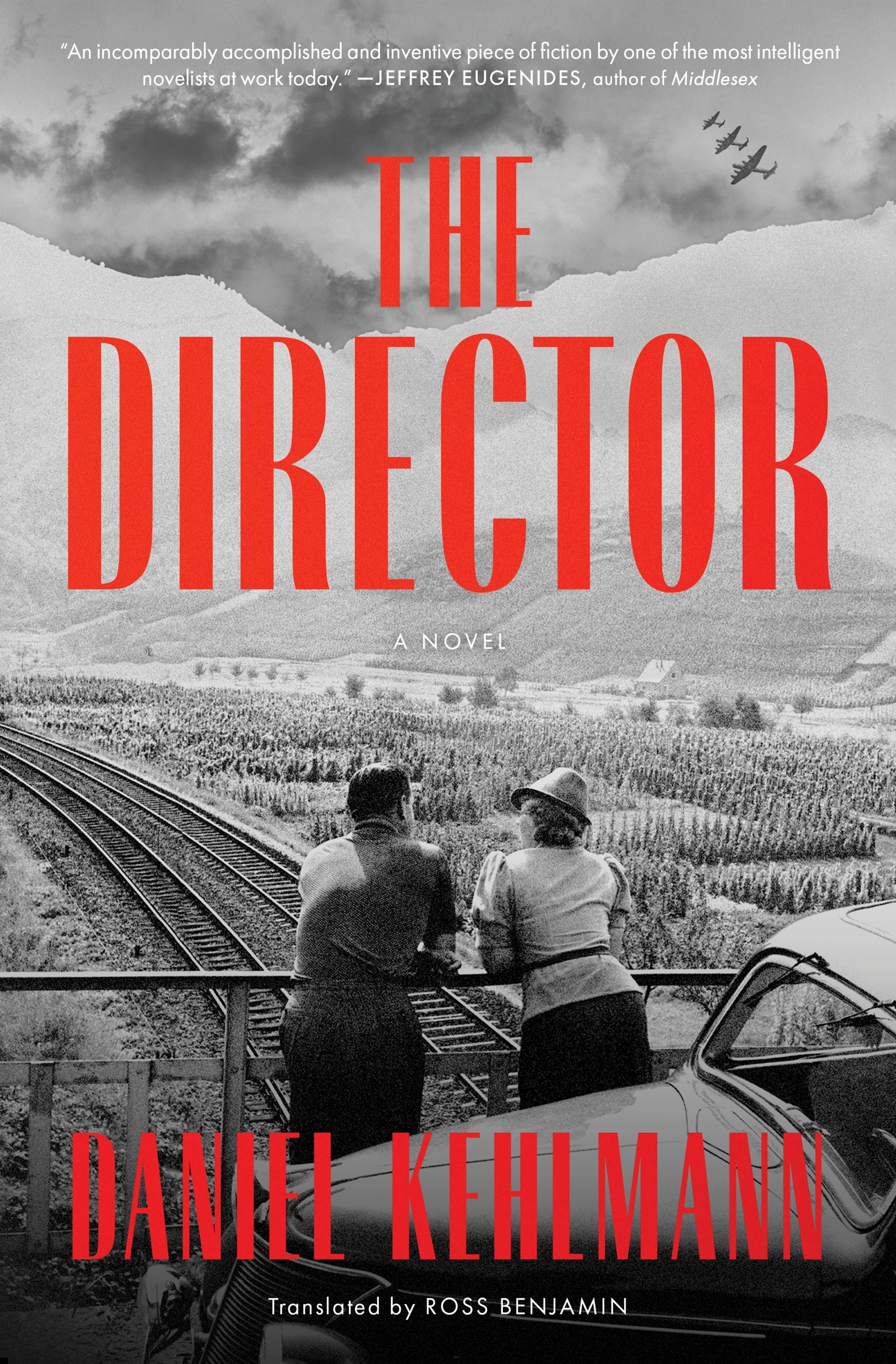
The Director
About this book
Pabst has escaped Germany but cannot reproduce his European stature under California’s hard light. News of his mother’s illness takes him home with his wife and son to a country now absorbed into the Reich.
The regime recognises the propaganda value of a famous filmmaker. Joseph Goebbels offers resources, status, and apparent creative freedom in terms that Pabst wants to treat as negotiable, even as every accepted condition narrows the possibility of refusal.
Daniel Kehlmann’s historical fantasia is sharply alert to self-deception. Complicity does not begin only with ideological conversion; it can grow through professional vanity, family concern, practical compromise, and the belief that art remains pure because an artist says so.
The Director is translated by Ross Benjamin. It is a darkly comic novel about beauty, barbarism, and the stories talented people tell themselves while serving power.
Read a sample
5,012 words
Plain text
From the opening
What’s New on Sunday?
Why am I in this car?
I’ll sit still. Sometimes, if you don’t move, your memory comes back.
But it’s not working. One thing is certain, the driver is smoking. The vehicle is filled with heavy smoke. My eyes are burning. I feel sick. The man has gray hair, dandruff on his shoulders. On the rearview mirror a small cross is swinging on a string of pearls.
One thing at a time. The driver picked me up, held the door open for me, and the others looked on open-mouthed, scrawny Franz Krahler, stupid Frau Einzinger, and also the small man whose name I can never remember.
Because actually, at the Abendruh Sanatorium, every day is the same as the next. At breakfast the radio is on, you go to the park, your back hurts, there’s lunch, you look at the newspaper and get annoyed, while the TV is on; some are watching, others are sleeping, someone is always coughing pitifully. Then it’s already half-past three and dinner is served, and then you lie awake and have to go to the bathroom every half an hour. Sometimes there are visitors, but never for me. Sometimes someone dies and is taken away. But those who are still alive are not usually picked up by a black car with a chauffeur.
We stop at an intersection, where three teenagers with long hair are crossing the street very slowly. The driver rolls down the window and yells that another war would do young punks like them some good, and when they ignore him, he only gets angrier. He drives off, still ranting.
And now it comes back to me: to the television studio.
“But which program?” I ask, leaning forward.
The driver turns around and looks at me through the clouds of smoke, not understanding.
I repeat the question.
“I don’t care!” he shouts. “Why should I give a damn?”
So I don’t say anything else.
But he’s getting worked up. “I want to be left alone, just left alone! Is that too much to ask?”
When we stop in front of the broadcasting studio, he has just pulled himself together. He gets out, walks around the car, opens the door for me. He grabs me by the elbow, pulls me up. This is rude, but it actually helps me get on the street without falling.
The facade of the broadcasting studio is even grayer than the surrounding facades. All the buildings in Vienna are gray now, except for a few that are dark brown. The whole city seems covered with dirt. In winter the sky is stony and low, in summer yellowishly damp. Even that was different once. If you’re old enough, you know that in this city of garbage, coal smoke, and dog shit, even the weather is no longer what it was.
The revolving door rotates haltingly, and for a moment I’m afraid that my journey will end here, but I get through, and in the lobby someone is actually waiting for me: a very thin young man with a clever face and round glasses, who shakes my hand and introduces himself as Rosenzweig, the editor in charge.
“Very good,” I say. I’m always pleased when young people are polite. It doesn’t happen often these days. “In charge of what?”
“Of the program.”
“What program?”
He looks at me for a few seconds before he says: “What’s new on Sunday?”
“I don’t know.”
“The program!”
“What?”
“That’s the name of the program. What’s New on Sunday.”
What is this person talking about?
“This way please!” He points to a door at the other end of the lobby. I follow him down a short corridor; then we’re standing—and this isn’t good at all—in front of a paternoster elevator.
The first compartment passes by, followed by a second. I suppose I have to step into the third, I’m frightened, it passes by too. Come on, I tell myself, you’ve experienced worse. As the fourth compartment rises in front of me, I close my eyes and stagger forward. I make it inside, but would have fallen down if he hadn’t held me by the shoulder. It’s a good thing he reacted so quickly.
“Let go of me,” I say sharply.
Getting out is even harder, of course. But he sees it coming, places his hand on my back, and gives me a little push. I stagger out, he holds me steady again, thank God.
“Stop that!” I say.
It smells of plastic; from somewhere comes the hum of large machines. We walk down a corridor with signed photos of grinning people hanging to the left and right. A few of them I recognize: Paul Hörbiger, Maxi Böhm, Johanna Matz, and there’s Peter Alexander, who for some reason has scrawled With great thanks to my dear, dear audience under his signature.
The young man opens a door with the word MAKEUP on it. A fat fellow with a full beard is sitting in front of a mirror, with a makeup artist standing behind him, working on his face with a brush. When she steps back, he leaps up so suddenly that I flinch, and he hugs me. He smells of aftershave and beer. In a voice quivering with happiness, he asks: “How are you, Franzl?”
I mumble that I’m doing fine, which is actually never true, least of all right now. I’m trying not to inhale. His beard is tickling my cheek.
Continue reading the sampleClose the sample
“And you?” I gasp.
“Oh Franzl, what can I say? Liesl died two years ago, and the thing with Wurmitzer didn’t end well. And I even say to him: Ferdl, you have to do it now because of the old friendship, but did he want to listen? And, as you know, then I preferred to stay with Stenger, but he wasn’t honest.”
I can’t breathe. Who the hell is this? Who are the people he’s talking about? At last he lets go of me, takes a loden jacket with staghorn buttons from the coat hook, big as a tent, throws it on, and walks out.
I sit down. The makeup artist starts working on my face, and asks the same questions makeup artists always ask, what it is I do and what brings me to the program. They never know beforehand, they never recognize anyone, they’ve never looked it up, they always ask.
“Herr Wilzek is a director,” says the young man who brought me here. I wish he’d told me his name, but young people these days don’t know how to conduct themselves.
Of course she now asks what movies I’ve made, and with the same discomfort as always I list my three measly titles: Peter Dances with Everyone with Peter Alexander, Gustav and the Soldiers, also with Peter Alexander and with Gunther Philipp, and Schlück Is the Last to Go Home with people I don’t remember.
And now, of course, she asks about Peter Alexander: “What’s he really like? He’s never been to me for makeup, surprisingly. I’d love to meet him one day.”
I tell the anecdote that I always tell: “On the very first day of filming Peter Dances with Everyone, he knew all his lines by heart. Then the shooting schedule had to be changed on short notice, and a young actress, whose name I’d rather not mention, because in the meantime she’s become quite well known, had only learned the lines for that day, and then Peter looked at her and said: ‘Dear Fräulein, learning lines is like riding horses, do you want to know why?’ ”
God, my reflection! At the Abendruh Sanatorium we don’t have mirrors, because no one shaves themselves; Zdenek, the caregiver, does it every morning. And so the sight comes unexpectedly: my eyes deep in their sockets, the sagging bags of skin, the cracked lips, the wrinkled gray skin on my bald head. My jacket sits askew, because my shoulders no longer fill it. My tie is not only stained but also badly tied, which isn’t my fault, because it’s been a long time since I’ve been able to tie a tie; Zdenek did that too. Can’t he make an effort? How often does it happen that one of us is put on television? I close my eyes so that I don’t have to see myself anymore. There’s a hissing sound; cold wind from the hair spray can blows over my scalp. But why? I have hardly any hair.
“Yes, why?” asks the makeup artist.
What’s going on?
“ ‘Like riding horses,’ he said, why?”
What does she want from me?
“All right,” she says after a pause. “Done.”
I stand up, my knees buckle, the makeup artist and the young man support me.
“Don’t worry,” he says, leading me out into the corridor. Hanging on the walls are signed photos of Paul Hörbiger, Johanna Matz, Peter Alexander. I once worked with him.
“Herr Conrads will ask only the questions we discussed beforehand. Just tell a few of those wonderful old stories of yours—nothing can go wrong. Herr Conrads never deviates from the script; he only asks questions prepared by the editorial team. And in this case, that’s me. He never improvises.”
“I have to go to the bathroom.”
He looks at his watch. Rosenblatt! I don’t know how I know it, but that’s his name. Something about it worries me, but at the moment I can’t say what.
He points to a door. “But please hurry.”
I go in. Everything is complicated: my fingers are numb and can’t properly feel the belt buckle and pants buttons, so it’s not exactly easy to pull my pants down, and on top of that the toilet seat is set too low. Then the roll of paper falls to the floor. I bend down, but when I try to pull it back, it unrolls further, and disappears through the gap under the stall wall.
I hear footsteps, someone pacing back and forth, calling my name: “Herr Wilzek, we have to go to the studio!”
“Yes, yes!” I shout.
“It’s a live broadcast!”
“Yes, just a moment. Just a moment.”
Now there are several people. I hear agitated voices. And I’ve finished, actually, but standing up is fiendishly difficult, because the seat is too low, and now it’s time for the pants buttons and the belt buckle. I do everything as slowly as necessary. Rushing only makes it harder.
I step out of the stall. Five men and three women are standing there, apparently all waiting for me. How can it be that women are allowed in here? Is this what we’ve come to, is nothing sacred anymore? But before I can even complain, they’ve surrounded me—one supports me from the right, another from the left, a third pushes; they don’t even let me wash my hands.
“The program has already started,” says one.
“We’ve moved the second guest up,” says another.
“You have to go in. You’ll be live immediately,” says a third.
A steel door opens, we are in a studio. Two cameras glide soundlessly through the room, I hear the high-pitched whistle of the spotlights, microphones hang on wires from the ceiling. In the middle a small living room is set up: flowered wallpaper with little landscape pictures in golden frames nailed to it, a sofa, an armchair, a table with coffee cups. Sitting on the sofa is a huge man with a beard, wearing a loden jacket. Standing next to him is a man I recognize; he’s always on the television in the Abendruh Sanatorium, but I can’t remember his name. At the moment he is singing to tinny music from the loudspeaker, kissing his fingertips again and again. Someone is pushing me forward, I almost trip over a cable, I’m maneuvered past the camera, now I’m sitting next to the bearded man on the sofa.
The presenter is no longer singing, he’s talking about me. “A special pleasure,” he says in a peculiar singsong, “to have Franz Wilzek here with me, my dear old friend!”
And I don’t even know him. I know I’m a little forgetful, but really, I’ve never met this person before.
He turns around and approaches me with his hand outstretched. “Dear Franzl!” The first camera circles around him, while the second turns to my face; the red light jumps from one to the other, and on a monitor I see myself, forcing a smile, with big bags under my eyes.
His name is Conrads! Suddenly it came to me, Heinz Conrads—my memory isn’t that bad. But I’ve really never met him before. I shake his hand without getting up. He is visibly displeased that he has to bend down.
He turns to the camera and continues talking about me. He is reading from a stack of cards, but stretching the words in such a surprised, confusedly thoughtful way that no one would suspect he isn’t coming up with everything he says on the spot. Director, he says, wonderful funny movies, brought us all much joy, Gustav and the Soldiers, Peter Dances with Everyone, worked with all the best-loved stars! The monitor shows a clip: Peter Alexander singing, leaping, and grinning. I give a friendly nod, even though I can see that I’m not on-screen; the red light is glowing on the camera filming Heinz Conrads, and the monitor again shows his doughy face under the concrete-hard white helmet of hair.
And now it has happened. He falls silent and looks at me. The light jumps; my face appears on the monitor. Did he ask me something? I was inattentive for just one moment, and that’s when it happened!
I listen to the whistling, electrically crackling silence. Then I tell an anecdote chosen at random about the actor Schlück Battenberg. It’s halfway funny, and it works too: Heinz Conrads kisses his fingertips and exclaims: “Delightful!” The bearded man next to me also laughs, pounding his chest.
“Have you two known each other long?” asks Heinz Conrads.
“All our lives,” says the man I don’t know.
They both laugh again. All in all, it seems to be going well. My head doesn’t work like it used to, but a program like this is something I can still manage.
So I don’t even wait for the next question, but tell the anecdote about how Gunther Philipp fell into the water during the filming of Gustav and the Soldiers. Actually a weak story, there’s no punch line, the stupid fellow just fell into the water, and then they pulled him out, but the two of them laugh again, and so I also tell my best story, the showpiece: the young actress who only learned the lines for the first day. And how Peter Alexander looked at her and said, “Dear Fräulein, learning lines is like riding horses! Do you want to know why?”
“Yes, Peter!” cries the idiot next to me. “He is really one of the greats!”
I give him a sharp look to show him that he should be quiet.
“Why?” asks the presenter.
“Why—what?”
“Riding horses?”
The whistle of the spotlights is so shrill and yet so soft that you can’t be sure whether you’re really hearing it. The red light jumps from one camera to the other. I follow it with my gaze and see my head jerking back and forth on the monitor.
“Oh, like riding horses!” I take a breath to finish my story.
But something has been thrown out of rhythm, the story has become tangled, the next sentence won’t come. The one after the next is ready, so I skip ahead, but just at that moment it too dissolves—I still sense its outline, and I can almost feel it with my tongue. But when the words don’t form, I make the mistake of looking at the screen. There I am, my face confused and my mouth open. And sitting opposite yourself like this, split in two, and knowing that everyone at the Abendruh Sanatorium is watching, you really can no longer remember anything.
The presenter nods, folds his hands with the cards, looks up at the ceiling as if in prayer, and exclaims: “Delightful! Horses!”
The man next to me laughs.
“Marvelous!” the presenter exclaims.
They must be sick with envy at the home right now, especially Franz Krahler and the stupid Frau Einzinger. And because I can’t push the image aside—I see Krahler sitting pale in his chair and Einzinger open-mouthed next to him—it happens once again, and I miss the next question.
“Excuse me?”
Heinz Conrads turns his eyes to the ceiling, sighs, and reads from his card: “Franz Wilzek became a director only late in life. Before that he was the assistant of G. W. Pabst.”
Why is he suddenly talking about me in the third person?
“G. W. Pabst,” he declares. “One of the great directors. A master, a legend. I knew him too, but no one knew him like you did!”
Images flicker on the monitor: Greta Garbo in The Joyless Street, Louise Brooks in Pandora’s Box, Mack the Knife twirling his cane. I clear my throat and explain: “That’s Garbo. He discovered her for the movie. I only joined later—in 1941 with The Comedians. We met on the set of… A year earlier. On another movie. I was actually a camera assistant.”
Now Heinz Conrads’s face fills the screen again. “He had just come back,” he reads from the next card. “From exile. To make films in German again. You became his new assistant.”
I nod. Apparently I’m supposed to say more, but what? Behind the camera a young man with round glasses has stepped out of the darkness. I’ve seen him before, but I can’t remember where. All I know is that his name is Rosenkranz.
“Did he tell you why he came back?” Heinz Conrads reads out. “He had already been in America. And then he was back here making movies for…” He falls silent and holds his card as if something is wrong. It only lasts a moment, then he gains control of his features, twists his mouth into his doughy smile, slides the card to the back of the stack.
“And after The Comedians the two of you made Paracelcus,” he reads. “With the great Werner Krauss, a great film, a classic.”
“A masterpiece!” I say.
“What was he like, G. W. Pabst—he did always have his name spelled with the two initials, G. W., didn’t he? He was usually addressed that way too. So what was he like, how would you describe him?”
“A bit too fat.”
Heinz Conrads laughs. “That’s Franzl! Always joking!”
“He always wanted to lose weight. He wasn’t very tall, but somewhat round, and on set he laughed a lot, but when the lights went out, he often looked emptied out. Like a costume that no one is wearing.”
The whistle has grown louder and shriller, and the brightness is suddenly almost unbearable. I can barely see the presenter anymore, I’m so blinded.
“But when he gave an order, everyone obeyed. It didn’t even occur to anyone to do otherwise. Except when his mother was there. I saw her only once, she came to visit when we were filming The Comedians, he immediately looked like a child. A few months later she died.” I have to swallow; my throat is dry. The couch under me seems to be slowly floating across the room. “He had his own theory of film editing. That a cut must always be based on a movement, creating an unbroken flow from the first shot to the last. Later, when I was directing myself, I realized that in practice it’s hardly…” No, I’ve gone too far, you can’t talk like that here. “He often talked about Greta Garbo!” I exclaim. “Such a beautiful woman! And Louise Brooks, who is hardly known today, but back then she was almost as big a star as Garbo. He discovered her too.”
“Ah yes! The beautiful women!” Heinz Conrads laughs with relief. He moves another card to the back and reads: “And in your next film, The Molander Case, the great Paul Wegener played the lead role?”
“Which film?”
“Your next film,” he reads off the card. “The Molander Case. Paul Wegener played the lead role.”
“Doesn’t exist.”
“Paul Wegener?”
“That film. It doesn’t exist; it was planned, but never shot.”
For a few seconds it’s silent, then Heinz Conrads says: “No, no, it says here… It was shot. It’s just that no one has seen it, it was then lost.”
“It wasn’t shot.”
Heinz Conrads looks somewhere behind the camera. “Well, I was told you finished filming it, in early forty-five in Prague. Under difficult conditions, in the last weeks of the war, but then the footage just disappeared.” He squints at his card. It’s evidently the last one. He flips it over, looks helplessly at the back.
“It wasn’t shot!” I shout. “It isn’t true, goddamnit, it doesn’t exist! It’s a mistake! A lie.”
“Excuse me?”
“A lie!”
Heinz Conrads looks at his last card, then at the young man with glasses, then at the card again. “Franzl, you must remember your film, don’t you?”
“It was never shot!”
Heinz Conrads frowns so hard that his face seems to be imploding. At that moment my eyes meet those of the young man with glasses. He isn’t looking at his boss but at me, intently and directly, with a thin, frozen smile.
I look at the screen. See myself looking off somewhere—of course, the monitor isn’t the camera, you have to look into the camera to see yourself looking out from the monitor, except then you obviously can’t see yourself because you’re looking into the camera, not at the monitor. And now the monitor, even though it’s showing me, is showing something else at the same time, and to avoid seeing it, I close my eyes, but that doesn’t help, and I still see them: black-and-white people in a concert hall. From high above I’m looking down on them, as if I were flying, a crystal chandelier is shining brightly, I’m sitting next to the camera on the arm of a long crane. They’re all facing forward, because they’re not allowed to look up.
I open my eyes, but I still see it, as clear as ever, just as we saw it on the small screen back when Pabst was editing the film beside me. And at the same time I see it from above, from the sweeping crane on which I’m perched, while down below Pabst directs through the megaphone, farther forward, now pan to the right, to the stage, farther, where the actor is standing and playing violin!
“It wasn’t shot! Your team did a bad job! You’re wrong! It never came to be!”
The people below me. They’re not allowed to look up. If anyone looked up, it would ruin everything. It is crucial that the soldiers stay out of the field of view, because the shot must be finished today, and now Heinz Conrads is coming up to me: “Dear Franzl, such a pleasure having you here, but unfortunately we’re out of time!” I think he’s about to take a swing at me, and I raise my hands in front of my face, but he turns to the camera, the red light flashes, the monitor shows his face so large that his nostrils look like craters. “Goodbye, dear friends,” he says in a singsong, “thanks for tuning in, and wishing you all the best until we meet again!” Tinnily tinkling piano music from the loudspeakers, the red light goes out, on the monitor swirling letters form the words What’s New on Sunday with Heinz Conrads.
Evidently it’s over. The young man with glasses whose eyes have been fixed on me the whole time is approaching me. “The credits will now run three times in their entirety. We had to bail out early. That has never happened before. You can be proud.”
“I hope you feel better soon,” says the bearded man in the loden jacket next to me. “Nice to see you again, Franzl.”
“You too,” I say, because I can’t think of anything else.
“Did you really not shoot Molander? I always thought it had been finished, but then, when the uprising began in Prague—”
I turn away and reach out my arm to indicate to the young man, whose name suddenly comes to me, it’s Rosenkranz, and for some reason this bothers me, to help me up. He does so. We take small steps toward the door.
But Heinz Conrads is blocking our way. His face is contorted with rage.
“Goodbye, dear Heinzi,” I say.
“Crawl into your shithole and die.”
I stare at him. For a moment I think I’ve misheard him.
“And you?” he says to the young man. “How dare you bring this ancient shithead on my show? Here he is with half his marbles, and you stick me with these questions. You pack your things and get the fuck out of here, I never want to see you again!”
“Very gladly,” says Rosenkranz.
“Shut up. I don’t want to hear it, fuck off!”
“Gladly,” Rosenkranz says again. We walk around Heinz Conrads, who is pale with rage. Walking with my eyes half shut, I hear a heavy door open and close.
“For months I’ve wanted to quit,” says Rosenkranz. “But anyone can just give notice, I thought. You have to come up with something better.”
I feel weak. The program really exhausted me; not only my hands but also my arms and shoulders are shaking. What happened anyway? My memory is already blurring. At first I was telling stories, everything was going well, then Pabst came up, of course, I’m always asked about him, and then everything fell apart. I got angry, perhaps even shouted, and I remembered the filming of Molander, but that’s not actually possible, because we never filmed Molander.
“And then the boss said, all right, let’s go ahead and invite him, and then I wrote the questions, as always.” He falls silent for a moment, then he says: “My father was there.”
“Your father?”
“He was an extra. In the concert hall… In hall seven, in the studio in Barrandov, when you were shooting The Molander Case.”
“Where’s the bathroom?”
I have to stop. The floor is swaying; I think I’m going to fall. But he’s wrong, the film was never shot. I know because I was there. I was there when we didn’t shoot the film. I remember it not happening. I clear my throat, I want to explain.
“I’ve searched everywhere,” he says. “There’s no copy. The negative is lost. You’re probably the only person who saw the dailies. Besides Pabst, of course. But Pabst is dead.”
I push on the handle of the bathroom door and go inside. For a moment I’m afraid that he’ll follow me, but fortunately he stays put.
The door closes. Everything is difficult, my clothing resists. My numb fingers can’t manage the pants buttons, the toilet bowl is too low. Only when I’m sitting down do I notice that the toilet paper roll is on the floor—I pull on it, but it only unrolls further, everything is so laborious. My elbow hurts, my back is stiff, my knees are so weak and wobbly that I can hardly stand up. One should die young. When I was a child, Dr. Sämann always came when I was sick. His cool hand on my forehead. “Are we sick?” he always said. “Do we have a fever?” And I thought, why is he saying “we,” he doesn’t have a fever at all, only I have a fever. I don’t know why he comes to my mind now, I haven’t thought of him for decades.
When I come out, a young man with glasses is waiting. His hair is untidy, his eyes are bloodshot, as if he’s been crying. Probably an alcoholic. Young people these days have no self-control.
“What’s the matter?”
“I was thinking about my father.”
“Will you take me to the tram?”
He removes his glasses, puts them back on, and says softly, no, not a tram, a car will take me.
We walk down a long corridor. Actors’ faces grin from the walls. I’ve made movies with some of them. There, for example, is Peter Alexander.
“That’s a pro,” I say. “Peter! You can’t even imagine. On the very first day of filming knows all his lines. A young actress, I won’t say her name now, because in the meantime she—”
“All right, all right!” he says sharply.
I fall silent, offended.
And here, to top it all, a paternoster elevator! Somehow I stagger into the compartment; I almost fall, but he holds me. The presenter—that much I still remember—was the famous Heinz Conrads. They’ll be pretty annoyed at the Abendruh Sanatorium that I was with Heinz Conrads, while for everyone else it was just another endless Sunday morning with a lousy breakfast.
Can it be that the program didn’t go well? I remember agitation, stupid questions, there was trouble, someone insulted me—or I insulted someone, one of the two. Pabst was brought up, of course, that goes without saying, everyone asks about him, my own career as a director was ludicrous, not to put too fine a point on it. The only thing that’s important about me is that I used to be his assistant.
The young man pushes me out of the paternoster elevator, holding me again. We cross the lobby. There’s a revolving door here too. The glass walls rotate, reflections interpenetrate, I shuffle forward and stand on the street. Soon I’d better lie down.
There are three cars parked on the side of the road, each of them labeled AUSTRIAN BROADCASTING CORPORATION. The young man—what’s his name again?—opens the door of the front seat and helps me get in.