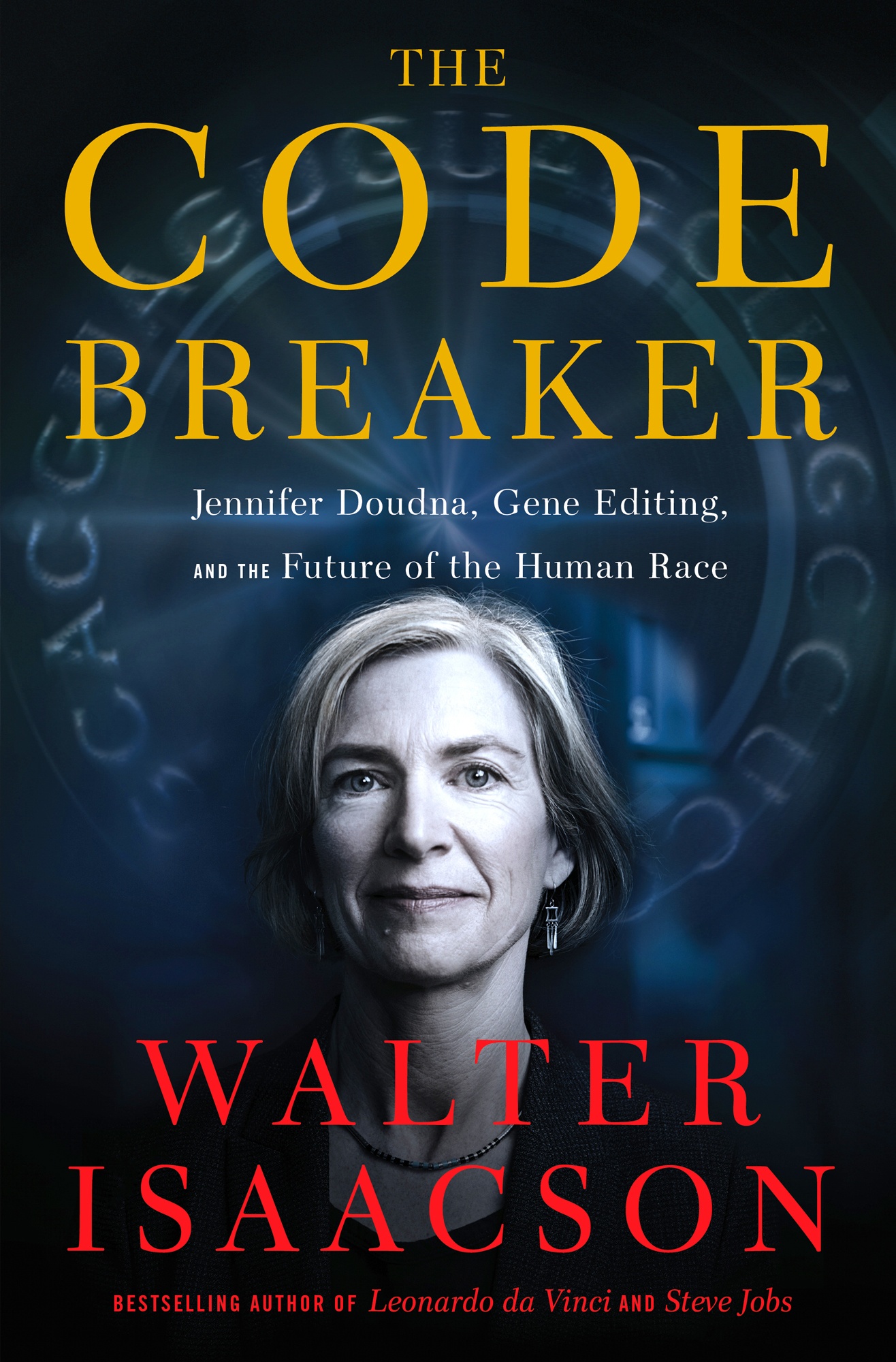
The Code Breaker: Jennifer Doudna and the Race to Understand Our Genetic Code
About this book
Walter Isaacson follows Doudna from childhood curiosity through structural biology and RNA research to collaboration with Emmanuelle Charpentier. Their work helped show that a CRISPR-Cas9 system could be programmed to cut DNA at a chosen target.
The story includes competing laboratories, patent disputes, commercial companies, prizes, and the many researchers whose work made the breakthrough possible. It also explains the experiments and concepts for general readers without presenting discovery as one isolated moment.
Gene editing raises different questions in medicine, agriculture, diagnostics, and heritable human embryos. The birth of CRISPR-edited babies in China makes governance immediate: technical ability arrived before broad agreement about acceptable use.
The Code Breaker is a scientific biography published in 2021, not a current clinical guide. CRISPR research and regulation continue to change, so claims about available therapies, risks, and legality should be verified with current primary and regulatory sources.
Read a sample
5,003 words
Plain text
From the opening
INTRODUCTION Into the Breach
Jennifer Doudna couldn’t sleep. Berkeley, the university where she was a superstar for her role in inventing the gene-editing technology known as CRISPR, had just shut down its campus because of the fast-spreading coronavirus pandemic. Against her better judgment, she had driven her son, Andy, a high school senior, to the train station so he could go to Fresno for a robot-building competition. Now, at 2 a.m., she roused her husband and insisted that they retrieve him before the start of the match, when more than twelve hundred kids would be gathering in an indoor convention center. They pulled on their clothes, got in the car, found an open gas station, and made the three-hour drive. Andy, an only child, was not happy to see them, but they convinced him to pack up and come home. As they pulled out of the parking lot, Andy got a text from the team: “Robotics match cancelled! All kids to leave immediately!”1
This was the moment, Doudna recalls, that she realized her world, and the world of science, had changed. The government was fumbling its response to COVID, so it was time for professors and graduate students, clutching their test tubes and raising their pipettes high, to rush into the breach. The next day—Friday, March 13, 2020—she led a meeting of her Berkeley colleagues and other scientists in the Bay Area to discuss what roles they might play.
A dozen of them made their way across the abandoned Berkeley campus and converged on the sleek stone-and-glass building that housed her lab. The chairs in the ground-floor conference room were clustered together, so the first thing they did was move them six feet apart. Then they turned on a video system so that fifty other researchers from nearby universities could join by Zoom. As she stood in front of the room to rally them, Doudna displayed an intensity that she usually kept masked by a calm façade. “This is not something that academics typically do,” she told them. “We need to step up.”2
It was fitting that a virus-fighting team would be led by a CRISPR pioneer. The gene-editing tool that Doudna and others developed in 2012 is based on a virus-fighting trick used by bacteria, which have been battling viruses for more than a billion years. In their DNA, bacteria develop clustered repeated sequences, known as CRISPRs, that can remember and then destroy viruses that attack them. In other words, it’s an immune system that can adapt itself to fight each new wave of viruses—just what we humans need in an era that has been plagued, as if we were still in the Middle Ages, by repeated viral epidemics.
Always prepared and methodical, Doudna (pronounced DOWD-nuh) presented slides that suggested ways they might take on the coronavirus. She led by listening. Although she had become a science celebrity, people felt comfortable engaging with her. She had mastered the art of being tightly scheduled while still finding the time to connect with people emotionally.
The first team that Doudna assembled was given the job of creating a coronavirus testing lab. One of the leaders she tapped was a postdoc named Jennifer Hamilton who, a few months earlier, had spent a day teaching me to use CRISPR to edit human genes. I was pleased, but also a bit unnerved, to see how easy it was. Even I could do it!
Another team was given the mission of developing new types of coronavirus tests based on CRISPR. It helped that Doudna liked commercial enterprises. Three years earlier, she and two of her graduate students had started a company to use CRISPR as a tool for detecting viral diseases.
In launching an effort to find new tests to detect the coronavirus, Doudna was opening another front in her fierce but fruitful struggle with a cross-country competitor. Feng Zhang, a charming young China-born and Iowa-raised researcher at the Broad Institute of MIT and Harvard, had been her rival in the 2012 race to turn CRISPR into a gene-editing tool, and ever since then they had been locked in an intense competition to make scientific discoveries and form CRISPR-based companies. Now, with the outbreak of the pandemic, they would engage in another race, this one spurred not by the pursuit of patents but by a desire to do good.
Doudna settled on ten projects. She suggested leaders for each and told the others to sort themselves into the teams. They should pair up with someone who would perform the same functions, so that there could be a battlefield promotion system: if any of them were struck by the virus, there would be someone to step in and continue their work. It was the last time they would meet in person. From then on the teams would collaborate by Zoom and Slack.
“I’d like everyone to get started soon,” she said. “Really soon.”
“Don’t worry,” one of the participants assured her. “Nobody’s got any travel plans.”
What none of the participants discussed was a longer-range prospect: using CRISPR to engineer inheritable edits in humans that would make our children, and all of our descendants, less vulnerable to virus infections. These genetic improvements could permanently alter the human race.
“That’s in the realm of science fiction,” Doudna said dismissively when I raised the topic after the meeting. Yes, I agreed, it’s a bit like Brave New World or Gattaca. But as with any good science fiction, elements have already come true. In November 2018, a young Chinese scientist who had been to some of Doudna’s gene-editing conferences used CRISPR to edit embryos and remove a gene that produces a receptor for HIV, the virus that causes AIDS. It led to the birth of twin girls, the world’s first “designer babies.”
Continue reading the sampleClose the sample
There was an immediate outburst of awe and then shock. Arms flailed, committees convened. After more than three billion years of evolution of life on this planet, one species (us) had developed the talent and temerity to grab control of its own genetic future. There was a sense that we had crossed the threshold into a whole new age, perhaps a brave new world, like when Adam and Eve bit into the apple or Prometheus snatched fire from the gods.
Our newfound ability to make edits to our genes raises some fascinating questions. Should we edit our species to make us less susceptible to deadly viruses? What a wonderful boon that would be! Right? Should we use gene editing to eliminate dreaded disorders, such as Huntington’s, sickle-cell anemia, and cystic fibrosis? That sounds good, too. And what about deafness or blindness? Or being short? Or depressed? Hmmm… How should we think about that? A few decades from now, if it becomes possible and safe, should we allow parents to enhance the IQ and muscles of their kids? Should we let them decide eye color? Skin color? Height?
Whoa! Let’s pause for a moment before we slide all of the way down this slippery slope. What might that do to the diversity of our societies? If we are no longer subject to a random natural lottery when it comes to our endowments, will it weaken our feelings of empathy and acceptance? If these offerings at the genetic supermarket aren’t free (and they won’t be), will that greatly increase inequality—and indeed encode it permanently in the human race? Given these issues, should such decisions be left solely to individuals, or should society as a whole have some say? Perhaps we should develop some rules.
By “we” I mean we. All of us, including you and me. Figuring out if and when to edit our genes will be one of the most consequential questions of the twenty-first century, so I thought it would be useful to understand how it’s done. Likewise, recurring waves of virus epidemics make it important to understand the life sciences. There’s a joy that springs from fathoming how something works, especially when that something is ourselves. Doudna relished that joy, and so can we. That’s what this book is about.
The invention of CRISPR and the plague of COVID will hasten our transition to the third great revolution of modern times. These revolutions arose from the discovery, beginning just over a century ago, of the three fundamental kernels of our existence: the atom, the bit, and the gene.
The first half of the twentieth century, beginning with Albert Einstein’s 1905 papers on relativity and quantum theory, featured a revolution driven by physics. In the five decades following his miracle year, his theories led to atom bombs and nuclear power, transistors and spaceships, lasers and radar.
The second half of the twentieth century was an information-technology era, based on the idea that all information could be encoded by binary digits—known as bits—and all logical processes could be performed by circuits with on-off switches. In the 1950s, this led to the development of the microchip, the computer, and the internet. When these three innovations were combined, the digital revolution was born.
Now we have entered a third and even more momentous era, a life-science revolution. Children who study digital coding will be joined by those who study genetic code.
When Doudna was a graduate student in the 1990s, other biologists were racing to map the genes that are coded by our DNA. But she became more interested in DNA’s less-celebrated sibling, RNA. It’s the molecule that actually does the work in a cell by copying some of the instructions coded by the DNA and using them to build proteins. Her quest to understand RNA led her to that most fundamental question: How did life begin? She studied RNA molecules that could replicate themselves, which raised the possibility that in the stew of chemicals on this planet four billion years ago they started to reproduce even before DNA came into being.
As a biochemist at Berkeley studying the molecules of life, she focused on figuring out their structure. If you’re a detective, the most basic clues in a biological whodunit come from discovering how a molecule’s twists and folds determine the way it interacts with other molecules. In Doudna’s case, that meant studying the structure of RNA. It was an echo of the work Rosalind Franklin had done with DNA, which was used by James Watson and Francis Crick to discover the double-helix structure of DNA in 1953. As it happens, Watson, a complex figure, would weave in and out of Doudna’s life.
Doudna’s expertise in RNA led to a call from a biologist at Berkeley who was studying the CRISPR system that bacteria developed in their battle against viruses. Like a lot of basic science discoveries, it turned out to have practical applications. Some were rather ordinary, such as protecting the bacteria in yogurt cultures. But in 2012 Doudna and others figured out a more earth-shattering use: how to turn CRISPR into a tool to edit genes.
CRISPR is now being used to treat sickle-cell anemia, cancers, and blindness. And in 2020, Doudna and her teams began exploring how CRISPR could detect and destroy the coronavirus. “CRISPR evolved in bacteria because of their long-running war against viruses,” Doudna says. “We humans don’t have time to wait for our own cells to evolve natural resistance to this virus, so we have to use our ingenuity to do that. Isn’t it fitting that one of the tools is this ancient bacterial immune system called CRISPR? Nature is beautiful that way.” Ah, yes. Remember that phrase: Nature is beautiful. That’s another theme of this book.
There are other star players in the field of gene editing. Most of them deserve to be the focus of biographies or perhaps even movies. (The elevator pitch: A Beautiful Mind meets Jurassic Park.) They play important roles in this book, because I want to show that science is a team sport. But I also want to show the impact that a persistent, sharply inquisitive, stubborn, and edgily competitive player can have. With a smile that sometimes (but not always) masks the wariness in her eyes, Jennifer Doudna turned out to be a great central character. She has the instincts to be collaborative, as any scientist must, but ingrained in her character is a competitive streak, which most great innovators have. With her emotions usually carefully controlled, she wears her star status lightly.
Her life story—as a researcher, Nobel Prize winner, and public policy thinker—connects the CRISPR tale to some larger historical threads, including the role of women in science. Her work also illustrates, as Leonardo da Vinci’s did, that the key to innovation is connecting a curiosity about basic science to the practical work of devising tools that can be applied to our lives—moving discoveries from lab bench to bedside.
By telling her story, I hope to give an up-close look at how science works. What actually happens in a lab? To what extent do discoveries depend on individual genius, and to what extent has teamwork become more critical? Has the competition for prizes and patents undermined collaboration?
Most of all, I want to convey the importance of basic science, meaning quests that are curiosity-driven rather than application-oriented. Curiosity-driven research into the wonders of nature plants the seeds, sometimes in unpredictable ways, for later innovations.3 Research about surface-state physics eventually led to the transistor and microchip. Likewise, studies of an astonishing method that bacteria use to fight off viruses eventually led to a gene-editing tool and techniques that humans can use in their own struggle against viruses.
It is a story filled with the biggest of questions, from the origins of life to the future of the human race. And it begins with a sixth-grade girl who loved searching for “sleeping grass” and other fascinating phenomena amid the lava rocks of Hawaii, coming home from school one day and finding on her bed a detective tale about the people who discovered what they proclaimed to be, with only a little exaggeration, “the secret of life.”
PART ONE The Origins of Life
The Lord God made a garden in the east, in Eden;
and there he put the man he had made.
Out of the ground the Lord God caused to grow
every tree that is beautiful and good for food;
the tree of life also in the midst of the garden,
and the tree of the knowledge of good and evil.
—Genesis 2:8–9
Jennifer in Hilo
Don Hemmes
Ellen, Jennifer, Sarah, Martin, and Dorothy Doudna
CHAPTER 1 Hilo
Haole
Had she grown up in any other part of America, Jennifer Doudna might have felt like a regular kid. But in Hilo, an old town in a volcano-studded region of the Big Island of Hawaii, the fact that she was blond, blue-eyed, and lanky made her feel, she later said, “like I was a complete freak.” She was teased by the other kids, especially the boys, because unlike them she had hair on her arms. They called her a “haole,” a term that, though not quite as bad as it sounds, was often used as a pejorative for non-natives. It imbedded in her a slight crust of wariness just below the surface of what would later become a genial and charming demeanor.1
A tale that became part of the family lore involved one of Jennifer’s great-grandmothers. She was part of a family of three brothers and three sisters. Their parents could not afford for all six to go to school, so they decided to send the three girls. One became a teacher in Montana and kept a diary that has been handed down over the generations. It is filled with tales of perseverance, broken bones, working in the family store, and other frontier endeavors. “She was crusty and stubborn and had a pioneering spirit,” said Jennifer’s sister Sarah, the current generation’s keeper of the diary.
Jennifer was likewise one of three sisters, but there were no brothers. As the oldest, she was doted on by her father, Martin Doudna, who sometimes referred to his children as “Jennifer and the girls.” She was born February 19, 1964, in Washington, D.C., where her father worked as a speechwriter for the Department of Defense. He yearned to be a professor of American literature, so he moved to Ann Arbor with his wife, a community college teacher named Dorothy, and enrolled at the University of Michigan.
When he earned his doctorate, he applied for fifty jobs and got only one offer, from the University of Hawaii at Hilo. So he borrowed $900 from his wife’s retirement fund and moved his family there in August 1971, when Jennifer was seven.
Many creative people—including most of those I have chronicled, such as Leonardo da Vinci, Albert Einstein, Henry Kissinger, and Steve Jobs—grew up feeling alienated from their surroundings. That was the case for Doudna as a young blond girl among the Polynesians in Hilo. “I was really, really alone and isolated at school,” she says. In the third grade, she felt so ostracized that she had trouble eating. “I had all sorts of digestive problems that I later realized were stress related. Kids would tease me every day.” She retreated into books and developed a defensive layer. “There’s an internal part of me they’ll never touch,” she told herself.
Like many others who have felt like an outsider, she developed a wide-ranging curiosity about how we humans fit into creation. “My formative experience was trying to figure out who I was in the world and how to fit in in some way,” she later said.2
Fortunately, this sense of alienation did not become too ingrained. Life as a schoolkid got better, she developed a genial spirit, and the scar tissue of early childhood began to fade. It would become inflamed only on rare occasions, when some act—an end run on a patent application, a male business colleague being secretive or misleading—scratched deeply enough.
Blossoming
The improvement began halfway through third grade, when her family moved from the heart of Hilo to a new development of cookie-cutter houses that had been carved into a forested slope further up the flanks of the Mauna Loa volcano. She switched from a large school, with sixty kids per grade, to a smaller one with only twenty. They were studying U.S. history, a subject that made her feel more connected. “It was a turning point,” she recalled. She thrived so well that by the time she was in fifth grade, her math and science teacher urged that she skip ahead. So her parents moved her into sixth grade.
That year she finally made a close friend, one she kept throughout her life. Lisa Hinkley (now Lisa Twigg-Smith) was from a classic mixed-race Hawaiian family: part Scottish, Danish, Chinese, and Polynesian. She knew how to handle the bullies. “When someone would call me a f—king haole, I would cringe,” Doudna recalled. “But when a bully called Lisa names, she would turn and look right at him and give it right back to him. I decided I wanted to be that way.” One day in class the students were asked what they wanted to be when they grew up. Lisa proclaimed that she wanted to be a skydiver. “I thought, ‘That is so cool.’ I couldn’t imagine answering that. She was very bold in a way that I wasn’t, and I decided to try to be bold as well.”
Doudna and Hinkley spent their afternoons riding bikes and hiking through sugarcane fields. The biology was lush and diverse: moss and mushrooms, peach and arenga palms. They found meadows filled with lava rocks covered in ferns. In the lava-flow caves there lived a species of spider with no eyes. How, Doudna wondered, did it come to be? She was also intrigued by a thorny vine called hilahila or “sleeping grass” because its fernlike leaves curl up when touched. “I asked myself,” she recalls, “ ‘What causes the leaves to close when you touch them?’ ”3
We all see nature’s wonders every day, whether it be a plant that moves or a sunset that reaches with pink fingers into a sky of deep blue. The key to true curiosity is pausing to ponder the causes. What makes a sky blue or a sunset pink or a leaf of sleeping grass curl?
Doudna soon found someone who could help answer such questions. Her parents were friends with a biology professor named Don Hemmes, and they would all go on nature walks together. “We took excursions to Waipio Valley and other sites on the Big Island to look for mushrooms, which was my scientific interest,” Hemmes recalls. After photographing the fungi, he would pull out his reference books and show Doudna how to identify them. He also collected microscopic shells from the beach, and he would work with her to categorize them so they could try to figure out how they evolved.
Her father bought her a horse, a chestnut gelding named Mokihana, after a Hawaiian tree with a fragrant fruit. She joined the soccer team, playing halfback, a position that was hard to fill on her team because it required a runner with long legs and lots of stamina. “That’s a good analogy to how I’ve approached my work,” she said. “I’ve looked for opportunities where I can fill a niche where there aren’t too many other people with the same skill sets.”
Math was her favorite class because working through proofs reminded her of detective work. She also had a happy and passionate high school biology teacher, Marlene Hapai, who was wonderful at communicating the joy of discovery. “She taught us that science was about a process of figuring things out,” Doudna says.
Although she began doing well academically, she did not feel that there were high expectations in her small school. “I didn’t get the sense that the teachers really expected very much of me,” she said. She had an interesting immune response: the lack of challenges made her feel free to take more chances. “I decided you just have to go for it, because what the hell,” she recalled. “It made me more willing to take on risks, which is something I later did in science when I chose projects to pursue.”
Her father was the one person who pushed her. He saw his oldest daughter as his kindred spirit in the family, the intellectual who was bound for college and an academic career. “I always felt like I was the son that he wanted to have,” she says. “I was treated a bit differently than my sisters.”
James Watson’s The Double Helix
Doudna’s father was a voracious reader who would check out a stack of books from the local library each Saturday and finish them by the following weekend. His favorite writers were Emerson and Thoreau, but as Jennifer was growing up he became more aware that the books he assigned to his class were mostly by men. So he added Doris Lessing, Anne Tyler, and Joan Didion to his syllabus.
Often he would bring home a book, either from the library or the local secondhand bookstore, for her to read. And that is how a used paperback copy of James Watson’s The Double Helix ended up on her bed one day when she was in sixth grade, waiting for her when she got home from school.
She put the book aside, thinking it was a detective tale. When she finally got around to reading it on a rainy Saturday afternoon, she discovered that she was right, in a sense. As she sped through the pages, she became enthralled with what was an intensely personal detective drama, filled with vividly portrayed characters, about ambition and competition in the pursuit of nature’s inner truths. “When I finished, my father discussed it with me,” she recalls. “He liked the story and especially the very personal side of it—the human side of doing that kind of research.”
In the book, Watson dramatized (and overdramatized) how as a twenty-four-year-old bumptious biology student from the American Midwest he ended up at Cambridge University in England, bonded with the biochemist Francis Crick, and together won the race to discover the structure of DNA in 1953. Written in the sparky narrative style of a brash American who has mastered the English after-dinner art of being self-deprecating and boastful at the same time, the book manages to smuggle a large dollop of science into a gossipy narrative about the foibles of famous professors, along with the pleasures of flirting, tennis, lab experiments, and afternoon tea.
In addition to the role of lucky naïf that he concocted as his own persona in the book, Watson’s other most interesting character is Rosalind Franklin, a structural biologist and crystallographer whose data he used without her permission. Displaying the casual sexism of the 1950s, Watson refers to her condescendingly as “Rosy,” a name she never used, and pokes fun at her severe appearance and chilly personality. Yet he also is generous in his respect for her mastery of the complex science and beautiful art of using X-ray diffraction to discover the structure of molecules.
“I guess I noticed she was treated a bit condescendingly, but what mainly struck me was that a woman could be a great scientist,” Doudna says. “It may sound a bit crazy. I guess I must have heard about Marie Curie. But reading the book was the first time I really thought about it, and it was an eye-opener. Women could be scientists.”4
The book also led Doudna to realize something about nature that was at once both logical and awe-inspiring. There were biological mechanisms that governed living things, including the wondrous phenomena that caught her eye when she hiked through the rainforests. “Growing up in Hawaii, I had always liked hunting with my dad for interesting things in nature, like the ‘sleeping grass’ that curls up when you touch it,” she recalls. “The book made me realize you could also hunt for the reasons why nature worked the way it did.”
Doudna’s career would be shaped by the insight that is at the core of The Double Helix: the shape and structure of a chemical molecule determine what biological role it can play. It is an amazing revelation for those who are interested in uncovering the fundamental secrets of life. It is the way that chemistry—the study of how atoms bond to create molecules—becomes biology.
In a larger sense, her career would also be shaped by the realization that she was right when she first saw The Double Helix on her bed and thought that it was one of those detective mysteries that she loved. “I have always loved mystery stories,” she noted years later. “Maybe that explains my fascination with science, which is humanity’s attempt to understand the longest-running mystery we know: the origin and function of the natural world and our place in it.”5
Even though her school didn’t encourage girls to become scientists, she decided that is what she wanted to do. Driven by a passion to understand how nature works and by a competitive desire to turn discoveries into inventions, she would help make what Watson, with his typical grandiosity cloaked in the pretense of humility, would later tell her was the most important biological advance since the double helix.
Darwin
Mendel
CHAPTER 2 The Gene
Darwin
The paths that led Watson and Crick to the discovery of DNA’s structure were pioneered a century earlier, in the 1850s, when the English naturalist Charles Darwin published On the Origin of Species and Gregor Mendel, an underemployed priest in Brno (now part of the Czech Republic), began breeding peas in the garden of his abbey. The beaks of Darwin’s finches and the traits of Mendel’s peas gave birth to the idea of the gene, an entity inside of living organisms that carries the code of heredity.1
Darwin had originally planned to follow the career path of his father and grandfather, who were distinguished doctors. But he found himself horrified by the sight of blood and the screams of a strapped-down child undergoing surgery. So he quit medical school and began studying to become an Anglican parson, another calling for which he was uniquely unsuited. His true passion, ever since he began collecting specimens at age eight, was to be a naturalist. He got his opportunity in 1831 when, at age twenty-two, he was offered the chance to ride as the gentleman collector on a round-the-world voyage of the privately funded brig-sloop HMS Beagle.2
In 1835, four years into the five-year journey, the Beagle explored a dozen or so tiny islands of the Galápagos, off the Pacific coast of South America. There Darwin collected carcasses of what he recorded as finches, blackbirds, grosbeaks, mockingbirds, and wrens. But two years later, after he returned to England, he was informed by the ornithologist John Gould that the birds were, in fact, different species of finches. Darwin began to formulate the theory that they had all evolved from a common ancestor.
He knew that horses and cows near his childhood home in rural England were occasionally born with slight variations, and over the years breeders would select the best to produce herds with more desirable traits. Perhaps nature did the same thing. He called it “natural selection.” In certain isolated locales, such as the islands of the Galápagos, he theorized, a few mutations (he used the playful term “sports”) would occur in each generation, and a change in conditions might make them more likely to win the competition for scarce food and thus be more likely to reproduce. Suppose a species of finch had a beak suited for eating fruit, but then a drought destroyed the fruit trees; a few random variants with beaks better suited for cracking nuts would thrive. “Under these circumstances, favorable variations would tend to be preserved, and unfavorable ones to be destroyed,” he wrote. “The results of this would be the formation of a new species.”