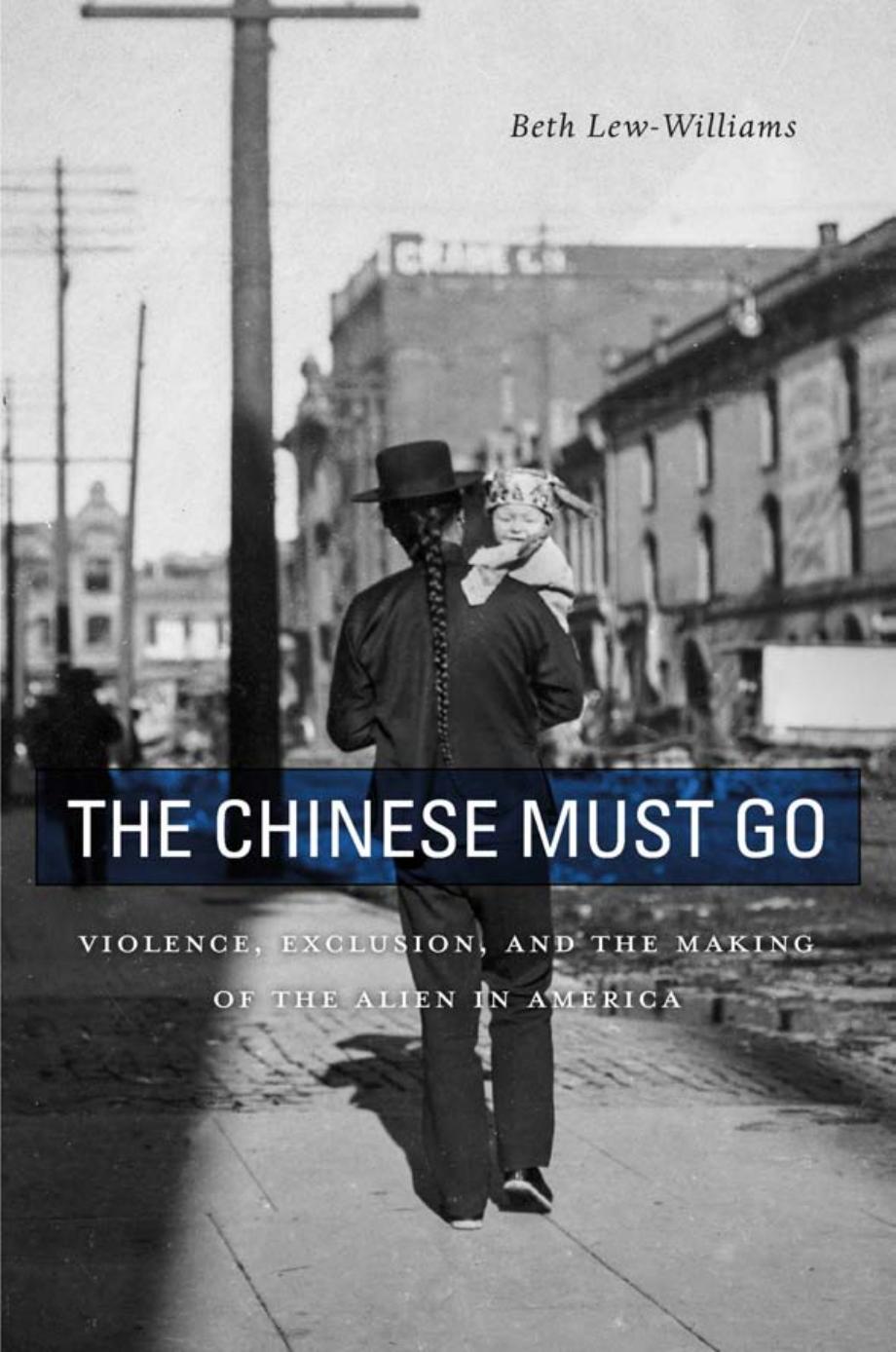
The Chinese Must Go: Violence, Exclusion, and the Making of the Alien in America
About this book
In 1885 and 1886, at least 168 communities across the American West drove out their Chinese residents. Beth Lew-Williams reconstructs these expulsions not as scattered prejudice at the edge of national history, but as organized violence with consequences for law, diplomacy, and the meaning of belonging in the United States.
The book moves among Chinese migrants facing removal, vigilantes demanding a white republic, and political and business elites worried about trade and disorder. Their conflicts link streets in Tacoma and mining towns in Wyoming to Congress and to negotiations between the United States and China.
Lew-Williams distinguishes restriction from the more durable regime of exclusion that followed. She argues that federal policy was shaped not only by racist ideas or electoral pressure, but by officials trying to contain white violence after local campaigns had made coexistence appear impossible.
Published by Harvard University Press in 2018, The Chinese Must Go is an archival history of how neighbors were made into aliens. Its scale is one of its strengths: local expulsions, national border law, and American power across the Pacific remain separate processes while their connections come into view.
Read a sample
5,214 words
Plain text
From the opening
WHEN CHINESE MIGRANTS arrived in the U.S. West in the 1850s, they were met with violence. They dodged rocks thrown by children as they labored in Sacramento, guarded against armed prospectors as they mined the rivers of Placer County, and fled angry mobs in the streets of Los Angeles.1 And while this violence did not arise every day or affect everyone, it was common enough to loom large over every encounter across the color line. The traces of this white-on-Chinese violence are at once ubiquitous and hidden in the historical record, overwhelming in their abundance and yet difficult to see. Even when records exist for a given incident, the particular nature of the violence is often obscured. Then, as now, it was hard to distinguish between interpersonal violence, which had little to do with color or creed, and political violence, which articulated vicious messages about race and nation.
Take, for example, the death of Hing Kee. On December 16, 1877, the Chinese laborer was murdered in his bed in the company town of Port Madison, Washington Territory. It was not a clean death. He was found with cuts to the fingers (suggesting a struggle), two cuts on the side of the head (deep enough to penetrate the skull), and a slit throat (inflicted by an “ax or cleaver”). The violence against Chinese workers in Port Madison did not end with this grisly killing; it was quickly followed by expulsion and arson. Within days, Hing Kee’s countrymen were driven out of town and the housing they had once shared was burned to the ground. In flight, these twodozen Chinese workers left behind their homes and livelihoods. But they carried with them, no doubt, the haunting image of Hing Kee’s body and the terror that they would be next.2
From this incident of violence and so many others, the only surviving account is a few paragraphs in the pages of a local English-language newspaper. But the Seattle Post-Intelligencer, even as it reported the crime, helped erase it from our historical memory of racial violence. Despite the brutality of the killing, the newspaper dismissed the crime as an act of larceny, emphasizing that the deceased was known to have been in possession of “a gold watch and some money.” To local white journalists, this was just another unfortunate act of personal violence in a society all too familiar with foul play. A brief investigation turned up nothing, so local authorities, along with the newspaper, declared the crime to have been committed by a “person or persons unknown.” When the remaining Chinese were “ordered to leave” Port Madison only days later, the newspaper did not report the expulsion as an act of violence, or even as a crime. Instead, it was “a solution” to the problem of Chinese labor, one tacitly endorsed by the editors.3
Curiously, on Christmas Day, the paper issued a correction and apology. It had failed to note that the superintendent of the mill company had ordered the Chinese to leave and the housing “pulled down, and the material afterwards burned.” 4 Who this retraction was intended to appease is unclear. Perhaps the correction was meant to insist to readers, especially those who read between the lines of print an untold tale of violence, that nothing nefarious had happened. After all, it was a company town so the company could do as it pleased. Or perhaps the paper simply wanted to give credit where credit was due. Either way, the effect was the same: this moment of racial violence was buried under layers of justification, obfuscation, and euphemism.
And then there was the anti-Chinese violence that never made it to print: violence that occurred behind closed doors, as mistresses beat on houseboys and johns assaulted prostitutes. There was violence that happened outside the bounds of white society, in the backcountry of the lumbering industry, along isolated railroad lines, or within the recesses of Indian reservations. But there was also plenty of violence in plain sight of authorities and news papermen, who simply chose to turn away. To white observers, the value of Chinese lives was so little, and the violence against them so abundant, that most forms of harassment seemed unremarkable.
For the Chinese, these incidents were, of course, far from banal. No one cared to record the migrants’ experiences at the time, but decades later a team of academics visited elderly Chinese who remembered the U.S. West in the 1860s and 1870s. Read together, the old-timers’ testaments of fear and abuse are relentlessly repetitive. “When I first came,” Andrew Kan remembered, “Chinese treated worse than dog. Oh, it was terrible, terrible. At the time all Chinese have queue and dress same as in China. The hoodlums, roughnecks and young boys pull your queue, slap your face, [throw] all kind of old vegetables and rotten eggs at you. All you could do was to run and get out of the way.” “O, I awful scared. I think we gonna get killed,” Law Yow recalled, “they stand on side throw rock, club, say God Damn Chinaman.” The slurs that most stayed with Daisy Yow were those of the white school children who called her “Chink,” “yellow face,” and “cheater.” As the white Americans lobbed objects and insults, the Chinese feared worse was to come. “Two or three times,” Andrew Kan testified, “I remember Chinese killed by mob in San Francisco.” In his memoir, Huie Kin wrote, “We were simply terrified; we kept indoors after dark for fear of being shot in the back. Children spit upon us as we passed by and called us rats.” “This make me very mad but what can I do[?]” Chin Chueng testified, “I can’t do anything.” From the abuse and their own feelings of helpless anger, the Chinese learned harsh lessons about a new country and their place within it. As Daisy Yow put it, “I think they feel that we are a very inferior race of people.”5
Continue reading the sampleClose the sample
The mid-nineteenth-century U.S. West saw the rise of anti-Chinese violence and an anti-Chinese movement, but they were not one and the same. A wide range of people, many of whom had personal rather than political aims, participated in scattered incidents of harassment and assault. In attempting to prohibit Chinese labor migration, a loosely organized political movement sometimes turned to violence but also relied on political lobbying, sandlot demonstrations, journalistic exposés, congressional petitions, third-party candidates, and union strikes. From the 1850s to the 1870s, anti-Chinese violence and anti-Chinese politics overlapped, fed off each other, and must have seemed indistinguishable to Chinese migrants. But in retrospect it is clear that racial violence, though ubiquitous, was not yet the mainstay of the anti-Chinese movement.
It was in these first three decades after their arrival that Chinese migrants, anti-Chinese advocates, and cosmopolitan elites established the terms of a debate that would continue into the next century. Though the anti-Chinese movement began almost as soon as the Chinese arrived, the campaign for Chinese exclusion did not find immediate success because its radical aim to halt Chinese migration had many detractors. While white Americans lamented the “Indian Problem” in the West and the “Negro Problem” in the South, they continued to be at odds over the “Chinese Question.” At the time, Native American and African American inferiority was considered a known problem in need of a solution, but Chinese migration represented uncharted territory. What did the arrival of Chinese migrants mean for America? And what should the federal government do about it? The Chinese Question proved difficult to answer, because it arose out of a fundamental conflict between distinct visions of America’s imperial future.6
In the nineteenth century, the United States expanded dramatically, extending its territory across the continent and its commercial interests across the Pacific. As Americans conquered and settled lands that would become the western states of the Union, they relied on capital expansion and diplomatic coercion to gain nonreciprocal access to Chinese territory, ports, and markets.7 While in many ways these were twin projects of American imperialism, the fraught issue of Chinese migration revealed the underlying tension between domestic and overseas expansion. Elite cosmopolitan expansionists saw Chinese migrants as integral to American penetration of Chinese markets, whereas working-class colonial settlers of the U.S. West saw the Chinese as an existential threat to their imagined free white republic.
Thus, the Chinese Question was not simply a question about race. The vast majority of Americans agreed that the Chinese were a distinct and inferior race, although they continued to quibble over the details. More fundamentally, it was a question about the nature of the American empire. Though they shared a similar belief in white supremacy, those who dreamed of overseas expansion saw its fruition in opening China for exploitation, while others invested in white settler colonialism saw its culmination in Chinese exclusion. How white Americans viewed Chinese migration depended, in part, on the scale they used to imagine their world. Comprehending these divergent worldviews, then, requires us to shift between scales.
There were times that this growing conflict became violent, but more often it remained in the realms of rhetoric and politics, as people on all sides voiced divergent dreams for America. The arrival of tens of thousands of Chinese migrants at mid-century thrust this seemingly intractable debate onto the national stage.
A Migrant’s Journey from China to California One of those migrants was Huie Kin, the third of five children born in a tiny, two-room farmhouse in a small village in the Taishan District of Guangdong (Canton) Province, China. His family had lived in the village for two hundred years, and Kin might have lived and died there if not for rumors of gold. In the 1860s a cousin returned from California, known locally as “Jinshan” or “Gold Mountain,” and recounted “strange tales of men becoming tremendously rich overnight by finding gold in river beds.” News of a gold strike at Sutter’s Mill in California quickly traveled to China in 1848. Within a year, 325 Chinese joined the gold rush, followed by 450 in 1850, 2,176 in 1851, and, suddenly, 20,026 in 1852.8
The talk of gold held power. Even as a child, Kin wrote many years later, he “knew what poverty meant. To toil and sweat year in and year out, as our parents did, and get nowhere.” He dreamed of crossing the “great sea to that magic land where gold was to be had for free.” At age fourteen, he summoned the courage to ask his father for permission to go, and for money to cover the cost. To Kin’s surprise, his father readily borrowed the price of the ticket, thirty U.S. dollars, from a wealthy neighbor, with his farm as security. “Probably [my father] had also dreamed of going abroad,” Kin hypothesized in his memoir, “but he was married and had a family on his hands. His son was plucky to want to go, and he might be equally lucky as the other cousins; then they would not have to toil and struggle any more.” If Kin struck it rich, the United States could mean salvation for the entire family.
Kin followed the same path that thousands of Chinese migrants took before and after him. In 1868, he traveled in a small boat or “junk” over the waterways of the Pearl River Delta, first to Guangzhou (Canton) and then to Hong Kong, carrying with him only a roll of bedding and a bamboo basket containing clothes and provisions. When he reached Hong Kong, he found a bed in the home of a friend or relative. There he awaited the arrival of an international steamship bound for America.9 When Kin left his village, he was part of a wave of predominately young, male, lower-middle-class migrants venturing out of Guangdong Province in search of opportunity. For generations, this same demographic group had left home to seek work in neighboring towns, provinces, or nations. Now with the help of new transportation lines, they crossed the Pacific. Except for a few merchants’ wives, servant girls, and prostitutes, Chinese women did not follow. Most men planned a temporary journey, to leave China only long enough to earn seed money to support their family in the future. This “sojourner’s mentality” arose from Chinese cultural traditions and religious beliefs that emphasized filial duties, but was reinforced by the conditions they found in America.10
When the day for departure arrived, Kin boarded a large sailing ship, powered by giant billowing white sails. He lined up on deck in front of the white captain for inspection and descended to his quarters below. Foreign vessels, mostly owned by American or British companies, first traveled north along the Chinese coast through the Formosa Strait and then took the westerlies across the Pacific. Most emigrants could not afford the thirty-to fiftydollar one-way ticket to the United States, so they borrowed the money (as Kin did) or used the credit-ticket system, signing contracts with Chinese brokers promising to repay the price of their ticket through their future earnings.11
Kin spent most of his journey on the lower deck, in the dark and crowded space between the top deck and cargo hold. There, Kin and his countrymen passed two months sleeping, gambling, smoking opium, and talking of the land they had left behind. Disease killed several passengers, including Kin’s eldest cousin who traveled with him. Their bodies were lowered overboard into a “watery grave” far from the land of their ancestors.12
When Kin finally disembarked in San Francisco, California, in 1868, he was tremendously relieved and excited. He remembered: “On a clear, crisp, September morning . . . the mists lifted, and we sighted land for the first time since we had left the shores of [Guangdong] over sixty days before. To be actually at the ‘Golden Gate’ of the land of our dreams! The feeling that welled up was indescribable. . . . We rolled up our bedding, packed our baskets, straightened our clothes, and waited.”13 When Kin arrived in the port of San Francisco, his appearance was as foreign as his language. He wore his hair in a long, braided queue and dressed in a loose shirt, wide-legged trousers, a broad-brimmed straw hat, and a pair of wooden shoes. As their ship docked, Kin and the other Chinese migrants entered a scene of loud confusion. Boatmen, merchants, draymen, customs officials, and spectators crowded onto piers strewn with baskets, matting, hats, bamboo poles, and other cargo. Kin remembered, “Out of the general babble someone called out in our local dialect and like sheep recognizing the voice only, we blindly followed and soon were piling into one of the waiting wagons.” Other Chinese migrants followed Chinese labor brokers on foot, walking single file with bamboo poles slung across their shoulders, to the Chinese quarter of the city. By the time Kin arrived in 1868, there were approximately 57,142 Chinese on the Pacific Coast.14
Kin remembered, “The wagon made its way heavily over the cobblestones, turned some corners, ascended a steep climb, and stopped at a kind of club house, where we spent the night.” The Chinese Six Companies, a mutual benefit organization established by community leaders in the United States, had dormitories where they housed newly arrived migrants until they found labor contracts or a relative came to pay their bill. Despite being an ocean away from home, the Chinese enclave had a familiar feel to the newcomers. Kin recalled, “In the [eighteen] sixties, San Francisco’s Chinatown was made up of stores catering to the Chinese only. . . . Our people were all in their native costume, with queues down their backs, and kept their stores just as they would do in China, with the entire street front open and groceries and vegetables overflowing on the sidewalks.”15 Kin had found a piece of home in this distant and exciting new land.
Kin may have dreamed of gold when he left China, but the Gold Rush was long over by the time he arrived in 1868, and he needed to find wage labor. First he acquired a job as the domestic servant of a white American family in Oakland, California. Even as a servant, Kin could make a wage that was unimaginable in China. He earned about thirty dollars a month, rather than the two to ten dollars he could have expected as a domestic in Guangdong. (In his home village, working as an agricultural laborer, he could have earned eight to ten dollars a year in wages.) Even after room and board in America, Kin could afford to send thirty dollars or more in annual remittances, a sum that was enough to purchase rice to sustain a small family for a year. Eventually, he could hope to earn enough wages and respect from his betters to buy into a Chinese restaurant, laundry, or store in America.
The ultimate dream was to become a wealthy elder, the sort of man who would loan money to the next generation of emigrants.16
To Kin, this was a personal journey with personal stakes. His success would mean rescuing himself and his family from poverty; failure could devastate them all. But in truth, Kin’s individual choices, and his eventual fate, were mediated and enabled by larger transformations in the Pacific world.17 Kin moved through a growing transpacific network of communication, trade, and diplomacy as he listened to his cousin’s stories, embarked on an American ship, and entered a Chinatown filled with people and goods. He traveled through a rapidly changing Pacific world and arrived in the United States during a long conversation on the meaning of his migration.
An Expansionist’s Dream for China and the Chinese For William H. Seward, Kin’s journey was an inevitable product of Ameri ca’s nascent imperial project in China. Seward, an antislavery Whig turned Republican, had an illustrious political career as governor of New York, a senator representing the same, and in 1860, a favorite for the Republican ticket (before he lost to Abraham Lincoln at the Republican convention on the third ballot). From 1861 to 1869, Seward served as secretary of state in the Lincoln and Andrew Johnson administrations. From his perch near the top of the federal government, Seward imagined America’s future on the largest scale, envisioning the young nation as the conduit between Western and Eastern civilizations.
For “near four hundred years,” Seward told the Senate in 1852, “merchants and princes have been seeking how they could reach, cheaply and expeditiously, ‘Cathay,’ ‘China,’ ‘the East,’ that intercourse and commerce might be established between its ancient nations and the newer ones of the West.” The discovery of America, he continued, was “ancillary to the more sublime result, now in the act of consummation—the reunion of the two civilizations.”18 Seward was one of a polyglot group of cosmopolitan expansionists: diplomats, traders, investors, and missionaries who believed that America’s destiny lay across the Pacific.
American dreams of the China Trade were as old as the nation itself. At the close of the Revolutionary War, U.S. merchants swiftly repurposed the privateer Empress of China into a trading vessel. These traders, and the many who followed, hoped to sell U.S. products to China’s vast population and buy valuable Chinese exports such as tea, silk, and porcelain. But U.S. traders could only gain limited access to Chinese markets. In 1757, the Qing (Ch’ing) Court had designated Guangzhou the only port through which Westerners could trade and severely curtailed business there. Even with these restrictions, Guangzhou and the southeastern province of Guangdong became the gateway through which Western influence began to penetrate China. Western imperialism sped the development of a market-oriented economy in the Pearl River Delta, as farmers grew more profitable crops such as oranges, sugar cane, and tobacco for trade, instead of local staples like rice.19
American and other Western merchants easily found domestic markets for goods imported from China but had trouble finding items of equal value to export to China. This trade imbalance continued until the British discovered that the Chinese would buy opium for recreational use and began transporting it in large quantities from India to China. American merchants, also eager to profit from drug trafficking, managed to control about 10 percent of the opium trade in the early nineteenth century. Fearing the spread of addiction, a special commissioner in Guangzhou in 1839 confiscated and burned approximately 3 million pounds of opium owned by British and U.S. traders. In response, Britain declared war on China. In the first Opium War (1839–1842), Britain fought both to legalize the opium trade and open China to Western influence. Capitulating, China surrendered the island of Hong Kong to Britain, along with access to other Chinese ports, and extraterritoriality for British subjects. Since China was eager to avoid conflict with another Western power, U.S. diplomats negotiated similar trade concessions from China.20 Through a series of unequal treaties signed over the next de cades, and their enforcement by Western militaries, China continued to lose power over its territory, economy, military, government, and society.21
Western commercialism and violence opened China but also set off mass Chinese emigration at mid-century. In the wake of the war, Guangdong Province was shaken by competition from foreign goods, poor agricultural harvests, the devastating Taiping Rebellion (1850–1864), and the subsequent rise of violent interethnic feuds. Guangzhou remained a busy and prosperous metropolis, but the surrounding districts and their workers benefited unevenly.22 As Western influence grew in China, the people of Guangdong began, like Kin, to hear more of the “Country of the Flowery-Flag.” American traders opened agencies in Guangzhou to coordinate their commerce, and through these local bases, interacted daily with Chinese laborers, interpreters, and merchants. American missionaries arrived on the traders’ heels, acquired at least a rudimentary knowledge of Cantonese, and began proselytizing to locals. Starting in 1862, Congress promoted these transpacific connections to Guangdong through a half-million-dollar annual contract with the Pacific Mail Steamship Company.23
Amid growing connections between Guangdong and the United States, news of the discovery of gold in California in 1848 quickly made its way to Guangzhou and rural regions surrounding the bustling port. Soon, Chinese men arranged passage to join other “forty-niners” in the mines.24 After the California gold fields ran dry in the 1870s, Chinese workers continued to journey to America. They fueled the rapid development of the Pacific Coast, performing the arduous labor necessary for an economy based on the extraction of natural resources: felling trees to build American railroads, clearing fields for white agriculturalists, and peddling vegetables to white miners.25 By 1880, the U.S. census counted 105,465 Chinese in the United States, 99 percent of whom lived in the West.26
To Seward and his allies, the arrival of tens of thousands of Chinese on America’s shores was unavoidable and perhaps beneficial. “The free migration of the Chinese to the American and other foreign continents will tend to increase the wealth and strength of all Western nations,” argued Seward, “while at the same time, the removal of the surplus of population of China will tend much to take away the obstructions which now impede the introduction into China of art, science, morality, and religion.”27 For the most part, cosmopolitan expansionists’ support for Chinese migration was not based on radical ideas of racial equality.28 Most white elites shared with white workingmen assumptions that the Chinese race was “inassimilable” and innately “servile.” Indeed, the very same racial traits that white workers loathed were prized by white elites. As traders and capitalists, they saw an abundant need for unskilled labor to extract natural resources and serve the leading households of the U.S. West. They assumed that the white working classes, as well as their own elite ranks, would benefit from this rapid development. As Senator Oliver P. Morton of Indiana explained, “Chinese labor has opened up many avenues and new industries for white labor, made many kinds of business possible, and laid the foundations of manufacturing interests that bid fair to rise to enormous proportions.”29 By taking the lowestpaid jobs, in Morton’s estimation, Chinese workers raised the status of white laborers and helped to bring prosperity to the U.S. West.
Viewing the Chinese as reserve armies of cheap and expendable labor, Seward optimistically claimed that the migration would only continue as long as recruitment did. “If . . . the people of the Pacific States need Chinese labor, they may safely encourage immigration,” wrote Seward, “when they cease to need it, the Chinese will cease to come to their shores.”30 Cosmopolitan expansionists saw a place for the Chinese in America as long as the migrants were temporary, subordinated, or (on occasion) assimilated.31
Protestant missionaries, adamant that the Chinese had the capacity to be saved, advanced the most inclusive vision for Chinese migrants. They argued that Chinese migration, and the racial uplift that would result, could speed their conversion efforts on both sides of the Pacific. In this fantasy, the “heathen Chinese” presented an unparalleled opportunity to fulfill the destiny of Christian America. Huie Kin had the fortune to cross paths with one such missionary, Reverend James Eells, who “loved the Chinese people and . . . believed that the best way to reach the Chinese people was through the Chinese themselves.” Reverend Eells tutored Kin in English, arranged his baptism, and guided Kin toward becoming a minister who could convert and Westernize his countrymen. Protestant missionaries held men like Kin up as proof that the Chinese could become American, but other cosmopolitan elites were not so sure.32
As American territorial expansion reached the Pacific and industrial expansion increased in the 1860s, U.S. leaders felt pressure to secure a new treaty with China that contained a clearer expression of its rights and privileges, which could expand the market for American goods.33 After decades spent reaping concessions won by the British navy and securing unequal treaties based on British models, U.S. diplomats like Seward questioned whether the United States could ever get ahead in the China Trade by simply following Britain’s lead. Seward secretly drafted a treaty based on a new vision of a cooperative open door in China. Instead of winning concessions and territory from China by force, as Britain had done, the United States would support Chinese territorial sovereignty in return for China’s commitment to allow all Western powers equal access to its markets. If Chinese markets were open to all, Seward believed that the Western power with the most commercial muscle and substantial friendship would pull ahead in the race for China.34
In 1867, the Chinese Imperial Court, in an unusual move, appointed Seward’s good friend and fellow U.S. diplomat Anson Burlingame to represent their interests. Having served as the U.S. minister to China, Burlingame now became the Chinese minister to the United States. China placed high trust in Burlingame and thought him better suited to navigate the intricacies of U.S. diplomacy than a Chinese courtier. The following year, Burlingame accompanied Chinese officials on a tour of the United States and adopted Seward’s treaty proposal. Seward and Burlingame agreed that the United States needed to “substitute fair diplomatic action in China for force” and use “sincere” “co-operation” with China “to win . . . respect and confidence.”35 Despite American misgivings about China’s “uncivilized” status, in 1868 the United States agreed to Seward’s treaty, which recognized China as “a most favored nation” and agreed to “free migration and emigration” between the two countries.36 Expansionists believed this new approach would open China to U.S. influence, expand missionary efforts to spread Christianity, and spur commercial efforts to Westernize China. The so-called Burlingame Treaty, and its premise of a cooperative open door, was unanimously ratified by Congress and hailed in the press as a triumph. So began a “special relationship” between the United States and China, born of America’s imperial vision but seeking Chinese goodwill.37
A Settler’s Nightmare of a Chinese Invasion California writer Pierton W. Dooner drew wildly different conclusions as he watched the arrival of Huie Kin and others like him. It was the beginning of the end of America. In the futuristic novel Last Days of the Republic (1880), he told a fictionalized history of Chinese migration to the West Coast, conjuring a dystopian future. Chinese differed from white Americans, according to Dooner, in “manners, dress, habits of life, religion and education,” but more important, “they were also incapable of assimilation, or of social intercommunication” and remain a “race alien alike to every sentiment and association of American life.” This rejection of American culture, in Dooner’s account, is intentional. Chinese migrants are harbingers of a planned invasion, organized by the Six Companies, with the aim of conquering the United States. Expansionists like Seward, who “never suspected the treachery that lay hidden,” are duped into advancing the Chinese cause through treaty negotiations.38
In his dark narrative, the white workingmen of California are the first to discover the surreptitious Chinese invasion of America. “Without stopping to consider treaty stipulations, or the rights of foreigners in our country,” he writes, “the whole of the citizen producing-class at once declared that the Chinese must go!”39 Although California workingmen beseech the government to protect the country, they cannot convince elites. The U.S. government allows the Chinese to naturalize, and with their citizenship comes America’s destruction.40 Soon, a quarter-million Chinese are enfranchised, and they elect their own countrymen to lead the nation. The white working class is driven into destitution and the institution of marriage crumbles, yet cosmopolitan expansionists will still not listen. When Chinese armies arrive in South Carolina, it is too late to save the union. By the end of the race war, “the very name of the United States of America [is] blotted from the record of nations and peoples” in favor of an “alien crown.” 41 Fantastical as Last Days of the Republic may seem, Dooner echoed racial ideology that was commonplace in the nineteenth-century U.S. West.42 An ethnically diverse group of American citizens (and aspiring citizens)— including unskilled and skilled workers, homemakers, and small businessmen—viewed the Chinese as an existential threat to their vision of a free white republic. While cosmopolitan expansionists were preoccupied by hopes of an American commercial empire stretching across the Pacific, these men and women focused on a smaller scale: America’s settler colonial project in the western states and territories. A representative of their ranks, Cameron King of San Francisco, explained to a congressional commission that it was “a selfish and short-sighted policy to allow this coast to be occupied by the Chinese” to advance the China Trade. “Our broad territory will in the future be demanded as a home of our own people,” he continued, “and should be preserved as the heritage of the generations to come after us.” Describing the Chinese as “filthy, vicious, ignorant, depraved, and criminal,” he maintained that they were “a standing menace to our free institutions, and an ever-threatening danger to our republican form of government.” King did not simply dislike the Chinese race; like Dooner, he believed that Chinese migrants endangered America’s westward expansion and, ultimately, the nation itself.43