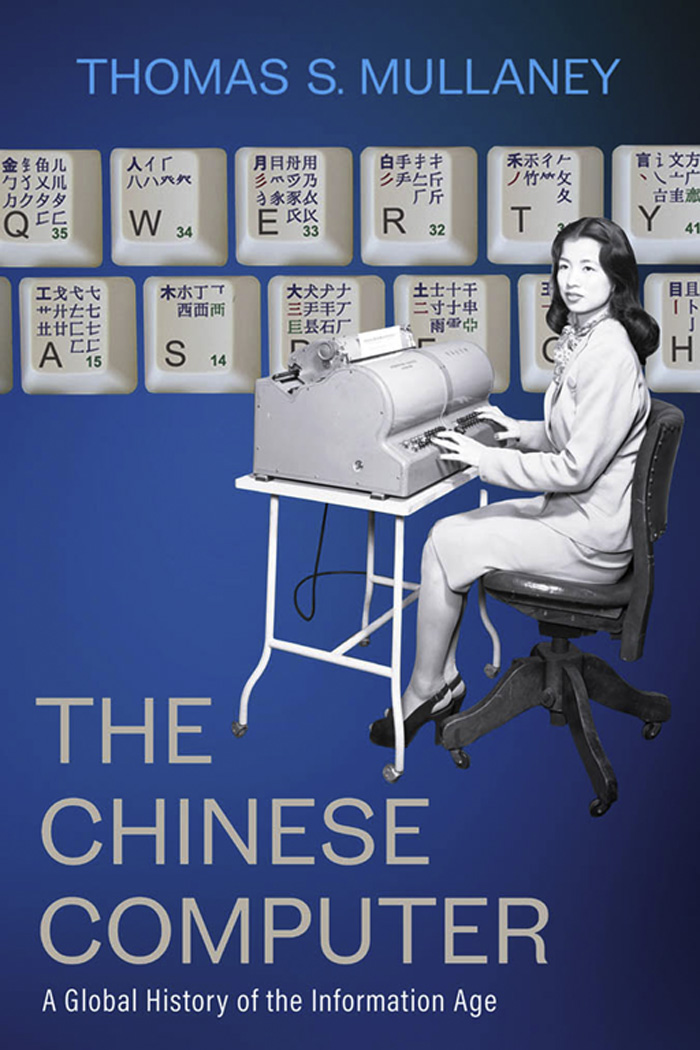
The Chinese Computer: A Global History of the Information Age
About this book
Modern computers appear to handle Chinese effortlessly. Thomas S. Mullaney asks how that became possible when early keyboards, character codes, printers, screens, and programming systems were designed around the small inventory of the Latin alphabet.
The answer runs through experiments that are now largely forgotten: women operating early IBM input systems, the Sinotype project, radical keyboard designs, character decomposition, competing input methods, and the emergence of predictive text. Chinese users did not merely adapt to the computer; their solutions changed what the computer could be.
Mullaney treats input as an intellectual problem as well as a technical one. Every method makes a claim about how characters relate, how memory works, and which actions should happen in a person's mind before a symbol appears on screen.
Published by the MIT Press in 2024, The Chinese Computer follows Mullaney's earlier history of the Chinese typewriter into the digital age. It replaces the familiar story of computing's smooth global spread with a history of negotiation, invention, and standards that were never culturally neutral.
Read a sample
5,078 words
Plain text
From the opening
Introduction: Chinese in the Digital Age
One billion Chinese speakers have been laid low by a strange new cognitive disorder.
They’re forgetting how to write Chinese.
That’s the rumor, at least.
Reports began circulating in the early 2000s, each following an eerily similar narrative arc. One moment, a person was competent, accomplished, often highly educated. A scientist. An entrepreneur. An author. The very next, they were schoolchildren, struggling to recall even the most basic Chinese characters.
They’d “lift the brush, but forget the character”: tibi wangzi, the expression went.1
Aphasia, some called it—a debilitating condition resulting in an inability to speak. Dysgraphia, others chimed in—aphasia’s cousin, for writing rather than speaking. A “strange new form of illiteracy,” still others suggested.2 No one could make sense of it, this epidemic whose pathology was so at odds with established medicine, its onset so sudden, that the story seemed stolen straight from the pages of science fiction.
“Character amnesia”—this is the label that stuck.3
Rumors gave way to sobering statistics: 98.8 percent of respondents in a survey from 2013 reported experiencing tibi wangzi, many on a daily basis.4 The entire country, it seemed, was in the grips of a bizarre “Chinese character crisis” (Hanzi weiji).5
The titanic scale of “character amnesia” was made only more worrisome by its perplexing behavior. It didn’t afflict people living at the fringes of society—the marginalized and impoverished, the way so many public health crises do. This one was stalking China’s elite, ruthlessly. The wealthier and more urbanized a person was, the more vulnerable. The greater their expendable income, the greater their risk of losing the ability to write.
A culprit finally revealed itself: digital writing. “Character amnesia” was most prevalent among those who used computers, smartphones, and tablets—any electronic device used to write Chinese with the aid of a QWERTY keyboard or a trackpad. One minute, a person entered steady streams of characters on a laptop or a mobile device. As soon as they powered down, though, it was as if their minds powered down, too.
How do we make sense of these astonishing accounts? Is it another case of moral panic in the digital age—whether concerns over “Textspeak,” emoticons, the decline of handwriting, or other matters of “language hygiene?” Or could it be that twenty-first century China is home to hundreds of millions of newly illiterate aphasics, or dysgraphic amnesiacs?6 If so, why don’t we find evidence of this crisis everywhere we look? A cratering economy? The collapse of higher education, perhaps? How, then, can China be one of the world’s most vibrant and wealthiest digital economies? How is it possible, moreover, that the Chinese-language internet is boiling over with activity, with an estimated 900 million internet users in mainland China alone, engaged in a frenetic, nonstop traffic in Chinese-language content?7 If China’s most connected, tech-savviest individuals are “incapable of writing” (a baseline definition of dysgraphia), who exactly is doing all this Chinese writing?
The Chinese Computer is the first history in any language about Chinese in the digital age. Grounded in more than fifteen years of research, it charts out the inception of electronic Chinese in the immediate wake of World War II, through its efflorescence in the present day. Based on oral histories, material artifacts, and archives drawn from dozens of collections across Asia, Europe, and North America, it’s a tale of eccentric and often brilliant personalities drawn from the ranks of IBM, the Central News Agency of China, RCA, MIT, the CIA, the US Air Force, the US Army, the Pentagon, the RAND Corporation, the British telecommunications giant Cable and Wireless, Silicon Valley, the Taiwanese military, Japanese industrial circles, and the highest rungs of mainland Chinese intellectual, industrial, and military establishments.
But this book does more than present a colorful cast of underdogs. It strives to explain six core dimensions of Chinese computing—six axioms that one must grasp in order to understand Chinese in the digital age.
To explore these axioms, we begin our journey in a winter-chilled auditorium in China’s Henan province, where a group of fifty-five talented digerati gathered in December 2013 during the very height of the “character amnesia” crisis. They came together, not to lament tibi wangzi, but to best their opponents in head-to-head competition: to take first place in a typing contest and secure bragging rights as the fastest computer keyboardist in China—and perhaps the world.
Continue reading the sampleClose the sample
The Six Axioms of Chinese Computing
ymiw2
klt4
pwyy1
wdy6
o1
dfb2
wdv2
fypw3
uet5
dm2
dlu1 . . .
A young Chinese man sat down at his QWERTY keyboard and rattled off an enigmatic string of letters and numbers.
Was it code? Child’s play? Confusion?
It was Chinese.
The beginning of Chinese, at least. These forty-four keystrokes marked the first steps in a process known as “input” or shuru: the act of getting Chinese characters to appear on a computer monitor or other digital device using a QWERTY keyboard or trackpad (figure 0.1).
Figure 0.1 Stills taken from a 2013 Chinese input competition screencast
Across all computational and digital media, Chinese text entry relies on software programs known as “Input Method Editors”—better known as “IMEs” or simply “input methods” (shurufa). IMEs are a form of “middleware,” so-named because they operate in between the hardware of the user’s device and the software of its program or application. Whether a person is composing a Chinese document in Microsoft Word, searching the web, sending text messages, or otherwise, an IME is always at work, intercepting all of the user’s keystrokes and trying to figure out which Chinese characters the user wants to produce. Input, simply put, is the way ymiw2klt4pwyy . . . becomes a string of Chinese characters.8
IMEs are restless creatures. From the moment a key is depressed, or a stroke swiped, they set off on a dynamic, iterative process, snatching up user-inputted data and searching computer memory for potential Chinese character matches. The most popular IMEs these days are based on Chinese phonetics—that is, they use the letters of the Latin alphabet to describe the sound of Chinese characters, with mainland Chinese operators using the country’s official Romanization system, Hanyu pinyin. (Pinyin phonetic input has not always been the most popular approach to Chinese input, however, a point we will return to shortly.)
With the first key depression—“C,” perhaps—IMEs such as Sogou pinyin, QQ pinyin, and Google pinyin begin to present the user with options. These “candidate” characters, appearing in a pop-up menu that follows along at the margins of the monitor, are ones whose phonetic values begin with “C,” such as chi (吃 “to eat”), cai (才 “only then,” among other meanings), or hundreds of other possibilities.
When the user depresses a second key—“H,” let’s say—the IME adjusts this list of candidates. It begins to present only those Chinese characters whose pronunciations begin with “CH” (eliminating the earlier possibility of cai but maintaining the possibility of chi). Once a user sees their desired character in the pop-up menu, one final keystroke—either the space bar, enter, or a number key—is all that’s needed to select characters and add them to the main composition window (perhaps the user’s desired term is chaoxi 抄袭, or “plagiarism”) (figure 0.2). Keystroke by keystroke, this is how Input Method Editors enable the use of a QWERTY keyboard to produce Chinese characters by means of alphanumeric symbols.9
Figure 0.2 Example of Chinese Input Method Editor pop-up menu (抄袭 / “plagiarism”)
This young man’s name was Huang Zhenyu (also known by his nom de guerre, Yu Shi). He was one of around sixty contestants that day, each wearing a bright red shoulder sash—like a tickertape parade of old, or a beauty pageant.10 “Love Chinese Characters” (Ai Hanzi) was emblazoned in vivid, golden yellow on a poster at the front of the hall. The contestants’ task was to transcribe a speech by outgoing Chinese president Hu Jintao, as quickly and as accurately as they could. “Hold High the Great Banner of Socialism with Chinese Characteristics,” it began, or in the original: 高举中国特色社会主义伟大旗帜为夺取全面建设小康社会新胜利而奋斗.11 Huang’s QWERTY keyboard did not permit him to enter these characters directly, however, and so he entered the quasi-gibberish string of letters and numbers instead: ymiw2klt4pwyy1wdy6. . . .
With these four-dozen keystrokes, Huang was well on his way, not only to winning the 2013 National Chinese Characters Typing Competition, but also to clock one of the fastest typing speeds ever recorded, anywhere in the world.12
In chapter 1, we confront the most basic, but also most profound, axiom of Chinese computing: ymiw2klt4pwyy1wdy6 . . . is not the same as 高举中国特色社会主义 . . . ; the keys that Huang actually depressed on his QWERTY keyboard—his “primary transcript,” as we could call it—were completely different than the symbols that ultimately appeared on his computer screen, namely the “secondary transcript” of Hu Jintao’s speech. This is true for every one of the world’s billion-plus Sinophone computer users. In Chinese computing, what you type is never what you get.
For readers accustomed to English-language word processing and computing, this should come as a surprise. For example, were you to compare the paragraph you’re reading right now against a key log showing exactly which buttons I depressed to produce it, the exercise would be unenlightening (to put it mildly). “F-o-r-_-r-e-a-d-e-r-s-_-a-c-c-u-s-t-o-m-e-d-_-t-o-_-E-n-g-l-i-s-h . . . ,” it would read (forgiving any typos or edits). In English-language typewriting and computer input, a typist’s primary and secondary transcripts are, in principle, identical. The symbols on the keys and the symbols on the screen are the same.
Not so for Chinese computing. When inputting Chinese, the symbols a person sees on their QWERTY keyboard are always different from the symbols that ultimately appear on the monitor or on paper. Every single computer and new media user in the Sinophone world—no matter if they are blazing-fast or molasses-slow—uses their device in exactly the same way as Huang Zhenyu, constantly engaged in this iterative process of criteria-candidacy-confirmation, using one IME or another. Not some Chinese-speaking users, mind you, but all. This is the first and most basic feature of Chinese computing: Chinese human-computer interaction (HCI) requires users to operate entirely in code all the time.13
How is this possible? With tens of thousands of Chinese characters, and a unique alphanumeric code for many if not most of them, how could Huang—or, more importantly, hundreds of millions of other Chinese computer users—be expected to memorize and deploy them all in real time? To answer this question, I venture back in the first chapter not to the 2010s, but to the 1940s and the earliest effort to build an electro-automatic Chinese writing machine: the IBM Electric Chinese Typewriter, invented by the Chinese engineer Chung-Chin Kao and prototyped by the International Business Machines corporation. On the keyboard of this unprecedented machine, as we will see, there were no Chinese characters at all. Instead, typists needed to input Chinese characters by means of a separate “primary transcript”—just like Huang Zhenyu—only in this case by using a series of unique, four-digit ciphers, one cipher for each of the more than 6,000 characters the machine was capable of printing. In this chapter, we will meet one of the first individuals to master this device: a remarkable woman named Lois Lew who, after a nearly ten-year-long quest to learn her story, I had the great fortune of interviewing.
If Huang Zhenyu’s mastery of a complex alphanumeric code weren’t impressive enough, consider the staggering speed of his performance. He transcribed the first 31 Chinese characters of Hu Jintao’s speech in roughly 5 seconds, for an extrapolated speed of 372 Chinese characters per minute. By the close of the grueling 20-minute contest, one extending over thousands of characters, he crossed the finish line with an almost unbelievable speed of 221.9 characters per minute.
That’s 3.7 Chinese characters every second.
In the context of English, Huang’s opening 5 seconds would have been the equivalent of around 375 English words-per-minute, with his overall competition speed easily surpassing 200 WPM—a blistering pace unmatched by anyone in the Anglophone world (using QWERTY, at least).14 In 1985, Barbara Blackburn achieved a Guinness Book of World Records–verified performance of 170 English words-per-minute (on a typewriter, no less). Speed demon Sean Wrona later bested Blackburn’s score with a performance of 174 WPM (on a computer keyboard, it should be noted).15 As impressive as these milestones are, the fact remains: had Huang’s performance taken place in the Anglophone world, it would be his name enshrined in the Guinness Book of World Records as the new benchmark to beat.16
Huang’s speed carried special historical significance as well.
For a person living between the years 1850 and 1950—the period examined in the prequel to this book, The Chinese Typewriter—the idea of producing Chinese by mechanical means at a rate of over two hundred characters per minute would have been virtually unimaginable. Throughout the history of Chinese telegraphy, dating back to the 1870s, operators maxed out at perhaps a few dozen characters per minute. In the heyday of mechanical Chinese typewriting, from the 1920s to the 1970s, the fastest speeds on record were just shy of eighty characters per minute (with the majority of typists operating at far slower rates). When it came to modern information technologies, that is to say, Chinese was consistently one of the slowest writing systems in the world.17
What changed? How did a script so long disparaged as cumbersome and helplessly complex suddenly rival—exceed, even—computational typing speeds clocked in other parts of the world? Even if we accept that Chinese computer users are somehow able to engage in “real time” coding, shouldn’t Chinese IMEs result in a lower overall “ceiling” for Chinese text processing as compared to English? Chinese computer users have to jump through so many more hoops, after all, over the course of a cumbersome, multistep process: the IME has to intercept a user’s keystrokes, search in memory for a match, present potential candidates, and wait for the user’s confirmation. Meanwhile, English-language computer users need only depress whichever key they wish to see printed on screen. What could be simpler than the “immediacy” of “Q equals Q,” “W equals W,” and so on?
In chapter 2, I answer this question by exploring a second axiom of Chinese computing: Even though Chinese human-computer interaction relies upon forms of mediation unseen in mainstream Anglophone computing, these additional layers of mediation can result in speeds that equal or surpass those of the seemingly “unmediated” world of what-you-type-is-what-you-get. Counterintuitively, the addition of mediation can lead to the subtraction of time.
To unravel this seeming paradox, we will examine the first Chinese computer ever designed: the Sinotype, also known as the Ideographic Composing Machine. Debuted in 1959 by MIT professor Samuel Hawks Caldwell and the Graphic Arts Research Foundation, this machine featured a QWERTY keyboard, which the operator used to input—not the phonetic values of Chinese characters—but the brushstrokes out of which Chinese characters are composed. The objective of Sinotype was not to “build up” Chinese characters on the page, though, the way a user builds up English words through the successive addition of letters. Instead, each stroke “spelling” served as an electronic address that Sinotype’s logical circuit used to retrieve a Chinese character from memory. In other words, the first Chinese computer in history was premised on the same kind of “additional steps” as seen in Huang Zhenyu’s prizewinning 2013 performance.
During Caldwell’s research, as we will see, he discovered unexpected benefits of all these additional steps—benefits entirely unheard-of in the context of Anglophone human-machine interaction at that time. The Sinotype, he found, needed far fewer keystrokes to find a Chinese character in memory than to compose one through conventional means of inscription. By way of analogy, to “spell” a nine-letter word like “crocodile” (c-r-o-c-o-d-i-l-e) took far more time than to retrieve that same word from memory (“c-r-o-c-o-d” would be enough for a computer to make an unambiguous match, after all, given the absence of other words with similar or identical spellings). Caldwell called his discovery “minimum spelling,” making it a core part of the first Chinese computer ever built. Today, we know this technique by a different name: “autocompletion,” a strategy of human-computer interaction in which additional layers of mediation result in faster textual input than the “unmediated” act of typing. Decades before its rediscovery in the Anglophone world, then, autocompletion was first invented in the arena of Chinese computing.
Why was Huang Zhenyu using a QWERTY keyboard in the first place? Given the profound challenge of “fitting” tens of thousands of Chinese characters onto a QWERTY keyboard, why didn’t computer engineers simply abandon QWERTY altogether and concentrate on designing a more uniquely “Chinese” interface—something that might have enabled Chinese computer users to bypass input altogether, and enjoy the same “unmediated” human-computer interaction as their Anglophone counterparts?
As we will see in chapter 3, this is exactly what engineers in the late 1960s and early-1970s tried to do—and for a time, they succeeded. The era’s rapid advances in computer processing opened new vistas for engineers across Asia, the United States, and the UK. Rather than attempting to build upon the initial promise of Sinotype and the QWERTY-based approach, they abandoned QWERTY entirely in a quest for what might be termed “immediate Chinese.”
The systems designed in this period were astonishing in their diversity. One of the custom-built interfaces we’ll encounter offered users 120 levels of SHIFT, as compared to the two found on standard QWERTY devices (i.e., lowercase and uppercase). Another interface featured a set of 256 keys, rather than the typical range of approximately 80 to 100 on Western-built machines. Another from this period offered upward of 2,000 keys. Still another employed a stylus and touch-sensitive tablet with which users could select characters directly from the input surface. Yet another dispensed with flat input surfaces altogether, opting instead to wrap a matrix of Chinese characters around a revolving, cylindric interface.
In addition to charting out this pivotal and poorly understood part of the timeline of Chinese computing, this chapter also serves as an important reminder: the IME has never been a revered technology, no matter its potential or proven track record. From its inception to the present day, input has tended to be understood as an inherently compensatory technology, one meant to assist or “work around” the challenges confronted in the computational processing of Chinese text. Despite the many achievements we will chart out in this history—up to and including blazing speed and efficiency—we must be cautious never to imagine that IMEs were somehow heralded as an “alternative modernity” or “competitor” to Western-style human-computer interaction. To the contrary, we will encounter throughout this time period—at times subtly, at times explicitly—the longing for a form of Chinese human-computer interaction that matched or approximated the revered “immediacy” of the English-language world.18 Input has almost never been anyone’s “first choice.”
From the late 1970s onward, the time period examined in chapter 4, custom-built Chinese interfaces steadily disappeared from marketplaces and laboratories alike, displaced by wave upon wave of Western-built personal computers crashing on the shores of Reform Era China (1978–1989). This resurgence of QWERTY—and with it, input—was not a return to the status quo ante, however. If the dawn of Chinese computing featured just a pair of input systems (Kao’s Four-Digit Code and Caldwell’s Sinotype code), the late 1970s and 1980s witnessed an explosion of competing methods—dozens, hundreds, and ultimately more than a thousand different IMEs. Huang Zhenyu and his competitors in 2013 were the great-grandchildren of this era, born into a world when it was second nature to have a wide array of IMEs at one’s fingertips. Indeed, even as Huang entered that cryptic alphanumeric sequence ymiw2klt4pwyy . . . into his computer, the key logs of the five dozen other competitors would have looked different.
This brings us to a fourth axiom of Chinese computing, and perhaps the most difficult to grasp: Chinese input is infinite. For every single Chinese character, there is an infinite number of input sequences that could be used to produce it—at least in theory.
To understand this bizarre “infinity-to-one” relationship, we need to return to Huang’s seemingly nonsensical alphanumeric sequence ymiw2klt4pwyy . . . , not just to grasp how it works but, more importantly, to recognize that this sequence was only one of an uncountable number he could have entered on his QWERTY keyboard to achieve the exact same text output. An infinite number of pathways could have all led to the same speech by Hu Jintao.
To delve in, “y-m-i-w-2” corresponds to the characters 高举 (gaoju) because, within the specific IME Huang was using—an IME known as “Five Stroke” or Wubi input—the keys “Y,” “M,” “I,” and “W” each correspond to a specific set of graphical shapes or pieces of Chinese characters. Within Wubi input, the key “Y” is assigned to eleven shapes in particular, one of them (亠) being the top-most portion of Huang’s intended character 高 (gao). By depressing the key “Y,” then, Huang was in effect telling the Wubi IME that he was in pursuit of a Chinese character containing that specific shape. As soon as he depressed “Y,” therefore, the IME began to present potential character matches in the pop-up menu.
Because the letter “Y” corresponds to ten other shapes as well, however, this initial set of character matches would have contained a great deal of noise. To disambiguate further, Huang then depressed the key “M”—which itself corresponds to a different set of fourteen shapes (including the shape 冂, also found within Huang’s intended character of 高, this time in the bottom half). By this point, then, the IME already had a great deal of information to go on, thus limiting the potential set of matches to only those Chinese characters containing both one of the eleven shapes corresponding to “Y” and one of the fourteen shapes corresponding to “M.” As the number of possibilities decreased dramatically, the IME refreshed the pop-up menu, and already started to “suggest” the character 高 to Huang, awaiting confirmation. Huang then continued the same process for the rest of the contest (figure 0.3).
For readers taken aback at the seeming complexity of Huang’s input string, prepare yourself for the real shock: Huang could have achieved the exact same text output by using a completely different alphanumeric input sequence. Within Wubi input, there is more than just one way to arrive at the same Chinese character. Meanwhile, had Huang chosen to use a different IME altogether (as many of his competitors did), his input sequence would have looked entirely different. And if, hypothetically, Huang just happened to be an inventor himself, designing his very own Chinese input method from scratch, he could have fashioned any one of a theoretically infinite number of ways to link a given alphanumeric “primary text” to the “secondary text” of President Hu’s speech.
Figure 0.3 The “Y” and “M” keys on a QWERTY keyboard with Wubi symbol markings
To understand how this can be so—how for any Chinese character, there can exist an infinite number of ways to input it—we need only scrutinize the logic of Wubi input a bit further. It becomes immediately apparent that although Wubi inventor Wang Yongmin chose to “set equal” the Latin letter ‘Y’ and the Chinese character component 亠, there exists no heaven-ordained law to tell us this must always be so. Likewise, there is no intrinsic property of the universe that tells us, for example, that “M” should equal 冂. All of these pairings of Latin letters and Chinese character components are arbitrary decisions. One could imagine entirely different ways of governing the relationship between the “primary transcript” of an input sequence and the “secondary transcript” of Chinese characters.
Contrast this with the computational inputting of English words, where convention dictates that there is one correct and accepted way to achieve a desired output. To input the word “electricity,” let’s say, we know to enter e-l-e-c-t-r-i-c-i-t-y. If I were I to enter “elctricity,” “electrcty,” “elec,” or otherwise, these would be either typos or abbreviations. By comparison, Chinese input system designers from the 1950s onward have developed over 1,000 ways to input the single Chinese character 电 (dian “electricity”). If using “Area-Position Code” input (Quwei ma), for example, the correct input sequence would be “2171.” Within “Taiji Code” input, the correct input sequence would be “NY.” Within “OSCO” input, “D79.” And the list goes on (see table 0.1).
Through the story of one engineer in particular—Zhi Bingyi, whose input system emerged out of his experience in a Cultural Revolution–era prison cell—chapter 4 examines how inventors in this period went on to design hundreds of different Chinese IMEs.
Putting aside Huang’s QWERTY keyboard for a moment, was there something else about his computer that distinguished it from ones used in the Anglophone world? And what exactly makes a computer “Chinese?” Is a “Chinese computer” any computer manufactured within the political boundaries of China or the Sinophone world? Do Chinese computers operate by some kind of alternate logic that sets them apart from computers built elsewhere? Is a computer “Chinese” only if developed by engineers who claim Chinese heritage? Was Huang’s computer uniquely “Chinese” in some way that cannot be discerned by the machine’s outward appearance?
Table. 0.1 More than two dozen of the thousand ways to input dian (electricity) using different Chinese IMEs
Inputting the Character 电 (dian) on a Computer
Using this Input Method Editor (IME) . . .
You enter . . .
Chinese Transalphabet
d i a n t m v v
Zheng code (Zheng ma) [郑码]
k z v v
Five-Stroke input system (Wubi shurufa) [五笔输入法]
j n v
Cangjie encoding (Cangjie bianma) [仓颉编码]
l w u
Beginning-and-End Sound-Shape Code (Shouwei yinxing shurufa) [首尾音形输入法]
d j f z
Double Stroke Sound-Shape input system (Shuangbi yinxing shurufa) [双笔音形输入法]
d j j m
Pinyin [拼音]
d i a n #
Stroke-Shape Code (Bixing bianma) [笔形编码]
6 0 11
Four Corner-Add Sound (Sijiao fuyin) [四角附音]
5 0 7 1 6 d2
Double Pinyin Double Radical Encoding System (Shuangpin shuangbu bianmafa) [双拼双部编码法]
d q t k
Yi input system (Yi shurufa) [易输入法]
r g d
Double Pinyin (Shuangpin) [双拼]
d m #
Area-Position Code (Quwei ma) [区位码]
2 1 7 1
GB Code (guobiao)[国标]
3 5 6 7
Shape-Meaning Three Letter Code (Xingyi sanma) [形意三码]
b 1
Weiwu Code (Weiwu ma) [唯物码]
亅 4 7
Fifty Character Element input method (Wushi ziyuan shurufa) [五十字元输入法]
l j d
Chinese Character Stroke-Shape Look-Up Encoding Method (Hanzi bixing chazifa bianmafa) [汉字笔形查字法编码法]
6 0
OSCO (Jianzi shima) [见字识码]
D D D D
Qian Code (Qian ma) [钱码]
d j m
Wubi zixing [五笔字型]
j n
Natural Code (Ziran ma) [自然码]
d m l o /
Shape-Describing Code (Biaoxing ma) [表形码]
l k k d
Public Code (Dazhong ma) [大众码]
d o w w
Hua Code (Hua ma) [华码]
d r z
Taiji Code (Taiji ma) [太极码]
n y
3F Code (3F ma) [3F 码]
; d
Cangjie [仓颉]
m b w u
Wubi xing [五笔型]
j t w
Graduated Four Corner (Cengci sijiao) [层次四角]3
x e
Internal Code (Neima) [内码]
B5E74
Ann’s System of Coding Chinese Characters
1060715
Basic Stroke input (Jiben bihua) [基本笔画]
1 0 4 66
Stroke Order Code (Bishunma) [笔顺码]
0 1 67
1. Tianjin City Zhonghuan Electronic Computer Company [天津市中环电子计算机公司], Chinese Character Encoding Manual (Hanzi bianma shouce) [汉字编码手册] (Tianjin: Tianjin City Zhonghuan Electronic Computer Company, 1982), 187.
2. Tianjin City Zhonghuan Electronic Computer Company, Chinese Character Encoding Manual.
3. Lin Shuzhen, Household Computer: Chinese Character Encoding Rapid Look-Up (Jiating diannao: Hanzi bianma sucha) [家庭电脑: 汉字编码速查] (Fuzhou: Fujian kexue jishu chubanshe, 1994), 16.
4. Lin Shuzhen, Household Computer, 16.
5. T. K. Ann [安子介], Chinese Character List A: Ann’s System of Coding Chinese Characters (Hong Kong: Stockflows Co., Inc., 1985), 14.
6. Tianjin City Zhonghuan Electronic Computer Company, Chinese Character Encoding Manual, 187.
7. Wang, Songping [王颂平], Complete Illustrated Guide to Stroke Order Code (Bishunma tujie quanji) [笔顺码图解全集]. Beijing: Zhongguo funü chubanshe [中国妇女出版社], 1998, 5.
In other words, if, on the outside, it looked the same as desktop machines found all over the world, was there something inside Huang’s machine—its CPU, perhaps—that made it uniquely capable of handling this highly complex form of textual input?
The answer to this question, as we will see in chapter 5, is both no and yes.
No, the computers in this competition were in no way different than Windows-compatible machines found in homes, offices, and schools elsewhere in the world. There was nothing specifically “Chinese” about them, inside or out.
In a historical sense, however, the answer is yes. In the twenty-first century, every mass-manufactured personal computer in the world comes equipped to handle Chinese IMEs of the sort examined here. Chinese IMEs come preloaded, in fact, with others available for download (often at no charge). Circa 2013, every store-bought desktop, laptop, and smartphone was “Chinese,” in the sense that they were capable of handling Chinese input and output.
This hasn’t always been the case, however. In fact, it is a remarkably recent phenomenon. During the early rise of consumer PCs in the 1980s, no Western-designed CPU, printer, monitor, operating system, or programming language was capable of handling Chinese character input or output—not “out of the box,” at least. For the better part of the history of computing, computing technology has been biased in favor of certain alphabetic scripts—none more so than the Latin alphabet. In the mid-twentieth century, for example, Western engineers determined that a 5-by-7 dot matrix grid offered sufficient resolution to render legible Latin alphabetic letters on monitors and dot-matrix printouts. To do the same for Chinese would have required engineers to expand this grid to no less than 16-by-16. In the 1960s, the development team behind ASCII (the American Standard Code for Information Interchange) determined that a 7-bit coding architecture and its 128 addresses offered sufficient space for all of the letters of the Latin alphabet, along with numerals and key analphabetic symbols and functions. Chinese characters, by comparison, would have demanded no less than 16-bit architecture to handle its more than 60,000 characters. And of course, long ago Western engineers piggy-backed on the preexisting typewriter keyboard, using the two-dimensional “shift” key to toggle between lower and uppercase letters (Chinese, of course, has neither an alphabet nor uppercase or lowercase).19 Whether in terms of character encoding, computer monitors, dot-matrix printers, programming languages, disk operating systems, input surfaces, optical character recognition algorithms, or otherwise, the early history of computing has, in many ways, been the story of one digital “Chinese exclusion act” after the next.20