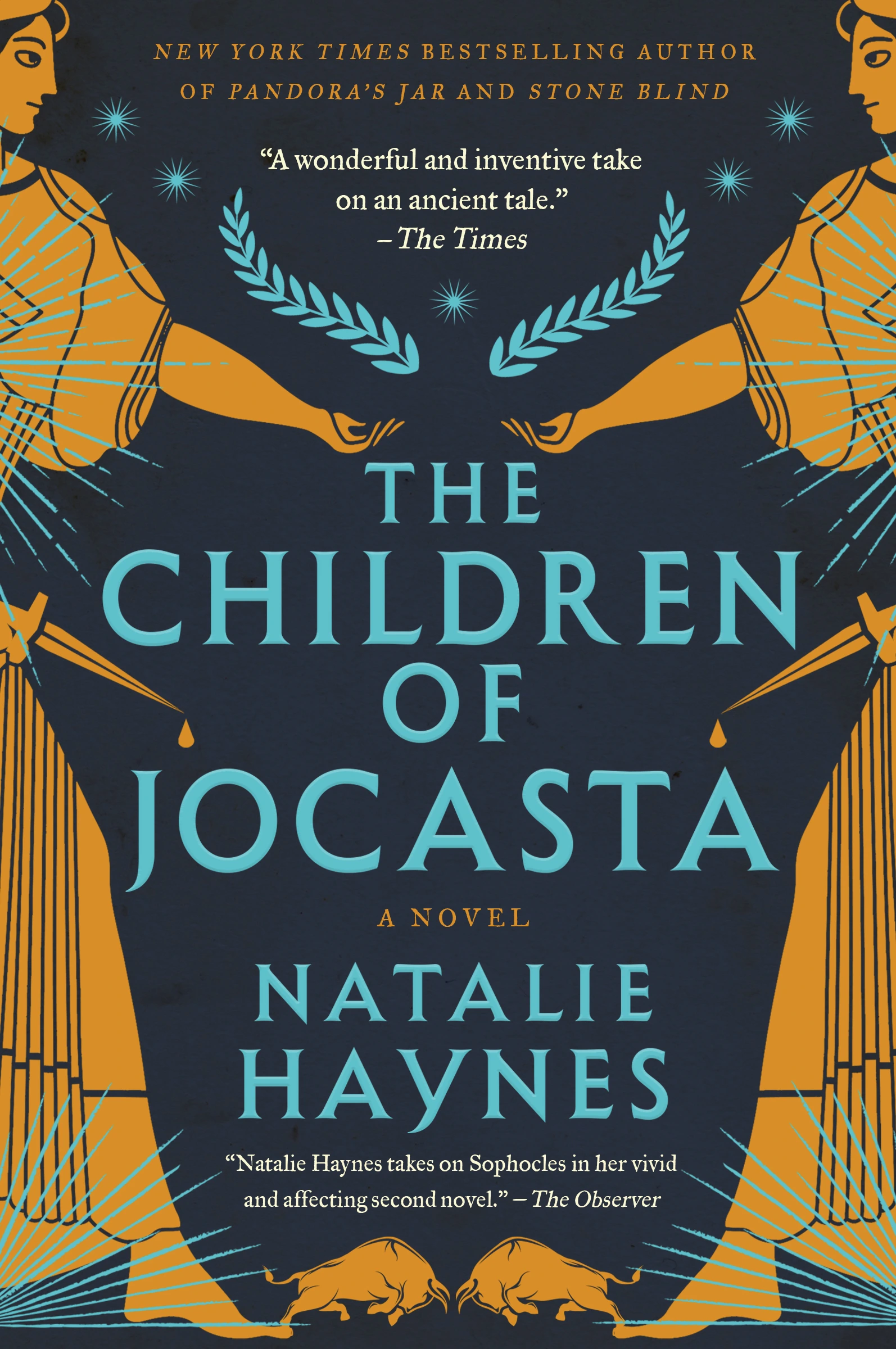
The Children of Jocasta
About this book
Two women encounter the royal house of Thebes at different moments in its history. The young Jocasta is married to an older king and learns how little truth the palace will offer her; years later, Ismene survives violence and illness while her brothers' rivalry pushes the city toward another crisis.
Their alternating stories move around prophecies, exposed children, disputed succession, and plague without granting any oracle a simple authority. Events known from Oedipus and Antigone emerge through partial knowledge, political need, family secrecy, and the explanations survivors construct afterward.
The Children of Jocasta combines two Greek tragedies into a novel about those required to live between their famous scenes. Natalie Haynes keeps the pressure of myth while asking how different the story becomes when Jocasta and Ismene are subjects rather than evidence in a hero's fall.
Read a sample
5,005 words
Plain text
From the opening
Prologue
The man looked across the room at his son, who lay shivering on the hard couch. He took a step towards the boy, thinking he would wrap a blanket more closely around him to coax the shivers away. But then he stopped, unable to persuade his limbs to repeat the actions they had carried out the day before and the day before that. He had kept his wife warm when the shakes ran through her; her body like an axe-blade, juddering in the trunk of a thick, black pine tree. And then he had kept his daughter warm until she too succumbed to the disease. What was it the washer-woman had called it? The Reckoning.
He felt his cracked lips stretch into a mirthless smile. What kind of a reckoning did the citizens of Thebes believe this to be? Punishment from the gods for a real or imagined slight? The temples rang out with the sound of prayers and offerings to every god, by every name. Most often they called on Apollo. Mindful of offending him, they addressed him by one name after another: Cynthios, Delphinios, Pythios, the son of Leto. Everyone knew that his arrows carried the plague on their immortal tips and that his aim was always true. But what possible grudge could the Archer have held against this man’s daughter, scarcely more than an infant? Or his wife, who had made her sacrifices devoutly with each new season? The god could not have resented her, but she had died all the same. Two days ago, he had carried her body into the streets himself, struggling with the weight not because his sickness-ravaged wife was heavy—she was sinew and bones, the skin hanging loosely from her arms—but because the plague had left him barely able to lift his own battered bones.
Carrying his daughter out the following day had been easier.
He looked over at Sophon again, and saw the convulsions ripple through his ten-year-old body. He felt a wetness beneath his eye and thought for a moment that he was weeping. But when he took his hand away from his face, he saw the raw crimson of fresh blood on his fingertips. The blisters were bursting, then. He had heard that men were losing their sight. Only a few heartbeats after he had silently cursed Apollo, he murmured a quiet prayer. Let me not go blind. A blind man was of no use to his young son. If the boy survived, he would not be able to take care of a blind beggar man. His prayers grew smaller: let me keep one eye, at least. One eye intact. And—they increased again without him noticing—let the boy live.
But should he really leave him to shake so? He had felt his own teeth drumming against one another when the shivering had consumed him a day ago. He worried he would bite through his own tongue. He paused, realizing that was not quite true; he had given no thought to his tongue when the fever rattled through him. Only afterwards, when the heat had broken and he lay spent on the ground, did he wonder how he had not injured himself. When the shakes came upon his wife, he had wrapped her up, and she had wrapped up their daughter. But neither had survived. He had placed all the blankets around them, so there was nothing left by the time he fell foul of the same cruel dance. Yet he was—so far—still alive. And so perhaps this was something he had learned about the Reckoning: it thrived in the heat. It might be driven out if it was denied warmth.
The boy moaned so softly that he wondered if he was hearing things. But he did not approach him, and he did not make him warm.
The Archer would take who he chose. But still, the man hoped—a tiny broken thing like a bird—that he would seek his prey elsewhere.
Continue reading the sampleClose the sample
1
Sixty years later
I didn’t hear him coming. I was in the old ice store, which lay at the furthest end of a forgotten corridor in a corner of the palace no one had used for years. Not since my parents were alive. My father loved ice, shaved with an iron pick from a block which dripped sullenly in this room, the thick walls protecting it from the constant sun which beat down on the white stone. How did it get here? I used to beg. Where did it come from? He would tell me a different answer each time: an angry river god had turned all the city’s water into ice one day, and no one had ever found time to defrost this last chunk. It was an egg left behind by a huge frozen bird. Then it was Thebes’s greatest treasure, and bandits had sailed across the oceans to invade the palace and seize it, like the Golden Fleece. This last story left me with nightmares of masked men, breaching one of the city’s seven gates, climbing to the high citadel—fearless as they ran beneath the mountain lions which were carved into the stone gateway, golden stones embedded into their eye sockets to ward off our enemies—trampling along the colonnades and rampaging into the courtyard where we lived. My mother told him to stop frightening me. So the next time I asked him, he made me promise solemnly that I wouldn’t tell her before explaining that he had won it in a bet with a Titan who now cursed his name. I shouldn’t be afraid of him, though, because he was fully occupied holding the weight of the sky upon his shoulders.
After my parents died, my uncle Creon had the palace extended and rebuilt. It needed to be more secure, he said, and grander. He added rooms and whole levels above the ground floor, so my home towered above every building in the city. The palace sat on the highest hill, and now it was the highest building too. Creon also insisted that the royal residence should no longer be kept ever-open to the city and her citizens, as my mother had liked it. There must be a space between us and them; we needed doors which could be bolted shut each night. Lessons had to be learned. And while all these works were being carried out by teams of efficient and almost silent slaves, he decided this corridor might as well be abandoned. He didn’t care for ice, the way my father did. So once the building works were completed, this room was no longer used for anything: it was too far from the new kitchens to be practical.
But it made a perfect place to read, on a bristling hot day. The light spilled in from two small slits, high up on the north- and east-facing walls. And with the door open onto the half-walled corridor outside, I could easily read the parchment roll I had taken from my tutor’s office yesterday. I would return it as soon as I’d finished, like I always did. He didn’t mind, so long as I placed it back on his dusty shelves in the exact spot from which I had removed it. I had learned to blow the dust across from either side to cover the tracks my fingers left on the wood. His eyes weren’t as sharp as they used to be. The manuscript would be back in its place before he even noticed it was gone.
I often lost track of time in this room, which was one of its many advantages. The long days of summer were so hot and bright and dull. My uncle liked to say girls all across the city, across Hellas, wished to be in our place. But they must have imagined our lives to be other than they were, because no one would cherish these empty days. I longed to go down to Lake Hylica and swim with the frogs and the fish. But there was no one to go with, and I knew my sister would be annoyed if I took the maids with me. What if she needed them to help her change her dress or rearrange her hair? We couldn’t all run around the palace like barbarians, she would say, not for the first time. I could almost imagine her petulant lower lip, protruding in annoyance at something I hadn’t yet done.
The light only entered the ice store through thin strips, so it was easy to lose track of where the sun was in the sky. I would usually leave when I’d finished reading, or when I was hungry, or sometimes when I heard Ani or Eteo calling for me. They always knew that if I wasn’t at lessons or in the courtyard, I’d be here. But no one was calling for me that day. It was always quiet in the palace in summer; anything important would be taking place in the public square at the front of the building. Perhaps that’s what made me stand up and press my aching shoulders against the cool stone wall behind me. It was so quiet, I must have begun to think I was supposed to be wherever the rest of the palace’s inhabitants were.
I heard his footsteps, I think, but I wasn’t afraid. He wasn’t walking like someone who had something to hide. I could hear heels striking the ground, a measured, easy pace. It didn’t occur to me to be worried. Even so, I stashed the roll of parchment under my arm, in case it was my tutor, and covered it with the fine cloak I shrugged over my shoulders. I knew it wasn’t his walk, though: he favours his right foot and drags the left one slightly. ‘An old injury’ is all he ever says if you ask him why. His eyes are dark and hooded, and they change if he doesn’t want you to pursue something. The light disappears from them, and the subject is closed.
I walked out into the corridor, and the temperature rose pitilessly. Even wearing my thinnest cloak—a pale fawn colour, made of flax—I was too hot out here. I wished I could just wear a simple tunic, as I did when I was younger. But if my uncle caught sight of me dressed so informally, I would be in trouble. I could feel the sweat forming behind my ears and at the base of my spine. I almost turned straight back into the ice store. But I had decided I should go and find my siblings, so I kept walking.
With the increase in temperature came other reminders of the world outside the palace: grasshoppers scratching away beside the walls, darting sparrows chattering in their nests. Usually, a man with a long broom sweeps away the birds’ nests from the walls, because their morning clamour irritates my uncle. But for some reason, they had been overlooked this year, and they chirruped away, gleeful at their reprieve. If the mountain eagles heard them, the sparrows would lose their fledglings.
The corridor twisted round to the left and then the right before it opened out into the family courtyard. My eyes were watering at the sudden brightness after the twilight of the ice store. I blinked away the tears and then licked them from my top lip. I realized I was thirsty; perhaps that was what had driven me out of my quiet corner. It must be Eteo I could hear, I thought, coming down the corridor to find me. Although he would surely be busy with his advisers at this hour. But the stride was much too long for Ani, and anyway, her shoes don’t have those hard leather soles that slap the stones as you walk.
I followed the corridor around to the left, and saw the shadow of the man along the ground. Not Eteo, then, because this man was wearing a long cloak, and Eteo would be in nothing more than a tunic on a day like today. I heard a strange, metallic sound I half-recognized. And then I walked around the second corner and when he caught sight of me, the man stiffened, as though he were suppressing alarm. I had heard him, but with my feet bare, he clearly hadn’t heard me. I was about to greet him when I realized his face was almost entirely covered, like the bandits of my nightmares. Only his eyes were visible: he had swathed the rest in a thin white fabric.
I tensed my arm against my side, to keep hold of Sophon’s scroll. Behind the veiled man, I could see the courtyard, but it was empty. There was no sign of my siblings, my cousin, my uncle. I took a breath and decided I would rather run past him than walk. I am the second quickest of all of us: much taller than Ani, and Polyn—my oldest brother—would never deign to engage in a race with his little sister, so I would win against him by default. Only Eteo, with his long, lean physique, could outrun me, though my uncle would be horrified if he ever saw me hitching up my tunic to give my legs free rein. And when Eteo was busy with matters of state, there was no one I could prevail upon to accompany me somewhere quiet and spacious enough to sprint. So I was out of practice, but I still trusted my speed. Once I was in the courtyard, I could raise an alarm that a stranger was present in the family quarters. The household slaves must be somewhere nearby, surely.
I pushed my toes into the stone beneath my feet. I must have left my sandals in my room this morning: something else which would provoke my uncle to raise a weary eyebrow if he saw me. I pressed forward and almost skittered past the man, but he stepped suddenly to his right, and I clattered into him. I felt a sharp jab under my ribs. He must have slammed the wooden end of the parchment roll into my side. I winced and said reflexively, ‘I’m sorry.’
We were the exact same height, so our eyes met for a moment: his were a watery sort of grey, with two brown specks in the right iris. It made it look like a bird’s egg. I should keep running into the courtyard, I thought, and then out the other side, and through to the next square where my brothers and my uncle would be. I could return the manuscript to Sophon and apologize for taking it without asking. He wouldn’t mind. But even as I was thinking this, it occurred to me that perhaps my legs wouldn’t carry me as far as the second courtyard. I was standing in the beating sun, but I was cold. The man looked past me for a second, though there was no one behind me, then his eyes met mine. Wordless, he turned and walked away. I thought perhaps I might sit on the ground for a moment.
I took a few more steps and fell to my knees, just before I was fully in the courtyard. A girl I didn’t recognize—the daughter of one of the house slaves, I suppose—was coming out of a bedroom, carrying a tray. The noise of me falling—my thick silver bangle crashing onto the ground—made her turn and she screamed, dropping what she was carrying everywhere. Hollow wooden things, cups maybe, or bowls. I heard them bounce and crash across the warm grey slabs. I hissed at her to be quiet, but she was too far away and besides, she was making so much noise herself, she wouldn’t have heard anything I said. The light was so bright, it made me want to close my eyes. I saw the shadows of birds flying across the square, but I couldn’t raise my head to see the birds themselves.
After a long time, or perhaps no time at all, I heard voices, but they all sounded strange, distorted as though I was hearing them underwater. I blinked but my eyes wouldn’t quite focus: there were guards and servants, and then my brothers, everyone running towards me. They were shouting—I could see from their flushed faces—but I could barely make out what they were saying. It sounded like, ‘They’ve killed her.’
Killed who? There was only one person left in my family who they could possibly mean: my sister, Ani. Please don’t let it be Ani, I thought. However much we argue, I can’t lose her too. Please.
The last thing I remembered was looking down to see that Sophon’s manuscript was completely ruined, covered in something sticky and red. I would have to apologize. It would be hard to replace. And then, of course, I realized they meant me. Someone had killed me.
2
As the pain coursed through her body, threatening to split her apart, Jocasta clawed at the bedclothes beneath her. If she could just get some air into her chest, she told herself, everything would be alright. Her lungs felt like an empty wineskin, trampled beneath a drunken soldier’s boot. Yet she couldn’t stop screaming for long enough to breathe. She felt Teresa’s hand grabbing her own hard enough to squash the bones together. The secondary pain was so unexpected, she turned to look stupidly at her crushed hand.
‘Breathe in,’ said Teresa and counted her to four. ‘And now out again.’ The two of them counted the breaths, together but apart, because although Jocasta needed the older woman’s help, she also knew it was all Teresa’s fault that she was probably about to die, and she found that hard to forgive.
It had been Teresa’s idea for the old king to marry. The city had gone too long without knowing its future. People were worried. If the king died without a son (even a daughter would be better than nothing), what would happen to the citizens of Thebes? They needed stability. Everyone agreed, the city had endured enough since the Reckoning had devastated them years before.
And it was strange, people said as they went about their business, that the king lived in a huge palace with courtiers, housekeepers, guards and cooks, but no family. He was past forty, past fifty almost: his habit of riding out into the mountains for weeks on end with his men—hunting deer or wild boar with their nets and short spears—was no longer as forgivable as it had once been.
Jocasta wasn’t told how she was chosen. The whole thing must have happened so quickly: a group of men in a room lit by smoky candles, drawing lots to decide whose daughter would be elevated to royalty. One day, she had been at home—her parents’ home, as she would soon learn to rename it—sitting in the women’s quarters, thinking about very little. Five days later, she was standing in the public courtyard of Thebes’s palace before an altar hastily dedicated to Ox-eyed Hera, pledged by her father to a man she had never met, before the eyes of a goddess who had ignored her prayers. She had no idea her father was considering marriage for her so soon, having expected to be at home for another year or two, at least. She was a dutiful daughter, careful at weaving and the other household skills her parents encouraged her to acquire. She would make a good wife. But surely not yet.
Her parents had acted with extraordinary haste. Jocasta felt foolish: she should have known what they were like. How else had they survived the Reckoning? Her father had a unique gift for profiting from situations that would fell lesser men. He had always been conscious of his standing: he was rich but he had earned his wealth, rather than inheriting it. Still he had earned plenty, and bought slaves enough to build a large house on the northern side of the city. It was not the most fashionable street (too far from the palace for that), but it was airy and the house was a grand stone affair, with the women’s quarters tucked away behind the building’s forbidding gates. His wife had slave women to do her weaving for her, though she still prided herself on the fineness of the cloth she used to make.
The particular pain of his behaviour this time came from the realization that he must have considered Jocasta—his only daughter, his first-born child—as nothing more than another problem waiting to be solved. It was one thing to be disliked by her mother—who had never tried to disguise the irritation she felt for her daughter—but another thing altogether to be rejected by her father, when he had always made her his pet, as if consoling her for her mother’s indifference. After Jocasta’s wedding—when she tried to defend him in her mind, so she could look back on some parts of her childhood fondly—she gave him credit for the fact that any father would be proud to marry his daughter to the king. Though she knew he had not thought about her, or what she might want, at all. Still, what man wouldn’t seize a marriage connection to the king? And what father would jeopardize such a connection on the whim of his daughter? None. But he should have known she would have done whatever he had asked, if he had only asked. Instead of which, he organized the whole thing without telling her. The only possible explanation for such secrecy was that he knew how she would feel when she found out, and it saddened her that he had known but not cared.
He was a little drunk when he came home that night: the men had been drinking their wine too strong. Whoever had been master of the grape—pouring it into the krater and mixing it with insufficient water—had intended them all to get drunk before the flute-girls arrived. Jocasta preferred the euphemism to the word she heard her mother hiss: whores. But now she could hear her father whispering to her mother, who let out a sudden squawk of delight before the two of them began to laugh. Like children, she thought, in annoyance. She heard her brother murmur in his dream, and wondered if he would wake up. But as she stared across the room in the dim light, willing him back to sleep, he rolled over to face the wall and his breathing levelled out once again. She moved her head slightly, trying to hear what her father was saying. But she couldn’t quite make out the words.
Would it have made any difference if she had? Would she have argued with him? She did that anyway, when she found out the next day, but it had no effect. Everything was already arranged, and there was nothing she could do. Would she have run away in the night, if she’d known sooner? Where could she have gone? Thebes wasn’t a large city, and her father knew everyone in it. Would she have tried to escape from the city altogether? But how would she have made it through any of its seven gates, all of which were guarded? She had never thought of herself as a prisoner behind the city walls. But that was only because she had never wanted to leave before.
Still, when she asked them the next day what all the fuss had been about, she wished she had known sooner. Her father smiled luxuriantly, his pleasure slowly revealing his yellowing teeth, greying now at the gums.
‘I have done the best deal of my life,’ he told her. ‘And you are to marry the king.’
The second sentence was so incongruous following the first. She had been waiting for him to say that he had discovered a new trading partner in the Outlying, Theban slang for Boeotia, the territory outside their beloved city, or to produce some rhyton that he had bought from a shipping merchant: her father loved the most ornate drinking cups. His favourite was a pointed vessel made from rock crystal, with smaller polished green crystal beads, wrapped in twists of gold, for a handle. She felt her face rearrange itself, from congratulatory to perplexed.
‘What do you mean?’ she said.
‘King Laius needs a wife,’ her mother explained, condemning herself forever in her daughter’s eyes. ‘You’re very lucky.’ Her father nodded.
‘The king is an old man,’ Jocasta said. ‘He must be more than fifty years old.’
‘Half-dead, then,’ said her father, his eyebrows raised in a parody of amusement. ‘He’s only ten years or so older than me, you little brat.’
‘So why would I want to marry him?’ she continued. ‘Instead of someone who isn’t older than my father?’
‘Sometimes,’ her mother sighed, ‘I think you take pleasure in being wilfully obtuse. I really do. So let me explain to you in words that even your little brother would understand: Thebes needs a powerful king. Laius is getting older, and people are growing nervous. What if something happens to him when he’s away from the city? What then? The Elders will fight to succeed him. The city could fall into chaos.’ She reached over to Jocasta and grabbed her shoulder, next to the fabric knots which formed the top of her daughter’s tunic. She allowed her nails to rest on Jocasta’s skin. ‘That can’t happen,’ she said. ‘The king needs a son. And, before that, he needs a wife, a young one, who could act as regent until the child comes of age, if something happened to him.’ She shook Jocasta’s shoulder with each alternate word. ‘And that is going to be you, because your father is clever and lucky, which is exactly why I married him. Do you understand?’
Jocasta nodded, and her mother let go of her arm. ‘It’s an honour, you ungrateful little bitch. You’ll be queen of the city. So run along to the temple of Artemis and dedicate your doll. And do it nicely, so she doesn’t curse you, as you deserve.’
The ritual should have been only a part of Jocasta’s proaulia: the time between betrothal and marriage when a bride prepared herself for her new life, but there was little time (and, on Jocasta’s part, no enthusiasm) for more. When Jocasta was born she had been given a small clay figure of an Amazon girl, wearing brightly patterned leggings and a tunic top. She had played with it so much that the paint had rubbed away, only the odd fleck of red or green remaining from what had once been a parade of colour. The doll’s left eye was still black, but the paint on the other had cracked, allowing the faded orange terracotta to show through. But married women could not have toys: she must take her doll to the temple and dedicate it to Artemis, praying for the goddess to give her strength, like the warrior woman. After the dedication, the next temple she would enter would be sacred to Hera. Artemis would have no time for her once she was married.
Traditionally, a girl’s family and friends accompanied her when she offered her doll to the Virgin Goddess. It should have been a party, a feast, an occasion for joy. But Jocasta’s parents were too angry with her—and she with them—so she went alone, save for the slave girl who followed two paces behind her, to the temple only a few streets away.
She placed the doll in a small brown leather bag and walked quickly along the dusty road, her feet reddening from the dirt that clung to the bottom of her shift. The rain would not come again for another month at least, and the sharp-pointed acanthus leaves at the side of the road were beginning to droop in the heat. She hitched her skirt up a little into her belt, but the disapproving stare of an old woman sweeping the steps outside a nearby house made her blush and drop it back to graze the dust once again. The temple would be cool inside, and she climbed the steps grateful to escape the glaring afternoon heat beneath the grand columns that ran along the front. She turned to her mother’s slave and told her to wait in the shade beneath the temple portico.
Jocasta stepped inside and blinked into the darkness, but no one else was present. She took the doll from her bag and walked up to the large statue of Artemis—her serene face expressing mild pleasure in holding her bow and arrows—feeling oddly self-conscious. She knew she should issue a formal prayer as she left her toy for the goddess, but with no priestess to help her, she couldn’t find the words. So she placed her doll carefully at the divine foot, propping it up against the cold stone. She murmured, ‘Keep me safe,’ and turned to go. As she walked through a shaft of sunlight, her eye was caught by an angry red weal on her shoulder. Her mother’s thumbnail had broken the skin, and when she raised her arm she saw four more gashes—the skin around them pink and inflamed—on the back of her shoulder.
She stopped and knelt on the ground, not wanting to go home again while her mother sat in the women’s quarters, emanating spite. Her brother would be at lessons with his tutor, and her father would be in the market square, clutching the hands of florid men as he accepted their congratulations. She could see the gold rings which pinned back the flesh of her father’s fingers, so they spilled fatly above the metal. He would consider this a very good day.