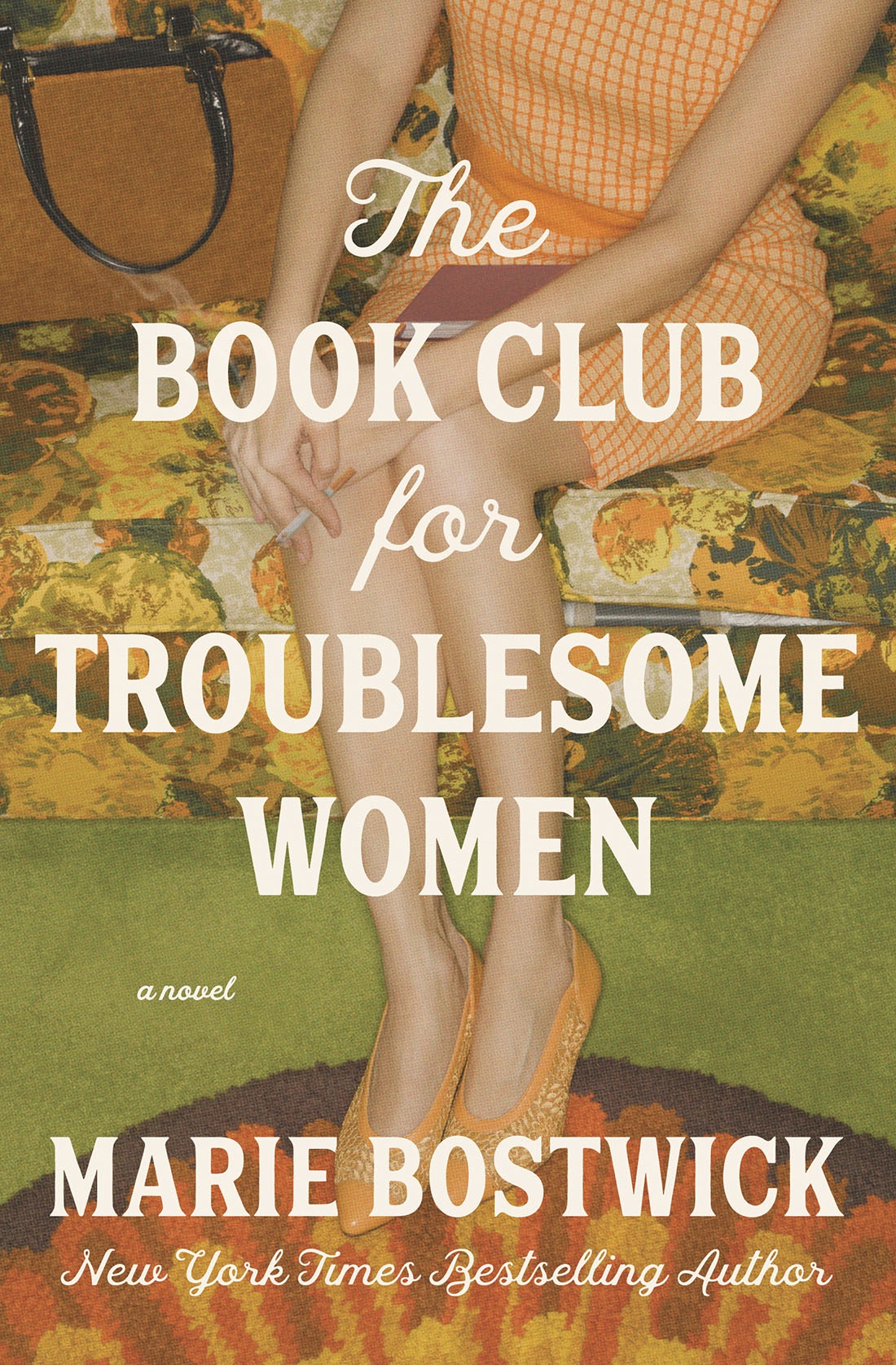
The Book Club for Troublesome Women
About this book
Margaret Ryan lives in a newly built Virginia community where appliances, tidy lawns, and a successful husband are supposed to constitute fulfilment. Reading The Feminine Mystique gives a name to dissatisfaction she has been trained to regard as private failure.
She forms a book club with Charlotte, Viv, and Bitsy, neighbours whose homes conceal different pressures involving work, marriage, race, ambition, and motherhood. Their reading list becomes a protected place to compare experience rather than accept the official description of their lives.
The women’s changes are gradual and uneven: opportunities carry economic and family costs, and friendship does not erase the period’s limits. The novel is most interested in the moment when an individual grievance becomes shared knowledge.
The Book Club for Troublesome Women is historical fiction about second-wave feminism at household scale. Marie Bostwick uses books as catalysts, while keeping the real transformation in the conversations and practical alliances they make possible.
Read a sample
5,053 words
Plain text
From the opening
Chapter 1 Members of the Club
March 1963
On a Wednesday morning in March 1963, twenty-five miles and yet a world away from the nation’s capital and the rumblings of change that were beginning to be felt there, in a northern Virginia suburb called Concordia, so new that the roots of the association-approved saplings were still struggling to take hold, and so meticulously planned that when the first wave of residents moved in the year before, the shops, library, and church opened on the very same day, as if God smote the ground and a fully formed suburb had erupted from the crack, Margaret Ryan stood in a sunny kitchen with appliances and matching Formica countertops of egg-yolk yellow, trying to decide what to serve the three women who would be coming to the first meeting of her new book club.
Beth Ryan, eleven years old and the eldest of Margaret’s three children, peered over her mother’s shoulder, shaking her head at the small mountain of recipes Margaret had torn from her extensive collection of women’s magazines.
“Why so many? Why not bake oatmeal cookies and be done with it like any normal mother?” Beth snatched a recipe clipping from the stack. “Anchovy and cream cheese canapés? If that’s dinner, I’m eating at Melanie’s.”
Every family has its smart-ass. Beth was theirs.
With her strawberry-blond hair and enviably long lashes, Beth was the image of her father. But her cheek was pure Margaret, and a payback, Margaret was sure, for the sins of her youth. When her own mother was still alive, she had cursed Margaret countless times, saying, “When you grow up, I hope you have a daughter that’s as fresh as you are. Then you’ll know.”
Now she did know, and it wasn’t so bad. Margaret liked that her daughter knew her own mind and wasn’t afraid to speak it. It was an underappreciated quality in women, one that often faded with age.
At age seventeen, Margaret had sworn that she would grow up to be nothing like her mother. After a promising start, the fruit of her early efforts had shriveled. Now, at age thirty-three, Margaret sometimes wondered if every woman was destined to become her mother eventually. Recently, however, things had started to shift.
And not just for Margaret.
As with any seismic occurrence, the impact would be felt more keenly by some than others, and responses to it would vary widely. Some would embrace the change. Some would decry it. Some would avert their eyes and pretend nothing had happened. It didn’t come all at once, of course. Meaningful change rarely does. There would be more rumblings, more waves, more altercations in decades to come. But in the fullness of time, no one could deny that landscapes and lives had been irrevocably transformed.
Nevertheless, Margaret didn’t fully appreciate that yet. Neither did she understand that the impulses she’d given in to over the last three months and the secrets she kept—including the presence of the rented seafoam-green typewriter she’d hidden in the far reaches of the linen closet—would alter her family, her future, and her sense of self. Today she was just excited about the book club, thrilled to be the point of connection for the other three women who had agreed to take part, some more reluctantly than others, and determined to make their first meeting memorable.
Without the assistance of an alarm, Margaret’s eyes had flown open promptly at five that morning. Walt hadn’t come home from the VFW until well after midnight, so there was little chance of disturbing him, but she slipped quietly from bed and tiptoed down the hall to the bathroom anyway. Why risk endangering her good spirits with some pointless confrontation?
Half an hour later, she emerged with her chestnut hair curled and sprayed into a shoulder-length flip, wearing lipstick, heels, and a black watch tartan jumper over a cream-colored blouse, as polished and pulled together as any magazine model. Coming downstairs for breakfast, the kids had hovered on the kitchen threshold, confused to see her looking so smart so early in the day.
“Is it Sunday?” six-year-old Susan whispered to Beth, who shook her head but didn’t budge from the doorway. Bobby, eight years old but already the tallest in his class and perpetually famished, broke the spell. “Mom? Can we have waffles? And bacon?”
“Waffles are for Saturdays,” Margaret said, chewing her lip as she scanned an ingredient list for turkey and mushroom roll-ups. “Have some cereal. There was a new kind at the market.”
Bobby trotted to the cupboard and let out a whoop.
“Cap’n Crunch! That’s the one from the TV! You are the best mom ever!”
He threw his arms around her waist. Margaret patted his back. He was so easy to please.
“Slice some banana on top,” she said. Despite the cereal company’s claims about vitamins, feeding her brood a sugarcoated breakfast with a cartoon captain spokesman didn’t make her feel like the best mom ever. Tomorrow she’d make scrambled eggs.
“Suzy,” she said, noticing the child had missed a button on her cardigan, “come here.”
Susan, who most closely resembled Margaret in looks, hopped up from the banquette. She stood perfectly still when Margaret knelt to rebutton her sweater, examining her mother’s face.
“How come you’re so dressed up? Are you going to the doctor?”
“My book club is tonight, remember? It’s our first meeting, so I’m excited.”
Continue reading the sampleClose the sample
“You don’t look excited. You look nervous.”
“Well . . .” Margaret picked a pill off Susan’s cardigan. “It’s always a little scary, isn’t it? Getting to know new people, letting them get to know you? So, yes. I am a little nervous. But also excited.”
“Like I felt on the first day at our new school?”
“Something like that. Go finish your breakfast.”
Beth tilted her chin toward a bright-red book lying next to the coffee percolator that Walt and Margaret had received as a premium for opening a new checking account.
“Is that what you’re reading?”
“Uh-huh.” Deciding that Beth had a point about anchovies, Margaret moved the canapé recipe to the reject pile. “It came out just last month.”
Beth picked up the book, lips moving silently as she sounded out the title.
“What does mystique mean?”
Margaret hesitated. Their bookstore order had been delayed, so she’d only had time to read the first few chapters. Even so, the declarations she encountered there were electric, jolting a shrouded, dormant part of her brain to life with ideas that seemed utterly fresh but also uncannily familiar. Reading about the strange stirrings and unnamed problem, knowing she wasn’t the only one who had wondered why “having it all” somehow wasn’t enough, had left Margaret awash with relief and an unexpected sense of vindication, akin to the moment she’d first spotted Charlotte Gustafson in the drugstore—a complete stranger who still barely qualified as an acquaintance—and somehow known they were in sympathy.
Charlotte had called the book groundbreaking. Margaret agreed. Would the others feel the same? As if they’d been unburdened of a shameful secret? Reprieved from a long, lonely, and unjust exile?
“Mom? Mystique?”
“It’s . . . a kind of aura, a sense of mystery or power, a sort of magical reputation attached to a person or group. But I don’t think that’s really what the author meant here. I think she’s saying a mystique can be a lie, or even a kind of diversion.”
“Sounds boring.” Beth tossed the book aside. “Who’s in the club?”
“So far, it’s just me, Viv, Bitsy, and Mrs. Gustafson.”
“Mrs. Gustafson? The new neighbor? People say she’s an oddball.”
“You shouldn’t be listening to what people say. Or repeating it,” Margaret said. “Anyway, Charlotte’s not an oddball. She’s just different, artistic, a freethinker. Heaven knows we could use a few more of those in Concordia.”
Beth frowned. “What’s wrong with Concordia? I like it here.”
“Nothing,” Margaret said, smoothing her daughter’s hair. “I like it too. It’s just that sometimes the people here can be a bit . . .”
Margaret searched for a word to sum up the conflicting emotions she felt regarding their new home, but her lifelong facility with language, which she’d honed to an even sharper edge over the previous three months, failed her. How could she explain her love-hate relationship with Concordia to her little girl when she didn’t really understand it herself?
* * *
Later that same morning, thirty-nine-year-old Charlotte Gustafson put a Newport between her lips, leaving a fire-engine-red imprint on the filter. She tilted her chin and exhaled, watching the smoke drift to the ceiling of Dr. Ernest Barry’s office.
His practice was located on the ground floor of a three-story redbrick townhouse in Alexandria, Virginia. Charlotte had to drive forty minutes each way for her twice-weekly appointments because there weren’t any psychiatrists in Concordia and she’d been referred to Barry’s practice by her old doctor in New York. She didn’t mind. Alexandria wasn’t Manhattan, but it had a few good antique shops, a decent shoe store, and a certain charm. Dr. Barry, who had a pompous attitude and an excess of nose hair, was considerably less charming. But anything to escape the mundanity of suburbia.
Charlotte took another drag and crossed her feet, clad in Italian leather pumps the same shade of sapphire as her sheath dress and matching swing coat, trying to get more comfortable.
“Charlotte, I’ve asked you before not to smoke.”
“Dr. Gould always let me smoke.”
“Dr. Gould doesn’t have asthma.” He held out an ashtray. Charlotte took a quick puff and stubbed out the cigarette butt. The doctor picked up his pen. “Did you dream this week?”
“I told you before, I don’t dream.”
“Everyone dreams.”
“Fine,” she said, clutching the fingers that should have been holding her cigarette into a fist. “I don’t remember any dreams.”
“All right. Let’s move on. What was your week like? Anything new?”
“Same old, same old.” She shrugged. “The mutual loathing Howard and I feel for one another continues unabated. My father still prefers him to me, treats my husband like the son he never had and me like a titian-haired, addlebrained idiot. Denise won’t take her nose out of her books to speak to me, or anyone else, and is still set on going to Oxford after graduation. I don’t blame her for wanting to escape, but why England? It rains incessantly, there’s no central heat, and the men have terrible teeth. Why not go someplace hip, with good weather and good-looking people? Why not escape to Rome? Or even Los Angeles?”
Charlotte craned her neck to the side, as if actually expecting a response. The doctor made a note on his pad. Charlotte sighed, wishing she’d worn her watch so she’d know how long it would be until the end of the session and her next cigarette.
“I suppose Junior is doing fine at the military academy, but he hasn’t written in weeks, so who knows? Laura and Andrew are still sweet, but at twelve and eleven, you’d expect that. Of course I was an early bloomer, but I don’t think most people start despising their parents until they hit their teens, do you? Let’s see . . . What else is new?” She drummed her fingernails against the brown leather of the therapy couch, which was really more of a chaise.
“Oh yes! Another gallery turned me down. This time the owner phoned personally to say he found my paintings amateurish and derivative. Good of him to make the effort, don’t you think? But that’s about it. Nothing new to report.
“Oh, wait,” she said, and snapped her fingers. “There is one thing. I joined a women’s book club.”
“A book club?” Barry scooted forward in his burgundy wingback chair. “Well, that’s excellent, Charlotte. Do you know these women?”
“Just one, Margaret Ryan. She showed up at the door unannounced with a plate of cookies and invited me to join.”
“Excellent. Making connections with other housewives can be very therapeutic and help you adjust to your role. Do you think you can become friends with this woman?”
“We’ll see,” Charlotte said, squishing her lips together. “She may be too nice. Her taste in literature is much too nice. I only agreed to join because she let me pick the book.”
“And what book is that?”
Had Dr. Barry been able to read Charlotte as well as he thought he could—something she was determined to prevent him from ever, ever doing—he would have seen the bow of her lips and known it was the smile of a woman who took pleasure in baiting hooks and seeing the barbs swallowed whole.
“The Feminine Mystique by Betty Friedan,” Charlotte said sweetly. “Have you read it?”
Barry’s bristly white brows became a disapproving line. “I’ve heard about it, and that’s quite enough. Therapeutically speaking, Charlotte, I don’t think—”
“Oh, but you must,” she interrupted, rolling onto her side and fixing him with her emerald-green eyes. “I found chapter five, ‘The Sexual Solipsism of Sigmund Freud,’ particularly enlightening. I’m sure you would too. Would you like to borrow my copy?”
“No, thank you,” Barry said stiffly, and scribbled another note on his pad.
Charlotte’s purse was sitting next to the couch. She reached inside for her cigarettes.
“Sorry,” she said when he shot her a look. “It’s beyond my control. Oral fixation. You understand.” She pushed herself to a sitting position and lit up. “I believe our time is up for today. But I think we’ve made real progress, don’t you?” She stood. “Oh, one more thing? I’m going to need a new prescription. The one Dr. Gould wrote for me is about to expire. Doesn’t have to be today though. I can get it at my next appointment.
“See you then,” she chirped, giving a little wave as she headed to the door.
* * *
The late afternoon sun was shining in Rock Creek Park, turning the newly unfurled leaves of the trees that lined the horse trail an even brighter shade of green.
As the end of the bridle path came into sight, Bitsy Cobb—whose hair, worn in a pageboy held back from her face with a narrow red velvet ribbon, was as black and shiny as the coat of her mount—loosened the reins, letting Delilah canter for the final hundred yards. Though the same age as her twenty-three-year-old rider, the horse moved well.
“You’ve still got it, don’t you, girl?” Bitsy said as they approached the stable and Delilah slowed to a walk.
The horse, spotting a well-dressed woman of middle years standing near a fence, perked up her ears and picked up her pace, jogging toward the woman, who murmured affectionately when Delilah stopped in front of her.
“Beautiful girl,” the woman said, pulling half an apple from the pocket of her well-cut tweed jacket and offering it to the horse. “You’re aging better than I am, aren’t you?”
Bitsy climbed down from the saddle.
“Mrs. Graham, have you been waiting? I’m sorry. I didn’t know you’d planned to ride.”
“No time today, I’m afraid. Two dozen editors, plus wives and girlfriends, are coming for dinner. Tomorrow it’s freshman congressmen—Democrats and Republicans. I’m putting the summer slipcovers on early in case blood is drawn,” she said, then laughed.
Katharine Graham was an heiress, the wife of Phil Graham, publisher of the Washington Post newspaper, and one of Washington, DC’s, most influential hostesses. Though Bitsy had only been working at the stables for a few weeks, she’d found Mrs. Graham to be unpretentious and kind.
“I just dropped by to say hello to my girl,” Katharine said, stroking Delilah’s neck as the horse munched the apple. “She was a wedding gift from my father, did I tell you? I was far more excited about Delilah than I was about those eighteen place settings of Limoges, believe me.” Mrs. Graham smiled. “Thank you for taking such good care of her.”
“Oh, it’s nothing,” Bitsy said in a soft Kentucky drawl. “Sometimes I can’t believe how lucky I am, getting paid to ride horses. Honestly, I’d do it for free. Don’t tell my boss though.”
“It’ll be our secret. But you do a lot more than just ride the horses. You curry, water, and feed them, too, among other less savory jobs.” Mrs. Graham shifted her gaze to a nearby manure shovel. “And always with unflagging dedication, I’ve noticed.”
Unaccustomed to much praise, Bitsy felt her cheeks go warm. “Well, I grew up with horses. My daddy was barn manager at Prescott Farms for thirty years before he passed.”
“In Lexington? You don’t say. They’ve produced some fine thoroughbreds, quarter horses too. Delilah’s grandfather came from Prescott Farms. You should be proud.”
Bitsy beamed. “Yes, ma’am. I am. Ever since I was this high,” she said, flattening her palm just above her knee, “I’d tag along behind Daddy, helping in the barn. Mother wanted me to be a lady, but the only thing I cared about was horses and books.”
Delilah nudged her shoulder, and Mrs. Graham stroked the animal’s nose. “I thought as much. I didn’t suppose that as the wife of a successful equine vet, you took this job for the money.”
“Well, he’s still building his practice,” Bitsy said. “But yes, we’re comfortable. We bought a house in Concordia. It’s nice, but different from Lexington. I’m the youngest woman in the neighborhood and the only one without children, so I don’t quite fit in. King is older than I am and anxious to start a family—I am, too, naturally—but no luck so far.
“Anyway . . . ,” she murmured, fearing she’d shared too much and remembering Mrs. Graham had things to do. But instead of making an exit, Katharine nodded.
“It’s a lot of pressure, isn’t it? You know, nearly three years passed before Phil and I had our first child. My mother called every single day to ask what was taking so long.”
Bitsy gasped. “Mine too! She doesn’t even say hello now, just, ‘Well?’ It’s unnerving!”
When their shared laughter faded, Mrs. Graham patted Bitsy’s arm. “Things have a way of working out when and how they’re meant to. You’ll see. As far as the women in your neighborhood, don’t turn yourself inside out trying to make everyone love you. Instead, be on the lookout for two or three like-minded souls who’ll take you as you are and stand by you no matter what. Acquaintances abound, but true friendships are rare and worth waiting for.”
“I just joined a book club,” Bitsy offered. “Maybe I’ll find friends there. We’re reading The Feminine Mystique. It’s interesting.”
“And controversial.” Mrs. Graham nodded appreciatively. “I like these women already.”
“Me too. So far.”
“Give it time,” Katharine said, then glanced at her wristwatch. “Speaking of which . . .”
Bitsy led Delilah toward the stable, and Mrs. Graham walked to her waiting sedan. After turning on the ignition, she pulled the car up alongside the fence and rolled down the window.
“Bitsy?” she called out. “When your mother phones, tell her that not only is it possible to love horses and books and still be a lady, but Katharine Graham says it’s practically required!”
* * *
After laying the teasing comb on the counter and giving her blond bouffant a final coat of hairspray, forty-one-year-old Vivian Buschetti cranked up the volume of the bathroom radio, hoping the sound of Eydie Gormé blaming it on the bossa nova would drown out the noise of her six children, whose argument over the television set was reaching a fever pitch.
Knowing she had only moments before the kids would start pounding on the bathroom door and demanding justice, Viv applied her eyeliner and pulled a black nylon and lace slip over her head, tugging to clear her full bosom and generous curves. There was a knock.
She turned down the radio. “Do not make me come down there,” she warned through the locked door. “If I do, nobody is watching anything for a week. Vince? Andrea? You hear me?”
“Loud and clear. But it’s not Vince. Or Andrea.”
Viv smiled and blotted her pink lipstick with a tissue. “Who is it?”
“The man of your dreams. But don’t tell your husband. I hear he gets crazy jealous.”
Viv opened the door. After eighteen years of marriage, the sight of tall, dark, and handsome Anthony Buschetti in his crisply pressed naval uniform, with his melting-chocolate eyes and teasing smile, still made her a little weak in the knees.
“You’re an idiot,” she said, shaking her head.
“You are a bombshell.” Tony’s eyes traveled over her body. “Va-va-voom!” He stepped across the threshold and locked the door, backing her up against the countertop and nuzzling her neck.
“Stop, honey,” Viv giggled. “We can’t. The kids.”
“They’re fine. I told them to go outside and wait for the pizza delivery guy.”
“You ordered pizza?”
“Uh-huh.” Tony’s lips moved from her neck to her décolletage. “So you can get ready for your hen party without having to worry about making dinner. Ain’t I a prince of a guy?”
“Yes. But it’s a book club, not a hen party. And I still need to get ready, Tony. Really.”
“Seriously?” he asked, lifting his head and groaning in response to her nod. “Well . . . okay. But try to come home early. Because you look amazing, absolutely irresistible.”
She turned to the mirror to fix her lipstick. Tony sat on the counter and watched her.
Viv sighed. “I don’t feel irresistible. I feel bloated, cranky, and tired. If I didn’t know it would hurt Margaret’s feelings, I’d skip tonight. I only agreed to join because she was so excited about it and because that stupid doctor made me so mad,” Viv said, her irritation rising. “The nerve of that man! Refusing to write me a prescription for the pill unless you show up to sign off on it. As if I’m a child instead of a grown woman. And as if an officer assigned to the Pentagon has time for his wife’s doctor appointments!” She stabbed the air with an eyebrow pencil. “If he wasn’t the only gynecologist in Concordia—”
“I know,” Tony said. “But let it go. I’m taking Tuesday off. We’ll see the doc, get the prescription, and that’ll be that. Play your cards right, and I might take you to lunch after.”
She smiled. “You know something, Anthony Buschetti? You really are a prince of a guy.”
Tony spread out his hands. “What do I keep telling you?”
Their kiss was interrupted when their eldest, seventeen-year-old Vince, rapped on the door to say the pizza had arrived. “Be right down,” Tony called, then peered into Viv’s face. “You really are tired, aren’t you? Maybe we should rethink the idea of you going back to work.”
“No!” Viv smacked her eyebrow pencil down on the counter. “We always said I’d get back into nursing once the kids were in school. It’d only be part-time. With Vince starting college next year, we need the money. And I need . . .”
“You need what?”
Tony pulled her close, resting his hands on the swell of her hips. Viv pressed her lips together. When she spoke again, her voice was hoarse.
“I need to feel important again. I was a good nurse, Tony.”
“Best on base. Best in the whole damned European theater,” he said. “The CO threatened to bust me a rank for taking you away from it. You are important, Viv. You’re the glue that holds this family together.” He traced a finger on her cheek. “You know that, right?”
Viv bobbed her head. She did know. Viv loved being a mother and was proud that they’d raised six terrific, respectful, clean-cut, all-American kids—Vince, Andrea, Mike, Nick, Mark, and little Jenny. Not a delinquent in the bunch. But now she wanted more.
Viv had never been much of a reader, and that book Margaret had talked her into reading for the club was so boring that it practically put her to sleep. But one part—an interview with a housewife who reported realizing one day she’d already hit all the expected milestones of the feminine achievement and had nothing new to look forward to—sounded a deep chord within her.
Tony tucked a blond strand that had somehow escaped the hairspray behind her ear.
“You know what? I think you need a break. On Saturday I’ll make pancakes for the kids so you can sleep, then drop them at a matinee and come back to join you. How’s that sound?”
“You, me, and the house to ourselves for two whole hours? Like heaven.”
“Good. It’s a date.”
Tony went downstairs to pay for the pizza, leaving the bathroom door slightly ajar. Viv opened a package of pantyhose she’d ordered from Sears, her first. She perched on the toilet seat to don them, amazed at how light they felt compared to a girdle. Would they hold her in as well? Probably not. But who cared? Margaret said she ought to give them a try, and she was right. They were so comfortable!
Viv got to her feet to pull them up. The sound of happy, hungry children digging into boxes of pizza wafted through the air, along with a powerful smell of greasy pepperoni that assaulted Viv’s nose, and then her stomach, making her gag. She spun toward the toilet, doubled over, vomited twice, then sank to her knees, overcome by an old, all-too-familiar weakness.
“No, no, no,” she murmured, her voice choked and rasping. “Not again. Not now!”
“Viv?” Tony’s voice boomed from below. “You coming? We saved you some pepperoni.”
Pepperoni. Even the word sickened her. She screwed her eyes shut and swallowed bile.
“That’s okay,” she called. “Let the kids have it. I’m not hungry.”
She went to the sink, pulled a flowered paper Dixie Cup from the wall dispenser, and rinsed out her mouth. A minute later, Tony appeared in the doorway.
“Are you okay?”
“Of course,” Viv said, screwing the top on the toothpaste tube. “Why wouldn’t I be?”
“You said you weren’t hungry.”
“So? I’m running late, that’s all. Don’t wait up.”
She turned sideways, trying to squeeze past. Tony put a hand out to stop her, frowning.
“Yeah, but honey—you love pizza.”
“Tony,” she laughed, “could you possibly be any more Italian? Just because a person isn’t hungry doesn’t mean something’s wrong. I’m saving my appetite for the book club, that’s all. I bet you anything that Margaret’s been cooking since dawn, trying to make things special. Remember what happened at Christmas? I know she tried to laugh it off, but I think that whole thing with Walt really hurt her feelings. She’s been acting funny ever since, like she’s keeping a secret or something.”
Viv dropped her gaze, speaking more to herself than to her husband.
“Margaret is my closest friend in Concordia, my only friend. I just can’t stand to see her disappointed again.”
Chapter 2 Consequential Christmas
Late December 1962 – Three months before
Walt said she was going overboard. Maybe she was. But it was their first Christmas in the new house, and she wanted to make it memorable. Was that so terrible?
“It’s a day like all the rest of them, Maggie,” Walt reminded her when she brought home kits to make needlepoint Christmas stockings for all three kids. “Don’t you think it might be a mistake, getting yourself worked up like this?”
His concerns were not unfounded.
The things Margaret set her heart on almost never came to pass. And if they did, they turned out to be less satisfying or meaningful or lasting than she’d imagined. Just less. Building up expectations was almost always a prescription for being let down, and never more so than at Christmas.
But it didn’t have to be that way.
Christmas of 1945, the celebration of which her mother had postponed until January 11, 1946, the day Dad mustered out of the military, lived in Margaret’s memory as a perfect day, a singular happiness. Had she been forced to choose one day to live over and over, that would have been it.
They didn’t have two nickels to rub together. Mom had been laid off from her job at National Cash Register, which had retooled to make fuses, gunsights, and airplane parts during the war. But everybody was strapped in those days; the postwar economic boom didn’t really get rolling until the 1950s. Sugar was still being rationed in ’46, but had it been otherwise, they wouldn’t have had money to buy it or much of anything else. There were a few presents, the kind that prove it really is the thought that counts, but nothing expensive. Her gift from Dad—a wooden bird whistle he’d carved from the branch of a German linden tree—still sat on Margaret’s dressing table. And even after all this time, the scent of freshly cut spruce still summoned memories of the fresh garlands and Christmas wreaths her mother had twisted together by hand on that one perfect day.
How that Christmas felt, how they felt about one another, was what mattered most. For four uncertain, troubled years, everybody had done their job and their share, pulling in the same direction even when they were apart, and had come out on the other side, united in purpose and together again, a family.
It didn’t last, of course. How could it?
When Margaret sat down to brush her hair at night, her fingers would light upon the touchstone of her father’s gift. Looking into the mirror, she’d see the earnest eyes of a fifteen-year-old girl who was certain she could recapture the moment once more and hold on to it forever if only she worked hard enough, did enough, was enough.
That was why, two days before Christmas, when driving home from the poultry farm with a special-order turkey stowed in the passenger side footwell and spotting a stand of spruce trees fifty yards from the road, Margaret had slammed on the brakes, bailed out of the station wagon, and climbed over a barbed wire fence to cut some branches. Her sweater snagged on the fence and her shoes were coated with mud, but the car being filled with evergreens was worth it. Christmas was going to be magical. A holiday they would always remember.