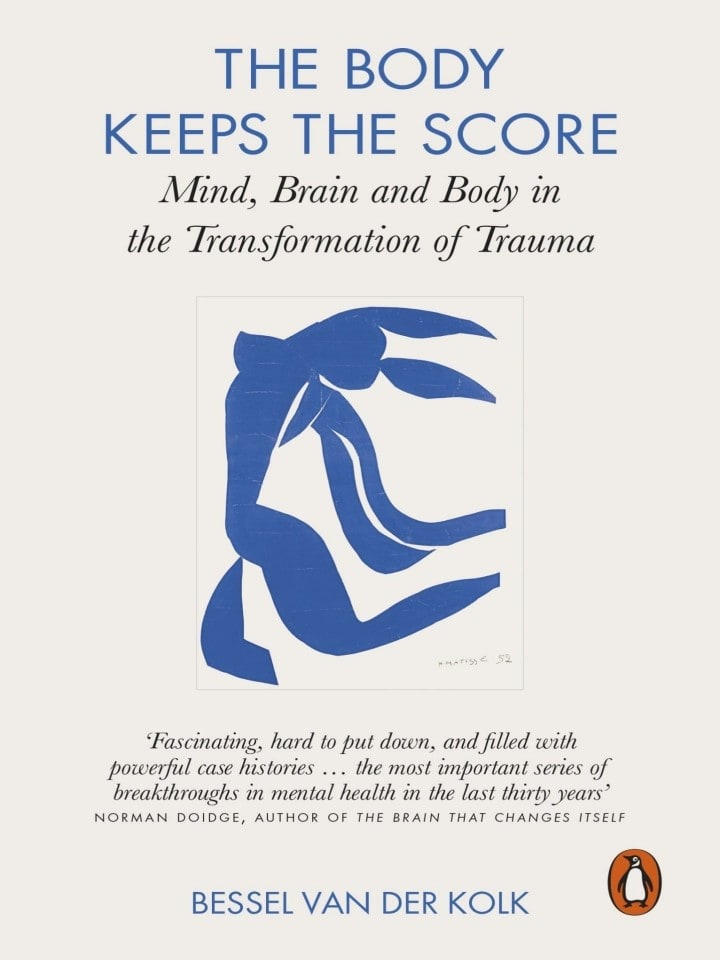
The Body Keeps the Score: Brain, Mind, and Body in the Healing of Trauma
About this book
The Body Keeps the Score grows from Bessel van der Kolk's clinical work with veterans, children, and adults whose lives continue to be organized around danger after the danger has passed. Trauma, in this account, is not only a memory but a changed pattern of attention, sensation, relationship, and bodily response.
Van der Kolk describes developments in neuroscience, attachment research, and the diagnosis of post-traumatic stress. Case histories show why recounting an event is not always enough when speech, memory, and physiological alarm no longer move together.
The later sections discuss treatments including psychotherapy, EMDR, neurofeedback, theater, yoga, and body-based practices. The common aim is not erasing the past but helping a person regain choice over reactions that once served survival.
The book is a broad synthesis rather than a personal treatment plan, and readers may want to discuss its claims with a qualified clinician. Its lasting contribution is a vocabulary for understanding why trauma can feel present and why recovery may require work through both mind and body.
Read a sample
5,118 words
Plain text
From the opening
PROLOGUE
FACING TRAUMA
One does not have be a combat soldier, or visit a refugee camp in Syria or the Congo to encounter trauma. Trauma happens to us, our friends, our families, and our neighbors. Research by the Centers for Disease Control and Prevention has shown that one in five Americans was sexually molested as a child; one in four was beaten by a parent to the point of a mark being left on their body; and one in three couples engages in physical violence. A quarter of us grew up with alcoholic relatives, and one out of eight witnessed their mother being beaten or hit.
As human beings we belong to an extremely resilient species. Since time immemorial we have rebounded from our relentless wars, countless disasters (both natural and man-made), and the violence and betrayal in our own lives. But traumatic experiences do leave traces, whether on a large scale (on our histories and cultures) or close to home, on our families, with dark secrets being imperceptibly passed down through generations. They also leave traces on our minds and emotions, on our capacity for joy and intimacy, and even on our biology and immune systems.
Trauma affects not only those who are directly exposed to it, but also those around them. Soldiers returning home from combat may frighten their families with their rages and emotional absence. The wives of men who suffer from PTSD tend to become depressed, and the children of depressed mothers are at risk of growing up insecure and anxious. Having been exposed to family violence as a child often makes it difficult to establish stable, trusting relationships as an adult.
Trauma, by definition, is unbearable and intolerable. Most rape victims, combat soldiers, and children who have been molested become so upset when they think about what they experienced that they try to push it out of their minds, trying to act as if nothing happened, and move on. It takes tremendous energy to keep functioning while carrying the memory of terror, and the shame of utter weakness and vulnerability.
While we all want to move beyond trauma, the part of our brain that is devoted to ensuring our survival (deep below our rational brain) is not very good at denial. Long after a traumatic experience is over, it may be reactivated at the slightest hint of danger and mobilize disturbed brain circuits and secrete massive amounts of stress hormones. This precipitates unpleasant emotions intense physical sensations, and impulsive and aggressive actions. These posttraumatic reactions feel incomprehensible and overwhelming. Feeling out of control, survivors of trauma often begin to fear that they are damaged to the core and beyond redemption.
• • •
The first time I remember being drawn to study medicine was at a summer camp when I was about fourteen years old. My cousin Michael kept me up all night explaining the intricacies of how kidneys work, how they secrete the body’s waste materials and then reabsorb the chemicals that keep the system in balance. I was riveted by his account of the miraculous way the body functions. Later, during every stage of my medical training, whether I was studying surgery, cardiology, or pediatrics, it was obvious to me that the key to healing was understanding how the human organism works. When I began my psychiatry rotation, however, I was struck by the contrast between the incredible complexity of the mind and the ways that we human beings are connected and attached to one another, and how little psychiatrists knew about the origins of the problems they were treating. Would it be possible one day to know as much about brains, minds, and love as we do about the other systems that make up our organism?
We are obviously still years from attaining that sort of detailed understanding, but the birth of three new branches of science has led to an explosion of knowledge about the effects of psychological trauma, abuse, and neglect. Those new disciplines are neuroscience, the study of how the brain supports mental processes; developmental psychopathology, the study of the impact of adverse experiences on the development of mind and brain; and interpersonal neurobiology, the study of how our behavior influences the emotions, biology, and mind-sets of those around us.
Research from these new disciplines has revealed that trauma produces actual physiological changes, including a recalibration of the brain’s alarm system, an increase in stress hormone activity, and alterations in the system that filters relevant information from irrelevant. We now know that trauma compromises the brain area that communicates the physical, embodied feeling of being alive. These changes explain why traumatized individuals become hypervigilant to threat at the expense of spontaneously engaging in their day-to-day lives. They also help us understand why traumatized people so often keep repeating the same problems and have such trouble learning from experience. We now know that their behaviors are not the result of moral failings or signs of lack of willpower or bad character—they are caused by actual changes in the brain.
This vast increase in our knowledge about the basic processes that underlie trauma has also opened up new possibilities to palliate or even reverse the damage. We can now develop methods and experiences that utilize the brain’s own natural neuroplasticity to help survivors feel fully alive in the present and move on with their lives. There are fundamentally three avenues: 1) top down, by talking, (re-) connecting with others, and allowing ourselves to know and understand what is going on with us, while processing the memories of the trauma; 2) by taking medicines that shut down inappropriate alarm reactions, or by utilizing other technologies that change the way the brain organizes information, and 3) bottom up: by allowing the body to have experiences that deeply and viscerally contradict the helplessness, rage, or collapse that result from trauma. Which one of these is best for any particular survivor is an empirical question. Most people I have worked with require a combination.
Continue reading the sampleClose the sample
This has been my life’s work. In this effort I have been supported by my colleagues and students at the Trauma Center, which I founded thirty years ago. Together we have treated thousands of traumatized children and adults: victims of child abuse, natural disasters, wars, accidents, and human trafficking; people who have suffered assaults by intimates and strangers. We have a long tradition of discussing all our patients in great depth at weekly treatment team meetings and carefully tracking how well different forms of treatment work for particular individuals.
Our principal mission has always been to take care of the children and adults who have come to us for treatment, but from the very beginning we also have dedicated ourselves to conducting research to explore the effects of traumatic stress on different populations and to determine what treatments work for whom. We have been supported by research grants from the National Institute of Mental Health, the National Center for Complementary and Alternative Medicine, the Centers for Disease Control, and a number of private foundations to study the efficacy of many different forms of treatment, from medications to talking, yoga, EMDR, theater, and neurofeedback.
The challenge is: How can people gain control over the residues of past trauma and return to being masters of their own ship? Talking, understanding, and human connections help, and drugs can dampen hyperactive alarm systems. But we will also see that the imprints from the past can be transformed by having physical experiences that directly contradict the helplessness, rage, and collapse that are part of trauma, and thereby regaining self-mastery. I have no preferred treatment modality, as no single approach fits everybody, but I practice all the forms of treatment that I discuss in this book. Each one of them can produce profound changes, depending on the nature of the particular problem and the makeup of the individual person.
I wrote this book to serve as both a guide and an invitation—an invitation to dedicate ourselves to facing the reality of trauma, to explore how best to treat it, and to commit ourselves, as a society, to using every means we have to prevent it.
PART ONE
THE REDISCOVERY OF TRAUMA
CHAPTER 1
LESSONS FROM VIETNAM VETERANS
I became what I am today at the age of twelve, on a frigid overcast day in the winter of 1975… . That was a long time ago, but it’s wrong what they say about the past… . Looking back now, I realize I have been peeking into that deserted alley for the last twenty-six years.
—Khaled Hosseini, The Kite Runner
Some people’s lives seem to flow in a narrative; mine had many stops and starts. That’s what trauma does. It interrupts the plot… . It just happens, and then life goes on. No one prepares you for it.
—Jessica Stern, Denial: A Memoir of Terror
The Tuesday after the Fourth of July weekend, 1978, was my first day as a staff psychiatrist at the Boston Veterans Administration Clinic. As I was hanging a reproduction of my favorite Breughel painting, “The Blind Leading the Blind,” on the wall of my new office, I heard a commotion in the reception area down the hall. A moment later a large, disheveled man in a stained three-piece suit, carrying a copy of Soldier of Fortune magazine under his arm, burst through my door. He was so agitated and so clearly hungover that I wondered how I could possibly help this hulking man. I asked him to take a seat, and tell me what I could do for him.
His name was Tom. Ten years earlier he had been in the Marines, doing his service in Vietnam. He had spent the holiday weekend holed up in his downtown-Boston law office, drinking and looking at old photographs, rather than with his family. He knew from previous years’ experience that the noise, the fireworks, the heat, and the picnic in his sister’s backyard against the backdrop of dense early-summer foliage, all of which reminded him of Vietnam, would drive him crazy. When he got upset he was afraid to be around his family because he behaved like a monster with his wife and two young boys. The noise of his kids made him so agitated that he would storm out of the house to keep himself from hurting them. Only drinking himself into oblivion or riding his Harley-Davidson at dangerously high speeds helped him to calm down.
Nighttime offered no relief—his sleep was constantly interrupted by nightmares about an ambush in a rice paddy back in ’Nam, in which all the members of his platoon were killed or wounded. He also had terrifying flashbacks in which he saw dead Vietnamese children. The nightmares were so horrible that he dreaded falling asleep and he often stayed up for most of the night, drinking. In the morning his wife would find him passed out on the living room couch, and she and the boys had to tiptoe around him while she made them breakfast before taking them to school.
Filling me in on his background, Tom said that he had graduated from high school in 1965, the valedictorian of his class. In line with his family tradition of military service he enlisted in the Marine Corps immediately after graduation. His father had served in World War II in General Patton’s army, and Tom never questioned his father’s expectations. Athletic, intelligent, and an obvious leader, Tom felt powerful and effective after finishing basic training, a member of a team that was prepared for just about anything. In Vietnam he quickly became a platoon leader, in charge of eight other Marines. Surviving slogging through the mud while being strafed by machine-gun fire can leave people feeling pretty good about themselves—and their comrades.
At the end of his tour of duty Tom was honorably discharged, and all he wanted was to put Vietnam behind him. Outwardly that’s exactly what he did. He attended college on the GI Bill, graduated from law school, married his high school sweetheart, and had two sons. Tom was upset by how difficult it was to feel any real affection for his wife, even though her letters had kept him alive in the madness of the jungle. Tom went through the motions of living a normal life, hoping that by faking it he would learn to become his old self again. He now had a thriving law practice and a picture-perfect family, but he sensed he wasn’t normal; he felt dead inside.
Although Tom was the first veteran I had ever encountered on a professional basis, many aspects of his story were familiar to me. I grew up in postwar Holland, playing in bombed-out buildings, the son of a man who had been such an outspoken opponent of the Nazis that he had been sent to an internment camp. My father never talked about his war experiences, but he was given to outbursts of explosive rage that stunned me as a little boy. How could the man I heard quietly going down the stairs every morning to pray and read the Bible while the rest of the family slept have such a terrifying temper? How could someone whose life was devoted to the pursuit of social justice be so filled with anger? I witnessed the same puzzling behavior in my uncle, who had been captured by the Japanese in the Dutch East Indies (now Indonesia) and sent as a slave laborer to Burma, where he worked on the famous bridge over the river Kwai. He also rarely mentioned the war, and he, too, often erupted into uncontrollable rages.
As I listened to Tom, I wondered if my uncle and my father had had nightmares and flashbacks—if they, too, had felt disconnected from their loved ones and unable to find any real pleasure in their lives. Somewhere in the back of my mind there must also have been my memories of my frightened—and often frightening—mother, whose own childhood trauma was sometimes alluded to and, I now believe, was frequently reenacted. She had the unnerving habit of fainting when I asked her what her life was like as a little girl and then blaming me for making her so upset.
Reassured by my obvious interest, Tom settled down to tell me just how scared and confused he was. He was afraid that he was becoming just like his father, who was always angry and rarely talked with his children—except to compare them unfavorably with his comrades who had lost their lives around Christmas 1944, during the Battle of the Bulge.
As the session was drawing to a close, I did what doctors typically do: I focused on the one part of Tom’s story that I thought I understood—his nightmares. As a medical student I had worked in a sleep laboratory, observing people’s sleep/dream cycles, and had assisted in writing some articles about nightmares. I had also participated in some early research on the beneficial effects of the psychoactive drugs that were just coming into use in the 1970s. So, while I lacked a true grasp of the scope of Tom’s problems, the nightmares were something I could relate to, and as an enthusiastic believer in better living through chemistry, I prescribed a drug that we had found to be effective in reducing the incidence and severity of nightmares. I scheduled Tom for a follow-up visit two weeks later.
When he returned for his appointment, I eagerly asked Tom how the medicines had worked. He told me he hadn’t taken any of the pills. Trying to conceal my irritation, I asked him why. “I realized that if I take the pills and the nightmares go away,” he replied, “I will have abandoned my friends, and their deaths will have been in vain. I need to be a living memorial to my friends who died in Vietnam.”
I was stunned: Tom’s loyalty to the dead was keeping him from living his own life, just as his father’s devotion to his friends had kept him from living. Both father’s and son’s experiences on the battlefield had rendered the rest of their lives irrelevant. How had that happened, and what could we do about it? That morning I realized I would probably spend the rest of my professional life trying to unravel the mysteries of trauma. How do horrific experiences cause people to become hopelessly stuck in the past? What happens in people’s minds and brains that keeps them frozen, trapped in a place they desperately wish to escape? Why did this man’s war not come to an end in February 1969, when his parents embraced him at Boston’s Logan International Airport after his long flight back from Da Nang?
Tom’s need to live out his life as a memorial to his comrades taught me that he was suffering from a condition much more complex than simply having bad memories or damaged brain chemistry—or altered fear circuits in the brain. Before the ambush in the rice paddy, Tom had been a devoted and loyal friend, someone who enjoyed life, with many interests and pleasures. In one terrifying moment, trauma had transformed everything.
During my time at the VA I got to know many men who responded similarly. Faced with even minor frustrations, our veterans often flew instantly into extreme rages. The public areas of the clinic were pockmarked with the impacts of their fists on the drywall, and security was kept constantly busy protecting claims agents and receptionists from enraged veterans. Of course, their behavior scared us, but I also was intrigued.
At home my wife and I were coping with similar problems in our toddlers, who regularly threw temper tantrums when told to eat their spinach or to put on warm socks. Why was it, then, that I was utterly unconcerned about my kids’ immature behavior but deeply worried by what was going on with the vets (aside from their size, of course, which gave them the potential to inflict much more harm than my two-footers at home)? The reason was that I felt perfectly confident that, with proper care, my kids would gradually learn to deal with frustrations and disappointments, but I was skeptical that I would be able to help my veterans reacquire the skills of self-control and self-regulation that they had lost in the war.
Unfortunately, nothing in my psychiatric training had prepared me to deal with any of the challenges that Tom and his fellow veterans presented. I went down to the medical library to look for books on war neurosis, shell shock, battle fatigue, or any other term or diagnosis I could think of that might shed light on my patients. To my surprise the library at the VA didn’t have a single book about any of these conditions. Five years after the last American soldier left Vietnam, the issue of wartime trauma was still not on anybody’s agenda. Finally, in the Countway Library at Harvard Medical School, I discovered The Traumatic Neuroses of War, which had been published in 1941 by a psychiatrist named Abram Kardiner. It described Kardiner’s observations of World War I veterans and had been released in anticipation of the flood of shell-shocked soldiers expected to be casualties of World War II.
Kardiner reported the same phenomena I was seeing: After the war his patients were overtaken by a sense of futility; they became withdrawn and detached, even if they had functioned well before. What Kardiner called “traumatic neuroses,” today we call posttraumatic stress disorder—PTSD. Kardiner noted that sufferers from traumatic neuroses develop a chronic vigilance for and sensitivity to threat. His summation especially caught my eye: “The nucleus of the neurosis is a physioneurosis.” In other words, posttraumatic stress isn’t “all in one’s head,” as some people supposed, but has a physiological basis. Kardiner understood even then that the symptoms have their origin in the entire body’s response to the original trauma.
Kardiner’s description corroborated my own observations, which was reassuring, but it provided me with little guidance on how to help the veterans. The lack of literature on the topic was a handicap, but my great teacher, Elvin Semrad, had taught us to be skeptical about textbooks. We had only one real textbook, he said: our patients. We should trust only what we could learn from them—and from our own experience. This sounds so simple, but even as Semrad pushed us to rely upon self-knowledge, he also warned us how difficult that process really is, since human beings are experts in wishful thinking and obscuring the truth. I remember him saying: “The greatest sources of our suffering are the lies we tell ourselves.” Working at the VA I soon discovered how excruciating it can be to face reality. This was true both for my patients and for myself.
We don’t really want to know what soldiers go through in combat. We do not really want to know how many children are being molested and abused in our own society or how many couples—almost a third, as it turns out—engage in violence at some point during their relationship. We want to think of families as safe havens in a heartless world and of our own country as populated by enlightened, civilized people. We prefer to believe that cruelty occurs only in faraway places like Darfur or the Congo. It is hard enough for observers to bear witness to pain. Is it any wonder, then, that the traumatized individuals themselves cannot tolerate remembering it and that they often resort to using drugs, alcohol, or self-mutilation to block out their unbearable knowledge?
Tom and his fellow veterans became my first teachers in my quest to understand how lives are shattered by overwhelming experiences, and in figuring out how to enable them to feel fully alive again.
TRAUMA AND THE LOSS OF SELF
The first study I did at the VA started with systematically asking veterans what had happened to them in Vietnam. I wanted to know what had pushed them over the brink, and why some had broken down as a result of that experience while others had been able to go on with their lives. Most of the men I interviewed had gone to war feeling well prepared, drawn close by the rigors of basic training and the shared danger. They exchanged pictures of their families and girlfriends; they put up with one another’s flaws. And they were prepared to risk their lives for their friends. Most of them confided their dark secrets to a buddy, and some went so far as to share each other’s shirts and socks.
Many of the men had friendships similar to Tom’s with Alex. Tom met Alex, an Italian guy from Malden, Massachusetts, on his first day in country, and they instantly became close friends. They drove their jeep together, listened to the same music, and read each other’s letters from home. They got drunk together and chased the same Vietnamese bar girls.
After about three months in country Tom led his squad on a foot patrol through a rice paddy just before sunset. Suddenly a hail of gunfire spurted from the green wall of the surrounding jungle, hitting the men around him one by one. Tom told me how he had looked on in helpless horror as all the members of his platoon were killed or wounded in a matter of seconds. He would never get one image out of his mind: the back of Alex’s head as he lay facedown in the rice paddy, his feet in the air. Tom wept as he recalled, “He was the only real friend I ever had.” Afterward, at night, Tom continued to hear the screams of his men and to see their bodies falling into the water. Any sounds, smells, or images that reminded him of the ambush (like the popping of firecrackers on the Fourth of July) made him feel just as paralyzed, terrified, and enraged as he had the day the helicopter evacuated him from the rice paddy.
Maybe even worse for Tom than the recurrent flashbacks of the ambush was the memory of what happened afterward. I could easily imagine how Tom’s rage about his friend’s death had led to the calamity that followed. It took him months of dealing with his paralyzing shame before he could tell me about it. Since time immemorial veterans, like Achilles in Homer’s Iliad, have responded to the death of their comrades with unspeakable acts of revenge. The day after the ambush Tom went into a frenzy to a neighboring village, killing children, shooting an innocent farmer, and raping a Vietnamese woman. After that it became truly impossible for him to go home again in any meaningful way. How can you face your sweetheart and tell her that you brutally raped a woman just like her, or watch your son take his first step when you are reminded of the child you murdered? Tom experienced the death of Alex as if part of himself had been forever destroyed—the part that was good and honorable and trustworthy. Trauma, whether it is the result of something done to you or something you yourself have done, almost always makes it difficult to engage in intimate relationships. After you have experienced something so unspeakable, how do you learn to trust yourself or anyone else again? Or, conversely, how can you surrender to an intimate relationship after you have been brutally violated?
Tom kept showing up faithfully for his appointments, as I had become for him a lifeline—the father he’d never had, an Alex who had survived the ambush. It takes enormous trust and courage to allow yourself to remember. One of the hardest things for traumatized people is to confront their shame about the way they behaved during a traumatic episode, whether it is objectively warranted (as in the commission of atrocities) or not (as in the case of a child who tries to placate her abuser). One of the first people to write about this phenomenon was Sarah Haley, who occupied an office next to mine at the VA Clinic. In an article entitled “When the Patient Reports Atrocities,” which became a major impetus for the ultimate creation of the PTSD diagnosis, she discussed the well-nigh intolerable difficulty of talking about (and listening to) the horrendous acts that are often committed by soldiers in the course of their war experiences. It’s hard enough to face the suffering that has been inflicted by others, but deep down many traumatized people are even more haunted by the shame they feel about what they themselves did or did not do under the circumstances. They despise themselves for how terrified, dependent, excited, or enraged they felt.
In later years I encountered a similar phenomenon in victims of child abuse: Most of them suffer from agonizing shame about the actions they took to survive and maintain a connection with the person who abused them. This was particularly true if the abuser was someone close to the child, someone the child depended on, as is so often the case. The result can be confusion about whether one was a victim or a willing participant, which in turn leads to bewilderment about the difference between love and terror; pain and pleasure. We will return to this dilemma throughout this book.
NUMBING
Maybe the worst of Tom’s symptoms was that he felt emotionally numb. He desperately wanted to love his family, but he just couldn’t evoke any deep feelings for them. He felt emotionally distant from everybody, as though his heart were frozen and he were living behind a glass wall. That numbness extended to himself, as well. He could not really feel anything except for his momentary rages and his shame. He described how he hardly recognized himself when he looked in the mirror to shave. When he heard himself arguing a case in court, he would observe himself from a distance and wonder how this guy, who happened to look and talk like him, was able to make such cogent arguments. When he won a case he pretended to be gratified, and when he lost it was as though he had seen it coming and was resigned to the defeat even before it happened. Despite the fact that he was a very effective lawyer, he always felt as though he were floating in space, lacking any sense of purpose or direction.
The only thing that occasionally relieved this feeling of aimlessness was intense involvement in a particular case. During the course of our treatment Tom had to defend a mobster on a murder charge. For the duration of that trial he was totally absorbed in devising a strategy for winning the case, and there were many occasions on which he stayed up all night to immerse himself in something that actually excited him. It was like being in combat, he said—he felt fully alive, and nothing else mattered. The moment Tom won that case, however, he lost his energy and sense of purpose. The nightmares returned, as did his rage attacks—so intensely that he had to move into a motel to ensure that he would not harm his wife or children. But being alone, too, was terrifying, because the demons of the war returned in full force. Tom tried to stay busy, working, drinking, and drugging—doing anything to avoid confronting his demons.
He kept thumbing through Soldier of Fortune, fantasizing about enlisting as a mercenary in one of the many regional wars then raging in Africa. That spring he took out his Harley and roared up the Kancamagus Highway in New Hampshire. The vibrations, speed, and danger of that ride helped him pull himself back together, to the point that he was able to leave his motel room and return to his family.
THE REORGANIZATION OF PERCEPTION
Another study I conducted at the VA started out as research about nightmares but ended up exploring how trauma changes people’s perceptions and imagination. Bill, a former medic who had seen heavy action in Vietnam a decade earlier, was the first person enrolled in my nightmare study. After his discharge he had enrolled in a theological seminary and had been assigned to his first parish in a Congregational church in a Boston suburb. He was doing fine until he and his wife had their first child. Soon after the baby’s birth, his wife, a nurse, had gone back to work while he remained at home, working on his weekly sermon and other parish duties and taking care of their newborn. On the very first day he was left alone with the baby, it began to cry, and he found himself suddenly flooded with unbearable images of dying children in Vietnam.