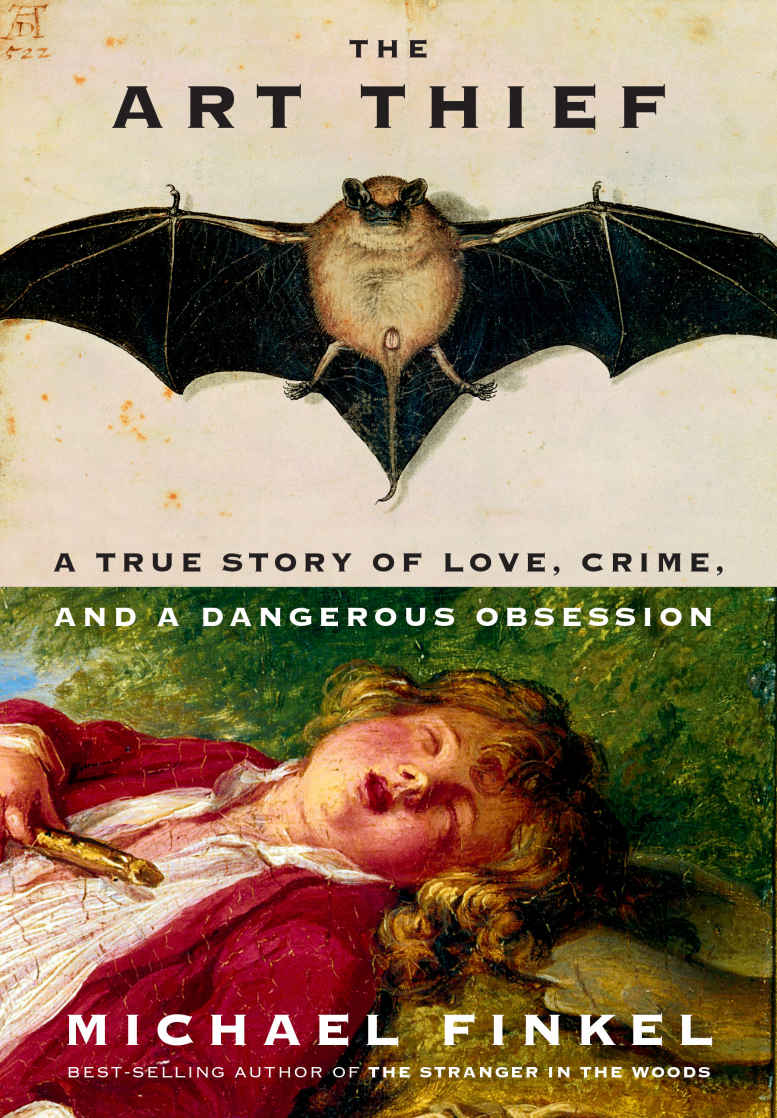
The Art Thief: A True Story of Love, Crime, and a Dangerous Obsession
About this book
Breitwieser did not sell the objects he took. With his girlfriend serving as lookout, he removed paintings, sculptures, silver, and historical pieces during ordinary museum hours, pursuing private possession rather than conventional profit.
The thefts depended on close observation, confidence, and the limited security of small institutions. As the collection grew, the practical and psychological risks became harder to contain, and the people around Breitwieser faced choices with irreversible consequences.
Finkel builds the narrative from interviews, police files, court material, and museum records. Fascination with the thief's audacity is held against the destruction, loss of public heritage, and self-serving philosophy by which he recast taking as appreciation.
The Art Thief is true crime about beauty, compulsion, and ownership. Its central paradox is a man who claimed to love art so intensely that he endangered the objects and denied everyone else access to them.
Read a sample
5,031 words
Plain text
From the opening
1
Approaching the museum, ready to hunt, Stéphane Breitwieser clasps hands with his girlfriend, Anne-Catherine Kleinklaus, and together they stroll to the front desk and say hello, a cute couple. Then they purchase two tickets with cash and walk in.
It’s lunchtime, stealing time, on a busy Sunday in Antwerp, Belgium, in February 1997. The couple blends with the tourists at the Rubens House, pointing and nodding at sculptures and oils. Anne-Catherine is tastefully dressed in Chanel and Dior bought in secondhand shops, a big Yves Saint Laurent bag on her shoulder. Breitwieser wears a button-down shirt tucked into stylish pants, topped by an overcoat that’s sized a little too roomy, a Swiss Army knife stashed in a pocket.
The Rubens House is an elegant museum in the former residence of Peter Paul Rubens, the great Flemish painter of the seventeenth century. The couple drifts through the parlor and kitchen and dining room as Breitwieser memorizes the side doors and keeps track of the guards. Several escape routes take shape in his mind. The item they’re hunting is sheltered at the rear of the museum, in a ground-floor gallery with a brass chandelier and soaring windows, some now shuttered to protect the works from the midday sun. Here, mounted atop an ornate wooden dresser, is a plexiglass display box fastened to a sturdy base. Sealed inside the box is an ivory sculpture of Adam and Eve.
Breitwieser had encountered the piece on a solo scouting trip a few weeks earlier and had fallen under its spell—the four-hundred-year-old carving still radiates the inner glow, unique to ivory, that feels to him transcendent. After that trip, he could not stop thinking of the sculpture, dreaming of it, so he has returned to the Rubens House with Anne-Catherine.
All forms of security have a weakness. The flaw with the plexiglass box, he had seen on his scouting visit, is that the upper part can be separated from the base by removing two screws. Tricky screws, sure, difficult to reach at the rear of the box, but just two. The flaw with the security guards is they’re human. They get hungry. Most of the day, Breitwieser had observed, there is a guard in each gallery, watching from a chair. Except at lunchtime, when the chairs wait empty as the security staff rotates shorthanded to eat, while those who remain on duty shift from sitting to patrol, dipping in and out of rooms at a predictable pace.
Tourists are the irritating variables. Even at noon there are too many of them, lingering. The more popular rooms in the museum display paintings by Rubens himself, but these pieces are too large to safely steal or too somberly religious for Breitwieser’s taste. The gallery with Adam and Eve features items Rubens collected during his lifetime, including marble busts of Roman philosophers, a terracotta sculpture of Hercules, and a scattering of Dutch and Italian oil paintings. The ivory itself, by the German carver Georg Petel, was likely received by Rubens as a gift.
As the tourists circle, Breitwieser positions himself in front of an oil painting and assumes an art-gazing stance. Hands on hips, or arms crossed, or chin cupped. His repertoire includes more than a dozen poses, all meant to connote serene contemplation, even while his heart is revving with excitement and fear. Anne-Catherine hovers near the gallery’s doorway, sometimes standing, sometimes sitting on a bench, always with an air of casual indifference, making sure she has a clear view of the hallway beyond. There are no security cameras in the area. There’s only a scattered handful in the whole museum, and he has noted that each has a proper wire; occasionally, in smaller museums, they’re fake.
A moment soon comes when the couple is alone in the room. The transformation is explosive, a flame to the fuel, as Breitwieser sheds his studious pose and leaps over the security cordon to the wooden dresser. He digs the Swiss Army knife from his pocket, pries open a screwdriver tool, and sets to work on the plexiglass box.
Four turns of the screw, maybe five. The carving to him is a masterpiece, just ten inches tall yet dazzlingly detailed, the first humans gazing at each other as they move to embrace, the serpent coiled around the tree of knowledge behind them, the forbidden fruit picked but not bitten: humanity at the precipice of sin. He hears a soft cough—that’s Anne-Catherine—and vaults away from the dresser, light-footed and fluid, and reassumes art-watching mode as a guard appears. The Swiss Army knife is back in his pocket, though the screwdriver is still extended.
The guard walks into the room and stops, then scans the gallery methodically. Breitwieser contains his breathing. The officer turns around and is barely beneath the doorway before the theft resumes. This is how Breitwieser progresses, in fits and starts, grasshoppering about the gallery, a couple of turns of the screw, then a cough, a couple more, then another.
To unfasten the first screw amid the steady drip of tourists and guards requires ten minutes of concentrated effort, even with the margin for error shaved thin. Breitwieser does not wear gloves, trading fingerprints for dexterity and touch. The second screw is no easier, finally yielding as further visitors arrive, forcing him to bound off again, the pair of screws in his pocket.
Anne-Catherine makes eye contact with him from across the room, and he taps his hand to his heart, signaling that he’s ready for the finishing step and will not need to use her big purse. She heads off to the museum’s exit. The security guard has already appeared three times, and although both he and Anne-Catherine have stationed themselves in different spots at each check-in, Breitwieser is stressed. He’d once worked as a museum guard, soon after graduating from high school, and he understands that while almost no one will detect a detail as tiny as a missing or protruding screw, all decent guards focus on people. To remain in the same room for two consecutive security visits, and then commit a theft, is inadvisable. Three visits is borderline reckless. A fourth, which by his watch is little more than a minute away, must not happen. He needs to act or abandon now.
Continue reading the sampleClose the sample
The problem is the group of visitors present. He slides his eyes over. They’re huddled near a painting, all wearing headphones attached to audio guides. Breitwieser deems them sufficiently distracted. This is the critical instant—one glance from one visitor and his life could effectively end—and he does not delay. It isn’t action, he suspects, that usually lands a thief in prison. It’s hesitation.
Breitwieser steps to the dresser, lifts the plexiglass box from the base, and sets it carefully aside. He grasps the ivory sculpture, sweeps his coattails out of the way, and pushes the work partially into the waistband of his pants at the small of his back, then readjusts the roomy overcoat so the carving is covered. There’s a bit of a lump, but you’d have to be extraordinarily observant to notice.
He leaves the plexiglass box to the side—he does not want to waste precious seconds replacing it—and strides off, moving with calculation but no obvious haste. He understands that such a conspicuous theft will swiftly be spotted, triggering an emergency response. The police will arrive. The museum could be locked down, all visitors searched.
Still, he does not run. Running is for pickpockets and purse thieves. He eases outside the gallery and slinks through a nearby door he’d scouted, one reserved for employees yet neither locked nor alarmed, and emerges in the museum’s central courtyard. He glides over the pale stones and along a vine-covered wall, the sculpture knocking at his back, until he reaches another door and pops through, returning inside the museum close to the main entrance. He continues past the front desk and onto the city streets of Antwerp. Police officers are likely descending, and he consciously keeps his pace easy, shuffling in his shiny loafers until he spots Anne-Catherine and they proceed together to the quiet road where he’d parked the car.
He pops the trunk of the little Opel Tigra, midnight blue, and sets the ivory down. Both of them holding in a bubbling euphoria, he takes the wheel and Anne-Catherine settles into the passenger seat. He wants to gun the engine and screech away, but he knows to drive slowly, pausing at traffic lights on the route out of town. Only when they reach the highway and he hits the accelerator does their vigilance fly away, and then they’re just a pair of twenty-five-year-old kids, joyously speeding, home free.
2
The house is humble, a pale cube of stuccoed concrete pitted with small windows and covered by a steep, red-tiled roof. A couple of pine trees shade a grassy patch out back. It sits on a street of similar homes among the suburban sprawl of Mulhouse, an automobile and chemical manufacturing city in the industrial belt of eastern France, one of the least attractive areas in a nation brimming with beauty.
Most of the living space is on the ground floor, but a narrow stairway leads up to two rooms, a living area and a bedroom, tucked beneath the rafters, low ceilinged and cramped. The door to these rooms is always kept locked, the window shutters permanently closed. Wedged into the bedroom is a majestic, four-poster canopied bed, draped with gold velour curtains tied back with maroon ribbons, covered with red satin sheets piled with cushions. Here, amid this odd opulence, is where the young couple sleeps.
When Breitwieser opens his eyes, one of the first things he sees is Adam and Eve. He’d placed the ivory piece on his bedside table specifically for this view. Sometimes he brushes his fingertips over the carving, where the artist’s own hands had once labored—across the ripples in Eve’s hair, along the serpent’s scales, up the nubby tree trunk. It’s among the most gorgeous works he has ever encountered; it might be worth more than every house on his block put together, times two.
Also on his bed table is a second ivory carving, a figurine of Diana, the Roman goddess of hunting and fertility, her right arm raised, clutching her golden arrows. And near that a third, a statuette of Catherine of Alexandria, an early Christian saint. And then another, of a curly-haired Cupid resting his foot on a skull, love overpowering death. Could anything offer a more stirring start to each day than the ethereal glow of an ivory collection?
Yes, it turns out. Near the ivories is a polished golden tobacco box, frilled in bright blue enamel, commissioned by Napoleon himself. To hold it in your palm is to travel through time. Next to that is a flower vase, prismatic and curvy, made by Émile Gallé, the French master glassblower of the late 1800s. Then an older item, a great silver goblet engraved with garlands and coils—held aloft by royalty, Breitwieser imagines, sloshing wine at feasts across centuries. Then more little round tobacco tins, so pleasingly shaped, and a section of bronze pieces near a porcelain figurine next to a nautilus-shell chalice. Just the contents of his nightstand could stock a museum exhibit of its own.
There is also a night table on Anne-Catherine’s side of the bed. And a large armoire with showcase shelves enclosed by glass doors. And a desk, and a dresser. Every flat surface in the bedroom is filled. Silver platters, silver bowls, silver vases, silver cups. Gilded tea sets and pewter miniatures. A crossbow, a saber, a poleax, a mace. Pieces in marble and crystal and mother-of-pearl. A gold pocket watch, a gold urn, a gold perfume flask, a gold brooch.
The second room of the couple’s hideaway has more. A wooden altarpiece, a copper plate, an iron alms box, a stained-glass window. Apothecary jars and antique game boards. Another group of ivory carvings. A violin, a bugle, a flute, a trumpet.
Further pieces are stacked on armchairs, propped against walls, balanced on windowsills, beached on piles of laundry, slid under the bed, and corralled in the closet. Wristwatches, tapestries, beer tankards, flintlock pistols, hand-bound books, and more ivory. A medieval knight’s helmet, a wooden statue of the Virgin Mary, a bejeweled table clock, an illustrated prayer book from the Middle Ages.
All of this is ancillary to the true splendor. The grandest, most valuable items, by far, hang on the walls: oil paintings, primarily from the sixteenth and seventeenth centuries, by masters of the late Renaissance and early Baroque styles, detailed and colorful with movement and life. Portraits, landscapes, seascapes, still lifes, allegories, peasant scenes, pastorals. Exhibited floor to ceiling, left to right, room to room; arranged thematically or geographically or whimsically.
The works include dozens of period greats—Cranach, Brueghel, Boucher, Watteau, Goyen, Dürer—so many that the rooms seem to swirl with color, amplified by the radiance of ivory, added to the sparkle of silver, multiplied by the glitter of gold. Everything, in total, has been estimated by art journalists to be worth as much as two billion dollars, all stashed in an attic lair in a nondescript house near a hardscrabble town. The young couple has conjured a reality that surpasses most fantasies. They live inside a treasure chest.
3
Stéphane Breitwieser is not really an art thief. Or so he believes, even though he is perhaps the most successful and prolific art thief who has ever lived. He doesn’t deny having stolen the pieces in his hidden rooms, most with the aid of Anne-Catherine Kleinklaus. He knows exactly what he has done; he can recount some of his crimes down to the precise number of steps it took him to sneak a work out the museum exit.
His issue is with other art thieves. They disgust him—virtually all of them, even the most accomplished ones. Like the two men dressed in police uniforms who arrived at Boston’s Isabella Stewart Gardner Museum on the night of Saint Patrick’s Day 1990. They were buzzed inside by the pair of overnight guards, who were swiftly subdued, eyes and mouths bound with duct tape, then handcuffed to pipes in the basement.
A violent, late-night heist is an insult to Breitwieser’s notion that stealing artwork should be a daytime affair of refined stealth in which no one so much as senses fear. But this is not why he despises the Gardner crime. It’s what happened next. The thieves marched upstairs and pulled down the most magnificent work in the museum, a Rembrandt from 1633, The Storm on the Sea of Galilee. Then one of the men stuck a knife in the canvas.
Breitwieser can hardly bring himself to imagine it—the blade ripping along the edge of the work, paint flakes spraying, canvas threads popping, cutting the full nineteen-foot perimeter until the piece, released from its stretcher and frame, curled up in death throes, paint cracking and chipping some more. And then the thieves moved on to another Rembrandt and did it again.
This is not the way Breitwieser works. No matter how depraved a criminal’s morals, deliberately slicing or breaking a painting should still be immoral. A picture frame, Breitwieser understands, can make a painting unwieldy to steal, so what he does after he detaches a piece from the wall is turn it over and coax the clips or nails on the back to drop the frame, which he leaves behind in the museum. If there’s no time for such diligence, he abandons the crime, and if there is, he’s mindful that the painting, now vulnerable as a newborn, must be shielded from scratches and warpage and creases and dirt.
The Gardner thieves, by Breitwieser’s standards, are savages—they gratuitously vandalized works by Rembrandt. Rembrandt. Virtuoso of human emotion and godly light. The thieves remain missing, along with the thirteen pieces they took, worth half a billion dollars, but even if the paintings are eventually found, they will never be whole. As with most art thieves, the Gardner burglars didn’t actually care about art. All they did was make the world uglier.
Breitwieser’s sole motivation for stealing, he insists, is to surround himself with beauty, to gorge on it. Very few art thieves have ever cited aesthetics as an incentive, but Breitwieser has emphasized this repeatedly, across dozens of hours of media interviews, during which he has not tried to hide his guilt, describing his crimes and emotions with present-tense immediacy and seemingly pinpoint precision. Sometimes he’s gone further to provide accuracy. Pressed on the details of the Adam and Eve theft, Breitwieser donned a quick disguise—a baseball cap pulled low and a fake pair of eyeglasses—and returned to the scene of the crime, to aid in recalling every decision point, screw removal, and art-watching pose. He’s done similar things for a few other heists. Hundreds of police reports help confirm the general facts of his accounts.
He takes only works that stir him emotionally, and seldom the most valuable piece in a place. He feels no remorse when he steals because museums, in his deviant view, are really just prisons for art. They’re often crowded and noisy, with limited visiting hours and uncomfortable seats, offering no calm place to reflect or recline. Guided tour groups armed with selfie-stick shanks seem to rumble through rooms like chain gangs.
Everything you want to do in the presence of a compelling piece is forbidden in a museum, says Breitwieser. What you first want to do, he advises, is relax, pillowed in a sofa or armchair. Sip a drink, if you desire. Eat a snack. Reach out and caress the work whenever you wish. Then you’ll see art in a new way.
Take the ivory Adam and Eve. There’s a profusion of symbolism embedded in the piece, augmenting a notable consistency of proportion and a fine balance of pose. Or so a museum tour guide will say, each word further walling off your chances of feeling any raw emotions at all.
Now steal the carving, follow Breitwieser’s advice, and look again: Adam’s left arm is draped around Eve’s shoulders while his other hand touches her body. The first couple, freshly formed by God, appears flawless—muscled, lean, healthy, great hair. Their lips are full, Eve’s neck coyly tilted. They are naked. Adam’s penis is right there; he seems to be circumcised. It’s okay to stare. Eve’s right hand lies on Adam’s back, urging him closer, and her left rests between her legs, fingers curled inward.
So many great works of art are sexually arousing that what you’ll also want to do, Breitwieser says, is install a bed nearby, perhaps a four-poster, for when your partner is there and the timing is right. When Breitwieser is not in bed, he dotes like a butler on the works in his rooms, monitoring temperature and humidity, light and dust. His pieces are kept in better condition, he says, than they were in museums. Lumping him in with the savages is cruel and unfair. Instead of an art thief, Breitwieser prefers to be thought of as an art collector with an unorthodox acquisition style. Or, if you will, he’d like to be called an art liberator.
And Anne-Catherine? Her feelings are more difficult to gauge. She is not willing to talk with reporters. A few people who have spent time with her, however, have spoken extensively, including lawyers, personal acquaintances, and detectives. Sections of psychology reports for both her and Breitwieser have been made public, along with transcribed interrogations and testimony. Preserved as well are some of the couple’s home videos and sections of personal letters. There are also museum security images, media reports, and statements from police officers, prosecutors, and several people in the art world.
Every item has been studied to offer an accurate depiction of the art thefts, though the most intimate details of the couple’s romance and criminality come only from Breitwieser. It might be enlightening to hear Anne-Catherine’s full version of her experiences, but her response to many questions would put her in the position of either incriminating herself, with potentially punitive repercussions, or overtly lying. Faced with these options, her silence seems wise.
What is evident, despite Anne-Catherine’s limited public remarks, is that she would not describe herself as an art liberator. Nor would she propose any other morally distorted justifications for the crimes. She’s the more pragmatic and rational of the two. Her feet are on the ground; his head’s in the clouds. Breitwieser provides the lift to carry them away on flights of fancy, while Anne-Catherine offers the ballast to bring them safely back home. Anne-Catherine, say people she’s confided in, views their stolen pieces with wary ambivalence—gorgeous, and just as surely tainted. Breitwieser’s conscience is clear. To him, beauty is the world’s only true currency, always enriching whatever its source. The person with the most beauty is therefore the richest. He has sometimes considered himself one of the wealthiest people alive.
Anne-Catherine would also not describe herself as wealthy, with good reason. The couple is perpetually broke. Breitwieser vows that he isn’t seeking financial gain, and never steals with the intent of selling anything, not one piece. This too sets him apart from nearly any other art thief. Breitwieser has so little money that even on getaway drives he avoids paying highway tolls. Occasionally he’ll take a temporary job—stocking shelves, unloading trucks, waiting tables at a pizza place, then a café, then a bistro—but mostly he collects government welfare and gifts from his family. Anne-Catherine works full time as a nurse’s assistant in a hospital, though isn’t well paid.
This is why the couple’s secret gallery is in such a strange site. Breitwieser can’t afford rent, so he lives with his mother and pays nothing. His mother’s rooms are on the ground floor and she respects his privacy, he insists, and does not venture upstairs. The items he and Anne-Catherine haul home, he tells his mother, are flea-market finds or knockoffs, to enliven a boring attic.
Breitwieser is an unemployed freeloader holed up in his mother’s house. This he acknowledges. The arrangement permits him to live cheaply, allowing him to keep all his illicit artwork without the need to even consider converting any loot into cash. Stealing art for money, he says, is disgraceful. Money can be made with far less risk. But liberating for love, he’s known a long time, feels ecstatic.
4
His first loves were pottery shards and tile fragments and arrowheads. He’d embark on “expeditions,” as he called them, for that is what they were to an elementary-school kid, exploring the ruins of medieval fortresses with his grandfather, who might have sparked a two-billion-dollar string of heists with the tip of his cane.
The grandfather, from the maternal side, had a beachcomber’s eye, and when he poked his cane in the soil, Breitwieser knew to dig with his hands. Unearthed remnants, such as glazed tiles and crossbow pieces, felt to Breitwieser like private messages that had waited centuries specifically for him to receive. He sensed, even then, that it might have been forbidden to keep them, but his grandfather said that he could, so he stashed them in a blue plastic box in the basement of his family’s home. Sneaking to the cellar and opening the blue box could make him tremble and cry. “Objects that held my heart,” is how Breitwieser described his cherished finds.
He was born, in 1971, into a family with deep roots in Alsace, a part of France that is often considered stolen property itself. His parents christened him with a regal-sounding name: Stéphane Guillaume Frédéric Breitwieser. He is the only child of Roland Breitwieser, an executive manager of a department store chain, and Mireille Stengel, a hospital nurse specializing in child care.
Breitwieser grew up, with a trio of dachshunds, in a stately home in the village of Wittenheim, on the French side of the three-way borderlands that include Switzerland and Germany. He speaks native French, fluent German, workable English, and some Alsatian, the regional Germanic dialect. France and Germany have wrested the area from each other five times in the past 150 years, and many locals, envious of the higher salaries and lower prices over the border, feel that it is France’s turn to give it back.
Their house was finely furnished—Empire dressers from the 1800s, Louis XV armchairs from the 1700s—and ornamented with antique weaponry. Breitwieser recalls playing with the old armaments, sneaking them off their display stands when his parents weren’t looking and dueling against imaginary enemies. The walls shimmered with paintings, several by the acclaimed Alsatian expressionist Robert Breitwieser, who has a street named after him in his hometown of Mulhouse. The painter was not a close family member, he was the brother of Stéphane Breitwieser’s great-grandfather, but he accepted visits from the whole Breitwieser clan. Shortly before the painter’s death, in 1975, he completed a portrait of Stéphane Breitwieser as a toddler.
For years, Breitwieser told acquaintances that he was Robert Breitwieser’s grandson. The lie was justified, Breitwieser felt, because the famous painter on his father’s side of the family had devoted the effort to enshrine him on canvas, while he’d never developed a deep relationship with either of his paternal grandparents.
Breitwieser’s attachment to his maternal grandparents, Aline Philippe and Joseph Stengel—the grandfather with the cane and the beachcomber’s eye—was unshakably strong. The best days of his youth, Breitwieser says, were spent with them: weekend lunches at their converted farmhouse in the country, Christmas feasts that unspooled until dawn, and of course expeditions with his grandfather in the hills above the Rhine valley, where Julius Caesar’s troops began building forts in the first century BC.
As Breitwieser’s tastes shifted and he flitted to new obsessions, most requiring financial assistance, his maternal grandparents invariably obliged. Breitwieser was their only grandchild, and they spoiled him rotten, he says, usually sending him home from a visit with a little white envelope. He fell in love with coins and stamps and old postcards, and happily spent the contents of the envelopes at flea markets and antiques fairs. He loved Stone Age tools, bronze miniatures, and vintage flower vases. He loved Greek and Roman and Egyptian antiquities.
Breitwieser was a moody and anxiety-prone adolescent, uncomfortable socially, awkward and stiff. He subscribed to archaeological journals and fine-art magazines and read textbooks on medieval pottery, classical architecture, and Hellenic history. He volunteered to work on a local archaeology dig. “I took refuge in the past,” he says, an old soul at a very young age.
Kids his own age baffled him. Their fixations—video games, sports, parties—were repulsive to him. As an adult, he feels the same about cell phones, email, and social media. Why make it easier to be bothered by others? Breitwieser’s parents expected him to excel in school, then become a lawyer, but for him the inside of a classroom was the worst place to learn. He has always been scrawny, and was bullied at school. “I am like the opposite of everyone,” he says. Depressive episodes closed around him like curtains and could hang there for weeks. He has spoken off and on with therapists since his teenage years, but suspects that his problem is incurably existential: he was born in the wrong century.
His father was authoritarian and demanding, Breitwieser says, dismayed by the softness he sensed in his son. One summer during high school, his father found him a job on the Peugeot auto-assembly line—long hours of physical labor to toughen him up. He lasted a week. “My father probably thought I was worth less than nothing,” he says. His mother ran hot and cold, volcanically temperamental or glacially inaccessible, though rarely with him. As if to counter the household tension between father and son, she tended to be permissive and pliable with her child, perhaps to a fault. While in high school, he brought home one report card with a poor grade in math, and when his mother saw it, she warned him that his father would be furious. With a black pen, Breitwieser forged a new mark, and his mother kept silent in tacit approval. She let him get away with anything, he says, or quickly forgave him.
When Breitwieser seemed intractably sullen, his parents, who had noted that visiting a museum always helped restore his equilibrium, would drop him off at any of a dozen small museums nearby and allow him to wander for an afternoon alone. He would find a private spot, out of the sight line of guards, and slide his hands across sculptures and paintings, sensing the tiny irregularities and imperfections. “Witness marks,” as art experts call them, do not exist on machine-stamped wares, and attest to the uniqueness of human creations, no two brushstrokes or chisel strikes ever the same. By the time his parents arrived to pick him up, he was invariably happier.
At the Archaeological Museum of Strasbourg during one of these drop-offs, his finger snagged on a loose bit of metal attached to a Roman coffin. A coin-sized piece of lead broke off in his palm. He stuffed it reflexively into his pocket. It might have been his first museum theft, but he thought of it, rationalizing from the start, more as a personal gift from the antiquity gods, like the pieces he had found while on expeditions with his grandfather. Back home, he added this two-thousand-year-old relic to the blue plastic box, still in his basement, that held items from the expeditions, as well as purchases funded by the little white envelopes—a box of his favorite things in the world.
In his teenage years, he fell in love with musical instruments and medical devices and pewter pitchers. He loved drinking steins, decorative boxes, and oil lamps. He loved the furniture, weapons, and paintings in his home, and his father’s collections of watches and ivory figurines. He loved porcelain dolls, antiquarian books, and fireplace tools.