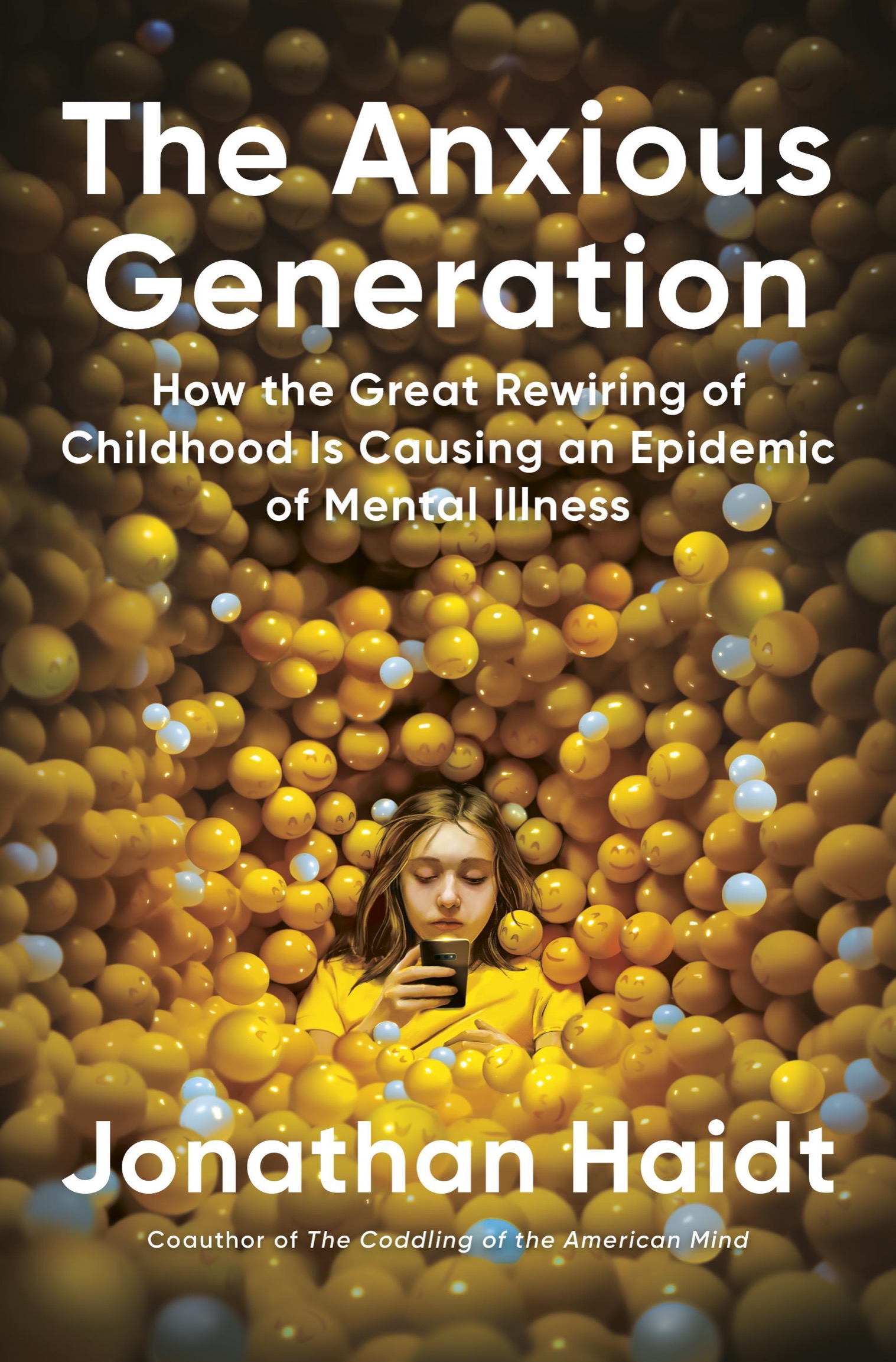
The Anxious Generation: How the Great Rewiring of Childhood Is Causing an Epidemic of Mental Illness
About this book
The Anxious Generation begins with a broad change Jonathan Haidt calls the Great Rewiring: during the early 2010s, smartphones and social platforms became central to adolescence at the same time that unsupervised play and independent movement continued to decline.
Haidt assembles mental-health trends, developmental research, platform design, and differences in how boys and girls use online space. His case is causal as well as descriptive: he argues that social deprivation, sleep loss, fragmented attention, and addictive feedback loops help explain the rise in distress.
The book places the phone-based childhood against a play-based one in which risk, negotiation, and face-to-face conflict allow children to practice autonomy. Adults, in this account, have overprotected children in the physical world while underprotecting them online.
The final sections propose coordinated changes for families, schools, technology companies, and governments. Whether or not every part of the diagnosis convinces, the book gives a clear framework for debating age limits, school phone policies, free play, and the obligations built into digital products for children.
Read a sample
5,049 words
Plain text
From the opening
Introduction
Growing Up on Mars
Suppose that when your first child turned ten, a visionary billionaire whom you’ve never met chose her to join the first permanent human settlement on Mars. Her academic performance—plus an analysis of her genome, which you don’t remember giving consent for—clinched her a spot. Unbeknownst to you, she had signed herself up for the mission because she loves outer space, and, besides, all of her friends have signed up. She begs you to let her go.
Before saying no, you agree to learn more. You learn that the reason they’re recruiting children is that they adapt better to the unusual conditions of Mars than adults, particularly the low gravity. If children go through puberty and its associated growth spurt on Mars, their bodies will be permanently tailored to it, unlike settlers who come over as adults. At least that’s the theory. It is unknown whether Mars-adapted children would be able to return to Earth.
You find other reasons for fear. First, there’s the radiation. Earth’s flora and fauna evolved under the protective shield of the magnetosphere, which blocks or diverts most of the solar wind, cosmic rays, and other streams of harmful particles that bombard our planet. Mars doesn’t have such a shield, so a far greater number of ions would shoot through the DNA of each cell in your daughter’s body. The project’s planners have built protective shields for the Mars settlement based on studies of adult astronauts, who have a slightly elevated risk of cancer after spending a year in space.[1] But children are at an even higher risk, because their cells are developing and diversifying more rapidly and would experience higher rates of cellular damage. Did the planners take this into account? Did they do any research on child safety at all? As far as you can tell, no.
And then there’s gravity. Evolution optimized the structure of every creature over eons for the gravitational force on our particular planet. From birth onward, each creature’s bones, joints, muscles, and cardiovascular system develop in response to the unchanging one-way pull of gravity. Removing this constant pull profoundly affects our bodies. The muscles of adult astronauts who spend months in the weightlessness of space become weaker, and their bones become less dense. Their body fluids collect in places where they shouldn’t, such as the brain cavity, which puts pressure on the eyeballs and changes their shape.[2] Mars has gravity, but it’s only 38% of what a child would experience on Earth. Children raised in the low-gravity environment of Mars would be at high risk of developing deformities in their skeletons, hearts, eyes, and brains. Did the planners take this vulnerability of children into account? As far as you can tell, no.
So, would you let her go?
Of course not. You realize this is a completely insane idea—sending children to Mars, perhaps never to return to Earth. Why would any parent allow it? The company behind the project is racing to stake its claim to Mars before any rival company. Its leaders don’t seem to know anything about child development and don’t seem to care about children’s safety. Worse still: The company did not require proof of parental permission. As long as a child checks a box stating she has obtained parental permission, she can blast off to Mars.
No company could ever take our children away and endanger them without our consent, or they would face massive liabilities. Right?
At the turn of the millennium, technology companies based on the West Coast of the United States created a set of world-changing products that took advantage of the rapidly growing internet. There was a widely shared sense of techno-optimism; these products made life easier, more fun, and more productive. Some of them helped people to connect and communicate, and therefore it seemed likely they would be a boon to the growing number of emerging democracies. Coming soon after the fall of the Iron Curtain, it felt like the dawn of a new age. The founders of these companies were hailed as heroes, geniuses, and global benefactors who, like Prometheus, brought gifts from the gods to humanity.
But the tech industry wasn’t just transforming life for adults. It began transforming life for children too. Children and adolescents had been watching a lot of television since the 1950s, but the new technologies were far more portable, personalized, and engaging than anything that came before. Parents discovered this truth early, as I did in 2008, when my two-year-old son mastered the touch-and-swipe interface of my first iPhone. Many parents were relieved to find that a smartphone or tablet could keep a child happily engaged and quiet for hours. Was this safe? Nobody knew, but because everyone else was doing it, everyone just assumed that it must be okay.
Yet the companies had done little or no research on the mental health effects of their products on children and adolescents, and they shared no data with researchers studying the health effects. When faced with growing evidence that their products were harming young people, they mostly engaged in denial, obfuscation, and public relations campaigns.[3] Companies that strive to maximize “engagement” by using psychological tricks to keep young people clicking were the worst offenders. They hooked children during vulnerable developmental stages, while their brains were rapidly rewiring in response to incoming stimulation. This included social media companies, which inflicted their greatest damage on girls, and video game companies and pornography sites, which sank their hooks deepest into boys.[4] By designing a firehose of addictive content that entered through kids’ eyes and ears, and by displacing physical play and in-person socializing, these companies have rewired childhood and changed human development on an almost unimaginable scale. The most intense period of this rewiring was 2010 to 2015, although the story I will tell begins with the rise of fearful and overprotective parenting in the 1980s and continues through the COVID pandemic to the present day.
Continue reading the sampleClose the sample
What legal limits have we imposed on these tech companies so far? In the United States, which ended up setting the norms for most other countries, the main prohibition is the Children’s Online Privacy Protection Act (COPPA), enacted in 1998. It requires children under 13 to get parental consent before they can sign a contract with a company (the terms of service) to give away their data and some of their rights when they open an account. That set the effective age of “internet adulthood” at 13, for reasons that had little to do with children’s safety or mental health.[5] But the wording of the law doesn’t require companies to verify ages; as long as a child checks a box to assert that she’s old enough (or puts in the right fake birthday), she can go almost anywhere on the internet without her parents’ knowledge or consent. In fact, 40% of American children under 13 have created Instagram accounts,[6] yet there has been no update of federal laws since 1998. (The U.K., on the other hand, has taken some initial steps, as have a few U.S. states.[7])
A few of these companies are behaving like the tobacco and vaping industries, which designed their products to be highly addictive and then skirted laws limiting marketing to minors. We can also compare them to the oil companies that fought against the banning of leaded gasoline. In the mid-20th century, evidence began to mount that the hundreds of thousands of tons of lead put into the atmosphere each year, just by drivers in the United States, were interfering with the brain development of tens of millions of children, impairing their cognitive development and increasing rates of antisocial behavior. Even still, the oil companies continued to produce, market, and sell it.[8]
Of course, there is an enormous difference between the big social media companies today and, say, the big tobacco companies of the mid-20th century: Social media companies are making products that are useful for adults, helping them to find information, jobs, friends, love, and sex; making shopping and political organizing more efficient; and making life easier in a thousand ways. Most of us would be happy to live in a world with no tobacco, but social media is far more valuable, helpful, and even beloved by many adults. Some adults have problems with addiction to social media and other online activities, but as with tobacco, alcohol, or gambling we generally leave it up to them to make their own decisions.
The same is not true for minors. While the reward-seeking parts of the brain mature earlier, the frontal cortex—essential for self-control, delay of gratification, and resistance to temptation—is not up to full capacity until the mid-20s, and preteens are at a particularly vulnerable point in development. As they begin puberty, they are often socially insecure, easily swayed by peer pressure, and easily lured by any activity that seems to offer social validation. We don’t let preteens buy tobacco or alcohol, or enter casinos. The costs of using social media, in particular, are high for adolescents, compared with adults, while the benefits are minimal. Let children grow up on Earth first, before sending them to Mars.
This book tells the story of what happened to the generation born after 1995,[9] popularly known as Gen Z, the generation that follows the millennials (born 1981 to 1995). Some marketers tell us that Gen Z ends with the birth year 2010 or so, and they offer the name Gen Alpha for the children born after that, but I don’t think that Gen Z—the anxious generation—will have an end date until we change the conditions of childhood that are making young people so anxious.[10]
Thanks to the social psychologist Jean Twenge’s groundbreaking work, we know that what causes generations to differ goes beyond the events children experience (such as wars and depressions) and includes changes in the technologies they used as children (radio, then television, personal computers, the internet, the iPhone).[11] The oldest members of Gen Z began puberty around 2009, when several tech trends converged: the rapid spread of high-speed broadband in the 2000s, the arrival of the iPhone in 2007, and the new age of hyper-viralized social media. The last of these was kicked off in 2009 by the arrival of the “like” and “retweet” (or “share”) buttons, which transformed the social dynamics of the online world. Before 2009, social media was most useful as a way to keep up with your friends, and with fewer instant and reverberating feedback functions it generated much less of the toxicity we see today.[12]
A fourth trend began just a few years later, and it hit girls much harder than boys: the increased prevalence of posting images of oneself, after smartphones added front-facing cameras (2010) and Facebook acquired Instagram (2012), boosting its popularity. This greatly expanded the number of adolescents posting carefully curated photos and videos of their lives for their peers and strangers, not just to see, but to judge.
Gen Z became the first generation in history to go through puberty with a portal in their pockets that called them away from the people nearby and into an alternative universe that was exciting, addictive, unstable, and—as I will show—unsuitable for children and adolescents. Succeeding socially in that universe required them to devote a large part of their consciousness—perpetually—to managing what became their online brand. This was now necessary to gain acceptance from peers, which is the oxygen of adolescence, and to avoid online shaming, which is the nightmare of adolescence. Gen Z teens got sucked into spending many hours of each day scrolling through the shiny happy posts of friends, acquaintances, and distant influencers. They watched increasing quantities of user-generated videos and streamed entertainment, offered to them by autoplay and algorithms that were designed to keep them online as long as possible. They spent far less time playing with, talking to, touching, or even making eye contact with their friends and families, thereby reducing their participation in embodied social behaviors that are essential for successful human development.
The members of Gen Z are, therefore, the test subjects for a radical new way of growing up, far from the real-world interactions of small communities in which humans evolved. Call it the Great Rewiring of Childhood. It’s as if they became the first generation to grow up on Mars.
The Great Rewiring is not just about changes in the technologies that shape children’s days and minds. There’s a second plotline here: the well-intentioned and disastrous shift toward overprotecting children and restricting their autonomy in the real world. Children need a great deal of free play to thrive. It’s an imperative that’s evident across all mammal species. The small-scale challenges and setbacks that happen during play are like an inoculation that prepares children to face much larger challenges later. But for a variety of historical and sociological reasons, free play began to decline in the 1980s, and the decline accelerated in the 1990s. Adults in the United States, the U.K., and Canada increasingly began to assume that if they ever let a child walk outside unsupervised, the child would attract kidnappers and sex offenders. Unsupervised outdoor play declined at the same time that the personal computer became more common and more inviting as a place for spending free time.[*]
I propose that we view the late 1980s as the beginning of the transition from a “play-based childhood” to a “phone-based childhood,” a transition that was not complete until the mid-2010s, when most adolescents had their own smartphone. I use “phone-based” broadly to include all of the internet-connected personal electronics that came to fill young people’s time, including laptop computers, tablets, internet-connected video game consoles, and, most important, smartphones with millions of apps.
When I speak of a play-based or phone-based “childhood,” I’m using that term broadly too. I mean it to include both children and adolescents (rather than having to write out “phone-based childhood and adolescence”). Developmental psychologists often mark the transition between childhood and adolescence as being the onset of puberty, but because puberty arrives at different times for different kids, and because it has been shifting younger in recent decades, it is no longer correct to equate adolescence to the teen years.[13] This is how age will be categorized in the rest of this book:
Children: 0 through 12.
Adolescents: 10 through 20.
Teens: 13 through 19.
Minors: Everyone who is under 18. I’ll also use the word “kids” sometimes, because it sounds less formal and technical than “minors.”
The overlap between children and adolescents is intentional: Kids who are 10 to 12 are between childhood and adolescence, and are often called tweens for that reason. (This period is also known as early adolescence.) They are as playful as younger children, yet they are beginning to develop the social and psychological complexities of adolescents.
As the transition from play-based to phone-based childhood proceeded, many children and adolescents were perfectly happy to stay indoors and play online, but in the process they lost exposure to the kinds of challenging physical and social experiences that all young mammals need to develop basic competencies, overcome innate childhood fears, and prepare to rely less on their parents. Virtual interactions with peers do not fully compensate for these experiential losses. Moreover, those whose playtime and social lives moved online found themselves increasingly wandering through adult spaces, consuming adult content, and interacting with adults in ways that are often harmful to minors. So even while parents worked to eliminate risk and freedom in the real world, they generally, and often unknowingly, granted full independence in the virtual world, in part because most found it difficult to understand what was going on there, let alone know what to restrict or how to restrict it.
My central claim in this book is that these two trends—overprotection in the real world and underprotection in the virtual world—are the major reasons why children born after 1995 became the anxious generation.
A few notes about terminology. When I talk about the “real world,” I am referring to relationships and social interactions characterized by four features that have been typical for millions of years:
They are embodied, meaning that we use our bodies to communicate, we are conscious of the bodies of others, and we respond to the bodies of others both consciously and unconsciously.
They are synchronous, which means they are happening at the same time, with subtle cues about timing and turn taking.
They involve primarily one-to-one or one-to-several communication, with only one interaction happening at a given moment.
They take place within communities that have a high bar for entry and exit, so people are strongly motivated to invest in relationships and repair rifts when they happen.
In contrast, when I talk about the “virtual world,” I am referring to relationships and interactions characterized by four features that have been typical for just a few decades:
They are disembodied, meaning that no body is needed, just language. Partners could be (and already are) artificial intelligences (AIs).
They are heavily asynchronous, happening via text-based posts and comments. (A video call is different; it is synchronous.)
They involve a substantial number of one-to-many communications, broadcasting to a potentially vast audience. Multiple interactions can be happening in parallel.
They take place within communities that have a low bar for entry and exit, so people can block others or just quit when they are not pleased. Communities tend to be short-lived, and relationships are often disposable.
In practice, the lines blur. My family is very much real world, even though we use FaceTime, texting, and email to keep in touch. Conversely, a relationship between two scientists in the 18th century who knew each other only from an exchange of letters was closer to a virtual relationship. The key factor is the commitment required to make relationships work. When people are raised in a community that they cannot easily escape, they do what our ancestors have done for millions of years: They learn how to manage relationships, and how to manage themselves and their emotions in order to keep those precious relationships going. There are certainly many online communities that have found ways to create strong interpersonal commitments and a feeling of belonging, but in general, when children are raised in multiple mutating networks where they don’t need to use their real names and they can quit with the click of a button, they are less likely to learn such skills.
This book has four parts. THEY explain the mental health trends among adolescents since 2010 (part 1); the nature of childhood and how we messed it up (part 2); the harms that result from the new phone-based childhood (part 3); and what we must do now to reverse the damage in our families, schools, and societies (part 4). Change is possible, if we can act together.
Part 1 has a single chapter laying out the facts about the decline in teen mental health and wellbeing in the 21st century, showing how devastating the rapid switch to a phone-based childhood has been. The decline in mental health is indicated by a sharp rise in rates of anxiety, depression, and self-harm, beginning in the early 2010s, which hit girls hardest. For boys, the story is more complicated. The increases are often smaller (except for suicide rates), and they sometimes begin a bit earlier.
Part 2 gives the backstory. The mental health crisis of the 2010s has its roots in the rising parental fearfulness and overprotection of the 1990s. I show how smartphones, along with overprotection, acted like “experience blockers,” which made it difficult for children and adolescents to get the embodied social experiences they needed most, from risky play and cultural apprenticeships to rites of passage and romantic attachments.
In part 3, I present research showing that a phone-based childhood disrupts child development in many ways. I describe four foundational harms: sleep deprivation, social deprivation, attention fragmentation, and addiction. I then zoom in on girls[*] to show that social media use does not just correlate with mental illness; it causes it, and I lay out the empirical evidence showing multiple ways that it does so. I explain how boys came to their poor mental health by a slightly different route. I show how the Great Rewiring contributed to their rising rates of “failure to launch”—that is, to make the transition from adolescence to adulthood and its associated responsibilities. I close part 3 with reflections on how a phone-based life changes us all—children, adolescents, and adults—by bringing us “down” on what I can only describe as a spiritual dimension. I discuss six ancient spiritual practices that can help us all live better today.
In part 4, I lay out what we can and must do now. I offer advice, based on research, for what tech companies, governments, schools, and parents can do to break out of a variety of “collective action problems.” These are traps long studied by social scientists in which an individual acting alone faces high costs, but if people can coordinate and act together, they can more easily choose actions that are better for all in the long run.
As a professor at New York University who teaches graduate and undergraduate courses, and who speaks at many high schools and colleges, I have found that Gen Z has several great strengths that will help them drive positive change. The first is that they are not in denial. They want to get stronger and healthier, and most are open to new ways of interacting. The second strength is that they want to bring about systemic change to create a more just and caring world, and they are adept at organizing to do so (yes, using social media). In the last year or so, I’ve been hearing about an increasing number of young people who are turning their attention to the ways the tech industry exploits them. As they organize and innovate, they’ll find new solutions beyond those I propose in this book, and they’ll make them happen.
I am a social psychologist, not a clinical psychologist or a media studies scholar. But the collapse of adolescent mental health is an urgent and complex topic that we can’t understand from any one disciplinary perspective. I study morality, emotion, and culture. Along the way I’ve picked up some tools and perspectives that I’ll bring to the study of child development and adolescent mental health.
I have been active in the field of positive psychology since its birth in the late 1990s, immersed in research on the causes of happiness. My first book, The Happiness Hypothesis, examines 10 “great truths” that ancient cultures East and West discovered about how to live a flourishing life.
Based on that book, I taught a course called Flourishing when I was a professor of psychology at the University of Virginia (until 2011), and I teach versions of it now at NYU’s Stern School of Business, to undergraduates and to MBA students. I have seen the rising levels of anxiety and device addiction as my students have changed from millennials using flip phones to Gen Z using smartphones. I have learned from their candor in discussing their mental health challenges and their complex relationships with technology.
My second book, The Righteous Mind, lays out my own research on the evolved psychological foundations of morality. I explore the reasons why good people are divided by politics and religion, paying special attention to people’s needs to be bound into moral communities that give them a sense of shared meaning and purpose. This work prepared me to see how online social networks, which can be useful for helping adults achieve their goals, may not be effective substitutes for real-world communities within which children have been rooted, shaped, and raised for hundreds of thousands of years.
But it was my third book that led me directly to the study of adolescent mental health. My friend Greg Lukianoff was among the first to notice that something had changed very suddenly on college campuses as students began engaging in exactly the distorted thinking patterns that Greg had learned to identify and reject when he learned CBT (cognitive behavioral therapy) after a severe episode of depression in 2007. Greg is a lawyer and the president of the Foundation for Individual Rights and Expression, which has long helped students defend their rights against censorious campus administrators. In 2014, he saw something strange happening: Students themselves began demanding that colleges protect them from books and speakers that made them feel “unsafe.” Greg thought that universities were somehow teaching students to engage in cognitive distortions such as catastrophizing, black-and-white thinking, and emotional reasoning, and that this could actually be causing students to become depressed and anxious. In August 2015, we presented this idea in an Atlantic essay titled “The Coddling of the American Mind.”
We were only partially correct: Some college courses and new academic trends[14] were indeed inadvertently teaching cognitive distortions. But by 2017 it had become clear that the rise of depression and anxiety was happening in many countries, to adolescents of all educational levels, social classes, and races. On average, people born in and after 1996 were different, psychologically, from those who had been born just a few years earlier.
We decided to expand our Atlantic article into a book with the same title. In it, we analyzed the causes of this mental illness crisis, drawing on Jean Twenge’s 2017 book, iGen. At the time, however, nearly all evidence was correlational: Soon after teens got iPhones, they started getting more depressed. The heaviest users were also the most depressed, while those who spent more time in face-to-face activities, such as on sports teams and in religious communities, were the healthiest.[15] But given that correlation is not proof of causation, we cautioned parents not to take drastic action on the basis of existing research.
Now, as I write in 2023, there’s a lot more research—experimental as well as correlational—showing that social media harms adolescents, especially girls going through puberty.[16] I have also discovered, while doing the research for this book, that the causes of the problem are broader than I had initially thought. It’s not just about smartphones and social media; it’s about a historic and unprecedented transformation of human childhood. The transformation is affecting boys as much as girls.
We have more than a century of experience in making the real world safe for kids. Automobiles became popular in the early 20th century and tens of thousands of children died in them until eventually we mandated seat belts (in the 1960s) and then car seats (in the 1980s).[17] When I was in high school in the late 1970s, many of my fellow students smoked cigarettes, which they could easily buy from vending machines. Eventually, America banned those machines, inconveniencing adult smokers, who then had to purchase cigarettes from a store clerk who could verify their age.[18]
Over the course of many decades, we found ways to protect children while mostly allowing adults to do what they want. Then quite suddenly, we created a virtual world where adults could indulge any momentary whim, but children were left nearly defenseless. As evidence mounts that phone-based childhood is making our children mentally unhealthy, socially isolated, and deeply unhappy, are we okay with that trade-off? Or will we eventually realize, as we did in the 20th century, that we sometimes need to protect children from harm even when it inconveniences adults?
I’ll offer many ideas for reforms in part 4, all of which aim to reverse the two big mistakes we’ve made: overprotecting children in the real world (where they need to learn from vast amounts of direct experience) and underprotecting them online (where they are particularly vulnerable during puberty). The suggestions I offer are based on the research I present in parts 1 through 3. Since the research findings are complicated and some of them are contested among researchers, I will surely be wrong on some points, and I will do my best to correct any errors by updating the online supplement for the book. Nonetheless, there are four reforms that are so important, and in which I have such a high degree of confidence, that I’m going to call them foundational. They would provide a foundation for healthier childhood in the digital age. They are:
No smartphones before high school. Parents should delay children’s entry into round-the-clock internet access by giving only basic phones (phones with limited apps and no internet browser) before ninth grade (roughly age 14).
No social media before 16. Let kids get through the most vulnerable period of brain development before connecting them to a firehose of social comparison and algorithmically chosen influencers.
Phone-free schools. In all schools from elementary through high school, students should store their phones, smartwatches, and any other personal devices that can send or receive texts in phone lockers or locked pouches during the school day. That is the only way to free up their attention for each other and for their teachers.
Far more unsupervised play and childhood independence. That’s the way children naturally develop social skills, overcome anxiety, and become self-governing young adults.
These four reforms are not hard to implement—if many of us do them at the same time. They cost almost nothing. They will work even if we never get help from our legislators. If most of the parents and schools in a community were to enact all four, I believe they would see substantial improvements in adolescent mental health within two years. Given that AI and spatial computing (such as Apple’s new Vision Pro goggles) are about to make the virtual world far more immersive and addictive, I think we’d better start today.
While writing The Happiness Hypothesis, I came to have great respect for ancient wisdom and the discoveries of previous generations. What would the sages advise us today about managing our phone-based lives? They’d tell us to get off our devices and regain control of our minds. Here is Epictetus, in the first century CE, lamenting the human tendency to let others control our emotions: