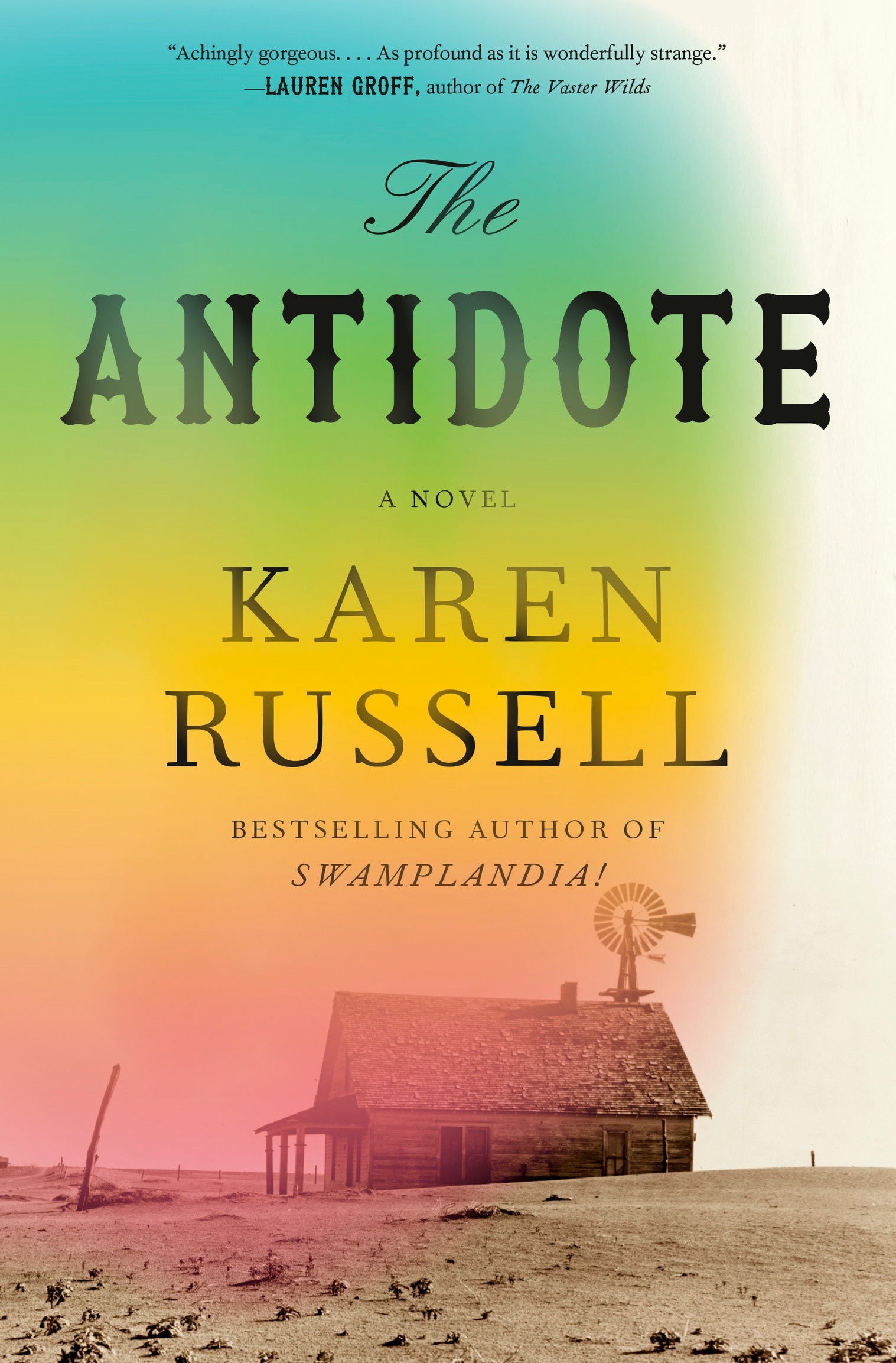
The Antidote
About this book
The dust storm that engulfs Uz is spectacular but not unprecedented: drought, economic collapse, dispossession, and local violence have already stripped the town of certainty. A Prairie Witch offers to hold memories for clients who cannot bear or cannot risk keeping them.
Her fate becomes entangled with a Polish wheat farmer, his grieving niece, a strangely articulate scarecrow, and a federal photographer whose camera records more than the present. Each carries a different relation to land and to the stories official history will preserve.
Magic exposes rather than replaces the material history of the Dust Bowl. Rain, seed, debt, photographs, and stolen memory all become contested resources, and the characters must decide whether forgetting is relief, complicity, or another form of theft.
The Antidote is Karen Russell's historical fantasy about ecological disaster and public memory. Its multiple voices create a town-sized argument over who owns the past, especially when the record of survival has been built by excluding the people who paid for it.
Read a sample
5,097 words
Plain text
From the opening
Prologue
Deposit 69818060-1-77 Harp Oletsky’s First Memory
It is nowhere you chose to be, and yet here you are. Papa steers your shoulders into the heart of the jack drive. Hundreds of rabbits stare at you through the wire around the fence posts. It feels like looking into the mirror. They do not want to be in this story either. Men have been working since dawn to herd the wild jacks into this pen. The town has gathered to solve the problem of the rabbits, who chew through rangeland and cropland, who eat the golden wheat your papa turns into money. Worse than the locusts, says Papa. Every hide brings a penny bounty. So many turnipy sweating bodies and a festive feeling in the air like a penny rubbed between two fingers, like blood shocked into a socket. A smell that reminds you of the room where babies are born. When you try to turn and run away, Papa grabs you. There’s Mr. O’Malley, Mr. Waldowko, Mr. Zalewski, Mrs. Haage. You can’t remember any more names. A hundred jointed arms come swinging into the pen that is alive with jackrabbits, the place of no escape. Now there is only madness. Terror of cudgels, terror of ax handles and hammers, terror of being trampled. “Papa! Help! Stop!” Rabbits run over your feet. “Settle down, Harp—” Papa is angry. He pours your name over your head like scalding water. The rabbits are angry. The rabbits are crying and dying, the clubs coming down, down, down. “If you ain’t gonna help, stay clear of us, boy—” You are six today. Your family will have a party after supper. The cake was cooling when you left for town. You feel sick thinking about it. Cherries come slopping out of the rabbits. Gray skins are splitting, slipping under bootheels and wooden bats. Papa shows you what to target: the skulls and the spines of the screaming jacks. It’s the fastest way to stop their screaming. There is another way, a voice cries out inside you. Smash it flat. You watch Papa click into his rhythm and begin to kill alongside the rest of the men.
You meet your baby sister’s gaze through the fan of her clean fingers. Lada is sitting on your mother’s lap. Three girls you know are watching from outside the fence. The girls are allowed to squeal and shield their faces. You wish you were a girl with them. Down, down, down come the clubs and the planks. Your stomach bulges and flattens. You are screaming with the rabbits. Your birthday wish is to get to the end of this sound. Quiet comes at last. The men’s arms rest against their sides like tools in a shed. Women are hanging the dead jacks to dry by their long ears. Every twitching rabbit’s foot has stilled. Inside of you, the screaming continues. It goes on and on and on. Papa finds you where you have hidden your eyes behind your hands, your tears inside your palms. “We can’t let the jacks overrun the whole prairie. No one likes it, Son.” This is a lie. Many had liked it. You shut your eyes along with the dead rabbits, because you did not want to see whose faces were smiling.
“Here,” says Papa. “One is still living. You cannot be softhearted, Harp.”
Your father puts the club in your hands. And after that, you are always afraid.
Section I
Collapse
The Prairie Witch
A person can lose everything in an instant. A fortune, a family, the sun. I’ve had to learn this lesson twice in my life. The first time it happened, I was a fifteen-year-old fugitive from the Home for Unwed Mothers. The second time, I was a prairie witch chained to my cot in a cinder-block jailhouse. “Your second home,” the Sheriff liked to say. Officially, I do not exist in his West; nevertheless, it is a crime to pay me a visit.
On Black Sunday, before anybody knew to call it Black Sunday, I woke up in the jailhouse to a sound like a freight train tunneling through me. An earsplitting howl that seemed to shake the stone walls. My body trembled like a husk on the cot. My fingers clawed into the mattress. For those early moments in the dark I was nothing but the fear of floating off. What had happened to me while I slept? It felt as if a knife had scraped the marrow from my bones. Something vital inside me had liquefied and drained away, and in its place was this new weightlessness. Lightness and wrongness, a blanketing whiteness that ran up my spine and seeped out of my mouth. Bankrupt was the word that rose in my mind. At first, I did not recognize the voice crying out for help as my own. I clamped down on the sound, panicked—I could not afford to lose any more ballast. My numb limbs began to prickle with feeling, pins and needles stitching them back to my brain. It was not a happy reunion. Ten white toes sprouted like mushrooms on the edge of a filthy green blanket, waving to me from the outermost limit of what I could make out. A kerosene lantern in the hallway gave off a feeble emerald glow, beyond which the cell plunged into shadow. Not even the pain was mine. It came and went like the wind. Then it drilled through my skin and swallowed the world.
Continue reading the sampleClose the sample
Or perhaps the black blizzard was already well under way when I woke up. Choking heat filled the jailhouse, along with lashing tails of dust. It occurred to me that I might be buried here before I could recollect who I was. Minutes and hours lost all meaning for me; I balled up on the cot and prepared to be pulled apart by a cyclone. Eventually the winds began to weaken. Light cut a pathway across the turbulent sky—I watched a pale line brightening and widening through the small cell window. A greenish disc hung above the cloud wall, and it took me ages to recognize the sun. It was not midnight after all, but well past noon.
I began to remember more about the land beyond this cell, the edgeless prairie. The name of the town where I worked returned to me: Uz, Nebraska, southeast of the Sandhills and west of the Platte River. We were four years into the worst drought that any newcomer to the Great Plains had ever experienced. Other beings kept older diaries. Cored cottonwood trees told a millennial story written in wavy circles that no politician had cared to read. Congressmen train themselves to think in election cycles, not planetary ones. They see spiking market highs and lows, and forget how to read in circles. Uz had been having brownouts for months. Plagues of jaws and mandibles. Grasshoppers rattled down on the tractor cabs from hissing clouds. Thousands of jackrabbits fanned over the Plains, chewing through anything green. Winged indigo beetles blew in from God alone knew where, husks shaped like hourglasses that nobody on the High Plains had ever seen before 1931. Red sand from Oklahoma and black dirt from Kansas and dove gray earth from the eastern plains of Colorado formed a rolling ceiling of dust above Uz that flashed with heat lightning.
The Sheriff and his family lived in a two-story brick frame house facing the jail, parts and blueprint purchased from the Sears, Roebuck catalog. It sat on the free side of the property, five hundred yards beyond the bars of my two-foot-by-two-foot window. As the dust blew into my cell, outside things became less and less real. The Sheriff’s house slimmed to a charcoal sketch. Erased, redrawn, and finally lost to sight. The sky was well and truly falling.
At last I forced myself to scream for help. It felt terrifying to release so much breath at once—the lightness rushed into my head. No one responded. How long had I been trapped here? The cell was seven feet by eight feet, and furnished with nothing but the cot and a tin bucket half-filled with the previous inmate’s piss. Or my own, perhaps. It seemed I was the only prisoner left inside the jailhouse. But I was wrong about that. Something pounced lightly onto my chest, then launched up to the ledge of the cell window—a huge bristling cat, whose carroty fur seemed absurdly bright. Her ears pitched forward, her claws tensing on the ledge. Her golden eyes regarded me serenely. Nothing called to the animal that I could hear. But a moment later, the cat slipped through the bars and jumped nimbly into the whirlwind.
Just as she leapt, I recognized her—the Sheriff’s cat, a flatulent tabby who often slept on my chest during my stays in the jailhouse. The Sheriff, out of stupidity or laziness, called her nothing at all, not even Cat. A memory wailed awake inside me: the Sheriff had once drowned a litter of her kittens in a washbasin within earshot of my cell. Five infant voices flooded through me, clawing at the soft walls within the walls. Again I heard the splash as the bag went under. Displaced water had come trickling down the hall while their silence deepened to permanence. The Sheriff had caged the mother cat in a nearby closet, locking us both into impotent witness. Her angry cries had blended with her children’s dissolving ones. The last voices in the world could not have sounded more forlorn.
A stupid man can still be a savant at torture. The Sheriff had squatted on his haunches in front of Cell 8, grinning through the bars at me as he poured fresh milk into a bowl for the dead kittens’ mother. “What a racket, eh? You’ll forget that nasty business in a snap. A powerful witch like you…”
My job returned to me before my name did. Yes, I am the Antidote I learned, and remembered. I am a prairie witch. A door swung open onto my life. Now I could picture my rented room in the boardinghouse. My poster facing the street from the third-floor window, hand-lettered for me by the calligrapher in Kinkaid gold: THE ANTIDOTE OF UZ! NOW ACCEPTING DEPOSITS. I advertised my banking services as a panacea for every ailment from heartburn to nightmares. Some of my customers, I recalled, had made up a little jingle about me, taking the lyrics from my poster:
“The Antidote to lovesickness! The Antidote to grief! The Antidote to gas pains! The Antidote to guilt! The Antidote to sleepless nights! The Antidote to sweaty palms! The Antidote to daydreaming! The Antidote to shame!”
Most everyone on the Great Plains knew about us, even those who denied our existence. The Vaults, some called us. The prairie witches. Now I remembered what I did to earn my bread—what I had been doing since I was a much younger woman. Absorbing and storing my customers’ memories. Banking secrets for the townspeople of Uz. Sins and crimes, first and last times, nights of unspeakable horror and dewdrop blue mornings—or who knew what my customers had transferred from their bodies into mine? These were only my guesses. I disappeared into a spacious blankness during my transfers. A prairie witch’s body is a room for rent. A vault to store the things people cannot stand to know, or bear to forget.
Half the town of Uz banked with me, and even those who denounced me as a fraud and a blackmailer knew that I was open for business in Room 11. People came and paid me to store some portion of their lives. A memory that felt too heavy to carry into the future, or too precious for daily reminiscence. As they whispered their stories into my green earhorn, memories lifted out of their bodies and into mine. It was a painless exchange. Nothing my customers told me had ever disturbed me, because I was not awake to hear them. Cocooned in blue trance, I could dilate to absorb anything. I did not return to my waking mind until a transfer was completed. “I know as little about what I contain,” I reassured my customers, “as a safety deposit box knows about its rocks. As a jar of pickling vinegar knows about its floating roots.” As an attic knows about its ghosts. Their dead were alive inside me, patiently waiting to be recollected. The weight of these deposits refreighted me. After a transfer, I often felt a heavy ache in my rib cage or my pelvis—sometimes a swimmy brightness like goldfish circling my chest—and in this way I knew that our exchange had been a success. My new customers would smile sheepishly at me and say, “I wonder what I just told you, ma’am? It’s gone clean out of my head!”
Now I understood why my body felt so frighteningly light, why the word bankruptcy kept running through my mind. Something had happened to me that I had not known to fear.
Fifteen years of deposits, somehow, had been siphoned from me while I slept. Drawn from my flesh, like vapor from a leaf. Where had they all gone? Out of my body and into the whirlwind? Were they still intact somewhere? Or had they dispersed with the dust? With each roomy breath, I learned more about the shape and the scale of what I’d lost. I rolled onto my side and pulled up my nightgown—a repurposed sackcloth from GROVER’S ORCHARDS, too short for a woman my height, printed with repeating sandy peaches that seemed to shrivel and ripen with each breath. I palpated my stomach with my fists, as if the thousands of secrets I’d housed might merely be misplaced.
To be clear, I hadn’t forgotten these secrets, because I’d never known them in the first place. Or perhaps that’s not entirely true. I knew them the way I knew you, my Son, before you were born. Nestled in my body, as pressure and weight. Memories are living things. When you house as many as I did, your bones begin to creak. Now I felt in danger of evaporating myself.
As it turned out, I was not alone. Farmers all over the Plains were losing their entire harvests at this very moment. Families hid in their cellars while the clouds grew fat with black earth. The sky became a growling belly. Uzians caught out in their fields when the darkness eclipsed the sun believed they’d gone blind.
Many of these same farmers and ranchers had also—unbeknownst to them—just lost huge tracts of the past. The days and the nights I’d held in reserve for them while they went about the business of living. My customers who had banked with me loyally since my arrival in Uz would soon learn about my crash—how could I prevent it? They’d come to make their withdrawals, and I’d have nothing to return to them. I had retained only a palmful of facts about my solitary life.
I have always kept scrupulous records. I could tell you who visited me on July 12 of 1927, and the duration of the visit. I could tell you to the penny how much money I made in Uz County between the years of 1920 and 1935. But what did it matter if I’d charged this client two dollars, and this one two hundred? None of the numbers I’d inked into my ledger had anything real to say about the vastness of what I’d just lost. It was spasms in my belly and the clawing grief.
Black Sunday, before the newspapermen named it and swept it into history, pulverized the region now known as the “Great Dust Bowl.” Like so many of my neighbors, I woke to ruin. In the center of the storm, I believed that the worst had happened. But I was wrong about that. The dust had another lesson to teach me: so long as you’re still drawing breath, there’s always more to lose.
Home. Home. I tugged at the word until a world rose up. Chained to the cot, dirt inflaming my nostrils, I smiled in the dark. I believed I’d lost everything, but I hadn’t after all. I remember You. Hope grew inside me then. Unstoppably, as You once grew. I pictured green leaves twining around my rib cage, tethering me to my memories of You. Your slippery, seven-pound body and your strong wail. Every kick and twist, I rehearsed in my mind. Even the ache of losing You, I welcomed home. It was the weight I needed to sit up and plant my feet on the floor of the cell. As long as there’s a chance of our reunion, Son, I promise You that I will go on living.
On the night that You were born, one of the nurses at the Milford Home for Unwed Mothers risked her job to let me hold You. Lie back, she said, and let your baby drink. He knows what to do, honey. See that? He was born for this. I had never met such a hungry creature, so eager to live. I hadn’t guessed my body could meet another being’s needs so completely. You cried out, and I realized with wonder that I was the one You were calling for. I was the answer to your question. The antidote to your distress, your fear, your ravening hunger, your life-thirst. I stared into your fierce, dark eyes, born open. We fluttered in and out of sleep together, in a dream of milk and heat and love. Then came the block of hours which were stolen from me—I believe now that I was drugged. We are sorry, but you lost your baby, a new nurse told me when I awoke. The sensation of my milk lifting through my breasts to flood your mouth was barely a memory when a doctor I had never seen before handed me your death certificate. Those monsters with their sad smiles lied to me. I knew You were alive.
Are You still?
Asphodel Oletsky
You know, if you sync up your breath with the thing breathing behind you, you can barely hear it at all.
On the morning of April 14, I was the only girl on the prairie court. I liked to play two-on-two with Valeria and Pazi and Nell whenever they could sneak away, but that afternoon I was alone. I’d refused to go to Mass with my uncle that morning, our Sunday ritual. When I first arrived in Uz, I went to the Polish church with him for a solid three months. So many whiskery parishioners felt compelled to tell me that if my mother hadn’t eloped with that deviant, that swindler—my father, a man unknown to me—she would never have been murdered.
“Lada was such a timid little flower. Such a sweet girl, before she run off with that roustabout,” said one Polish grandmother who smelled like borax and Grape Sparkle. “She’d be alive, had she only stayed in Uz—”
“Well, buscia,” my uncle had interrupted. “That’s true. But if she’d stayed with us, her daughter wouldn’t be alive. It’s the killer we must blame for his crime, eh? Not my sister.” For an instant, I felt pure love for my uncle; then my face went hot with shame. What was I doing here, breathing? Using up the air that had been earmarked for her? For the next few weeks, I prayed intently for my mother’s soul, genuflecting on the wavy yellow risers that someone had made out of a forest’s kneecaps. Who knew that prayer could give you splinters? I could not keep it up. Going to Mass at St. Agnieszka feels like attending a headache with fifty strangers. The bells! The holy smoke! Like a hangover without the party. Too many eyes staring at me with pity and superiority. The only gaze I liked to meet belonged to Veronica in the Sixth Station of the Cross, whose onyx eyes were cool and pupilless and capable. Veronica was a great teammate to Jesus, wiping the blood and crud from his face. Once I made varsity, I discovered my own way of worshipping—under the fiery sky, with my basketball. I would rather leap than kneel. I pray to the God who loves to win.
“Maybe next Sunday,” Uncle Harp had muttered, taking my hand through the driver’s side window before releasing the clutch. He shouted a reminder to me that my soul was in jeopardy, then reversed down the sandy cow path to the main highway, the baked ground under his tires coughing yellow dust. This was exactly what his God had done, if you thought about it—disappearing into that remoteness my uncle called heaven, leaving the rest of us poor rubes to rake up the ashes. Uncle Harp prayed for rain every morning, and then he used the wheat comb to dig out the porch. At the start of our last basketball season, Dagmara’s mother gave every player a Red Cross dust mask dyed in our team colors.
When I first came to Uz, coughing woke me every night. I’d sit up in bed with my face in my hands and think for a good moment that my mother was still alive. That we were living in the yellow house in Hubbell. Then I’d remember: she’d been murdered and I’d been sent to live with her gray-haired brother. Every morning that I wake up here, I enter and exit that same tunnel of facts. I wake to a view of the fallowland, tangled in my dead mother’s blue cotton sheets in my dead mother’s bed, a bad dream that has continued for almost two years without interruption.
The detectives in our town never found my mother’s killer, but they did manage to locate her living brother. They shipped me to Uz on August 4, 1933, in the middle of the hottest summer on record. It was 104 degrees on the afternoon my train pulled in. My uncle seemed to feel this record-breaking heat was no coincidence—not that he blamed me, exactly, just saw me as more bad luck.
My hopes had no shape when I stepped onto the train platform at the Uz depot, looking for this uncle I’d never met. When I found him, the fog of hope cinched itself into a disappointment that was exactly Harp Oletsky’s height and shape. This rat-gnawed corncob of a man took my satchel and brushed my hair out of my face as if he were pulling back the curtains—a gesture that made me want to bite him. “Well, you don’t look a thing like her!” he told me. “Your mother was a very pretty child.”
Disappointment was the first thing we ever shared. Harp Oletsky, I realized, had no idea who my mother was. When he said “Lada Oletsky,” he was picturing a baby sister. The youngest mother in my memory is twenty-seven, with her ruby lipstick on at night and her sun-colored freckles. Harp Oletsky had no awareness of my mother’s best qualities, and her other qualities—her very poor judgment of men’s characters; her love of polka music and any kind of party; her struggles to keep hold of jobs and money; her gift for reviving sick birds and bald plants; her laughter that fell like rain inside our house, washing the sticky sadness from the walls; her habit of sticking out her tongue when she was reading or sewing. Right from the start, I understood that I was going to be alone with her. My mama’s only pallbearer. Even dead, she needs my care. I had hoped that Harp Oletsky would help me to remember her. Her real voice was slipping away from me, sounding more and more like my bad ventriloquy. But this stranger could only tell his silly stories about a toddler.
Hopes soar and teach you what a fool you are—Mama used to say this after a new job or a new man disappointed her. Staring into my uncle’s wrinkled face, I felt embarrassed by my hopes. Never once did my uncle come looking for his sister, even though he claimed to be heartbroken when she ran off. “Well, she didn’t run far,” I’d pointed out. The town where we lived on the Kansas border was a three-hour train ride from Uz.
“Lada didn’t want us to find her,” he’d said curtly. “I can show you her letters.”
On my first day in Uz, my uncle toured me around the Oletsky house. He led me to a faded family portrait hanging in the parlor. “This was Lada—” He pointed to a blurry child with a shy expression, clutching a tin watering can. Frozen there forever, never to be liberated, between my custard-colored grandparents and her two unsmiling brothers.
“You Poles all look bewildered or constipated,” I told my uncle.
“You’re a Pole, Dell.”
He followed me throughout the house, saying very little. I could feel his eyes drilling into me like two woodpeckers. He took me upstairs and opened the door onto Mama’s childhood bedroom—my room, now. “Well, Dell,” he said at last. “I can see this ain’t what you pictured. You tell me what’s missing. What would it take to make this place feel like home?”
“My bones in the ground,” I told him. “And even then, I’d just be visiting.”
On Black Sunday, before I knew it was Black Sunday, I picked up my ball and stepped back into the furnace. It had been ninety degrees every day for three weeks. My uncle’s truck bulged on the horizon, twin beams shining up the sparkling mineral inside the dust. It was no longer unusual to see cars driving with their headlights on at noon.
I would have liked a ride into town, but not enough to ask for one. I walked four miles into the once-grassy hills. The creek had run dry last summer. A foot of earth was missing. More blew off every time the wind picked up. The bankers worried themselves sick about their money flying off, but my uncle said that gold was small potatoes compared to what the High Plains had lost during this drought: soil. “Six inches of topsoil is what makes everything happen, Dell. All the food you’ve ever eaten depends on those six inches.”
Hardpan is what remains after the soil has vanished. Bony earth so dry you could bounce a basketball off it.
I was only alive to play basketball. It got me out of bed and it gave me a reason to keep breathing. Alone on Black Sunday, I pretended Coach was watching me. I ran downcourt while the dust scraped my calves raw, missing shot after shot, screaming whenever a gust came at me headlong. To move at all was a struggle. To breathe through my mask. To push a ball through the wind took enormous strength. The backstop shuddered almost, almost. Down-down-down, repeated the basketball to the ground.
We played on a secret court a mile west of downtown, on concrete that Coach had personally poured onto the prairie. Land that had been abandoned, too sandy to turn a profit. “Nobody will ever pay a nickel to watch girls play ball,” Dottie Iscoe once told me. “Female basketball is a freak show.” Dottie Iscoe clearly did not know about Babe Didrikson and the Barnstorming Reds, or the AAU tournaments with their prize money and college scholarships. We all held on to the prospect of being a prospect. Scoped by recruiters and sent to play for real money. But it was love that drove us outside in all seasons. A crazy love that pitched us against the dust, that hurled our bodies into the inferno that Coach was still calling Spring Training. “Who needs a rival team, girls,” Coach shouted from the sidelines, “when you can play against this wind?” Later was better, to beat the heat. When possible—not every girl could get away from her family so easily—several of us met to practice by moonlight. Coach was a gruff voice in our heads, directing our movements. At our afternoon practices, when attendance was mandatory, the whole team assembled and awaited Coach’s instructions. He’d blow his whistle and scream criticism of everything I was doing, his voice raking through me and drawing secret blood. It felt wonderful. Coach didn’t love me. He didn’t much like any of us. He never bothered with our names during practices and games. He called us by the numbers stitched onto our jerseys. We were like a math problem that Coach was continually solving. He wanted the same thing I did, which was to win.
Coach would stand under the basket barking insults at us, his snouty green car parked at the edge of the court with its headlights burning. He angled the lights so we could see the center line. We practiced half-blind, running through swirling corollas of dust. Pink shorts ballooned above our knees, floating through the twin beams as we ran, and I saw this again in my dreams at night, where I was still practicing, always practicing. Downcourt, upcourt. Coach honking three times for each basket, flashing the lights on us. Basketball turned me into something so much larger than a girl. All the legs on the court belonged to a single unstoppable animal.
The land here is so flat that it’s easy to lose your bearings. When the sun begins to sink, even veteran Plainsmen consult their compasses. I’ve heard that it feels like being lost at sea. I have never seen the ocean, but I know what it means to live without landmarks. I turned to find the road. When I looked to the southeast, I saw a black bar, floating midair. This was not such an unusual sight. The dust played tricks on our eyes. A city might seem to ripple into focus on the horizon and then collapse again. This had happened, said my uncle, even before the drought. He took me to see the “Mirage Flats” in the Sandhills, where the light and the grassy dunes cast up all sorts of illusions in people’s minds. One of them was that this sandy country could be profitably farmed. These vintage mirages decorate the Grange Hall. An entire wall is covered with the posters from the railroads that advertised Uz, Nebraska, to people like my grandparents as an “American Eden”: WHEAT PILES UP LIKE GOLD IN SOUTHERN NEBRASKA! RAIN FOLLOWS THE PLOW!