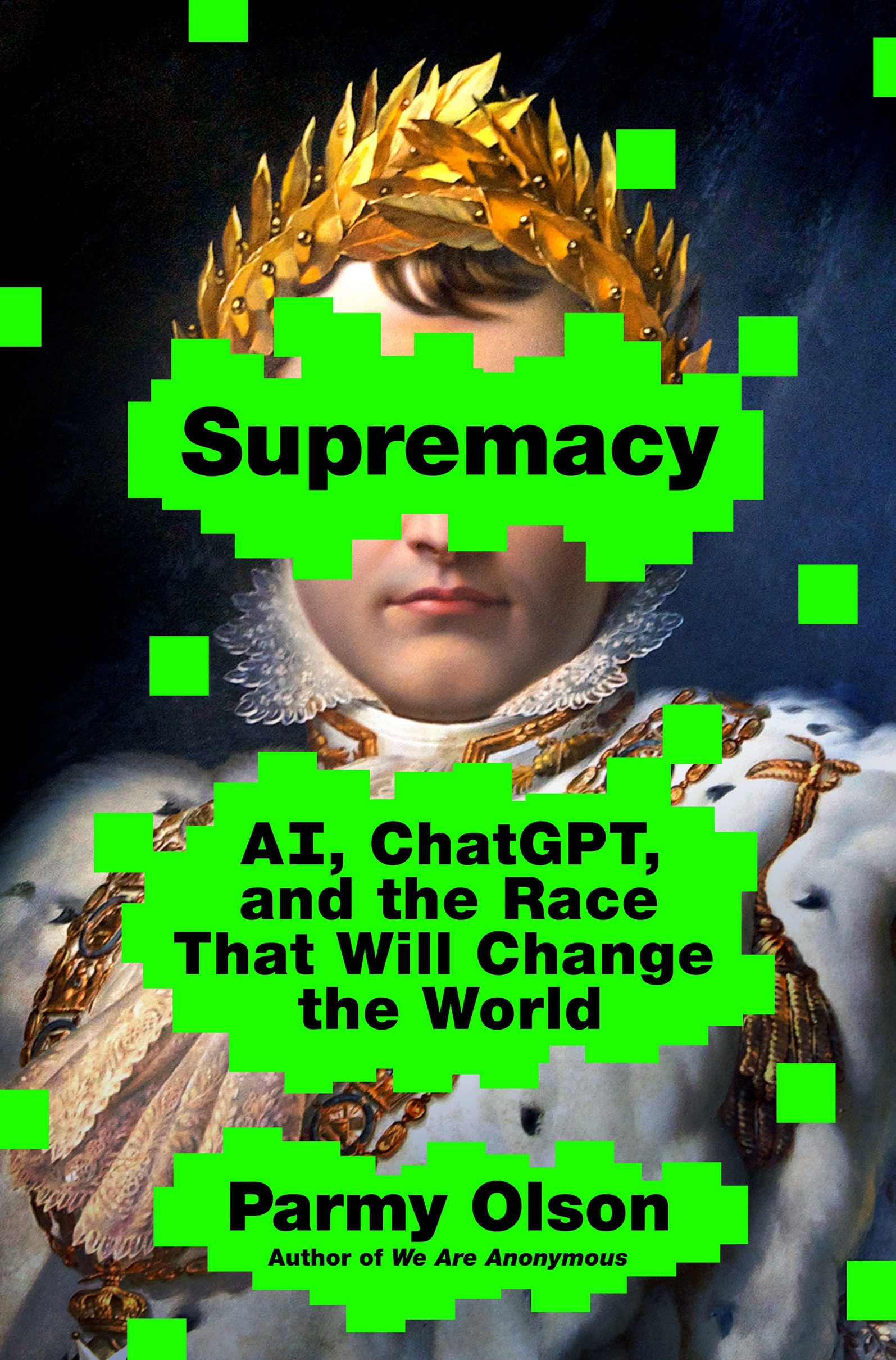
Supremacy: AI, ChatGPT, and the Race That Will Change the World
About this book
Supremacy follows two organizations that set out to build transformative artificial intelligence. DeepMind gathered around Demis Hassabis in London; OpenAI formed around Sam Altman and a promise that advanced AI should benefit humanity rather than belong to one company.
Both labs required talent, computing power, data, and money on a scale that independence could not easily sustain. Their missions became entangled with Google and Microsoft, whose infrastructure and commercial interests changed the conditions under which the research could continue.
Olson reports the race through founders, researchers, investors, executives, and employees who argued over safety, openness, product releases, and control. Technical milestones matter here, but so do board structures, personal ambition, and the incentives attached to being first.
Supremacy is a history of the modern AI industry at the point when laboratories became strategic assets of the largest technology companies. It asks who can govern systems built under competitive pressure when the institutions promising restraint are also racing for advantage.
Read a sample
5,049 words
Plain text
From the opening
PROLOGUE
After picking up this book and reading these first few words, you might be wondering if a human wrote them.
That’s OK. I’m not offended.
Two years ago, that thought would not have even crossed your mind. But today, machines are generating articles, books, illustrations, and computer code that seem indistinguishable from the content created by people. Remember the “novel-writing machine” in the dystopian future of George Orwell’s 1984 and his “versificator” that wrote popular music? Those things exist now, and the change happened so fast that it’s given the public whiplash, leaving us wondering whether today’s office workers will have jobs in the next year or two. Millions of white-collar professionals suddenly look vulnerable. Talented young illustrators are wondering if they should bother going to art school.
What’s remarkable is how quickly this has all come to pass. In the fifteen years that I’ve written about the technology industry, I’ve never seen a field move as quickly as artificial intelligence has in just the last two years. The release of ChatGPT in November 2022 sparked a race to create a whole new kind of AI that didn’t just process information but generated it. Back then, AI tools could produce wonky images of dogs. Now they are churning out photorealistic pictures of Donald Trump, whose pores and skin texture look so lifelike they’re almost impossible to distinguish as fake.
Many AI builders say this technology promises a path to utopia. Others say it could bring about the collapse of our civilization. In reality, the science fiction scenarios have distracted us from the more insidious ways AI is threatening to harm society by perpetuating racism, threatening entire creative industries, and more.
Behind this invisible force are companies that have grabbed control of AI’s development and raced to make it more powerful. Driven by an insatiable hunger to grow, they’ve cut corners and misled the public about their products, putting themselves on course to become highly questionable stewards of AI.
No other organizations in history have amassed so much power or touched so many people as today’s tech giants. Google conducts web searches for 90 percent of Earth’s internet users, and Microsoft software is used by 70 percent of humans with a computer. But neither company is satisfied. Microsoft wants to grab a chunk of Google’s $150 billion search business, and Google wants Microsoft’s $110 billion cloud business. To fight their war, each company has grabbed the ideas of others—which is why, when you boil everything down, our AI future has been written by just two men: Sam Altman and Demis Hassabis.
One is a scrawny but placid entrepreneur in his late thirties who wears sneakers to the office. The other is a former chess champion in his late forties who is obsessed with games. Both are fiercely intelligent, charming leaders who sketched out visions of omnipotent AI so inspiring that people followed them with cult-like devotion. Both got here because they were obsessed with winning. Altman was the reason the world got ChatGPT. Hassabis was the reason we got it so quickly. Their journey has not only defined today’s race but also the challenges coming our way, including a daunting struggle to steer AI’s ethical future when it is under the control of industry giants.
Hassabis risked scientific ridicule when he established DeepMind, the first company in the world intent on building AI that was as smart as a human being. He wanted to make scientific discoveries about the origins of life, the nature of reality, and cures for disease. “Solve intelligence, and then solve everything else,” he said.
A few years later, Altman started OpenAI to try to build the same thing but with a greater focus on bringing economic abundance to humanity, increasing material wealth, and helping “us all live better lives,” he tells me. “This can be the greatest tool humans have yet created, and let each of us do things far outside the realm of the possible.”
Their plans were more ambitious than even the craziest Silicon Valley visionaries. They planned to build AI that was so powerful it could transform society and make the fields of economics and finance obsolete. And Altman and Hassabis alone would be the purveyors of its gifts.
In their quest to build what could become humankind’s last invention, both men grappled with how such transformative technology should be controlled. At first they believed that tech monoliths like Google and Microsoft shouldn’t steer it outright, because they prioritized profit over humanity’s well-being. So for years and on opposite sides of the Atlantic Ocean, they both fumbled in the dark for novel ways to structure their research labs to protect AI and make benevolence its priority. They promised to be AI’s careful custodians.
But both also wanted to be first. To build the most powerful software in history, they needed money and computing power, and their best source was Silicon Valley. Over time, both Altman and Hassabis decided they needed the tech giants after all. As their efforts to create superintelligent AI became more successful and as strange new ideologies buffeted them from different directions, they compromised their noble goals. They handed over control to companies who rushed to sell AI tools to the public with virtually no oversight from regulators, and with far-reaching consequences. The concentration of power in AI would lead to reduced competition and herald new intrusions into private life and new forms of racial and gender prejudice. Already today, if you ask a popular AI tool to generate images of women, it’ll make them sexy and scantily clad; ask it for photorealistic CEOs, and it’ll generate images of white men; ask for a criminal, and it will often generate images of Black men. Such tools are being woven into our media feeds, smartphones, and justice systems, without due care for how they might shape public opinion.
The pair’s journey was not all that different from one two centuries ago, when two entrepreneurs named Thomas Edison and George Westinghouse went to war. Each had pursued a dream of creating a dominant system for delivering electricity to millions of consumers. Both were inventors-turned-entrepreneurs, and both understood that their technology would one day power the modern world. The question was this: Whose version of the technology would come out on top? In the end, Westinghouse’s more efficient electrical standard became the most popular in the world. But he didn’t win the so-called War of the Currents. General Electric did.
As corporate interests pushed Altman and Hassabis to unleash bigger and more powerful models, it was the tech titans who came out as the winners, only this time the race was to replicate our own intelligence. Now the world has been thrown into a tailspin. Generative AI promises to make people more productive and bring more useful information to our fingertips through tools like ChatGPT. But every innovation has a price to pay. Businesses and governments are adjusting to a new reality where the distinction between real and “AI-generated” is a crapshoot. Companies are throwing money at AI software to help displace their employees and boost profit margins. And a new breed of personal AI devices that can conduct an unimaginable new level of personal surveillance is cropping up.
The second half of this book lays out those risks, but first I’ll explain how we got here, and how the visions of two innovators who tried to build AI for good were eventually ground down by the forces of monopoly. Their story is one of idealism but also one of naivety and ego, and of how it can be virtually impossible to keep an ethical code in the bubbles of Big Tech and Silicon Valley. Altman and Hassabis tied themselves into knots over the stewardship of AI, knowing that the world needed to manage the technology responsibly if we were to stop it from causing irreversible harm. But they couldn’t forge AI with godlike power without the resources of the world’s largest tech firms. With the goal of enhancing human life, they would end up empowering those companies, leaving humanity’s welfare and future caught in a battle for corporate supremacy. This was how it happened.
Continue reading the sampleClose the sample
ACT 1 THE DREAM
CHAPTER 1 High School Hero
Sam Altman knew he ought to keep his mouth shut. In the conservative stronghold of St. Louis, Missouri, people didn’t talk about whether they were gay or straight. While the rest of America was coming to grips with gay rights, Altman’s midwestern hometown was lagging in the early 2000s and still made it a crime to sleep with someone of the same gender. Teenagers like him who had an inkling they were gay tended to find safety in silence. Altman was different. He had to speak up, not because he wanted people to know everything about him, but because talking about it would become a mission.
Altman was that one kid in high school who seemed to magically transcend the labels that others tried to slap on him. He was as bright as any geek, charismatic as any jock. In his English literature assignments, he’d emulate the challenging prose of Faulkner, and in math, he breezed through calculus. Then he’d jump into the pool to bark orders to his water polo team, which he captained, or head home to coordinate video games with his friends for hours on end. At the dinner table with his younger brothers, Max and Jack, he’d geek out about space travel and rocket ships, and then when they played a board game, like Samurai, Sam would declare himself the leader. In this and many other situations, he liked to take charge.
Altman grew up in a middle-class Jewish family, his mother, Connie, a dermatologist and his father, Jerry, a lawyer. Jerry helped push for affordable housing in the city of St. Louis, as well as the reconstruction of historic buildings, and his actions fueled his son’s public-spirited view of the world. Sam vividly remembers Jerry bringing him to his office one day and telling him that even if he didn’t have the time to help somebody, “you have to figure out how to do it anyway,” he says.
Sam also had an enormous amount of self-belief that came from being the eldest of four children as well as a brazenness that others respected. He talked openly about his sexuality when other kids his age, and kids generally in the late nineties, would have kept it secret. He leaned into something that many folks in the Midwest believed was bad and made it seem cool, in part because he wanted to help others who were like him.
That calling came from the internet. When Altman started logging onto the web portal America Online (AOL), he realized there were many more out there like him. Here was the wonderful thing about logging onto AOL’s chat rooms. You’d hear the dial tone and beeps denoting the “handshake” as your modem negotiated a secure connection to the World Wide Web, and the screeching tonal overtures of what sounded like a busted CB radio. Then you got connected, your heart beating a little faster at all the possibilities before you, all the chat rooms. Here you could talk to another interesting person on a computer in another part of the world. The rooms had names like “Beach Party” or “The Breakfast Club.” Some of the biggest rooms were noisy and teeming with creeps, but if you explored rooms in more specific categories like Pet Lovers, X-Files Fans, or Gay & Lesbian, you’d find more coherent conversations.
For people like Altman, these rooms became a lifeline. You could hide under the anonymity of a screen name and lurk while others talked about LGBTQ-friendly places to go. They gave him a sense of belonging in a world where it was easy to feel like an outsider. “Finding AOL chat rooms was transformative,” he would say later in a New Yorker magazine profile. “Secrets are bad when you’re eleven or twelve.”
AOL chat rooms were so significant to the LGBTQ community that by 1999, when Altman was fourteen, about a third of its rooms were focused on gay topics. When he was sixteen, he came out to his parents. His mother was shocked. Her son had always seemed “unisexual and tech-y,” she later said in that same magazine profile on her son, but he also tended not to fit classifications. For instance, he was a vegetarian in a part of America where everybody loved barbecue. He was obsessed with computers, but he also wasn’t reclusive or socially awkward. And while everyone else was listening to nineties pop, he preferred classical music.
The Altmans transferred their precocious teen to John Burroughs, an elite private school on the outskirts of St. Louis that boasted a sprawling, leafy campus and sought to grow its students’ talents for “the improvement of human society.”
He stepped up to as many leadership roles as he could manage. As well as captaining the water polo team, he edited the yearbook and spoke at school assemblies. He socialized with the faculty while occasionally stretching the rules so he could make a stir. At the annual fall pep rally, Altman and his water polo team ripped off their clothes on stage so they were left standing in their Speedos, grinning to whoops and cheers.
He got in trouble for that with the school’s athletic director, but rather than let it go and complain about the admonishment to his friends, or even to another teacher, he fought back and went straight to the top. He knocked on the door of school principal Andy Abbott, a former English teacher with a gentle demeanor. The older educator was charmed by the gangly, dark-haired teen with eyes like saucers, who frequently dropped into his office to pitch ideas or complain about an injustice that he planned to write about in the student paper.
The young man was utterly unintimidated by authority, he noticed. If Principal Abbott ever made an unpopular decision that affected the other students, the kid would take it upon himself to be their savior. “He would object,” Principal Abbot remembers, “and thoughtfully.” To this day, the soft-spoken educator sees Altman as “the most brilliant kid I knew.”
That same earnestness, along with an ability to come across as candid and vulnerable, would later help the young man curry favor with other powerful figures in the worlds of technology and government, from investors to the press, to some of the world’s most powerful CEOs, his solemn stare imploring them to support an epic mission. Altman would learn over time that people in power could smooth the road for your ambitions, just as Principal Abbott would do for him in high school.
His big school project was to build a real-life version of the network he’d found on AOL. He pushed through the school’s red tape and got his principal’s blessing to create the school’s first LGBTQ support group. It was like an underground network that students could visit for counseling or to meet others like themselves. Within a year, about a dozen students had joined.
But Altman wasn’t satisfied. He started approaching his teachers, asking them to put stickers on their doors that said their classrooms were a safe space for gay students, trying to turn his teachers into allies. He eventually started a Gay-Straight Alliance group, aimed at raising public awareness of gay rights.
He then decided to make a splash at the morning assembly. His new group went into the main hall early and placed a series of printed numbers on all the chairs before the audience took their seats. As Altman went up to the mic, he asked everyone with a certain one of the numbers to stand up. “Look around you,” he told the audience, as about sixty kids stood up. “That’s one in ten of you. That’s how many people in the school identify as gay.”
It was a bold demonstration, but something was odd. Several students were missing from the audience, and they all happened to be part of the school’s Christian club. Altman found out later that they had boycotted his presentation by staying at home or in their classrooms. Indignant that these kids had pushed back against his objective, he once again marched into the office of Principal Abbott, demanding that the Christian kids be counted as absent.
“There was nothing damaging about making them more aware,” the teenager argued. He wasn’t a table thumper, but it was clear by his words and his stern expression that he was angry.
“I tried to justify it for a while,” Principal Abbott remembers. “But I think he was probably right about that.”
Altman left school with a hard lesson. If you had ambitious ideas, there would always be some haters. The solution was to align yourself with those who had power and authority and to surround yourself with a support network.
Soon enough, Altman got accepted into the prestigious Stanford University in the heart of California’s Silicon Valley, a fount of brilliant software engineers and technology entrepreneurs who populated the sun-drenched region with technology start-ups. Despite his interest in programming and his admittance to a computer science degree, the lanky eighteen-year-old couldn’t stand to focus on one subject alone. He was fascinated by everything. He took an array of humanities classes and creative writing classes.
Then outside of school hours, he’d drive twenty minutes south for lessons that would become critical to his future life as a globally renowned entrepreneur. He’d play hours of poker at a popular casino in San Jose, honing his skills of psychological maneuvering and influence. Poker is all about watching others and sometimes misdirecting them about the strength of your hand, and Altman became so good at bluffing and reading his opponents’ subtle cues that he used his winnings to fund most of his living expenses as a college student. “I would have done it for free,” he would later tell one podcast. “I loved it so much. I strongly recommend it as a way to learn about the world and business and psychology.”
The field that Altman would one day focus on to transform the world came up as part of his regular degree. He became a researcher at Stanford’s AI lab, a pocket of the university’s vast campus that was filled with cables and the odd robot arm. The AI lab had just been reopened and its leader was Sebastian Thrun, a computer scientist with radical views, a soft German lilt, and piercing blue eyes. Thrun was part of a new breed of academics who weren’t content to spend their days writing grant proposals and waiting for tenure but who worked with tech giants. Stanford was just five miles from Google’s headquarters, and Thrun also ran the cutting-edge “moonshot” projects at Google X that made self-driving cars and augmented reality glasses.
In class, Thrun taught his students about machine learning, a technique that computers used to infer concepts from being shown lots of data instead of being programmed to do something specific. The concept was critical in the field of AI, even though the term learning was misleading: machines can’t think and learn as humans do. Thrun noticed that the serious kid from St. Louis was interested in the possibility of unintended consequences in AI. What would happen if a machine learned to do the wrong thing?
Thrun explained that AI systems could act in unpredictable ways to achieve their “fitness function,” or goal. If an AI was designed with a fitness function to survive and reproduce, it might inadvertently wipe out all biological life on Earth, Thrun said. This didn’t mean the AI was bad. It was just unaware of the gravity of what it was doing. Its motives weren’t all that different from ours when we washed our hands. We didn’t hate the bacteria on our skin and want to destroy it. We just wanted clean hands.
Altman mused on this idea for some time. As a science fiction fan, he wondered if this was why humans had never had contact with alien life. Perhaps beings on other planets had tried creating AI, too, and then been wiped out by their own creation. If that was avoidable, someone would have built safer AI before others created the dangerous kind.
This seed of an idea would lay dormant in the back of Altman’s mind for a little over a decade before blossoming into the creation of OpenAI. But for now it was far too big to tackle. Academics like Thrun built AI systems. Stanford students like Altman built start-ups that became companies like Google, Cisco, and Yahoo. The young geek wanted to do the same. He just needed a business idea. Then it came to him when he was walking out of class. “Wouldn’t it be great if I could open my mobile phone and see a map of where all my friends are?” he asked his Stanford classmate and friend Nick Sivo.
What if he created a digital map for his mobile phone on which he could find his friends and make that the main product of a company? Starting a company wasn’t easy. You needed to raise money from venture capitalists, and while there were dozens of those within three miles of Stanford, Altman was young and inexperienced. His answer came from the other side of the United States, in Cambridge, Massachusetts, where an older tech mogul was starting what he called a boot camp for young entrepreneurs. Altman and Sivo decided to join the three-month program, called Y Combinator, and create a start-up. Y Combinator would go on to become the most successful start-up accelerator of all time, seeding $400 billion worth of tech companies with names like Airbnb, Stripe, and Dropbox.
Altman, who was now nineteen, didn’t know any of this at the time. Most investors in Silicon Valley dismissed Y Combinator as a silly summer camp for hackers. Its creator was Paul Graham, a forty-one-year-old cargo shorts–wearing computer scientist who’d become a millionaire after selling his e-commerce company to Yahoo. Having achieved his wealth, Graham had fashioned himself as a thought leader, publishing essays on his website about topics beyond the purview of software geeks, from economics to having kids, from free speech to being a nerd in high school.
But his most popular essays, the ones that made kids like Altman sit up in the kind of rapt attention given to spiritual leaders, were about building start-ups. Over and over, those essays emphasized that the quality of a start-up founder mattered more than anything else. You didn’t need a brilliant idea to start a successful tech company. You just needed a brilliant person behind the wheel.
“Google’s plan, for example, was simply to create a search site that didn’t suck,” Graham wrote. And look where that had led. Lightbulb moments were passé. It was the founders who mattered, and the best were hackers—programmers who were willing to break conventional wisdom to build new things. As a hacker, “you could be 36 times more productive than you’re expected to be in a random corporate job,” he wrote.
Starting a tech company in Silicon Valley was even patriotic because it emulated the rugged individualism of America’s founding fathers: “Hackers are unruly,” he wrote. “That is the essence of hacking. And it is also the essence of Americanness. It is no accident that Silicon Valley is in America, and not France, Germany, England, or Japan. In those countries, people color inside the lines.”
The path was almost simple, Graham taught. Bootstrap your company, start with a minimum viable product, and optimize it over time. Work in a tight bubble, because it was better to have ten people love what you made than thousands liking it. And don’t be afraid to bend the rules along the way. In fact, why not rewrite society itself?
Graham’s ideas would eventually strike a huge chord in Silicon Valley and fuel a prevailing new wisdom that the vision of a start-up’s creators was so sacrosanct that they should be allowed to act with impunity, like gods. It’s why the founders of Google and Facebook could fashion themselves as modern-day autocrats of business, often grabbing a majority of a company’s voting shares and sometimes taking their companies in strange directions. (A case in point was the lack of pushback from Facebook’s board or shareholders to Mark Zuckerberg’s strange and expensive decision to become a virtual reality company.) Thanks to something called a dual-class share structure, many tech start-up founders, including those behind Airbnb and Snapchat, could hold these unusual levels of control of their companies. Graham and others believed founders had this authority for good reason. When the smartest and most talented people had a long-term vision, they needed the freedom to carry it out.
Graham saw those same hacker instincts in Altman: deeply curious, fiercely intelligent, and a big thinker. And there was something else. This teenager with unruly dark hair was comfortable around older people to the point that he’d have no trouble managing people like Graham, who was twenty years his senior. When Graham suggested Altman wait a year to join his Y Combinator program since he was only nineteen, the kid replied that he was coming anyway. Graham liked him immediately.
Most of the other entrants to the program were engineers and hackers, including the founders of the popular online forum Reddit. Graham and his wife, Jessica Livingston, gave $6,000 to each start-up in their new program, a number based on the stipend that MIT gave grad students during the summer. While most venture capitalists threw millions of dollars at start-ups, Graham told founders to do more with less, and aim for “ramen profitability,” discouraging them from hiring lawyers, bankers, and PR people so they could do that work more cheaply themselves.
Graham himself did everything on a shoestring. He cooked dinner every Tuesday night, his specialty being chicken fricassee, and brought in his friends as speakers to talk about start-ups, while Livingston took care of the legal paperwork for each new company.
Altman and his friend Sivo named their new company Loopt, and he moved to Cambridge, Massachusetts, to work out of Y Combinator’s first office near Graham’s house. Altman and Graham formed a close relationship similar to the one he’d had with his high school principal. Among the hopeful young entrepreneurs, Graham was like a spiritual leader whom they just called PG. Altman took Graham’s teachings seriously and saw Loopt not as a company that could make him rich but as an idea that could make the world a better place. He tinkered nonstop on the prototype, living off instant ramen noodles and Starbucks coffee ice cream. He worked so hard and ate so badly that he developed scurvy, a disease caused by a lack of vitamin C.
Though he was a decent enough programmer, the boyish-faced Altman was an even better businessman. He had no qualms about calling up executives from Sprint, Verizon, and Boost Mobile and pitching a grand vision about changing the way people socialized and used their phones. Speaking in low tones and using elegant turns of phrase that he’d honed from his creative writing classes, he explained that Loopt would one day be essential to anyone who had a mobile. App stores didn’t exist yet, so he had to rely on mobile operators to preinstall Loopt on some of the earliest smartphones. That’s why getting the telecom executives on board was so key, and Altman was a master at marketing his new company. Sprint, Verizon, Boost, and even BlackBerry agreed to put his service on their phones.
At the end of Y Combinator’s three-month program, Altman raised some money so he could grow his start-up. He presented the Loopt vision to a group of fifteen investors, most of whom were Graham’s wealthy friends, for about fifteen minutes and then reached out to people with even deeper pockets: venture capital firms in Silicon Valley. He got several offers and took $5 million from two premier venture capital firms who’d backed Google, Yahoo, and PayPal.
With all that funding, Altman dropped out of Stanford University to work on Loopt full-time. He moved with a handful of engineers he’d hired to Palo Alto, California, settling into Sequoia’s coworking space. They were churning out code late into the night alongside the creators of YouTube before Altman moved his team to their first office in Mountain View, prime real estate that was a few blocks away from the headquarters of Google. It was as close to the heart of Silicon Valley as you could get.
Silicon Valley was the land of crazy thinkers. You didn’t start a business here. You started an empire. Or you sought to build something on the frontier of technology and science. If you wanted to conduct scientific research on a disease like Alzheimer’s, you could go to a university on the East Coast or in Europe. But if you wanted to reverse aging, you went to Silicon Valley.
The region’s network was its big selling point. On any given day you could bump into someone at an event who could juice your business. Go to breakfast at Buck’s in Woodside, California, and you might catch the cofounder of Yahoo having a fruit and yogurt combo while sitting at the same table where Elon Musk had his first funding meeting for PayPal. Grab a drink at the Musto Bar at the Battery Club in San Francisco and you could spot one of the cofounders of Facebook.
Altman quickly integrated himself into Silicon Valley’s web of programmers, investors, and executives. If you knew how to plug yourself into this modern old-boys network, you were more likely to get swept up in the success that propelled its members to billionaires. Altman was so good at networking that he managed to make the right connections to present Loopt at Apple’s prestigious annual conference for developers in 2008. Dressed in jeans and two green and pink polo shirts that gave him the look of a children’s TV presenter, the slender young entrepreneur told his audience that Loopt was the largest social mapping service in the world. “We make serendipity happen,” he said, staring at the crowd and barely cracking a smile.