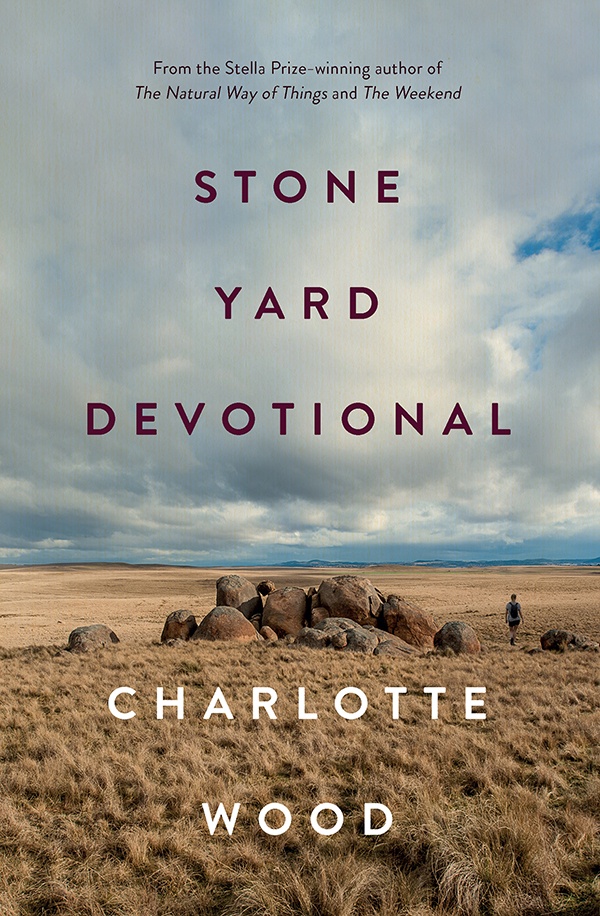
Stone Yard Devotional
About this book
The unnamed narrator arrives at an abbey near the country town where she grew up. She does not intend a dramatic conversion; she wants to stop participating in the life she has made and observe the disciplined routines of women who have chosen another one.
Meals, prayer, chores, weather, mice, and the return of human remains from abroad give the retreat its shape. Memories of parents, school, friendship, activism, and unfinished shame surface without assembling into one confession.
A former classmate who became a famous nun brings old resentment into the community, while ecological disaster continues beyond its walls. Withdrawal offers attention rather than innocence: the world’s claims remain present even where no answer is demanded.
Stone Yard Devotional is a spare contemplative novel by Charlotte Wood. It treats solitude as work rather than escape, asking whether devotion can exist in the act of staying with what cannot be repaired.
Read a sample
5,046 words
Plain text
From the opening
DAY ONE
ARRIVE FINALLY AT about three. The place has the feel of a 1970s health resort or eco-commune, but is not welcoming. Signs on fences, or stuck on little posts by driveways: NO ENTRY. NO PARKING. A place of industry, not recreation.
I park in a nondescript spot near a fence, and sit in the quiet car.
~
On the way here I stopped in the town and visited my parents’ graves for the first time in thirty-five years. It took some time for me to find them in what is called the ‘lawn cemetery’, the newer part fenced off – why? – from the original town graveyard with its crooked rows of tilting white headstones and crosses. That old part is overlooked by enormous black pine trees; ravens and cockatoos scream from their high branches. The lawn cemetery, by contrast, is a dull, flat expanse filled with gently curved rows of low, ugly headstones of identical dimensions. Neater, I suppose (but why should a cemetery be neat?).
There is no lawn, just dusty dead grass.
To find my parents I had to recall the cold, unsheltered feeling I had – physically, I mean – at each of their funerals. There had been the sensation of too much space around me there, at the place where my father, then later my mother, were sent into their adjacent shafts of opened earth. (It seemed callous to me back then, to lower a person into a hole in the ground using ropes and cords instead of arms.) But walking around the cemetery now, remembering that sensation helped me find the spot again. I stood before my mother’s and father’s gravestones, two machine-cut and polished pieces of stone. The colour and design of the stones and the words on them seemed to bear no trace of either of my parents, though I must have decided on, approved of, them.
Someone had pushed some ugly plastic flowers into the small metal grate beside the headstones. Perhaps there are volunteers who go around leaving fake flowers at unvisited graves. Who else would want to mark my parents’ burial place after all this time? The plastic of the flowers had turned grey, every part of them, though they must have once been luridly coloured like those I could see sticking up from the little metal vases at other headstones: ragged synthetic petals in puce and maroon and white with dark green stems, angled here and there with artificial nodules and leaves.
I stood on the grass and looked at the ugly flowers, then at my parents’ names carved into each slab in front of me. And I realised: Your bones are here, beneath my feet. I squatted then, those few feet of earth between their bodies and mine, and I kissed my fingers and pressed them to the crackly grass.
~
Walking back to the car I remembered something else: a phone call, many months after my mother’s death. A man’s voice quietly telling me her headstone was ready. I recall standing by the laundry door with the phone in my hand, my outsides unaltered but everything within me plummeting. Like a sandbank collapsing inside me.
~
Near the end of the drive the sky darkened, turned drizzly. The road coiled up a steep hill, entering a tunnel of thick bush – my car struggled on the wet bitumen – and then on the other side it opened out into these endless, shallow, angular plains, bare as rubbed suede.
Place names I thought I’d forgotten returned to me one by one: Chakola, Royalla, Bredbo, Bunyan. Jerangle, Bobundara, Kelton Plain, Rocky Plain, Dry Plain, like beads on a rosary. Like naming the bones of my own body.
~
A little after I arrive, the sun comes out. I get out and look around me, trying to work out where I should go. There are some skinny pencil pines, a few dripping eucalypts, a lot of silence. Three or four small wooden cabins painted a drab olive; green peaked tin roofs.
I wander the grounds for a time, eventually finding a shed marked OFFICE, and knock on the door. A woman appears, introduces herself as Sister Simone. She pronounces it Simone, traces of an accent (French?). Indeterminate age, business-like but soft-looking at the same time. Scrawnyish. Quite yellow teeth. She apologises for not having come out to greet me; she is busy, but a housekeeper will show me around if I wait for a bit. She tells me with a teeth-showing smile – more a grimace – that she’s looked me up on the internet and that my work sounds ‘very impressive’. Her tone seems lightly insulting. I smile and tell her the internet is very misleading. She pauses, then says coolly that saving God’s creatures most certainly is important work. She’s slightly cross, I think. Not accustomed to disagreement. We bare our teeth at each other again and she closes the office door.
~
Anita, the housekeeper. Chatty and broad-bummed. Shivering a little in her maroon fleece vest over a turquoise shirt, navy pants. She leads me around the buildings and grounds, and I trot behind her as she rattles on. She could never be a nun – imagine getting up for Vigils at five a.m. In winter! Plus, they can’t watch Netflix: ‘That’s never going to work for me.’
She unfolds her arms now and then to point at something – shop, old orchard, guest cabins; gestures further off to indicate the paddocks, a small dam – then refolds them against the cold and we take off towards a little stone chapel. I open my mouth to say, It’s okay, I don’t need to see inside, but don’t want to be rude. We push through a big wooden door. Anita’s chatter doesn’t stop but turns to a whisper, though there is nobody in the church. She has just learned, she says, that this is not called a chapel – chapels are privately owned. This is a Consecrated Church. When they come in here it’s called the Liturgy of the Hours, she whispers, enunciating these words as if from a foreign language. Which I suppose they are.
Continue reading the sampleClose the sample
Anita points to a corner: ‘This is where you sit.’
Four wooden pews off to the side, away from those in the centre of the church, which are presumably used by the sisters. The guest pews are smaller than theirs, more modern in design and made of a golden pinewood. Each place is marked with a flat, square, brown cushion, and a brown leather-padded kneeler runs the length of the pew. Anita waits for me to show her that I know how to sit. The seat is surprisingly comfortable.
There’s no altar. Instead, a simple wooden lectern in front of a huge carved wooden crucifix on the whitewashed wall.
As we leave, Anita pauses to show me a large angular flower arrangement set on the floor to one side, beneath the crucifix. It was made by one of the oblates, she says. I murmur some generic sound. Yes, says Anita, sighing with admiration. This particular oblate really thinks outside the box.
I don’t tell her I have no idea what an oblate is.
~
Next on my tour Anita stops at a double-doored fridge-freezer on a verandah. She yanks open the fridge door to show me the shelves containing eggs, milk, a few apples. Slams that door shut, opens the freezer to reveal individually packaged meat pies and four-slice packets of wholemeal bread. This food is for those who don’t want to take lunch from the dining room, she explains.
I will not see the sisters except in church, she warns, as if I will be disappointed. The nuns live in another long low building, fenced off by a hedge behind the church, a hidden part closed to guests.
At last to my cabin, which Anita calls by a saint’s name I immediately forget. The cabins nearby seem to be unoccupied, but who knows? I don’t ask if there are any other guests. The place feels pretty empty.
Anita unlocks my door and stamps about opening curtains, showing me the remote control for the reverse-cycle air conditioner. (‘It gets very hot here in summer, you’d be surprised, but look, it’s on “heater” – see the little sunshine symbol?’) She picks up a laminated booklet from the small desk – ‘Everything you need to know is in here’ – and slaps it down again. Waves a hand at the kitchenette with its canisters and cupboards, and then in the opposite direction to the unseen bathroom, then smiles at me and sighs with a bright finality, as if now the formalities are over we can settle down to a proper chat. I thank her briskly, stepping towards the door. She finally seems to accept that I am not looking for conversation, and leaves.
~
Alone at last, having flipped through the booklet and ferried my few things from the car, I lie on the floor in a patch of wan afternoon sunlight. The heating works well; the room is soon warm. The light from the window illuminates a small wooden crucifix positioned on the wall above the desk. The silence is so thick it makes me feel wealthy.
My phone vibrates, its buzz making me jolt. Alex has landed at Heathrow; his new colleagues are to collect him. I reply, then lie back on the floor again. Neither of us has said it yet, but we both know I won’t be following. We both know he’ll be relieved.
I realise that it would be possible here, once Anita had given you your key and trudged off in her sheepskin boots, to spend the entire visit without seeing or hearing another soul. It is accepted, the laminated booklet says, that guests might want total solitude, and they are free to decline joining others for eating or worship. Noise is discouraged. Nobody would have to know, until the end of one’s stay, that a person might choose to end their life here on this clean carpet in a warm, silent room. At this moment I cannot think of a greater act of kindness than to offer such privacy to a stranger.
But my own escape is a different, less definitive kind than that.
From somewhere beyond my window comes the faint burbling of chickens.
~
At five o’clock I decide to try to wake myself up by joining the nuns at Vespers. I walk the track to the little church in the falling light, in the silence. My footsteps on the gravel make the only sound. I sit in the cold church and wait. I was wrong about other visitors: two women bustle to the front row of the guest pews and settle in. They seem quite at home. Then, from a door on the other side of the church, the nuns enter in ones and twos. Long brown habits, white collars. Some of them tuck their hands into the apron fronts of their gowns. One very old woman arrives in an electric wheelchair, jerking slightly to cross the lip of the entrance way. Another uses a walking frame. There are eight altogether, at least half of them quite elderly. Sister Simone is there. She doesn’t look in the direction of our seats; none of them does.
Their pews have panelled wooden fronts, so they are visible only from the waist up. They begin to sing a series of prayers I find it impossible to locate in either of the two photocopied booklets on my seat, one with a musical score and another with the words of the psalms. The nuns have very high, thin voices, some quite lovely. It’s a kind of chanting, the same seven or eight notes released, over and over. There is another congregant a few pews behind me. A man’s quiet, low voice, a throat clearing softly now and then. The singing is mesmerising, until I find the right page in the right booklet and discover that the lyrics are all about denouncing evil this and God’s enemies that. The subtlety of the lilting chant belies the blunt instrument of the words themselves.
Watching the women, I’m convinced that the words they’re singing are meaningless; that instead, this ritual is all about the body and the unconscious mind. Every so often, at some signal I can’t discern, they bow very deeply in their little wooden pews, so they disappear for a minute. Then they pop up again. I keep thinking of yoga: it has the same rhythmic quiet, the same slow, feminine submission.
At the end, I sit for a moment after the nuns and then the women in front of me (and the unseen man) have filed out. By the time I leave the church, it is completely empty. I walk back to my cabin in the dusk.
It’s shockingly peaceful.
I eat two bowls of peanuts and drink three glasses of wine for dinner.
My back is very painful now, worsened by the six hours of driving and the hard wooden pew, despite its cushion. I lie on the carpet, arms outstretched. When I wake I see Jesus on his cross, looking down at me.
DAY TWO
SLEPT POORLY. THE light from the green exit sign above my cabin door was too bright, and the ticking and cracking of the wooden building in the wind kept me awake. I get up at five thirty and shower, then make coffee. Manage to hotspot to my phone momentarily – reception very poor, but that is supposed to be the point of coming here – and download a short cheerful email from Alex, and a few others. Read some of them but can’t face answering any. I should have set up an auto-reply, but even that seemed an impossible task. I sit with my coffee at the little wooden desk and watch the sky slowly lightening beyond the spires of the pencil pines. I listen to the wind as it gradually drops.
At seven thirty I go, out of curiosity, to Lauds. (What else did I imagine I’d be doing here? Sleeping, I think. Deciding, perhaps, about Alex, my work. Crying. Hiding.) As I close my cabin door in the sunrise, the cold clean air moving down from the mountains, and the taste of that air, comes to me as if from childhood.
The sun is lifting and it streams into the church each time the big wooden door opens. The nuns enter quietly. The one with the walking frame arrives first. She might play the organ, though from my seat near the back of the guest pews I can’t see around the corner. Another lights the candles – one near their door, another by the lectern and two on the floor, at the foot of the big crucifix.
The singing is transporting, especially when they harmonise. One nun leads a psalm and the others do a repeated chorus. Lauds, like Vespers, goes for half an hour.
After this comes the Eucharist (which might also be called Terce?) at nine o’clock.
During Lauds I found I was thinking, But how do they get anything done? All these interruptions day in, day out, having to drop what you’re doing and toddle into church every couple of hours. Then I realised: it’s not an interruption to the work; it is the work. This is the doing.
~
The candles in the church are plain and white with a pleasant smell. Sort of herbal or cinnamony. A hint of incense, but not overpowering.
In the church, a great restfulness comes over me. I try to think critically about what’s happening but I’m drenched in a weird tranquillity so deep it puts a stop to thought. Is it to do with being almost completely passive, yet still somehow participant? Or perhaps it’s simply owed to being somewhere so quiet; a place entirely dedicated to silence. In the contemporary world, this kind of stillness feels radical. Illicit.
~
Later in the day I turn up again, at Middle Hour. It’s only about twenty minutes long. The same little tune is used for the various psalms, the same fatigue overwhelms me, and I can barely stay awake. Their singing is a chiming, medieval sort of sound: unexpected and unbalanced, yet melodious, in those thin reedy voices. They sing everything very slowly. It’s hypnotic. The words seem to make no sense. There’s a lot about evil-doers trying to destroy the psalm’s narrator. All day long they crush me. Foes and enemies, intent on massacre and annihilation. All this warbled by a bunch of nuns way out here on the high, dry Monaro plains, far from anywhere.
At the end of the Middle Hour, two approach the centre from opposite sides of the church, bow to the crucifix, then turn and bow to each other, then they leave. The next two arrive at the centre, bow to Jesus and then to each other. And so on, until there is nobody left.
~
Lunch is either to be ‘shared at table with other guests’ – no thank you – or a takeaway affair. I set off with my basket and a couple of containers from my cabin, down to the dining room. When Anita described this arrangement it sounded romantic, taking your basket and filling it with food. Images of wicker and chequered tea towels, Red Riding Hood-style. But it turns out the basket is the gaudy plastic kind used in the supermarket express lane. The decor (if that is what you can call it in a nunnery) is very simple, sort of innocent and somehow poignant. Like the house of an elderly aunt, but with crucifixes instead of ‘Bless this house’ plaques. Today’s lunch is thick slices of cooked ham, some bright yellow chutney, a plain green salad with a bottle of ‘Italian dressing’ nearby, and roast carrots, potatoes and parsnip, all a little hard. Plus a big vat of sticky-looking mashed potato that I avoid. The dessert is some kind of apple pudding. The pudding is good; everything else is ordinary. You wouldn’t want to eat this stuff every day of your life. The other guests – the two women, anyway; I haven’t seen the man – don’t look up when we pass each other. Which is fine by me.
Lunch is the main meal of the day, and we are to assemble our own dinners from one of the many packets or single-serve tins in one’s room. I’m saving two slices of lunch ham to have for supper with baked beans. The cupboards in my room are like some kind of storeroom from one of the country motels of my childhood. Everything’s packaged in individual sachets and servings – Nescafé, sugar, Vegemite, margarine, teabags. Teensy cans of Heinz spaghetti or baked beans, or tuna. Little boxes of highly processed breakfast cereal. There are biscuits in two-packs; Scotch Fingers, Jatz. And tiny individual packets of cheese slices in the bar fridge. Something makes me wonder if all this has been donated by some corporation or other. When I first saw all that packaging I couldn’t stop my tears coming, which was ridiculous. But something about the nasty little packets overcame me; it was to do with splitting everything into awful, unnatural fragments. The loneliness and waste of it. And a polluted feeling: even here, the inescapable imperative to generate garbage. Surely, if God exists, He could not approve of all this rubbish. Yet I have brought with me, quite against the spirit of the place, my own rubbish – blocks of chocolate, packages of salted peanuts, blueberries in a plastic carton, coffee, wine. He probably wouldn’t approve of that either.
Being here feels somehow like childhood; the hours are so long and there is so much waiting, staring into space. Absolutely nothing is asked of me, nothing expected.
~
I think of wandering to the shop to buy some candles. If there are any plain ones like those in the church, I would like to take one home. But instead of taking that three-minute walk I lie on the floor again and fall into a syrupy sleep.
Later, around four, I do visit the shop. There is nothing of interest to buy. Many hideous greeting cards, some of which bear religious images, but mostly they are just bad paintings of flowers. The Handmade Candles are especially ugly, garishly coloured and decorated with lumpy gold scrolls and astrological-looking designs. I do buy a plain sandalwood-scented candle, a plastic torch and a wooden cross. The cross has rounded edges and fits snugly in the hand. I am a bit ashamed of it. I don’t know why I buy it, except maybe as a mark of respect to these people, and as a kind of talisman, to hold and feel. It is for the body, not the mind.
~
Vespers again. There is one spoken element that disrupts the singing; ‘prayers of the faithful’ is the phrase that bubbles up from my childhood. ‘We pray for a marriage that is breaking down,’ one of the sisters says. I look at the floor. I think about Alex, but he’s free. He needs no prayers from me.
Then this: ‘We pray for all those who will die tonight.’
~
After my parents died – not together, though close enough in time to fuse inside my primitive self, inside my dreams and my body, into a single catastrophe – for many years I felt as though I were breathing and moving through some kind of glue. I could not have said this then. If someone had asked me how I felt, I would not have been able to answer. The only true reply would have been: I don’t know.
The day after I learned that my mother’s illness would not be cured I kept a doctor’s appointment in the inner city, where I lived then. When I entered the room and the doctor asked brightly how I was, I began to cry, and then – embarrassed – explained. She asked about my father, and when I told her he was dead she asked about the kind of counselling my mother and I had sought when he died. I was mystified. As far as I knew there was no such thing as counselling in our town.
She then told me I was clever, and right, to seek help now. But I only came here for a pap test, I said through my tears. She handed me a tissue box and said we would do the test another time. She asked me about my parents, and listened for some time. Towards the end of the consultation she recommended I see a bereavement counsellor. She herself was not a trained counsellor, only a general practitioner, and a specialist would be better able to help me. She wrote the name and address of the centre on a piece of paper.
Can’t I just talk to you? I asked her.
And so I did. I went to see her three times.
The doctor was big and square and imperious. For some reason her authority and her deep, practical kindness made me assume she was gay. She did not gush or emote, which was a relief. If someone had been openly empathetic, if I’d been entreated to elaborate upon the emotional terrain of what was now being called my grief, I would have been ashamed.
On my second visit, I remarked (embarrassed again by my tears) that it seemed my friends were deserting me, just when I needed them most. She was unsurprised. Your life has been stripped down to bedrock, she said. It’s not their fault; their lives are protected by many layers of cushioning, and they can’t understand or acknowledge this difference between you. It probably frightens them. They’re not trying to hurt you.
She didn’t say, Understand this: you are alone, but that is what I heard. I found it strangely comforting. She said again, I think you should call the bereavement centre.
The last time I saw the doctor, she seemed weary of me and my problems. She asked from behind her desk, a little testily: What is it that you want right now?
For this not to be happening, I said. I could hear the sullenness in my voice.
The doctor looked at me and waited for a moment. She seemed to decide on the simple, brutal truth. Well, it’s happening, she said.
I have always been grateful to her.
DAY THREE
SLEPT DEEP AND long this time. I covered the exit sign with my jacket last night so it was much darker, and without any wind the night was quiet.
In Lauds again, I wonder if they think boredom is a sin. Do all religions include some form of this repetitive movement? It feels ancient, superstitious. Walking in circles, bowing and prostrating, kneeling and standing. What is its purpose? Eradication of the ego, in some way? Denying the human craving for newness, or escape, or surprise? Returning and returning and returning, a prescribed revisiting. Watching them do their thing, I wonder if the nuns annoy each other. Whether one’s very low bowing is seen as pretentious by another; or if another’s failure to hit the right note drives her neighbour nuts. It seems impossible that this sort of emotional life would not be carrying on beneath the silence. Today’s psalms were not so full of evil foes but there was a lot of nationhood-praise stuff. The Lord has made our borders safe and filled our fields with harvest etc. Much celebration of all the good things He has brought to our land … I struggle to see the relevance of any of it to these women and their lives. What is the meaning of this ancient Hebrew bombast about enemies and borders and persecution? What’s the point of their singing about it day after day after day?
~
At ten, I’m reading in my room when a leaf blower starts up outside! I leap to my window to see one of the stouter nuns wielding the hateful thing, revving it, trudging along the pathway, turning slowly from side to side, pointlessly scattering leaves. It goes for about two minutes.
~
I’m becoming a little afraid the tranquillised feeling will never lift. I could just leave, but the effort of even packing my bag feels beyond me. Instead, at noon I go to something called the Lectio Divina with a Sister Bonaventure. When I arrive I’m pretty sure she is the leaf blower nun, but I don’t say anything. The Lectio Divina, she explains in a low, husky voice, is ‘divine reading’; a slow, contemplative reading of a bit of gospel (which she hands out printed on pieces of paper). The other people in the room are the two women, who are called Diane and Cynthia and have come from Melbourne; another woman I have not seen before, called Lavinia; and a man called Richard, who seems to live locally. I think it may have been his voice I heard in the church behind me that first day, and there is something distantly familiar about him.
We sit on plastic chairs in a circle and go around the room, each person reading a paragraph aloud. After each reading there is silence for several minutes, during which you are to think about what you have heard. Then you are supposed to say aloud any word that has struck you or troubled you or caught your attention. After this the reading begins again, with the next paragraph. The same process of thinking and offered words or phrases follows, but during a longer period of silence. When that is done, Sister Bonaventure reads the whole piece again. More silence, then a discussion. She says the piece today has suddenly revealed itself to her as about obedience – which is handy, because there’s a novice she’s looking after who’s just up to the obedience part of her vows. People throw in words here and there. Richard is the only one closely attending as he reads, considering for potential meaning – the others go through the motions, offering banal observations in an effort to score brownie points from Sister Bonaventure. Cynthia from Melbourne (whom Bonaventure calls ‘Wendy’; a patient glance between Cynthia and Diane makes me think this has been going on for days) is especially obsequious, marvelling over every word of the paragraph. Bonaventure seems to be just tolerating her. My own thoughts are not interesting, except as arguments against what the Scriptures are saying. Which I don’t think is the purpose of the exercise, so I keep my mouth shut.
Despite this, the process is strangely beautiful. Sister Bonaventure says getting caught on a word is the point, and that if you remain troubled or confused by it, you just ‘hand it over to God’. This is so antithetical to everything I have believed (knowledge is power, question everything, take responsibility) that it feels almost wicked. The astonishing – suspect – simplicity of just … handing it over.
(Later in the day, from somewhere in my memory comes an artist I once saw on television, peering at a canvas as he worked. He quoted Kipling: ‘When your Daemon is in charge, do not try to think consciously. Drift, wait, and obey.’)
Sister Bonaventure says in passing that when she entered the ‘monastery’ – she keeps using the word monastic rather than any nun-specific terminology – she was worried about growing bored. But then she laughs, as if the notion is ludicrous. ‘Never a dull moment,’ she says. I can tell she means it.
~
Afterwards, as I’m pushing open the door to my cabin, it comes to me: the man is Richard Gittens, from high school! A wash of fondness comes at the memory of his fuzzy, light-reddish hair and skinny body, his amused, modest way of being. The body is thicker, the hair shorn close now, grey and mostly gone, but the self-irony, it seems, remains.
~
Lunch is tepid ricotta lasagne and a watery cauliflower, carrot and broccoli ‘cheese’. A reasonable kind of tabouli – made with pearl barley, I think. Everything is severely under-seasoned (though at least yesterday’s ham was salty). Very glad I brought the peanuts, which I keep scoffing for the salt. There is a creamy-looking cake I skip, but I flip into my basket several tins of peaches to eat for breakfast with yoghurt, as I’ve eaten all my berries.