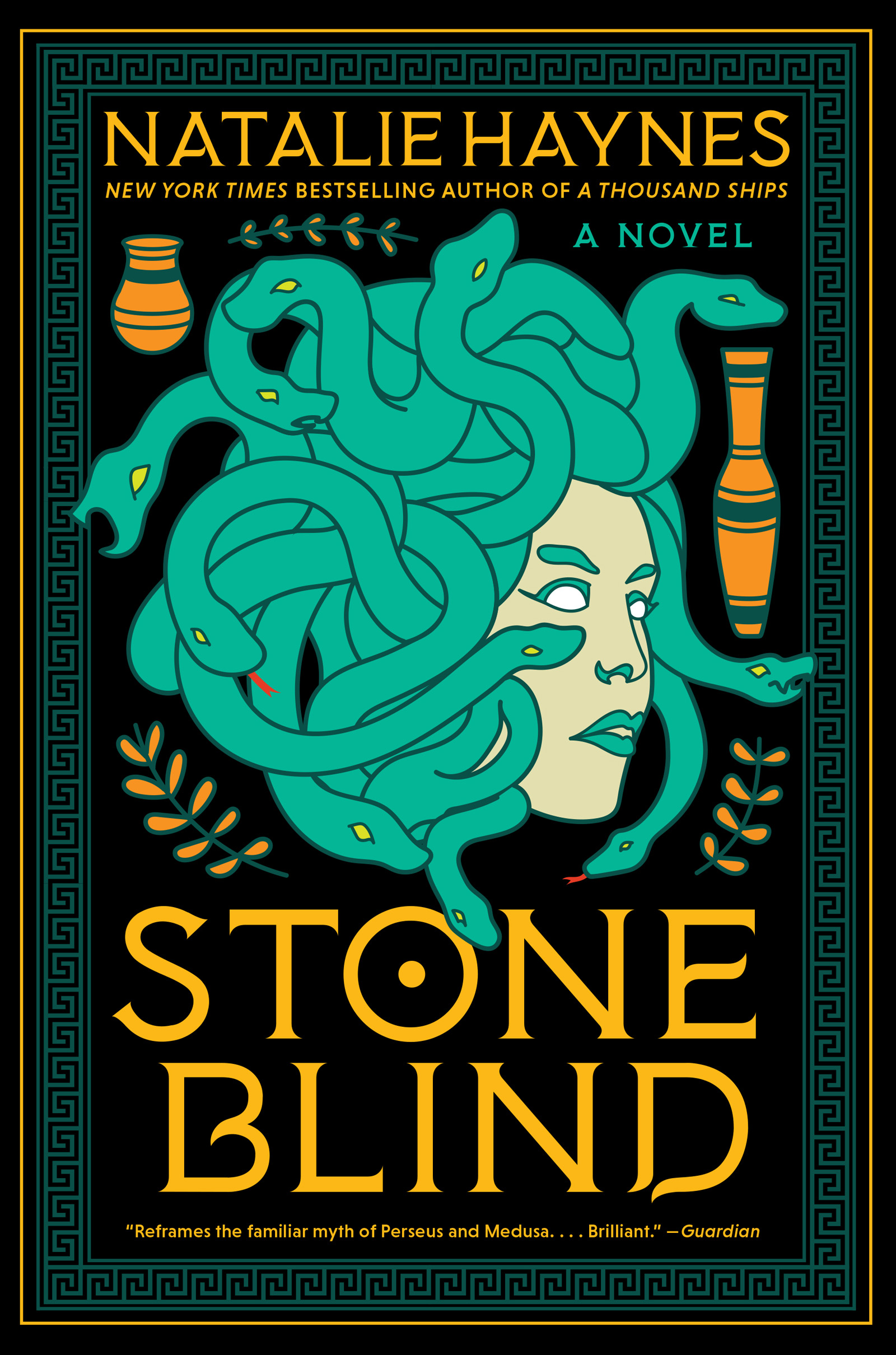
Stone Blind
About this book
Medusa is the vulnerable child in a family of deathless Gorgons. Sthenno and Euryale learn fear because their little sister can bleed, age, and die, and their fierce care gives her a home far from the Olympian conflicts gathering around them.
Athene's birth, Poseidon's violence, Zeus's rule, and Perseus's quest converge on Medusa without making her their narrative center. A shifting chorus of gods, mortals, sea creatures, and even objects exposes how easily power names its victims monsters and its instruments heroes.
Stone Blind retells the famous decapitation while refusing the clean moral shape of a hero defeating an evil creature. Its many voices preserve comedy and divine absurdity, but the Gorgon sisters' love gives the novel its measure of what the heroic version leaves unseen.
Read a sample
5,055 words
Plain text
From the opening
Gorgoneion
I see you. I see all those who men call monsters.
And I see the men who call them that. Call themselves heroes, of course.
I only see them for an instant. Then they’re gone.
But it’s enough. Enough to know that the hero isn’t the one who’s kind or brave or loyal. Sometimes – not always, but sometimes – he is monstrous.
And the monster? Who is she? She is what happens when someone cannot be saved.
This particular monster is assaulted, abused and vilified. And yet, as the story is always told, she is the one you should fear. She is the monster.
We’ll see about that.
Panopeia
As far towards the evening sun as it is possible to travel, there is a place where the sea winds inland in a narrow twist. You are where Ethiopia meets Oceanos: the furthest land and the furthest sea. If you could fly above it, see it as the birds see it, this channel (which is not a river because it flows the wrong way, but you may see this as part of its magic), coils like a viper. You have flown past the Graiai, although you may not have noticed, as they keep to their cave to avoid stumbling on their rocky cliffs and falling into the wild sea. Would they survive such a fall? Of course: they are immortal. But even a god doesn’t want to be battered between the waves and the rocks for all eternity.
You have also sped past the home of the Gorgons, who live not so very far from the Graiai, their sisters. I call them sisters, but they have never met. They are connected – though they do not know, or have long forgotten – by the air and the sea. And now, also by you.
You’ll need to travel to other places too: Mount Olympus, of course. Libya, as it will come to be called by the Egyptians and later, the Greeks. An island named Seriphos. Perhaps this seems too daunting a journey. But the place you have found yourself means you are already at the end of the earth, so you’ll need to find your way back. You’re not far from the home of the Hesperides, but they won’t help you, I’m afraid, even if you could find them (which you can’t). So that means the Gorgons. It means Medusa.
Metis
Metis changed. If you had been able to see her in the moments before she realized the threat, you would have seen a woman. Tall, long-limbed, with thick dark hair plaited at the back. Her large eyes were ringed with kohl. There was a quickness in the way her gaze seemed to fall on everything at once: even when she was still, she was alert. And she had her defences, what goddess did not? But Metis was better prepared than most, even though she was not armed with arrows, like Artemis, or with thinly contained rage, like Hera.
And so when she sensed – rather than saw – that she was in danger, she changed into an eagle and flew high, the gentle south wind ruffling the feathers of her golden wings. But even with these sharp eyes, she could not see what it was that had made the short hairs pulling at the edge of her plait prickle when she was in human form. She circled in the air a few times, but nothing revealed itself to her and eventually she flew down and settled on the top of a cypress tree, curving her muscular neck in every direction, just in case. She perched there, thinking.
She dropped down from the high branches onto the sandy ground, her talons scratching small furrows in the dust. And then she was not an eagle any more. Her hooked beak retracted and her feathered legs disappeared beneath her. As one muscled body became another, only the intelligence in the slit of her eyes remained constant. Now she slithered over the stones, a brown zig-zag stripe along her dorsal scales, her belly the colour of pale sand. She flickered across the ground as quickly as she had flown through the sky. And as she paused beneath a large prickly pear, she pressed her body into the earth, trying to feel the source of unease that she had not been able to spot as an eagle. But even as the rats that lived on scraps from the nearby temple raced away from her, she could not feel the footsteps of the creature she should be fleeing. She wondered what to do next.
She stayed under the cactus for a long time, enjoying the heat of the ground, allowing her hooded eyes to move, but nothing else. She was almost invisible, she knew. She was faster than most other creatures, and her bite was venomous, devastating. She had nothing to fear. But still she did not feel safe. And she could not stay here, a snake for ever.
She uncurled herself from the base of the cactus, and moved into the shade of the cypresses. Suddenly she reared up, and transformed again. The zig-zag on her scales fractured and became spots, the scales themselves softening to a coarse fur. Ears sprouted, clawed feet appeared at the end of muscular legs. The panther was beautiful, swishing her tail to send the flies spinning. She moved slowly at first, sensing each individual stone beneath the pads of her paws. Again, she felt the ripple of alarm she produced in the animals nearby. But once more, she could not shake her own fear. She ran through the trees, weeds snagging on her fur as her speed increased. They did not slow her at all. She could catch anything. And what could catch her? Nothing. She revelled in her power. She felt almost weightless, pure muscle in pursuit of prey. And then she was caught.
Continue reading the sampleClose the sample
Zeus was everywhere and nowhere at once. She could not outrun this bright cloud enveloping her. She flinched as her cat’s eyes could not tolerate the glare, changed back to a snake as the cloud seemed to thicken and close in. She tried to slither away beneath it, but there was no beneath. The cloud emanated from everywhere, from the ground as much as from the air. She tried to speed away from it, but whichever direction she turned, it became more impenetrable. The brightness was intolerable: even through the brille that covered them, her eyes ached. She made one last attempt to free herself, changing forms again in rapid succession: eagle, but she couldn’t fly above it; boar, but she couldn’t gore her way through it; locust, but she couldn’t consume it; panther again, but she couldn’t outrun it. The cloud began to solidify and she felt herself squeezed. Her muscles began to throb from the pressure and she had no choice but to make herself smaller and smaller still: weasel, mouse, cicada. But still the pressure increased. She tried one last time: ant. And then she heard his hated voice, telling her she could not escape him. She already knew what she had to do to make the pain stop. Submit to another pain. Beaten at last, she gave in and reverted to her original form.
As Zeus raped her, she thought of being an eagle.
* * *
The only good thing about Zeus’s sexual incontinence, his wife Hera had often thought, was its extreme brevity. His desire, pursuit and satiation were so short-lived that she could almost convince herself of their irrelevance. If only it didn’t invariably result in offspring. More and more gods and demigods, each one appearing for no reason other than to confirm to her that he was virtually indiscriminate in his infidelity. Even she, a goddess with an almost limitless supply of spite, could barely keep up with the number of women, goddesses, nymphs and mewling infants she needed to persecute.
She did not usually have to turn her attention to his previous wife. Metis was someone she preferred not to think about at all, but if she did it was with a mild irritation. No one likes to come second, or third, and Hera was no exception. Metis had been wife to Zeus long before Hera had been interested in the idea. They had parted so long ago that people had forgotten they were ever married. On good days, Hera didn’t think about it. On bad days, she saw it as cheating. It seemed particularly unreasonable that any goddess could claim priority over her, Hera, consort of Zeus, merely by having been there first. And since Hera had many more bad days than good days, she disliked Metis. But because she had so many other provocations to cope with, she usually ignored this.
It had been Metis, of course, who had advised Zeus in his war against the Titans. Metis who aided Zeus in his battle with Cronos, his father. Metis, who was so wily and clever, always hatching a plan. Hera was just as clever as her predecessor, she had no doubt. But circumstances forced her to use her plots against Zeus, whereas Metis had offered him her wisdom as a gift. Hera snorted. Much good that had done her. Hera had replaced her: who now thought of Metis in conjunction with Zeus? Who doubted the superiority of his sister and wife, Hera, queen of Mount Olympus? No mortal or god would dare.
Which made it all the more infuriating that Zeus had betrayed her with his former wife. The rumour had flown between the gods and goddesses like a swirling breeze. No one dared be the one who told Hera, but she knew about it just the same. She despised her husband more with each fresh revelation, and she determined to take her revenge. Zeus had been very quiet for the past day or so, no doubt hoping that if he avoided his wife, she might somehow forget her rage. When she heard him returning, Hera sat herself on a large, comfortable chair in her chamber, deep within the echoing halls of Olympus, and looked idly at her fingernails. She draped her dress to reveal more than her ankles, and tugged it down a little at the front. ‘Husband,’ she said, as Zeus entered the room, a slightly shifty expression on his otherwise majestic brow.
‘Yes?’ he replied.
‘I’ve been so worried about you.’
‘Well, I was . . .’ Zeus had learned over time that it was better to stop a sentence partway through than lie to his wife. Her capacity to unravel his deceits was one of her least appealing characteristics.
‘I know where you were,’ she said. ‘Everyone’s talking about it.’
Zeus nodded. Of course they were: no one gossiped like Olympian gods. He wished he had had the sense to render them all mute, at least the ones he had created. He wondered if it might be possible to do so retrospectively.
Hera sensed she did not have his undivided attention. ‘And I was worried,’ she repeated.
‘Worried?’ He knew there must be a trap, but sometimes it was just easier to jump right into it.
‘Worried about your future, my love,’ she murmured and shifted artlessly so her dress fell open a little further. Zeus tried to assess his situation. His wife was often furious and sometimes seductive, but he couldn’t remember an occasion when she had been both at once. He moved a little closer, in case this was the right thing to do.
‘My future?’ he asked, as he reached out and pulled teasingly at one of her curls. She turned her head up to face him.
‘Yes,’ she said. ‘I have heard such terrible things about the offspring of Metis.’ She felt him stiffen, before his fingers went back to caressing her hair. He was trying very hard. ‘It was Metis, wasn’t it? This time?’
She could not keep the edge from her voice and Zeus quickly wrapped his hand in her curls. She knew he would wrench her hair from her scalp if she wasn’t careful. ‘I was just wondering if you can really have forgotten what she once told you about her children,’ Hera sighed. ‘That she would give birth to one who would overthrow you.’
Zeus said nothing, but she knew her barb had found its mark. How could he have been so foolish? When he had overthrown his father – with Metis’s help, no less – and his father had done the same before him? How could he have forgotten what Metis herself had once told him when they were still married? How?
‘You need to act quickly,’ Hera added. ‘She told you she would have a daughter who would exceed all but her father in wisdom. And after her, a son who would be king over gods and mortals. You cannot take that risk.’
But she was speaking to the ether, because her husband had already disappeared.
* * *
The second time Zeus came for her, Metis did not try to hide. She knew what was coming and she knew she could not evade him. The only thing left to her was to hope that her daughter (she would have known it was a daughter even without her prophetic gifts; she could feel it) would survive. Had she known this was how it would happen, when she’d told her husband long ago that she could bear him a daughter and then a son who could overpower his father? She knew Zeus’s fears better than anyone. He would do anything to ensure that their son was never born.
Again she found herself surrounded by the brightest light, the inside of a thunderbolt. Again she felt the pressure to become smaller and smaller: panther, snake, grasshopper. But this time, there was no pain. Only a sudden, enveloping darkness as Zeus grabbed her in his huge hand. And then a strange sensation of being inside the black cloud that follows the thunderbolt. It was a darkness that would never end. Zeus had, she realized, consumed her, swallowed her whole. Now she and her daughter were inside the king of the gods with no means of escape. And even as Metis understood this, and accepted it, she felt something within her, within Zeus, resist it.
Sthenno
Sthenno was not the older sister, because they didn’t think of time in that way. But she was the one who had been less horrified when the baby was left on the shore outside their cave. Euryale had been equal parts baffled and appalled: where had the child come from? What mortal would ever dare to approach the Gorgons’ lair to abandon it there? Sthenno had no answers to her questions, and for a while, they both stared at the creature and wondered what to do.
‘Could we eat it?’ asked Euryale. Sthenno thought for a moment.
‘Yes,’ she said. ‘I suppose we could. It is quite small, though.’ Her sister nodded glumly. ‘You can have it,’ Sthenno said. ‘I already . . .’ She didn’t need to finish. Her sister could see the pile of cattle bones lying beside her.
The sisters did not eat from hunger: Gorgons were immortal, they had no need for food. But their sharp tusks, their powerful wings, their strong legs: all were designed for the hunt. And if you were going to hunt, you might as well eat your kill. They looked at the baby again. It lay on its back in the sand, its head propped up on a tuft of grass. Sthenno did not need her sister to say the words out loud: it looked like a deeply unsatisfying kill. It wasn’t running away, it hadn’t even tried to hide in the longer grass.
‘Where could it have come from?’ Euryale asked again. She raised her huge head, her bulbous eyes searching the rocks above them. There was no sign of anyone.
‘It must have come from the water,’ Sthenno replied. ‘Mortals can’t find their way without divine assistance. And even if they could, they wouldn’t dare to come here. The baby was brought to us from the sea.’
Euryale nodded, beating her wings. She scanned the ocean in every direction. No vessel could have sailed out of sight in the time it had taken the two of them to find the baby. They had heard a sound and it had roused them and they had left the cave together. No ship, no swimmer could be invisible to them so quickly.
‘I don’t know,’ Sthenno said, hearing her sister’s thoughts. ‘But look.’ She pointed at the baby and now Euryale noticed the circle of damp sand beneath the child and the seaweed-strewn trail leading back to the water’s edge.
They sat in silence, thinking.
‘It couldn’t have been left there by . . .’ Euryale glanced at her sister, not wanting to feel stupid.
Sthenno shrugged her broad shoulders, her wings catching the edge of the breeze. ‘I don’t know who else could have done it,’ she replied. ‘It must have been Phorcys.’
Euryale’s bulging eyes widened. ‘Why would he do that?’ she asked. ‘Where would he have got a mortal child from? A shipwreck?’
The Gorgons knew very little about their father. An old god, he lived in the depths of the ocean with their mother, Ceto. They had many offspring besides Euryale and Sthenno: Scylla, a nymph with six dog heads and their six vicious mouths, who lived in a high cave over the sea from which she would appear to eat passing sailors. Proud Echidna, half-nymph, half-snake. The Graiai – three sisters who shared a single eye and a single tooth – who dwelt in a cave somewhere even the Gorgons would hesitate to go.
Sthenno and her sister were gradually closing in on the child. The sea whispered behind them. The baby had been left far above the tide’s reach. Sthenno pointed to the wet trail that led to it: there were paired indentations on either side.
Euryale nodded. ‘It was Father,’ she said. ‘Those are the marks of his claws, surely.’
As they drew nearer, Sthenno noticed that the child was sleeping on a messy pile of dead seaweed: had her father scooped it up to form a sort of bed? Everything she could see and everything she thought she knew were battling one another in her mind. The thought of Phorcys doing anything as – Sthenno hunted for the word – mortal as laying a baby in a handmade crib was impossible. And yet, here were the marks of his claws, each side of the wide path made by his fish tail. And there was the baby lying safely beyond the water, sleeping on a thick pile of translucent dead weeds. Like empty skins snakes left behind in the sand, she thought.
It was only when they were right on top of the child, and Euryale was eyeing it as an unwanted visitor and an undersized meal, that the two sisters understood that Phorcys had delivered it to them for a reason.
‘She has . . .’ Euryale dropped into a low crouch, tilting her head for a better view of the child’s shoulders. They could see only a little of her back through the seaweed, but her sister was right. The baby had wings.
* * *
It took the Gorgons a whole day to accept that they had acquired another sister, a mortal one. It took them several more days to learn not to kill her by accident.
‘Why is it crying?’ Euryale asked her sister, prodding the baby with her hand, talon curled carefully into her palm so she wouldn’t injure her.
Sthenno looked at her sister in alarm. ‘I don’t know,’ she said. ‘Who knows why mortals do anything?’ Both tried to think of mortals they might have seen behaving similarly, but neither could bring one to mind. In fact, they couldn’t remember seeing any human children, but Euryale suddenly thought of a cormorant’s nest in the rocks nearby. The cormorant had chicks, she told Sthenno, who nodded as though she remembered.
‘The chicks made a terrible noise,’ Euryale said. ‘And the mother fed them.’ Her wide mouth split into a grin. She flew a little way inland until she came to the nearest settlements. She flew back with a stolen sheep under each arm. ‘Milk,’ she said. ‘They give babies milk.’
And so even though they were goddesses, they learned to feed their sister. After a while, Sthenno found she couldn’t remember what their home had looked like without a small flock of curve-horned sheep scrambling over the rocky ground with ease. Even Euryale – who had once combed the skies searching for prey, seizing it in her mighty jaws and crunching its bones for the sheer pleasure of the sound – seemed to enjoy looking after them. One day, an eagle tried to pick off one of their lambs, and Euryale rose in the air to defend it. The eagle was too fast for her, and she returned empty-handed, a few of the bird’s feathers falling to the sand behind her. But still it did not dare to try again.
In the early days, Sthenno wondered if Phorcys might return to explain his behaviour or to bring a message from their mother, Ceto, but he never came. The two Gorgons felt differently about this: Euryale was proud that their parents had entrusted the strange mortal child to them to look after. Sthenno wondered if her father had left the child with them hoping they would fail. It was impossible for gods to look at mortals and not feel some revulsion. Sthenno loved her new sister as much as she loved Euryale. But she still had to repress a shudder when she caught sight of her sister’s horrifyingly small hands and feet, her revolting little fingernails. And yet, even if something had gone wrong with her birth, Medusa was a Gorgon too. And perhaps she would improve with time.
Because this was the next upsetting development. The baby kept changing: growing, shifting as they watched, like Proteus. No sooner had they adapted to some inexplicable feature of her than she developed a new one. They carried her everywhere because she couldn’t move on her own, and then without warning she could crawl. They grew accustomed to that, and then she stopped crawling and started to walk. Her wings grew along with the rest of her, and it was a relief to them both to discover that even if she couldn’t fly very well, she was not completely earthbound. Euryale confessed that the wings reminded her they were sisters, in spite of everything. They felt a brief surge of hope when her teeth appeared, but they were small and stayed firmly inside her mouth, not like proper tusks. She could use them to chew, but what use was that to anyone?
As Medusa would not stop changing, her sisters had to change too. Sthenno learned to make bread because milk no longer satisfied her. The three of them stared at the dough as it blistered and rose on the wide flat rock they had balanced over their fire. Euryale had been watching women perform the same chore and had brought back instructions and advice. The more time went on, the more they found themselves copying the humans who lived nearby.
* * *
Mortals had always feared the Gorgons, but the feeling was not reciprocated. Although their sisters, the Graiai, lived in a cave as far from humankind as they could, the Gorgons simply lived where they chose and people avoided them. Neither sister could remember why they had decided on this particular spot on the shores of Libya, but they had made it their home. They had a wide, sandy shore, bordered on both sides by large sun-bleached rocks, marked here and there by tufts of sturdy grass. The rocks formed great outposts: a hard climb but an easy flight for a Gorgon to reach the highest points and gaze out over the sea with its sharp-beaked birds diving for fish, or turn to face inland across the vivid red earth and the dark green scrub. And cutting across the furthest edge of the shore was a jagged scar in the rock, left by one of Poseidon’s earthquakes which had almost torn the land in two. The ground was higher on the Gorgons’ side of the breach, but not by much. Nonetheless, it gave the two of them an unspoken sense that they had picked the right part, the higher part, of the coast for themselves.
Libya was home to many creatures – cattle and horses were their closest neighbours, brought by the people who had settled nearby. Euryale remembered a time when there were no humans within a day’s flying of their home. They used to be further away, but something had changed. She asked Sthenno if she could recall what had happened, but there was never any point asking Sthenno about these things. She always thought the world was as unchanging as they were. But even the Gorgons had changed, Euryale said: they had been two and now they were three. Sthenno shrugged and said, perhaps it was the weather. Humans worried about the weather, didn’t they? Because they had animals to feed and crops to grow. And perhaps that was the difference. The land was drier, hotter than before. Euryale reminded her sister of a time when they had flown across great swathes of green, bursting with noise: the conversation of swallows, the call of bee-eaters and the song of crested larks. When they had landed beside a huge lake, and watched the storks bathing in the still water. Sthenno nodded uncertainly. She never disputed her sister’s memory, but she didn’t always share its clarity.
Gradually, Sthenno agreed, their neighbours had moved closer to the coast, closer to the sea. But their secluded shore remained private because it was too inaccessible, and anyway, men told each other stories about the creatures they believed they had glimpsed there. Monsters from the deep with huge mouths, vicious tusks, leathery wings: so fast and strong and always to be feared. They had manes like lions, or hair made from snakes, or bristles like wild boar. The Gorgons were everything and nothing to most mortals, Sthenno said. She might remember less than Euryale but she understood more.
And so men avoided their home, the beach and the sea, the rocks and the cave. The cave which Sthenno thought they must have chosen because of Medusa. Euryale knew they had lived beside it before Medusa was their sister, but she never mentioned it. The cave was Medusa’s home, as soon as she was big enough to explore it. Gorgons loved the heat: Sthenno and Euryale could lie for hours in the scorching sun, unfurling their wings and allowing the warmth to seep through them. But Medusa would squint in the brightest part of the day, and her skin would become too hot. When she was still small, she found shade beneath her sisters’ outstretched wings. But as she grew bigger, she spent long days learning the recesses of their cave – its many hidden tunnels and paths, and the way the jagged scar visible on the sands could somehow also be found underfoot in the blackness inside the cave – so intimately that when the sun grew too hot, she would kiss her sisters on their bearded cheeks and withdraw to the cooler air to sleep.
Sthenno had no daughter, but she felt like the mother of Medusa and she knew Euryale felt the same. And although she hadn’t chosen the emotions she now experienced, she tried not to be appalled by them. The confusion and revulsion that Medusa had first provoked in both sisters had ebbed away. The anxiety, however, had not. Sthenno had never felt a moment of fear in her life before she was responsible for a child. What should she be afraid of, a Gorgon like her? Of men? Of beasts? The idea was absurd. And she had never experienced fear for another creature until Medusa. She had never felt the slightest worry when Euryale was away hunting or exploring: her sister could defend herself against any attack, just as she could. And then there was Medusa, who could be hurt by anything, even a stone.
Did all children have such unsteady limbs when they were small? Did they all collapse with no warning? Did they all spout blood when they came into contact with anything hard? Forgetful as she was, Sthenno remembered one thing and that was the cold dread which shuddered through her when Medusa tripped over the grasses that their flock negotiated without hesitation. She had been playing up on the higher rocks, showing off the wings that had let her fly the little way she could not climb. Medusa’s fall was sudden and brief as she dropped onto a jutting rock that pierced through the sand beneath her. Sthenno could not say how old her sister had been, but she was not even the height of Euryale’s bony hip. The noise she had made: Sthenno and Euryale had exchanged a wordless glance, each knowing the other’s thought. Was this the moment when their sister emerged as a true Gorgon? The moment when she finally made the same deathless howl that Sthenno could create if she merely opened her wide mouth and cried out?
It was not. This was not a display of strength but of fragility. The howl was disappointingly short-lived, as the little girl had to gulp for more breath to sustain it. Breathing was an awful weakness. And then the blood appeared, pouring in a vicious stream down the child’s leg. Sthenno hadn’t even known what it was at first, had no idea that her sister’s veins ran with this sticky redness when she should be filled with ichor, like a normal creature. She and Euryale ran to their sister, lifted her in their arms, cradled their wings around her. Euryale licked the blood gently from Medusa’s skin. The howls subsided and the tears that ran down her cheeks disappeared, faint salt traces all that was left of them until Euryale licked those away too. Medusa stared at the rock that had hurt her. Euryale didn’t need words to understand. She drove a clawed foot into it, watching her sister as the rock fractured and smashed beneath her.