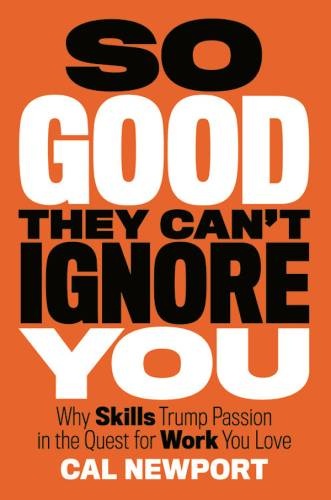
So Good They Can't Ignore You: Why Skills Trump Passion in the Quest for Work You Love
About this book
The book begins by examining the passion hypothesis: the belief that everyone has a pre-existing calling waiting to be matched with the right job. Newport argues that this account is both historically unusual and a poor description of how many people came to love their work.
His alternative is career capital, the rare and valuable abilities accumulated through focused practice. Those abilities can later be exchanged for control, impact, creativity, and other traits that make a working life attractive.
Case studies include craftspeople, founders, performers, and professionals whose choices show both the value and the danger of autonomy. Control acquired before a skill is valuable may be unstable, while valuable skill without an intentional mission can still produce a well-paid drift.
So Good They Can't Ignore You is a practical argument about developing a career rather than discovering one. Cal Newport offers rules, examples, and cautions for readers who want meaningful work without making a temporary feeling of passion carry the entire decision.
Read a sample
5,021 words
Plain text
From the opening
Introduction
The Passion of the Monk
“ ‘Follow your passion’ is dangerous advice.”
Thomas had this realization in one of the last places you might expect. He was walking a trail through the oak forest that outlines the southern bowl of Tremper Mountain. The trail was one of many that cross through the 230-acre property of the Zen Mountain Monastery, which has called this corner of the Catskill Mountains its home since the early 1980s. Thomas was halfway through a two-year stay at the monastery, where he was a practicing lay monk. His arrival, one year earlier, had been the fulfillment of a dream-job fantasy that he had nurtured for years. He had followed his passion for all things Zen into this secluded Catskills retreat and had expected happiness in return. As he stood in the oak forest that afternoon, however, he began to cry, his fantasy crumbling around him.
“I was always asking, ‘What’s the meaning of life?’ ” Thomas told me when I first met him, at a coffee shop in Cambridge, Massachusetts. By then, several years had passed since Thomas’s realization in the Catskills, but the path that led him to that point remained clear and he was eager to talk about it, as if the recounting would help exorcise the demons of his complicated past.
After earning a pair of bachelor’s degrees in philosophy and theology, then a master’s degree in comparative religion, Thomas decided that Zen Buddhist practice was the key to a meaningful life. “There was such a big crossover between the philosophy I was studying and Buddhism that I thought, ‘Let me just go practice Buddhism directly to answer these big questions,’ ” he told me.
After graduation, however, Thomas needed money, so he took on a variety of jobs. He spent a year, for example, teaching English in Gumi, an industrial town in central South Korea. To many, life in East Asia might sound romantic, but this exoticism soon wore off for Thomas. “Every Friday night, after work, the men would gather at these street carts, which had tents extending out from them,” Thomas told me. “They gathered to drink soju [a distilled rice liquor] late into the night. During winter there would be steam coming from these tents, from all the men drinking. What I remember most, however, is that the next morning the streets would be covered in dry vomit.”
Thomas’s search also inspired him to travel across China and into Tibet, and to spend time in South Africa, among other journeys, before ending up in London working a rather dull job in data entry. Throughout this period, Thomas nurtured his conviction that Buddhism held the key to his happiness. Over time, this daydream evolved into the idea of him living as a monk. “I had built up such an incredible fantasy about Zen practice and living in a Zen monastery,” he explained to me. “It came to represent my dream come true.” All other work paled in comparison to this fantasy. He was dedicated to following his passion.
It was while in London that Thomas first learned about the Zen Mountain Monastery, and he was immediately attracted to its seriousness. “These people were practicing really intense and sincere Zen,” he recalls. His passion insisted that the Zen Mountain Monastery was where he belonged.
It took nine months for Thomas to complete the application process. When he finally arrived at Kennedy airport, having been approved to come live and practice at the monastery, he boarded a bus to take him into the Catskill countryside. The ride took three hours. After leaving the city sprawl, the bus proceeded through a series of quaint towns, with the scenery getting “progressively more beautiful.” In a scene of almost contrived symbolism, the bus eventually reached the foot of Tremper Mountain, where it stopped and let Thomas out at a crossroads. He walked from the bus stop down the road leading to the monastery entrance, which was guarded by a pair of wrought-iron gates, left open for new arrivals.
Once on the grounds, Thomas approached the main building, a four-story converted church constructed from local bluestone and timbered with local oak. “It is as if the mountain offered itself as a dwelling place for spiritual practice” is how the monks of the monastery describe it in their official literature. Pushing past the oaken double doors, Thomas was greeted by a monk who had been tasked with welcoming newcomers. Struggling to describe the emotions of this experience, Thomas finally managed to explain it to me as follows: “It was like being really hungry, and you know that you’re going to get this amazing meal—that is what this represented for me.”
Thomas’s new life as a monk started well enough. He lived in a small cabin, set back in the woods from the main building. Early in his visit he asked a senior monk, who had been living in a similar cabin for over fifteen years, if he ever got tired of walking the trail connecting the residences to the main building. “I’m only just starting to learn it,” the monk replied mindfully.
The days at the Zen Mountain Monastery started as early as 4:30 A.M., depending on the time of year. Remaining in silence, the monks would greet the morning with forty to eighty minutes of meditation on mats arranged with “geometric precision” in the main hall. The view outside the Gothic windows at the front of the hall was spectacular, but the mats kept the meditators too low to see out. A pair of hall monitors sat at the back of the room, occasionally pacing among the mats. Thomas explained: “If you found yourself falling asleep, you could request that they hit you with a stick they kept for this purpose.”
Continue reading the sampleClose the sample
After breakfast, eaten in the same great hall, everyone was assigned jobs. Thomas spent time cleaning toilets and shoveling ditches as part of his housecleaning duties, but he was also assigned, somewhat anachronistically, to handle the graphic design for the monastery’s print journal. A typical day continued with more meditation, interviews with senior practitioners, and often long, inscrutable Dharma lectures. The monks were given a break each evening before dinner. Thomas often took advantage of this respite to light the woodstove in his cabin, preparing for the cold Catskill nights.
Thomas’s problems began with the koans. A koan, in the Zen tradition, is a word puzzle, often presented as a story or a question. They’re meant to defy logical answers and therefore force you to access a more intuitive understanding of reality. In explaining the concept to me, Thomas gave the following example, which he had encountered early in his practice: “Show me an immovable tree in a heavy wind.”
“I don’t even know what an answer to that would look like,” I protested.
“In an interview,” he explained, “you have to answer right away, no thinking. If you pause like that, they kick you out of the room; the interview is over.”
“Okay, I would have been kicked out.”
“Here’s the answer I gave to pass the koan,” he said. “I stood, like a tree, and waved my hands slightly as if in a wind. Right? The point was that this is a concept you really couldn’t capture in words.”
One of the first major hurdles a young practitioner faces in serious Zen practice is the Mu koan: Passing this koan is the first of the “eight gates” of Zen Buddhism. Until you reach this milestone, you’re not yet considered a serious student of the practice. Thomas seemed reluctant to explain this koan to me. I had encountered this before in my research on Zen: Because these puzzles defy rationality, any attempt to describe them to a non-practitioner can be trivializing. Because of this I didn’t press Thomas for details. Instead, I Googled it. Here’s one translation I found:
A pilgrim of the way asked the Grand Master Zhaozhou, “Does a dog have Buddha nature or not?” Zhaozhou said, “Mu.”
In Chinese, mu translates roughly to “no.” According to the interpretations I found, Zhaozhou is not answering the pilgrim’s question, but is instead pushing it back to the questioner. Thomas struggled to pass this koan, focusing on it intensely for months. “I worked and worked on that koan,” he told me. “I went to bed with it; I let it inhabit my whole body.”
Then he cracked it.
“One day I was walking in the forest, and a moment passed. I had been looking at these leaves, and ‘I’ had disappeared. We all experience things like this but don’t attach any importance to them. But when I had this experience, I was prepared for it, and it clicked. I realized, ‘This is the whole koan.’ ” Thomas had achieved a glimpse of the unity of nature that forms the core of the Buddhist understanding of the world. It was this unity that provided the answer to the koan. Excited, at his next interview with a senior monk Thomas made a gesture—“a simple gesture, something you might do in everyday life”—that made it clear that he had an intuitive understanding of the koan’s answer. He had made it through the first gate: He was officially a serious student of Zen.
It was not long after passing the Mu koan that Thomas had his realization about passion. He was walking in the same woods where he had cracked the koan. Armed with the insight provided by passing the Mu, he had begun to understand the once obtuse lectures given most days by the senior monks. “As I walked that trail, I realized that these lectures were all talking about the same thing as the Mu koan,” said Thomas. In other words, this was it. This was what life as a Zen monk offered: increasingly sophisticated musings on this one, core insight.
He had reached the zenith of his passion—he could now properly call himself a Zen practitioner—and yet, he was not experiencing the undiluted peace and happiness that had populated his daydreams.
“The reality was, nothing had changed. I was exactly the same person, with the same worries and anxieties. It was late on a Sunday afternoon when I came to this realization, and I just started crying.”
Thomas had followed his passion to the Zen Mountain Monastery, believing, as many do, that the key to happiness is identifying your true calling and then chasing after it with all the courage you can muster. But as Thomas experienced that late Sunday afternoon in the oak forest, this belief is frighteningly naïve. Fulfilling his dream to become a full-time Zen practitioner did not magically make his life wonderful.
As Thomas discovered, the path to happiness—at least as it concerns what you do for a living—is more complicated than simply answering the classic question “What should I do with my life?”
A Quest Begins
By the summer of 2010, I had become obsessed with answering a simple question: Why do some people end up loving what they do, while so many others fail at this goal? It was this obsession that led me to people like Thomas, whose stories helped cement an insight I had long suspected to be true: When it comes to creating work you love, following your passion is not particularly useful advice.
The explanation for what started me down this path goes something like this: During the summer of 2010, when this preoccupation first picked up steam, I was a postdoctoral associate at MIT, where I had earned my PhD in computer science the year before. I was on track to become a professor, which, at a graduate program like MIT’s, is considered to be the only respectable path. If done right, a professorship is a job for life. In other words, in 2010 I was planning what might well be my first and last job hunt. If there was ever a time to figure out what generates a passion for one’s livelihood, this was it.
Tugging more insistently at my attention during this period was the very real possibility that I wouldn’t end up with a professorship at all. Not long after meeting Thomas, I had set up a meeting with my advisor to discuss my academic job search. “How bad of a school are you willing to go to?” was his opening question. The academic job market is always brutal, but in 2010, with an economy still in recession, it was especially tough.
To complicate matters, my research specialty hadn’t proven to be all that popular in recent years. The last two students to graduate from the group where I wrote my dissertation both ended up with professorships in Asia, while the last two postdocs to pass through the group ended up in Lugano, Switzerland, and Winnipeg, Canada, respectively. “I have to say, I found the whole process to be pretty hard, stressful, and depressing,” one of these former students told me. Given that my wife and I wanted to stay in the United States, and preferably on the East Coast, a choice that drastically narrowed our options, I had to face the very real possibility that my academic job search would be a bust, forcing me to essentially start from scratch in figuring out what to do with my life.
This was the backdrop against which I launched what I eventually began to refer to as “my quest.” My question was clear: How do people end up loving what they do? And I needed an answer.
This book documents what I discovered in my search.
Here’s what you can expect in the pages ahead:
As mentioned, I didn’t get far in my quest before I realized, as Thomas did before me, that the conventional wisdom on career success—follow your passion—is seriously flawed. It not only fails to describe how most people actually end up with compelling careers, but for many people it can actually make things worse: leading to chronic job shifting and unrelenting angst when, as it did for Thomas, one’s reality inevitably falls short of the dream.
With this as a starting point, I begin with Rule #1, in which I tear down the supremacy of this passion hypothesis. But I don’t stop there. My quest pushed me beyond identifying what doesn’t work, insisting that I also answer the following: If “follow your passion” is bad advice, what should I do instead? My search for this answer, described in Rules #2–4, brought me to unexpected places. To better understand the importance of autonomy, for example, I ended up spending a day at an organic farm owned by a young Ivy League graduate. To better nuance my understanding of skill, I spent time with professional musicians—examples of a dying craftsman culture that I thought had something important to say about how we approach work. I also dived into the world of venture capitalists, screenwriters, rock-star computer programmers, and of course, hotshot professors, to name just a few more examples among many—all in an effort to pick apart what matters and what doesn’t when building a compelling career. I was surprised by how many sources of insight became visible once I burned off the obscuring fog generated by a mono-focused insistence on following your passion.
The narratives in this book are bound by a common thread: the importance of ability. The things that make a great job great, I discovered, are rare and valuable. If you want them in your working life, you need something rare and valuable to offer in return. In other words, you need to be good at something before you can expect a good job.
Of course, mastery by itself is not enough to guarantee happiness: The many examples of well-respected but miserable workaholics support this claim. Accordingly, this main thread of my argument moves beyond the mere acquisition of useful skills and into the subtle art of investing the career capital this generates into the right types of traits in your working life.
This argument flips conventional wisdom. It relegates passion to the sidelines, claiming that this feeling is an epiphenomenon of a working life well lived. Don’t follow your passion; rather, let it follow you in your quest to become, in the words of my favorite Steve Martin quote, “so good that they can’t ignore you.”
To many, this concept is a radical shift, and as with any disruptive idea, it needs to make a splashy entrance. This is why I wrote this book in a manifesto style. I divided the content into four “rules,” each given a deliberately provocative title. I also tried to make the book short and punchy: I want to introduce a new way of looking at the world, but I don’t want to belabor the insights with excessive examples and discussions. This book does offer concrete advice, but you won’t find ten-step systems or self-assessment quizzes in these pages. This topic is too subtle to be reduced to the formulaic.
By the end of this book, you’ll have learned how my own story ends up and the specific ways I’m applying the insights in my own working life. We’ll also return to Thomas, who after his dispiriting realization at the monastery was able to return to his first principles, move his focus away from finding the right work and toward working right, and eventually build, for the first time in his life, a love for what he does. This is the happiness that you, too, should demand.
It’s my hope that the insights that follow will free you from simplistic catchphrases like “follow your passion” and “do what you love”—the type of catchphrases that have helped spawn the career confusion that afflicts so many today—and instead, provide you with a realistic path toward a meaningful and engaging working life.
RULE #1
Don’t Follow Your Passion
Chapter One
The “Passion” of Steve Jobs
In which I question the validity of the passion hypothesis, which says that the key to occupational happiness is to match your job to a pre-existing passion.
The Passion Hypothesis
In June 2005, Steve Jobs took the podium at Stanford Stadium to give the commencement speech to Stanford’s graduating class. Wearing jeans and sandals under his formal robe, Jobs addressed a crowd of 23,000 with a short speech that drew lessons from his life. About a third of the way into the address, Jobs offered the following advice:
You’ve got to find what you love…. [T]he only way to do great work is to love what you do. If you haven’t found it yet, keep looking, and don’t settle.
When he finished, he received a standing ovation.
Though Jobs’s address contained several different lessons, his emphasis on doing what you love was the clear standout. In the official press release describing the event, for example, Stanford’s news service reported that Jobs “urged graduates to pursue their dreams.”
Soon after, an unofficial video of the address was posted on YouTube, where it went viral, gathering over 3.5 million views. When Stanford posted an official video, it gathered an additional 3 million views. The comments on these clips homed in on the importance of loving your work, with viewers summarizing their reactions in similar ways:
“The most valuable lesson is to find your purpose, follow your passions…. Life is too short to be doing what you think you have to do.”
“Follow your passions—life is for the living.”
“Passion is the engine to living your life.”
“[It’s] passion for your work that counts.”
“ ‘Don’t Settle.’ Amen.”
In other words, many of the millions of people who viewed this speech were excited to see Steve Jobs—a guru of iconoclastic thinking—put his stamp of approval on an immensely appealing piece of popular career advice, which I call the passion hypothesis:
The key to occupational happiness is to first figure out what you’re passionate about and then find a job that matches this passion.
This hypothesis is one of modern American society’s most well-worn themes. Those of us lucky enough to have some choice in what we do with our lives are bombarded with this message, starting at an early age. We are told to lionize those with the courage to follow their passion, and pity the conformist drones who cling to the safe path.
If you doubt the ubiquity of this message, spend a few minutes browsing the career-advice shelf the next time you visit a bookstore. Once you look past the technical manuals on résumé writing and job-interview etiquette, it’s hard to find a book that doesn’t promote the passion hypothesis. These books have titles like Career Match: Connecting Who You Are with What You’ll Love to Do, and Do What You Are: Discover the Perfect Career for You Through the Secrets of Personality Type, and they promise that you’re just a few personality tests away from finding your dream job. Recently, a new, more aggressive strain of the passion hypothesis has been spreading—a strain that despairs that traditional “cubicle jobs,” by their very nature, are bad, and that passion requires that you strike out on your own. This is where you find titles like Escape from Cubicle Nation, which, as one review described it, “teaches the tricks behind finding what makes you purr.”
These books, as well as the thousands of full-time bloggers, professional counselors, and self-proclaimed gurus who orbit these same core issues of workplace happiness, all peddle the same lesson: to be happy, you must follow your passion. As one prominent career counselor told me, “do what you love, and the money will follow” has become the de facto motto of the career-advice field.
There is, however, a problem lurking here: When you look past the feel-good slogans and go deeper into the details of how passionate people like Steve Jobs really got started, or ask scientists about what actually predicts workplace happiness, the issue becomes much more complicated. You begin to find threads of nuance that, once pulled, unravel the tight certainty of the passion hypothesis, eventually leading to an unsettling recognition: “Follow your passion” might just be terrible advice.
It was around the time I was transitioning from graduate school that I started to pull on these threads, eventually leading to my complete rejection of the passion hypothesis and kicking off my quest to find out what really matters for creating work you love. Rule #1 is dedicated to laying out my argument against passion, as this insight—that “follow your passion” is bad advice—provides the foundation for everything that follows. Perhaps the best place to start is where we began, with the real story of Steve Jobs and the founding of Apple Computer.
Do What Steve Jobs Did, Not What He Said
If you had met a young Steve Jobs in the years leading up to his founding of Apple Computer, you wouldn’t have pegged him as someone who was passionate about starting a technology company. Jobs had attended Reed College, a prestigious liberal arts enclave in Oregon, where he grew his hair long and took to walking barefoot. Unlike other technology visionaries of his era, Jobs wasn’t particularly interested in either business or electronics as a student. He instead studied Western history and dance, and dabbled in Eastern mysticism.
Jobs dropped out of college after his first year, but remained on campus for a while, sleeping on floors and scrounging free meals at the local Hare Krishna temple. His non-conformity made him a campus celebrity—a “freak” in the terminology of the times. As Jeffrey S. Young notes in his exhaustively researched 1988 biography, Steve Jobs: The Journey Is the Reward, Jobs eventually grew tired of being a pauper and, during the early 1970s, returned home to California, where he moved back in with his parents and talked himself into a night-shift job at Atari. (The company had caught his attention with an ad in the San Jose Mercury News that read, “Have fun and make money.”) During this period, Jobs split his time between Atari and the All-One Farm, a country commune located north of San Francisco. At one point, he left his job at Atari for several months to make a mendicants’ spiritual journey through India, and on returning home he began to train seriously at the nearby Los Altos Zen Center.
In 1974, after Jobs’s return from India, a local engineer and entrepreneur named Alex Kamradt started a computer time-sharing company dubbed Call-in Computer. Kamradt approached Steve Wozniak to design a terminal device he could sell to clients to use for accessing his central computer. Unlike Jobs, Wozniak was a true electronics whiz who was obsessed with technology and had studied it formally at college. On the flip side, however, Wozniak couldn’t stomach business, so he allowed Jobs, a longtime friend, to handle the details of the arrangement. All was going well until the fall of 1975, when Jobs left for the season to spend time at the All-One commune. Unfortunately, he failed to tell Kamradt he was leaving. When he returned, he had been replaced.
I tell this story because these are hardly the actions of someone passionate about technology and entrepreneurship, yet this was less than a year before Jobs started Apple Computer. In other words, in the months leading up to the start of his visionary company, Steve Jobs was something of a conflicted young man, seeking spiritual enlightenment and dabbling in electronics only when it promised to earn him quick cash.
It was with this mindset that later that same year, Jobs stumbled into his big break. He noticed that the local “wireheads” were excited by the introduction of model-kit computers that enthusiasts could assemble at home. (He wasn’t alone in noticing the potential of this excitement. When an ambitious young Harvard student saw the first kit computer grace the cover of Popular Electronics magazine, he formed a company to develop a version of the BASIC programming language for the new machine, eventually dropping out of school to grow the business. He called the new firm Microsoft.)
Jobs pitched Wozniak the idea of designing one of these kit computer circuit boards so they could sell them to local hobbyists. The initial plan was to make the boards for $25 apiece and sell them for $50. Jobs wanted to sell one hundred, total, which, after removing the costs of printing the boards, and a $1,500 fee for the initial board design, would leave them with a nice $1,000 profit. Neither Wozniak nor Jobs left their regular jobs: This was strictly a low-risk venture meant for their free time.
From this point, however, the story quickly veers into legend. Steve arrived barefoot at the Byte Shop, Paul Terrell’s pioneering Mountain View computer store, and offered Terrell the circuit boards for sale. Terrell didn’t want to sell plain boards, but said he would buy fully assembled computers. He would pay $500 for each, and wanted fifty as soon as they could be delivered. Jobs jumped at the opportunity to make an even larger amount of money and began scrounging together start-up capital. It was in this unexpected windfall that Apple Computer was born. As Young emphasizes, “Their plans were circumspect and small-time. They weren’t dreaming of taking over the world.”
The Messy Lessons of Jobs
I shared the details of Steve Jobs’s story, because when it comes to finding fulfilling work, the details matter. If a young Steve Jobs had taken his own advice and decided to only pursue work he loved, we would probably find him today as one of the Los Altos Zen Center’s most popular teachers. But he didn’t follow this simple advice. Apple Computer was decidedly not born out of passion, but instead was the result of a lucky break—a “small-time” scheme that unexpectedly took off.
I don’t doubt that Jobs eventually grew passionate about his work: If you’ve watched one of his famous keynote addresses, you’ve seen a man who obviously loved what he did. But so what? All that tells us is that it’s good to enjoy what you do. This advice, though true, borders on the tautological and doesn’t help us with the pressing question that we actually care about: How do we find work that we’ll eventually love? Like Jobs, should we resist settling into one rigid career and instead try lots of small schemes, waiting for one to take off? Does it matter what general field we explore? How do we know when to stick with a project or when to move on? In other words, Jobs’s story generates more questions than it answers. Perhaps the only thing it does make clear is that, at least for Jobs, “follow your passion” was not particularly useful advice.
Chapter Two
Passion Is Rare
In which I argue that the more you seek examples of the passion hypothesis, the more you recognize its rarity.
The Roadtrip Nation Revelation
It turns out that Jobs’s complicated path to fulfilling work is common among interesting people with interesting careers. In 2001, a group of four friends, all recently graduated from college, set out on a cross-country road trip to interview people who “[lived] lives centered around what was meaningful to them.” The friends sought advice for shaping their own careers into something fulfilling. They filmed a documentary about their trip, which was then expanded into a series on PBS. They eventually launched a nonprofit called Roadtrip Nation, with the goal of helping other young people replicate their journey. What makes Roadtrip Nation relevant is that it maintains an extensive video library of the interviews conducted for the project1. There’s perhaps no better single resource for diving into the reality of how people end up with compelling careers.
When you spend time with this archive, which is available for free online, you soon notice that the messy nature of Steve Jobs’s path is more the rule than the exception. In an interview with the public radio host Ira Glass, for example, a group of three undergraduates press him for wisdom on how to “figure out what you want” and “know what you’ll be good at.”
“In the movies there’s this idea that you should just go for your dream,” Glass tells them. “But I don’t believe that. Things happen in stages.”