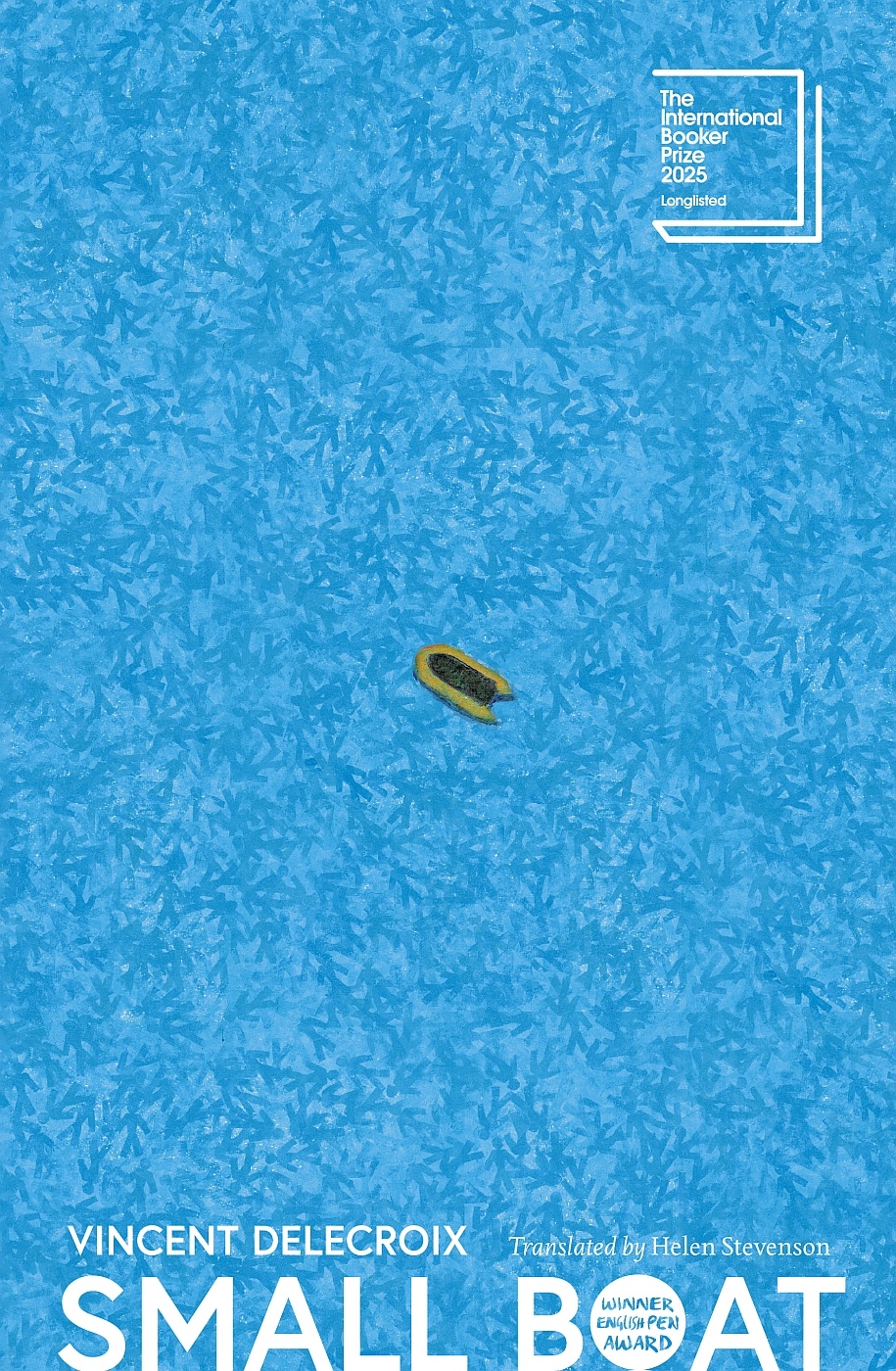
Small Boat
About this book
The narrator worked in a French maritime rescue centre on the night a small boat carrying migrants called for help. As an investigator reconstructs the hours before the disaster, she insists that she followed protocol and that the decision to embark belonged to those on the water.
Her account moves through recordings, timings, jurisdiction, weather, and the language by which institutions distribute responsibility. The voice is controlled, intelligent, and increasingly revealing in the distinction it draws between legal duty and human obligation.
The novel refuses the relief of a heroic rescuer or a singular villain. It stays with the ordinary mechanisms that allow preventable death to become nobody’s individual act, while the dead remain largely outside the narrator’s imagination.
Small Boat is a short, severe novel by Vincent Delecroix, translated by Helen Stevenson. Based on the moral circumstances of Channel crossings, it examines how bureaucracy can make cruelty sound like administrative accuracy.
Read a sample
5,055 words
Plain text
From the opening
I
I didn’t ask you to leave, I said.
It was your idea, and if you didn’t want to get your feet wet, love, you shouldn’t have embarked. I didn’t push you into the water, I didn’t fetch you from your village or field or ruin of a suburb and put you in your wretched leaky boat, and now the water’s up to your ankles, I get it that you’re frightened, and you want me to save you and you’re impatient. You’re counting on me. But I didn’t ask you for any of that. So you’ll just have to grin and bear it and let me get on with my job.
And apparently these thoughts were so strong that I actually spoke them out loud, the first bit, at least, certainly if the recordings are to be believed and there’s no reason not to believe them. I accept that.
While I was at it I should perhaps have added things like ‘I’m not God Almighty either’, which must have been what was in my mind, and I could have actually said it. I could have said ‘There are guys like you everywhere tonight, forty small boats supposedly sinking at the same time in the Channel and I can’t see to everyone at once. So you’ll have to be patient, love, or tell all the others that are sinking to calm down and get off their phones so I can just look after you; you go ahead and call all the others, since you’ve got a phone, all those people climbing into battered old boats with no compass or flares, thirty at once on a raft that can scarcely take the weight of five, no instruments, nothing to steer by, no knowledge of the sea, along with their women and children.
But in the end I said to Julien, who was next to me: These guys are unbelievable, one minute they jump in the water, the next they’re practically shouting at you for not throwing them the lifebuoy fast enough, cheeky, I call it. He smiled and plunged back into his book. Leaky, more like, he remarked. That’s the sort of joke that raised a laugh at 3 am.
That joke didn’t get recorded; it probably wouldn’t have looked too good, and Julien can rest easy: no one’s going to call him a monster for making a joke about inflatable dinghies springing leaks. Besides, on the phone recordings you can only hear my voice, unluckily for me.
After that I went back to my screens, my PC, my microphone, thinking surely they should be happy; they wanted to get to England, they’re there now, in British waters, in a British vessel by now, wrapped up like sweeties in gold paper; they can continue their conversation in English to their hearts’ content.
But in the end the currents brought their bodies back into French waters.
So now they were floating on the investigator’s desk, at the Coast Guard office. There were twenty-seven of them to be exact, including a little girl, scattered among the ballpoint pens, the note blocks, folders, floating round the police inspector’s computer, including also the body of the man who had called me fourteen times that night and who now, obviously, had fallen silent. The sea was calm on the surface of the desk, no wind, no swell, and alongside the bodies only orderly piles of paper.
While she was playing me the recordings, the policewoman sometimes stared hard at me, sometimes gazed out of the window at I know not what, because from my signal station all I ever saw was the sea, and given a choice I would much rather, like today, look out at a stretch of road with a building site, some workers, Africans mostly, but at least they were alive, not wet and chilled to the bone, not women, not children, so I was ok looking at all that, while they played me the recording of the voice saying Please, please and me saying Calm down, help is coming.
The policewoman wore her hair tied back severely in a pony tail, exactly like me, I thought, and sat up straight like me, a bit like a soldier, with coat-rack shoulders as Eric used to say, the same look, if that makes sense, but ten years older, her in her blue police pullover and me in my own clothes, obviously, a ridiculous sweatshirt, and trainers, as though I’d just come back from my morning run, looking like a kid even with my severe pony tail, like some sulky, stony-faced school kid summoned before the head teacher. And I expect it was this absurd and vaguely humiliating resemblance, this caricature, this depressing, unsparing image of what I must actually look like, staring me in the face, that made it so hard for me to like her, so easy to dislike, in fact, though in any case there was no question, in this situation, of liking her.
As she showed me into her office she had said, Thank you for coming of your own accord, your boss has so far refused to give us your contact details. She added, Your colleague, apparently, the one on duty with you that night, has not shown a similar – the same – but she hesitated over what should come next, Conscientiousness perhaps, or maybe Courage, or even Moral Scruple, or Sense of Duty, but she couldn’t find quite the right words, so she corrected herself saying, ‘Has not chosen to do so, as yet.’
Continue reading the sampleClose the sample
And, fortunately, she did not ask me why I had chosen to take this step, as she finally put it, and why I had turned up like this of my own free will, before the judge and quite possibly the police came to my house anyway to take me away in front of my little girl and put me in the dock on a charge of failure to assist a person in danger or some such; anyway, fortunately, she did not ask me why, after dropping Léa off with my parents that morning, I had got in my car and driven to the coastguard station at Cherbourg, a four-hour drive from Boulogne, a motorway stop for an insipid coffee, on the surface of which I saw little dinghies bobbing about but actually they were biscuit crumbs, and all around me people silently pointing at me behind my back, a call to my parents to check everything was ok with my daughter, if she was upset about not going to school, another to the police to say I’m coming, I’m on the road, surprised when they don’t answer in English at the other end, no voice saying Please, please, no one screaming in the background, just We will wait for you, as reasonable shipwrecked people should have said, sitting it out quietly, since there wasn’t much else they could do anyway except pray and keep their eyes peeled for a boat. We will wait for you, they would have said calmly, instead of continuing their endless, pointless pleading, refusing to understand the difference between being in French waters and being in British waters – instead of calling fourteen times in two hours to say they were sinking, instead of annoying me by saying it over and over again, as if it was me that didn’t understand, when I did. I understood perfectly, your feet are in the water but it’s English water, not French, and yes I know they’re both equally cold, so set your sights in that direction if you still know your north from your south.
Lucky then that she didn’t ask me why I’d finally decided to come, because I wouldn’t have known what to say, though I’m pretty sure I wouldn’t have used words like Moral Scruple or Sense of Duty, definitely not Courage, words like Exhaustion and Nausea more likely, and definitely Anger like Shame.
It was also that I wanted to hear myself. I mean hear and not read myself, read my words in the newspaper, hear my own voice and not the voice of the journalists repeating on the television what I said, alongside expressions like migrant drama, migrant tragedy, as though every evening at eight o’ clock we were at the theatre and they were putting on the same play, and it really is the same play, with me in the front row – I never miss a performance, I show up every evening for the migrant drama; they give me a free seat and even pay me for it; some people are in boxes, some in the gallery, but they give me a look-out post in the front row so I can see clearly; that way, I’m both in the front row and in the dress circle looking out at the sea, and even if the title of the play varies – sometimes Migrant Drama, sometimes Migrant Tragedy, Drama in the Channel, or sometimes Drama in the Mediterranean – of course it’s always the same play, and always the same character, and at one point the character picks up a phone to address the audience. It’s interactive, he calls out to them, it starts with Please, please, but he’s not really addressing the audience, who meanwhile are gasping oh and ah and sometimes sighing with indignation, it’s me, just me, he’s talking to. It’s for me to answer, and answer well, or the audience isn’t happy, and the sighs of indignation are for me, and the next day the theatre critics lay into me, because my responses determine how the play unfolds, and if I do a good job the Migrant Drama is a bit less of a Migrant Drama, not to mention the fact that at the same time I have to sort out what’s happening on other stages where they’re showing the Drifting Yacht Drama, or the Capsized Trawler Tragedy.
To hear myself, then, hear my own voice, right here in the Coast Guard’s office, to be absolutely sure of what I said instead of hearing some dolled-up journalist parroting that I’d said this, that and the next thing – including horrible things, scandalous things, or shocking things, and going on to say that I had done or had not done things that I should or shouldn’t have.
But it was mostly him you heard on the recordings. I don’t know what to call him – the Migrant, Telephone Man, Sinking Man, but I knew his voice by heart, what he was saying, too, because in reality it’s always the same man calling. Every night, the same voice, the same pleas, because it doesn’t matter how many times you pull this idiot out of the water, back he comes – one time, ten times, a hundred times. One night you pull him out when he’s drowning and he’s safe and sound, he might even thank you, and the next night he’s calling back again, because he’s in the water again, as though he didn’t learn his lesson and he’s saying, Please, please. Every day you set him back on dry land and every night he’s back again and it feels like it will go on this way till Judgement Day – the same guy, every time, back in the water, drowning in mid-Channel, waiting to be rescued, so he can do it again the next night, and eventually it’s wearing.
But my voice too, though it wasn’t quite my voice, not because the recording inevitably distorts the tone, but because it was my professional voice, the one that crisply handles the nightly disaster with phrases like Calm down and Send me your geolocation by WhatsApp or Help is coming. So we heard mostly phrases of this kind at 2.05, 2.36, 3.12, 4.22 right up till 4.32, after which we heard nothing more, and among these phrases there were others which I apparently should not have uttered, like when I said I didn’t ask you to leave and the investigator asked me what to make of that particular phrase.
So I told the investigator that in my opinion they shouldn’t attach too much importance to that particular phrase – since it was clearly a problem – even though I didn’t know if they were going to send me to prison for stating the blindingly obvious – namely that it really wasn’t me that asked them to leave, if that was one of the mistakes they were accusing me of, but what mistake exactly? Because after all, I might have said that to any irresponsible person out sailing, to the cretin who takes to the waves regardless of the weather conditions or doesn’t know how to handle their dumb little sailboat and is gobsmacked to find themselves in trouble, and panics and the entire French Navy has to be called out so they don’t get a dunking. And if he tried telling me I’m not acting fast enough, as though what’s happening to him is my fault, I’d tell him the same thing, that it wasn’t me that asked him to leave, after all.
But she looked at me, as though she didn’t believe me and I had a moment of doubt myself. But why?
Sensing this, she asked sneakily Can you not see the difference between an irresponsible pleasure tripper and a dinghy full of migrants? It was not the most wellmeaning question, but actually it was quite easy to answer because my profession requires us to make no distinction, so that’s what I said, and that I should be congratulated for not making one: you rescue everyone without distinction. Should I be more intent on saving some more than others?
But that wasn’t what she meant, of course, because I seemed to somehow think that some hick who sets out to sea with a leak in his pleasure boat and people fleeing poverty and war were the same thing, as though they were all in the same boat, on a fishing trip. The distinction to be made was not between one man who’s drowning and another man who’s drowning, but between the reasons, how they came to be in this situation. The distinction to be made is why people leave, why thirty people might set out in a little nut shell and not all alone in their First 24. So the problem actually was that I didn’t make a distinction, that I didn’t appear to grasp that every situation is different, that not everyone sets out in the same way, and certainly not for the same reasons, and therefore not under the same conditions.
However, this insidious question implied that, on the contrary, I actually was making a distinction, but in the wrong direction. In other words I would ultimately have been keener to save some rich guy showing off on his yacht on a stormy night than on calling out help for a handful of Iraqi Kurds who insist on splashing about in the Channel every night. In other words, I failed to make a distinction when I should have, and when I shouldn’t have made a distinction, I did, and there was only one possible reason for that, and it was the same one. And since she was clearly about to end up asking me if I had a grudge against the migrants, or if I considered the life of a migrant of lesser value than that of a yachtsman or a company boss on a fishing spree, in order to head off a question of that kind, I said that I held no opinion on the migrants. I had no more opinion on the migrants than I did on migration policy or the right to asylum, relations between North and South, problems, solutions, the woes of the world, injustice: I was not required to have an opinion on the migrants.
Honestly, I have no opinions about the migrants; in fact, I have even less of an opinion about them than other people, I imagine, and in fact I am required to have none, and that’s fine by me. If anyone has opinions about the migrants it’s my ex, Lea’s dad; he’s got plenty, and they’re pretty much the same as those of the baker on the corner and the checkout women at the local supermarket, who I sometimes chat with on my a week off. Pretty much the same, in fact, as those of half of Calais, Boulogne and Dunkerque. Working at the CROSS meant I got to hear even more of Eric’s views on the migrants, because not only could he not see why we went to so much trouble, at the CROSS, to come to the aid of these parasites, and why, as soon as we spotted one, we didn’t chuck them straight in the water, with a good thwack of an oar if possible, to make sure they didn’t rise back up to the surface.
It had all started with stories about Calais and the Jungle, because Calais was where Eric came from, and by the end he just couldn’t bear the thought of me doing that job, rescuing trawlers and cargo ships, yes, rescuing migrants, no. Every time I got home he’d ask how many did you fish out of the water this time, and how much does this bullshit cost us, and why don’t you push them over into English waters and let them get on with it if they’re determined to get there, and why, once you’ve fished them out, don’t you send them straight to Africa. Don’t you think we’ve got better things to do than kiss them better? They should look after themselves or stay at home. I’d heard it a thousand times, until, for reasons that actually had nothing to with that, I asked him to leave, once and for all. I was not there to tell the story of my life with Lea’s dad and how we ended up separating.
(Is that why I came here, I wondered: to talk about the Migrant Drama? Is that the object of this enquiry: what I think about the migrants? As though I wasn’t in an office at a police station, but in a television studio, to express my views and be judged on them, i.e. was I bothered about the famous Migrant Drama, showing nightly in the Channel, the Mediterranean, Ceuta or Lesbos? What did I think about the Calais jungle, did I think installing showers and toilet blocks in the camps rendered them dangerously attractive?)
For sure, I might well hold opinions on these subjects. I might well have a view, or have formed one, as they say, given that every day I have the dregs of the earth spilling out before my eyes, stagnating for a while in Calais, in Grande-Synthe, then throwing themselves into the sea – all these people who think we owe them something because they’re dying of hunger in their own countries, or simply because they want their own car and might be entitled to it, who come looking for the blanket of universal health care and are lucky if they find a survival blanket. But I don’t have opinions of that kind because it wouldn’t be professional and, unlike Julien, who is almost always my partner in the rescue group, I don’t even assume that absence of opinion – which is an opinion in itself – when he looks down from on high or askance at all the trivial, tragic turbulence out there in the Channel, affecting the indifference of a world-weary sage, an air of couldn’t-care-less as he reads his book when the weather is calm. And I’d even have to say I had no views on the matter; I’ll leave that to other people, who have plenty. That way they won’t have to worry about life belts. It’s not that I don’t know what to think about the Migrant Drama, the Migrant Tragedy, the Shipwreck of Europe, the Graveyard of the Mediterranean or the Channel – to employ all those received journalistic expressions that simply disgust me – it’s not that I don’t know what to think, it’s that I don’t have any thoughts about them at all.
I’m not running an NGO. I’m not there to defend a cause and I don’t send help because it’s right; that’s what I needed to say to the police inspector, to get her to understand. It’s not my moral conscience or whatever, that throws life belts or survival blankets.
So I have no opinions, I said again, at least, not opinions on that matter, no particular convictions, nor should I, because I’m paid to monitor maritime traffic and coordinate rescue if necessary, not to have convictions, one way or another. I can’t think why I would need to have convictions, one way or another, to do this job; if I did, it really would be a disaster. Likewise, if I let my conscience trouble me, because having a conscience stops you acting, making decisions, being effective. That’s a given, and it’s the first thing they teach you in this job. I’m required precisely not to have convictions or a conscience. And you are the last person, I concluded, of all people, who can contradict me on that, because I’m sure that if one of your police colleagues had a conscience you’d consider it a professional weakness.
So I didn’t enlist with the Navy to save the migrants sloshing about on the rail tracks of Pas-de-Calais, that’s for sure, but if I’m asked to do it, or to help do it, I do. So don’t then ask me what I think, deep down, about these people, or rather about their obsession with flinging themselves into the water in search of I know not what. Also, I have to do it with the means available, and that’s something we might talk about, the means available, or rather the lack of means available for carrying out these missions, because this lack of means available might actually have something to do with what happened, seeing as how I cannot send out dozens of dinghies, speedboats, patrol boats or forty helicopters to save forty small boats at the same time. You have to prioritise.
Yes, but the fact is you didn’t send anyone at all, she interrupted, and in the end that, she added, was what I needed to explain. That was why we were there: to explain why they had spent three hours sinking when there was a patrol boat twenty kilometres away, why even once the English had been alerted, no one (i.e. not me) had informed them that the small boat was in trouble; why when a ship spotted them and asked me what to do, I had told them they should just carry on, take no notice. Why I had lied to the migrants for almost three hours. And with a gesture of annoyance she played the recordings again, and ten times over I heard myself say Calm down help is coming, admittedly in an increasingly irritable tone, because they just didn’t understand, they were so caught up in their terror, their obtuse despair, caught up in not wanting to die, with staving off the night that was consuming them, the water that was grabbing their ankles and dragging them down into the deep. And they started to sink all over again in the piercing cold night as I looked out of the window at the workers busy on the building site opposite.
But the more I said Calm down and then First, I need your position, and Yes, but now you are in English waters you must call 999, the more it seemed to me that the sea, incomprehensibly, had begun to encroach on the building site opposite the police station window, so that soon the living Africans would also have their feet in the water and be calling for help.
I decided instead to listen to my daughter’s voice, and that’s what I did, forgetting the recordings, because at least she doesn’t ask me in English to save her every night, and I don’t need to – she’s not in danger of drowning in her little bed at night or in her bowl of hot chocolate in the morning. The night isn’t threatening to swallow her, and when she holds out her arms to me, it’s not so I’ll get her out of there, and when I tuck her in, it’s not with a survival blanket, and when I lie down next to her in the evening, when I hold her tight to warm her up and send her to sleep, burying my face in her neck, I don’t feel her shivering with cold and terror.
But my daughter said nothing. She was sleeping, and in her bedroom you could hear a voice from the depths of the night saying Please save us, so then I had to hold my daughter even tighter, so that the imploring cries didn’t wake her, to murmur in her ear not to worry, go back to sleep, everything was fine. She stirred in her sleep, pressed up against me, but now there were more cries. I was waiting for them to stop, once and for all, but back they came, so I had to cover her ears, cover them so everyone would go back to sleep, which I was about to do myself when the voice of the police inspector spoke in my daughter’s bedroom, too, saying, Madame, are you still with us or are you day-dreaming? Because I clearly hadn’t paid as much attention as I should have to the recordings, and instead had gone into a daydream, watching the workers on the construction site, who were now doing their best to struggle against the rising water.
(I hadn’t even noticed that during this time another policeman had come into the room, and was standing there with his back to the wall opposite the window with his arms folded, listening to the recording with his colleague, watching me in silence.)
The police inspector wanted to establish the sequence of events once and for all, as she put it, on which basis we could finally get down to discussing the essential.
We’re not listening to this just to make you feel bad, she tried to assure me, in a gentler tone, she was simply trying, she insisted, to shed some light on what had happened. I had to smile because shed some light on seemed to me a particularly unfortunate expression, seeing as how it is precisely at night, in the deep dark of night, that everything happens. Shed some light, I murmured, is exactly what we need to do.
But, on the contrary, it was dark and it was night, since it was one in the morning, and at one in the morning the English contacted us about a small boat that was adrift, and forty-eight minutes later the occupants of the boat themselves called us asking for help. According to the GPS, it’s true, they were in French waters, but the currents were pushing them into English waters, so I called the English back to warn them they were approaching, and I told the occupants of the small boat not to panic because the rescue services were on their way. There was no sound of an engine – theirs must have broken down – and the dinghy might be drifting and perhaps it was filling with water, and when an hour later they did actually find themselves in English waters, I called the English again to inform them, and the English, as far as I know, mobilised a patrol boat but since they were forty-five minutes away they asked us to send a patrol boat to the area, too. This was not possible since our boat was busy on another mission, and from then on the occupants of the dinghy kept on and on calling, saying the dinghy was broken, it was filling with water, we must help them, we must come and save them, etc…but no one did save them and the English did not find them. They sank, apparently and drowned, twenty-seven of the twenty-nine of them. Two survived. End of story.
*
End of story, indeed, sighed the police inspector, not looking particularly satisfied with my version of events. Which was confirmed when she observed that I had presented all that, in her opinion, without much sympathy, and, if the truth be told, with an astounding degree of detachment. But I couldn’t see what it would have added if I had spoken elegantly, or brought my personal feelings, which in any case I didn’t have, into what was, after all, supposed to be simply an objective account of the facts. What difference would it have made if I’d said those poor people instead of them, for example? Besides, I added, the whole exercise seemed superfluous to me, seeing as she knew very well what had happened, the sequence of events, as she put it. But, apparently, she wanted to hear my version of events or rather, she corrected, she wanted to hear how I’d experienced them.
So I replied that the whole point was that I’d laid out the facts in the way I’d experienced them, at which she looked even more concerned and glanced at her colleague, who still had not spoken. She asked if I wanted a coffee.
Without waiting for my response, she left the office together with the other police officer, leaving me looking out at the construction site opposite – which this time was deserted, no water either (I must have been imagining things); it must be their lunch break. And my eyes started wandering round the room, the shelves and cupboards, the incomprehensible posters, the files, things you could equally well have found in the operations room at the CROSS, and the surface of the desk from which the drowned people had vanished, thank God, while I was beginning to think that I had better go home and pick Lea up from my parents because, to be honest, we’d pretty much covered everything here. I’m coming home, I said to Lea, I’ll just say goodbye to the police inspector. We’re done; I’m on my way back now, we’ll have tea at home. Don’t worry about your homework being late.