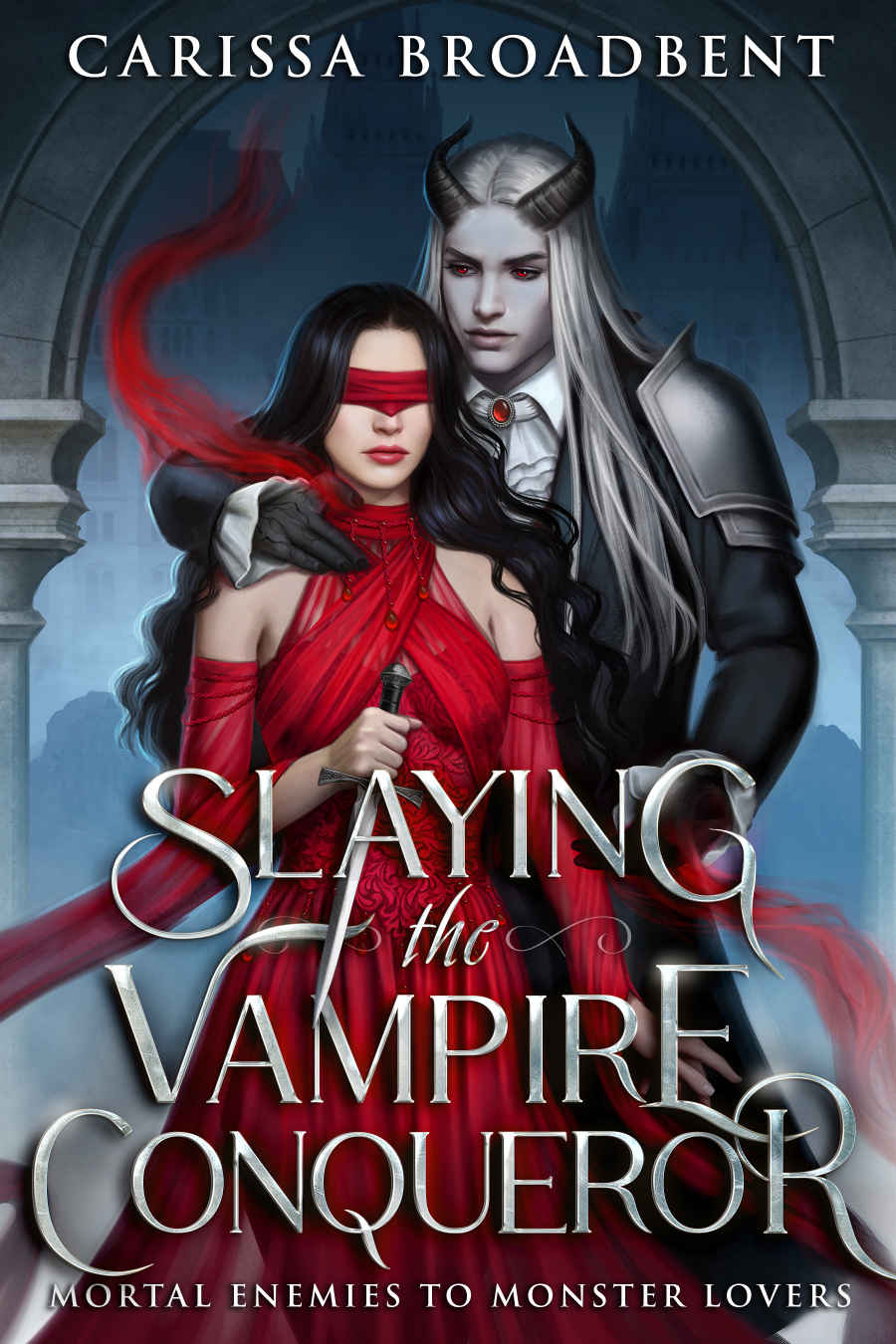
Slaying the Vampire Conqueror
About this book
Sylina belongs to an order that trained her to perceive the world without sight and to treat devotion as a weapon. Her mission is to infiltrate the forces of Atrius, a vampire who has conquered human territory, gain his trust, and end his campaign with a single strike.
Atrius proves harder to reduce to the monster described by Sylina's superiors. Working beside him exposes the structure of his army, the cost of the occupation, and weaknesses in the doctrine that has governed her own life.
The enemies-to-lovers plot turns on divided loyalties rather than a simple mistaken identity. Sylina must decide whether obedience is still honorable when the institution demanding it has withheld the truth.
Slaying the Vampire Conqueror is a standalone novel in the Crowns of Nyaxia world. Its political conflict and romance are complete in this volume, so readers do not need the main series to follow it.
Read a sample
5,001 words
Plain text
From the opening
1
I didn’t miss sight anymore. Sight was an inefficient way to perceive the world around you. It was a crutch. What I was given instead was far more useful.
Take this moment, for example—this moment when my back was pressed to the wall, dagger in my hand, as I waited to kill the man on the other side.
If I was relying on sight alone, I would have to crane my neck around the doorframe. I would have to risk being seen. I’d have to go by whatever I could make out in the darkness of him and his lover, squint into that writhing mass of flesh, and figure out the best way to make my move.
Inefficient. Room for error. A terrible way to work.
Instead, I felt. I sensed. Through the magic of the threads, I could still perceive the boundaries of the physical world—the color and shape of the scenery, the planes of a face, the absence or existence of light—but I had so much more than that, too. Crucial, in my work.
My target was a young nobleman. Six months ago, his father died. Within weeks of him receiving the keys to his father’s significant cityscape, he began using all that newfound wealth and power to steal from his people and build more wealth for the Pythora King.
His essence now was slick with desire. The Arachessen could not read minds, not truly, but I didn’t need to see his thoughts. What use were his thoughts when I saw his heart?
“More,” a female voice moaned. “Please, more.”
He mumbled something in response, the words buried in her hair. Her desire was genuine. Her soul shivered and throbbed with it—her pleasure spiking as he shifted angles, pushing her down to the bed. For the briefest of moments, I couldn’t help being jealous that this snake had better sex than I did.
But I drove that thought away quickly. Arachessen were not supposed to mourn the things we gave up in the name of our goddess—Acaeja, the Weaver of Fates, the Keeper of the Unknown, the Mother of Sorcery. We could not mourn the eyesight, the autonomy, the pieces of our flesh carved away in sacrifice. And no, we could not mourn the sex, either.
I wished they’d hurry up.
I pressed my back to the wall and let out a frustrated breath through my teeth. I blinked, my lashes tickling the fabric of my blindfold.
{Now?}
Raeth’s voice was very quiet in the back of my head—she was nearly out of Threadwhisper range, all the way downstairs, near the entrance of the beach house. When she spoke into my mind, I could sense a faint echo of the ocean wind as it caressed her face.
{Not yet,} I answered.
I felt Raeth’s irritation.
{I don’t know how much longer we have. He’s distracted, isn’t he? Take him and go before he starts to pay attention.}
Oh, he was distracted, alright. His woman wasn’t the only vocal one now, his grunts echoing against the wall behind me.
I didn’t answer right away.
{Sylina—} Raeth started.
{I want to wait until the girl is gone.}
As I knew she would, Raeth scoffed at this. {Wait until the girl is gone? If you wait that long, someone will notice that something is off.}
I clenched my jaw and did not answer, letting her Threadwhispers fade beneath the sounds of our target’s enthusiastic climax.
Threadwhispers were very useful. Communication that couldn’t be overheard, that could transcend sound the same way we transcended sight. It was a gift from the Weaver, one for which I was very grateful.
…But I hated that it meant I could never pretend I hadn’t heard something.
{Sylina!}
{She might not know,} I told her.
What he is. Who he is. What he’s doing, and who he’s doing it for.
I had no qualms about killing the nobleman. I would take more joy than I should in feeling his presence wither and die beneath me—and that would be my little secret, a guilty pleasure. But the girl…
Again, Raeth’s scoff reverberated between us.
{She knows.}
{She—}
{If she’s fucking him, then she knows. And if not, she has terrible taste in men. What difference does it make?}
And then I felt it.
A sudden crack through the air. Sound, yes, a distant BANG—but the sound was nothing compared to the sensation that ripped through the threads of life beneath the physical world, a force powerful enough to set them vibrating.
I froze.
My target and his paramour stopped.
“What was that?” the woman whispered.
But I was no longer focused on them. Not with the force of the vibrations, and Raeth’s wordless panic spreading slowly across them, rolling toward me like a pool of blood.
{Raeth?}
Nothing.
{Raeth? What was that?}
Confusion. Fear. I felt it, though it was dimming, because she must have been walking away from the door—then running, out into the city streets.
{Raeth!}
But she was out of range now. All I could feel from her were faint reverberations.
That is, until I heard her scream.
An Arachessen was not supposed to abandon a mission for anything, not even for the sake of saving a Sister’s life. But every thought of my dutiful teachings drained from me the moment I felt her terror, visceral and human and too familiar in ways I’d never admit aloud.
Continue reading the sampleClose the sample
I ran.
Down marble steps, across tile floors, newly slick with I didn’t-even-know-what, through the door where my Sister had been moments ago, standing watch. The air hit me, salty and ocean-sweet.
And with it came the sensation of them.
The vampire invaders.
Decades later, I would not forget this moment. Exactly how it felt when they made landfall. Their magic sickened me, tainted and cursed, making the air taste so thickly of blood I nearly gagged on it.
Sisters of the Arachessen are trained extensively in the magic of every god. From the time we were children, we were exposed to all magics, even when our bodies protested, even when it burned us or broke us.
This, I recognized immediately, was Nyaxia’s magic. The heretic goddess. The Mother of Vampires.
Hundreds, perhaps thousands, of them crashed upon our shores that night.
Sound was useless, all the bangs and screams and groans of crumbling stone running together like the rush of a waterfall. For a moment, I was blinded, too, because the sensations were so much—every essence, every soul, screaming at once.
In that moment, I didn’t know what was happening. I wouldn’t understand until later exactly what I was witnessing. But I did know that this wasn’t the work of the Pythora King. These were foreigners.
{Raeth!}
I threw the call as far down the threads as I could, flinging it toward her like a net. And there, near where the land met the sea, I felt her. Felt her running—not away from the explosions at the shore, but toward them.
No.
Idiot girl. Stupid girl. Impulsive. Impatient.
I ran for her.
{Raeth! Fall back!}
But Raeth didn’t listen.
I was getting closer, dodging slabs of broken rock, dodging clusters of the strangest fire I’d ever felt—not hot, but cold, devouring trees, devouring buildings. My head pounded, my magic wailing with overexertion at having to constantly reorient myself, over and over.
But I didn’t miss a single step.
Raeth was at the shore. At the docks. Many, many presences surrounded her—so many I struggled to separate them from each other. Human. Vampire. I couldn’t count them. Too many. More coming. Pouring onto the shore in a wave of sea froth and magic and explosives and bloodthirsty rage that I could feel throbbing in my veins.
{Sylina!}
Asha’s voice was sharp as she called to me. Even a little afraid.
I’d never felt my commander’s fear before.
I’d never disobeyed her before, either.
Because in that moment, Raeth screamed. Another explosion of dark magic roared through the air, so powerful that when it faded, I was on my knees, splinters of the pier digging into my flesh.
And Raeth was simply gone.
It is difficult to describe what it feels like to sense the death of a Sister. I could not see her. I could not hear her voice. But when you’re near another of the Arachessen, you can simply feel them the way that one feels the body warmth of another, all their threads connected to yours.
All that, all at once, severed.
The dead did not have threads.
Raeth’s color was purple. Sometimes it was a little warmer when she was happy or excited, a glowy pink hue of delight. Sometimes it was colder when she was moody, like storm clouds at sunset.
Now it was nothing, a hole in all of us where Raeth should have been. It was strange how viscerally it reminded me of another distant memory, a memory I was no longer supposed to have, of how it felt to witness life snatched away in the unforgiving jaws of war.
Asha felt it, too. Of course she did. We would feel it everywhere.
{Let her go,} Asha said again. {Come back. We need to leave now. We’ll complete our task another time.}
Task? Who cared about that limp-dicked little nobleman now?
I had bigger game.
Because there he was.
Even in the sea of vampires and magic, he stood out. His presence was bigger than all of theirs, a gravitational force. All the rest of it—the countless souls, the grey of the sea foam, the cold of the night—framed him like a throne, as if the universe simply oriented itself around him as he rose from the surf.
Even then, through the chaos, with the lack of information I had, I knew I was witnessing something deadly and incredible and horrible. I knew, from that first moment, that he was the leader.
I’d burn his presence into my soul after that. Every angle of him. Every scent that war carried across the sea breeze. Even from this distance, I could sense his appearance through the threads—that he wore fine clothes, and even finer armor over them. His hair was long and reflected the moonlight, soaked in salty tendrils around his shoulders.
And of course, there were the horns. Black as night, protruding from his upper forehead and curling back. They were like nothing I’d ever witnessed before. The product, surely, of some dark, unknown magic.
He was cursed. He was tainted. I could feel that even from here. And as he stepped right over Raeth’s body, I didn’t even think as I reached to my back and withdrew my bow.
I was a fantastic shot. Human eyes are fallible. But the threads are never fooled.
I had a perfect opening. A single thread stretching from me to him, straight to his heart.
{Get back here, Sylina!} Asha commanded.
{I have the shot.}
{You’re too far.}
I was not too far.
I drew.
{We can’t sacrifice another Sister here!} Asha roared—so strong her words made me lurch, my head splitting.
He stepped onto the shore. The thread between us stretched tight. I felt his head turn. Felt his gaze fall to me. Felt his toxic magic shiver down the connection.
{Sylina, the Sightmother commands that you come back.}
I could make it.
I could make it.
My hands shook. Every shred of my focus went toward cutting through all these sensations, falling only on him. Nothing else existed.
But the Sightmother’s stare was on me, too. A Sister did not disobey the Sightmother.
I lowered my bow and backed away, fleeing into the chaotic night. By the time I reached Asha, I had so overexerted my magic and my senses that I was stumbling over rocks in the road. I knew I had a punishment waiting for me at the Keep, but I didn’t care.
It was punishment enough. That moment.
The moment I let him go.
I’d think about that moment for a long, long time.
2
When they take your eyes, they take them slow—an offering given in pieces every day, rather than all at once.
The Sightmother told me then that it meant more to Acaeja that way. A single act can be made in impulse. It can be rash. It can be regretted. But it can never be rash to decide every day for one year to give your goddess your eyes, and mean it each one.
It was a fair trade. The Arachessen, after all, saved me.
I was ten years old. Older than most. I was acutely aware of that then and would remain aware of it forever after—those ten years of life that separated me from my Sisters. Most of them barely recalled the process of their initiation, nor did they remember the life they had before coming here. The Arachessen and the Salt Keep were all they knew. Sometimes I pitied them, because they would love this place even more if they understood what it had been like to live beyond it.
I did. I remembered it all.
I was old enough to remember the way each drop of Marathine extract burned going into my eyes. I was old enough to remember the visions that came after, visions that would leave me jerking awake at night with tears crusted to my face. And above all, I was old enough to remember that even that pain was an embrace compared to the outside world.
People thought that we were so isolated, that we did not hear the things they said about us. Foolish. We heard everything. I knew that people talked about us like we’re insane—as if we’d made some unimaginable sacrifice. It was not a sacrifice. It was an exchange: Close your eyes, child, and you will see an entire world.
Contrary to what people thought, we were not blind. The threads of life that ran through our world, and our mastery over them, told us everything we needed to know. Everything and more.
The first time, it was the Sightmother herself who leaned over me, pinning my arms to the stone table. I was frightened, then, though I was smart enough to know that I shouldn’t be. I hadn’t yet gotten used to the sight of the Arachessen and their covered eyes. As the Sightmother leaned over me, I didn’t know where to look, so I stared into the deep crimson silk of her blindfold. She was the kind of woman who defied markers of time. The faint lines around her mouth and nose did little to dull the uncanny appearance of her youth.
“You must be very still, child,” she said. “Even in the face of great pain. Do you remember how?”
I liked the Sightmother’s voice. It was smooth and gentle. She spoke to me like she respected both my vulnerability and my intelligence, which was very rare among adults. The moment I met her, I knew I would do anything for her. Secretly, I imagined the goddess Acaeja with her face.
“Do you understand, Sylina?” she said, when I did not answer.
It was the first time she’d called me by that new name. It felt good to hear it, like I’d just been let into an open door.
I nodded, my mouth dry. “Yes. I understand.”
I knew, even then, that this was another test. I’d been tested before they allowed me into the Salt Keep. The ability to withstand pain was a non-negotiable skill. I was good at withstanding pain. I showed the Sisters so, and I had the broken fingers to prove it. Decades later, I would still feel a bit of pride when I touched my left hand.
The Sightmother had smiled at me, and then nodded to the Sister at my side.
When it was done, tears streamed down my face, and blood pooled in the back of my throat—from my tongue, which I had bitten so hard I couldn’t eat solids for a week.
It was worth it, though. They told me later I was the only recruit that didn’t make a sound.
* * *
I no longer noticed the Sightmother’s blindfold, because I, like all my Sisters, had my own. Tonight, I wore my red one, the same shade that the Sightmother had donned when she leaned over me that day, fifteen years ago. An accidental coincidence, and I only thought of it now, as I sat at the gathering table with my Sisters, my fingertips in the gritty pile of salt that had been spread along the large, circular table. Forty of us gathered here, each pressing our hands to the salt—our grounding connection to each other, and to the Weaver, the Lady of Fate, the goddess Acaeja, to whom we had all sworn our unending loyalty.
But I was acutely aware of the empty chairs. More empty still since our last meeting, when Asha and I returned from the south the day the invasion began.
It was impossible not to feel their absence. The breaks in the chain, the expanses of salt left untouched.
Raeth was lost in their initial landfall. And then, later, Vima was lost in Breles. Another city conquered by our invaders, another lost Sister.
The vampires moved quickly. They didn’t waste time. It was clear that their goal was to take over all of Glaea—why else would they start at the southernmost shores and then move slowly north?
So, it was not a surprise to me when the Sightmother cleared her throat and said, “The vampires have taken Vaprus.”
Utter silence. But we all felt the ripple of fear, of grief, through the threads.
I tilted my head to the third empty chair. I didn’t need to ask to know the truth. But a young Sister, Yylene, said weakly, “Amara?”
The Sightmother let out a long exhale. We all sensed her sadness before her words came. “She has been lost.”
Yylene bit her lip, sagging a little over the table. She was only seventeen. Loss still hit her deep. But then, I supposed it hit us all deep. We just learned how to cover the wounds with other things. Stitch it up with the threads of our next task.
My jaw tightened, and I tried to exhale my frustration before anyone else could sense it. My whole life, I had never felt more seen, more accepted, than I was here at this table—connected to all my Sisters, to my Sightmother, to the goddess Acaeja herself.
But these last few weeks, what had once felt like connection had started to feel stifling, as it grew harder and harder for me to strangle the shameful thoughts I was not supposed to feel.
“Do we have any further insight into what they want, Sightmother?” Asha asked. I found it slightly satisfying that I could hear, could feel, the tinge of anger in her words, too.
“I assume,” the Sightmother said mildly, “they want to conquer.”
“The Obitraens have never conquered a human nation before.”
Obitraens—those of the continent of Obitraes, the home of vampires and the domain of Nyaxia, the heretic goddess. Obitraes consisted of three kingdoms: the House of Shadow, the House of Night, and the House of Blood. They squabbled among themselves, but had never been known to venture forth into human nations—at least, certainly not as a coordinated act. And this? This was nothing if not coordinated. This was an army.
“We know that the House of Blood is the most unpredictable of the vampire nations,” the Sightmother said. “It’s impossible now to say why they have moved.”
“Has there not been a formal declaration?” Asha asked.
“No. The king of the House of Blood has offered no declaration of war.”
“Then this man… this commander… could he be acting independently?”
“We can’t say.”
There was a certain weakness in the Sightmother’s voice at that—a helplessness from a woman who was never helpless. I hated hearing it.
Everyone was silent for a long moment.
“Perhaps it’s all a mercy,” Asha said softly, at last. “Let them destroy each other. Maybe it will thin the herds.”
My head snapped toward Asha. I couldn’t choke down the sudden wave of indignation at that statement.
I bit my tongue, right over the raised ridge of scar tissue from when I was ten years old, until the pain supplanted the anger.
Too late, though. I could feel the Sightmother’s gaze on me.
“What do you wish to say, Sylina?”
“Nothing, Sightmother.”
“No lies are spoken here.”
The refrain was uttered frequently around this table, as we pressed our fingertips to the salt—and maybe it was true, because we were never more exposed to each other than we were around this table, but it didn’t mean that there weren’t thoughts that were unacceptable to express. To even feel.
I shouldn’t have answered at all.
But before I could stop myself, I said, “There could be a high human cost to letting that happen.”
“I would think that you, of all people, Sylina, would know this,” Asha said, in a pitying tone that made me want to leap across the table and slap her. “We act on the will of Acaeja alone. Not our personal feelings.”
Yes. True. The Pythora King had ravaged our country, leaving Glaea in a state of perpetual war since his own ruthless conquering path, two decades ago. But even that would not be enough to make the Arachessen act. The Arachessen didn’t make decisions based on morality—some made-up measure of right and wrong, though of course, by any measure, the Pythora King was wrong. Worse, the Weaver had shown us that the Pythora King disrupted the natural order. His actions moved our world away from its course.
That is the measure of an enemy of the Arachessen. Acaeja’s will. Balance. Not evil or righteousness.
But this… it felt…
“Acaeja has no hatred for Nyaxia’s children,” Asha reminded me. “She may support this. Sometimes, gods deem a purge necessary.”
I choked out, too angry to stop myself, “A purge?”
“No progress comes without a cost.”
My temper had been short lately. Too short. Especially with Asha. Sometimes, when I heard her voice, I could only hear how it had sounded as she commanded me to stand down.
I could have taken the shot. These seats would not be empty.
And yet, I knew that she was right. Nyaxia, the mother of vampires, was an enemy of the White Pantheon of human gods. Two thousand years ago, when she was just a young, lesser god, she had fallen in love with and married Alarus, the God of Death. But their relationship was forbidden by the rest of the White Pantheon, ultimately resulting in Alarus’s execution. Enraged and grieving, Nyaxia had broken away from the other gods and created vampires—a society to rule all on her own. Now, the gods of the White Pantheon despised her. Acaeja was the only exception—the only god who tolerated Nyaxia and the vampire society she had created.
It was not up to us to judge our conqueror.
But I wanted to. I wanted to judge him. I wanted to judge anyone who made a city look like that, feel like that, just as my own home had felt so many years ago.
That made me a poor Sister. I was, at least, self-aware.
It would be one thing to control a facial expression. But like sight, facial expressions were shallow indicators of the truth. I could control every muscle in my body, including those on my face—it was much harder to control the shifts of my aura, more visible than ever here before my Sisters.
Right now, it seethed with anger. Anger at our conqueror. Anger at Asha for daring to claim his killing could be for the greater good.
And—who was I kidding?—anger at Asha for not letting me take that shot.
{Is there something more you want to say, Sylina?} Asha Threadwhispered, and I was so close to snapping back—
{Enough!}
“Enough!”
The Sightmother spoke in both places simultaneously—her voice ripping through the air and the threads.
We all went silent. I collected myself.
The Sightmother said, “Sylina is right.”
Beneath my blindfold, my brows twitched in surprise.
And satisfaction.
“We know better than any that evil can wear many different faces,” she went on. “Yes, the Pythora King is our enemy. But that doesn’t mean that all his enemies must be our friends. This conqueror is troubling indeed.”
Troubling might seem, to any other, to be a mild word. Coming from the Sightmother, it might as well be damnation.
“Has the Weaver spoken to you, Sightmother?” Yylene asked tentatively.
The Sightmother did not answer for a long moment. Then she rose, her palms pressed to the salt. “It is too early to say what the Weaver believes. But we all must be ready for dark times ahead. That, daughters, is true. We must look inward. So go now and prepare for evening recitations.”
In unified movements, we each drew our flattened hands in a single sweep across the table before us, scattering the salt. Then we rose. I went to follow my Sisters from the room, but the Sightmother said, {Not you, Sylina. You’re coming with me.}
3
The Salt Keep earned its name due to its location in the mountains of eastern Glaea, a notoriously inaccessible piece of land. The mountains that surrounded the Keep were tall, treacherous, dense, and incredibly effective at keeping outsiders away. Even if one managed to locate the Keep—difficult on its own, given the Arachassen’s unmatched ability to keep secrets—the journey over the mountains on foot would be almost certain death. The mountain range was so dense that even most magical travel—already very rare—was impossible over such a distance, and dangerous. Unless your coordinates were very, very accurate, you had a significant chance of throwing yourself into a ravine. Which did indeed happen once, about a century back, when some poor lovestruck sorcerer tried to follow the object of his affections back to the Keep.
Yes, there were many practical reasons why the Salt Keep was built here, right where the mountains met the sea, isolated from the rest of the world. None of them were its aesthetics.
Still, it was beautiful.
When I saw it for the first time as a child, I’d never felt smaller in my life—like I was caught between two godly realms, the mountains to one side and the sea to the other, massive forces that rendered me nothing but inconsequential flesh and bones. It cemented the Arachessen in my mind as a power greater than the sum of its members—something greater than all of us. Of course, I reasoned, the Salt Keep would be the only thing that could exist here, at the apex of these two worlds.
I no longer could see the view as I did then, of course. Not that I didn’t see it in my own way—not that I didn’t still experience it, maybe even more deeply than I did that day. I now felt the world around me in every sense, the presence of the world wrapping me up from all angles. Every jagged plane of the rocky cliffs—grey—the roll of the surf—green—the dusty, dry, shin-tickling grass—dim gold.
I had nothing to mourn. I had gained more than I had lost. This is what I would tell anyone who asked me.
But secretly, in a part of myself I tried not to acknowledge, I missed being able to see it. Sometimes, when I’d come out here, I’d try to conjure that memory—the memory of sight, from when I was ten years old.
“You’re distracted, Sylina,” the Sightmother said, and I snapped my head forward. We walked through the rocky paths along the cliffs, pulling our cloaks tight against the salty wind that stung our cheeks.
She was right. I was distracted.
“I apologize.”
I heard the warm smile in her voice. “You don’t need to apologize. Ascensions are difficult. And I know Raeth’s has been especially so for you.”
This was what I had always appreciated about the Sightmother, from the time I was a child. She was foreboding, powerful, strict—yes. But she was also kind, warm, present. I had so needed that when I met her. I still felt that I needed it.
For this reason, I didn’t bother trying to lie to her.
“I’ve struggled with it,” I admitted.
“Raeth is more alive than she has ever been. But I know that you know that.”
“Yes.”
Ascension, not death. Never death. Arachessen didn’t believe in death, only change. Just as the loss of our eyes didn’t mean the loss of sight, the loss of a heartbeat didn’t mean the loss of life.
Still, it was hard not to mourn someone who existed now only as air and earth and water, which had no room for the memories or thoughts or experiences that made a human a human.
“What’s so troubling to you, Sylina?” the Sightmother asked.
I didn’t answer, and she laughed softly. “You were always ever the mysterious one. Even when we found you.”
“I—” I chose my words carefully. “I felt that Raeth’s fate was avoidable, and I’ve carried bitterness about that. That is my weight to carry, not Asha’s.”
“It isn’t just about Raeth.”
I didn’t answer. I couldn’t think of a way to do so without sounding resentful. Maybe because I was.
“Weaver’s name, Sylina, just speak your mind.” The Sightmother nudged my shoulder affectionately, shaking her head. “It’s no interrogation.”
“I don’t like to give voice to thoughts that don’t deserve it.”
“And I’m sure Acaeja is grateful for your piousness. But humor me.”