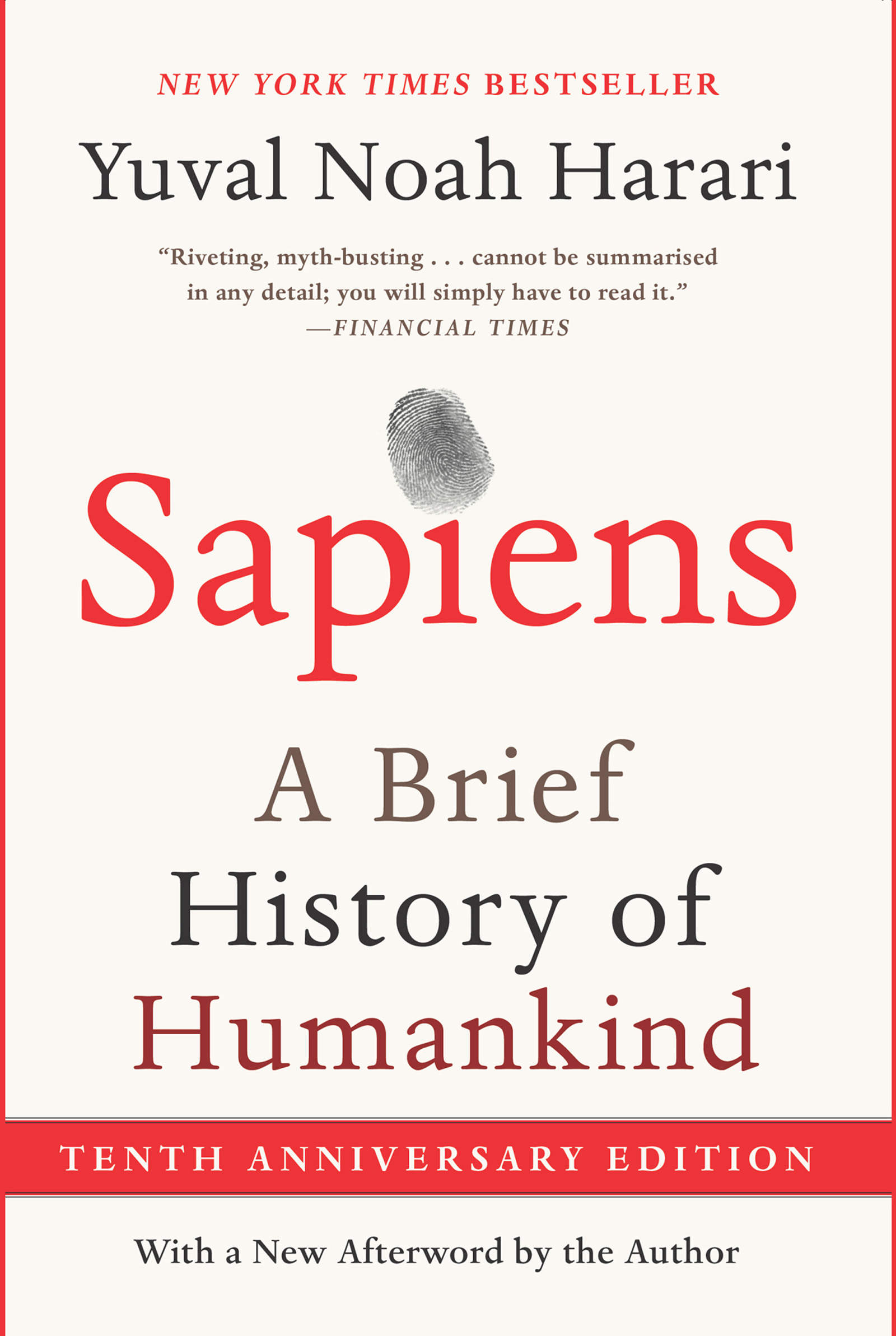
Sapiens: A Brief History of Humankind
About this book
Seventy thousand years ago, Homo sapiens was one human species among several, and not the obvious winner. Harari's account of how that changed centers on a single claim: our advantage is the ability to believe in shared fictions — gods, nations, money, human rights — and to cooperate by the millions around them.
The book moves through three revolutions. The Cognitive Revolution gave us myth and gossip; the Agricultural Revolution gave us wheat, which domesticated us as much as we did it; and the Scientific Revolution, fused with capitalism and empire, gave us the power to remake the planet in a few frantic centuries. Each step is told with provocative clarity and a willingness to puncture sacred cows on every side.
Harari's most uncomfortable question runs underneath the history: did any of this make us happier? The forager's afternoon stroll versus the office worker's commute is not an obvious upgrade, and Sapiens insists on asking what progress actually bought.
First published in Hebrew in 2011 and in English in 2014, it became a global bestseller read by presidents and students alike. Agree or argue, it changes how the species looks in the mirror.
Read a sample
5,001 words
Plain text
From the opening
Timeline of History
Years Before the Present
13.8 billion Matter and energy appear. Beginning of physics. Atoms and molecules appear. Beginning of chemistry.
4.5 billion Formation of planet Earth.
3.8 billion Emergence of organisms. Beginning of biology.
6 million Last common grandmother of humans and chimpanzees.
2.5 million Humans evolve in Africa. First stone tools.
2 million Humans spread from Africa to Eurasia. Evolution of different human species.
500,000 Neanderthals evolve in Europe and the Middle East.
300,000 Daily usage of fire.
200,000 Homo sapiens evolves in East Africa.
70,000 The Cognitive Revolution. Emergence of fictive language. Beginning of history. Sapiens spread out of Africa.
45,000 Sapiens settle Australia. Extinction of Australian megafauna.
30,000 Extinction of Neanderthals.
16,000 Sapiens settle America. Extinction of American megafauna.
13,000 Extinction of Homo floresiensis. Homo sapiens the only surviving human species.
12,000 The Agricultural Revolution. Domestication of plants and animals. Permanent settlements.
5,000 First kingdoms, script and money. Polytheistic religions.
4,250 First empire – the Akkadian Empire of Sargon.
2,500 Invention of coinage – a universal money. The Persian Empire – a universal political order ‘for the benefit of all humans’. Buddhism in India – a universal truth ‘to liberate all beings from suffering’.
2,000 Han Empire in China. Roman Empire in the Mediterranean. Christianity.
1,400 Islam.
500 The Scientific Revolution. Humankind admits its ignorance and begins to acquire unprecedented power.Europeans begin to conquer America and the oceans.The entire planet becomes a single historical arena. The rise of capitalism.
200 The Industrial Revolution. Family and community are replaced by state and market. Massive extinction of plants and animals.
The Present Humans transcend the boundaries of planet Earth.Nuclear weapons threaten the survival of humankind.Organisms are increasingly shaped by intelligent design rather than natural selection.
The Future Intelligent design becomes the basic principle of life? First nonorganic life forms? Homo sapiens is replaced by superhumans?
Part One
The Cognitive Revolution
1. A human handprint made about 30,000 years ago on the wall of the Chauvet-Pont-d’Arc Cave in southern France. Somebody tried to say, ‘I was here!’
© ImageBank/Getty Images Israel.
1
An Animal of No Significance
ABOUT 14 BILLION YEARS AGO, MATTER, energy, time and space came into being in what is known as the Big Bang. The story of these fundamental features of our universe is called physics.
About 300,000 years after their appearance, matter and energy started to coalesce into complex structures, called atoms, which then combined into molecules. The story of atoms, molecules and their interactions is called chemistry.
About 4 billion years ago, on a planet called Earth, certain molecules combined to form particularly large and intricate structures called organisms. The story of organisms is called biology.
About 70,000 years ago, organisms belonging to the species Homo sapiens started to form even more elaborate structures called cultures. The subsequent development of these human cultures is called history.
Three important revolutions shaped the course of history: the Cognitive Revolution kick-started history about 70,000 years ago. The Agricultural Revolution sped it up about 12,000 years ago. The Scientific Revolution, which got under way only 500 years ago, may well end history and start something completely different. This book tells the story of how these three revolutions have affected humans and their fellow organisms.
There were humans long before there was history. Animals much like modern humans first appeared about 2.5 million years ago. But for countless generations they did not stand out from the myriad other organisms that populated the planet.
On a hike in East Africa 2 million years ago, you might well have encountered a familiar cast of human characters: anxious mothers cuddling their babies and clutches of carefree children playing in the mud; temperamental youths chafing against the dictates of society and weary elders who just wanted to be left in peace; chest-thumping machos trying to impress the local beauty and wise old matriarchs who had already seen it all. These archaic humans loved, played, formed close friendships and competed for status and power – but so did chimpanzees, baboons and elephants. There was nothing special about humans. Nobody, least of all humans themselves, had any inkling that their descendants would one day walk on the moon, split the atom, fathom the genetic code and write history books. The most important thing to know about prehistoric humans is that they were insignificant animals with no more impact on their environment than gorillas, fireflies or jellyfish.
Biologists classify organisms into species. Animals are said to belong to the same species if they tend to mate with each other, giving birth to fertile offspring. Horses and donkeys have a recent common ancestor and share many physical traits. But they show little sexual interest in one another. They will mate if induced to do so – but their offspring, called mules, are sterile. Mutations in donkey DNA can therefore never cross over to horses, or vice versa. The two types of animals are consequently considered two distinct species, moving along separate evolutionary paths. By contrast, a bulldog and a spaniel may look very different, but they are members of the same species, sharing the same DNA pool. They will happily mate and their puppies will grow up to pair off with other dogs and produce more puppies.
Species that evolved from a common ancestor are bunched together under the heading ‘genus’ (plural genera). Lions, tigers, leopards and jaguars are different species within the genus Panthera. Biologists label organisms with a two-part Latin name, genus followed by species. Lions, for example, are called Panthera leo, the species leo of the genus Panthera. Presumably, everyone reading this book is a Homo sapiens – the species sapiens (wise) of the genus Homo (man).
Continue reading the sampleClose the sample
Genera in their turn are grouped into families, such as the cats (lions, cheetahs, house cats), the dogs (wolves, foxes, jackals) and the elephants (elephants, mammoths, mastodons). All members of a family trace their lineage back to a founding matriarch or patriarch. All cats, for example, from the smallest house kitten to the most ferocious lion, share a common feline ancestor who lived about 25 million years ago.
Homo sapiens, too, belongs to a family. This banal fact used to be one of history’s most closely guarded secrets. Homo sapiens long preferred to view itself as set apart from animals, an orphan who has no family, no cousins and – most importantly – no parents. But that’s just not the case. Like it or not, we are members of a large and particularly noisy family called the great apes. Our nearest living relatives include chimpanzees, gorillas and orangutans. The chimpanzees are the closest. Just 6 million years ago, a single female ape had two daughters. One became the ancestor of all chimpanzees, the other is our own grandmother.
Skeletons in the Closet
Homo sapiens has kept hidden an even more disturbing secret. Not only do we possess an abundance of uncivilised cousins, once upon a time we had quite a few brothers and sisters as well. We are used to thinking about ourselves as the only humans, because for the last 10,000 years, our species has indeed been the only human species around. Yet the real meaning of the word human is ‘an animal belonging to the genus Homo, and there used to be many other species of this genus besides Homo sapiens. Moreover, as we shall see in the last chapter of the book, in the not so distant future we might again have to contend with non-sapiens humans. To clarify this point, I will often use the term ‘Sapiens’ to denote members of the species Homo sapiens, while reserving the term ‘human’ to refer to all members of the genus Homo.
Humans first evolved in East Africa about 2.5 million years ago from an earlier genus of apes called Australopithecus, which means ‘Southern Ape’. About 2 million years ago, some of these archaic men and women left their homeland to journey through and settle vast areas of North Africa, Europe and Asia. Since survival in the snowy forests of northern Europe required different traits than those needed to stay alive in Indonesia’s steaming jungles, human populations evolved in different directions. The result was several distinct species, to each of which scientists have assigned a pompous Latin name.
2. Our siblings, according to speculative reconstructions (top to bottom): Homo rudolfensis (East Africa); Homo erectus (East Asia); and Homo neanderthalensis (Europe and western Asia). All are humans.
© Visual/Corbis.
Humans in Europe and western Asia evolved into Homo neanderthalensis (‘Man from the Neander Valley’), popularly referred to simply as ‘Neanderthals’. Neanderthals, bulkier and more muscular than us Sapiens, were well adapted to the cold climate of Ice Age western Eurasia. The more eastern regions of Asia were populated by Homo erectus, ‘Upright Man’, who survived there for close to 2 million years, making it the most durable human species ever. This record is unlikely to be broken even by our own species. It is doubtful whether Homo sapiens will still be around a thousand years from now, so 2 million years is really out of our league.
On the island of Java, in Indonesia, lived Homo soloensis, ‘Man from the Solo Valley’, who was suited to life in the tropics. On another Indonesian island – the small island of Flores – archaic humans underwent a process of dwarfing. Humans first reached Flores when the sea level was exceptionally low, and the island was easily accessible from the mainland. When the seas rose again, some people were trapped on the island, which was poor in resources. Big people, who need a lot of food, died first. Smaller fellows survived much better. Over the generations, the people of Flores became dwarves. This unique species, known by scientists as Homo floresiensis, reached a maximum height of only 3.5 feet and weighed no more than fifty-five pounds. They were nevertheless able to produce stone tools, and even managed occasionally to hunt down some of the island’s elephants – though, to be fair, the elephants were a dwarf species as well.
In 2010 another lost sibling was rescued from oblivion, when scientists excavating the Denisova Cave in Siberia discovered a fossilised finger bone. Genetic analysis proved that the finger belonged to a previously unknown human species, which was named Homo denisova. Who knows how many lost relatives of ours are waiting to be discovered in other caves, on other islands, and in other climes.
While these humans were evolving in Europe and Asia, evolution in East Africa did not stop. The cradle of humanity continued to nurture numerous new species, such as Homo rudolfensis, ‘Man from Lake Rudolf’; Homo ergaster, ‘Working Man’; and eventually our own species, which we’ve immodestly named Homo sapiens, ‘Wise Man’.
The members of some of these species were massive and others were dwarves. Some were fearsome hunters and others meek plant-gatherers. Some lived only on a single island, while many roamed over continents. But all of them belonged to the genus Homo. They were all human beings.
It’s a common fallacy to envision these species as arranged in a straight line of descent, with Ergaster begetting Erectus, Erectus begetting the Neanderthals, and the Neanderthals evolving into us. This linear model gives the mistaken impression that at any particular moment only one type of human inhabited the earth, and that all earlier species were merely older models of ourselves. The truth is that from about 2 million years ago until around 10,000 years ago, the world was home, at one and the same time, to several human species. And why not? Today there are many species of bears: brown bears, black bears, grizzly bears, polar bears. The earth of a hundred millennia ago was walked by at least six different species of man. It’s our current exclusivity, not that multi-species past, that is peculiar – and perhaps incriminating. As we will shortly see, we Sapiens have good reasons to repress the memory of our siblings.
The Cost of Thinking
Despite their many differences, all human species share several defining characteristics. Most notably, humans have extraordinarily large brains compared to other animals. Mammals weighing 130 pounds have an average brain size of 12 cubic inches. The earliest men and women, 2.5 million years ago, had brains of about 36 cubic inches. Modern Sapiens sport a brain averaging 73–85 cubic inches. Neanderthal brains were even bigger.
That evolution should select for larger brains may seem to us like, well, a no-brainer. We are so enamoured of our high intelligence that we assume that when it comes to cerebral power, more must be better. But if that were the case, the feline family would also have produced cats who could do calculus, and frogs would by now have launched their own space program. Why are giant brains so rare in the animal kingdom?
The fact is that a jumbo brain is a jumbo drain on the body. It’s not easy to carry around, especially when encased inside a massive skull. It’s even harder to fuel. In Homo sapiens, the brain accounts for about 2–3 per cent of total body weight, but it consumes 25 per cent of the body’s energy when the body is at rest. By comparison, the brains of other apes require only 8 per cent of rest-time energy. Archaic humans paid for their large brains in two ways. Firstly, they spent more time in search of food. Secondly, their muscles atrophied. Like a government diverting money from defence to education, humans diverted energy from biceps to neurons. It’s hardly a foregone conclusion that this is a good strategy for survival on the savannah. A chimpanzee can’t win an argument with a Homo sapiens, but the ape can rip the man apart like a rag doll.
Today our big brains pay off nicely, because we can produce cars and guns that enable us to move much faster than chimps, and shoot them from a safe distance instead of wrestling. But cars and guns are a recent phenomenon. For more than 2 million years, human neural networks kept growing and growing, but apart from some flint knives and pointed sticks, humans had precious little to show for it. What then drove forward the evolution of the massive human brain during those 2 million years? Frankly, we don’t know.
Another singular human trait is that we walk upright on two legs. Standing up, it’s easier to scan the savannah for game or enemies, and arms that are unnecessary for locomotion are freed for other purposes, like throwing stones or signalling. The more things these hands could do, the more successful their owners were, so evolutionary pressure brought about an increasing concentration of nerves and finely tuned muscles in the palms and fingers. As a result, humans can perform very intricate tasks with their hands. In particular, they can produce and use sophisticated tools. The first evidence for tool production dates from about 2.5 million years ago, and the manufacture and use of tools are the criteria by which archaeologists recognise ancient humans.
Yet walking upright has its downside. The skeleton of our primate ancestors developed for millions of years to support a creature that walked on all fours and had a relatively small head. Adjusting to an upright position was quite a challenge, especially when the scaffolding had to support an extra-large cranium. Humankind paid for its lofty vision and industrious hands with backaches and stiff necks.
Women paid extra. An upright gait required narrower hips, constricting the birth canal – and this just when babies’ heads were getting bigger and bigger. Death in childbirth became a major hazard for human females. Women who gave birth earlier, when the infant’s brain and head were still relatively small and supple, fared better and lived to have more children. Natural selection consequently favoured earlier births. And, indeed, compared to other animals, humans are born prematurely, when many of their vital systems are still underdeveloped. A colt can trot shortly after birth; a kitten leaves its mother to forage on its own when it is just a few weeks old. Human babies are helpless, dependent for many years on their elders for sustenance, protection and education.
This fact has contributed greatly both to humankind’s extraordinary social abilities and to its unique social problems. Lone mothers could hardly forage enough food for their offspring and themselves with needy children in tow. Raising children required constant help from other family members and neighbours. It takes a tribe to raise a human. Evolution thus favoured those capable of forming strong social ties. In addition, since humans are born underdeveloped, they can be educated and socialised to a far greater extent than any other animal. Most mammals emerge from the womb like glazed earthenware emerging from a kiln – any attempt at remoulding will only scratch or break them. Humans emerge from the womb like molten glass from a furnace. They can be spun, stretched and shaped with a surprising degree of freedom. This is why today we can educate our children to become Christian or Buddhist, capitalist or socialist, warlike or peace-loving.
* * *
We assume that a large brain, the use of tools, superior learning abilities and complex social structures are huge advantages. It seems self-evident that these have made humankind the most powerful animal on earth. But humans enjoyed all of these advantages for a full 2 million years during which they remained weak and marginal creatures. Thus humans who lived a million years ago, despite their big brains and sharp stone tools, dwelt in constant fear of predators, rarely hunted large game, and subsisted mainly by gathering plants, scooping up insects, stalking small animals, and eating the carrion left behind by other more powerful carnivores.
One of the most common uses of early stone tools was to crack open bones in order to get to the marrow. Some researchers believe this was our original niche. Just as woodpeckers specialise in extracting insects from the trunks of trees, the first humans specialised in extracting marrow from bones. Why marrow? Well, suppose you observe a pride of lions take down and devour a giraffe. You wait patiently until they’re done. But it’s still not your turn because first the hyenas and jackals – and you don’t dare interfere with them – scavenge the leftovers. Only then would you and your band dare approach the carcass, look cautiously left and right – and dig into the edible tissue that remained.
This is a key to understanding our history and psychology. Genus Homo’s position in the food chain was, until quite recently, solidly in the middle. For millions of years, humans hunted smaller creatures and gathered what they could, all the while being hunted by larger predators. It was only 400,000 years ago that several species of man began to hunt large game on a regular basis, and only in the last 100,000 years – with the rise of Homo sapiens – that man jumped to the top of the food chain.
That spectacular leap from the middle to the top had enormous consequences. Other animals at the top of the pyramid, such as lions and sharks, evolved into that position very gradually, over millions of years. This enabled the ecosystem to develop checks and balances that prevent lions and sharks from wreaking too much havoc. As lions became deadlier, so gazelles evolved to run faster, hyenas to cooperate better, and rhinoceroses to be more bad-tempered. In contrast, humankind ascended to the top so quickly that the ecosystem was not given time to adjust. Moreover, humans themselves failed to adjust. Most top predators of the planet are majestic creatures. Millions of years of dominion have filled them with self-confidence. Sapiens by contrast is more like a banana republic dictator. Having so recently been one of the underdogs of the savannah, we are full of fears and anxieties over our position, which makes us doubly cruel and dangerous. Many historical calamities, from deadly wars to ecological catastrophes, have resulted from this over-hasty jump.
A Race of Cooks
A significant step on the way to the top was the domestication of fire. Some human species may have made occasional use of fire as early as 800,000 years ago. By about 300,000 years ago, Homo erectus, Neanderthals and the forefathers of Homo sapiens were using fire on a daily basis. Humans now had a dependable source of light and warmth, and a deadly weapon against prowling lions. Not long afterwards, humans may even have started deliberately to torch their neighbourhoods. A carefully managed fire could turn impassable barren thickets into prime grasslands teeming with game. In addition, once the fire died down, Stone Age entrepreneurs could walk through the smoking remains and harvest charcoaled animals, nuts and tubers.
But the best thing fire did was cook. Foods that humans cannot digest in their natural forms – such as wheat, rice and potatoes – became staples of our diet thanks to cooking. Fire not only changed food’s chemistry, it changed its biology as well. Cooking killed germs and parasites that infested food. Humans also had a far easier time chewing and digesting old favourites such as fruits, nuts, insects and carrion if they were cooked. Whereas chimpanzees spend five hours a day chewing raw food, a single hour suffices for people eating cooked food.
The advent of cooking enabled humans to eat more kinds of food, to devote less time to eating, and to make do with smaller teeth and shorter intestines. Some scholars believe there is a direct link between the advent of cooking, the shortening of the human intestinal track, and the growth of the human brain. Since long intestines and large brains are both massive energy consumers, it’s hard to have both. By shortening the intestines and decreasing their energy consumption, cooking inadvertently opened the way to the jumbo brains of Neanderthals and Sapiens.1
Fire also opened the first significant gulf between man and the other animals. The power of almost all animals depends on their bodies: the strength of their muscles, the size of their teeth, the breadth of their wings. Though they may harness winds and currents, they are unable to control these natural forces, and are always constrained by their physical design. Eagles, for example, identify thermal columns rising from the ground, spread their giant wings and allow the hot air to lift them upwards. Yet eagles cannot control the location of the columns, and their maximum carrying capacity is strictly proportional to their wingspan.
When humans domesticated fire, they gained control of an obedient and potentially limitless force. Unlike eagles, humans could choose when and where to ignite a flame, and they were able to exploit fire for any number of tasks. Most importantly, the power of fire was not limited by the form, structure or strength of the human body. A single woman with a flint or fire stick could burn down an entire forest in a matter of hours. The domestication of fire was a sign of things to come.
Our Brothers’ Keepers
Despite the benefits of fire, 150,000 years ago humans were still marginal creatures. They could now scare away lions, warm themselves during cold nights, and burn down the occasional forest. Yet counting all species together, there were still no more than perhaps a million humans living between the Indonesian archipelago and the Iberian peninsula, a mere blip on the ecological radar.
Our own species, Homo sapiens, was already present on the world stage, but so far it was just minding its own business in a corner of Africa. We don’t know exactly where and when animals that can be classified as Homo sapiens first evolved from some earlier type of humans, but most scientists agree that by 150,000 years ago, East Africa was populated by Sapiens that looked just like us. If one of them turned up in a modern morgue, the local pathologist would notice nothing peculiar. Thanks to the blessings of fire, they had smaller teeth and jaws than their ancestors, whereas they had massive brains, equal in size to ours.
Scientists also agree that about 70,000 years ago, Sapiens from East Africa spread into the Arabian peninsula, and from there they quickly overran the entire Eurasian landmass.
When Homo sapiens landed in Arabia, most of Eurasia was already settled by other humans. What happened to them? There are two conflicting theories. The ‘Interbreeding Theory’ tells a story of attraction, sex and mingling. As the African immigrants spread around the world, they bred with other human populations, and people today are the outcome of this interbreeding.
For example, when Sapiens reached the Middle East and Europe, they encountered the Neanderthals. These humans were more muscular than Sapiens, had larger brains, and were better adapted to cold climes. They used tools and fire, were good hunters, and apparently took care of their sick and infirm. (Archaeologists have discovered the bones of Neanderthals who lived for many years with severe physical handicaps, evidence that they were cared for by their relatives.) Neanderthals are often depicted in caricatures as the archetypical brutish and stupid ‘cave people’, but recent evidence has changed their image.
According to the Interbreeding Theory, when Sapiens spread into Neanderthal lands, Sapiens bred with Neanderthals until the two populations merged. If this is the case, then today’s Eurasians are not pure Sapiens. They are a mixture of Sapiens and Neanderthals. Similarly, when Sapiens reached East Asia, they interbred with the local Erectus, so the Chinese and Koreans are a mixture of Sapiens and Erectus.
The opposing view, called the ‘Replacement Theory’ tells a very different story – one of incompatibility, revulsion, and perhaps even genocide. According to this theory, Sapiens and other humans had different anatomies, and most likely different mating habits and even body odours. They would have had little sexual interest in one another. And even if a Neanderthal Romeo and a Sapiens Juliet fell in love, they could not produce fertile children, because the genetic gulf separating the two populations was already unbridgeable. The two populations remained completely distinct, and when the Neanderthals died out, or were killed off, their genes died with them. According to this view, Sapiens replaced all the previous human populations without merging with them. If that is the case, the lineages of all contemporary humans can be traced back, exclusively, to East Africa, 70,000 years ago. We are all ‘pure Sapiens’.
Map 1. Homo sapiens conquers the globe.
A lot hinges on this debate. From an evolutionary perspective, 70,000 years is a relatively short interval. If the Replacement Theory is correct, all living humans have roughly the same genetic baggage, and racial distinctions among them are negligible. But if the Interbreeding Theory is right, there might well be genetic differences between Africans, Europeans and Asians that go back hundreds of thousands of years. This is political dynamite, which could provide material for explosive racial theories.
In recent decades the Replacement Theory has been the common wisdom in the field. It had firmer archaeological backing, and was more politically correct (scientists had no desire to open up the Pandora’s box of racism by claiming significant genetic diversity among modern human populations). But that ended in 2010, when the results of a four-year effort to map the Neanderthal genome were published. Geneticists were able to collect enough intact Neanderthal DNA from fossils to make a broad comparison between it and the DNA of contemporary humans. The results stunned the scientific community.
It turned out that 1–4 per cent of the unique human DNA of modern populations in the Middle East and Europe is Neanderthal DNA. That’s not a huge amount, but it’s significant. A second shock came several months later, when DNA extracted from the fossilised finger from Denisova was mapped. The results proved that up to 6 per cent of the unique human DNA of modern Melanesians and Aboriginal Australians is Denisovan DNA.
If these results are valid – and it’s important to keep in mind that further research is under way and may either reinforce or modify these conclusions – the Interbreeders got at least some things right. But that doesn’t mean that the Replacement Theory is completely wrong. Since Neanderthals and Denisovans contributed only a small amount of DNA to our present-day genome, it is impossible to speak of a ‘merger’ between Sapiens and other human species. Although differences between them were not large enough to completely prevent fertile intercourse, they were sufficient to make such contacts very rare.
How then should we understand the biological relatedness of Sapiens, Neanderthals and Denisovans? Clearly, they were not completely different species like horses and donkeys. On the other hand, they were not just different populations of the same species, like bulldogs and spaniels. Biological reality is not black-and-white. There are also important grey areas. Every two species that evolved from a common ancestor, such as horses and donkeys, were at one time just two populations of the same species, like bulldogs and spaniels. There must have been a point when the two populations were already quite different from one another, but still capable on rare occasions of having sex and producing fertile offspring. Then another mutation severed this last connecting thread, and they went their separate evolutionary ways.
It seems that about 50,000 years ago, Sapiens, Neanderthals and Denisovans were at that borderline point. They were almost, but not quite, entirely separate species. As we shall see in the next chapter, Sapiens were already very different from Neanderthals and Denisovans not only in their genetic code and physical traits, but also in their cognitive and social abilities, yet it appears it was still just possible, on rare occasions, for a Sapiens and a Neanderthal to produce a fertile offspring. So the populations did not merge, but a few lucky Neanderthal genes did hitch a ride on the Sapiens Express. It is unsettling – and perhaps thrilling – to think that we Sapiens could at one time have sex with an animal from a different species, and produce children together.