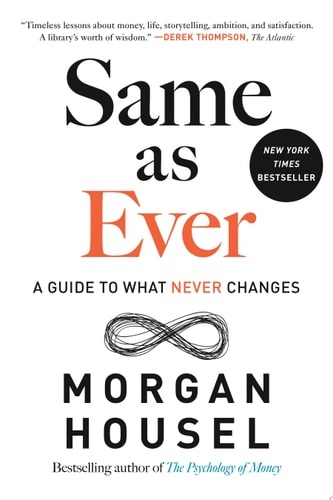
Same as Ever: A Guide to What Never Changes
About this book
The future is difficult to predict because events depend on surprises, but human responses to risk, status, scarcity, opportunity, and uncertainty repeat more reliably. Housel therefore looks for durable patterns rather than a list of coming events.
Chapters move through business, war, invention, investing, and ordinary life. Expectations often matter more than absolute conditions, calm periods encourage risk, and stories can move people faster than technically complete explanations.
The argument does not claim history repeats in detail. It treats recurring behaviour as a base rate: a way to make decisions that remain sensible across several possible futures instead of requiring one precise forecast to come true.
Same as Ever is a companion in spirit to The Psychology of Money. Its compact essays ask readers to build plans around endurance, room for error, and the parts of human nature that technological change has not made obsolete.
Read a sample
5,032 words
Plain text
From the opening
Introduction
The Little Laws of Life
I once had lunch with a guy who’s close to Warren Buffett.
This guy—we’ll call him Jim (not his real name)—was driving around Omaha, Nebraska, with Buffett in late 2009. The global economy was crippled at this point, and Omaha was no exception. Stores were closed, businesses were boarded up.
Jim said to Warren, “It’s so bad right now. How does the economy ever bounce back from this?”
Warren said, “Jim, do you know what the bestselling candy bar was in 1962?”
“No,” Jim said.
“Snickers,” said Warren. “And do you know what the bestselling candy bar is today?”
“No,” said Jim.
“Snickers,” Warren said.
Then silence. That was the end of the conversation.
This is a book of short stories about what never changes in a changing world.
History is filled with surprises no one could have seen coming. But it’s also filled with so much timeless wisdom.
If you traveled in time to five hundred years ago or five hundred years from now, you would be astounded at how much technology and medicine has changed. The geopolitical order would make no sense to you. The language and dialect might be completely foreign.
But you’d notice people falling for greed and fear just like they do in our current world.
You’d see people persuaded by risk, jealousy, and tribal affiliations in ways that are familiar to you.
You’d see overconfidence and shortsightedness that remind you of people’s behavior today.
You’d find people seeking the secret to a happy life and trying to find certainty when none exists in ways that are entirely relatable.
When transported to an unfamiliar world, you’d spend a few minutes watching people behave and say, “Ah. I’ve seen this before. Same as ever.”
Change captures our attention because it’s surprising and exciting. But the behaviors that never change are history’s most powerful lessons, because they preview what to expect in the future. Your future. Everyone’s future. No matter who you are, where you’re from, how old you are, or how much money you make, there are timeless lessons from human behavior that are some of the most important things you can ever learn.
It’s a simple idea, but it’s so easy to overlook. And once you grasp it, you’ll be able to make better sense of your own life, understand why the world is the way it is, and become more at ease with what the future has in store.
Amazon founder Jeff Bezos once said that he’s often asked what’s going to change in the next ten years. “I almost never get the question: ‘What’s not going to change in the next ten years?’ ” he said. “And I submit to you that that second question is actually the more important of the two.”
Things that never change are important because you can put so much confidence into knowing how they’ll shape the future. Bezos said it’s impossible to imagine a future where Amazon customers don’t want low prices and fast shipping—so he can put enormous investment into those things.
The same philosophy works in almost all areas of life.
I have no clue what the stock market will do next year (or any year). But I’m very confident about people’s penchant for greed and fear, which never changes. So that’s what I spend my time thinking about.
I have no idea who will win the next presidential election. But I’m confident about the ways people’s attachment to tribal identities influences their thinking, which is the same today as it was a thousand years ago and will be a thousand years from now.
I cannot tell you what businesses will dominate the next decade. But I can tell you how business leaders let success go to their heads, becoming lazy and entitled and eventually losing their edge. That story hasn’t changed in hundreds of years and never will.
Philosophers have spent centuries discussing the idea that there are an infinite number of ways your life could play out, and you just happen to be living in this specific version. It’s a wild thing to contemplate, and it leads to the question: What would be true in every imaginable version of your life, not just this one? Those universal truths are obviously the most important things to focus on, because they don’t rely on chance, luck, or accident.
Entrepreneur and investor Naval Ravikant put it this way: “In 1,000 parallel universes, you want to be wealthy in 999 of them. You don’t want to be wealthy in the fifty of them where you got lucky, so we want to factor luck out of it. . . . I want to live in a way that if my life played out 1,000 times, Naval is successful 999 times.”
That’s what this book is about: In a thousand parallel universes, what would be true in every single one?
Each of the following twenty-three chapters can be read independently, so there is no harm in skipping and choosing as you wish. What they have in common is that I’m confident each of these topics will be as relevant hundreds of years from now as they were hundreds of years ago.
None of the chapters are long, and you’re welcome for that. Many are derived from my blog at the Collaborative Fund, where I write about the intersection of money, history, and psychology.
Continue reading the sampleClose the sample
The first looks at how fragile the world is, with a personal story about the scariest day of my life.
Hanging by a Thread
If you know where we’ve been, you realize we have no idea where we’re going.
A big lesson from history is realizing how much of the world hangs by a thread. Some of the biggest and most consequential changes in history happened because of a random, unforeseeable, thoughtless encounter or decision that led to magic or mayhem.
Author Tim Urban once wrote, “If you went back in time before your birth you’d be terrified to do anything, because you’d know that even the smallest nudges to the present can have major impacts on the future.”
How hauntingly true.
Let me tell you a personal story about how I became interested in this topic.
I grew up ski racing in Lake Tahoe. I was on the Squaw Valley Ski Team, and it was the center of my life for a decade.
Our ski team consisted of a dozen racers. By the early 2000s we were teenagers, and most of us had spent the majority of our lives together. We skied six days a week, ten months a year, traveling the globe to wherever we could find snow.
I wasn’t close to most of them—we spent too much time together and fought like cats. But four of us had become inseparable friends. This is the story of two of those friends—Brendan Allan and Bryan Richmond.
On February 15, 2001, our team had just returned from a race in Colorado. Our flight home was delayed because Lake Tahoe had been hit with a blizzard extreme even by its own standards.
You can’t ski race when there’s a blanket of new snow—racing requires hard-packed ice. So training was canceled, and Brendan, Bryan, and I prepared for a week of what we called free skiing: unstructured goofing off, skiing around, and having a good time.
Earlier that month Tahoe received several feet of light, fluffy snow that comes from bitter-cold air. The storm that hit in mid-February was different. It was warm—barely at the freezing point—and powerful, leaving three feet of heavy, wet snow.
We didn’t think about it at the time, but the combination of heavy snow on top of fluffy snow creates textbook avalanche conditions. A light base of snow with a heavy layer on top is incredibly fragile and prone to sliding.
Ski resorts are pretty good at protecting customers from avalanches by closing off the most dangerous slopes and using explosives to intentionally set off avalanches late at night, before customers arrive in the morning.
But if you’re skiing out of bounds—ducking under the do not cross ropes to ski the forbidden, untouched terrain—that system won’t help you.
On the morning of February 21, 2001, Brendan, Bryan, and I met in the Squaw Valley Ski Team locker room, like we had hundreds of times before. Bryan’s last words when he left his house that morning were, “Don’t worry, Mom, I won’t ski out of bounds.”
But as soon as we clicked into our skis, that’s what we did.
The backside of Squaw Valley (now called Palisades Tahoe), behind the KT-22 chairlift, is a stretch of mountain about a mile long that separates Squaw from Alpine Meadows ski resort.
It’s amazing skiing—steep and wide-open, with rolling terrain.
Before February 21 I had skied it maybe a dozen times. It wasn’t one of our frequent spots, because it takes so much time. It spits you out on a backcountry road, from where we would hitchhike back to our locker room.
Brendan, Bryan, and I decided to ski it that morning.
Within seconds of ducking under the out-of-bounds ropes, I remember getting caught in an avalanche.
I had never experienced one before, but it was unforgettable. I didn’t hear or see the slide. I just suddenly realized my skis weren’t on the ground anymore—I was literally floating in a cloud of snow. You have no control in these situations, because rather than you pushing the snow to gain traction with your skis, the snow is pushing you. The best you can do is keep your balance to remain upright.
The avalanche was small, and ended quickly.
“Did you see that avalanche?” I remember saying when we got to the road.
“Haha, that was awesome,” Brendan said.
We didn’t say another word about it as we hitchhiked back to our locker room.
When we got back to Squaw, Brendan and Bryan said they wanted to ski the backside again.
I don’t know why, but I didn’t want to go.
But I had an idea. Brendan and Bryan could ski the backside again, and I would drive around and pick them up so they wouldn’t have to hitchhike back.
We agreed on the plan and went our separate ways.
Thirty minutes later I drove to the backcountry road where I was scheduled to pick up Brendan and Bryan.
They weren’t there.
I waited another thirty minutes before giving up. It took about a minute to ski down, so I knew they weren’t coming. I figured they had beat me to the bottom and already hitchhiked back.
I drove back to our locker room, expecting to find them. They weren’t there either. I asked around. No one had seen them.
Later that day, around 4:00 p.m., Bryan’s mom called me at home. I remember every word.
“Hi, Morgan, Bryan didn’t show up for work today. Do you know where he is?” she asked.
I told her the truth. “We skied the backside of KT-22 this morning. He and Brendan did it again, I was going to pick them up on the road. But they weren’t there, and I haven’t seen them since.”
“Oh my God,” she said. Click.
Bryan’s mom was an expert skier herself. I think in that moment she pieced together what may have happened. I did too.
The hours ticked by, and everyone started to worry.
Someone eventually called the police and filed a missing person report. The police didn’t take it very seriously, suggesting Brendan and Bryan likely snuck off to a party.
I knew that was wrong. “Their shoes are right there,” I said, pointing to Brendan’s and Bryan’s sneakers on the locker-room floor. “That means their ski boots are on their feet. And it’s now nine p.m. Think about that. It’s nine p.m. and they have their ski boots on their feet.” It was the first moment everyone looked around and realized how bad this was.
Around ten I was told to go to the Squaw Valley Fire Department, where I met the local search and rescue team.
I explained everything that Brendan, Bryan, and I did that day. The search team pulled out these giant photo maps that must have been taken from a helicopter. I showed them exactly where we entered the out-of-bounds area.
I told them about the small avalanche that morning. As soon as I mentioned it I could see the dots connecting in the rescuers’ heads. I remember that when I finished talking two of the rescuers looked at each other and sighed.
In the middle of the night, with giant floodlights and a team of search dogs, the rescuers went looking for Brendan and Bryan.
I later learned that as soon as they entered the out-of-bounds area where I told them we skied, they discovered the fresh scars of a recent avalanche debris field. It was massive, “like half the mountain had been torn away,” one said.
I drove back to the locker room around midnight. The Squaw Valley parking lot can hold several thousand cars. By this time it was almost empty. Everyone had gone home, except two cars parked next to each other: Brendan’s Jeep and Bryan’s Chevy pickup.
I tried to sleep on a bench in the locker room but couldn’t shut my eyes. I remember thinking Brendan and Bryan would come bounding through the door, and we could laugh about the time I had to call the cops to find them.
By nine a.m. the locker room was packed with other ski racers, parents, friends, and family, all eager to help. It became a staging area for the search.
I laid back down on the bench and finally fell asleep.
A few minutes later I awoke to the sound of a scream, yelling, and commotion.
I knew what had happened. No one needed to say it.
I walked to the second floor of the locker room, where I saw Bryan’s mom on a couch. The scream was hers.
“I’m so sorry,” I told her, bawling.
It’s hard to describe a moment like that. I didn’t know what else to say then. I don’t know what else to say now.
Search dogs had homed in on a spot in the avalanche field where rescuers with probe poles found Brendan and Bryan buried under six feet of snow.
They were born one day apart, and died ten feet from each other.
Later that day I drove to see my dad at work. I wanted to be around my family. He met me in the parking lot and said, “I’ve never been so happy to see you.” It’s the only time in my life I’ve seen him cry.
It didn’t occur to me until that moment how close I was to going with Brendan and Bryan on that fateful run.
Then I began wondering: Why did I ski the backside with them once that morning, then decline a second run—a decision that almost certainly saved my life?
I’ve thought about it a million times. I have no idea.
I have no idea.
There is no explanation.
I didn’t think it through, I didn’t calculate the danger, I didn’t consult an expert, I didn’t weigh the pros and cons.
It was a complete fluke, a random and thoughtless bit of dumb luck that became the most important decision of my life—far more important than every intentional decision I’ve ever made—or ever will make.
That’s my personal story, and maybe you have a similar one about your own life. But if you look, I think you’ll see that a lot of history is the same.
Let me give you three freakish examples about how much of today’s world relies on a few tiny things you’d never think about.
The Battle of Long Island was a disaster for George Washington’s army. His ten thousand troops were crushed by the British and its four-hundred-ship fleet.
But it could have been so much worse. It could have been the end of the Revolutionary War.
All the British had to do was sail up the East River and Washington’s cornered troops would have been wiped out.
But it never happened, because the wind wasn’t blowing in the right direction and sailing up the river became impossible.
Historian David McCullough once told interviewer Charlie Rose that “if the wind had been in the other direction on the night of August twenty-eighth [1776], I think it would have all been over.”
“No United States of America if that had happened?” Rose asked.
“I don’t think so,” said McCullough.
“Just because of the wind, history was changed?” asked Rose.
“Absolutely,” said McCullough.
Compelled to save money, Captain William Turner shut down the fourth boiler room on his giant steamship for its passage from New York to Liverpool. The decision would slow the ship’s voyage by one day—an annoyance, but worth the savings as the passenger-ship industry struggled economically.
Little did he or anyone else know how fateful the decision would be.
The delay meant Turner’s ship—the Lusitania—would now sail directly into the path of a German submarine.
The Lusitania was hit with a torpedo, killing nearly twelve hundred passengers and becoming the most important trigger to rally U.S. public support for entering World War I.
Had the fourth boiler room been operating, Turner would have reached Liverpool a day before the German submarine had even entered the Celtic Sea, where it crossed paths with the Lusitania. The ship likely would have avoided attack. A country may have avoided a war that became the seed event for the rest of the twentieth century.
Giuseppe Zangara was tiny, barely five feet tall. He stood on a chair outside a Miami political rally in 1933 because that was the only way he could aim his gun across the crowd.
Zangara fired five shots. One of them hit Chicago mayor Anton Cermak, who was shaking hands with Zangara’s intended target. Cermak died. The target, Franklin Delano Roosevelt, was sworn in as president two weeks later.
Within months of his inauguration Roosevelt transformed the U.S. economy through the New Deal. John Nance Garner—who would have become president had Zangara hit his target—opposed most of the New Deal’s deficit spending. He almost certainly wouldn’t have enacted many of the same policies, some of which still shape today’s economy.
You can play this game all day. Every big story could have turned out differently if a few little puffs of nothingness went the other direction.
So much of the world hangs by a thread.
An irony of studying history is that we often know exactly how a story ends, but we have no idea where it began.
Here’s an example: What caused the 2008 financial crisis?
Well, you have to understand the mortgage market.
What shaped the mortgage market? Well, you have to understand the thirty-year decline in interest rates that preceded it.
What caused falling interest rates? Well, you have to understand the inflation of the 1970s.
What caused that inflation? Well, you have to understand the monetary system of the 1970s and the hangover effects from the Vietnam War.
What caused the Vietnam War? Well, you have to understand the West’s fear of communism after World War II . . . and so on forever.
Every current event—big or small—has parents, grandparents, great-grandparents, siblings, and cousins. Ignoring that family tree can muddy your understanding of events, giving a false impression of why things happened, how long they might last, and under what circumstances they might occur again. Viewing events in isolation, without an appreciation of their long roots, helps explain everything from why forecasting is hard to why politics is nasty.
People like to say, “To know where we’re going, you have to know where we’ve been.” But more realistic is admitting that if you know where we’ve been, you realize we have no idea where we’re going. Events compound in unfathomable ways.
I try to keep two things in mind in a world that’s this vulnerable to chance and accident.
One is highlighting this book’s premise—to base predictions on how people behave rather than on specific events. Predicting what the world will look like fifty years from now is impossible. But predicting that people will still respond to greed, fear, opportunity, exploitation, risk, uncertainty, tribal affiliations, and social persuasion in the same way is a bet I’d take.
Forecasting events is hard because it’s easy to skip the question “And then what?”
Saying “Higher gas prices will cause people to drive less” seems logical.
But then what?
Well, people have to drive, so maybe they’ll look for more fuel-efficient vehicles. They’ll complain to politicians, who will offer tax breaks to buy those vehicles. OPEC is asked to drill more; energy entrepreneurs innovate. And the oil industry knows two speeds: boom and bust. So they’ll probably pump too much. Then prices fall, all while people own more efficient vehicles. Then maybe the suburbs become more popular—and people end up driving even more than before.
So who knows.
Every event creates its own offspring, which impact the world in their own special ways. It makes prediction exceedingly hard. The absurdity of past connections should humble your confidence in predicting future ones.
The other thing to keep in mind is to have a wider imagination. No matter what the world looks like today, and what seems obvious today, everything can change tomorrow because of some tiny accident no one’s thinking about. Events, like money, compound. And the central feature of compounding is that it’s never intuitive how big something can grow from a small beginning.
Next, let me tell you another old story showing how easy it is to ignore risks.
Risk Is What You Don’t See
We are very good at predicting the future, except for the surprises—which tend to be all that matter.
It’s well-known that people are bad at predicting the future.
But this misses an important nuance: We are very good at predicting the future, except for the surprises—which tend to be all that matter.
The biggest risk is always what no one sees coming, because if no one sees it coming, no one’s prepared for it; and if no one’s prepared for it, its damage will be amplified when it arrives.
A quick story about a guy who learned this the hard way.
Before launching themselves into space on rockets, NASA astronauts ran tests in high-altitude hot-air balloons.
A balloon flight on May 4, 1961, took American Victor Prather and another pilot to 113,720 feet, scraping the edge of space. The goal was to test NASA’s new space suit.
The flight was a success. The suit worked beautifully.
As Prather descended back to earth, he opened the faceplate on his helmet when he was low enough to breathe on his own, ostensibly to catch some fresh air.
He landed in the ocean as planned, where a helicopter was to pull him to safety. But there was a small mishap: While connecting himself to the helicopter’s rescue line, Prather slipped, falling into the ocean.
This shouldn’t have been that big a deal, and no one in the rescue helicopter panicked. The space suit should have been watertight and buoyant.
But since Prather had opened his faceplate, he was now exposed to the elements. Water rushed into his suit. Prather drowned.
Think of how much planning goes into launching someone into space. So much expertise, so many contingencies. So many what-ifs and what-thens. Every detail is contemplated by thousands of experts. NASA is probably the most planning-centric organization that has ever existed; you don’t go to the moon by crossing your fingers and hoping for the best. Every conceivable risk has a plan A, plan B, plan C.
But even then—despite so much planning—a tiny thing no one had considered invites catastrophe.
As financial advisor Carl Richards says, “Risk is what’s left over after you think you’ve thought of everything.”
That’s the real definition of risk—what’s left over after you’ve prepared for the risks you can imagine.
Risk is what you don’t see.
Look at the big news stories that move the needle—COVID-19, 9/11, Pearl Harbor, the Great Depression. Their common trait isn’t necessarily that they were big; it’s that they were surprises, on virtually no one’s radar until they arrived.
“After booms come busts” is about as close to economic law as it gets. Study history, and the calamity that followed the booming 1920s, late 1990s, and early 2000s seems more than obvious. It seems inevitable.
In October 1929—the peak of history’s craziest stock bubble and the eve of the Great Depression—economist Irving Fisher famously told an audience that “stock prices have reached what looks like a permanently high plateau.”
We look at these comments today and laugh. How could someone so smart be so blind to something so inevitable? If you follow the rule that the crazier the boom, the harder the bust, the Great Depression must have been obvious.
But Fisher was a smart guy. And he wasn’t alone.
In an interview years ago I asked Robert Shiller, who won the Nobel Prize for his work on bubbles, about the inevitability of the Great Depression. He responded:
Well, nobody forecasted that. Zero. Nobody. Now there were, of course, some guys who were saying the stock market is overpriced. But if you look at what they said, did that mean a depression is coming? A decade-long depression? No one said that.
I have asked economic historians to give me the name of someone who predicted the depression, and it comes up zero.
That stuck with me. Here we are today, blessed with hindsight, knowing the crash after the Roaring Twenties was obvious and inevitable. But for those who lived through it—people for whom the 1930s was a yet-to-be-discovered future—it was anything but.
Two things can explain something that looks inevitable but wasn’t predicted by those who experienced it at the time:
• Either everyone in the past was blinded by delusion.
• Or everyone in the present is fooled by hindsight.
We are crazy to think it’s all the former and none of the latter.
The Economist—a magazine I admire—publishes a forecast of the year ahead each January. Its January 2020 issue does not mention a single word about COVID-19. Its January 2022 issue does not mention a single word about Russia invading Ukraine.
That’s not a criticism—both events were impossible to know when the issues were planned in the months before publication.
But that’s the point: The biggest news, the biggest risks, the most consequential events are always what you don’t see coming.
Put another way: There is rarely more or less economic uncertainty; just changes in how ignorant people are to potential risks. Asking what the biggest risks are is like asking what you expect to be surprised about. If you knew what the biggest risk was you would do something about it, and doing something about it would make it less risky. What your imagination can’t fathom is the dangerous stuff, and it’s why risk can never be mastered.
I can promise you that will be the case going forward. The biggest risk and the most important news story of the next ten years will be something nobody is talking about today. No matter what year you’re reading this book, that truth will remain. I can say that confidently because it’s always been true. The fact that you can’t see it coming is exactly what makes it risky.
Even for something as giant as the Great Depression, many people were blind to what was happening even when it was well under way.
The Depression, as we know today, began in 1929. But when the well-informed members of the National Economic League were polled in 1930 as to what they considered the biggest problem of the United States, they listed, in order:
1. Administration of justice
2. Prohibition
3. Disrespect for law
4. Crime
5. Law enforcement
6. World peace
And in eighteenth place . . . unemployment.
A year later, in 1931—a full two years into what we now consider the Great Depression—unemployment had moved to just fourth place, behind prohibition, justice, and law enforcement.
That’s what made the Great Depression so awful: No one was prepared for it because no one saw it coming. So people couldn’t deal with it financially (paying their debts) and mentally (the shock and grief of sudden loss).
A big part of this idea is coming to terms with how limited our view of what’s happening in the world can be.
Franklin Delano Roosevelt looked around the room and chuckled when his presidential library opened in 1941. A reporter asked why he was so cheerful. “I’m thinking of all the historians who will come here thinking they’ll find the answers to their questions,” he said.
There is so much we don’t know. And not just about the future, but the past.
History knows three things: 1) what’s been photographed, 2) what someone wrote down or recorded, and 3) the words spoken by people whom historians and journalists wanted to interview and who agreed to be interviewed.
What percentage of everything important that’s ever happened falls into one of those three categories? No one knows. But it’s tiny. And all three suffer from misinterpretation, incompleteness, embellishment, lying, and selective memory.
When your view of what’s happening and has happened in the world is so limited, it’s easy to underestimate what you don’t know, what else could be happening right now, and what could go wrong that you’re not even envisioning.
Think of a content child, blissfully playing with toys and smiling as the sun hits their face.
In their mind, everything is great. Their world begins and ends with their immediate surroundings—Mom is here, Dad is there, toys are nearby, food is in my stomach. As far as they’re concerned, life is perfect. They have all the information they need.
What they’re unaware of is so much greater. In the mind of a three-year-old, the concept of geopolitics is completely unimaginable. The idea of rising interest rates hurting the economy, or the reason someone needs a paycheck, or what a career even is, or the risk of cancer, is utterly out of sight, out of mind.