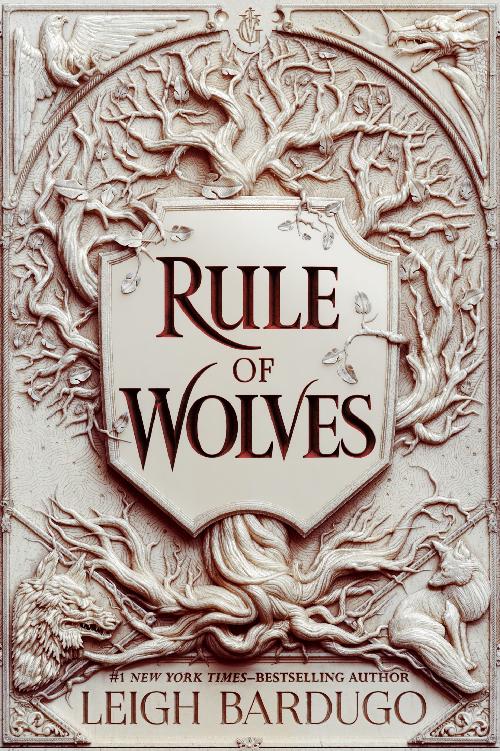
Rule of Wolves
About this book
Fjerda is preparing to invade, and Ravka cannot match its military strength through ordinary means. Nikolai Lantsov must turn diplomacy, invention, and the dangerous power within him into a strategy before his enemies expose the weakness behind the crown.
Zoya confronts the scale and cost of her Grisha abilities while Nina continues her work inside the Fjerdan capital. Nina's position gives her access to the regime's plans, but every useful relationship also raises the risk of discovery and complicates the grief that brought her there.
The conflict widens beyond a single battlefield to propaganda, succession, industry, and the stories nations tell about their enemies. Victories depend on alliances among people who have good reasons not to trust one another.
Rule of Wolves concludes the King of Scars Duology and resolves arcs from across the Grishaverse. It should be read after King of Scars; the political reversals and emotional choices assume the reader knows how Nikolai, Zoya, and Nina reached this war.
Read a sample
5,022 words
Plain text
From the opening
1
QUEEN MAKHI
MAKHI KIR-TABAN, BORN OF HEAVEN, was a queen from a long line of queens.
And they were all fools, she thought, her pulse quickening as she read the invitation in her hand. If they hadn’t been fools, I wouldn’t be in this predicament right now.
No rage showed on her face. No blood rushed to her smooth cheeks. She was a queen and conducted herself accordingly—back erect, body poised, expression composed. Her fingers did not tremble, though every muscle in her body longed to crush the elegantly lettered paper to dust.
King Nikolai Lantsov, Grand Duke of Udova, sole sovereign of the great nation of Ravka, and Princess Ehri Kir-Taban, Daughter of Heaven, most Ethereal of the Taban Line, would welcome Queen Makhi Kir-Taban to a celebration of matrimony in the royal chapel of Os Alta.
The wedding would take place one month from now. Enough time for Makhi’s servants to pack the appropriate gowns and jewels, to assemble her royal retinue, to ready her contingent of the Tavgharad, the elite soldiers who had guarded her family since the first Taban queen took the throne. Plenty of time to make the journey over land or in the new luxury airship her engineers had constructed.
Plenty of time for a clever queen to start a war.
But right now, Makhi had to perform for the ministers arrayed before her in the council chamber. Her mother had passed only a month ago. The crown could have returned to Makhi’s grandmother, but Leyti Kir-Taban was nearly eighty and was done with the troubles of running a nation. She wanted only to prune her roses and rusticate with a series of wildly handsome lovers, and so she had given Makhi her blessing and retired to the country. Makhi had been crowned scant days after her mother’s funeral. Her reign was a new one, but she intended to ensure it was long. She would usher in an age of prosperity and empire for her people—and that required the support of the royal ministers currently gazing up at her, their faces full of expectation.
“I see no personal message from Ehri,” she said, leaning back on her throne. She rested the invitation in her lap and allowed her brow to furrow. “It is a concern.”
“We should be rejoicing,” said Minister Nagh. He wore the dark green, brass-buttoned coat of the bureaucrat class—as all the ministers did, the two crossed keys of the Shu pinned at their lapels. They looked like a forest of stern trees. “Is this not the result we hoped for? A wedding to seal an alliance between our nations?”
The result you hoped for. You would have us cower behind our mountains forever.
“Yes,” she said with a smile. “It is why we risked our precious Princess Ehri in such a savage land. But she should have written a note to us in her hand, given some sign that all is well.”
Minister Zihun cleared her throat. “Your Most Celestial Highness, Ehri may not actually be happy, but only resigned to this. She has never wanted a public life, let alone a life led away from the only home she has ever known.”
“We are Taban. What we want is what our country needs.”
The minister bowed her head respectfully. “Of course, Your Majesty. Shall we pen your reply?”
“I will do it myself,” said the queen. “As a sign of respect. It’s best we begin this new partnership on the right foot.”
“Very good, Your Majesty,” Nagh said, as if Makhi had executed a particularly fine curtsy.
Somehow the minister’s approval made Makhi prickle even more than his opposition.
She rose and, as one, the ministers took a step back, following protocol. She descended from her throne, and her Tavgharad guards fell into step behind her as she made her way down the long hallway that led to the queen’s sanctuary. The silk train of her gown sighed against the marble floor, as fretful as one of her advisers. Makhi knew exactly how many steps it took to reach the privacy of her rooms from the council chamber. She had made the walk innumerable times with her mother, and her grandmother before that. Now she counted down—fifty-six, fifty-five—trying to release her frustration and think clearly.
She sensed Minister Yerwei behind her, though the sound of his slippered feet was masked by the rhythmic thump of Tavgharad boots. It was like being pursued by a ghost. If she told her guards to slit his throat, they would do it without hesitation. And then when she was tried for murder, as even a queen could be in Shu Han, they would give testimony against her.
When they reached the queen’s sanctuary, Makhi passed beneath a gilded arch and entered a small receiving room of pale green marble. She waved off the waiting servants and turned to the Tavgharad. “Do not disturb us,” she instructed.
Yerwei followed her through the sitting room and on to the music room, until they reached the grand parlor where Makhi had once sat at her mother’s knee, listening to stories of the first Taban queens—warriors who, accompanied by their retinue of tame falcons, had come down from the highest mountains in the Sikurzoi to rule the Shu. Taban yenok-yun, they were called. The storm that stayed.
The palace had been built by those queens, and it was still a marvel of engineering and beauty. It belonged to the Taban dynasty. It belonged to the people. And for this brief moment—just a few measured steps in the march of the Taban line—it belonged to Makhi. She felt her spirits lift as they entered the Court of the Golden Wing. It was a room of gilded light and flowing water, the slender, repeating arches of its terrace framing the groomed hedges and burbling fountains of the royal gardens below, and beyond them, the plum orchards of Ahmrat Jen, the trees standing like a regiment of soldiers in tidy rows. It was winter in Ravka, but here in the Shu Han, in this blessed land, the sun still shone warm.
Continue reading the sampleClose the sample
Makhi walked out onto the terrace. This was one of the few places she felt safe talking, away from the prying eyes and curious ears of servants and spies. A green glass table had been set with pitchers of wine and water and a platter of late figs. In the garden below, she saw her niece Akeni playing with one of the gardener’s boys. If Makhi didn’t conceive daughters with one of her consorts, she had decided Akeni would one day inherit the crown. She wasn’t the oldest of the Taban girls, but even at eight years old she was clearly the brightest. A surprise, given that her mother had the depth of a dinner plate.
“Aunt Makhi!” Akeni shouted from below. “We found a bird’s nest!”
The gardener’s boy did not speak or look directly at the queen, but stood silently beside his playmate, eyes on his battered sandals.
“You must not touch the eggs,” Makhi called down to them. “Look but do not touch.”
“I won’t. Do you want flowers?”
“Bring me a yellow plum.”
“But they’re sour!”
“Bring one to me and I’ll tell you a story.” She watched as the children ran toward the southern wall of the garden. The fruit was high in the trees and would take time and ingenuity to reach.
“She is a good child,” said Yerwei from the archway behind her. “Perhaps too biddable to make a good queen.”
Makhi ignored him.
“Princess Ehri is alive,” he said.
She grabbed the pitcher and hurled it down onto the paving stones below.
She tore the curtains from the windows and shredded them with her fingernails.
She buried her face in the silk pillows and screamed.
She did none of those things.
Instead she tossed the invitation onto the table and removed the heavy crown from her head. It was pure platinum, thick with emeralds, and always made her neck ache. She set it beside the figs and poured herself a glass of wine. Servants were meant to attend to these needs, but she didn’t want them near her right now.
Yerwei slithered onto the balcony and helped himself to wine without asking. “Your sister is not supposed to be alive.”
Princess Ehri Kir-Taban, most beloved of the people, most precious—for reasons Makhi had never been able to grasp. She wasn’t wise or beautiful or interesting. All she could do was simper and play the khatuur. And yet she was adored.
Ehri was meant to be dead. What had gone wrong? Makhi had made her plans carefully. They should have ended with both King Nikolai and Princess Ehri dead—and Fjerda blamed for the assassinations. On the pretext of avenging her beloved sister’s murder, she would march into a kingless, rudderless country, claim its Grisha for the khergud program, and use Ravka as a base for waging war with the Fjerdans.
She had chosen her agent well: Mayu Kir-Kaat was a member of Princess Ehri’s own Tavgharad. She was young, a talented fighter and swordswoman, and most importantly, she was vulnerable. Her twin brother had vanished from his military unit and his family had been told that the young man had been killed in action. But Mayu had guessed the truth: He’d been selected to become one of the khergud, inducted into the Iron Heart program that would make him stronger and more lethal, and not entirely human. Mayu had begged that he be released before his conversion could take place and returned to service as an ordinary soldier.
Queen Makhi knew the process of becoming khergud—of having Grisha steel fused to one’s bones or mechanical wings attached to one’s back—was painful. But there was talk that the process did something else, that the soldiers brought into the program emerged changed in terrible ways, that the khergud lost some fundamental part of themselves through the conversion, as if the pain burned away a piece of what had made them human. And of course, Mayu Kir-Kaat didn’t want that for her brother. They were twins, kebben. There was no closer bond. Mayu would take her own life and the life of a king to save him.
Queen Makhi set down her wine and poured herself a glass of water instead. She needed a clear head for what was to come. Her nursemaid had once told her that she’d been meant to be a twin, that her brother had been brought into the world stillborn. “You ate his strength,” she’d whispered, and even then, Makhi had known that she would one day be a queen. What might have happened had her brother been born? Who might Makhi have been?
It made no difference now.
Ravka’s king was still very much alive.
And so was her sister.
This was bad. But Queen Makhi couldn’t be sure of how bad. Did Nikolai Lantsov know of the plot against him? Had Mayu lost her nerve and told Princess Ehri of the true plan? No. It couldn’t be. She refused to believe it. The bond of the kebben was too strong for that.
“This invitation feels like a trap,” she said.
“Most marriages are.”
“Spare me your wit, Yerwei. If King Nikolai knows—”
“What can the king prove?”
“Ehri might have much to say. Depending on what she knows.”
“Your sister is a gentle soul. She would never believe you capable of such subterfuge, and she would certainly never speak against you.”
Makhi swatted the invitation. “Then explain this!”
“Perhaps she fell in love. I hear the king is quite charming.”
“Don’t be absurd.”
Princess Ehri had taken Mayu’s place in the Tavgharad. Mayu had masqueraded as Princess Ehri. Mayu’s task was to get close to King Nikolai, murder him, then take her own life. As far as Princess Ehri knew, that would be the end of it. But in the invasion that would ensue, lives would invariably be lost, and the Tavgharad had orders to make sure Ehri was one of the casualties. They had been assigned to Ehri’s household, but they followed the queen’s orders alone. Makhi’s ministers would never know of the plan she had put into place. So what had gone wrong?
“You must attend this wedding,” Yerwei lectured. “All of your ministers will expect it. This is the realization of their plans for peace. They think you should be thrilled.”
“Did I not seem thrilled enough for your liking?”
“You were as you always were, a perfect queen. Only I saw the signs.”
“Men who see too much have a way of losing their eyes.”
“And queens who trust too little have a way of losing their thrones.”
Makhi’s head snapped around. “What do you mean by that?”
Only Yerwei knew the truth—and not just the details of her plan to murder the Ravkan king and her own sister. He had served as personal physician to her mother and her grandmother. He had been a witness on her mother’s deathbed when Queen Keyen Kir-Taban, Born of Heaven, had chosen Ehri as her heir instead of Makhi. It was the right of a Taban queen to choose her successor, but it was almost always the oldest daughter. It had been that way for hundreds of years. Makhi was meant to be queen. She had been born for it, raised for it. She was as strong as a member of the Tavgharad, a skilled horsewoman, a brilliant strategist, cunning as a spider. And yet. Her mother had chosen Ehri. Soft, sweet, beloved Ehri, whom the people adored.
“Promise me,” her mother had said. “Promise me you will abide by my wishes. Swear it on the Six Soldiers.”
“I promise,” Makhi had whispered.
Yerwei had heard it all. He was her mother’s longest-serving adviser, so old Makhi had no idea how many years he’d been on this earth. He never seemed to age. She’d looked to him, to his watery eyes in his wizened face, wondering if he’d told her mother of the work they’d pursued together, the secret experiments, the birth of the khergud program. All of that would end with Ehri on the throne.
“But Ehri does not want to rule—” Makhi had attempted.
“Only because she has always assumed you would.”
Makhi had taken her mother’s hand in hers. “But I should. I have studied. I have trained.”
“And yet no lesson has ever taught you kindness. No tutor has ever taught you mercy. You have a heart hungry for war and I do not know why.”
“It is the falcon’s heart,” Makhi had said proudly. “The heart of the Han.”
“It is the falcon’s will. That is a different thing. Swear to me that you will do this. You are a Taban. We want what the country needs, and this nation needs Ehri.”
Makhi had not wept or argued; she’d only given her vow.
Then her mother had breathed her last. Makhi said her prayers to the Six Soldiers, lit candles for the fallen Taban queens. She’d tidied her hair and brushed her hands over the silk of her robes. She would have to wear blue soon, the color of mourning. And she had so much to mourn—the loss of her mother, the loss of her crown.
“Will you tell Ehri or shall I?” she’d asked Yerwei.
“Tell her what?”
“My mother—”
“I heard nothing. I’m glad she went peacefully.”
That was the way their pact had been formed over her mother’s cooling corpse. And how a new queen had been made.
Now Makhi leaned her arms on the balcony and breathed in the scents from the garden—jasmine, sweet oranges. She listened to the laughter of her niece and the gardener’s boy. When she’d taken her sister’s crown, she hadn’t realized how little it would solve, that she would be forever competing with kind, oblivious Ehri. Only one thing would end that suffering.
“I will see my sister wed. But first I must send a message.”
Yerwei moved closer. “What is it you intend? You know your ministers will read the note, even if it is sealed.”
“I’m not a fool.”
“One can be foolish without being a fool. If—”
Yerwei’s sentence broke without warning.
“What is it?” asked Makhi, following his gaze.
A shadow was moving over the plum orchards beyond the palace wall. Makhi looked up, expecting to see an airship, but the skies were clear. The shadow kept growing, spreading like a stain, speeding toward them. The trees it touched toppled, their branches turning black, then vanishing, leaving nothing behind but gray earth and a curl of smoke.
“What is this?” Yerwei gasped.
“Akeni!” the queen screamed. “Akeni, get down from the tree! Come away from there right now!”
“I’m picking plums!” the girl shouted, laughing.
“I said right now!”
Akeni couldn’t see beyond the walls, this black tide of death that came on without a sound.
“Guards!” the queen yelled. “Help her!”
But it was too late. The shadow slid over the palace wall, turning the golden bricks black and descending over the plum tree. It was as if a dark veil descended over Akeni and the gardener’s boy, silencing their laughter.
“No!” Makhi cried.
“My queen,” said Yerwei urgently. “You must come away.”
But the blight had stopped, right on the edge of the fountain, clear as the mark of high tide on the sand. All it had touched lay gray and wasted. All that lay beyond was lush and green and full of life.
“Akeni,” the queen whispered on a sob.
Only the wind answered, blowing in off the orchard, scattering the last, faint tendrils of shadow. Nothing remained but the sweet smell of flowers, happy and unknowing, their faces turned to the sun.
2
NINA
NINA TASTED THE SALT AIR on her tongue, letting the sounds of the marketplace wash over her—the call of vendors hawking their wares, the gulls in the Djerholm harbor, the shouts of sailors aboard their ships. She glanced up to the cliff top where the Ice Court loomed above it all, its high white walls gleaming bright as exposed bone, and she restrained a shiver. It was good to be out in the open, away from the cloistered rooms of the White Island, but she felt as if the ancient building was watching her, as if she could hear it whisper, I know what you are. You do not belong here.
“Kindly shut up,” she muttered.
“Hmm?” said Hanne as they made their way down the quay.
“Nothing,” Nina replied hastily.
Talking to inanimate structures was not a good sign. She’d been cooped up too long, not just in the Ice Court but in Mila Jandersdat’s body, her face and form tailored to keep her true identity secret. Nina cast another baleful glance at the Ice Court. Its walls were said to be impenetrable, never breached by an attacking army. But her friends had breached it just fine. They’d blown a hole in those grand walls with one of Fjerda’s own tanks. Now? Nina was more like a mouse—a big blond mouse in too-heavy skirts—nibbling away at the Ice Court’s foundation.
She paused at a wool vendor’s stall, the racks crowded with the traditional vests and scarves worn for Vinetkälla. Despite her best intentions, Nina had been charmed by Djerholm from the first time she’d seen it. It was tidy in the way only a Fjerdan town could be, its houses and businesses painted in pink and blue and yellow, the buildings snug against the water, huddled close together as if for warmth. Most cities Nina had seen—how many had there been? how many languages had she spoken in them?—were built around a town square or a high street, but not Djerholm. Its lifeblood was salt water and its market faced the sea, sprawled across the quay, shops and carts and stalls offering fresh fish, dried meats, dough wound around hot irons and cooked over coals, then dusted with sugar. The stone halls of the Ice Court were imperious and cold, but here there was mess and life.
Everywhere Nina looked there were reminders of Djel, his sacred ash boughs woven into knots and hearts in preparation for the winter parties of Vinetkälla. In Ravka, they would be readying for the Feast of Sankt Nikolai. And for war. That was the knowledge that sat heavy on her chest every night when she lay down to sleep, that crept up to twine around her throat and choke the breath from her every day. Her people were in danger and she didn’t know how to help them. Instead she was browsing nubbly hats and scarves behind enemy lines.
Hanne was beside her, bundled in a thistle-colored coat that made her tawny skin glow despite the overcast day, an elegant knit cap tucked over her shorn hair to avoid drawing attention. As much as Nina hated the confines of the Ice Court, Hanne was suffering even more. She needed to run, to ride; she needed the fresh smell of snow and pine, and the comfort of the woods. She’d come to the Ice Court with Nina willingly, but there was no question that the long days of polite conversation over tedious meals had taken their toll. Even this little bit of freedom—a trip to the market with parents and guards in tow—was enough to bring color to her cheeks and shine to her eyes again.
“Mila! Hanne!” called Ylva. “Don’t go too far.”
Hanne rolled her eyes and lifted a ball of blue wool from the vendor’s cart. “Like we’re children.”
Nina glanced behind her. Hanne’s parents, Jarl and Ylva Brum, trailed them by only a few yards, drawing admiring glances as they walked along the quay—both of them tall and lean, Ylva in warm brown wool and red fox fur, Brum in the black uniform that filled Nina with loathing, the silver wolf of the drüskelle emblazoned on his sleeve. Two young witchhunters followed, their faces clean-shaven, their golden hair worn long. Only when they had completed their training and heard the words of Djel at Hringkälla would they be permitted to grow beards. And then off into the world they would merrily go to murder Grisha.
“Papa, they’re setting up for some kind of show,” Hanne said, gesturing farther down the quay to where a makeshift stage had been erected. “Can we go watch?”
Brum frowned slightly. “It isn’t one of those Kerch troupes, is it? With their masks and lewd jokes?”
If only, Nina thought glumly. She longed for the wild streets of Ketterdam. She’d take a hundred bawdy, raucous performances of the Komedie Brute over the five interminable acts of Fjerdan opera she’d been forced to sit through the previous night. Hanne had kept jabbing her in the side to prevent Nina from nodding off.
“You’re starting to snore,” Hanne had whispered, tears leaking down her cheeks as she tried to keep from laughing.
When Ylva saw her daughter’s red face and wet eyes, she had patted Hanne’s knee. “It is a moving piece, isn’t it?”
All Hanne had been able to do was nod and squeeze Nina’s hand.
“Oh, Jarl,” Ylva said to her husband now. “I’m sure it will be perfectly wholesome.”
“Very well.” Brum relented and they made their way toward the stage, leaving the disappointed wool seller behind. “But you’d be surprised at the turn this place has taken. Corruption. Heresy. Right here in our capital. You see?” He pointed to a burned-out store- front as they passed. It looked like it had once been a butcher shop, but now the windows were broken and the walls stained with soot.
“Only two nights ago, this shop was raided. They found an altar to the supposed Sun Saint and one to … what’s her name? Linnea of the Waters?”
“Leoni,” Hanne corrected softly.
Nina had heard about the raid through her contacts in the Hringsa, a network of spies dedicated to liberating Grisha throughout Fjerda. The butcher’s wares had been thrown into the street, the cupboards and shelves stripped to unearth hidden relics—a finger bone from the Sun Saint, an icon painted in an amateurish hand that clearly showed beautiful Leoni with her hair in coiled braids, arms raised to pull poison from a river and save a town.
“It’s worse than just the worship of the Saints,” Brum continued, jabbing a finger at the air as if it had personally offended him. “They’re claiming Grisha are the favored children of Djel. That their powers are actually a sign of his blessing.”
Those words put an ache in Nina’s heart. Matthias had said as much. Before he died. Her friendship with Hanne had helped to heal that wound. This mission, this purpose had helped, but the pain was still there and she suspected it always would be. His life had been stolen from him, and Matthias had never had the chance to find his own purpose. I served it, my love. I protected you. To the very end.
Nina swallowed the lump that had formed in her throat and forced herself to say, “Hanne, should we get a honeywater?” She would have preferred wine, maybe something stronger, but Fjerdan women weren’t permitted alcohol, certainly not in public.
The honeywater seller smiled at them, his jaw dropping when he caught sight of Brum’s uniform. “Commander Brum!” he said. “Some hot drinks for your family? To fortify you on this chilly day?”
The man was broad-shouldered and thick-necked, with a long ginger mustache. His wrists were tattooed with circles of waves that might have indicated a former sailor. Or something more.
Nina felt a strange sense of doubling as she watched Jarl Brum shake the vendor’s hand. Nearly two years ago, only a few yards from where they stood now, she had fought this man. She had faced the drüskelle commander as her true self, as Nina Zenik, the drug jurda parem thick in her blood. That drug had allowed her to take on hundreds of soldiers, had made her impervious to bullets, and had forever altered her Grisha gift, granting her power over the dead rather than the living. She had spared Brum’s life that day, though she’d taken his scalp. Nina was the reason for his bald head and the scar that ran across the base of his skull like the fat pink tail of a rat.
Matthias had pleaded mercy—for his people, for the man who had been a second father to him. Nina still wasn’t sure if she’d done the right thing by granting it. If she had killed Brum, she would never have met Hanne. She might never have come back to Fjerda. Matthias might still be alive. When she thought too much about the past, she got lost in it, in all the things that might have been. And she couldn’t afford that. Despite the false name she bore and the false face she wore thanks to Genya’s expert tailoring, Nina was Grisha, a soldier of the Second Army, and a spy for Ravka.
So pay attention, Zenik, she scolded herself.
Brum tried to pay the honeywater vendor, but the man refused to take his coin. “A gift for Vinetkälla, Commander. May your nights be short and your cup always full.”
A cheerful burst of flutes and drums sounded from the stage, signaling the start of the performance, and the curtain lifted, revealing a painted cliff top and a miniature marketplace below. The crowd burst into delighted applause. They were looking at Djerholm, the very city where they stood, and a banner that read THE STORY OF THE ICE COURT.
“You see, Jarl,” said Ylva. “No lewd japes. A properly patriotic tale.”
Brum seemed distracted, checking his pocket watch. What are you waiting for? Nina wondered. Diplomatic talks between Fjerda and Ravka were still proceeding, and Fjerda had not yet declared war. But Nina felt sure battle was inevitable. Brum would settle for nothing less. She’d passed on what little intelligence she’d been able to gather eavesdropping at doors and over dinners. It wasn’t enough.
Cymbals crashed to start the tale of Egmond, the prodigy who had designed and built extraordinary castles and grand buildings when he was only a child. The acrobats pulled at long skeins of silk, creating a towering mansion of gray spires and glittering arches. The audience clapped enthusiastically, but an actor with a haughty face—a nobleman who didn’t want to pay for his fanciful new home—cursed Egmond, and the handsome young architect was bound in chains, to be dragged off to the old fort that had once stood on the cliff top above the harbor.
The scene changed to Egmond in his cell as a great storm arrived on a roll of thundering drums. Blue ripples of silk cascaded over the stage, embodying the flood that had engulfed the fort with the king and queen of Fjerda inside it.
Working undercover wasn’t simply a question of mastering a language or learning a few local customs, so Nina knew her Fjerdan myths and legends well. This was the part of the story where Egmond was meant to place his hand on the roots of a tree that had poked through his cell wall, and with Djel’s help, use the strength of the sacred ash to buttress the walls of the fort, save the king and queen, and build the foundation for the mighty Ice Court.
Instead three figures walked onto the stage—a woman engulfed in red paper roses, a young girl in a white wig with antlers around her neck, and a woman with black hair in a blue gown.
“What is this?” growled Brum.
But the gasp from the audience said it all: Sankta Lizabeta of the Roses, the Sun Saint Alina Starkov, and—an excellent touch if Nina did say so herself—the Stormwitch, Zoya Nazyalensky, had entered the play.