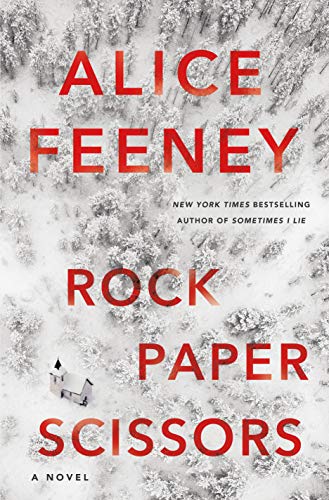
Rock Paper Scissors
About this book
Adam and Amelia Wright win a weekend at a remote chapel in the Scottish Highlands. The trip is supposed to rescue a marriage that has become a collection of evasions, but the weather closes in and the building does not feel empty.
Adam is a screenwriter with face blindness: he cannot reliably recognize even the people closest to him. Amelia knows how that condition shapes their life, yet recognition is only one of the ways the weekend makes perception uncertain.
Between chapters, anniversary letters mark the years of the marriage. They record gifts, resentments, promises, and facts that do not sit neatly beside the couple's present account of themselves.
Rock Paper Scissors is a domestic thriller built around controlled disclosure. Alice Feeney uses the isolated setting and alternating perspectives to make every new fact revise an earlier one, turning a familiar story about a failing marriage into a question of whose story it has been.
Read a sample
5,055 words
Plain text
From the opening
Amelia
February 2020
My husband doesn’t recognise my face.
I feel him staring at me as I drive, and wonder what he sees. Nobody else looks familiar to him either, but it is still strange to think that the man I married wouldn’t be able to pick me out in a police line-up.
I know the expression his face is wearing without having to look. It’s the sulky, petulant, I told you so version, so I concentrate on the road instead. I need to. The snow is falling faster now, it’s like driving in a white-out, and the windscreen wipers on my Morris Minor Traveller are struggling to cope. The car – like me – was made in 1978. If you look after things, they will last a lifetime, but I suspect my husband might like to trade us both in for a younger model. Adam has checked his seatbelt a hundred times since we left home, and his hands are balled into conjoined fists on his lap. The journey from London up to Scotland should have taken no more than eight hours, but I daren’t drive any faster in this storm. Even though it’s starting to get dark, and it seems we might be lost in more ways than one.
Can a weekend away save a marriage? That’s what my husband said when the counsellor suggested it. Every time his words replay in my mind, a new list of regrets writes itself inside my head. To have wasted so much of our lives by not really living them makes me feel so sad. We weren’t always the people we are now, but our memories of the past can make liars of us all. That’s why I’m focussing on the future. Mine. Some days I still picture him in it, but there are moments when I imagine what it would be like to be on my own again. It isn’t what I want, but I do wonder whether it might be best for both of us. Time can change relationships like the sea reshapes the sand.
He said we should postpone this trip when we saw the weather warnings, but I couldn’t. We both know this weekend away is a last chance to fix things. Or at least to try. He hasn’t forgotten that.
It’s not my husband’s fault that he forgets who I am.
Adam has a neurological glitch called prosopagnosia, which means he cannot see distinguishing features on faces, including his own. He has walked past me on the street on more than one occasion, as though I were a stranger. The social anxiety it inevitably causes affects us both. Adam can be surrounded by friends at a party and still feel like he doesn’t know a single person in the room. So we spend a lot of time alone. Together but apart. Just us. Face blindness isn’t the only way my husband makes me feel invisible. He did not want children – always said that he couldn’t bear the thought of not recognising their faces. He has lived with the condition his whole life, and I have lived with it since we met. Sometimes a curse can be a blessing.
My husband might not know my face, but there are other ways he has learned to recognise me: the smell of my perfume, the sound of my voice, the feel of my hand in his when he still used to hold it.
Marriages don’t fail, people do.
I am not the woman he fell in love with all those years ago. I wonder whether he can tell how much older I look now? Or if he notices the infiltration of grey in my long blonde hair? Forty might be the new thirty, but my skin is creased with wrinkles that were rarely caused by laughter. We used to have so much in common, sharing our secrets and dreams, not just a bed. We still finish each other’s sentences but these days we get them wrong.
‘I feel like we’re going in circles,’ he mutters beneath his breath, and for a moment I’m not sure whether he’s referring to our marriage or my navigational skills. The ominous-looking slate sky seems to reflect his mood, and it’s the first time he’s spoken for several miles. Snow has settled on the road ahead, and the wind is picking up, but it’s still nothing compared with the storm brewing inside the car.
‘Can you just find the directions I printed out and read them again?’ I say, trying but failing to hide the irritation in my voice. ‘I’m sure we must be close.’
Unlike me, my husband has aged impossibly well. His forty plus years are cleverly disguised by a good haircut, tanned skin, and a body shaped by an over-indulgence in half-marathons. He has always been very good at running away, especially from reality.
Adam is a screenwriter. He started far below the bottom rung of Hollywood’s retractable ladder, not quite able to reach it on his own. He tells people that he went straight from school into the movie business, which is only an off-white lie. He got a job working at the Electric Cinema in Notting Hill when he was sixteen, selling snacks and film tickets. By the time he was twenty-one, he’d sold the rights to his first screenplay. Rock Paper Scissors has never made it beyond development, but Adam got an agent out of the deal, and the agent got him work, writing an adaptation of a novel. The book wasn’t a bestseller, but the film version – a low-budget British affair – won a Bafta, and a writer was born. It wasn’t the same as seeing his own characters come to life on screen – the roads to our dreams are rarely direct – but it did mean that Adam could quit selling popcorn and write full-time.
Continue reading the sampleClose the sample
Screenwriters don’t tend to be household names, so some people might not know his, but I’d be willing to bet money they’ve seen at least one of the films he’s written. Despite our problems, I’m so proud of everything he has achieved. Adam Wright built a reputation in the business for turning undiscovered novels into blockbuster movies, and he’s still always on the lookout for the next. I’ll admit that I sometimes feel jealous, but I think that’s only natural given the number of nights when he would rather take a book to bed. My husband doesn’t cheat on me with other women, or men, he has love affairs with their words.
Human beings are a strange and unpredictable species. I prefer the company of animals, which is one of the many reasons why I work at Battersea Dogs Home. Four-legged creatures tend to make better companions than those with two, and dogs don’t hold grudges or know how to hate. I’d rather not think about the other reasons why I work there; sometimes the dust of our memories is best left unswept.
The view beyond the windscreen has offered an ever-changing dramatic landscape during our journey. There have been trees in every shade of green, giant glistening lochs, snow-capped mountains and an infinite amount of perfect, unspoilt space. I am in love with the Scottish Highlands. If there is a more beautiful place on Earth, I have yet to find it. The world seems so much bigger up here than in London. Or perhaps I am smaller. I find peace in the quiet stillness and the remoteness of it all. We haven’t seen another soul for over an hour, which makes this the perfect location for what I have planned.
We pass a stormy sea on our left and carry on north, the sound of crashing waves serenading us. As the winding road shrinks into a narrow lane, the sky – which has changed from blue, to pink, to purple, and now black – is reflected in each of the partially frozen lochs we pass. Further inland, a forest engulfs us. Ancient pine trees, dusted with snow, and taller than our house, are being bent out of shape by the storm as though they are matchsticks. The wind wails like a ghost outside the car, constantly trying to blow us off course, and when we slide a little on the icy road, I grip the steering wheel so tight that the bones in my fingers protrude through my skin. I notice my wedding ring. A solid reminder that we are still together, despite all the reasons we should perhaps be apart. Nostalgia is a dangerous drug, but I enjoy the sensation of happier memories flooding my mind. Maybe we’re not as lost as we feel. I steal a glance at the man sitting beside me, wondering whether we could still find our way back to us. Then I do something I haven’t done for a long time, and reach to hold his hand.
‘Stop!’ he yells.
It all happens so fast. The blurred, snowy image of a stag standing in the middle of the road ahead, my foot slamming on the brake, the car swerving and spinning before finally skidding to a halt just in front of the deer’s huge horns. It blinks twice in our direction before calmly walking away as if nothing happened, disappearing into the woods. Even the trees look cold.
My heart is thudding inside my chest as I reach for my handbag. My trembling fingers find my purse and keys and almost all other contents before locating my inhaler. I shake it and take a puff.
‘Are you OK?’ I ask, before taking another.
‘I told you this was a bad idea,’ Adam replies.
I have bitten my tongue so many times already on this trip, it must be full of holes.
‘I don’t remember you having a better one,’ I snap.
‘An eight-hour drive for a weekend away…’
‘We’ve been saying for ages that it might be nice to visit the Highlands.’
‘It might be nice to visit the moon, too, but I’d rather we talked about it before you booked us on a rocket. You know how busy things are for me right now.’
Busy has become a trigger word in our marriage. Adam wears his busyness like a badge. Like a boy scout. It is something he is proud of: a status symbol of his success. It makes him feel important, and makes me want to throw the novels he adapts at his head.
‘We are where we are because you’re always too busy,’ I say through gritted, chattering teeth. It’s so cold in the car now, I can see my own breath.
‘I’m sorry, are you suggesting it’s my fault that we’re in Scotland? In February? In the middle of a storm? This was your idea. At least I won’t have to listen to your incessant nagging once we’ve been crushed to death by a falling tree, or died from hypothermia in this shit-can car you insist on driving.’
We never bicker like this in public, only in private. We’re both pretty good at keeping up appearances and I find people see what they want to see. But behind closed doors, things have been wrong with Mr and Mrs Wright for a long time.
‘If I’d had my phone, we’d be there by now,’ he says, rummaging around in the glove compartment for his beloved mobile, which he can’t find. My husband thinks gadgets and gizmos are the answer to all of life’s problems.
‘I asked if you had everything you needed before we left the house,’ I say.
‘I did have everything. My phone was in the glovebox.’
‘Then it would still be there. It’s not my job to pack your things for you. I’m not your mother.’
I immediately regret saying it, but words don’t come with gift receipts and you can’t take them back. Adam’s mother is at the top of the long list of things he doesn’t like to talk about. I try to be patient while he continues searching for his phone, despite knowing he’ll never find it. He’s right. He did put it in the glovebox. But I took it out before we left home this morning and hid it in the house. I plan to teach my husband an important lesson this weekend and he doesn’t need his phone for that.
Fifteen minutes later, we’re back on the road and seem to be making progress. Adam squints in the darkness as he studies the directions I printed off – unless it’s a book or a manuscript, anything written on paper instead of a screen seems to baffle him.
‘You need to take the first right at the next roundabout,’ he says, sounding more confident than I would have expected.
We are soon reliant on the moon to light our way and hint at the rise and fall of the snowy landscape ahead. There are no streetlights, and the headlights on the Morris Minor barely light the road in front of us. I notice that we are low on petrol again, but haven’t seen anywhere to fill up for almost an hour. The snow is relentless now, and there has been nothing but the dark outlines of mountains and lochs for miles.
When we finally see a snow-covered old sign for Blackwater, the relief in the car is palpable. Adam reads the last set of directions with something bordering on enthusiasm.
‘Cross the bridge, turn right when you pass a bench overlooking the loch. The road will bend to the right, leading into the valley. If you pass the pub, you’ve gone too far and missed the turning for the property.’
‘A pub dinner might be nice later,’ I suggest.
Neither of us says anything when the Blackwater Inn comes into view in the distance. I turn off before we reach the pub, but we still get close enough to see that its windows are boarded up. The ghostly building looks as though it has been derelict for a long time.
The winding road down into the valley is both spectacular and terrifying. It looks like it has been chiselled out of the mountain by hand. The track is barely wide enough for our little car, and there’s a steep drop on one side with not a single crash barrier.
‘I think I can see something,’ Adam says, leaning closer to the windscreen and peering into the darkness. All I can see is a black sky and a blanket of white covering everything beneath it.
‘Where?’
‘There. Just beyond those trees.’
I slow down a little as he points at nothing. But then I notice what looks like a large white building all on its own in the distance.
‘It’s just a church,’ he says, sounding defeated.
‘That’s it!’ I say, reading an old wooden sign up ahead. ‘Blackwater Chapel is what we’re looking for. We must be here!’
‘We’ve driven all this way to stay in… an old church?’
‘A converted chapel, yes, and I did all the driving.’
I slow right down, and follow the snow-covered dirt track that leads away from the single-lane road and into the floor of the valley. We pass a tiny thatched cottage on the right – the only other building I can see for miles – then we cross a small bridge and are immediately confronted by a flock of sheep. They are huddled together, eerily illuminated by our headlights, and blocking our path. I gently rev the engine, and try tapping the car horn, but they don’t move. With their eyes glowing in the darkness they look a little supernatural. Then I hear the sound of growling in the back of the car.
Bob – our giant black Labrador – has been quiet for most of the journey. At his age he mostly likes to sleep and eat, but he is afraid of sheep. And feathers. I’m scared of silly things too, but I am right to be. Bob’s growling does nothing to scare the herd. Adam opens the car door without warning, and a flurry of snow immediately blows inside, blasting us from all directions. I watch as he climbs out, shields his face, then shoos the sheep, before opening a gate that had been hidden from view behind them. I don’t know how Adam saw it in the dark.
He climbs back into the car without a word, and I take my time as we trundle the rest of the way. The track is dangerously close to the edge of the loch and I can see why they named this place Blackwater. As I pull up outside the old white chapel, I start to feel better. It’s been an exhausting journey, but we made it, and I tell myself that everything will be OK as soon as we get inside.
Stepping out into a blizzard is a shock to the system. I wrap my coat around me, but the icy cold wind still knocks the air out of my lungs and the snow pummels my face. I get Bob from the boot, and the three of us trudge through the snow towards two large gothic-looking wooden doors. A converted chapel seemed romantic at first. Quirky and fun. But now that we’re here, it does feel a bit like the opening of our own horror film.
The chapel doors are locked.
‘Did the owners mention anything about a keybox?’ Adam asks.
‘No, they just said that the doors would be open.’
I stare up at the imposing white building, shielding my eyes from the unrelenting snow, and take in the sight of the thick white stone walls, bell tower, and stained-glass windows. Bob starts to growl again, which is unlike him, but perhaps there are more sheep or other animals in the distance? Something that Adam and I just can’t see?
‘Maybe there is another door around the back?’ Adam suggests.
‘I hope you’re right. The car already looks like it might need digging out of the snow.’
We traipse towards the side of the chapel, with Bob leading the way, straining on his lead as though tracking something. Although there are endless stained-glass windows, we don’t find any more doors. And despite the front of the building being illuminated by exterior lights – the ones we could see from a distance – inside, it’s completely dark. We carry on, heads bowed against the relentless weather until we have come full circle.
‘What now?’ I ask.
But Adam doesn’t answer.
I look up, shielding my eyes from the snow, and see that he is staring at the front of the chapel. The huge wooden doors are now wide open.
Adam
If every story had a happy ending then we’d have no reason to start again. Life is all about choices, and learning how to put ourselves back together when we fall apart. Which we all do. Even the people who pretend they don’t. Just because I can’t recognise my wife’s face, it doesn’t mean I don’t know who she is.
‘The doors were closed before, right?’ I ask, but Amelia doesn’t answer.
We stand side by side outside the chapel, both shivering, with snow blowing around us in all directions. Even Bob looks miserable, and he’s always happy. It’s been a long and tedious journey, made worse by the steady drumbeat of a headache at the base of my skull. I drank more than I should with someone I shouldn’t have last night. Again. In alcohol’s defence, I’ve done some equally stupid things while completely sober.
‘Let’s not jump to conclusions,’ my wife says eventually, but I think we’ve both already hurdled over several.
‘The doors didn’t just open by themselves—’
‘Maybe the housekeeper heard us knocking?’ she interrupts.
‘The housekeeper? Which website did you use to book this place again?’
‘It wasn’t on a website. I won a weekend away in the staff Christmas raffle.’
I don’t reply for a few seconds, but silence can stretch time so it feels longer. Plus, my face feels so cold now I’m not sure I can move my mouth. But it turns out that I can.
‘Just so I’ve got this clear… you won a weekend away, to stay in an old Scottish church, in a staff raffle at Battersea Dogs Home?’
‘It’s a chapel, but yes. What’s wrong with that? We have a raffle every year. People donate gifts, I won something good for a change.’
‘Great,’ I reply. ‘This has definitely been “good” so far.’
She knows I detest long journeys. I hate cars and driving full stop – never even took a test – so eight hours trapped in her tin-can antique on four wheels, during a storm, isn’t my idea of fun. I look at the dog for moral support, but Bob is too busy trying to eat snowflakes as they fall from the sky. Amelia, sensing defeat, uses that passive-aggressive sing-song tone that used to amuse me. These days it makes me wish I was deaf.
‘Shall we go inside? Make the best of it? If it’s really bad we’ll just leave, find a hotel, or sleep in the car if we have to.’
I’d rather eat my own liver than get back in her car.
My wife says the same things lately, over and over, and her words always feel like a pinch or a slap. I don’t understand you irritates me the most, because what’s to understand? She likes animals more than she likes people; I prefer fiction. I suppose the real problems began when we started preferring those things to each other. It feels like the terms and conditions of our relationship have either been forgotten, or were never properly read in the first place. It isn’t as though I wasn’t a workaholic when we first met. Or writeraholic as she likes to call it. All people are addicts, and all addicts desire the same thing: an escape from reality. My job just happens to be my favourite drug.
Same but different, that’s what I tell myself when I start a new screenplay. That’s what I think people want, and why change the ingredients of a winning formula? I can tell within the first few pages of a book whether it will work for screen or not – which is a good thing, because I get sent far too many to read them all. But just because I’m good at what I do, doesn’t mean I want to do it for the rest of my life. I’ve got my own stories to tell. But Hollywood isn’t interested in originality anymore, they just want to turn novels into films or TV shows, like wine into water. Different but same. But does that rule also apply to relationships? If we play the same characters for too long in a marriage, isn’t it inevitable that we’ll get bored of the story and give up, or switch off before we reach the end?
‘Shall we?’ Amelia says, interrupting my thoughts and staring up at the bell tower on top of the creepy chapel.
‘Ladies first.’ Can’t say I’m not a gentleman. ‘I’ll grab the bags from the car,’ I add, keen to snatch my last few seconds of solitude before we go inside.
I spend a lot of time trying not to offend people: producers, executives, actors, agents, authors. Throw face blindness into that mix, and I think it’s fair to say I’m Olympian level when it comes to walking on eggshells. I once spoke to a couple at a wedding for ten minutes before realising they were the bride and groom. She didn’t wear a traditional dress, and he looked like a clone of his many groomsmen. But I got away with it because charming people is part of my job. Getting an author to trust me with the screenplay of their novel, can be harder than persuading a mother to let a stranger look after their firstborn child. But I’m good at it. Sadly, charming my wife seems to be something I’ve forgotten how to do.
I never tell people about having prosopagnosia. Firstly, I don’t want that to define me, and honestly, once someone knows, it’s all they want to talk about. I don’t need or want pity from anyone, and I don’t like being made to feel like a freak. What people don’t ever seem to understand, is that for me, it’s normal not to be able to recognise faces. It’s just a glitch in my programming; one that can’t be fixed. I’m not saying I’m OK with it. Imagine not being able to recognise your own friends or family? Or not knowing what your wife’s face looks like? I hate meeting Amelia in restaurants in case I sit down at the wrong table, I’d choose takeout every time were it up to me. Sometimes I don’t even recognise my own face when I look in the mirror. But I’ve learned to live with it. Like we all do when life deals us a less than perfect hand.
I think I’ve learned to live with a less than perfect marriage, too. But doesn’t everyone? I’m not being defeatist, just honest. Isn’t that what successful relationships are really about? Compromise? Is any marriage really perfect?
I love my wife. I just don’t think we like each other as much as we used to.
‘That’s nearly all of it,’ I say, rejoining her on the chapel steps, saddled with more bags than we can possibly need for a few nights away. She glares at my shoulder as if it has offended her.
‘Is that your laptop satchel?’ she asks, knowing full well that it is.
I’m hardly a rookie so I can’t explain or excuse my mistake. I imagine Amelia pulling a Go-to-Jail-card face. This is not a good start. I will not be allowed to write this weekend or pass Go. If our marriage were a game of Monopoly, my wife would charge me double every time I accidentally landed on one of her hotels.
‘You promised no work,’ she says in that disappointed, whiney tone that has become so familiar. My work paid for our house and our holidays; she didn’t complain about that.
When I think about everything we have – a nice home in London, a good life, money in the bank – I think the same thing as always: we should be happy. But all the things we don’t have are harder to see. Most friends our age have elderly parents or young children to worry about, but we only have each other. No parents, no siblings, no children, just us. A lack of people to love is something we’ve always had in common. My father left when I was too young to remember anything about him, and my mother died when I was still in school. My wife’s childhood was no less Oliver Twist, she was an orphan before she was born.
Bob saves us from ourselves by growling at the chapel doors again. It’s strange, because he never does that, but I’m grateful for the distraction. It’s hard to believe he used to be a tiny puppy, abandoned in a shoe box and dumped in a skip. Since then he has grown into the biggest black Labrador I have ever seen. He has a collection of grey hairs on his chin these days, and walks more slowly than he used to, but the dog is the only one still capable of unconditional love in our family of three. I’m sure everyone thinks we treat him like a surrogate child, even if they are too polite to say so. I always said I didn’t mind not having a real one. People who don’t get to name their children get to name a different future. Besides, what’s the point in wanting something you know you can’t have? Too late for that now.
I don’t normally feel forty. I sometimes struggle to understand where the years went and when I transitioned from boy to man. Maybe doing a job that I love has something to do with that. My work makes me feel young, but my wife makes me feel old. The marriage counsellor was Amelia’s idea, and this trip was theirs. ‘Call me Pamela’, the so-called ‘expert’, thought a weekend away might fix us. I guess all the weekends and evenings spent together at home were null and void. Weekly visits to share the most private corners of our lives with a complete stranger cost more than just the extortionate fee. For that money, and several other reasons, I repeatedly called the woman Pammy or Pam every time we met. ‘Call me Pamela’ didn’t like that, but I didn’t like her much so it helped make things even. My wife didn’t want anyone else to know that we were having problems but I suspect some might have noticed. Most people can see the writing on the wall, even if they can’t always read what it says.
Can a weekend away really save a marriage? That’s what Amelia said when ‘Call me Pamela’ suggested it. I don’t think so. Which is why I came up with my own plan for us long before I agreed to hers. But now we’re here… climbing the chapel steps… and I don’t know if I can go through with it.
‘Are you sure you want to do this?’ I say, stopping just before going inside.
‘Yes. Why?’ she asks, as though she can’t hear the dog growling and the wind howling.
‘I don’t know. Something doesn’t feel right—’
‘This isn’t a horror story written by one of your favourite authors, Adam. This is real life. Maybe the wind blew the doors open?’
She can say what she likes, but the doors weren’t just closed before. They were locked and we both know it.
We find ourselves in what posh people call a boot room and I put the bags down. A puddle of melting snow forms around my feet. The flagstone floor looks ancient, and there is built-in storage along the back wall with rustic wooden cubbyholes designed for boots. There are also rows of hooks for coats, all of which are empty. We don’t remove our snow-covered shoes or jackets. Partly because it is just as cold in here as it was outside, but also perhaps because it still seems uncertain whether we are staying.