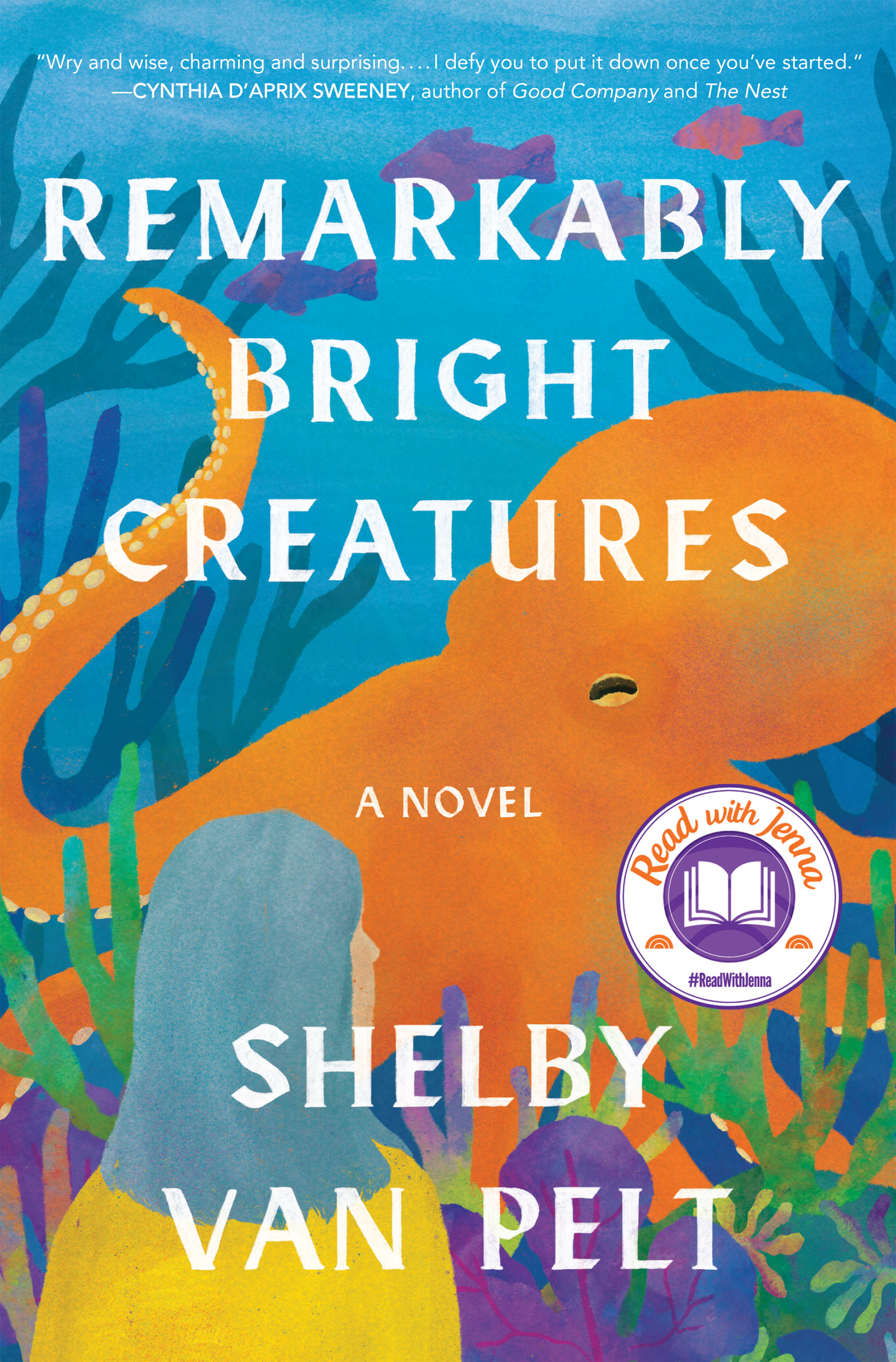
Remarkably Bright Creatures
About this book
Tova Sullivan cleans the Sowell Bay Aquarium at night, keeping busy after her husband's death and the long-ago disappearance of their son. In one of the tanks lives Marcellus, a giant Pacific octopus who regards his captivity with dry intelligence and occasionally escapes to investigate the building.
When Tova finds Marcellus tangled outside his tank, the rescue begins a quiet friendship. Meanwhile, Cameron Cassmore arrives in town searching for the father he never knew. Marcellus notices a connection between their histories before any of the humans do.
Van Pelt lets the mystery develop through chores, misplaced objects, old photographs, and the limits of what each character is willing to ask. Marcellus can understand much of the human world, but he has only brief opportunities to interfere with it.
Published in 2022, Remarkably Bright Creatures is warm without pretending grief can be solved by a single revelation. Its characters find one another through patience, and through the attention of a captive animal who is better at recognizing patterns than the people around him.
Read a sample
5,038 words
Plain text
From the opening
Day 1,299 of My Captivity
DARKNESS SUITS ME.
Each evening, I await the click of the overhead lights, leaving only the glow from the main tank. Not perfect, but close enough.
Almost-darkness, like the middle-bottom of the sea. I lived there before I was captured and imprisoned. I cannot remember, yet I can still taste the untamed currents of the cold open water. Darkness runs through my blood.
Who am I, you ask? My name is Marcellus, but most humans do not call me that. Typically, they call me that guy. For example: Look at that guy—there he is—you can just see his tentacles behind the rock.
I am a giant Pacific octopus. I know this from the plaque on the wall beside my enclosure.
I know what you are thinking. Yes, I can read. I can do many things you would not expect.
The plaque states other facts: my size, preferred diet, and where I might live were I not a prisoner here. It mentions my intellectual prowess and penchant for cleverness, which for some reason seems a surprise to humans: Octopuses are remarkably bright creatures, it says. It warns the humans of my camouflage, tells them to take extra care in looking for me in case I have disguised myself to match the sand.
The plaque does not state that I am named Marcellus. But the human called Terry, the one who runs this aquarium, sometimes shares this with the visitors who gather near my tank. See him back there? His name’s Marcellus. He’s a special guy.
A special guy. Indeed.
Terry’s small daughter chose my name. Marcellus McSquiddles, in full. Yes, it is a preposterous name. It leads many humans to assume I am a squid, which is an insult of the worst sort.
How shall you refer to me, you ask? Well, that is up to you. Perhaps you will default to calling me that guy, like the rest of them. I hope not, but I will not hold it against you. You are only human, after all.
I must advise you that our time together may be brief. The plaque states one additional piece of information: the average life span of a giant Pacific octopus. Four years.
My life span: four years—1,460 days.
I was brought here as a juvenile. I shall die here, in this tank. At the very most, one hundred and sixty days remain until my sentence is complete.
The Silver-Dollar Scar
Tova Sullivan prepares for battle. A yellow rubber glove sticks up from her back pocket like a canary’s plume as she bends over to size up her enemy.
Chewing gum.
“For heaven’s sake.” She jabs at the pinkish blob with her mop handle. Layers of sneaker tread emboss its surface, speckling it with grime.
Tova has never understood the purpose of chewing gum. And people lose track of it so often. Perhaps this chewer was talking, ceaselessly, and it simply tumbled out, swept away by a slurry of superfluous words.
She bends over and picks at the edge of the mess with her fingernail, but it doesn’t budge from the tile. All because someone couldn’t walk ten feet to the trash bin. Once, when Erik was young, Tova caught him mashing a piece of bubble gum under a diner table. That was the last time she bought bubble gum for him, although how he spent his allowance as adolescence set in was, like so much else, beyond her control.
Specialized weaponry will be necessary. A file, perhaps. Nothing on her cart will pry up the gum.
As she stands, her back pops. The sound echoes down the empty curve of the hallway, bathed in its usual soft blue light, as she journeys to the supply closet. No one would fault her, of course, for passing over the blob of gum with her mop. At seventy years old, they don’t expect her to do such deep cleaning. But she must, at least, try.
Besides, it’s something to do.
TOVA IS SOWELL BAY AQUARIUM’S oldest employee. Each night, she mops the floors, wipes down the glass, and empties the trash bins. Every two weeks, she retrieves a direct-deposit stub from her cubby in the break room. Fourteen dollars an hour, less the requisite taxes and deductions.
The stubs get stashed in an old shoebox on top of her refrigerator, unopened. The funds accrue in an out-of-mind account at the Sowell Bay Savings and Loan.
She marches toward the supply closet now, at a purposeful clip that would be impressive by anyone’s standards but is downright astonishing for a tiny older woman with a curved back and birdlike bones. Overhead, raindrops land on the skylight, backlit by glare from the security light at the old ferry dock next door. Silver droplets race down the glass, shimmering ribbons under the fogbound sky. It’s been a dreadful June, as everyone keeps saying. The gray weather doesn’t bother Tova, though it would be nice if the rain would let up long enough to dry out her front yard. Her push mower clogs when it’s soggy.
Shaped like a doughnut, with a main tank in the center and smaller tanks around the outside, the aquarium’s dome-topped building is not particularly large or impressive, perhaps fitting for Sowell Bay, which is neither large nor impressive itself. From the site of Tova’s encounter with the chewing gum, the supply closet is a full diameter across. Her white sneakers squeak across a section she’s already cleaned, leaving dull footprints on the gleaming tile. Without a doubt, she’ll mop that part again.
Continue reading the sampleClose the sample
She pauses at the shallow alcove, with its life-sized bronze statue of a Pacific sea lion. The sleek spots on its back and bald head, worn smooth from decades of being petted and climbed on by children, only enhance its realism. On Tova’s mantel at home, there’s a photo of Erik, perhaps eleven or twelve at the time, grinning wildly as he straddles the statue’s back, one hand aloft like he’s about to throw a lasso. A sea cowboy.
That photo is one of the last in which he looks childlike and carefree. Tova maintains the photos of Erik in chronological order: a montage of his transformation from a gummy-grinned baby to handsome teenager, taller than his father, posing in his letter jacket. Pinning a corsage on a homecoming date. Atop a makeshift podium on the rocky shores of deep blue Puget Sound, clutching a high school regatta trophy. Tova touches the sea lion’s cold head as she passes, quelling the urge to wonder yet again how Erik might’ve looked now.
She continues on, as one must, down the dim hallway. In front of the tank of bluegills, she pauses. “Good evening, dears.”
The Japanese crabs are next. “Hello, lovelies.”
“How do you do?” she inquires of the sharp-nosed sculpin.
The wolf eels are not Tova’s cup of tea, but she nods a greeting. One mustn’t be rude, even though they remind her of those cable-channel horror films her late husband, Will, took to watching in the middle of the night when chemotherapy nausea kept him awake. The largest wolf eel glides out of its rocky cavern, mouth set in its trademark underbite frown. Jagged teeth jut upward from its lower jaw like little needles. An unfortunate-looking thing, to say the least. But then, looks are deceiving, aren’t they? Tova smiles at the wolf eel, even though it could never smile back, not even if it wanted to, with a face like that.
The next exhibit is Tova’s favorite. She leans in, close to the glass. “Well, sir, what have you been up to today?”
It takes her a moment to find him: a sliver of orange behind the rock. Visible, but mistakenly, like a child’s hide-and-seek misstep: a girl’s ponytail sticking up behind the sofa, or a socked foot peeking out from under the bed.
“Feeling bashful tonight?” She steps back and waits; the giant Pacific octopus doesn’t move. She imagines daytime, people rapping their knuckles on the glass, huffing away when they don’t see anything. Nobody knows how to be patient anymore.
“I can’t say I blame you. It does look cozy back there.”
The orange arm twitches, but his body remains tucked away.
THE CHEWING GUM mounts a valiant defense against Tova’s file, but eventually it pops off.
When Tova pitches the crusty blob into the trash bag, it makes a satisfying little swoosh as it rustles the plastic.
Now she mops. Again.
Vinegar with a hint of lemon tinges the air, wafting up from the wet tile. So much better than the dreadful solution they’d been using when Tova first started, bright green junk that singed her nostrils. She’d made her case against it right off the bat. For one thing, it made her dizzy, and for another, it left unsightly streaks on the floors. And perhaps worst of all, it smelled like Will’s hospital room, like Will being sick, although Tova kept that part of her complaint private.
The supply room shelves were crammed with jugs of that green junk, but Terry, the aquarium director, finally shrugged, telling her she could use whatever she wanted if she brought it herself. Certainly, Tova agreed. So each night she totes a jug of vinegar and her bottle of lemon oil.
Now, more trash to collect. She empties the bins in the lobby, the can outside the restrooms, then ends in the break room, with its endless crumbs on the counter. It’s not required of her, as it’s taken care of by the professional crew from Elland that comes every other week, but Tova always runs her rag around the base of the ancient coffee maker and inside the splatter-stained microwave, which smells of spaghetti. Today, however, there are bigger issues: empty takeout cartons on the floor. Three of them.
“My word,” she says, scolding the empty room. First the gum, and now this.
She picks up the cartons and tosses them in the trash can, which, oddly, has been scooted several feet over from its usual spot. After she empties the can into her collection bag, she moves it back to its proper place.
Next to the trash sits a small lunch table. Tova straightens the chairs. Then she sees it.
Something. Underneath.
A brownish-orange clump, shoved in the corner. A sweater? Mackenzie, the pleasant young lady who works the admission kiosk, often leaves one slung over the back of a chair. Tova kneels, preparing to fetch it and stash it in Mackenzie’s cubby. But then the clump moves.
A tentacle moves.
“Good heavens!”
The octopus’s eye materializes from somewhere in the fleshy mass. Its marble pupil widens, then its eyelid narrows. Reproachful.
Tova blinks, not convinced her own eyes are working properly. How could the giant Pacific octopus be out of his tank?
The arm moves again. The creature is tangled in the mess of power cords. How many times has she cursed those cords? They make it impossible to properly sweep.
“You’re stuck,” she whispers, and the octopus heaves his huge bulbous head, straining on one of his arms, around which a thin power cord, the kind used to charge a cell phone, is wrapped several times. The creature strains harder and the cord binds tighter, his flesh bulging between each loop. Erik had a toy like this once, from a joke shop. A little woven cylinder where you stuck in an index finger on either end then tried to pull them apart. The harder you pulled, the tighter it became.
She inches closer. In response, the octopus smacks one of his arms on the linoleum as if to say: Back off, lady.
“Okay, okay,” she murmurs, pulling out from under the table.
She stands and turns the overhead light on, washing the break room in fluorescent glow, and starts to lower herself down again, more slowly this time. But then, as usual, her back pops.
At the sound, the octopus lashes again, shoving one of the chairs with alarming force. The chair skids across the room and ricochets off the opposite wall.
From under the table, the creature’s impossibly clear eye gleams.
Determined, Tova creeps closer, trying to steady her shaking hands. How many times has she passed by the plaque under the giant Pacific octopus tank? She can’t recall it stating anything about octopuses being dangerous to humans.
She’s but a foot away. He seems to be shrinking, and his color has become pale. Does an octopus have teeth?
“My friend,” she says softly. “I’m going to reach around you and unplug the cord.” She peers around and sees exactly which cord is the source of his predicament. Within reach.
The octopus’s eye follows her every movement.
“I won’t hurt you, dear.”
One of its free arms taps on the floor like a house cat’s tail.
As she yanks the plug, the octopus flinches backward. Tova flinches, too. She expects him to slink out along the wall toward the door, in the direction he’d been straining.
But instead, he slides closer.
Like a tawny snake, one of his arms slithers toward her. In seconds, it winds around her forearm, then twists around her elbow and bicep like a maypole ribbon. She can feel each individual sucker clinging to her. Reflexively, she tries to yank her arm away, but the octopus tightens his grip to the point where it’s almost uncomfortable. But his strange eye glints playfully, like a naughty child’s.
Empty takeout cartons. Misplaced trash can. Now it makes sense.
Then, in an instant, he releases her. Tova watches, incredulous, as he stalks out the break room door, suckering along on the thickest part of each of his eight legs. His mantle seems to drag behind him and he looks even paler now; he’s moving with effort. She hurries after him, but by the time she reaches the hallway, the octopus is nowhere to be seen.
Tova drags a hand down her face. She’s losing her faculties. Yes, that’s it. This is how it begins, isn’t it? With hallucinations about an octopus?
Years ago, she had watched her late mother’s mind slip away. It started with occasional forgetfulness, familiar names and dates elusive. But Tova does not forget phone numbers or find herself searching the back of her mind for names. She looks down at her arm, which is covered in tiny circles. Sucker marks.
Half-dazed, she finishes the evening’s tasks, then makes her usual last round of the building to say good night.
Good night, bluegills, eels, Japanese crabs, sharp-nosed sculpin. Good night, anemones, seahorses, starfish.
Around the bend she continues. Good night, tuna and flounder and stingrays. Good night, jellies, sea cucumbers. Good night, sharks, you poor things. Tova has always felt more than a bit of empathy for the sharks, with their never-ending laps around the tank. She understands what it means to never be able to stop moving, lest you find yourself unable to breathe.
There’s the octopus, once again hidden behind his rock. A puff of flesh sticks out. His orange is more vivid now, compared to how he looked in the break room, but he’s still paler than usual. Well, perhaps it serves him right. He ought to stay put. How on earth did he get out? She peers through the rippling water, scanning up under the rim, but nothing seems amiss.
“Troublemaker,” she says, shaking her head. She hovers for an extra moment in front of his tank before leaving for the night.
TOVA’S YELLOW HATCHBACK chirps and blinks its sidelights as she presses the key fob, a feature she’s still not accustomed to. Her friends, the group of lunching ladies who affectionately call themselves the Knit-Wits, convinced her she needed a new car when she started her job. A safety issue, they argued, to drive at night in an older vehicle. They badgered her about it for weeks.
Sometimes it’s easier to simply give in.
After depositing her jug of vinegar and bottle of lemon oil in the trunk, as always, because no matter how many times Terry has told her she’s welcome to store them in the supply closet, one never knows when a bit of lemon and vinegar might come in handy, she casts a glance down the pier. It’s empty at this late hour, the evening fishermen long gone. The old ferry dock sits across from the aquarium like some ancient rotting machine. Barnacles cover its crumbling pilings. At high tide, the barnacles snag strands of seaweed, which dry into green-black plaque when the seawater ebbs.
She crosses the weathered wooden planks. As always, the old ticket booth is exactly thirty-eight steps from her parking space.
Tova looks once more for any bystanders, anyone lingering in the long shadows. She presses her hand to the ticket booth’s glass window, its diagonal crack like an old scar across someone’s cheek.
Then she walks onto the pier, out to her usual bench. It’s slick with salt spray and speckled with seagull droppings. She sits, pushing up her sleeve, looking at the strange round marks, half expecting them to be gone. But there they are. She runs the tip of her finger around the largest one, right on the inside of her wrist. It’s about the size of a silver dollar. How long will it linger there? Will it bruise? Bruises come so easily these days, and the mark is already turning maroon, like a blood blister. Perhaps it will remain permanently. A silver-dollar scar.
The fog has lifted, nudged inland by the wind, shunted off toward the foothills. To the south, a freighter is anchored, hull riding low under the rows of containers stacked like a child’s building blocks on its deck. Moonlight shimmies across the water, a thousand candles bobbing on its surface. Tova closes her eyes, imagining him underneath the surface, holding the candles for her. Erik. Her only child.
Day 1,300 of My Captivity
CRABS, CLAMS, SHRIMP, SCALLOPS, COCKLES, ABALONE, fish, fish eggs. This is the diet of a giant Pacific octopus, according to the plaque next to my tank.
The sea must be a delightful buffet. All of these delicacies, free for the taking.
But what do they offer here? Mackerel, halibut, and—above all—herring. Herring, herring, so much herring. They are foul creatures, disgusting little slips of fish. I am sure the reason for their abundance here is their low cost. The sharks in the main tank are rewarded for their dullness with fresh grouper, and I am given defrosted herring. Sometimes still partially frozen, even. This is why I must take matters into my own arms when I desire the sublime texture of fresh oyster, when I yearn to feel the sharp crack of my beak crushing a crab in its shell, when I crave the sweet, firm flesh of a sea cucumber.
Sometimes my captors will drop me a pity scallop if they are attempting to lure me into cooperation with a medical examination or bribe me into playing one of their games. And once in a while, Terry will slip me a mussel or two just because.
Of course, I have sampled crabs, clams, shrimp, cockles, and abalone many times over. I simply must take it upon myself to fetch them after hours. Fish eggs are an ideal snack, in terms of both gastronomical pleasure and nutritional value.
One might make a third list here, which would consist of things humans clamor for, but most intelligent life would consider entirely unfit for consumption. For example: every last offering in the vending machine in the lobby.
But tonight, another smell lured me. Sweet, salty, savory. I found its source in the rubbish bin, its remains ensconced in a flimsy white container.
Whatever it was, it was delicious. But had I not been fortunate, it could have been my downfall.
The cleaning woman. She saved me.
Falsehood Cookies
There were once seven Knit-Wits. Now there are four. Every few years brings another empty place at the table.
“My word, Tova!” Mary Ann Minetti lowers a teapot onto her dining table, staring at Tova’s arm. The pot is swaddled in a crocheted yellow cozy, probably a project someone knitted once, back when knitting was something the Knit-Wits actually did at their weekly luncheons. The teapot cozy matches the yellow jeweled barrette at Mary Ann’s temple, the clip holding back tawny curls.
Janice Kim eyes Tova’s arm as she fills her mug. “An allergy, maybe?” A swirl of oolong steam fogs her round spectacles, and she takes them off and wipes them on the hem of her T-shirt, which Tova suspects must belong to Janice’s son, Timothy, because it’s at least three sizes too large and emblazoned with the logo of the Korean shopping center down in Seattle where Timothy invested in a restaurant some years back.
“That mark?” Tova says, tugging the sleeve of her sweater down. “It’s nothing.”
“You should get it checked out.” Barb Vanderhoof plops a third sugar cube into her tea. Her cropped gray hair has been combed into gel-set spikes, which is one of her favored styles lately. When she first debuted this look, she joked that it was only fitting for a Barb to have barbs, which made the Knit-Wits laugh. Not for the first time, Tova imagines poking her finger down on one of the thorns on her friend’s head. Would it prick her, like one of the sea urchins down at the aquarium, or would it crumple under her touch?
“It’s nothing,” Tova repeats. Heat seeps into the tips of her ears.
“Well, let me tell you.” Barb takes a slurp of her tea and goes on. “You know my Andie? She had this rash last year when she came up for Easter. Mind you, I never saw it myself—it was in sort of an indelicate place, if you catch my drift, but not the sort of rash one gets from indecent behavior, mind you. No, it was just a rash. Anyway, I told her she should see my dermatologist. He’s wonderful. But my Andie is beyond stubborn, you know. And that rash kept getting worse, and—”
Janice cuts off Barb. “Tova, do you want Peter to recommend someone?” Janice’s husband, Dr. Peter Kim, is retired but well-connected in the medical community.
“I don’t need a doctor.” Tova forces a weak smile. “It was a minor incident at work.”
“At work!”
“An incident!”
“What happened?”
Tova draws in a breath. She can still feel the tentacle wrapped around her wrist. The spots had faded overnight, but they remained dark enough to see plainly. She tugs her sleeve down again.
Should she tell them?
“A mishap with some of the cleaning equipment,” she finally says.
Around the table, three pairs of eyes narrow at her.
Mary Ann wipes an imaginary spot from the tabletop with one of her tea towels. “That job of yours, Tova. Last time I was down at the aquarium, I nearly lost my lunch from the smell. How do you manage?”
Tova takes a chocolate chip cookie from the platter Mary Ann set out earlier. Mary Ann warms the cookies in the oven before the ladies arrive. One can’t have tea, she always comments, without something homemade to nibble on. The cookies came from a package Mary Ann bought at Shop-Way. All of the Knit-Wits know this.
“That old dump. Of course it smells,” Janice says. “But really, Tova, are you okay? Manual labor, at our age. Why must you work?”
Barb crosses her arms. “I worked down at St. Ann’s for a while after Rick died. To pass the time. They asked me to run the whole office, you know.”
“Filing,” Mary Ann mutters. “You did filing.”
“And you quit because they couldn’t keep it organized the way you liked,” Janice says, her voice dry. “But the point is, you weren’t down on your hands and knees washing floors.”
Mary Ann leans in. “Tova, I hope you realize, if you need help . . .”
“Help?”
“Yes, help. I don’t know how Will arranged your finances.”
Tova stiffens. “Thank you, but I have no such need.”
“But if you did.” Mary Ann’s lips knit together.
“I do not,” Tova replies quietly. And this is true. Tova’s bank account would cover her modest needs several times over. She does not need charity: not from Mary Ann, not from anyone else. And further, what a thing to bring up, and all because of a little set of marks on her arm.
After rising from the table, Tova sets her teacup down and leans on the counter. The window over the kitchen sink overlooks Mary Ann’s garden, where her rhododendron bushes cower under the low gray sky. The tender magenta petals seem to shiver as a breeze ruffles the branches, and Tova wishes she could tuck them back into their buds. The chill in the air is unseasonable for mid-June. Summer is certainly dragging its feet this year.
On the windowsill, Mary Ann has arranged a collection of religious paraphernalia: little glass angels with cherub faces, candles, a small army of shiny silver crosses in various sizes, lined up like soldiers. Mary Ann must polish them daily to keep them gleaming.
Janice cups her shoulder. “Tova? Earth to Tova?”
Tova can’t help but smile. The lilt in Janice’s voice makes Tova think Janice has been watching sitcoms again.
“Please don’t be upset. Mary Ann didn’t mean anything by it. We’re just worried.”
“Thank you, but I am fine.” Tova pats Janice’s hand.
Janice raises one of her neatly groomed eyebrows, steering Tova back toward the table. It’s clear Janice understands how deeply Tova wishes to change the subject, because she goes for low-hanging conversational fruit.
“So, Barb, what’s new with the girls?”
“Oh, did I tell you?” Barb draws in a dramatic breath. No one has ever needed to ask Barb twice to muse on the lives of her daughters and grandchildren. “Andie was supposed to bring the girls up for their summer break. But they had a hitch in their plans. That’s exactly what she said: a hitch.”
Janice wipes her glasses with one of Mary Ann’s embroidered napkins. “Is that right, Barb?”
“They haven’t been up since last Thanksgiving! She and Mark took the kids to Las Vegas for Christmas. If you can believe that. Who spends a holiday in Las Vegas?” Barb pronounces both words, Las and Vegas, with equal weight and contempt, the way someone might say spoiled milk.
Janice and Mary Ann both shake their heads, and Tova takes another cookie. All three women nod along as Barb launches into a story about her daughter’s family, who live two hours away in Seattle, which one might conclude was in another hemisphere for how infrequently Barb purports to see them.
“I told them, I sure hope to hug those grandbabies soon. Lord only knows how long I’ll be around!”
Janice sighs. “Enough, Barb.”
“Excuse me a moment.” Tova’s chair scrapes on the linoleum.
AS ONE WOULD gather from the name, the Knit-Wits began as a knitting club. Twenty-five years ago, a handful of Sowell Bay women met to swap yarn. Eventually, it became a refuge for them to escape empty homes, bittersweet voids left by children grown and moved on. For this reason, among others, Tova had initially resisted joining. Her void held no sweetness, only bitterness; at the time, Erik had been gone five years. How delicate those wounds were back then, how little it took to nudge the scabs out of place and start the bleeding anew.
The faucet in Mary Ann’s powder room lets out a squeak as Tova turns on the tap. Their complaints haven’t changed much over the years. First, it was what a pity the university is such a long drive, and what a shame we only get phone calls on Sunday afternoons. Now it’s grandbabies and great-grandbabies. These women have always worn motherhood big and loud on their chests, but Tova keeps hers inside, sunk deep in her guts like an old bullet. Private.
A few days before Erik disappeared, Tova had made an almond cake for his eighteenth birthday. The house carried that marzipan smell for days after. She still remembers how it lingered in her kitchen like a clueless houseguest who didn’t know when to leave.
At first, Erik’s disappearance was considered a runaway case. The last person who saw him was one of the deckhands working the eleven-o’clock southbound ferry, the last boat of the night, and the deckhand reported nothing unusual. Erik was meant to lock up the ticket booth afterward, which he always did, dutifully. Erik was so pleased they trusted him with the key; it was only a summer job, after all. The sheriff said they found the ticket booth unlocked, with the register cash fully accounted for. Erik’s backpack was stashed under the chair, along with his portable cassette player and headphones, even his wallet. Before they ruled out the possibility of foul play, the sheriff speculated that perhaps Erik had stepped away for a short time, planning to come back.
Why would he leave his booth alone when on duty? Tova has never understood. Will always had a theory there was a girl involved, but no trace of any girl—or any boy, for that matter—was ever found. His friends insisted that he wasn’t seeing anyone at the time. If Erik had been seeing someone, the world would’ve known about it. Erik was a popular kid.
One week later, they found the boat: a rusty old Sun Cat no one had noticed was missing from the tiny marina that used to be next to the ferry dock. It washed ashore with its anchor rope cut off clean. Erik’s prints were on the rudder. Evidence was thin, but it all pointed to the boy taking his own life, the sheriff said.
The neighbors said.
The newspapers said.
Everyone said.
Tova has never believed that. Not for one minute.
She pats her face dry, blinking at the reflection in the powder room mirror. The Knit-Wits have been her friends for years, and sometimes she still feels as if she’s a mistaken jigsaw piece who found her way into the wrong puzzle.