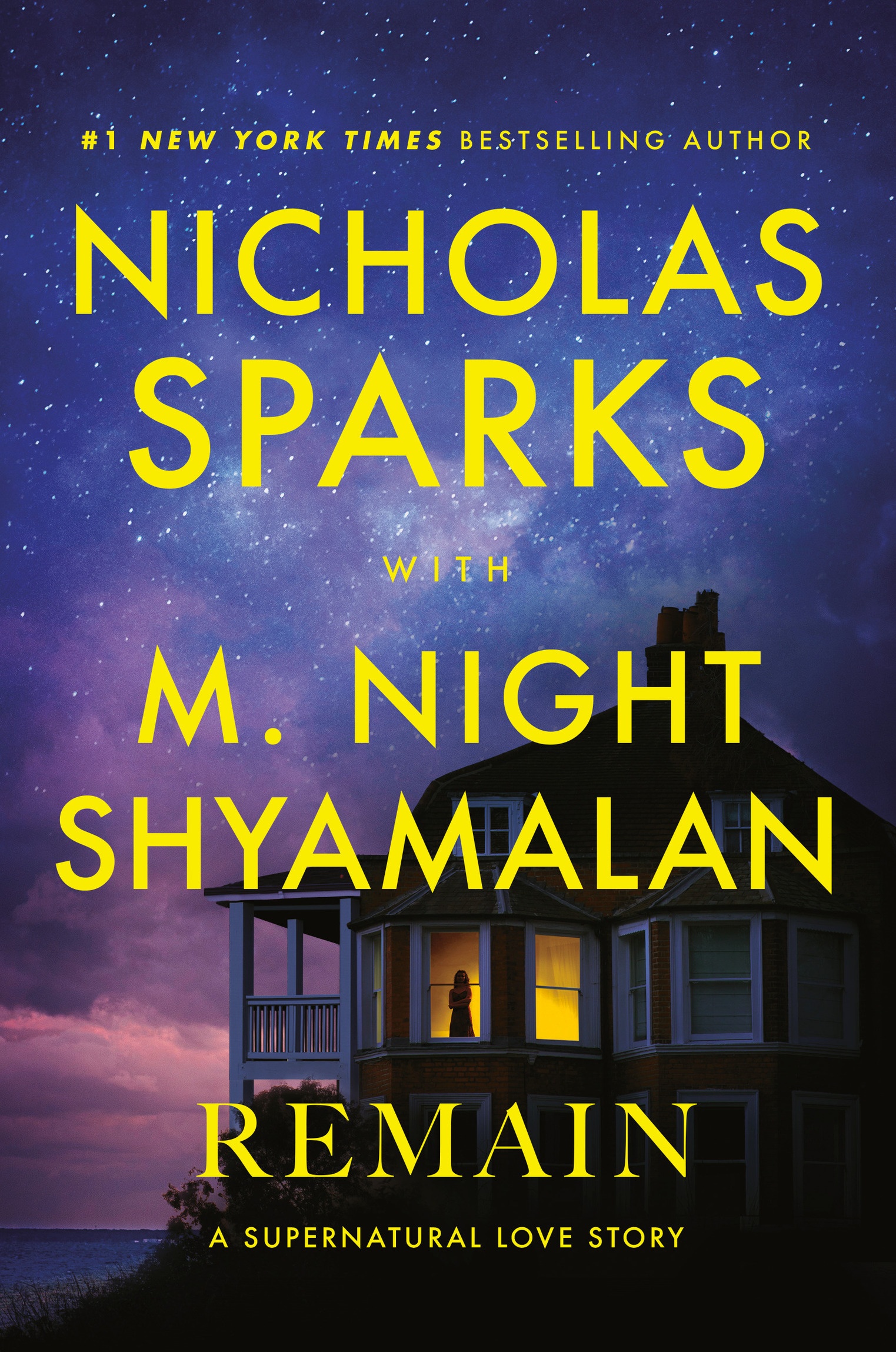
Remain: A Supernatural Love Story
About this book
A major project offers professional purpose after personal loss, but the place attached to it carries a history its plans cannot contain. The woman Tate meets there seems to understand both the building and his grief with an intimacy that resists an ordinary explanation.
Their connection develops alongside signs that time, memory, and physical presence are not operating in the expected way. Love becomes inseparable from the question of what can remain when a person or a life has apparently ended.
Nicholas Sparks supplies the emotional architecture of romance and bereavement, while M. Night Shyamalan’s premise keeps the reality of each encounter unsettled. The supernatural element is a condition of the relationship, not simply a final twist.
Remain is a romantic ghost story about grief, design, and the human need to make absence inhabitable. It asks whether accepting an impossible connection is an escape from loss or another way of moving through it.
Read a sample
5,015 words
Plain text
From the opening
Chapter 1
Cape Cod in May stirs hope in the hearts of previously frozen New Yorkers, its verdant lawns and ocean breezes holding the promise of summer days just around the corner. As I rolled down the window of my car, breathing in the scent of growing things, I marveled at how distant the chilly gray skies and rain-flooded gutters of city life felt. Here, at least, winter had long since retreated and the dream of slower, sun-drenched days felt close enough to touch.
I had visited the Cape a few times before, but never this particular town. A quieter, smaller cousin to the nearby magnet of Provincetown, Heatherington seemed to revel in its classic 1950s vibe. Cruising down its main thoroughfare, Pleasant Street, I took note of the quaint, upscale stores selling antiques, gourmet ice cream, wooden toys, and brick oven pizza, as well as the parents pushing expensive strollers on brick-paved sidewalks. Day-trippers ducked in and out of shops, while beneath a large old-fashioned clock, a pair of older gentlemen in baseball caps conferred on a wooden bench. Idling at an intersection to allow some musicians with guitars strapped to their backs to cross, I spotted a retro-style pharmacy and soda shop on the corner; inside, a group of teenagers sat at a counter, sipping shakes out of long straws.
I smiled, thinking the scene was almost too perfect to be real, but upon reflection it made sense that my best friend, Oscar, the offspring of immigrant parents who’d run a deli in Boston, would seek out a slice of the mythic American ideal. As traffic began to move again, I caught glimpses of neatly kept Colonials and clapboard homes with white picket fences on the side streets to my left and right. Heatherington was picturesque, I had to admit, and as if on cue, the clouds overhead suddenly cleared, giving way to a blue sky so intense that it made me squint.
It was Monday, the typical beginning of a new workweek, and I was in town to help Oscar and his wife, Lorena, design and build their vacation home, although until now I’d only seen photographs of the plot of land they’d bought. I was looking forward to hearing what they had in mind, as today would be our first real conversation about the project. Following the directions they’d given me and keeping an eye on my GPS, I turned off Pleasant Street, heading for the house’s future site, where we planned to meet. On the outskirts of town, I passed a sprawling fairground with performance stages in various states of construction. Dusty pickup trucks filled the gravel parking lot while workers toiled in the distance. It was a hive of activity, frantic preparations under way for the upcoming Mask and Music Festival on Memorial Day weekend at the end of the month. I’d heard about the festival while trying and failing to find a place to stay; in the end, I’d had to enlist Oscar’s help to find accommodations. Apparently forty or fifty bands would be descending on the town for the long weekend, and as many as twenty thousand people were expected to attend. When I asked about the kind of music being showcased, Oscar had merely snorted. “How would I know? It’s probably weird Gen Z music.”
A few minutes later, I turned off the road onto a grassy track that climbed to what I assumed was a bluff overlooking the ocean. I drove slowly, following the tread marks of previous vehicles, my Aston Martin bouncing and shimmying as the grass gave way to dirt. On either side, arching birch and elm and maple trees formed a canopy overhead until I emerged into a clearing at the top.
It was a flat and grassy plateau, ringed with majestic oak trees and a panoramic view of an ocean the color of dark sapphires. Butterflies floated above a small patch of dandelions, and the air was briny, conjuring my own memories of summers at the beach. Over the sound of the engine, I could hear vibrant birdcalls drifting from the trees, and when I looked up, I glimpsed a Cooper’s hawk circling. I marveled that this lot had somehow escaped development.
Soon a substantial wooden structure came into sight: a city-size playset that looked as if it had been dropped from the sky, complete with swings, hanging bars, sandbox, multiple slides, and a fort crowned with a multicolor awning. All five of Oscar’s kids swarmed over the structure while he and Lorena watched from a nearby picnic table. As usual, Oscar was wearing a throwback football jersey from the early 1960s, this one from the Cleveland Browns.
Not long after graduating from NYU, Oscar had secured funding to purchase franchise rights from the NFL, NBA, NHL, and MLB for the purpose of manufacturing and selling apparel. His concept was to put current players’ names and numbers on vintage-style jerseys. He was meticulous about design and quality, making sure each garment felt ultrasoft and appeared appropriately distressed. He was also extremely savvy when it came to promoting and marketing on social media, and while the jerseys were popular from the start, sales exploded when a prominent rapper began wearing them at concerts and trendy influencers began posting regularly about them. Eventually, private equity firms started sniffing around and Oscar sold the company for nearly a billion dollars. It was the ultimate success story. His parents, whom I regarded almost as foster parents of my own, could barely contain their pride and wore matching jerseys whenever they went out, bragging to their many relatives in the U.S. and back in India about their son’s success. Oscar humored his parents, but the money hadn’t fundamentally changed him or Lorena.
Continue reading the sampleClose the sample
I parked next to their matching Cadillac Escalades, which made my car look like a toy, and Oscar approached with his arms opened wide for a hug. Like the rest of his family, he was a hugger, and I’m pretty sure he hugged everyone, including grocery store clerks, the guy who cleaned his pool, even IRS auditors. I’d long given up any WASP-like resistance and embraced him in return. He slapped my back before we separated.
“You made it,” he said, with a wide grin. “What do you think?”
“It’s incredible,” I admitted. “Even better than the photos you sent.”
Oscar looked around with a faint air of wonder. “I still can’t believe I was able to close on this place. I was bidding against one of those hedge fund bros and you know how much they hate to lose.”
He nodded in the direction of the picnic table. “Come on. Lorena has been asking about you nonstop.”
As we started toward her, I tilted my head at the playset. “What’s with that?”
“I had it installed last week. I figure that once we start building, it’ll keep the kids occupied when we visit the site to check on the progress.”
“Remind me how old they all are now?”
“Leo is seven. Lalita and Lakshmi are six. Logesh is five, and Luca just turned four. I know it’s a lot of Ls, but on the plus side, I get to say things like, ‘Get the L out here!’ or ‘Shut the L up!’ or ‘Sit the L down!’ ”
“I’ll bet Lorena loves that.”
“Not so much,” he said with a chuckle. “But the whole their-first-names-should-start-with-L thing was her idea, and they think it’s hilarious.”
By then, Lorena was standing. She shook her dark bangs out of her eyes and hurried over. A gregarious Italian American dynamo, she possessed unyielding strength and stamina that even Oscar couldn’t match. Like him, she was a hugger, and her embrace felt like being enveloped in a down comforter. After pulling back, she continued to hold my hands.
“How are you doing?” she asked, her expressive brown eyes searching my face. “I’ve been so worried about you.”
“I’m better,” I answered with what I hoped was a reassuring smile.
“Did you get my care package?”
Halfway through my recent stay at the hospital, a giant basket had arrived filled with snacks, candy bars, and Jolly Ranchers, and accompanied by a rather large plush toy penguin. For some reason—maybe because I’d once enthused about the documentary March of the Penguins—Lorena believed that I was particularly fond of emperor penguins, and I’d never bothered to correct her.
“I did. Thank you. I hope you don’t mind that I shared those goodies with some of the other patients.”
“Not at all,” she said, finally letting go of my hands and appraising me. “You look good. More…rested than the last time I saw you.”
“I feel more rested,” I agreed. “How are the kids?”
“Wild as ever.” She sighed, waving in the direction of the playset with a rueful smile. “I never should have let Oscar talk me into a fifth. All standards and rules had fallen by the wayside by the time Luca arrived. He gets away with murder.”
She laughed good-naturedly. An economics major whom Oscar had met at NYU, Lorena had helped him build his business until the twins arrived, at which point she stepped back to tend to their growing brood. Their home, like Oscar’s had been, was messy and loud, a constant buzz of energy coursing through the walls and hallways. Yet Lorena took the chaos in stride. Never once had I seen her frazzled or impatient.
“How long will you be able to stay?” I asked her.
“Just until Friday night,” she said. “The kids have recitals and exams next week. But once their break starts, we’ll be here the rest of the summer.”
“Let the L go!” Oscar shouted, and I couldn’t help smiling when Lorena rolled her eyes. “Hold on,” Oscar said to us before marching toward the play area. Leo had Logesh in a headlock but was doing his best to act innocent on the off chance Oscar had been yelling at one of the other kids.
“I don’t know how you two do it,” I said. “It’s always impressive.”
“What? Raising kids?” She feigned innocence. “The nanny helps, but really, it’s just like taking care of Paulie. You put out bowls of food and water in the morning along with a litter box and forget about them the rest of the day.”
I smiled. “Thank you for looking after her while I was in the hospital. Where is she?”
“She’s still in the cat carrier in my SUV,” Lorena said, “the one next to yours. Don’t worry—I left the windows open, but I wasn’t sure how she’d react if I brought her outside. I know she’s an indoor cat.”
“She is,” I confirmed. “Aside from visits to the vet and staying with you, she’s never left my apartment. How was she?”
“It took her a few days to come out of hiding, but after that, she was sweet and happy, except when the little ones were chasing her around the house. She spent a lot of time on the back of the sofa near the window, where they couldn’t reach her. At night, though, after they were in bed, she’d curl up on my lap.”
“Sounds like she took a liking to you.”
“I always thought of myself as a dog person, but she totally changed my mind,” Lorena declared. “I have to ask, though: why did you name her Paulie?”
“What do you mean?”
“She’s a girl, and Paulie is a boy’s name.”
“I loved the movie Rocky when I was a kid.”
“Then why not name her Adrian?”
“Because she looked like a Paulie.”
Lorena laughed. In the meantime, Leo had released Logesh, who continued to rub his neck, while Oscar rejoined us.
“He said he was trying to show Logesh what to do if bullies ever went after him,” Oscar explained.
“And you told him that instead of putting someone in a headlock, he should tell a teacher or come to us, right?” Lorena asked.
“Yeah.” Oscar nodded emphatically. “Of course I did.”
She gave him a skeptical look before clearing her throat. “I know that you and Oscar have some catching up to do, so I’m going to take the kids into town to get something to eat. They’re probably starving by now. What can I bring back for the two of you?”
“A salad with grilled chicken would be great, thanks,” I said. “Or whatever you can manage—I know you’ll have your hands full,” I apologized, nodding in the direction of the playset.
“Can you bring me a double cheeseburger and onion rings?” Oscar chimed in with a hopeful look. “And a chocolate shake?”
Lorena lifted an eyebrow in amusement. “Uh, yeah…That’ll be two salads with grilled chicken coming right up,” she answered.
“But, honey, I’m hungry…”
“Then I’ll bring you an apple, too.” She turned toward the playset. “Kids?” she called out. “Let’s go get some lunch!”
The kids ignored her.
“Time for grub, so get the L in Mom’s car!” Oscar boomed.
With some reluctance, they climbed down from the playset and slowly jogged toward Lorena’s car. The adults followed, and Oscar opened the back hatch to pull out the cat carrier. Taking it from him, I peeked in at Paulie, who stared back with wide, frazzled eyes.
While Oscar and Lorena helped the kids load up—some were still in car seats—I brought the carrier to my car. Putting my fingers inside the cage, I murmured greetings to Paulie, but she was still too nervous, or discombobulated from the drive, to approach me. I let her be, and after rolling down my windows, I retrieved my laptop, as well as a notebook and a pen from my backpack. Lorena waved at us as she backed out of the driveway.
As soon as we sat down at the picnic table, Oscar leaned toward me.
“Okay, now that we finally have some peace and quiet, fill me in on your last couple of weeks at the hospital. I gotta say, the place looked more like a country club or a small college campus than a psychiatric facility.”
“They went well.” I shrugged. “And yes, the amenities were pretty fancy, although it wasn’t just a bunch of spa treatments.”
Though we’d chatted by phone occasionally during my stay, I briefly described the program again; it emphasized DBT, or dialectical behavior therapy. DBT, I explained, focuses on the importance of behaviors as opposed to feelings or emotions, which are transitory.
“Okay.” Oscar nodded. “But was the food really as good as you said?” he persisted.
“Yes,” I assured him. “On the weekends, if the weather was good, we even had barbecues.”
“It sounds like White Lotus with therapy.”
“It’s not a bad place,” I admitted. “But I also got to explore some aspects of my life that I’d spent a lot of time trying to ignore.”
“You mean your Richie Rich childhood and the wacky parents who messed you up?” Oscar cracked.
“Something like that.”
Oscar folded his hands in front of him and studied me, serious once more. “You have to promise to call me if you feel that darkness creeping up on you again, Tate.” He looked away for a moment before solemnly meeting my eyes. “I was scared for you.”
Moved by his words, I nodded, both of us silent at the memory of those harrowing days. But Oscar’s expression soon turned mischievous again. He leaned in, his eyes alight with curiosity.
“Did they ever help you decode those little bombshells your sister dropped right before she died?”
Recalling what she’d told me, I shrugged again. “The doctors speculated that Sylvia was experiencing neurological anomalies as her organs were shutting down.”
“But you believed her?” Oscar pressed.
I hesitated, choosing my words carefully. “Sylvia never lied to me, which means she believed everything she told me. But let’s talk about it when we have more time. After all,” I said, opening my notebook, “we have a house to design.”
Chapter 2
I lost my sister, Sylvia, almost a year ago. After she died, I found myself sliding into a paralyzing depression, one that eventually robbed me of my ability to get out of bed for weeks on end, to answer phone calls or emails, or even to bathe. My sole anchor during that dark period was Paulie; despite neglecting everything else in my life, I managed somehow to keep her alive. When Oscar finally banged on the door of my apartment and convinced me to enter a psychiatric hospital’s treatment program, he promised to watch her during my stay. For that—and so much else—I’ll be forever grateful to him.
I arrived at the hospital during a late January blizzard, snow falling for three straight days, blanketing the landscape in white. As I stared out the window of my room overlooking the grounds, I remember wondering where all the birds went during storms like this, thinking that Sylvia would have known.
Five years older than I and preternaturally attuned to the natural world, Sylvia cherished beauty and life in all forms, perhaps because so much of the latter had been denied her in her youth. Her heart had been damaged by a virus in early childhood, and though she was seen by renowned specialists from around the country, she spent much of her early life confined to our home on Fifth Avenue, educated by tutors. In her spare time, she either escaped into romance or fantasy novels, or stared out her bedroom window, wistfully observing the people below in Central Park. The longing I saw on her face as she tracked the families, lovers, and tourists relaxing on the grass made me ache for her, but she’d nonetheless been able to see the world in a way that felt utterly foreign to me. To her, it was a place of infinite mystery and wonder. I recall, when I was a child, her pointing out the everyday miracles that caught her attention—the dusty pathways left on the window after the rain had dried, for instance, or the symmetrical intricacy of a spider’s web. She explained that if I was willing to really see the world around us, not simply look, then I, too, might experience the transcendent, whatever that meant.
My psychiatrist, Dr. Rollins, often observed that Sylvia would have been proud of me for getting the help I needed, and I have no doubt he was right. It was an expensive place with a top-tier reputation, located in the lush countryside of Connecticut. During the course of my four-month stay, I saw him three times a week, in addition to participating in group therapy and sessions on emotional skills building. While most of the patients were struggling with addiction, a smaller subset, like me, were there for other reasons, and I’d checked in voluntarily with the knowledge that I could leave at any time. These days, I’m relieved to say that I no longer feel as though I’m living in a darkened tunnel, although I sometimes wonder whether I’m really cured.
I’m still me, after all: Tate Donovan, a thirty-eight-year-old architect who lost his only true family with the death of his sister. In the wake of all that happened and many months of physical and mental absence, I finally allowed my partners at one of New York’s premier architectural firms to buy me out. Thus, I found myself for the first time in my adult life entirely at loose ends, alone and uncertain of what kind of future was still possible for me.
If you’d asked my parents, they probably would have expressed little surprise that I ended up this way. Then again, nothing I did ever seemed to please them, and while I may not be alone in feeling that I was neglected or unloved as a child, Dr. Rollins helped me understand that I didn’t need to allow those feelings to define me forever. Still, even he admitted my childhood had been unusual in its circumstances.
My father had been the CEO of a conglomerate that made money in a variety of industries. Mining. Farming. Pharmaceuticals. Oil and gas. Aerospace. Despite the fact that I was still one of the major shareholders, I’d never paid much attention to the business, other than to glance at the monthly statements when they arrived in my inbox. The company had been started by my great-grandfather, expanded by my grandfather, and eventually built into an empire by my father. Real go-getters on that side of the family, at least when it came to creating generational wealth. My mother, on the other hand, was a Romanian beauty who spoke several languages fluently and had appeared on the covers of magazines. She’d been working as a model when my parents met, and I suspected they had children for no other reason than that people of their station were expected to make heirs. But I’m just guessing. I don’t really know.
What I do know is this: We lived in a penthouse on the Upper East Side of New York, but my father was seldom around. He traveled extensively, usually for business but other times—as I eventually learned—to enjoy the company of his various mistresses. My mother started drinking every day after her morning workouts, picked at her salads instead of eating them, and spent many evenings at charitable events. My sister and I were raised by nannies, and the staff included housekeepers, assistants, a chef, even a lady who came in twice a week to wrap gifts. I was driven by chauffeurs, flew on private jets, and like Sylvia, was educated by tutors during my early life, which kept me isolated from other children my age. We spent our summers in an oceanfront mansion in the Hamptons, where every other night my parents hosted cocktail parties, which my sister and I were forbidden to attend. Instead, we would watch movies upstairs or sit on the beach while drunken guests reveled by the pool. On the rare night that the four of us were home together, I had the sense that whenever my parents glanced at Sylvia and me, they were baffled by who we were and where we had come from.
If my parents had one redeeming feature, it was their appreciation for the value of a good education, which explained the endless string of highly paid tutors. After surgery led to an improvement in her health, Sylvia was finally allowed to attend Brearley, an elite all-girls school just blocks from our home. A few years after that, when I was twelve, I was shipped off to Exeter.
My years at boarding school had a profound effect on me. While I missed my sister, dorm life and distance from my parents finally gave me a chance to make friends. Over time, I learned the art of small talk and casual conversation, even if I continued to keep my inner world private. As my confidence grew, I joined the soccer and lacrosse teams, and was a natural enough athlete to pick up the sports I hadn’t played as a younger kid. I excelled in math and developed a knack for drawing. I even had a bit of luck with girls, eventually dating Carly, a pretty girl from Newport, Rhode Island, for much of my senior year. Most significant, I became best friends with a scholarship student named Oscar and spent occasional weekends with his large and lively South Asian immigrant family in Dorchester. They joked and talked over one another, laughing loudly. When I gathered with the nine of them at the table for dinner, watching as they grabbed at the platters of aromatic food while telling colorful stories, I couldn’t help feeling that I’d suddenly landed on another planet. It was Oscar who taught me what it meant to be a friend, and with him, as with my sister, I was able to relax my defenses and simply be myself.
Because I seldom saw my parents—I went home only in summers and on holiday breaks until I graduated from Yale—they remained mostly strangers to me. I do remember that in the tumult of my high school graduation, my father pulled me aside to tell me that he wanted me to follow in his footsteps and major in business at college. Nonplussed, I stared in silence, then pretended to see a friend in the crowd and rushed off. Following my own inclinations and openly defying my parents’ expectations for the first time in my life, I majored in architecture instead. The summer after I received my diploma, I moved into my own apartment in the city and started work as a lowly draftsman at an Upper East Side architectural firm. Eventually, after returning to school a few years later for a master’s degree, I became a partner at that same firm, attracting newly wealthy clients who were intent on building their dream homes.
Sylvia, meanwhile, attended college in the city, graduating from the New School with a degree in environmental science. She was working for a nonprofit and living in the East Village when she met a man named Mike through friends and fell in love. My father insisted on a prenup—Mike taught music at a tony prep school near our home and was as poor as we were rich—but it was clear that Sylvia and Mike truly adored each other. After our parents’ jet nosedived into the Atlantic when I was twenty-nine, Mike held my sister while she wept at the funeral and supported her with patience and understanding through her grief. He was, and remains, a genuinely good guy.
Sylvia took their deaths harder than I did, but then again, she’d never felt alienated from or unloved by them. My sessions with Dr. Rollins helped me accept the idea that they might have been different with her because of her health issues; that the neglect I felt may have been at least partially the result of their anxious focus on Sylvia. Still, in my heart I believe that Sylvia’s innate goodness simply skewed her perceptions. She was kinder than I, more forgiving and inclined to assume the best about people. Unlike me, she believed in God and the mysteries of the unknown, including the existence of ghosts and the afterlife.
I wouldn’t understand just how deep those beliefs ran until much later.
Chapter 3
At the picnic table, I turned to the first page of my notebook.
“You and Lorena have discussed the basics of what you want, right?”
“Somewhat,” Oscar answered. “We’ve always dreamed about having a summer house, and the kids love the beach.”
I cocked my head. “Do you two have a style in mind? Like a traditional Cape Cod? Or something more modern?”
“We were going to wait to see what you might recommend.”
I nodded, unfazed. Many of my previous clients—all of them highly successful in all sorts of ways—had difficulty at the concept stage of the process. The challenge usually lay in their desire to build something recognizably better and different and more attention getting than their equally wealthy neighbors’ houses, but I knew that neither Oscar nor Lorena thought in those terms. They were less interested in building a status symbol than in having a place that would truly feel like a home.
“Do you want to wait until she gets back? Before we start getting into it?”
“Nah. She won’t mind if we go ahead.”
“All right,” I said. “But before we jump in, I wanted to take a minute to thank you.”
“For what?” Oscar looked puzzled.
“For giving me the opportunity to design and oversee the building of this house.”
“Tate—”
I held up my hand. “I know that you threw me this project because you felt like I needed something concrete to get me back on my feet, especially because I left my firm. And I’m in a better place now—thanks in large part to you. I’m excited to start working for myself.” I faced him squarely. “But I want you to know that I’m determined to build you and Lorena the most beautiful house imaginable.”
Oscar smiled. “I know you will.”
After hashing out some basics—among other things, Oscar guessed they’d need twelve bedrooms to accommodate not only the kids but extended family members, in-laws, and friends they intended to host—we walked toward the bluff. The sun had begun to warm the air, making the sea breeze feel almost balmy. The Cooper’s hawk continued to circle, tracking our progress across the property. At the edge, the bluff sloped gently toward the sandy beach below.
“The property stretches halfway down,” Oscar said, pointing. “It’s public land from there to the beach, but as you can see, there’s really no way for the public to access it except by boat. And the view is unbeatable.”
“You’re going to love it here.”
“Is it anything like your place in the Hamptons?” he asked, referring to the house I’d inherited from my parents.
“No,” I answered, “but it’s just as beautiful.”
As I continued to study the rhythm of the waves below, I noticed movement off to the left, near my car, a familiar flickering at the very edge of my peripheral vision.
These flickering “visions,” referred to as peripheral oscillopsia, had begun shortly after my sister died. Neurologists at New York-Presbyterian had checked me, wanting to rule out possible congenital defects, disease, or injury unrelated to my depression. They’d run every test imaginable, no matter how expensive or time-consuming, before concluding there was nothing physically wrong with me. They’d theorized instead, as Dr. Rollins later would, that it was a symptom of stress associated with the loss of my sister and that the incidents would subside over time.
But they hadn’t, and as the oscillopsia continued, I felt a sudden tension in my neck and shoulders. No, I thought, not again. I reminded myself that there was nothing off to the left. And yet…