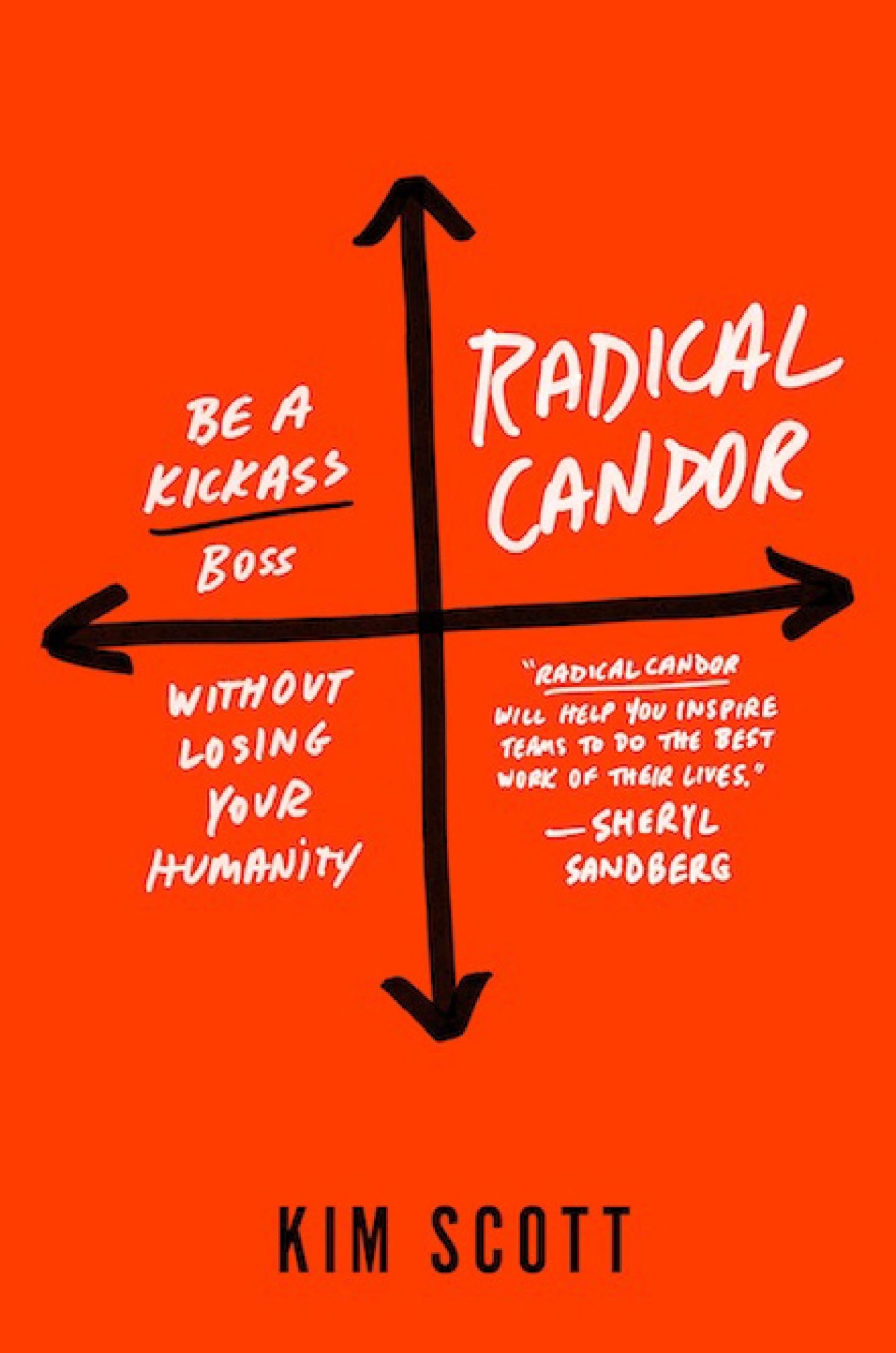
Radical Candor: Be a Kickass Boss Without Losing Your Humanity
About this book
Radical Candor sits at the intersection of ‘care personally’ and ‘challenge directly.’ The other quadrants—ruinous empathy, obnoxious aggression, and manipulative insincerity—describe common ways feedback becomes kind but useless, clear but demeaning, or politically empty.
Scott connects the framework to praise, criticism, one-to-ones, hiring, career conversations, meetings, and team performance. Managers are asked to solicit criticism before giving it, making openness an observable practice rather than a value imposed downward.
The book also distinguishes people on steep growth trajectories from equally valuable people seeking stability or mastery in a role. Leadership requires understanding changing motivations instead of turning one preferred career path into a universal ranking.
Radical Candor offers memorable language for difficult conversations, not permission to deliver every opinion without judgment. Directness is only part of the model; accuracy, context, power, and demonstrated care determine whether feedback helps.
Read a sample
5,050 words
Plain text
From the opening
INTRODUCTION
LIKE MOST OF US, I once had a terrible boss—a person who thought that humiliating people was a good way to motivate them. At one point, a colleague mistakenly copied me on an email chain in which my boss had ridiculed me repeatedly to my peers. When I confronted my boss, he told me not to worry my “pretty little head” about it. Really.
Partially as a result of this experience, I started my own company—Juice Software. My goal was to create an environment where people would love their work and one another. Friends often laughed when I said that, as if I were talking about a commune instead of a company. But I was serious. I spent a lot more than eight hours a day at my job. If I didn’t enjoy my work and my colleagues, the majority of my brief time on this planet would be unhappy.
Unfortunately, while I did succeed in avoiding the mistakes my boss had made—that was easy—I made a very different set of mistakes. In an effort to create a positive, stress-free environment, I sidestepped the difficult but necessary part of being a boss: telling people clearly and directly when their work wasn’t good enough. I failed to create a climate in which people who weren’t getting the job done were told so in time to fix it.
When I look back on that time, my mind immediately goes to a person I’ll call “Bob.” Bob was one of those instantly likeable people who make going to work a pleasure. He was a kind, funny, caring, and supportive colleague. What’s more, he came to me with a stellar résumé and great references. He seemed to be an A-plus hire, and I was thrilled to have him. There was just one problem: his work was terrible. He lost my confidence shortly after we hired him. He’d been working for weeks on a document to explain that Juice allowed people to create Excel spreadsheets that updated automatically. When I reviewed the document he’d been working on so diligently, I was shocked to discover that it was totally incoherent—a kind of word salad. And thinking back to when he handed it over to me, I realized then that Bob also knew his work wasn’t good enough—the shame in his eye and the apology in his smile when he handed it over to me were unmistakable.
LET’S STOP RIGHT here for a second. If you’re a manager, you know already that this was a hinge moment in the relationship between Bob and me, and a significant bellwether of success or failure for my team. Bob’s work wasn’t even close to good enough. We were a small company, struggling to get on our feet, and we had zero bandwidth to redo his work, or to pick up his slack. I knew this at the time. And yet, when I met with him, I couldn’t bring myself to address the problem. I heard myself tell Bob that the work was a good start and that I’d help him finish. He smiled uncertainly and left.
What happened? First, I liked Bob, and I didn’t want to come down too hard on him. He had looked so nervous during the meeting when we reviewed his document that I feared he might even cry. Because everyone liked him so much, I also worried that if he did cry, everyone would think I was an abusive bitch. Second, unless his résumé and references were bogus, he’d done great work in the past. Maybe he’d been distracted by something at home or was unused to our way of doing things. Whatever the reason, I convinced myself that he’d surely return to the performance level that had gotten him the job. Third, I could fix the document myself for now, and that would be faster than teaching him how to re-write it.
Let’s first deal with how this affected Bob. Remember, he knew his work wasn’t good, and so my false praise just messed with his mind. It allowed him to deceive himself into thinking that he could continue along the same course. Which he did. By failing to confront the problem, I’d removed the incentive for him to try harder and lulled him into thinking he’d be fine.
It’s brutally hard to tell people when they are screwing up. You don’t want to hurt anyone’s feelings; that’s because you’re not a sadist. You don’t want that person or the rest of the team to think you’re a jerk. Plus, you’ve been told since you learned to talk, “If you don’t have anything nice to say, don’t say anything at all.” Now all of a sudden it’s your job to say it. You’ve got to undo a lifetime of training. Management is hard.
To make matters worse, I kept making the same mistake over and over for ten months. As you probably know, for every piece of subpar work you accept, for every missed deadline you let slip, you begin to feel resentment and then anger. You no longer just think the work is bad: you think the person is bad. This makes it harder to have an even-keeled conversation. You start to avoid talking to the person at all.
And of course, the impact of my behavior with Bob didn’t stop with him: others on the team wondered why I accepted such poor work. Following my lead, they too tried to cover for him. They would fix mistakes he’d made and do or redo his work, usually when they should have been sleeping. Covering for people is sometimes necessary for a short period of time—say, if somebody is going through a crisis. But when it goes on too long it starts to take a toll. People whose work had been exceptional started to get sloppy. We missed key deadlines. Knowing why Bob’s colleagues were late, I didn’t give them too hard a time. Then they began to wonder if I knew the difference between great and mediocre; perhaps I didn’t even take the missed deadlines seriously. As is often the case when people are not sure if the quality of what they are doing is appreciated, the results began to suffer, and so did morale.
As I faced the prospect of losing my team, I realized I couldn’t put it off any longer. I invited Bob to have coffee with me. He expected to have a nice chat, but instead, after a few false starts, I fired him. Now we were both huddled miserably over our muffins and lattes. After an excruciating silence, Bob pushed his chair back, metal screeching on marble, and looked me straight in the eye. “Why didn’t you tell me?”
As that question was rolling around in my mind with no good answer, he asked me a second question: “Why didn’t anyone tell me? I thought you all cared about me!”
It was the low point of my career. I had made a series of mistakes, and Bob was taking the fall. Not only was my earlier praise a head-fake—I’d never given Bob any criticism. I’d also never asked him to give me feedback, which might have allowed him to talk things through and perhaps find a solution. Worst of all, I’d failed to create a culture in which Bob’s peers would naturally warn him when he was going off the rails. The team’s cohesion was cracking, and it showed in our results. Lack of praise and criticism had absolutely disastrous effects on the team and on our outcomes.
You can draw a straight line from lack of guidance to a dysfunctional team that gets poor results. It wasn’t just too late for Bob. It was too late for the whole company; Juice failed not too long after I fired Bob.
Continue reading the sampleClose the sample
GOOGLE: FREE AT WORK
IT WAS 2004, and I needed a job, so I called a classmate from business school, Sheryl Sandberg. She’d joined Google three years earlier, and I’d recently sat next to her at a mutual friend’s wedding. What had struck me was that, though Sheryl clearly cared about the people who worked on her team at Google, I had a feeling she would not make the same mistake I’d made with Bob. Later, I’d learn just how true that was.
After running a gauntlet of twenty-seven interviews, I got an offer to work for Sheryl to lead a team of one hundred people responsible for sales and service of small- and medium-sized groups of AdSense1 customers. I didn’t even know what AdSense was. What I did know was that Google’s culture struck me as the resurrection of my dream about creating an environment where people loved their work and one another, and that Sheryl struck me as a great boss. As a friend of mine later joked, “In Silicon Valley, you don’t fall down; you fall up.” (Rest assured, Bob has also landed on his feet.)
SHORTLY AFTER I joined Google, I witnessed an impressive display of productive but extremely direct feedback. I was at a meeting with Larry Page, Google’s cofounder, and Matt Cutts, who led the team that fought Webspam.2 We were discussing a proposal that Matt and I had. Larry had a different, more subtle plan, which I didn’t understand. But it was clear that Matt did understand Larry’s plan and didn’t like it one bit. Matt—generally a very pleasant, easygoing guy—disagreed, heatedly. When Larry wouldn’t back down, Matt started yelling at Larry. He said Larry’s idea would flood him with “so much crap” he’d never keep up.
I felt unnerved by Matt’s reaction. I liked him, and I was afraid he’d get fired for criticizing Larry’s position so vehemently. Then I saw the big grin on Larry’s face. Not only did he permit Matt’s challenging him—he seemed to relish it. I could see from the open, happy way he responded to the argument that he wanted not just Matt but everyone at Google to feel comfortable criticizing authority—especially his. It didn’t make any sense to label this conversation “nice” or “mean,” “rude” or “polite.” It was productive and collaborative. It was free. It was driving to the best answer. How had Larry achieved that?
I decided to try to take a page out of Larry’s book. Rather than focus on “giving feedback” to my team, I encouraged them to tell me when I was wrong. I did everything I could to encourage people to criticize me, or at least simply to talk to me. After a false start (more on that later) the team started to open up. We began to debate openly, and we had more fun together. I was lucky enough to hire some remarkable people, including Russ Laraway, with whom I’ve cofounded a new company, Candor, Inc., and Jared Smith, cofounder of Qualtrics, whose board I sit on now. I learned just as much from the people who worked for me as from the people whom I worked for about how to be a good boss. We experimented with not making any decisions in my staff meeting, instead pushing them out to the people closest to the facts. We started executing more efficiently. Wanting to make it safe to “speak truth to power” at all levels of the organization, we experimented with “manager fix-it weeks” and carefully designed “manager feedback sessions.”
I’ll explain all these techniques and more in the second half of this book, but the important thing to know for now is that at Google managers couldn’t just rely on “power” or “authority” to get things done. They had to figure out a different, better way.
After six years at Google, I felt confident I’d done just that: I’d learned a better way to be a boss. I didn’t repeat my mistake with Bob, but I didn’t become an asshole either. The businesses I led had grown revenue by more than ten times, to several billion dollars. A lot of that growth was product-driven, not sales-driven. But we certainly contributed. We were obsessive about efficiency, and we managed to shrink headcount in North America even as revenue grew dizzyingly—the definition of scaling. Over time, in addition to AdSense, my team included the global YouTube and DoubleClick online sales and operations teams. We started out with one team in North America, and the team’s quirky, fun-loving culture was strong enough to be a unifying force between Dublin, São Paulo, Buenos Aires, New York, Mountain View, Sydney, Seoul, Tokyo, Beijing, and Singapore.
Increasingly, though, I found myself caring less and less about the core business metrics (cost per click, revenue, etc.). What really interested me was figuring out how to define and teach others this “better way” to be a boss that I’d developed. It was still more of an instinct than a philosophy, though. I needed time to think, so I could articulate it.
APPLE: “WE HIRE PEOPLE WHO TELL US WHAT TO DO, NOT THE OTHER WAY AROUND”
THERE WAS NO job at Google that would allow me to sit back and just think, and an operating role doesn’t leave much time for quiet contemplation. Fortunately, nine miles to the southwest, Steve Jobs had started Apple University. My business school professor, Richard Tedlow, had just left Harvard to join Job’s new factory of good leadership. He described Apple U’s mandate like this: “We want to defy the gravitational pull of organizational mediocrity.” An important part of achieving that goal was to develop a class: Managing at Apple. When I was offered the job to design and teach that class, I jumped at the chance.
Managing at Apple was for first-time managers, but executives found it equally useful for the senior leaders on their teams. Though the class was not required, our biggest problem was keeping up with demand. In the time I worked at Apple, we taught thousands of people, to great reviews. Many more have taken the class since I left.
I learned as much as I taught. A conversation I had with one of Apple’s leaders helped me see a critical flaw in my approach to building teams earlier in my career. I’d always focused on the people most likely to be promoted. I assumed that was how it had to be at a growth company. Then a leader at Apple pointed out to me that all teams need stability as well as growth to function properly; nothing works well if everyone is gunning for the next promotion. She called the people on her team who got exceptional results but who were on a more gradual growth trajectory “rock stars” because they were like the Rock of Gibraltar on her team. These people loved their work and were world-class at it, but they didn’t want her job or to be Steve Jobs. They were happy where they were. The people who were on a steeper growth trajectory—the ones who’d go crazy if they were still doing the same job in a year—she called “superstars.” They were the source of growth on any team. She was explicit about needing a balance of both.
This was a revelation. Apple was growing fast, and bigger than Google. And yet Apple made room for people with all sorts of different ambitions. You had to be great at what you did and you had to love your work, but you did not have to be promotion-obsessed to have a fulfilling career at Apple. At Google, I’d systematically undervalued the so-called rock stars. This mistake had caused a lot of unhappiness for people who contributed significantly. Google’s bias for people on a steep growth trajectory was in part a reaction against the norm at traditional companies, which tend to clip the wings of people who want to “change everything.” Apple made room for all different types of ambition, and that was part of how it got big while defying “the gravitational pull of organizational mediocrity.”
GOOGLE IS FAMOUSLY viewed as a bottom-up company, one that empowers even very young employees to drive decision-making. The managers’ role is mostly to stay out of the way, sometimes to help, but never to interfere too much. I expected the opposite at Apple, having bought in to the narrative of the all-controlling Steve Jobs passing down his brilliant vision from on high, brooking no dissent, and driving his team to make it happen. But it wasn’t so.
A colleague shared an anecdote about interviewing with Steve that illustrated why this was the case. My colleague asked Jobs several perfectly reasonable questions: “How do you envision building the team? How big will the team be?” Steve’s curt response: “Well, if I knew the answer to all those questions, then I wouldn’t need you, would I?” Borderline rude, but also empowering. Jobs articulated this approach more gently in an interview with Terry Gross: “At Apple we hire people to tell us what to do, not the other way around.” And indeed, this was my experience at the company.
At Apple, as at Google, a boss’s ability to achieve results had a lot more to do with listening and seeking to understand than it did with telling people what to do; more to do with debating than directing; more to do with pushing people to decide than with being the decider; more to do with persuading than with giving orders; more to do with learning than with knowing.
YOUR RELATIONSHIPS ARE CORE TO YOUR JOB
THERE’S A WORLD of difference between autonomy and neglect, though … I learned what it felt like to get that wrong in my experience with Bob. Here’s what I learned about how to get that right.
In Managing at Apple, we often played a video of Steve explaining his approach to giving criticism. He captured something very important: “You need to do that in a way that does not call into question your confidence in their abilities but leaves not too much room for interpretation … and that’s a hard thing to do.” He went on to say, “I don’t mind being wrong. And I’ll admit that I’m wrong a lot. It doesn’t really matter to me too much. What matters to me is that we do the right thing.”3 Amen! Who could argue with that?
But if you rewound that tape just a bit, you’d find the question that had prompted Steve’s reply. Someone had asked him why he frequently used the phrase “Your work is shit.” At face value, these words are, to say the least, unlikely to build trust or make your team feel empowered to take risks. It feels like bullying, and in some cases it might have been. I certainly couldn’t recommend that anyone say that to people. Initially, I got around this in a flip way. “Remember,” I said, “You are not Steve Jobs.”
This always got a chuckle, but it actually dodged an important issue. I thought back to that argument between Matt Cutts and Larry Page. For some reason, they could yell at each other and it was OK. Why? I certainly would never say, “Your work is shit,” or yell at my colleagues.
Or would I? I recalled a time at Google when we were rolling out AdSense internationally. Jared Smith, who’d worked with me at Juice and was also on my team at Google kept confusing Slovakia and Slovenia and acting as if the distinction didn’t matter. After the fifth time he’d confused the two in a thirty-minute meeting, I snapped, “It’s Slovakia, dumbass!!”
Jared and I had worked together long enough that he (and everyone else in the room) knew how deeply I respected him. He could, and occasionally did, rebuke me in the same affectionately rude way. My sharp correction was simply a short, effective way to get him to focus. He didn’t make the mistake again. The only reason it was OK for me to talk to Jared that way was because of the relationship we’d formed over the years.
My point is not that you need to cuss or shout or be rude to be a great boss. In fact, I wouldn’t recommend it, because even if your relationship evolves to the point where you think mutual respect is understood, as boss you sometimes just misread signals. The point is, rather, that if you are someone who is most comfortable communicating in that way, you have to build relationships of trust that can support it, and you have to hire people who can adapt to your style.
SILICON VALLEY WAS an ideal setting in which to explore the relationships between bosses and the people who report directly to them. Twenty years ago, management skills were neither taught nor rewarded in Silicon Valley, but today its companies are obsessed with it. This isn’t for the reasons you might think—that they are run by new-age gurus ever in search of a theory, or because the people there are fundamentally different from people anywhere else. Nor is it because the companies there have huge budgets for training, or have some fundamental insight into human nature unleashed by access to all that big data.
No, the reason why Silicon Valley turned out to be a good place to study the relationships between bosses and the people who report to them is that the war for “talent” there is intense. So many great companies in the Valley are growing and hiring that there’s no reason to stay with a company if you are unhappy or think your potential is being wasted. And there’s certainly no reason to pay the “asshole tax.” If you don’t like your boss, you quit, knowing that ten other companies will be lining up to hire you. So the pressure on companies to get these relationships right is enormous.
Even in Silicon Valley, relationships don’t scale. Larry Page can’t have a real relationship with more than a handful of people any more than you can. But the relationships you have with the handful of people who report directly to you will have an enormous impact on the results your team achieves. If you lead a big organization, you can’t have a relationship with everybody. But the relationships you have with your direct reports will impact the relationships they have with their direct reports. The ripple effect will go a long way toward creating—or destroying—a positive culture. Relationships may not scale, but culture does.
Is “relationship” really the right word? Yes. The relationship between Eric Schmidt, Google’s CEO from 2001–2011, and Larry Page was one of business history’s more interesting dances. And the willingness of Tim Cook, then COO and now CEO of Apple, to give part of his liver to Steve Jobs, and Jobs’s refusal to accept the sacrifice, exemplifies a profoundly personal relationship.
What is the proper nature of this relationship? Managerial capitalism is a relatively new phenomenon, so this human bond was not described by ancient philosophers. Even though almost everybody today has a boss at some point, the nature of this connection has gotten short shrift in philosophy, literature, movies, and all the other ways we explore the relationships that govern our lives. I want to fix that, because at the very heart of being a good boss—at Apple, at Google, or anywhere else on earth—is a good relationship.
The term I found that best describes this relationship is Radical Candor.
HOW TO USE THIS BOOK
I’VE WRITTEN THIS BOOK WITH the end user—you—in mind. What I have learned not only from my own experiences but also from coaching leaders is that, no matter how supportive the environment, bosses often feel alone. They feel ashamed that they’re not doing a good job, sure that everyone else is doing better, and thus unable or afraid to seek help. But of course no boss is perfect. What drives my mission to share the concepts and methods presented here is the desire to help you avoid making the mistakes I made. That is why I tell so many personal stories.
Part I is designed to set your mind at ease. Being a good boss is hard for everyone, no matter how successful they appear on the outside. You’ll find some part of your own experience borne out in the real-life stories described here. I hope you’ll also feel the optimism that comes from knowing that 1) you are not alone and 2) a better approach may be less difficult than you fear. Your humanity is an asset to your effectiveness, not a liability.
Part II is the how-to handbook: a step-by-step approach for building Radically Candid relationships with your direct reports, and how Radical Candor can help you fulfill your key responsibility as a boss: to guide your team to achieve results.
As you read on, you might occasionally feel overwhelmed by the number of things I’m suggesting you do as a manager. Take a deep breath. My goal is to save you time, not to litter your calendar with meetings. You do need to spend time with your direct reports to be a great boss, but you don’t need to spend ALL your time with them. If you implement every single idea, tool, and technique in this book, the time you dedicate to managing your team will come to approximately ten hours a week, and those ten hours should save you enormous lost time and headaches later. I’ll also suggest you block out about fifteen hours a week for you to think and execute independently in your area of expertise. That leaves another fifteen hours in a forty-hour work week. Hopefully you can claim them as your own, though if you’re like me you’ll have to use most of them to deal with the unpredictable.
While this book was written very much with you, the boss, in mind, I also want to acknowledge your boss, as well as the Human Resources and Learning and Development people who support you. When I led a team of seven hundred people at Google, I saw that managers typically make the same mistakes over and over again. Despite the predictability, successful intervention proved dishearteningly elusive. Some days I felt like I was watching a slow-motion train wreck I’d seen dozens of times before. It was the worst sort of déjà vu. I’ve recognized the same feeling in the expressions of the HR and L&D people who advised me as I wrote this book. I hope it will help you prevent the endless repetition of predictable mistakes.
Radical Candor is also directly relevant to people struggling with issues of diversity and leadership. Gender, racial, and cultural differences do make having Radically Candid relationships harder. It’s scary to be Radically Candid with those who look like us. It’s scarier when people look different, speak a different language, or practice a different religion. We are all more likely to be “ruinously empathetic” or “obnoxiously aggressive” or “manipulatively insincere” toward people who are different from us. Learning how to push ourselves and others past this discomfort, to relate to our shared humanity, can make a huge difference.
PART I
A NEW MANAGEMENT PHILOSOPHY
1.
BUILD RADICALLY CANDID RELATIONSHIPS
Bringing your whole self to work
IT’S CALLED MANAGEMENT, AND IT’S YOUR JOB
I USUALLY FELT a little surge of pleasure as I stepped off the elevator into the cavernous former warehouse in the East Village we’d rented as the office of Juice Software, the start-up I’d cofounded in 2000. That day, I just felt stressed.
The engineers had worked nights and weekends on an early “beta” version of our product, which would be ready in a week. The sales team had gotten thirty big-name customers lined up for beta testing. If those customers were using our product, we’d be able to raise another round of funding. If not, we’d run out of money in six months.
There was one blocker: me. The night before, one of our angel investors, Dave Roux, had told me he thought our pricing was all wrong. “Think about the last time you bought a used car—one that cost less than $10,000. Now, think about the guy who sold it to you. That’s who your salespeople will be. That’s who’ll represent you in the market.” I knew in my gut Dave was right, but I couldn’t go to my sales team or my board and change everything just based on a gut feeling. I needed to sit down and do some analysis—fast. I’d cleared my calendar of meetings for the morning so I could do just that.
I’d gotten only a few steps into the office when a colleague suddenly ran up. He needed to talk right away. He had just learned that he might need a kidney transplant, and he was completely freaked out. After an hour and two cups of tea, he seemed calmer.
I walked toward my desk, past an engineer whose child was in the ICU. Must check in. “How’d your son do last night?” I asked. He hadn’t improved—and as he told me how the night had gone we both had tears in our eyes. I convinced him to leave the office and go and take care of himself for an hour before returning to the hospital.
I left his desk drained, passing by our quality assurance manager. His child had better news: she’d just received the highest score in the entire state on a standardized math test. He wanted to talk about it. I felt emotional whiplash as I jumped from sympathy to celebration.
By the time I got back to my desk, I had no time or emotional reserves to think about pricing. I cared about each of these people, but I also felt worn out—frustrated that I couldn’t get any “real” work done. Later that day, I called my CEO coach, Leslie Koch, to complain.
“Is my job to build a great company,” I asked, “or am I really just some sort of emotional babysitter?”
Leslie, a fiercely opinionated ex-Microsoft executive, could barely contain herself. “This is not babysitting,” she said. “It’s called management, and it is your job!”
Every time I feel I have something more “important” to do than listen to people, I remember Leslie’s words: “It is your job!” I’ve used Leslie’s line on dozens of new managers who’ve come to me after a few weeks in their new role, moaning that they feel like “babysitters” or “shrinks.”