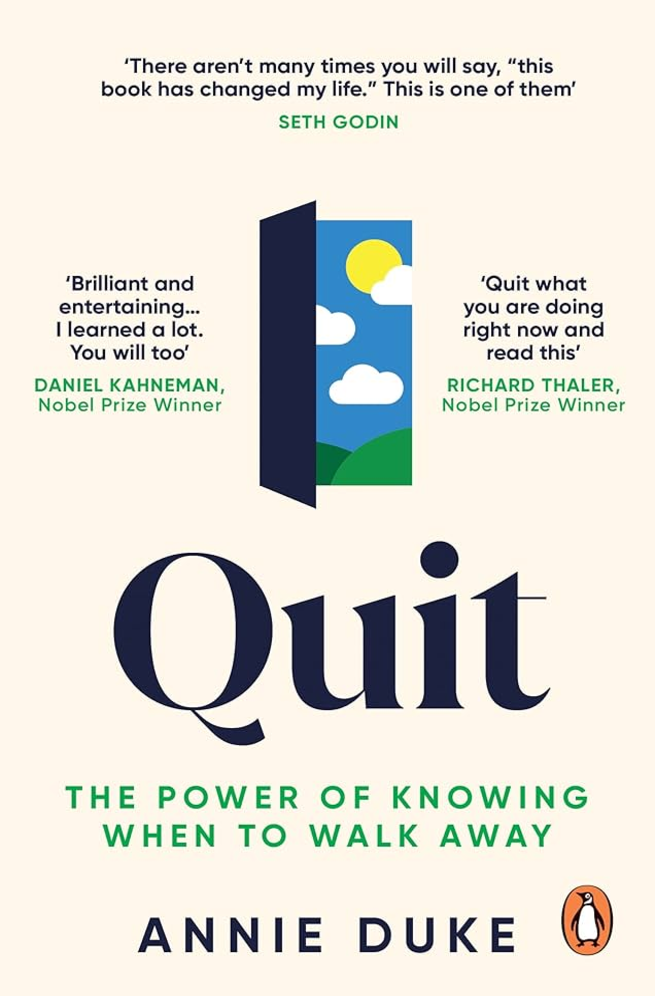
Quit: The Power of Knowing When to Walk Away
About this book
People abandon losing projects too late because effort, identity, public promises, and the hope of recovery all increase after costs have already been paid. Goals can become traps when only completion counts as success.
Annie Duke draws from business, sport, climbing, entertainment, and public policy to identify kill criteria, quitting contracts, and other ways to make exit conditions before pressure is highest.
The key distinction is between uncertainty before an attempt and new information during it. Stopping can be rational even when starting was rational, because a decision is not obliged to preserve the assumptions that produced it.
Quit is a companion in spirit to Thinking in Bets but stands alone. It offers a framework for deciding when persistence still purchases useful possibility and when it only increases exposure.
Read a sample
5,000 words
Plain text
From the opening
PROLOGUE
The Gaffed Scale
In October 1974, boxer Muhammad Ali pulled off one of the greatest upsets in the history of sports when he knocked out George Foreman in the famous “Rumble in the Jungle.” With that victory, Ali regained the heavyweight boxing championship, a title he had first earned when he dethroned Sonny Liston a decade earlier in 1964.
Ali faced unbelievable odds and adversity on the way to this momentous triumph. In 1967, he was stripped of his heavyweight title after refusing to serve in the Vietnam War, depriving him of the opportunity to fight for three and a half years during what should have been the prime of his career. After that layoff, he had to fight his way back into contention for another four years to get the title shot against George Foreman. By this time, Ali was nearly thirty-three and had fought as a professional forty-six times.
Foreman was heavily favored: younger, bigger, stronger, undefeated, and considered indestructible. Ali had split a pair of fights that went the distance against both Joe Frazier and Ken Norton. Neither Frazier nor Norton lasted two rounds against Foreman.
When Ali bested Foreman, he cemented his status as the Greatest of All Time.
Muhammad Ali became a symbol of grit. Against all odds, among a sea of naysayers, he had refused to give up and triumphed. Is there any greater testament to the power of persistence and perseverance when it comes to pursuing your dreams?
But the story doesn’t end there.
That same grittiness led Ali to fight for seven more years. From 1975 to December 1981, Ali persisted despite repeated, unambiguous signals that he should quit. In 1977, after friends and reporters noticed signs of his physical and mental deterioration, Teddy Brenner, the matchmaker at Madison Square Garden (which had hosted eight Ali fights) begged him to retire.
Ali waffled.
Brenner followed with the announcement that Madison Square Garden would never host another of his fights. “I don’t want him to come over to me some day and say, ‘What’s your name?’ The trick in boxing is to get out at the right time, and the fifteenth round last night [against Earnie Shavers] was the right time for Ali.”
A week later, Ali’s fight doctor, Ferdie Pacheco, also tried to get him to retire after receiving a post-fight lab report about the condition of Ali’s kidneys. After getting no response, Pacheco was the one who quit.
In 1978, Ali lost his title to Leon Spinks, who had boxed as a professional only seven times. In 1980, he barely and only under suspicious circumstances obtained medical clearance in Nevada to fight Larry Holmes, the current champion. Ali suffered such a physical beating in that loss that Holmes cried after the match.
Sylvester Stallone, who was in the audience that night, described the last round as “like watching an autopsy on a man who’s still alive.” Yet, Ali still wouldn’t give up. Giving up wasn’t how he had knocked out George Foreman. Giving up wasn’t how he became the Greatest.
By 1981, Muhammad Ali couldn’t get licensed to fight in America, usually a formality, with race-to-the-bottom standards between state commissions to get any marketable fight. If the world was ever screaming, “Time to hang up your gloves!,” that was it. But he went ahead and fought in the Bahamas anyway.
He lost again, in an embarrassing spectacle even by boxing standards. The promotion was such a mess that they couldn’t find a key to the venue. They provided only two sets of gloves for the entire undercard so there were additional lengthy delays to unlace the fighters’ gloves so they could be reused. They had to borrow a cowbell to signal the start and end of each round.
Muhammad Ali obviously paid a heavy price for continuing to fight until he was nearly forty. He had already shown signs of neurological damage toward the end of his career. All those punches he absorbed after vanquishing Foreman unquestionably contributed to the 1984 diagnosis of Parkinson’s disease, and his physical and mental decline thereafter.
Persistence is not always the best decision, certainly not absent context. And context changes.
The same grit that helped Ali become such a great champion—admired and revered almost without equal—became his undoing when it drove him to ignore signs that were obvious to anyone on the outside looking in that he should quit.
That’s the funny thing about grit. While grit can get you to stick to hard things that are worthwhile, grit can also get you to stick to hard things that are no longer worthwhile.
The trick is in figuring out the difference.
Grit vs. Quit
We view grit and quit as opposing forces. After all, you either persevere or you abandon course. You can’t do both at the same time, and in the battle between the two, quitting has clearly lost.
While grit is a virtue, quitting is a vice.
The advice of legendarily successful people is often boiled down to the same message: Stick to things and you will succeed. As Thomas Edison said, “Our greatest weakness lies in giving up. The most certain way to succeed is always to try just one more time.” Soccer legend Abby Wambach echoed this sentiment over a century later when she said, “You must not only have competitiveness but ability, regardless of the circumstance you face, to never quit.”
Continue reading the sampleClose the sample
Similar inspirational advice is attributed to other great sports champions and coaches, such as Babe Ruth, Vince Lombardi, Bear Bryant, Jack Nicklaus, Mike Ditka, Walter Payton, Joe Montana, and Billie Jean King. You can also find almost identical quotes from other legendary business successes through the ages, from Conrad Hilton to Ted Turner to Richard Branson.
All these famous people, and countless others, have united behind variations of the expression “Quitters never win, and winners never quit.”
It is rare to find any popular quote in favor of quitting except one attributed to W. C. Fields: “If at first you don’t succeed, try, try again. Then quit. There’s no use being a damn fool about it.”
Fields was hardly a role model, creating a public persona out of characters who loved drinking, hated children and dogs, and eked out an existence on the fringes of society. That’s not much of a counterbalance . . . and Fields didn’t actually say it!
By definition, anybody who has succeeded at something has stuck with it. That’s a statement of fact, always true in hindsight. But that doesn’t mean that the inverse is true, that if you stick to something, you will succeed at it.
Prospectively, it’s neither true nor good advice. In fact, sometimes it’s downright destructive.
If you are a bad singer, it doesn’t matter how long you stick with it. You’re not going to be Adele. If you are fifty years old and set your sights on becoming an Olympic gymnast, no amount of grit or effort will make it possible for you to succeed. Thinking otherwise is as absurd as reading one of those articles about the habits of billionaires, finding out that they wake up before 4 a.m., and figuring that if you get up before 4 a.m. you will become a billionaire.
We ought not confuse hindsight with foresight, which is what these aphorisms do.
People stick to things all the time that they don’t succeed at, sometimes based on the belief that if they stick with it long enough, that will lead to success. Sometimes they stick with it because winners never quit. Either way, a lot of people are banging their heads against the wall, unhappy because they think there is something wrong with them rather than something wrong with the advice.
Success does not lie in sticking to things. It lies in picking the right thing to stick to and quitting the rest.
When the world tells you to quit, it is, of course, possible you might see something the world doesn’t see, causing you to rightly persist even when others would abandon the cause. But when the world is screaming at the top of its lungs to quit and you refuse to listen, grit can become folly.
Too often, we refuse to listen.
This may be, in part, because quitting has a nearly universal negative connotation. If someone calls you a quitter, would you ever consider it a compliment? The answer is obvious.
Quitting means failing, capitulating, losing. Quitting shows a lack of character. Quitters are losers (except, of course, when it involves giving up something obviously bad like smoking, alcohol, drugs, or an abusive relationship).
The English language itself favors grit, describing those who persevere with positive terms like can-do, unwavering, steadfast, resolute, daring, audacious, undaunting, gutsy, and hardy. Or as having backbone, pluck, mettle, tenacity, or stick-to-itiveness.
As readily as positive words to describe perseverance come to mind, so do the negative terms for those who quit, all of which encompass the idea that quitters are failures who don’t deserve our admiration. They are backtrackers, chickens, defeatists, deserters, dropouts, shirkers, wimps, and wusses. They give up and abandon things, waver and vacillate.
We consider them aimless, capricious, craven, erratic, fickle, weak-willed, undependable, unreliable, and even untrustworthy. Or we call them the politically toxic flip-floppers.
It’s not as if there aren’t any negative words for grit (like rigid or obstinate), or positive words for quitting (like agile or flexible). But if you tried filling a two-by-two table with positive and negative terms for both concepts, you would soon see the imbalances.
On the perseverance side, the imbalance would be toward positive ways to talk about grittiness over negative ones. That would be mirrored by an imbalance in favor of negative ways to talk about quitters. Unlike grittiness, there just aren’t that many positive words for quittiness, as evidenced by the absence of quittiness itself from the dictionary.
One of the biggest clues to the way that the language favors grit over quitting is that one of the synonyms for grittiness is heroism. Others include bravery, courage, and fearlessness.
When we think of perseverance, particularly in the face of danger, we picture the hero, who gets to the edge of death, faces down the abyss, and perseveres when other people would give up.
Meanwhile, people who quit are cowards.
In a world where perseverance is almost universally seen as the road to honor and success, grit is the star. Quitting, meanwhile, is either the villain (an obstacle to overcome) or, more often, a bit player (credited only as “Henchman #3” or “Cowardly Soldier”).
Wrapped in Euphemism
In February 2019, Lindsey Vonn, one of the world’s most famous athletes, announced on Instagram that she was retiring from ski racing: “My body is broken beyond repair and it isn’t letting me have the final season I dreamed of. My body is screaming at me to STOP and it’s time for me to listen.”
After detailing her most recent series of injuries, surgery, and rehabilitation (much of which she had not previously disclosed), she added the following message: “I always say, ‘Never give up!’ So to all the kids out there, to my fans who have sent me messages of encouragement to keep going . . . I need to tell you that I’m not giving up! I’m just starting a new chapter.”
In the first part of Vonn’s statement, she very clearly, in all caps, says she is stopping competitive skiing. (Translation: She’s quitting.) But then, in the second part of the statement, she gives a full-throated denial of the very quitting that she just announced, instead wrapping it in the euphemism “starting a new chapter.”
If anybody has earned the right to proudly quit without their mettle or stick-to-itiveness questioned, it’s Lindsey Vonn. Stories of her comebacks from serious crashes are almost as impressive as her unrivaled record of success. After being airlifted to a hospital from a horrible crash at the 2006 Olympics, she tried to sneak out before being cleared by doctors and competed two days later.
In 2013, after suffering a torn ACL and MCL and another fracture, having surgery, and working through a grueling rehabilitation, she reinjured both reconstructed ligaments and went through the same process again. She missed the Sochi Olympics and most of 2014 yet returned to win another twenty-three World Cup races between late 2014 and early 2018.
If Lindsey Vonn finds it so hard to just say that she’s quitting, imagine what it’s like for us mere mortals to do so. The idea of quitting is such a bitter pill to swallow that we have to take it with a spoonful of sugar. Or, in this case, a spoonful of euphemism, the most famous of which is “pivot.”
If you search any major bookselling website, you will see that titles with pivot in them are awfully popular. Many books are simply titled Pivot (plus one titled Pivot!). There is also The Big Pivot, The Great Pivot, Pivot with Purpose, Pivot to Win, and Pivot for Success, among countless others.
I’m certainly not knocking these books. But whether you say “pivot” or “moving on to the next chapter” or “strategic redeployment,” all of these things are, by definition, quitting. After all, stripped of its negative connotation, quitting is merely the choice to stop something that you have started.
We ought to stop thinking that we need to wrap the idea of quitting in bubble wrap and serve it soft. After all, there are lots of circumstances in which quitting is the right choice, particularly when the world tells you that you ought to, and your kidneys are failing, or you’re facing another set of career-ending injuries. Or you’re in a miserable marriage, or a dead-end job, or a major you hate.
Why is the word given the Voldemort treatment (The-Word-Which-Must-Not-Be Named)?
Back in the days when people bought their meat at a local butcher’s shop, every comic had a gag about getting cheated by the butcher’s scale. One of Borscht Belt comedian Milton Berle’s famous bits went like this: “I’m beginning to question my butcher’s accuracy. The other day a fly landed on his scale. It weighed four-and-a-half pounds.”
What Berle was talking about was a common Borscht Belt meme of the butcher “gaffing” the scale, usually by sneaking his thumb on it, to cheat customers. A carnival’s wheel of fortune could be gaffed with some mechanism that got it to stop at a certain point in its spin, guaranteeing the house would not have to pay out. Shady backroom roulette wheels could be similarly gaffed. The dice in an impromptu craps game could be gaffed.
When it comes to quitting, the scale is similarly gaffed. What Muhammad Ali, Lindsey Vonn, the aphorisms, the language, and the euphemisms are telling us is that there is a cognitive and behavioral thumb tilting the scale’s balance toward persevering when it comes to weighing grit versus quit.
Science Says
Given the way the scale is gaffed toward grit, and the way we admire people who persist as heroes, it shouldn’t surprise us that books about the power of perseverance, like Angela Duckworth’s Grit and Malcolm Gladwell’s Outliers (with its famous ten-thousand-hours trope), are so popular.
The implication of the massive, enthusiastic audience for such books is that the human condition is one of persevering too little.
But anybody who reads Grit as suggesting that perseverance, absent context, is always a virtue, is misinterpreting Angela Duckworth’s work. She would never say, “Just stick with things and you’ll succeed.” She has herself written about the importance of trying lots of things (which requires that you quit lots of other things) to find the thing that you want to stick with. Duckworth, whose book makes the case for the importance of persistence, would certainly agree that knowing when to quit is a skill worth developing.
While grit might have won the battle of the popular mind, the case for quitting earlier and more often is also well established.
There is a rich universe of science studying the human tendency to persevere too long, particularly in the face of bad news. The science spans disciplines from economics to game theory to behavioral psychology and covers topics from sunk cost to status quo bias to loss aversion to escalation of commitment, and much more.
Some of the deepest work on the topic of the tendency to over-persist, particularly the circumstances under which we do that, has been done by Daniel Kahneman and Richard Thaler. Kahneman won the Nobel Prize in Economic Sciences in 2002, and Thaler won the same prize in 2017. When two Nobel laureates opine on the same topic, we ought to pay attention.
And what the science is telling us is that every day, in ways big and small, we act like Muhammad Ali, sticking to things too long in the face of signals that we ought to quit.
The aim of this book is to create a better understanding of those forces that work against good choices about what and when to quit and the circumstances in which we are reluctant to walk away, and to help all of us view quitting more positively so we can improve our decision-making. I’ve organized this material into four sections, with three interludes.
Section I will make the case for quitting as a decision skill worth developing. Chapter 1 covers why quitting is our best tool for making decisions under uncertainty, because it allows us to change course after new information is revealed. I’ll also examine how the very uncertainty that makes the option to quit so valuable can make it hard to quit at all. Chapter 2 explores why, when you quit on time, it usually feels like you quit too early. Quitting is ultimately a forecasting problem, meaning that when to quit is a problem of whether the future looks dire, not whether the present is dire. And a rosy present is a hard thing to walk away from. Chapter 3 will dive into the science of quitting, showcasing the evidence that we all tend to poorly calibrate our grit/quit decisions: In particular, when the world gives us bad news we tend to persevere too long, but when we get good news, we tend to quit too soon.
In Section II, I cover specifically how your decision to quit is affected by whether you are winning or losing (“in the losses”). Chapter 4 introduces the concept of escalation of commitment, where we respond to bad news by increasing our commitment to a losing course of action. Chapter 5 describes why sunk costs make it so hard to walk away. I’ll dive deep into the fear of waste and how the money, time, effort, or other resources we have invested in a course of action negatively impact decisions about whether to move forward. Chapter 6 offers up strategies to improve decisions about when to quit, including the importance of tackling the hardest part of a project first, as well as ways to develop benchmarks, criteria, and signals, called kill criteria, that will help ensure you quit sooner when persisting is no longer in your best interest.
In Section III, I’ll get deeper into the cognitive biases that interfere with quitting. Chapter 7 explores how ownership, both of things and ideas, makes it difficult to change course, as well as the powerful pull of the status quo. I’ll cover the dual effects of how the fear of uncertainty and the fear of losing associated with changing course prevent us from charting a new path. Chapter 8 looks at how our identity—and our desire for a consistent identity—becomes an impediment to quitting, and can cause us to escalate commitment to disastrous choices. Chapter 9 offers an additional strategy for mitigating the cognitive biases that make walking away so hard: a quitting coach, or someone who can see our situation from the outside and help us to change course when the time is right.
In Section IV, I examine the problem of opportunity cost. Whenever we commit to a course of action, by default we are committing to not pursuing other things. How do we know when it’s time to quit one choice in favor of another, better one? Chapter 10 highlights the lessons we learn when we’re forced to quit, and how to apply those lessons preemptively. Chapter 11 looks at the downside of goals, arguing that although goals are a motivating force, they can also motivate you to stick to things that are no longer worthwhile. The pass-fail nature of goals is at odds with an unfixed and flexible world, and the desire to meet a goal can keep us from seeing other paths and opportunities available to us. I’ll also argue for why every goal needs caveats, as well as progress markers along the way.
I hope that as a result of reading this book, you will learn to recognize why quitting should be celebrated and how it can become a skill you can develop and use to enrich your life, encouraging you to value optionality, execute better on the things you stick with, and continue exploring so you can flexibly change with (or in advance of) a changing world.
To be clear, there are lots of hard things that are absolutely worth sticking to, and resilience and grit are going to help you do that. Success is not achieved by quitting things just because they are hard. But success is also not achieved by sticking to hard things that are not worthwhile.
The trick is in figuring out when to persevere and when to walk away. This book will help you develop the tools to do that.
So let’s get to it. It’s time to rehabilitate quitting.
SECTION I
CHAPTER 1
The Opposite of a Great Virtue Is Also a Great Virtue
There is no place in the world where you would expect more stories of grit—per vertical foot, at least—than the upper reaches of Mount Everest. Such an unforgiving environment requires perseverance just to survive, much less reach the summit. You’ve probably heard many such stories, certainly the most famous ones.
And so, Everest also happens to be an appropriate place to begin a book about the virtues of quitting.
This Everest story is about three climbers you are likely unfamiliar with, Dr. Stuart Hutchison, Dr. John Taske, and Lou Kasischke. They were part of a commercial, guided expedition of Mount Everest, operated by Adventure Consultants, one of the most successful, highly regarded companies guiding climbers to the summit in the 1990s. Its expedition that year consisted of three guides, eight climbing Sherpas, and eight clients.
It takes several weeks of intermediate climbs to acclimatize and move equipment up the mountain before, weather permitting, the expedition members at Camp 4 can attempt to reach the summit. Hutchison, Taske, and Kasischke had become friendly and climbed together that year on the numerous treks between Base Camp (17,600 feet) and Camp 4 (26,000 feet).
Companies like Adventure Consultants had made it possible for relatively inexperienced climbers to reach the summit of the world’s tallest mountain. All you needed was $70,000 to cover the costs, enough free time to spend several months in Nepal, and to be in good physical condition. This last requirement is, of course, no guarantee of success or safety. The air above 25,000 feet is too thin to sustain human life for an extended period. In addition, the average temperature during climbing season is minus 15 degrees Fahrenheit (minus 26 degrees Celsius).
Anybody who reaches the summit (or gets anywhere high on the mountain) must be capable of persevering in conditions most people could not handle.
Back at Base Camp, the expedition leader had impressed on the clients the importance of having strictly observed turnaround times for each day’s climb up the mountain as they ascended from the foot of Everest to each intermediate camp and, ultimately, to the summit.
While at Base Camp, the expedition leader set the turnaround time on summit day at 1 p.m.
A turnaround time is, simply put, the time at which climbers are to stop their ascent, even if they haven’t yet reached their destination, and return to camp. Turnaround times are meant to protect climbers from putting themselves in danger on the descent, which requires more skill than ascending the mountain.
Climbers on the descent can suffer from a combination of fatigue, oxygen deprivation (hypoxia), frostbite, changing weather, becoming lost or disoriented, falling into a crevasse, and darkness if they persist too long in their summit attempt. The darkness and fatigue multiply the likelihood of making a mistake and slipping on the narrow Southeast Ridge, where a misstep can cause you to fall 8,000 feet to your death into Tibet, or 12,000 feet to your death into Nepal.
In fact, eight times more people die on Everest on the way down than on the way up
No client makes the sacrifices needed to get to the top of Everest with the intent of stopping short of the summit. And the pull of the summit goes beyond the amateur climbers. Assistant expedition guides prove their ability by summiting Everest, or doing it multiple times. Expedition leaders, competing with each other for business, market their successes in getting their clients to the top of the mountain. Sherpas aren’t immune to the pull either. Their marketability and local standing are enhanced by summiting.
Turnaround times are there to prevent people from making poor decisions to keep going when they’re in the shadow of the summit, building into a climbing plan three crucial concepts. The first is that persistence is not always a virtue. Whether it is prudent to continue up the mountain depends both on the climbing conditions and the condition of the climbers. When those conditions warrant quitting, it is a good decision to heed those signals.
The second is that making a plan for when to quit should be done long before you are facing the quitting decision. It recognizes, as Daniel Kahneman has pointed out, that the worst time to make a decision is when you’re “in it.” On Everest, when the summit is within reach and you have sacrificed so much to be there, you are truly in it. That is when you will be the least fit to make a decision about whether to continue on or to quit. That is why turnaround times are set long before you are ever faced with that choice.
Third, and perhaps most important, the turnaround time is a reminder that the real goal in climbing Everest is not to reach the summit. It is, understandably, the focus of enormous attention, but the ultimate goal, in the broadest, most realistic sense, is to return safely to the base of the mountain.
The Invisible Men at the Top of the World
Hutchison, Taske, and Kasischke were part of one of three expeditions trying to reach the summit on the same day and the top of the mountain was crowded. More crowded than it was supposed to be.
The evening before, the expedition leader with the least experience announced that his group would not attempt to summit the next day. Yet, around midnight (which is when summit day begins), there they were, part of what was now an unusually large group of thirty-four, setting out from Camp 4 at the same time.
Hutchison, Taske, and Kasischke had gotten stuck at the back of the pack, behind some climbers from that group. Those climbers were slow and difficult to pass because they were clumped together, which was a problem since you have to go much of the way along a single fixed rope (experienced climbers know to spread out to allow faster climbers to pass). Also stuck with them was Adventure Consultant’s expedition leader, whom Hutchison asked at one point how long it would be until they reached the summit.
The reply was about three hours. At that point, the expedition leader started climbing faster, trying to get past the clump of incompetent climbers in front of them.
Hutchison held Taske and Kasischke back for a talk. Looking at their watches, it was nearly 11:30 a.m. They’d been climbing for almost twelve hours. All three climbers remembered that their expedition leader said back at Base Camp that 1 p.m. would be the turnaround time on summit day.
Hutchison announced his opinion: Their summit attempt was done. It would be well past 1 p.m. when they reached the summit, even accounting for wiggle room. They all understood that the turnaround time was meant to protect them from the dangers during the descent. Because of the harshness of the environment at 26,000 feet and above, a likely enough outcome of most of those dangers was, obviously, death.
Taske agreed to turn back, but Kasischke was reluctant to quit. He needed to summit Everest to complete the last of “Seven Summits,” climbing the highest mountain on every continent. Achieving the Seven Summits requires a significant expenditure of time and money. Several of the peaks are in remote, difficult-to-reach areas. (If you think it’s hard to get to Everest, try planning a trip to the Vinson Massif, the highest point in Antarctica.) Quitting would mean giving up on that goal for at least a year.
Hutchison and Taske managed to persuade Kasischke and, at 11:30 a.m., they gave up on their summit attempt. They turned around and made it—safely, uneventfully—back to Camp 4 and, later, off the mountain.
It’s probably obvious to you why this isn’t a famous story. It’s pretty uneventful, after all. The heroes of our story got within three hours of the summit of Mount Everest, followed the rules, and abandoned their summit attempt. They never faced the brink of death. Instead, they turned around and lived.
It feels anticlimactic. Not the stuff movies are made of.
But the funny thing is that if you’ve read books about Everest or seen any of the movies, I’d be willing to bet that you have already heard the story of Hutchison, Taske, and Kasischke.