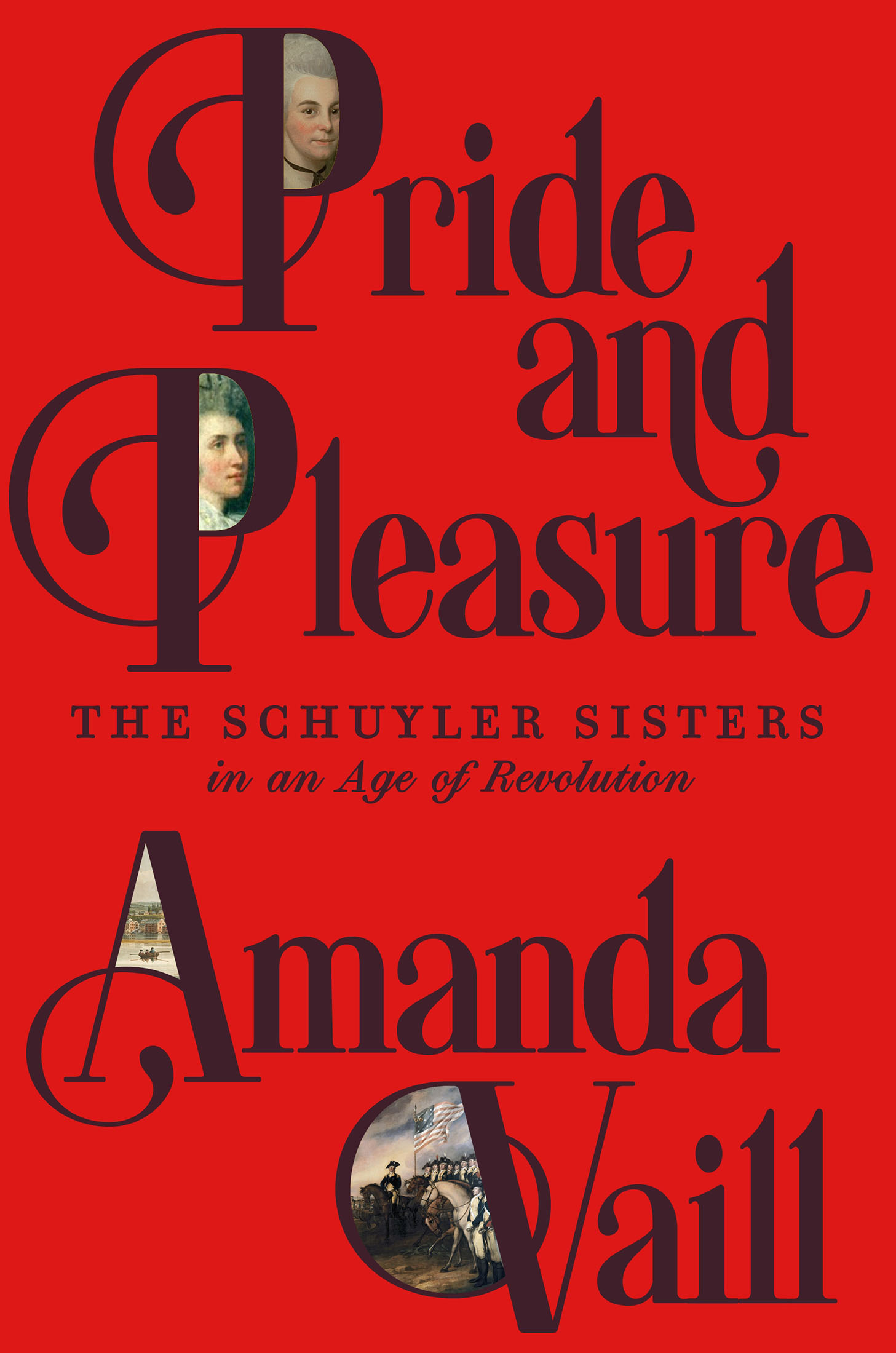
Pride and Pleasure: The Schuyler Sisters in an Age of Revolution
About this book
Born into a wealthy New York family, both women were raised to manage households and secure suitable matches. Revolution disrupted that plan and brought them close to military, political, and financial power.
Angelica eloped with John Church and moved through elite circles in Paris and London, corresponding with figures such as Jefferson. Eliza married Alexander Hamilton, endured public scandal and private loss, and later worked to shape his memory.
Amanda Vaill keeps the sisters' relationship at the center while following the men and events surrounding them. Letters, property, reputation, motherhood, and widowhood show forms of political action that formal office excluded.
Pride and Pleasure is a dual biography grounded in the founding era. Readers interested in Hamilton will find familiar history reorganized around the women who lived with its consequences.
Read a sample
5,154 words
Plain text
From the opening
A Note on Method
When I began work on this book, a biographer who knew the field I proposed to explore cautioned me about pursuing the project because there was so little material to support it. Fortunately, I discovered that the opposite was true: not only had my subjects and their families and acquaintances left substantial archives for me to sift through but their activities could be traced in newspaper articles, family histories, court records, and dozens of other sources, each of which might yield a fragment of information or anecdote.
Pride and Pleasure assembles these fragments, orders them, and where necessary (for there are gaps in the lives of girls and women in this period) amplifies them, to reconstruct the revolutionary experience Angelica and Elizabeth Schuyler lived through. In telling their stories, I’ve used a mode of close, present-tense narration to re-create the immediacy of my subjects’ perspective, interwoven with a past-tense account of the historical events surrounding them. Both narratives are supported by or deduced from documentation, for which the reader should consult my endnotes—which not only list sources but also correct errors of fact in the historical record, some of them of long standing, and explore questions of historical interpretation that might impede the narrative but are useful for a fuller understanding of it.
Prologue
July 11, 1804
Shortly before eight o’clock on the morning of July 11, under a clear sky with a light breeze ruffling the surface of the water,1 four oarsmen rowed a boat across the Hudson River from Weehawken, in New Jersey, to the village of Greenwich. The boat carried three passengers: Nathaniel Pendleton, a judge; David Hosack, a physician and botanist; and Alexander Hamilton, a forty-seven-year-old lawyer, formerly the first treasury secretary of the United States and inspector general of the United States Army. Pendleton and Hosack were sitting in the stern sheets; but Hamilton, his habitually fair complexion deathly pale, lay in the bottom of the boat, unconscious and unable to move, his breeches soaked with blood. Less than an hour ago he had been shot in a duel by Aaron Burr, a longtime political rival who was now vice president of the United States: the bullet entered above his hip, fracturing a rib and tearing his organs asunder before lodging in his spine. By the following afternoon he would be dead.
But now, as the oarsmen pulled hard against the strong Hudson current, Hosack tried to revive him by rubbing spirit of hartshorn, an ammoniated solution, on his face, wrists, and chest; Hamilton seemed to come to, murmuring to Hosack that his vision was blurred and his limbs numb. As they approached the shore, he asked that his wife be sent for: “Let the event be gradually broken to her, but give her hopes,” he said.
The boat tied up at the private dock of Samuel Bayard, a wealthy merchant who was a friend of Hamilton’s. Alerted by a manservant, Bayard had been watching their approach; when he saw the shattered cargo they were bearing, he began to weep uncontrollably. Soon his family, equally grief-stricken, were clustered at the dock, “scarcely able,” Hosack would later recall, “to summon fortitude enough to yield sufficient assistance to their dying friend.”2 They managed to lift Hamilton carefully out of the boat and carry him across the sloping green lawn and upstairs to a bedroom in Bayard’s capacious house. He was in such pain that Hosack didn’t dare remove his bloodied clothes, or probe his wound; all he could do was give him a little weak wine and water.
A messenger was dispatched to Hamilton’s country estate, more than an hour away on the Harlem Heights of upper Manhattan, to summon his wife, Elizabeth Schuyler Hamilton—daughter of the Revolutionary War general Philip Schuyler, descendant of one of the most powerful of the Dutch Hudson Valley families—to his bedside. Since their first meeting twenty-four years previously, at which (he said) he “metamorphosed from a statesman and soldier into a puny lover,”3 she had borne and mothered Hamilton’s eight children, kept his house, taken his dictation, copied his manuscripts, and turned a blind eye to the slanders and brickbats of political opponents and the gutter press. She also tolerated, or ignored, not only an adulterous affair to which Hamilton had publicly confessed but also what society cognoscenti suspected was a covert relationship between him and her glamorous, flirtatious elder sister, Angelica—wife of the wealthy businessman John Barker Church—that went beyond the bounds of fraternal affection. Perhaps such tolerance was one reason why, in a letter he left to be given to Eliza in the event of his death, Hamilton called her “best of wives and best of Women.”4
By now it was nearly midmorning; Hamilton’s pain was severe, and Hosack administered an opiate before peeling off his blood-sodden clothing, transferring him to the bed, and drawing the bedroom curtains. Hamilton managed to make another request: he wanted Benjamin Moore, the Episcopal bishop of New York and rector of Trinity Church, to come and give him holy communion. But although Hamilton rented a pew at Trinity, although he had attended services there with George Washington and John Adams and every other notable in the United States, although Eliza Hamilton regularly received communion—in the church’s view, the metaphoric consumption of the body and blood of Christ, ritually represented by bread and wine—he himself had not taken the sacrament for years. In this he followed most of the leadership of the country, including Washington and Thomas Jefferson, who preferred reason to revelation and repudiated the miraculous trappings of traditional religion, of which communion was one. So when Bishop Moore arrived and heard Hamilton’s request, he temporized, feeling the need for “serious reflection.” Was Hamilton in earnest about receiving “one of the most solemn offices of our religion”? Was he “disposed to live in love and charity with all men”—including his recent opponent? Did he sincerely repent his past sins? On this last point, the bishop might have had only the “barbarous custom” of dueling in mind; or he might have been wondering about more carnal transgressions. In any case, he left without complying with Hamilton’s wish;5 and Hamilton was no more fortunate with the Presbyterian minister he next asked for, the Reverend John M. Mason, a family friend who nonetheless told him that the Presbyterian faith forbade administering the sacrament privately to any person.6 However, at about one p.m., Moore returned, relenting, and gave Hamilton the absolution, and the spiritual food, he craved.
Continue reading the sampleClose the sample
In the meantime, news of the duel and Hamilton’s precarious condition had spread through the city. Knots of curious citizens had formed on street corners, and the Bayards’ front parlor was filling with anxious friends, among them Oliver Wolcott, who had succeeded Hamilton at the Treasury, and the founding father, diplomat, and man-about-town Gouverneur Morris, a family friend of the Hamiltons and the Schuylers. Suddenly, Angelica Church rushed in and began “weeping her eyes out” (said Morris);7 almost at the same time, Eliza Hamilton arrived from Harlem. She had been led to believe that Hamilton, who had lately been suffering from a stomach complaint, was stricken with “spasms,” and Wolcott, for one, was afraid to disabuse her, for fear “she would become frantic.”8 Indeed, when she was taken to see her husband and realized the truth she was “half distracted” with grief. But Hamilton, drugged with laudanum, his mind seemingly already straying from the present, murmured, “Remember, my Eliza, you are a Christian”—meaning, you believe there is a life after this one, where we will see each other again—and whether she drew comfort from his words or her own extraordinary reserves of courage, Eliza managed to compose herself.9 As fever and shock overtook him she fanned Hamilton’s face; and while the doctor-consultants Hosack had called in, and the men of consequence who were Hamilton’s friends and associates, crowded the room, she and Angelica—diminutive dark-haired women whom Hamilton called his “dear brunettes”—kept silent, unnoticed watch on either side of his bed. Years before, in one of her half-teasing, half-serious big-sister letters, Angelica had told Eliza, “I love your husband very much and if you were as generous as the old Romans you would lend him to me for a little while.”10 Whatever Eliza thought of this, whatever she or Angelica did then, they shared him now, sitting beside him until, at two p.m. on Tuesday, July 12, 1804, the man they both loved had breathed his last.
Two days later, Hamilton was memorialized at the largest funeral ever yet held in New York City. Neither Eliza nor Angelica was in attendance; it was thought that women might exhibit unseemly grief on such occasions, grief that should not be on public display. From the portico at Trinity Church, Gouverneur Morris gave the eulogy for his fallen friend, speaking feelingly of Hamilton’s heroism in the revolutionary struggle against Great Britain, his “strenuous … efforts to establish and to preserve the Constitution,” and his service as founding treasury secretary to the new republic, service that assured its very survival. What he didn’t mention, what (he would confide to his diary) he effortfully avoided saying, was a single word about Hamilton’s “domestic Life” or his “conjugal Infidelity.”11 Hamilton himself had already laid the latter bare in an extraordinary public confession that arguably ended his political career; but with four of Hamilton and Eliza’s sons, aged eighteen to six, weeping beside the casket, it would have been a breach of decorum to speak of it.
In the service of tact and good manners, though, Morris missed something important. Mixed up in the tangle of Hamilton’s private life, and in the extraordinary family romance of himself, his wife, and her sister, were some of the reasons why this brilliant, ambitious, needy man had achieved the glorious career Morris celebrated, why it had terminated in this tragic manner, and how, despite the posthumous assaults of his enemies, his reputation would persist and even grow.
He missed something else, too. The stories of Eliza Hamilton and Angelica Church had value in themselves, as exemplars of a way to be that was as revolutionary as the time they lived in. But even Morris, who (far more than most of his contemporaries) valued women’s intellects and actions, couldn’t see that then. So Eliza and Angelica, like so many women, were pushed to the sidelines; not just on that day but afterward. Their accomplishments and their testimony were largely ignored. Future generations might edit or destroy their letters, because a woman’s thoughts and words were negligible or too private for others to see; or bury them in the archives of their male relations; or simply toss them aside, or use them for kindling or to line the walls against drafts, anything to serve a useful purpose. And we were left with two histories: what the scholar Carol Berkin calls the “exclusively male events” of the Revolutionary War and the founding era that followed,12 and another narrative, hidden beneath the surface, whose details must be found in the pages of household account books, or court records, or classified advertisements in old newspapers, or in personal archives not previously plumbed for the biographies of consequential figures.
In the following pages I aim to uncover that narrative and show how it colors, and is colored by, the history we thought we knew. For the women I write of were in their contrasting ways as formidable, and in some respects stronger, than the men they loved, married, and mothered. They may have signed no declarations, negotiated no treaties, enacted no laws; but though their stories may be concealed beneath the pattern of history, they’re the warp on which it’s woven.
1 A Careless, Good-Humored Young Man
In 1609, almost two hundred years before Alexander Hamilton was ferried across the Hudson River for the last time, an Englishman ventured upon it for the first. His name was Henry Hudson, and he was a sailor of fortune in the employ of the Dutch East India Company. Like many who would come after him, he was seeking a way to great wealth—in this case, a northwest passage through the American landmass to the spice islands of the East Indies. But after sailing for eight days up the river’s wide green maw in an 85-foot square-rigged three-masted ship called De Halve Maen (Half Moon), he had to face the truth: It was just a river after all, not a channel to the Indies. Disappointed, he turned the Half Moon for home, and never returned: instead he persisted in the chimerical search for a route to Asia, and died, far to the north, in the Arctic, at the hands of his mutinous crew, on another futile search for it.
His Dutch employers, though, knew what he’d found: a rich territory for settlement and exploitation. They formed a corporation, the West India Company, to do just this. They named the land on either side of Hudson’s river (and to the south and east) New Netherland; and to any company member who would purchase a portion of it from its native inhabitants, and settle fifty people there, they offered the title of patroon, or master, which along with his property rights was granted in perpetuity. The patroon would be a little king, who could charter towns and create courts, have a monopoly on hunting, fishing, mining, and milling on his lands, and exact a yearly rent from all his tenants. In addition, to ensure he would always have a supply of labor, the company would provide him with twelve enslaved Africans.1
Despite the allure of such power, only a handful of men took up the West India Company’s offer; and of them one of the first, and the most successful, was Killiaen Van Rensselaer, an Amsterdam diamond and pearl merchant, who in 1631 established the manor of Rensselaerswijk near Fort Orange, the fortified riverside trading post the Dutch had set up at approximately the same point where Henry Hudson gave up his quest. Rensselaerswijk covered nearly a thousand square miles on either side of what was then called the North River, including “everything along the west bank and inland indefinitely”2—almost all of what would one day be called Albany and Rensselaer counties and a considerable portion of Greene and Columbia counties as well.
Within a decade a number of less substantial colonists followed the patroons, hoping to make their own way in the new world, and among these was a twenty-two-year-old carpenter named Philip Pieterse (or Pietersen) Schuyler. Settling in Beverwijck, a village of about a hundred houses adjacent to Fort Orange, he began trading in furs, then used the profits to buy land, and more land, on which he built mills to grind grain and from which he harvested timber. As more and more Dutchmen poured into New Netherland, needing beaver hats for themselves and fur tippets for their womenfolk, and grain for bread and lumber to build their ships and houses, Philip Pieterse Schuyler and his offspring got rich, amassed larger and larger landholdings, and became even richer. They married well: and in New Netherland, where women were permitted by law to own and bequeath property in their own right,3 marriage also increased the Schuylers’ wealth. They prospered even when the Dutch were defeated in war by their maritime rivals, the English, in 1664, thus losing the colonies of New Netherland. Although they didn’t do quite as well for themselves as the Van Rensselaers (who swore oaths of fealty to the English and in return were given a royal warrant for, and feudal dominion over, what was now the Manor of Rensselaerswyck), Philip Pieterse’s sons, Pieter and Johannes, each became mayor of Albany—as Beverwijck, by now a thriving town, was renamed by the English. Philip Pieterse’s daughter, Alida, first married a son of Killiaen Van Rensselaer; then, when he died, wed his secretary, Robert Livingston, whose business partner she became, helping him to receive the grant of a manor of 160,000 acres along the Hudson River from the royal governor of the province of New York, as New Netherland was now called. And Philip Pieterse’s grandson—another Johannes, or John, and another mayor of Albany (the nineteenth)—acquired for himself 200,000 acres to the west of Albany and 12,000 acres on the east bank of the Hudson. He might have done more had he not died in 1741, at the age of forty-four, leaving a sizable estate and five surviving children (six had predeceased him). But his promise was amply fulfilled—and his legacy transformed—by his third child, Philip Johannes, who was born on November 22, 1733.
Philip’s father’s estate was entailed, meaning it was to be passed intact to his eldest male child, sixteen-year-old John Schuyler; the other children, seventeen-year-old Gertrude, eight-year-old Philip, and two younger sons, Cortlandt and Stephen, had no claim on it. Nor did his forty-two-year-old widow, the children’s mother, Cornelia Van Cortlandt Schuyler; but she was independently wealthy, having shared equally with her brothers and sisters in the considerable (and unentailed) estate of her father, which included property in New York City as well as lands in Westchester County and in New Jersey—property to which she added, shortly after her husband’s death, by purchasing with her own money 1,300 acres of land on the east side of the Hudson River, just north of Saratoga.4
As the second son of a second son, young Philip Schuyler was expected to forge his own way in the world, which the men in his family had always done, by trading goods and buying land, relying on his wits and his already apparent charm to make his fortune. But suddenly a confluence of three events changed the course of his life. In November 1745 his uncle Philip, his father’s unmarried elder brother, was killed by French marauders on his farm at Saratoga, with his estate reverting to his father, young Philip’s grandfather. Almost exactly a year later, John Schuyler died a bachelor at twenty-one, at which point the thirteen-year-old Philip inherited any money and properties their father had amassed. Then, the following July, his grandfather Schuyler also died, leaving—in addition to “much personal property”—approximately 2,500 acres in what was known as the Saratoga Patent, on both banks of the Hudson River north of Albany; 4,000 acres along the Mohawk River west of Albany; 2,500 acres in the Schoharie Valley; and a thousand acres on the east bank of the Hudson, adjoining the Van Rensselaer manor;5 to all of which Philip John Schuyler was the sole heir.
He was now a very rich boy indeed.
By the middle of the eighteenth century, the continent Henry Hudson had seen only as an obstacle in the way of swift passage to the Indies had become a territory to be fought over by the great powers of Europe. The British had driven the Dutch from their enclave on its eastern shore, but the French had claimed Canada, and their traders and trappers had moved into the vast valley of the Mississippi to the west, all the way from the Great Lakes to the Gulf of Mexico. And now the French were pressing south and east, toward lands the British hoped to keep for themselves. In particular they were moving into the Ohio River valley, establishing trading posts and forts, to the discomfiture not only of British colonists from Virginia, who had formed something called the Ohio Company to settle it, but also of the Six Nations of Native Americans who called themselves Haudenosaunee, Keepers of the Long House, and whom the French settlers in Canada had dubbed the Iroquois. They had a series of agreements with the British that they called the Covenant Chain—agreements that had been forged, in part, with the help of Philip Schuyler’s great-uncle—and they expected their treaty partners to defend the valley from French encroachment.
Matters escalated. Demands were exchanged and ignored by the French and the British. Virginia sent a detachment of militia under the command of a young major named George Washington into the Ohio Valley, where they exchanged fire with a French patrol; across the Atlantic both the British king and the French began mustering armies to send to America. In New York, a northern offensive was planned: the colony’s agent for Indian affairs, William Johnson, was ordered to strike a French fort at Crown Point, on Lake Champlain, a hundred miles north of Albany, with a force made up of warriors from the Six Nations and eight companies of colonial militiamen, each led by a captain responsible for mustering a hundred volunteers. And in May 1755, Philip Schuyler was commissioned as one of those captains by New York’s governor, James De Lancey. Having raised his company—two lieutenants, four sergeants, three corporals, eighty-nine private soldiers, and a drummer, all outfitted with “a blanket, a good lapelled coat, a felt hat, one shirt, two pair of Oznaburg trowzers, one pair of shoes, and one pair of stockings”6—he, and the rest of the army, waited in Albany from May until early August for their provisions, transport boats, and artillery to arrive.
Schuyler was then twenty-one, “a careless, good-humored young man” (said a family friend), full of “frank hilarity and indolent good humor.”7 He’d studied at the academy of a Swiss Protestant preacher, the Reverend Pierre Stouppe, in New Rochelle, outside New York City, and had then spent time in the counting rooms and back offices of his mercantile relatives in Albany and New York, and participated in several trading expeditions among the Onondaga of the upper Mohawk. He had a passion for the sciences and a gift for numbers, but he was a man of action, not a scholar, and he was eager to test himself against the French. Not so eager, however, that he chafed at the three-month delay he and his fellow soldiers were experiencing in starting their military adventures, for the young officer’s days in Albany were far from empty. On the contrary, they were enlivened by the presence of a graceful large-eyed girl, a year younger than he, with a long, straight Dutch nose and bountiful brown hair, who was described as “a lady of great beauty, shape, and gentility.”8 He called her “sweet Kitty V. R.”9 or, when he knew her better, “Caty.”
Her name was Catharine Van Rensselaer, and she was the eldest child (and only surviving daughter) of Johannes Van Rensselaer—great-grandson of the original patroon, Killiaen Van Rensselaer—and Engeltje Livingston (whose mother was a Schuyler). Her mother had died in childbirth when Catharine was thirteen. She’d spent her youth at her father’s estate, called the Crailo, a fortified brick manor house at Greenbush, across the river from Albany, with summer sojourns on the Van Rensselaer property at Claverack and seasonal excursions to visit her numerous kinfolk in New York. Like most of the young women Philip Schuyler knew, she was a sort of distant cousin of his, and moved in the same circles he did, so during his youth he must have seen her hundreds of times. Now something caused him to look more closely; and soon he and the beautiful, genteel, and shapely Miss Van Rensselaer were on terms of some intimacy—such that by early August, when he was at last ordered north with General Johnson’s army, she was three months pregnant.
This was not an especially unusual circumstance among the youth of that time and that place, as a contemporary would later explain: “The desire … of obtaining the object of their affection, was to them a stimulus … The enamored youth did not listlessly fold his arms and sigh over his hopeless or unfortunate passion … If the temper of the youth was rash and impetuous, and his fair one gentle and complying, they frequently formed a rash and precipitate union without consulting their relations … [and] the relations of both parties met, and with great calmness consulted on what was to be done.”10
In this case, the young people’s situation was given particular urgency, even danger, by the fact that Philip Schuyler was going into combat and might not live long enough for his and his sweetheart’s relations to do anything at all. Fortunately, although hundreds of lives were lost in the battle that took place on September 8 on the shores of what General Johnson had renamed Lake George, Captain Schuyler survived unscathed. Soon he was back in Albany, arranging for the reception of the French prisoners of war, and at this point the families of the young lovers wasted no time. On September 17, Catharine Van Rensselaer and Philip J. Schuyler were married by Dominie Frelinghuysen of the Dutch Reformed Church in Albany by license, rather than following the traditional practice of having banns (a marriage announcement) read from the church’s pulpit for three successive Sundays before the anticipated event—a useful shortcut, given the exigency of the young couple’s situation.11 The wedding itself took place at the Crailo, not in the church, but not because of the interesting condition of the bride: it was customary for marriages to be solemnized at home, in the presence of the family and a few close friends. After the ceremony the groom commemorated the event in the familial Bible: “In the year 1755 on the 17th of September was I Philip John Schuyler married in the 21st year 9th month & 17th day of my age to Catharine Van Rensselaer aged 20 years 9 months and 27 days. May we live together in peace and to the Glory of God.”12
The newlyweds were permitted little more than a week’s celebration before Captain Schuyler had to return to his post at Lake George, leaving his bride with his mother in the Schuyler townhouse on Pearl Street.13 But he returned to Albany when Catharine was delivered of a daughter on February 20, 1756. Two days later, when the baby girl was baptized at the Dutch Reformed Church by Pastor Frelinghuysen, with her grandfather John Van Rensselaer and aunt Margarita Livingston as godparents, the dominie wrote her name in the church register in the Dutch style: “Engeltje.” Little angel.
2 Left to Nature
The three girls are a year apart in age, their births, each with an appropriate aphorism, recorded by their father in the fat Dutch Bible, illustrated with woodcuts, where all important family information is set down. The eldest is Angelica, or Engeltje, nicknamed Ann, born on February 20, 1756. Under her name her father has inscribed “May the Lord grant that she may grow in his fear and for her happiness.” Next is Elizabeth (Betsey), on August 9, 1757—“Lord, do according to thy will with her” is her father’s comment. Is he disappointed at not getting a son? Then there is Margarita (Peggy), named after her great-aunt, born on September 18, 1758: “Lord give her peace on earth, and everlasting glory.” All three are dark-haired and dark-eyed, small-boned and elfin; being so close in age, they’re also close in spirit, although sometimes two will pair off against the third in the petty power struggles every family knows.
When they are little, and their father is intermittently absent at the French wars that never seem to end, Ann, Betsey, and Peggy live with their mother at their great-aunt’s estate, the Flatts, three miles above Albany on the banks of the Hudson River. It’s a comfortable place, not ostentatious but substantial: there are fields, orchards, woods, pastures, a great barn you can drive a wagon into, a rambling farmhouse with walls two feet thick and a Dutch gambrel roof. The house is mostly given over to bedrooms (each with its Dutch bed built into an alcove in the wall), and there’s no drawing room; but there are some good carpets on the floors, oilcloth painted to look like blue and white marble in the hall, Delft tiles around the fireplaces, and several fine paintings, portraits and biblical scenes, on the walls. And there is a library, for Aunt Schuyler—as everyone in Albany calls her, that or “Madame”—is a great reader, of scripture, essays, biography, poetry, but rarely of plays and never of novels,1 which she considers frivolous.
Before Betsey’s birth, baby Ann and her parents resided in Albany, in the Schuyler manse on Pearl Street, with Philip Schuyler’s mother, Cornelia; her widowed daughter, Gertrude; Gertrude’s two children; and, intermittently, Philip’s two younger brothers, Cortlandt and Stephen.2 But in the spring of 1757, Philip Schuyler’s uncle, another Philip, died suddenly of pleurisy, and his wife, heretofore a sturdy matron whose well-ordered life ran like clockwork, sank into a deep depression. Unable to sleep, she would rise from her bed in the small hours, dressed in her nightgown, and steal out into the garden, where her husband was buried, to mourn. She believed herself unobserved, but she was a tall woman who had become stout with age, and in the moonlight her capacious form was unmissable. Soon neighboring farmers, passersby, and her own servants began whispering about a large, white-clad ghost that hovered near the late colonel’s grave. So Madame, whose scorn for belief in the occult outweighed her unwillingness to speak of her personal grief, had to confess that the spirit was none other than herself.3
At this point, Philip Schuyler, always a great favorite of his aunt, decided to move his young and growing family to the Flatts4—possibly out of concern for Madame’s loneliness, but perhaps equally to please his wife, who grew up in the country and wasn’t used to waking in the morning to the sound of cartwheels and tradesmen’s cries. And so for the first years of their childhood, Ann, Betsey, and Peggy are “very much left to nature” (as a friend will describe it). Wearing odds and ends whose only function is to protect them from the sun in summer and from the cold in winter, they’re allowed to run wild, or as wild as their little-girl legs can carry them, over the fields and woods that line the banks of the Hudson River. Their first companions are the Onondaga children whose families set up their dwellings every summer at the edge of what everyone calls the Indian field, and they chatter with their playmates in a made-up Dutch/English/Onondaga patois. As they grow, their circle of friends is extended and refined: their numerous Van Rensselaer and Cuyler cousins and the offspring of other local families replace their Iroquois comrades, and the children organize themselves into companies—bands of half a dozen or more, both boys and girls, of various ages, who go together on berry-picking or fishing excursions, or skate on the frozen river or sled down the snowy hills.