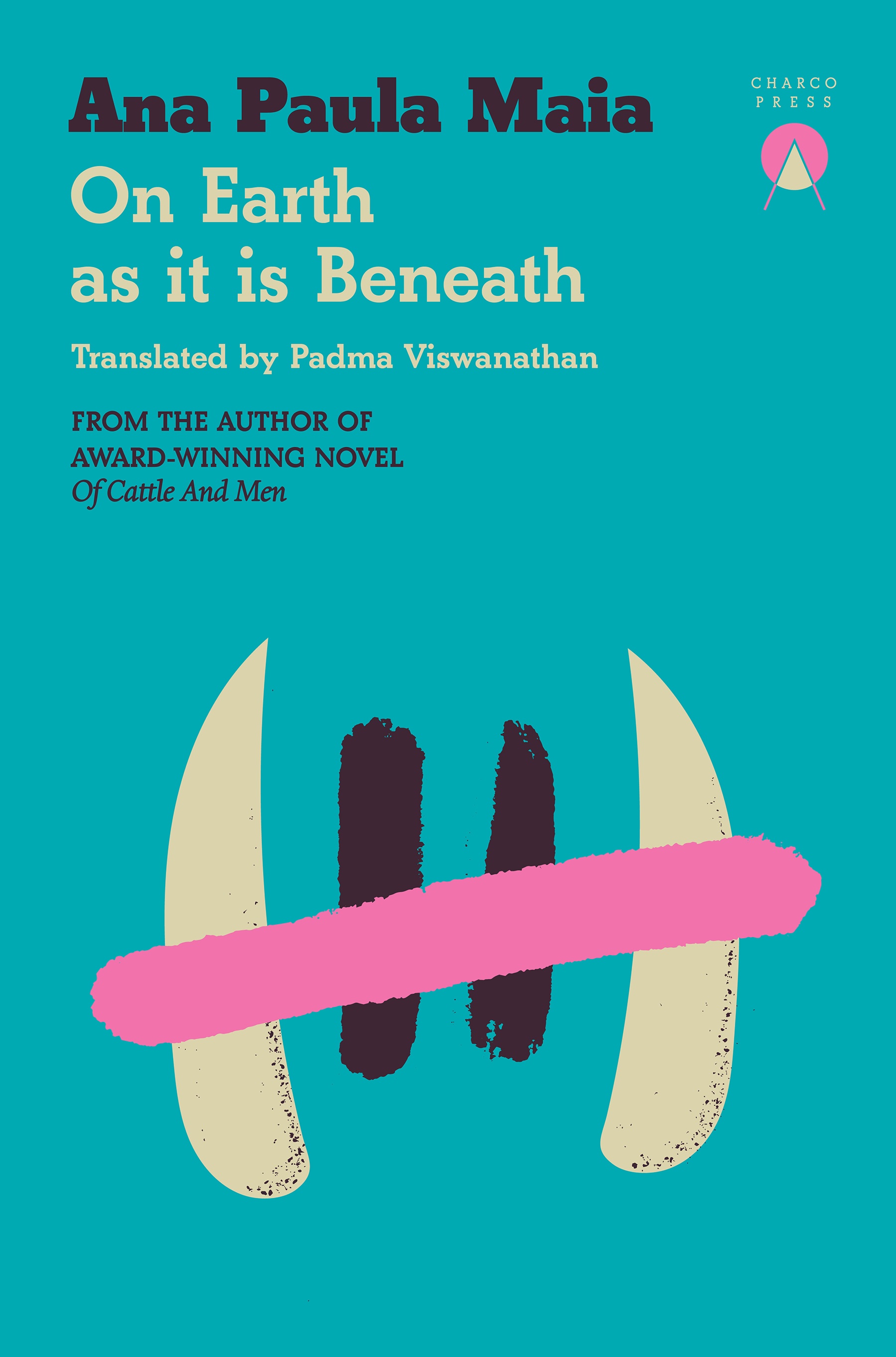
On Earth as It Is Beneath
About this book
The prison sits far from ordinary scrutiny, on ground where enslaved people were once tortured and killed. Guards, officials, and prisoners inhabit a system whose remoteness permits power to operate without meaningful correction.
A sadistic turn in the colony’s routine exposes how quickly administrative neglect becomes deliberate violence. The landscape holds older brutality beneath the modern institution, making the state’s claim to order difficult to separate from historical punishment.
Ana Paula Maia writes with stark physical economy. Animals, labour, dirt, confinement, and damaged bodies carry the allegory, while the horror remains grounded in choices made by people with authority over those who cannot leave.
On Earth as It Is Beneath is translated by Padma Viswanathan. It is a short, severe novel about carceral power, the legacy of enslavement, and a society’s habit of placing violence out of sight.
Read a sample
5,069 words
Plain text
From the opening
1.
Little is left, men or animals. Hoes and sickles lie where they were dropped, in the corners of fields dried up for lack of rain. A narrow, stinking creek provides water, but it dwindles visibly day by day, sucked dry by the fierce heat evaporating it, making the air humid and heavy. There’s still movement in the chicken coop and occasional grunts from the pigpen, guaranteeing meat in the pot for the next few days. Beyond that, the scarcity is worrying. They’re awaiting orders, a convoy to come take them somewhere else, but consternation’s been growing since they lost contact with the outside. The phone lines have been down for days, but, last they heard, an official was coming out to do a final inspection and drive them to their next stop. According to their calculations, the official’s at least seven days late, causing a steep increase in anxiety. All they can do is wait.
Valdênio uses his straw hat to swat at flies circling the mutt’s shrivelled carcass, its jutting ribs. They’ve been feeding off it for days. It died sick, with a sore on its belly that gradually expanded, rotting it. It’d lick its own wound, contemplating its withering flesh with sadness and a kind of wonder. The wound started small, about the size of a wart, coppery. The dog got more and more subdued and its excitement over kitchen leftovers dropped off. Valdênio was making gruel for it by the time it stopped eating, so weakened its feeble jaws could no longer chew. He’d smeared the wound with herbs and gunpowder, but it wasn’t enough. He spent two days searching for it when it went missing. It’d died under a nearly leafless tree. Valdênio grabs a hoe lying nearby and digs a shallow pit where he places the skeletal animal, covering it with earth.
In the distance, a man shouts his name, beckoning him. Valdênio, on his knees, finishes sticking a small cross made of two twigs into the red dirt. He gets up and makes his way over, dragging his left leg, leaning on a wooden cane.
‘Yes, sir?’ he says.
‘Melquíades wants to talk to you,’ says Taborda.
Valdênio is turning towards Melquíades’ office when Taborda asks him about the dog.
‘I’m going to miss that pup,’ Taborda remarks.
‘All of us will, sir.’
‘Never thought I’d get so attached to a mutt like that.’
Valdênio keeps quiet, noticing the prison guard’s sad expression. He waits for him to look up and give him permission to go see Melquíades, the superior officer and highest authority inside the walls.
‘Guess that’s what happens to people in a place like this. You end up latching onto any old scrap.’
Taborda finally gives him the nod, and Valdênio, leaning on his cane, walks slowly towards the main office, located in the central pavilion.
Melquíades is at his desk, sleeves rolled up and collar unbuttoned. Arms and legs crossed, waiting for God knows what.
‘Can I help you, sir?’
‘Valdênio, what’re we having for lunch today?’
‘Chicken, sir.’
‘Again?’
‘It’s what we have and…’
Melquíades interrupts. ‘But what about the piglet?’
‘What about it?’
‘We could roast it.’
‘Yes, sir. Except Pablo already killed and plucked a chicken for today.’
‘I was thinking, Valdênio, that we could keep the piglet for the day the official arrives. After all, we’re going to have to give him lunch.’
‘Whatever you say, sir.’
Melquíades jumps out of his chair and claps his hands, once. His zeal has turned increasingly strange, upsetting everyone in the Colony with his disturbing behaviour. He grabs Valdênio by the shoulders and looks into his trembling eyes.
‘I’m positive, Valdênio, that you’ll make the best roast suckling pig in this whole damn place.’
‘I’ll do my best, sir.’
‘We still have that hooch?’
‘Bronco Gil still has two bottles.’
‘Excellent. We’ll lay out a feast for the official.’
He releases Valdênio’s shoulders as forcefully as he seized them, making the man lose his balance. With the cane for help, though, he finds his footing again.
‘I was also going to say we should have a little music here, don’t you think? Does Pablo still play that harmonica?’
‘You confiscated the harmonica, sir.’
‘I confiscated it? Really?’
Melquíades furrows his brow, trying to recall confiscating Pablo’s harmonica.
‘And would you happen to know where I put it?’
‘You threw it over the wall, sir.’
‘I did?’ He spreads his hand on his chest, surprised at his own conduct. ‘When was this?’
‘Last week.’
Melquíades walks up close to Valdênio, slyly, as though to steal the man’s thoughts.
‘And could you tell me why I confiscated the harmonica?’
Valdênio keeps his eyes lowered, fixed on his bad leg. He doesn’t know whether to tell the truth or just plead ignorance.
‘If you confiscated it, sir, you had your reasons.’
‘Oh, very good. Good answer. Obviously, I had my reasons, and I’d like to know: do you agree with my reasons?’
Valdênio keeps his head down.
‘I’m sorry, sir. I just work in the kitchen. I don’t know anything about the law.’
‘I’m not talking about the law, man. I’m talking about justice. Pablo disobeyed my orders. Punishment was necessary, don’t you agree?’
‘Yes, sir,’ he answers through his teeth, his throat tight.
Continue reading the sampleClose the sample
Melquíades positions himself in front of Valdênio, staring at his face, eyes tensing as he examines him thoroughly, not touching him, just sniffing at him.
‘Valdênio, you’re the best cook I’ve ever had in this place. We have potatoes?’
‘Yes, sir, we do.’
‘Don’t forget to make them nice and crisp. You know how I like ’em.’
Melquíades does an about-face and goes to sit at his desk. He opens the drawer, pulls out a few sheets of paper and lines them up according to a sequence that makes sense to him but that Valdênio finds impenetrable.
‘What are you doing here, prisoner?’
Valdênio opens his mouth slightly, intending to speak, but all that comes out is babble. His eyes, trembling nonstop, don’t land on anything specific. He looks down and takes a small step backwards.
‘What are we having for lunch today?’
‘Chicken.’
‘Again? I’m going to end up growing feathers. What about the piglet?’
‘Sir, you said you’d like to roast the piglet when the official gets here.’
‘Well, of course, Valdênio. That’s an excellent idea. Let’s do that. What are you waiting for?’
‘Waiting, sir, what?’
‘Standing there… what are you waiting for?’
‘Nothing, sir. If you’ll permit me, I’ll be on my way to the kitchen.’
Valdênio drags his bad leg like it’s chained to an iron ball. His gait brings to mind the plight of a prisoner, living in relative freedom, who never forgets his true state. He wears an electronic tag on his right ankle. It’s not heavy and hardly bothers him, but it’s a reminder for him, and everyone else here, that one step beyond the Colony walls, his leg would blow up. It can’t be taken off, except by the guards, way worse than an iron ball, an electronic bomb that would sever his foot.
Valdênio is old for a place like this, sixty-five. He’s spent half his life incarcerated, behind iron bars or in penal colonies like this one, doing all kinds of work. He should be free by now, but Justice keeps him here. Now, he doesn’t even want freedom in his lifetime, since no one’s waiting for him any more on the outside. He and the world both changed, but not in time with each other. Valdênio got older, sick, not much sharper. The world renewed itself. To be thrown outside the walls would be to serve another sentence of survival and resistance that he couldn’t stand to repeat. His first years in jail were tough; little by little, he’s come to understand how the system works. He was beaten up dozens of times, his skull crushed, his jaw dislocated, arms and legs broken; finally, one day, his leg was maimed after he was thrown off the roof of a pavilion. He didn’t even always know what he was being beaten for, much less that last time, when he was left to die but survived. His body, ground down in hell, awaits the end of its days. He no longer questions. He obeys, follows orders, lowers his head and steps back. He’s beaten, sometimes for a reason, sometimes not. Wherever he’s gone, they’ve spilled his blood. He’s left a trail. It’s a wonder he’s survived so long. Very few reach old age in prison.
Valdênio heads from the central pavilion towards the western one, where the kitchen and prisoners’ quarters are. Taborda’s still sitting in the same place as before, in the shade of an almond tree. He sees Bronco Gil appear in the distance, bow and arrow slung over one shoulder, a rope hanging from the other, pulling something dark and heavy behind him. He walks slowly, worn out from his long night, dragging his leather boots across the surface of the dusty red earth. He’s got a cut on his right arm. Drips of blood have dried on his skin. He creases his face into a frown, showing his teeth. No clouds in the sky, just a cruel sun abusing everything beneath it.
Taborda looks up when Bronco Gil’s footsteps come within earshot. One arm still lying across his belly, he tips his cap up and lets out a long whistle.
‘You’ve outdone yourself this time, Indian.’
‘Damn thing had me up all night.’
‘Where you going?’
‘To rub your boss’s face in it,’ Bronco Gil replies, heading for the central pavilion without stopping.
Bronco Gil dumps the dead boar in the middle of Melquíades’ office. Right away, Melquíades stops polishing the shotgun resting in his lap. He looks at Bronco Gil and at the animal giving off an offensive smell of putrefying flesh. Bronco Gil lights a cigarette, his last one, saved to relish once he finally finished his work. He says nothing, watching Melquíades, who goes back to looking at the gun in his hands. The door of a cabinet holding dozens of guns is open behind him.
‘I remember the first time my father took me hunting,’ Melquíades begins. ‘I used one of these.’ He looks at the gun affectionately. ‘I really got to like the hunt, until an ocelot almost ripped my guts out. I stopped hunting wild animals for a long time.’ Melquíades gets up and puts the shotgun back, running his hands gently over the carefully organised weapons. He picks out a rifle before padlocking the cabinet shut.
‘This one’s my favourite out of all of them. Nice, huh?’
Bronco Gil agrees with a brief nod. Melquíades makes an adjustment to the gun and points it at Bronco Gil, who stays still, not showing any emotion. He tweaks the rifle’s scope.
‘Personally, I don’t much care for these scopes. I prefer aiming with the naked eye. I could take out your good eye from here, Indian.’ He edges the gun millimetrically to the side. ‘Or your ear.’
Bronco Gil takes another drag on his cigarette, as though dismissing Melquíades’ behaviour. The warden slings the rifle over his shoulder and comes out from behind his desk. Straightening himself up, he runs a hand over his smooth, sweaty head, and, in a few steps, comes across to the boar now at his feet. Leaning over the animal, he checks out its tusks. Touching the rough black hide lightly, he feels it prickle his hand.
‘Ever notice how dead boars look happy?’ He gives Bronco Gil an enquiring look, then goes back to examining the animal. ‘This is a lovely specimen. I’d like to hang this huge head on my wall. It’s incredibly powerful.’ He gets quiet, bringing his face up near the boar’s snout, then slapping his own leg, ecstatic. ‘Remarkable. They die smiling. So, tell me, Indian, how’d you bag this beast?’
‘You see the arrow in its back, sir?’
‘Got it in a single shot, just like that?’
‘It’s their weak spot, the one place guaranteed to kill a wild boar.’
‘Imagine what you could do, Indian, if you had two working eyes, eh? What would that be like? God sure knows what he’s doing.’
‘Now: our deal.’
‘What’re you talking about?’
‘I said I’d get the critter.’
‘Forest demons! They destroy everything.’
‘It’s just a big pig. Demons don’t die from one arrow.’
‘No, they certainly don’t. Let’s roast it. But I want the head stuffed. I’m going to put it right there.’ He points at the wall behind his desk. ‘It’ll be beside the head of a boar I caught a few months ago.’ Melquíades brings his hand to his chin and contemplates the wall, decorated with a framed photo of the president of the Republic.
‘Now, our agreement, sir.’
‘What are you talking about, Bronco? Bronco, I don’t get your name. Bronco,’ he splutters.
‘I brought you the boar, sir, and you…’
‘I know, I know… I’ll honour the deal. From today on, you can all use the games room, listen to music, who knows, bring in some woman… though in this hellhole and without working telephones, it’s going to be pretty hard to get a whore,’ he stresses, raising a finger. ‘But… there’ll be rules and schedules.’
Bronco Gil grins. ‘I’m going to butcher the boar and stick it in the freezer.’
‘And ask Taborda to stuff that head. Use it as a chance to tell him I want to know what’s up with that head he’s been working on for me for over two months now. Ah,’ Melquíades motions at the bow and arrows hanging from Bronco Gil’s shoulder. ‘Those stay here.’
Dismissed, Bronco Gil leaves the bow and arrows on the office floor beside the door, and, pulling the boar by the rope, drags it outside the central pavilion. Taborda’s still in the same position, sitting in the shade of the almond tree. Bronco Gil lays the boar out on the ground, grabs a cleaver and starts dismembering it. He takes the head off first and carries it to Taborda.
‘Melquíades said for you to stuff this.’
‘Is there any sawdust left?’
‘Yeah. Over in the workshop. And he asked about that head you’ve been working on.’
‘Oh, yeah, it’s just missing the eyes. I can’t figure out how to get hold of a good pair of eyes in this hellhole.’
Taborda looks at the boar’s head on the ground. Small insects immediately start going at it.
‘It’s a beautiful head, but you messed it up a little here,’ he says, touching the jowl. ‘You could’ve been more careful.’
He sighs and, with some difficulty, heaves his heavy body up to standing. Holding the boar’s head, he walks away, leaving a faint trail of blood.
* * *
Pablo leans his belly against the kitchen sink, sniffling nonstop, his eyes irritated as he dices an onion.
‘You find the mutt?’
‘Already buried him,’ Valdênio replies, coming over to the sink.
‘I wish I’d put a bullet in his head. I hate seeing an animal suffer like that. Think the official might come today?’
‘Don’t know. I’m worried he won’t come in time.’
‘Melquíades has gone totally insane.’
‘He’s completely unhinged.’
‘Hope they don’t take too much longer to get here.’ Pablo gathers a pile of chopped onion on the cutting board. He looks behind him and lowers his voice. ‘What if they leave us here?’
‘We run away,’ Valdênio whispers.
‘With these bombs round our ankles? I don’t think anyone has any chance of escaping. Besides, Melquíades will kill us first.’
‘God’s looking out for us. You can stand it a little longer.’
‘I don’t think we’ll get past today.’
‘We’ve got to have faith, Pablo. Just a little longer and they’ll get here.’
‘You’re going to die a prisoner, Valdênio.’
‘There’s nothing left for me out there.’
‘But there is for me. You still going to help me get away?’
Valdênio doesn’t respond, keeping his head down, peeling potatoes. Pablo looks at him insistently, dismayed by his silence. They stay side by side, making lunch, sweating over the boiling pots in the pavilion’s large, grimy kitchen.
2.
Taborda separates the hide from the bone and hangs the skin from a tree branch. He cleans out the boar’s head, skilled at the job. The stench around him means only flies come near the bloody scraps. With a small knife, he scrapes off any flesh still sticking to the bone, drying sweat off his forehead with the back of his hand. It pleases him to see a pile of shredded flesh beside his leg. Getting up, he takes the skull and a shovel and heads towards the anthill behind the central pavilion. Hundreds of ants emerge as he deftly digs a hole in the earth and places the boar’s skull inside. He shovels earth back on top of it and hurries away, shaking his legs and stomping his feet. In two months, the ants, eating day and night, will have stripped the skull entirely of any flesh not removed by hand. He picks up the hide from where it hung on the tree branch and takes it to an abandoned room, used in the past for hay storage, to cure it with rock salt.
In a few days, the hide will be rinsed free of the salt and immersed in a can filled with a solution of potassium alum. There it will stay for two months, until the skull is properly cleaned by the ants, to be covered once more in the hide and stitched up at the edges.
Gathering up the brain matter, Taborda takes it to an area of the grounds they use as the dump. They usually burn the trash, since it’s only collected once a month. Taborda walks slowly; time moves at a different pace within these walls. He’s worked as a prison guard for ten years. In this time, he’s put on weight. He shoots on command and obeys his boss’s every order. He manages to follow all the football championships and is thinking of retiring in a few years. Maybe he doesn’t do much now, but when he’s retired, he plans to buy a boat and sail all over. Having spent the better part of the last decade on the inside, he doesn’t feel that different from the prisoners he oversees. His visits are home rare, as are days off. He hears from his family now and again and sends money every month.
Trained to obey, he doesn’t have to agree with every method or procedure, he just has to do what he’s told. Indifferent towards others and himself, he no longer has any creed, ideology or political stance. He carries a gun and when he has to use it, he does. Thinking about his kids still gives him a good feeling, but there’s not a lot left of him.
Going back to sit under the almond tree, he waits for the lunch bell. Meantime, he will keep watch over the different areas of the Colony, reduced now that there are fewer occupants. When they received word that the Colony would be shut down, Melquíades turned even more violent. Two guards quit; Taborda’s the only one who stayed. Maybe the scant contents of his soul include mercy. Though he prefers not to think about it, each day he chooses to stay in the Colony, guarding the inmates and watching Melquíades’ every move, is an impulsive act. He doesn’t show it, but he’s afraid of his boss, just like every other man in here.
Bronco Gil comes up to him and sits on a tree stump.
‘What is it, Indian?’
‘Any news about the official?’
‘What’s that got to do with you?’
‘I just want to know.’
‘None of your business.’
‘Know where we’re going to go?’
‘Nope. What do you want to know for?’
‘I have a right to know.’
‘Your body and soul don’t belong to you anymore. Same goes for your right to know. All you get to know is what they want you to know.’
‘Taborda, do you agree with what’s going on here?’
Enraged, Taborda jumps to his feet and shoves Bronco Gil with the butt of his shotgun.
‘Don’t underestimate me, Bronco Gil. I know you’re up to something. You really think you’re getting out of this place? Melquíades is going to leave you for last and eat your good eye for breakfast.’
Taborda stomps off, adamantly maintaining the same rigid stance as Melquíades, but his heart is heavy. He doesn’t agree with any of his superior’s actions and it makes him miserable when the prisoners look at him with fellow feeling. What can he do, he’s not trained to have compassion or disobey. The feeling of hierarchy eats away at him like a worm.
Bronco Gil feels trapped. He could have killed both officers already, but that would mean decades in prison. He’ll grow old in jail, like Valdênio, if he doesn’t die first, which seems more likely. His problem isn’t so much killing them as what those deaths would bring on. Killing an officer of Justice makes her bare her ferocious teeth. So, he waits, resigned. Bronco Gil’s not a good man and he knows it. He’s not expecting to be treated according to his character, though, but according to his behaviour within these walls. If he killed Melquíades and Taborda, he could expect to be sliced up, slowly. Justice would eat the pieces until nothing was left but his glass eye. It would be best to escape, but the Colony’s isolation means he wouldn’t get far. The officers have the jeep and would nab him on the road. Melquíades shot all the horses in the head to make sure they couldn’t be used in an escape. The stable’s been empty for months. That happened shortly after Bronco Gil was transferred to the Colony.
* * *
There were no signs pointing the way. The asphalt was full of cracks and potholes. Not a single animal crept along the roadside. No bird in the sky or even perched in a tree. No chirp. No nest. Not even a breeze, or none that could be felt. Looking back, it was hard to tell if they were headed for the start or the finish, since both directions were so alike.
The van transporting Bronco Gil and two other men had bars over the small side windows and over the door at the back. The three men were silent, en route to a place that was supposed to be better than the smelly, overcrowded prison where they’d been. They’d been chosen to go to the Colony, but none of them knew exactly what set them apart, what qualities granted them a transfer from the hole where they’d been to some spacious, sunny location, granted them the right to a lighter sentence. For now, they found themselves cuffed at the wrists and ankles, with those cuffs locked to an iron bar welded to the van. It was hard to move. There was no way to escape, besides which they’d been rigorously searched.
‘Hope they have a carpentry shop. I’m a carpenter,’ one man remarked, making conversation. ‘I had my own shop and made doors, wardrobes, beds, bunkbeds. I even made coffins for a while but I had to stop. My wife didn’t like it. She was superstitious.’
Neither of the other men comments but they’re paying attention. It makes the long journey easier.
‘How’d you end up here?’ the other prisoner asks.
‘Killed a police officer.’
‘Was it personal?’
‘Yes and no.’ He shrugs. ‘At the end of the day, lots of people profited from his death. Including me. I paid for my daughter’s operation with the money. She’s all better now. Got a new kidney.’
They resume their silence. A nauseating spectre envelops them. They’re all men marked by blood. Most of them kill for others, like butchers in a slaughterhouse. Some buy death; others sell it like merchandise.
The man starts up again, after a few minutes sunk in a state of reflection.
‘I suffered a lot in prison because if you kill a police officer, you suffer more.’ He pauses and thinks a bit before going on. ‘That’s why I don’t know if we’re going anywhere better.’ He leans forward a little and whispers. ‘If I’m going there, I doubt anything good’s waiting for us.’
Bronco Gil’s killed various kinds of men and women, but he’s only serving time for one crime: the murder of a small-town mayor. It was good money, but he ended up getting caught. The guy who hired him didn’t give Bronco the protection he should have. Anyway, Bronco squealed, told them everything he knew. He took five other people down with him.
‘So what about you, Indian, what are you in for?’ asked the prisoner at the end of his own story.
‘Killing a mayor,’ he replied, terse.
‘Oof, killing a mayor is complicated. Pain in the ass.’
‘Sure is.’
‘Was it a hit?’
‘Yep.’
‘So what happened to the guy who hired you?’
‘I snitched on all of them.’
‘And what happened to them?’
‘All free, awaiting trial.’
‘Sons of bitches. They always get away with it. Doesn’t matter what for, they wait on the outside.’
‘I went down for bank robbery and kidnapping,’ says the third prisoner.
‘That’s a long sentence,’ Bronco remarks.
‘Sure is. They pulled my file, sent me down for two crimes in two different years.’
‘You kill before that?’
‘Yeah, but I didn’t go down for murder. They never investigated it.’
An officer bangs a tin cup on the grate separating the prisoners in the back from the cabin up front where the two policemen sit, and tells them to shut up. There’s no escort, which is unusual, but the prisoners only found out about the transfer last night. There wouldn’t have been time to plan an escape with people on the outside.
There’s no way to tell how long the journey’s taking but, judging by the colour of the sky outside the small window, it’s been at least five hours already. They haven’t yet stopped when the van pulls over. One prisoner wakes up and asks if they’re there yet. The others don’t respond because they don’t know. One policeman opens the van door while the other stands guard, gun drawn.
‘One at a time, you can all get out and piss, but make it quick.’
‘Sir, I’m dying of thirst,’ one prisoner says.
The cop gets a plastic water bottle for each of them.
‘Drink and piss. We’ve still got four hours to go, no stops.’
The cop climbs into the back of the van and unchains them one at a time from the iron bar. One after the other, they climb out of the van, cuffed at the hands and feet, and walk side by side with the officer. They piss off the side of the road, stretch their legs and breathe the fresh late-afternoon air.
Bronco Gil is the last; he unzips his trousers and pisses like a donkey. The red earth sinks under the pressure of the jet, making a puddle appear between his feet.
‘Sir, where are we going?’
‘You’ll know when we get there.’
‘Why were we picked for this transfer?’
‘All I know is that I have three deliveries: you and those two other bastards sitting in the back of that van. Hope you guys don’t try anything, because we have shoot-to-kill orders if you attempt to flee.’
Back in the vehicle, the prisoners rattle around for hours, not knowing where the road might be taking them. An hour and a half later, they’re shrouded by night, a kind of desolation permeating their cold, mobile captivity like a harbinger of the end.
3.
Taborda sews the hide onto the boar’s desiccated skull. He adjusts both tusks and aligns the snout. The eye sockets are still just two holes waiting for a pair of glass eyes – there’s no way to get a pair of reflective black eyes out here – but as soon as he can get to town, he plans to order them. He holds the stuffed head up to his own face and admires his work, so well-done despite limited resources.
Melquíades is sprawled on the sofa, leather with foam leaking from tiny rips. Pablo finishes polishing his boots, now impeccably clean and shiny, and leaves them in the corner of the room. Melquíades stretches his neck for a look, but before his eye lands on the boots, he comes across a toe sticking out of a hole in his sock. Pablo lingers near the door, waiting for permission to leave.
‘Look at that, inmate. My last good pair of socks. Know how to sew?’
Pablo nods yes.
‘Over on that shelf, there’s a box with a needle and thread.’
While Pablo fetches the box, Melquíades takes off the worn sock and hands it to the prisoner, who sits down on the same wooden stool where he shone the boots, feeds a dark thread through the eye of the needle and starts sewing.
‘I was reading your file and was amazed to learn you’ve absconded five times. Five times!’ Melquíades emphasises, raising his voice. ‘You’re pretty persistent. No wonder you got sent here for me to look after. Know how many men have escaped from here? Huh? Zero. Hear that? Zero men. This place has already seen its glory days, inmate, before your time. Shipment after shipment of men were sent to this Colony for me to whip into shape. The problem is that after one infraction is corrected, the punishment for the next one has to be even more severe. And so on and so forth, until everyone is broken down, used to brutality. Don’t look at me like that!’ Melquíades exclaims, noticing that Pablo has stopped mending the hole in the sock and is staring at his face while he gives this speech.