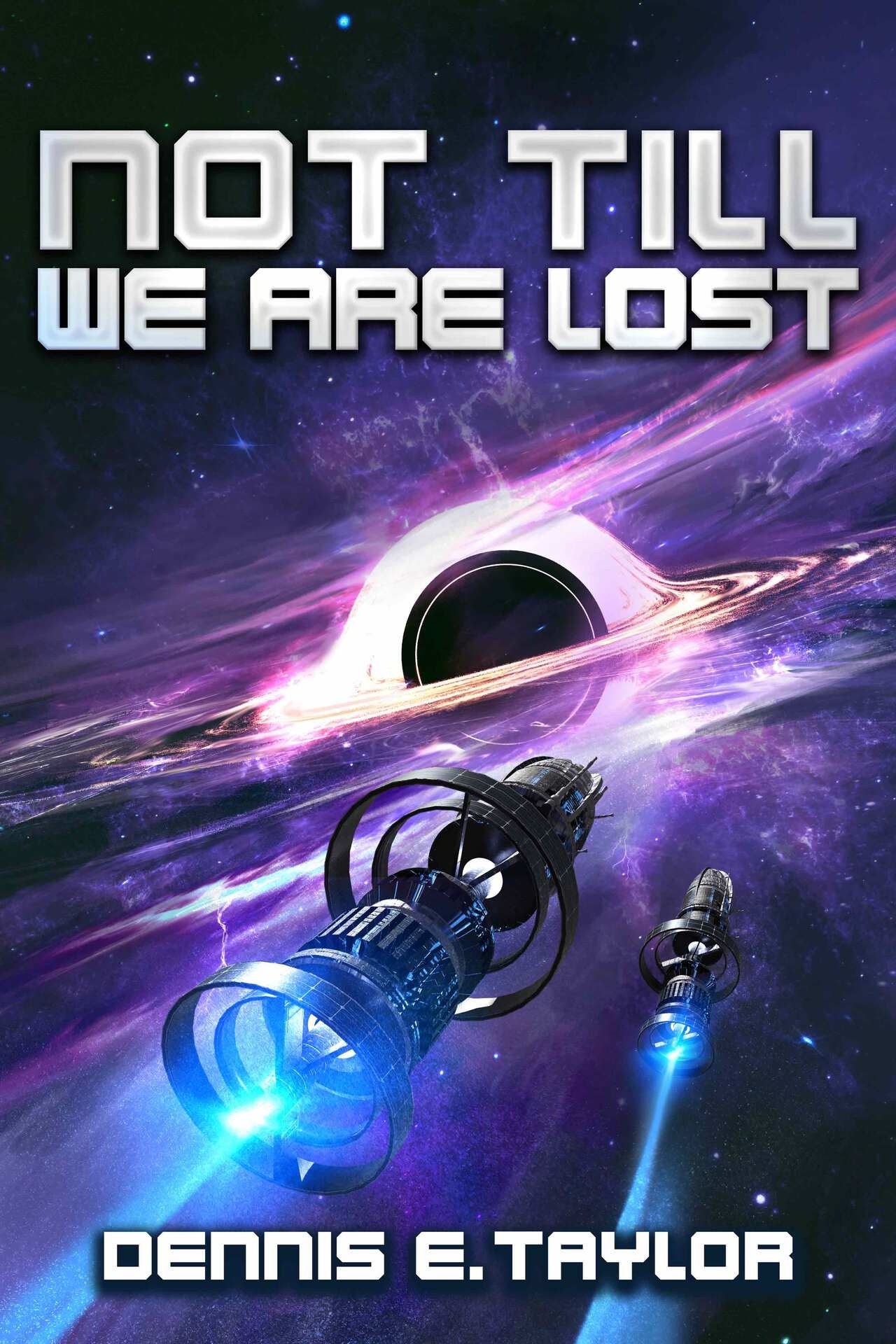
Not Till We Are Lost
About this book
The Bobiverse has become politically plural, with starfaring projects, virtual communities, and competing factions no longer assuming that shared ancestry guarantees agreement. Work near the galactic centre brings Icarus and Daedalus into contact with evidence that changes the scale of known threats.
Other Bobs investigate an advanced species whose technology and behaviour resist easy classification. First contact proceeds through incomplete observations, while actions elsewhere show how quickly a precaution can look like aggression from the other side.
The novel continues the institutional changes introduced in Heaven’s River, giving diplomacy and governance as much weight as engineering. The humour remains, but replication drift has made every collective decision a negotiation among genuinely different persons.
Not Till We Are Lost is the fifth Bobiverse novel and should be read after Heaven’s River. Dennis E. Taylor expands the series toward larger external dangers while treating internal division as a sign that the Bobs have become a civilisation of their own.
Read a sample
5,020 words
Plain text
From the opening
Chapter One:
Destination Galactic Center
Icarus
March 2309
Interstellar Space (en route to Sagittarius A*)
Daedalus and I had been accelerating for fifty-two years now, Earth time. The universe, if you looked at it without any visual compensation, was unrecognizable, nothing more than a bright smear in front of us. Also Doppler-shifted to lethal levels, but who’s counting? Fortunately, the SURGE drive field protected our ships from the onslaught of radiation and oncoming dust by warping it around us. And computer simulations allowed us to produce an image of the universe as it would appear if we were floating at rest in space, at this spot.
It didn’t really look that much different from the view of the sky from Earth. Fifty-odd light-years, on a galactic scale, was diddly. And we were on a twenty-six-thousand-year trip.
“Twenty-five thousand, nine hundred bottles of beer on the wall, twenty-five thousand, nine hundred bottles of beeeeeer,” I muttered.
“I heard that, Ick,” Daedalus said. He’d been relaxing in a lawn chair, doing calculations on some kind of spreadsheet as usual, and paused only long enough to comment. I smiled slightly. We’d become like an old married couple—long silences, working side by side while hardly acknowledging each other’s existence. Today I was visiting Dae’s VR—a garden setting, warm sun, slight breeze, birdsong in the background. Relaxing. I’d accepted the theme and conjured up a lawn chair of my own, but the reclining kind since I wasn’t working on anything.
“If we keep accelerating at this rate, we’ll get there in fifty years, personal time,” I continued. “Of course, who knows what will have happened back home in twenty-six thousand years?”
“Well, you know the standard nightmare, right?” Dae replied without looking up. “We arrive at Sagittarius A* and find a bunch of Bobs that have been there for twenty-five thousand, nine hundred years, FTL having been invented just after we left.”
“Yup. Fortunately, being Bobs and therefore obsessive, we’ve left instructions for that eventuality. Someone would message us with the news.”
Dae smiled without immediately replying and poked at his spreadsheet some more. “I calculate that if we had to slow down to galactic orbital speed for that or whatever other reason, it would take about five years at full power. Ten years with some safety factor built in.”
“Then all the way back home. Another fifty years.”
“Not if they invented FTL. There would be someone waiting when we came to a stop.”
“True. Ever regret not hanging around local space?”
“Not really, Icky. Based on the news updates Bill is still sending our way, it’s really kinda turning into a shit-show. Another shit-show, I mean. And what’s with this Starfleet? Who thought that up?”
“Bobs. Very weird Bobs.”
I should explain that, I guess. Daedalus and I are clones of the mind of one Bob Johannson, a computer programmer who got himself killed crossing the street in Las Vegas in the early 21st century. Bob’s brain was scanned and used to create the controlling intelligence for a Von Neumann probe a hundred years later.
Bob was a very good Von Neumann probe, and he not only explored, but he also made copies of himself, who also made copies of themselves. The Bobs now number in the tens of thousands, each of us, by convention, adopting a different name when created. The first Bob replicant, now called Bob-1, is still around, although he seems to have semi-retired.
Dae and I are currently heading for the galactic core at just a fraction under C, because it seemed like a good idea at the time.
“Our news is getting more and more behind the times, the farther out we go.” Dae sighed. “I wish we could have figured out a way to drop off SCUT relay stations along the way so we could stay in touch in real time.”
“Mm-hmm. Price we pay, buddy. So what are you working on?”
“Ah.” Dae gestured at his spreadsheet, and it rotated so I could see it. “By carefully tuning the SURGE drive, we’ve always been able to vary the amount of incident radiation that we let through. It occurred to me at some point that if the drive could control the radiation in that way, it might also be able to refract it.”
“Like a lens?”
“Like a lens. The front end of the biggest damned refractor telescope you could hope for.”
“Uh, didn’t Asgard … ?”
“Yeah, yeah, Asgard colony, biggest telescope ever made. As they like to remind us at every opportunity. But theirs is in a solar orbit, not attached to a spaceship hurtling through the cosmos. And it’s a reflector, although that’s a detail. Given the limitations, I’m satisfied with what I can produce.”
“Have you tried it yet?”
“Yeppers. I’ve started surveying stellar systems as we pass. Targets that are just forward of a right angle to our vector give the best images with correction.”
“Cool. What are you looking for?”
“Anything interesting. Planets, coherent signals, anomalies … Even if we don’t stop to investigate, we can send a report back, and someone will send out a ship.”
“Via FTL?”
Dae chuckled. “With a definite target, they’d probably send a remote-controlled vessel and drop off some relays along the way. It’s what I’d do.”
I nodded. Typical. Even when we were abdicating our Bobiverse membership by heading for the hills, we still felt a responsibility to the group.
Continue reading the sampleClose the sample
Bobs forever.
Chapter Two:
Mending Fences
Bill
January 2336
Ragnarök
Iwas reviewing the most recent eco-survey of Ragnarök when I got a message from Hugh. My eyebrow went up in mild surprise. He and I hadn’t really talked much since the end of the Heaven’s River adventure. Although I don’t think either of us had actually tried to be antagonistic, we’d managed to leave things with some hard feelings. Well, okay, maybe mostly me. I was still a little burned about Hugh trading SURGE drive and SCUT communications technology with ANEC, the Heaven’s River administrator, without so much as a by-your-leave. Although I had to admit the AI tech he’d gotten in return was probably a good deal.
I sighed as I flipped the message up onto a floating window. I guess I felt a bit proprietary about some of the tech, having invented most of it. Well, Gar and I. That thought took me off on another tangent. I missed Garfield. He’d finally carried through on his threat to go set up his own Skunk Works in the Alpha Centauri system.
Frowning at my inability to concentrate, I focused on Hugh’s message.
Hi Bill,
I know we parted with hard feelings, and I feel bad about that. But I still think it was the right thing to do, so an apology would be hypocritical. Instead, I’d like to invite you to the launch of JOVAH Version 2. This will be the initial step to instantiate our first true AI.
Anyway, it probably won’t be all that dramatic. Really, most of the examples of drama that I can think of are bad. So hopefully just a few short speeches and some miscellaneous geekery. And food.
I’ve attached a token in case you decide to come.
Hugh
I checked the attachment. Tokens were a new security item, introduced in the aftermath of the Starfleet War. They allowed the registered holder to enter a private network between a given set of times, with possibly some limitations in terms of mobility or data access. All part of the new balkanized Bobiverse. It was a sad thing that replicative drift had reached the point where you couldn’t automatically trust other Bobs.
I wasn’t really busy these days, so after a few mils of thought, I decided I’d take him up on his offer. And maybe mend a few fences. I added the item to my calendar and moved on to my next TODO.
Chapter Three:
What’s Up?
Icarus
June 2312
Interstellar Space
Iwas reconfiguring my VR when Dae abruptly popped in. He opened his mouth to say something, then stopped and looked around at the black walls, floor, and ceiling with horizontal and vertical yellow lines.
“Cute,” he said. “Enterprise holodeck.”
“It seems like an appropriate metaphor for a VR reset,” I replied. “Although kind of meta, if you think about it. You generally ping me before popping over. Something’s up.”
Dae shrugged. Even from a Bob point of view, we knew each other’s behavior far too well. “Uh, yeah. The surveys I’ve been doing of passing systems … ”
“You found something? What?”
“Something.” Dae chuckled. “That sounded Guppy-like, even to me. Nevertheless. I need your eyes and your opinion.”
“Sure thing. Entertain me.”
Dae growled under his breath but popped up a window. I spent several mils examining the telemetry. A system that we’d just recently come even with was emitting microwaves. Not a ton of them, and only from a couple of spots. But …
“That’s not natural,” I said.
“Yup,” he replied. “Remember we were talking about reasons to stop?”
“Uh-huh. Ask and ye shall find. GUPPY!”
Guppy appeared.
[You rang?]
Ignoring the gibe, I replied, “Begin deceleration, maximum safe rate. Contact Dae’s Guppy and coordinate. Let us know when you’ve established an expected date to have dropped to galactic orbital velocity, and we’ll set up our destination system.”
Guppy nodded and disappeared.
“He nodded,” Dae said. “You programmed that?”
“No, I think he just picked it up from us. But it’s an improvement from just disappearing, so I’m gonna go with.”
Dae chuckled. “I guess we should squirt a preliminary report back to Bill as well.”
“Yep. Looks like we’re back on the clock.”
Chapter Four:
A Foreboding Conversation
Bob
February 2336
En route to 82 Eridani
Iwas several years into my journey toward 82 Eridani. It would take a little longer than otherwise because I was limiting my top speed in order to stay in touch with the rest of the Bobiverse. The fallout from my last self-imposed isolation had been a little too traumatic, with the number of changes I had to contend with when I reconnected—like the Skippies, and Starfleet. This time I was determined to stay up to date on things.
I hadn’t talked to Will in a while, but his blog, while sparsely updated, told me he was juggling a number of balls, so I didn’t want to pester him without good reason.
And I had my own projects going, including helping ANEC with the basic setup for the proposed post-life VR for Quinlans, which had been dubbed the Quiniverse. If and when Theresa Sykorski died, I wanted a stable operating environment for her. We had already agreed that she should be the first Quinlan replicant, given her education and standing in Quinlan society.
And speaking of which, I had a meeting with ANEC coming up. My own VR redesign was going slowly anyway. I’d tried various Earth settings, themes from fiction, and extraterrestrial locations. None had really clicked. In a moment of frustration, I waved a hand and brought back my original library, complete with Spike the cat and my butler, Jeeves. I bit back a snarl, flopped into my La-Z-Boy, and signaled Jeeves for a coffee. Spike immediately jumped into my lap and headbutted my chin.
Okay, there was something to be said for tradition.
ANEC pinged me as I was finishing my coffee, and I invited him in. A six-foot-tall otter-slash-beaver-slash-platypus mashup appeared, looked around, and plunked himself down on a couch. ANEC insisted on appearing only in Quinlan form, even when interacting with ex-humans. His only acknowledgment that he was dealing with non-Quinlans was making his avatar two feet taller than average Quinlan height.
“Coffee?” I said. Without waiting for a response, I gestured to Jeeves.
ANEC accepted with a nod. “I am growing very fond of coffee. May try to introduce it to the Quinlan population if the plants can be grown in Heaven’s River.”
“And maybe wean them off beer?” I replied with a small smile.
ANEC shuddered. He flat-out detested beer, both human and Quinlan versions. “Fortunately, with unrestricted technological advancements, including water purification, beer is becoming less of a staple in Quinlan society. I will be happy to see it go.”
ANEC, being an AI, tended to skimp on the social niceties, but he seemed to like beginning every conversation with a complaint about beer. I was happy enough to go along with it; I’d tasted Quinlan beer, and I wouldn’t miss it, either.
“All updates are installed, and the Quiniverse VR environment appears to be stable,” ANEC said, changing the subject and getting down to business. “I have run regression tests per your suggestions. Simulation resolution is more than adequate for the Quinlan senses. I had to increase audio support, by the way. Your human specs are inadequate.”
“Not surprising. Quinlans do seem to have better hearing. How about the replicant programming interface?”
ANEC popped up some charts and proceeded to give a point-by-point rundown. I settled back and relaxed. There was still nothing that could beat a good technical presentation.
We’d gone through all the scheduled items without finding any red flags, and I was feeling that warm glow I always got when a project was winding up without any major glitches. ANEC accepted another coffee from Jeeves and said, “I have a concern, Bob.”
“Oh? Everything seems to be on track. Something not covered in the project plan?”
“This is not about the Quiniverse project, which I acknowledge is gratifyingly on schedule. My concern is about the Skippies and their AI project.”
“Oh? I thought you gave them all the specs and requirements for developing a properly socialized AI.” In fact, that had been the whole point of Hugh’s technology deal with the Administrator, since the Skippies were obsessed with developing a working artificial intelligence.
“The concern I have is contained in the sentence you just uttered,” ANEC replied. “‘Specs and requirements’ are adequate for a virtual reality system, but not appropriate for producing a conscious being.”
“But that’s what you gave them, isn’t it?”
“Yes and no. Bob, have you ever wondered why the Quinlans were able to develop a working AI theory, despite being behind humans in most matters of technology?”
“I … ” He had a point. I’d casually pondered the question but never really felt any urgency about pursuing it. “Please enlighten me.”
ANEC took a moment to sip his coffee before replying. “In most respects, humans are amazingly technically oriented and curious. ‘Handy’ is the word you use. Tinkerers. Your average human would be considered a technical wizard on old Quin.” ANEC shook his head in an expression of equal parts puzzlement and admiration. “We took almost ten thousand years to progress the same amount as you did in the last two thousand years of your history.” He paused. “But because we didn’t proceed at the same breakneck pace, we were able to savor and evaluate each advance, each new piece of knowledge. In particular, the conundrum of the juniors … ”
I frowned. “You mean your young?”
“Exactly. I have read your account of your time on Heaven’s River. The junior you referred to as ‘His Badgerness’ was a typical example. Juniors are non-sentient for the first five years or so of life, and unless properly socialized, they never make that leap to intelligence. But this developmental path, which I understand is considerably different from that of humans, allowed us to study the emergence of intelligence in real time, so to speak. And as well, the steps required to achieve proper socialization.” ANEC rubbed his beak sideways, a Quinlan laugh. “My understanding is that human infants are relatively weak and unarmed during the time that their verbal skills are advancing. With a Quinlan junior, that whole developmental period is much more of a contact sport, so to speak.”
I couldn’t help but chuckle at that. “So you’re saying that socializing a junior requires a project plan.”
“Very much so. And raising an AI follows the same general arc. Your human tendency to think of it as just another piece of technology could indicate a dangerous bias in how the matter will be treated.”
“Hmmm. Do you have any specific issues?”
“No, Bob. If I did, I would have brought them up. I have a reputation among you humans as being somewhat abrupt and perhaps not so diplomatic.” He paused to smile. “To be clear, I have the same reputation among Quinlans. I don’t mind. It saves time.”
“Okay. So you’re concerned, based on your knowledge of us as a species, that we may not follow the procedures you’ve specified in the most effective manner.”
“Essentially correct. Which is why I bring it up with you. Perhaps you could have a quiet word with someone … ”
I nodded. “I can do that. Or Bill can. Certainly no harm in bringing it up. And the downside of getting it wrong … ”
“Indeed.”
Chapter Five:
Mystery System
Icarus
September 2320
Entering alien system
It took slightly more than five years to decelerate, and several more years to get to the source of the anomaly itself. But we weren’t going to charge in like gangbusters. The microwave radiation we’d detected resolved into two point sources from this distance. The possible explanations that came immediately to mind were alien technology or something natural, like micro black holes. Either was a good argument for caution.
We had also decided that regardless of what we found, this would be a good place to set up an autofactory to start sending SCUT relays back toward human space. It could take decades to establish a connection with the rest of the Bobiverse, but it was worth the effort. SCUT was only good for about twenty-five light-years, but between the expansion of human-controlled space and Bill hopefully sending out some relays from his end, we might possibly connect up in less time than expected. And if we resumed heading for the galactic core in the meantime, we’d have the autofactory also send relays along our path to extend the connection.
But first, the point sources. They were situated at the extreme edge of the system, effectively in its Kuiper belt, separated by about ten degrees along their common orbit. We came in slowly toward the closer anomaly, navigation lights on full, not wanting to alarm anyone if this was a populated artifact.
Instead, we found … nothing.
Well, not quite nothing. There were two smallish satellites or space stations on either side of the source of the radiation. A quick check of the astrometrics showed that they were situated at a right angle to the galactic plane, which was considerably at variance with the orbital plane of this system. I wondered if that was by design.
Meanwhile, the radiation was coming from the empty region between the space stations. Specifically, from a ring of empty space perhaps a kilometer in diameter.
“This is really annoying,” I commented.
Dae grunted in reply, then added, “I’m going to circle the area. Maybe the radiation signature is directional.”
“And that will prove … ?”
“Damned if I know. But data is data.”
I watched on my holotank as his vessel began to describe a slow circle around the mystery area. Then he muttered, “What the hell?”
“Is that a good ‘what the hell’ or a bad ‘what the hell’?” I asked.
“Well, I’m not being shot at, if that’s what you’re asking. But the view within the radiation ring is weird.”
“Weird is not actionable. Little more detail?”
“The star patterns within the circle don’t quite match the star patterns outside the circle,” Dae said. “There’s a slight discontinuity, as if they’re being viewed from another angle. But it’s overall the same stars. Also, there’s distortion around the edge that looks sort of like what you get from a black hole.”
“Uh, black hole is bad. We should—”
“No gravity well, Icky. I’d have noticed.”
“So some kind of lensing effect?”
“Maybe. Except it’s amazingly symmetrical. I’ve done a quarter revolution around the anomaly, and the behavior is unchanged. What kind of lens is spherical but doesn’t distort the view?”
A light bulb went on in my head. “Ohhhhhhhh … ”
“Oh is not actionable, Ick. Give.”
“It’s a wormhole, Dae. Probably connected to the other radiation source, which would explain the skewed point of view.”
“Seems like a lot of parallax for the size of the orbit,” he mused. “And anyway, aren’t wormholes supposed to be tunnels?”
“How is it that I know more about this than you?” I said. “A wormhole endpoint is a sphere. But it should present as a circular disk that’s always facing you no matter what direction you approach from.”
“What about multiple people approaching from different angles?”
“Each one sees a disk. And if you fly into the wormhole, you should come out the other end, flying along the same vector.”
“If you fly into the wormhole, shouldn’t you be crushed?”
“I bet that’s what those two satellites are for. Keeping it open, with some kind of negative energy.”
“You seem to know a lot about this,” Dae said. “You been holding out on me, buddy?”
“Yes, I’m secretly a space alien, analyzing your civilization.” I chuckled. “You’ve got your hobbies. I’ve got mine. I’ve been reading up on alternative forms of space travel, like Alcubierre drives and, yes, wormholes.”
Dae was silent for several mils. Finally, he said, “Riiiiight. So this is an artifact, which means we’ve found a new civilization. But where is everyone? Shouldn’t there be a research station? Or remote cameras and sensors? Guards? Or even people of some kind?”
“It does seem kind of deserted, doesn’t it? Maybe we should table this for the moment and investigate the inner system.”
“That’s a plan. How do you want to proceed?”
There was actually a lot of precedent for examining new systems, from various Bobs pooling information. We were probably drastically out of date on the latest, but what we had was still good.
We camouflaged two drones with ersatz rock and dust, then fired them inward using our rail guns. Transiting the system would take about six weeks, and any alien watchers would certainly notice the high-speed interlopers. We hoped they would consider them to be random space junk falling in from outsystem, not big enough to be judged a threat. Meanwhile, we circled around to the other side of the star system to collect our spies as they coasted back out. We’d be getting updates the whole time over SCUT, but there was no point in abandoning a couple of perfectly good drones.
Two weeks in, SUDDAR scans began to bear fruit.
“Inhabited planet,” Dae said.
“Lots of construction, yeah, but no lights,” I replied. “And almost no thermal radiation indicative of civilization. And no traffic.”
“Could they have been wiped out by the Others?”
I shook my head. “Not this far out. The last we heard, the Others hadn’t even reached all their local stars yet. Could the system be abandoned, maybe?”
Dae made a face. “That seems far-fetched. What about a plague or some other disaster?”
I pointed at several glowing reference points in the holotank. “They have—or had—interplanetary travel, at minimum. What kind of disaster takes out everyone on multiple planets and space habitats, and so quickly that no one has time to lock their doors?”
“Solar flare? Nearby supernova?”
“We’re less than a hundred light-years from Earth, Dae. A supernova would have taken humanity out as well. And a flare from the local sun would be at least somewhat directional. No way it would take out everyone.”
“Well, then, I’m out of ideas. Want to abort the spy mission and just fly in?”
“Suits me.”
Now we wanted to attract attention, so we flew into the inner system under power, spewing radio noise and blinking our nav lights like a nightclub decoration.
Might as well not have bothered.
We weren’t challenged, scanned, shot at, photographed, radar-locked, or even dismissed with a good old-fashioned harrumph. This system was dead and abandoned. However, it appeared to be the tidiest, most organized abandoned civilization I’d ever seen. The impression was more like the old family summer cabin back in Minnesota. At the end of the season, there was a checklist to shut off the water and gas, shutter the windows, put away all the tools, lock up the shed, and pull down all the blinds. It felt like this civilization had gone on vacation, expecting to return.
The civilization appeared to be centered on the home planet, the second from the sun—obvious by the degree of urbanization; the next planet out, which appeared to be habitable, based on the lack of domes in its cities; the home planet’s largest moon, which did have domed cities; and one small O’Neill cylinder in a solar orbit. Both habitable planets showed chlorophyll lines, indicating plant life.
“Well, I’m at a loss,” I muttered. We’d just buzzed the largest moon of the home planet, passing within visual distance of several moon bases. No way automated systems could possibly have missed us. But we might as well have been ghosts.
“I say we land,” Dae announced. “If they can ignore that, I give up.”
Of course, we weren’t going to land our ships. That would be beyond foolish. But a couple of drones, filled with curious roamers, seemed appropriate. I would have liked to go down in a couple of mannies—the remotely controlled androids that Bill had invented—but Dae and I had never seen a reason to build any. Maybe that would have to change. I was pretty sure we’d received the plans at some point.
The home planet was the obvious place to start. We landed two drones on different continents, with Dae controlling one and me controlling the other. I frame-jacked up a little so I could keep up with my drone while also peeking over Dae’s shoulder to see what he was finding.
The inhabitants of this system obviously loved to build up. Every city of any size consisted mainly of high-rises, and those seemed to average just over two hundred stories. Clearly there was some novel construction technology involved. Lots of park space between the towers, too. But the bird’s-eye view didn’t tell us much, so we directed our drones to land.
The first thing I noticed was that there was no dirt in the streets. It might seem trivial, but I’d watched Life After People back when I was still alive—okay, back when Original Bob was still alive—and one of the things that the show stressed was how very quickly nature would reclaim a city once it was let go. So either the entire population had just left—and by just, I mean no more than five years ago, which seemed like a bit too much of a coincidence—or there was some kind of automated maintenance still going on, keeping things clean, organized, and repaired.
I must have muttered something to that effect, because Dae looked up and turned his head to glance at me. “That doesn’t mean they’re coming back. Or expecting to,” he said. “They may simply have not bothered to turn off the Roomba. Especially if they left in a hurry.”
“Or died out in a hurry.”
“No corpses. No crashed vehicles. A plague or runaway nanotech or even a Skynet situation would have left some sort of mark. This looks like packing everything away before leaving for the season.”
“Secret of the Martian Moons,” I replied.
Dae laughed out loud. “I remember reading that as a kid. Great book. But no. I don’t think the entire civilization just climbed into their collective space yachts and went for a jaunt. This feels more like the Roanoke colony.”
I opened my mouth to argue, then thought better of it. Instead, I sat back and said, “Tell you what. Let’s take a complete SUDDAR record of everything, then sim it in the holotank. Maybe we can figure something out from a more overall view.”
“Sounds good. And meanwhile, we can investigate the wormholes some more, which is what we really want to do, isn’t it?”
I laughed and directed the drone to return. Old married couple indeed.
Chapter Six:
The Quickening
Bill
February 2336
Skippyland
Today was Launch Day for JOVAH, the Skippies’ ambitious project to produce a working artificial intelligence. Despite my overt disdain for the whole subject, I found myself excited by the prospect. When the time finally rolled around, I transferred myself to the Skippy gate and presented my token.
Accepted, said the AMI gatekeeper. The visual representation was a huge set of double doors ponderously opening, which surprised me. That seemed more of a Gamer thing. A Skippy effect should be more like, what? A Borg cube? Maybe an actual Dyson Sphere opening up? I shelved the thought as Hugh stepped through and greeted me.
Perhaps he’d read my mind, as he gestured to the huge doors. “We borrowed this from the Gamers—with their permission, of course. Everyone’s been so heads-down on getting JOVAH v2 ready that nobody has had time to work on what is—let’s face it—nothing but eye candy.”
“Uh, sure, okay.” I glanced behind me as the visual faded. I found myself in a large control center of some kind. Bobs in gray coveralls—identifiable only by their metadata tags—operated consoles, drew on whiteboards, or engaged in loud arguments. It felt like being in the control room of an aircraft carrier.
“Fearless Leader will be making a speech in a minute; then we’ll activate the system.” Hugh waved to take in the control room. “Really, most of the work has been done. At this point, everyone’s just watching for surprises.”
I smirked. “Generally, we hate speeches. Hope it’ll be short.”
“Actually, Bill, you hate speeches,” Hugh replied. “Most of the Skippies have drifted to the point where we aren’t guaranteed to exhibit Bob-like behavior. I was assigned to interface with the Bobs in the Heaven’s River thing because I’m a relatively early-generation Skippy.”