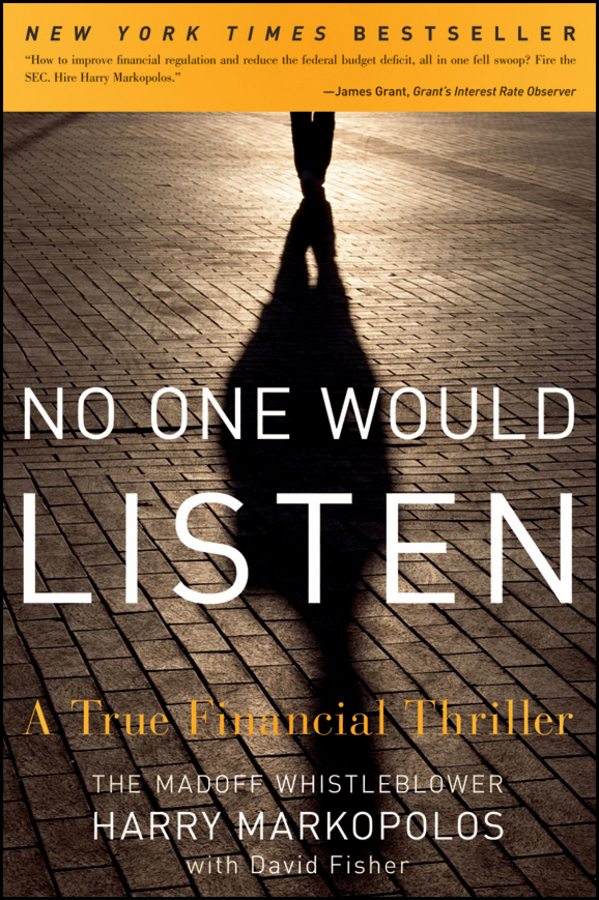
No One Would Listen: A True Financial Thriller
About this book
Asked to study a competitor's remarkably smooth performance, quantitative analyst Harry Markopolos quickly became convinced that the numbers could not come from the strategy Madoff claimed to use. The deeper he looked, the more serious the implications became.
Markopolos describes the evidence he assembled, the complaints he submitted to the SEC, and the frustration of watching warnings disappear inside an institution that did not understand or pursue them. His team continued even as Madoff's reputation grew.
No One Would Listen is a first-person account with the urgency and anger of someone who knew a fraud was expanding in public view. It also records the limits of being right when the people with authority do not act.
Read a sample
5,058 words
Plain text
From the opening
Foreword
Harry Markopolos is a hero.
But not for anything he meant to do. He did not stop Bernie Madoff from creating the largest Ponzi scheme of all time; nor did he save Madoff’s investors any money.
What he did do was create a clearly documented record of his warnings so that when Madoff’s scheme eventually toppled under its own weight, the Securities and Exchange Commission (SEC), which was charged with stopping fraud and protecting investors, could not assume an ostrich defense.
Ponzi schemes exist in stable disequilibrium. This means that while they can’t ultimately succeed, they can persist indefinitely—until they don’t. Just the fact that something has gone on for a very long time doesn’t mean it’s legitimate. Madoff’s story shows that investors are attracted to too-good-to-be-true situations despite the red flags. How statistically different was Bernie Madoff’s track record from General Electric’s 100-quarter record of continual earnings growth or Cisco’s 13-quarter record of beating analysts’ quarterly estimates by exactly one penny per share between 1998 and 2001? Madoff’s record was clearly implausible and, therefore, raised the question of what was wrong. The question is: Do we draw the line at Ponzi schemes or do we do something about less clear-cut manipulations as well?
One time I pointed out to a Wall Street analyst that a certain company was cooking the books. The analyst responded that it made him more confident in his bullish recommendation because such a company would never disappoint Wall Street.
For years, I observed and experienced the SEC protecting large perpetrators of abuse at the expense of the investors whom the SEC is supposed to protect. The SEC has been very tough, and usually appropriately so, on small-time cons, promoters, insider traders, and, yes, hedge funds. But when it comes to large corporations and institutionalized Wall Street, the SEC uses kid gloves, imposes meaningless nondeterring fines, and emphasizes relatively unimportant things like record keeping rather than the substance of important things—like investors being swindled.
Bernie Madoff epitomized the problem. When he was legit, Madoff was a large broker-dealer and the former chairman of NASDAQ. He was not famous as a money manager, let alone as a hedge fund manager, because he wasn’t one. After his scheme collapsed and he became known as a crook, he was rechristened as a hedge fund operator—even though, to this day, his was the only so-called hedge fund I’ve heard of that didn’t charge a management fee or an incentive fee. I doubt he would have fooled the SEC had he been known as a hedge fund manager, as the SEC would’ve been predisposed to catch him if they had known him with that title.
Warren Buffett said, “You only find out who is swimming naked when the tide goes out.” The financial crisis of 2008 revealed many, including Madoff, to be inappropriately attired. Effective regulation must mean that the skinny-dippers are stopped while the tide is still in.
As you will see, the SEC has taken some steps toward reform, and Harry Markopolos is optimistic that the agency will do better. I’d hold off judgment until the SEC brings cases that matter against large corporations that haven’t gone bankrupt (taking action before the money is lost) and against institutionalized Wall Street.
The silver lining in the Madoff collapse, if there could be such a thing, is that for at least one moment in time, the SEC has been exposed. And for his role in making that happen, Harry Markopolos deserves all of our thanks.
David Einhorn
December 2009
Who’s Who
Investigation Team and Advisers
Frank Casey
Neil Chelo CFA, CAIA, FRM
Gaytri Kachroo, personal attorney
Harry Markopolos CFA, CFE
Phil Michael, qui tam (whistleblower) attorney
Michael Ocrant
Madoff and Advisers
Nicole DeBello, Madoff’s attorney
Bernard Madoff, founder, Madoff Investment Securities LLC
Ira Lee Sorkin, Madoff’s attorney
Wall Street Feeder Funds
Access International Advisors and Marketers
Francois de Flaghac, marketing
Patrick Littaye, Founder
Prince Michel of Yugoslavia, marketing
Tim Ng, junior partner (and husband of Debbi Hootman)
Rene-Thierry Magon de la Villehuchet, Chief Executive Officer
Fairfield Greenwich Group
Douglas Reid, Managing Director
Amit Vijayvergiya, Chief Risk Officer
Financial Wizards and Wall Street Brains
Dan DiBartolomeo, Founder, Northfield Information Services
Jeff Fritz, Oxford Trading Associates
Leon Gross, Head of Equity Derivatives Research, CitiGroup
Andre Mehta, CFA, super-quant and Managing Director of Alternative Investments at Cambridge Associates
Chuck Werner, math wizard from MIT
Markopolos’s Friends and Colleagues
Harry Bates, sergeant, Whitman, Massachusetts, Police Department
Pat Burns, Director of Communications, Taxpayers Against Fraud (whistleblower organization)
Boyd Cook, major general in the National Guard, Maryland dairy farmer
George Devoe, CFA, Chief Investment Officer, Rampart Investment Management Company
Elaine Drosos and family, owners of the Venus Cafe in Whitman, Massachusetts
Dave Fraley, managing partner, Rampart Investment Management Company
Scott Franzblau, Principal, Benchmark Plus
Bud Haslett, CFA, Chief Option Strategist, Miller Tabak Securities
Dave Henry, CFA, Chief Investment Officer, DKH Investments in Boston, Massachusetts
Chuck Hill, CFA, succeeded Markopolos as president of the Boston Security Analysts Society
Daniel E. Holland III, Managing Director, Goldman Sachs in Boston
Debbi Hootman, Darien Capital Management
Greg Hryb, CFA, Darien Capital Management
Louie Markopolos, Harry’s younger brother
Matt Moran, Vice President of Marketing, Chicago Board Options Exchange
Peter Scannell, Putnam Investments’ Quincy employee who filed a claim with the Securities and Exchange Commission
Rudi Schadt, PhD, Director of Risk Management, Oppenheimer Funds
Diane Schulman, False Claims Act fraud investigator
Continue reading the sampleClose the sample
Jeb White, President, Taxpayers Against Fraud
Burt Winnick, Managing Partner, McCarter & English in Boston
Bill Zucker, attorney, McCarter & English
Journalists
Erin Arvedlund, Barron’s magazine reporter
Reuben Heyman-Kantor, 60 Minutes
Andy Court, 60 Minutes
John “Front Page” Wilke, Wall Street Journal reporter
Greg Zuckerman, Wall Street Journal reporter
Government Officials
Securities and Exchange Commission (SEC)
David Becker, General Counsel
Steve Cohen, attorney
Christopher Cox, former Chairman
David Fielder, Assistant Inspector General
Noelle Frangipane, Deputy Inspector General
Robert Khuzami, current Director of Enforcement
David Kotz, Inspector General
Lori Richards, former Director, Office of Compliance, Inspections and Examinations
Mary Schapiro, current Chairman
Jonathan Sokobin, Deputy Chief Economist, Office of Economic Analysis, and Director of Risk Management
Heidi Steiber, Senior Counsel
Linda Thomsen, former Director of Enforcement
Andrew Vollmer, former Acting General Counsel
John Walsh, Chief Counsel, Office of Compliance, Inspections and Examinations
Chris Wilson, Senior Counsel
David Witherspoon, Senior Counsel
Boston Regional Office
Jim Adelman, former senior enforcement attorney
David Bergers, former New England Regional Director of Enforcement, who replaced Grant Ward, current Regional Administrator
Michael Garrity, Assistant Regional Director
Edward Manion, Senior Staff Accountant
Juan Marcelino, former Regional Administrator
Joseph Mick, Assistant Regional Director
Walter Ricciardi, former Regional Administrator
Grant Ward, former New England Regional Director of Enforcement
Northeast Regional Office in New York
Doria Bachenheimer, Assistant Director of Enforcement
Meaghan Cheung, Branch Chief
Peter Lamoure
Simona Suh, enforcement attorney
Senate
Jeff Merkley (D-OR)
Chuck Schumer (D-NY)
House of Representatives
Gary Ackerman (D-NY)
Shelly Capito (R-WV)
Joe Donnelly (D-IN)
Barney Frank (D-MA), Chairman of the House Financial Services Committee
Scott Garrett (R-NJ), Ranking Member, House Capital Markets Subcommittee
Al Green (D-TX)
Paul Kanjorski (D-PA), Chairman of the House Capital Markets Subcommittee
Carolyn Maloney (D-NY)
James Segel, Special Counsel to the House Financial Services Committee
Brad Sherman (D-CA)
Other
Andrew Cuomo, current New York State Attorney General
William Galvin, Massachusetts Secretary of the Commonwealth
Eliot Spitzer, former New York State Attorney General
Kathleen Teahan (D, Plymouth), Markopolos’s former local Massachusetts state representative
Introduction to the Paperback Edition
I lead a very busy life. I’m involved in several investigations of the financial industry that will shock people when, and if, they become public. The “if,” of course, is the result of my experience in the Madoff case, when so many individuals and institutions simply chose to ignore the facts in front of them. However, these investigations are what matter to me now. I have made several speeches about our Madoff investigation, mostly to professional organizations, but it has reached the point where I really don’t enjoy talking about it anymore. Fortunately, it is in my rearview mirror. Unfortunately, that’s not true for most of us.
We’re going to be living with Bernie Madoff for the rest of our lives. He has become so much a part of our culture that he has achieved a certain kind of infamy—his name has become a metaphor for a brilliant and heartless criminal, while his face has become a popular and instantly recognizable Halloween mask. This is a story that will have an impact for generations and still produces frequent headlines in the news: Madoff got beaten up in prison; Madoff’s son commits suicide and his body goes unclaimed; the victims’ trustee, Irving Picard, files another lawsuit; another formerly exclusive golf club has been put up for sale because too many of its members lost too much money; an auction of Madoff’s personal belongings grosses $2 million—including $6,100 for slippers with his initials embroidered in gold thread. But for me, of course, and the Fox Hounds, Bernie Madoff will always be the one who got away.
In the months since the initial publication of this book there have been substantial and significant actions. On paper, Madoff defrauded an estimated three million investors of $64.8 billion, although his records included only 5,000 direct accounts. Obviously, $64.8 billion is an arbitrary number, as there are several different ways of calculating the losses. But any conversation about Madoff has to begin with the fates of the victims. I’ve come to believe that there are far more victims than anyone has speculated. I actually didn’t appreciate how depraved a human being Bernie Madoff was until I began meeting a few of those victims. I’ve been invited to make many speeches, and each time I do I meet victims. I’ve heard too many stories about people who have committed or attempted suicide, or who died of heartbreak or stress, after losing much or all of their life savings to Madoff. In addition to the 339 funds of funds in more than 40 countries we know about, I’ve learned of consolidators who put together large groups of small investors and delivered their money to established funds that invested with Madoff. After one TV interview, the host of a major news program whispered to me, “Harry, there are a lot of victims here.” It turned out that almost all of the camera operators had lost their life savings.
That surprised me. Madoff almost exclusively accepted large investors and, while technicians make a comfortable salary, they don’t have millions of dollars to invest. The host explained that they had been approached by a consolidator who pooled their savings and gave it to a fund of funds. They’d lost everything—but only the name of the consolidator appeared on the long list of victims. I heard similar stories several different times, meaning at least some of the names on the victims list actually represented multiple investors.
It’s clear now that some people will get some money back. Who and how much is another question. Initially one investor who had lost several million dollars was offered 10 percent of the value of his loss by a syndicate trying to buy debt in the event there is money returned. Recently that same person was offered as much as 35 percent of his claim, so obviously there are people who believe that eventually there will be a significant payout. In fact, by the end of 2010 it appeared investors whose claims had been approved might receive as much as half of their investments minus what they already had received.
European victims have fared much better than Americans. According to reports, a group of European banks that sold Madoff-linked financial products to their clients have agreed to pay $15.5 billion to an estimated 720,000 Madoff investors. Supposedly that represents the entire amount those clients had invested, but not the profits Madoff had reported to them. About 20 percent of all European investors have chosen to file their own lawsuits. Not all European banks or funds of funds are participating, but it’s still a much better settlement than anything offered thus far to American investors. The fact that the banks settled isn’t surprising; the European investors included the wealthiest and most powerful citizens in those countries—among them some royals—and they had a lot of clout with those banks.
It also seems clear at least some of those banks had doubts about Madoff. ABC News reported that JP Morgan’s London office filed a “Suspicious Activity Report” with UK authorities two months prior to Madoff’s arrest claiming his returns were most likely fraudulent. Morgan already had begun withdrawing investments from feeder funds dealing with Madoff, which caused an advisor to one of those funds to threaten a Morgan representative that the fund’s “Colombian friends” could “create havoc.”
These “friends,” obviously drug lords, as well as Russian Mafia and other criminals who had invested tens of millions of dollars, were precisely the people I was so concerned about when we began blowing the whistle on Madoff.
In this country the court-appointed trustee, Irving Picard, has reviewed more than 16,000 claims for repayment of losses. Picard is in a very difficult situation but he is doing an extraordinary job. He’s decided that profits on paper aren’t legitimate and has rejected all those claims. He’s also decided that those people who took out an amount equal to or greater than the money they actually put in won’t receive any funds. Taking everything into consideration, he has found that only about 2,300 of the claims, worth $5.58 billion, are valid.
The question is how much money Picard will eventually be able to claw back or recover. By the end of 2010 he had recovered about $3 billion, and had reached an additional $7.2 billion settlement with the estate of the late investor Jeffrey Picower. Picower was one of Madoff’s largest investors and had received those funds in excess of his investments. Picard also had filed civil suits against Madoff’s family, investment funds, and wealthy investors, seeking an additional $48 billion. In November he brought a $2 billion lawsuit against UBS AG, accusing that bank and its related entities of 23 counts of financial fraud, pointing out, “Madoff’s scheme could not have been accomplished unless UBS had agreed not only to look the other way, but also to pretend that they were truly ensuring the existence of assets and trades when in fact they were not and never did.” In early December, he sued JPMorgan Chase for $6.4 billion, and Sonja Kohn’s Bank Medici for $19.6 billion—but asking the courts to treble the Kohn figure under racketeering statutes. When filing those charges he referred to Kohn as Madoff’s “criminal soul mate.”
All of these entities have denied his charges. For example, Morgan’s spokesperson said the lawsuit “blatantly distorts both the facts and the law in an attempt to grab headlines,” and the bank will defend itself vigor-ously.” But it does seem clear that many of these banks and funds knew Madoff was a fraud, if not a Ponzi scheme. The Financial Times reported in December that several banks, as well as Access International, had been warned of serious problems. A specialist brought in by that fund warned after four days of investigation, “If this were a new investment product not only would it fail to meet due dil standards you would likely shove it out the door . . . EITHER extremely sloppy errors OR serious omissions in tickets.” By the time Picard is done, he estimates he could end up filing lawsuits against as many as 1,000 investors he describes as “net winners.” Those are “the people who made money, who got more, have made money at the expense of the people who didn’t.”
Unfortunately, at least some of those net winners are elderly people who were duped by Madoff or investment funds, people who were dependent on the returns they got from him and are now living on whatever they have left. So what do you do about those people? Do you take their remaining money and leave them destitute? It’s difficult not to be sympathetic; I’ve met several people who have already lost most of their life savings and are terrified the trustee will be able to claw back what they have left.
It’s a lot easier to go after those people who walked away from Madoff with a fortune. The question that I have been asked more often than any other is: Do I think Madoff’s family knew what he was doing? Certainly Irving Picard does, claiming that the family used Madoff’s Ponzi scheme as “a family piggy bank.” In July 2010 he sued three businesses controlled by Madoff’s sons and other family members to recover more than $30 million. In his court papers Picard wrote that Madoff family members spent as much as $200 million for their own purposes. “Foremost among the recipients of Madoff’s gifts of customer funds were his closest family members, including his wife Ruth Madoff, his brother Peter, his two sons Andrew and Mark, and his niece Shana.” In November 2010 Picard filed 40 lawsuits against family members and former employees of the firm seeking to recover $69 million that was fraudently transferred to these people. In addition, Madoff’s former secretary and the woman who handled daily cash balances were arrested and charged with conspiracy, securities fraud, and falsifying records.
And in December 2010 Mark Madoff committed suicide in his $6 million apartment, writing despairingly that “No one wants to hear the truth,” as his two-year-old child slept in the next room. Unfortunately, I suspect this will not be the last death directly attributable to Bernie Madoff.
In response to the public outrage, and perhaps to my testimony, the government has taken steps to encourage whistleblowers. The Dodd-Frank Wall Street Reform and Consumer Protection Act, which was part of the regulatory overhaul signed into law by President Obama in July 2010, specifically increased the potential reward to whistleblowers who provide “original information” from 10 percent up to 30 percent of any successful enforcement action that exceeds $1 million. Even while the precise details of the program were still being hammered out in Congress, plaintiff law firms began advertising on radio and in the newspapers for whistleblowers. While it is still rare for a bounty to be paid, with fines in the tens of millions of dollars these cases can be far more lucrative than the normal slip-and-falls many of these firms han-dle. As one Washington firm offered, “If you are aware of any securities or tax law violations and would like to discuss the SEC [Securities and Exchange Commission], CFTC [Commodity Futures Trading Commission], or IRS whistleblower programs with a [name of firm] attorney at no charge, please contact us.”
Obviously a lot of major corporations are nervous about this new regulation, as perhaps they should be. In October 2010, attorneys representing several major financial, pharmaceutical, and big-box companies asked the SEC to force employees to bring any accusations to the firm before taking them to the agency. In addition, they asked the SEC to refuse to accept charges from those people with “fiduciary responsibility” to the company, basically executives and directors.
It’s actually pretty funny: The SEC is finally ready to show some teeth—and these firms are asking the agency to have those teeth pulled. Until the final regulations are promulgated, it’s impossible to know how weak or strong they will be. A lot of people are watching.
The only member of the Fox Hounds still actively working on the Madoff case is Gaytri Kachroo. She was invited to speak in front of the World Legal Forum in The Hague about the problems facing investors trying to make claims concerning financial frauds across national borders. She has served as the vice-chair of the Global Alliance on the Madoff case (a civil society of about 5,000 lawyers from 28 countries), which has led to international discussions about how to deal with multinational financial frauds. She also is actively representing many Madoff investors in their negotiations with Irving Picard, and in their potential lawsuits against the SEC. It’s an extraordinarily complex situation, and it isn’t going to be resolved quickly or to the satisfaction of most of the people who have suffered damages.
For the rest of Fox Hounds—Neil, Frank, Mike, and me—the Madoff case remains the superglue that bonded us together, but it long ago ceased to be part of our daily or weekly lives. Unless there is a story in the papers, we rarely even discuss it. We get up in the morning and, unlike Madoff or many of his victims, we simply move forward with our normal lives. And having once been so close to pure evil, we are enjoying every minute of normality.
Introduction
On the rainy afternoon of June 17, 2009, David Kotz sat patiently in a small room with a single barred window at the Metropolitan Correction Center, a prison in lower Manhattan, waiting to interview Bernard Madoff, the mastermind behind the greatest financial crime in history. Kotz, the Securities and Exchange Commission (SEC) inspector general, was investigating the total failure of his agency to expose Madoff’s $65 billion Ponzi scheme—even after I’d warned the SEC about it in five separate submissions over a nine-year period.
Kotz and his deputy, Noelle Frangipane, sat across from an empty chair, and on either side of it sat Madoff’s two attorneys, Ira Lee Sorkin and Nicole DeBello. Eventually Madoff was escorted into the room by a guard, who carefully unlocked and removed his handcuffs. Bernie Madoff had been a king of the financial industry, the widely respected cofounder and former chairman of NASDAQ, the owner of one of Wall Street’s most successful broker-dealers, and a prominent New York philanthropist. Now, wearing a bright orange prison jumpsuit that glared against the drab gray walls of the room, he sat down between his impeccably dressed lawyers.
Madoff had agreed to this interview with the single stipulation that it not be taped or transcribed. Kotz began by explaining to Madoff that he had a legal obligation to tell the truth. The fact that he was to be sentenced a week later may have influenced his decision to talk openly to Kotz. Or it may simply have been his ego making a last grasp for attention. When it comes to assigning motives to Madoff’s actions, who can really say? His motives make him an enigma, even to this day.
As Kotz later recalled, Madoff was overly polite and seemed forthcoming. “I guess we were concerned that all the answers to our questions would be one or two words or he wouldn’t provide much information or his lawyer would cut him off every time he tried to say something, but there was none of that. He answered all of our questions expansively. It seemed like he didn’t hold anything back.”
Over a three-hour period, Kotz and Frangipane took copious, nearly verbatim notes as Madoff revealed for the first time the whole story of his Ponzi scheme, claiming it had been started almost by accident and that he admittedly was astonished that he hadn’t been caught by the SEC. He was extremely critical of that agency, calling its investigators idiots, assholes, and blowhards. Kotz noted how frequently Madoff boasted of his connections in the financial industry. “He claimed to know so many important people—‘I knew this one,’ that one ‘was a good friend,’ this one he ‘knows very well,’ that one he ‘had a special relationship with.’”
But it was about halfway through this interview, when Kotz asked him about me, that his attitude changed. “So let me ask you,” Kotz said, consulting his notepad, “How much do you know about Harry Markopolos?”
Madoff immediately waved his arm dismissively. He bristled. I was nothing, he told Kotz. “This guy is getting all this press, all this attention. He thinks he’s some kind of seer. But believe me, it’s all overblown. You know what? He’s really a joke in the industry.”
Madoff continued, explaining that I was “a guy who was just jealous” of his business success. As Kotz listened to him, he began to realize that Madoff considered me a competitor and appeared to be bothered by the fact that I was getting attention that rightfully belonged to him. He wouldn’t let it go. Later in the interview he defended his investment strategy, which I had ripped apart, telling Kotz, “All you have to do is look at the type of people I was doing this for to know it was a credible strategy. They knew the strategy was doable. They knew a lot more than this guy Harry.”
No, they didn’t. They just saw the money. And they could not see through the dangerously charming exterior of a man who labeled me a “joke.”
Let me say first that I take no pride in having the last laugh. I’m Harry Markopolos, and this is the true account of my first case as a whistleblower to the SEC.
How did I become a whistleblower? It all began in 1999 when my friend Frank Casey first brought Madoff to my attention. I was confounded by the Wall Street mogul’s financial successes, and had to know more. I tried but couldn’t replicate his results. I later concluded it was impossible. One red flag led to another, until there were simply too many to ignore.
In May 2000, I turned over everything I knew to the SEC. Five times I reported my concerns, and no one would listen until it was far too late. I was a whistleblower taking on one of the most powerful men on Wall Street, and at some points through the nightmarish journey, I feared for both my safety and that of my family. I was convinced the crime he was committing was going to be the worst in market history. Ten years later, Madoff is now behind bars and we all know why.
My investigation team, as it came to be known, was comprised of four honest people with the shared belief that good ethics demands action. The four of us were the last and unfortunately only functioning line of defense between Madoff, his global organization of feeder funds, and their victims. We tried mightily to stop what we knew was wrong. As a result of our work the SEC—if it continues to exist—will be a different agency, and the way we police and regulate our markets will have been changed completely.
This is our story.
Chapter 1
A Red Wagon in a Field of Snow
On the morning of December 11, 2008, a New York real estate developer on a JetBlue flight from New York to Los Angeles was watching CNBC on the small seat-back television. A crawl across the bottom of the screen reported that Bernard Madoff, a legendary Wall Street figure and the former chairman of NASDAQ had been arrested for running the largest Ponzi scheme in history. The developer sat silently for several seconds, absorbing that news. No, that couldn’t be right, he thought, but the message streamed across the screen again. Turning to his wife, he said that he knew that she wasn’t going to believe what he was about to tell her, but apparently Bernie Madoff was a crook and the millions of dollars that they had invested with him were lost. He was right—she didn’t believe him. Instead, she waved off the thought. “That’s not possible,” she said, and returned to the magazine she was reading.
The stunned developer stood up and walked to the rear of the plane, where the flight attendants had gathered in the galley. “Excuse me,” he said politely, “but I’m going to be leaving now. So would you please open the door for me? And don’t worry—I won’t need a parachute.”
At about 5:15 that December afternoon, I was at the local dojo in my small New England town watching my five-year-old twin boys trying to master the basic movements of karate. It had been a gloomy day. Rain continued intermittently, and there was a storm in the air. I noticed there were several voice mails on my cell phone. That’s curious, I thought; I hadn’t felt it vibrate. I stepped into the foyer to retrieve the messages. The first one was from a good friend named Dave Henry, who was managing a considerable amount of money as chief investment officer of DKH Investments in Boston. “Harry,” his message said clearly, “Madoff is in federal custody for running a Ponzi scheme. He’s under arrest in New York. Call me.” My heart started racing. The second message was also from a close friend, Andre Mehta, a super-quant who is a managing director of alternative investments at Cambridge Associates, a consultant to pension plans and endowments. I could hear the excitement in Andre’s voice as he said, “You were right. The news is hitting. Madoff’s under arrest. It looks like he was running a huge Ponzi scheme. It’s all over Bloomberg. Call me and I’ll read it to you. Congratulations.”
I was staggered. For several years I’d been living under a death sentence, terrified that my pursuit of Madoff would put my family and me in jeopardy. Billions of dollars were at stake, and apparently some of that money belonged to the Russian mafia and the drug cartels—people who would kill to protect their investments. And I knew all about Peter Scannell, a Boston whistleblower who had been beaten nearly to death with a brick simply for complaining about a million-dollar market-timing scam. So I wouldn’t start my car without first checking under the chassis and in the wheel wells. At night I walked away from shadows and I slept with a loaded gun nearby; and suddenly, instantly and unexpectedly, it was over. Finally, it was over. They’d gotten Madoff. I raised my fist high in the air and screamed to myself, “Yes!” My family was safe. Then I collapsed over a wooden railing. I had to grab hold of it to prevent myself from falling. I could barely breathe. In less time than the snap of my fingers I had gone from being supercharged with energy to being completely drained.