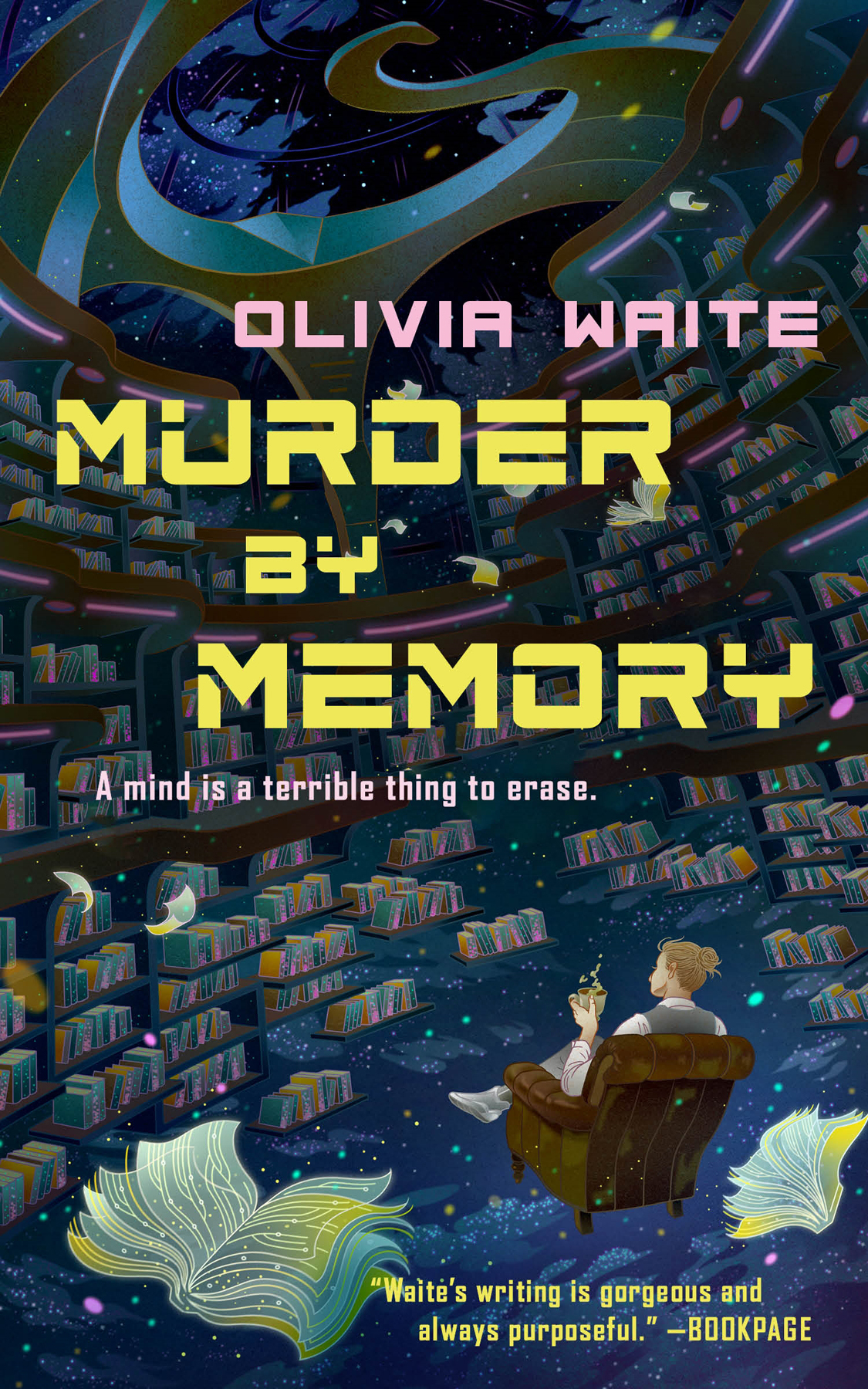
Murder by Memory
About this book
Dorothy Gentleman lives aboard the generation ship HMS Fairweather, where passengers can receive replacement bodies and store their minds safely in the Library between lives. She wakes unexpectedly in a body that is already occupied.
A murder would ordinarily be repairable in this society, but someone is also erasing the victim's preserved mind. The attack turns a bodily death into permanent extinction and suggests that the Library's promise of continuity has been compromised.
Dorothy investigates through ship etiquette, technical access, and the disorienting intimacy of sharing another person's form. The cozy setting remains genuinely comfortable while its rules create new motives for inheritance, identity, and concealment.
Murder by Memory is the first Dorothy Gentleman novella. It introduces the Fairweather through a complete mystery and leaves room for further cases aboard the ship.
Read a sample
5,003 words
Plain text
From the opening
Near the topmost deck, in a small lift with glass walls and flickering buttons, I, Dorothy Gentleman, ship’s detective, opened a pair of eyes and licked a pair of lips and awoke in a body that wasn’t mine.
It was the nails that first tipped me off. Blank bodies were just that: blank. My nails ought to have been the same color as the skin beneath—in my case, somewhere in a range of pinks, tending to florid.
Not silver, and not shaped.
This body was already inhabited.
My skin—someone’s skin—broke out in gooseflesh. Of course every human body was a horrifying collection of juices and tissues, acids and effluvia poured into a bag with a bunch of long rocks, a shambling accident of biology that made its own mysterious and often frustrating decisions without reference to the mind. They were disgusting miracles, every one. It was always a bit unsettling to wake up in a fresh form, until habit made a home of it.
But someone else’s home, and my self inside it! A nightmare. Imagine going to the washroom to be sick and having someone else’s sick come out.
I came very close to making this more than a metaphor. It took many deep, deliberate breaths for the squeamish feeling to subside.
It wasn’t supposed to be like this.
Normally one woke up in Medical, surrounded by institutional teal paint and staff with the kind of professionally soothing voices that made you want to claw your own skin off. Not in the central lift, which went only from the topmost three decks to the Library at the very peak of the ship.
Oh, the Library was a marvel. I wish you could have seen it.
Everyone on the Fairweather had a book and a body: the Library held a copy of your mind in the one while you walked around in the other. You could update your book as often as you pleased, adding in experiences and memories from your waking self. And when your body was damaged—in an accident, or from the inescapable progression of aging and illness—you could have your book-mind decanted into a new one based on your personal genetic pattern and preferences for sex. Et voilà, a whole new lifetime.
And if, say, you’d had a rather rough time of things in your last body, you could rest for a time on the Library shelves, until you felt like being a human grappling with the world again.
I’d meant to be resting. I’d insisted, the last time I was asked. Yet here I was, contrary to my will, walking around on someone else’s legs and running my thoughts with someone else’s brain.
Something untoward must have happened.
“Ferry?” I queried, reaching out for the shipmind.
No response.
Not terribly odd: the Fairweather—Ferry for short—had a million different things to monitor at any one time. Unless it was actively listening, you sometimes had to wait a minute for your query to make it to the head of the queue. The lift had stopped—had been stopped?—between decks, and until I knew more about what was happening it seemed foolish to go blundering around like a bear escaped from a zoo.
To pass the time, I started riffling through my pockets.
Apparently the person who owned this body was fastidious: they’d chosen a fine white cotton shirt and gray wool suiting of elegant simplicity. My trouser and waistcoat pockets held only four things: an access card, a pocket watch in a sleek silvered case, a powder compact with a mirror, and a small electric torch engraved with ALL MY LOVE, V.
The pocket watch opened to reveal the usual bright round screen. I held my thumb to it until it unlocked, then scrolled to the registration entry: Gloria Vowell, single, current body age twenty-seven. A clerk for one of the bank branches high on Forward Starboard Deck Three.
I had just about convinced myself that it was perfectly ethical to go digging for more information when Ferry deigned to respond.
Dorothy! the ship caroled, with a drunkard’s delirious joy. But how could a shipmind be drunk? I’m jolly glad you’re awake! Had to put you in a what’s a thing. Smallshape. Notship. Body!
“So I gathered,” I muttered. “But why?”
To save you! the ship went on. A giggle of triumph followed. You’re my favorite detective but don’t tell anyone and I didn’t want to lose you and now you’re saved and everything is fiiiiiiiiiiine!
Everything was evidently not fine. I hadn’t even been aware Ferry could impose a mind on a body not built for it. Perhaps that was a new development?
Perhaps everything was different?
I needed to get my bearings, and fast. “Ferry, what year is it?”
F307, came the swift reply. F for Fairweather, now more than three centuries into the millennium-long transit toward Whatever-We’ll-Call-It. The number 307 made it two years since my last body had worn out in 305 and I’d had myself shelved. A lot could happen in two years, certainly, but probably not a complete breakdown of civil society.
Probably.
I pressed my face almost up against the glass, but it was night and the lights were dim and scattered, no people anywhere that I could see. “Ferry, what were you saving me from?”
Your memory-book got erased!
All the blood in my veins turned to ice, and I sat down, feeling faint.
Continue reading the sampleClose the sample
But if my book was gone, then how was I here?
The ship was chattering on. I was just trying to navigate and then all the alarms went wooga-wooga. To say a book was damaged. And when a ship’s detective gets erased, my script says to put their secondary backup into the nearest body at once. But nobody in Medical. Or anyone on the bridge. Or Librarians. And there’s a magnetic storm, so everyone else is battened down on the habitat decks—but Miss Vowell was right there in the lift. So you see I had to—what’s a thing—impose.
I squeezed my eyes shut, suspicion rising up thick and searing as heartburn. No need to ask who’d written that script and authorized the secondary backup that even I hadn’t known about.
Whenever anything went frighteningly wrong in my life, one person was always at the root of it.
Rutherford Talmadge IV. The only son of my late sister, and one of Ferry’s scriptwriters.
Oh, Ruthie was well-intentioned, even a genius in some very specific ways, but the boy had a talent for chaos that was an equal to the strong nuclear force. You could blindfold him, gag him, tie his hands, shackle his legs, put him in a room alone for five minutes—and when you returned Ruthie would still have found a way to lose all his money on a comet race or buy himself six shirts in a print so blindingly garish that lighthouses could use it in place of a beacon.
Ruthie was the reason I was on the Fairweather in the first place—and now it seemed he was the reason I had possessed someone, like a spirit summoned by an accidentally competent medium.
And like I said, Ruthie invariably meant well: if he’d done something this outrageous, it was to solve a problem. “Ferry, has anything else been damaged? Can you do a full self-inventory?”
A long, worrying pause—then the shipmind said in thoughtful tones: You know, Dorothy, now that you mention it … I think somebody may be dead.
The chill of my cold hands was a balm against throbbing temples. The shipmind was odd as a seven-winged duck, and didn’t always appreciate the human point of view. “May be dead? Can you not say for certain either way?”
Good idea. Let’s check.
I breathed in and out and tried to get a handle on my runaway exasperation. My nephew had authored so many of the ship’s internal scripts over the centuries—no wonder certain commonalities of phrasing and expression crept in. Ferry babbling, the sense of tipsiness … This was easily the nephewest the shipmind had ever sounded. It boded not well.
Yes, said the ship, with what sounded suspiciously like a hiccup. I resisted the urge to speculate what a shipmind could even hiccup with. There is definitely a new dead body in one of the passenger cabins. Aft Port Deck Sixteen, Janet Dodds. No vitals at all. I remember now I felt them die, but it was just as the magnetic storm started! So I couldn’t send Medical—and then things got rather scrambly, and now they’re just there, a blank spot interrupting all my comfortable scans. The ship made a noise of profound unhappiness. It itches.
The magnetic storm—the only one I remembered—had happened two years ago. “Ferry, how many magnetic storms have there been since I got shelved?”
Thirteen.
I winced.
The science people say they’re … something. About this corner of space. The quasars? So there may be many more of them.
The ship’s mental voice was full of dread, and no wonder. Ruthie had once tried to explain—before I begged him to stop—how the first storm distorted the magnetics used in maintaining orientation and attitude. Redundancies kept the ship from abrupt physical changes in direction—say, turning the wrong way around and flinging us tiny humans up against the ceiling—but did not prevent the effects on the ship’s sensors. Essentially, a magnetic storm turned Ferry into the ship equivalent of a bachelor on a bender.
This one’s supposed to last until half ten, Ruthie told me. But the storms never killed anyone! They haven’t even damaged anyone in the Library! A slight cough with metallic echoes. Not since the first one, anyway.
I shied away from that particular reminder. It was barely three months ago, for me. I wondered how Celia had spent the years since then …
My hands—I might as well start thinking of them as mine, since nobody else was using them—itched to get around a pair of knitting needles. Better to count stitches and rows and cable crosses than to dwell on what I’d lost. Or rather, what I’d kept, and what Celia had lost.
Ferry had begun to sing softly—something maudlin about sailors and rum and home.
The later stages of intoxication: I suspected I’d get nothing useful from this point forward. I asked for the address of the corpse, then gave strict instructions to do the shipmind version of sleeping it off.
The lift rang with the silence, now that it was just me and my own thoughts. Down the long decks below no doors were open, no passengers prowled the artificial night. Battened down, Ferry had said, and I was briefly grateful to be the only person awake. It gave me an opportunity.
A detective’s book erased, and a fresh corpse killed at almost the same moment. I was willing to bet the timing was more than mere coincidence.
And one lone person out and about, who thanks to Ferry’s imposition I couldn’t even question.
Had Miss Vowell seen something? Was she a witness or an instigator? I’d have to wait to ask her, because for now I needed her body. It would be two long days before I could get a new one of my own—better to strike while the iron was hot, and before the trail had gone cold. We could always restore Miss Vowell’s mind later, after all.
I pressed the button for Deck Sixteen and felt my stomach lurch as the descent began.
From launch, the Fairweather’s Community Charter had been very clear that police were considered largely unnecessary. We had a small security force Ferry could deploy as needed—glorified bouncers, really—and a wealth of social workers in various fields; these two groups managed most everyday crises that arose.
For more complex situations—your elaborate hoaxes, your sudden deaths, your inexplicable accidents and incidents in which witness statements vastly differed—there were the ship’s detectives. We had no power to arrest or enforce: our duty was strictly to sort out the truth from the lies and report them to the Crime Committee, which would arrange for any necessary punishments or reparations. I had volunteered as a lark in the first six months of the journey, and had surprised myself, at the age of fifty-seven, by finding my calling.
That was several lifetimes ago, and it had yet to turn tedious. Frustrating and disillusioning, sometimes, but never dull.
A detective’s primary privilege was access, so when I reached the dead woman’s apartment on Aft Port Deck Sixteen I reached out and offered my fingerprint to the lock. The doors slid open, and I stepped across the threshold.
Down here on Aft Port Sixteen the flats were sprawling, single-level affairs: a kitchen at the back, a bedroom and bathroom off the center hallway, and one large front room for entertaining company and/or any side business the occupant was involved in.
Miss Dodds’s front room looked as though a wardrobe had exploded: garments in various states of construction and fabric samples were everywhere. Several sizes and genders of dress mannequins lurked headlessly in one corner. Colored pencil sketches on thin paper fluttered from the widest wall: skirts and trousers and evening wear, front and back pictured side by side. The retromat had recently produced a vivid silk print of clouds and cranes, folded in half and ready to be cut on the ruler-edged table shoved up close beneath the porthole on the farthest wall.
There were ever only the dark, distant stars outside instead of the warming sunlight or soothing rain of Old Earth, but somehow every human on board always put their worktables beneath their windows all the same. Myself included. As if we were careful to leave space in our lives for the weather we never experienced on board ship.
I moved closer to the wall of sketches. The same name was inked carefully in tiny capitals in the corner of every page: EMPYREAN DESIGNS.
The retromats, which fabricated objects from the operator’s memories, were notoriously bad at producing clothing—at least, if you valued your dignity and were certain you wouldn’t forget an important stitch or seam or zipper. But most people could make fabrics easily, and more than a few passengers on the Fairweather made extra money by creating and selling patterns to turn those fabrics into garments. Judging by the quantity and quality of designs I was seeing, Miss Dodds was more than a mere hobbyist.
I was halfway across the front room and headed for the rest of the apartment when the realization hit me: Dorothy Gentleman’s body had a detective’s privileges—but Gloria Vowell’s didn’t.
Which meant: the lock had recognized me. Gloria and the dead woman were connected.
It made sense, and I berated myself for not having thought of it earlier. Ferry had said everyone battened down during the storms—but there was Gloria, in the Library elevator, where she had no obvious business being.
I stopped where I was and pulled out Gloria’s pocket watch again.
Sure enough, the dead woman’s name was there in the address book: Janet Dodds, late thirties, a longtime member of Ferry’s custodial staff. Everyone on the ship received a standard income; necessary jobs came with wages on top of that. Custodians were among the most highly paid of all, along with Medical staff, teachers, and Librarians.
I scrolled through the notes. Gloria’s written conversations with Janet went back at length, but they didn’t appear to be social. They were full of references to Empyrean Designs. I brought up the infobank portal and poked a little further. It seemed Empyrean was a company Gloria and Janet had formed—and it stretched back nearly two hundred years.
Suddenly it seemed vital to find out precisely how Janet had died. Natural, accident, or something more sinister? The timing was enormously dodgy.
I found I rather misliked the idea of walking around wearing the body of a potential murderer.
I found the dead woman—where else?—in the bathroom.
The bathtub was the standard diamond-glass scoop that rose and sank into the floor, to provide everything from a spill lip for a shower to a full tub for a relaxing soak. Janet Dodds had raised hers to its full height, filled it full of memory liqueur, and then drowned in it.
Or so it appeared.
The rainbow swirl of liquids had preserved her like a damselfly in amber, a look of awe and wonder on her face. I recognized some of the colors: the soft pink of a sunrise, the greens of walks through woods in spring. Miss Dodds’s thick red hair drifted in curls around her like something out of John Singer Sargent, and her hands were raised softly to the surface of the liquid as though reaching out to cradle something that would vanish if grasped too tightly.
It was all very pretty and very tragic, and could not have been more obviously staged.
It was the prettiness of it that convinced me: this was a romantic’s notion of death by overindulgence. None of the graceless poses or unpleasant smells that usually came with corpses. People who drowned in memories also forgot where they were: they splashed and thrashed and spilled liquors all over in the throes of their final confusion. But the bathroom around me was pristine—as if it had been cleaned up, wiped down, and presented to a jury like a painting in an exhibition.
We detectives had seen a great deal of this kind of death in the early days, when people were still adjusting to their new reality of life on board ship. The temptation toward consciousness-altering experiences was very human, and the existence of the Library meant even fatal experiments didn’t stay fatal. Our bodies were temporary—at least until that distant day of planetfall, when we’d pick one to keep until real, permanent death overcame us.
But being temporary was not the same as being disposable. And that was how Janet had clearly been treated: as something to be gotten rid of. A nonmystery with all the bows tied up nice and neat for whoever was first to find her.
It was an affront to any detective’s soul, even if they weren’t—possibly—walking around with the hands that had done the deed.
Murder had happened before on the Fairweather. We were all still human, after all. The first century of the crossing had seen several famous incidents: a fraudster, a jealous lover, a brawl in a pub that went too far. But murder trials were quite different when the victim could be brought in to testify in court—or when the shipmind could subpoena the killer’s own memories as evidence. One victim had even been able to name her murderer, since she’d realized she’d been poisoned and managed to make it to the Library and update her memory-book in the last instants before her body’s death.
And since killing someone no longer removed them permanently but still came with many of the old punishments, the payoff was generally not deemed worth the effort.
Unless someone had come up with something clever to shift that calculus.
It was a thought to send a chill through all my borrowed bones.
Maybe Gloria’s not a killer, I thought. Grasping at straws, but it helped shake off the paralysis. Perhaps the two of them were just having a little fun, and something went wrong, and Gloria panicked. Perhaps some third party was involved.
And after all, Miss Dodds could be restored from her memory-book.
Couldn’t she?
What was it Ferry had said? I’d been put in Gloria’s body because someone had erased my book from the Library. What if other books had been damaged as well? By the storm, or by sabotage?
Those questions would be the first ones I’d ask once Ferry was, well, sober again.
In the meantime, I could start pulling threads on the other mystery: the secret copy of my mind that Ferry had brought forward when my real copy was erased.
And I knew precisely who was to blame.
Far more awe-inspiring than the stars, to my mind, was the view of the Fairweather’s heart.
Vast round windows in both bow and stern, like the domes of some sideways cathedral, now flickering with the green-and-purple auroras of magnetic disturbances. Ramps and lifts up and down between decks, abandoned from the storm and the lateness of the hour. The diamond patterns of the metal railings, turning shadows into stripes. Doors both simple and ornate, flanked by planters and chairs. Flats and home shops and small cafés, vanishing into the distance, an entire small city flowering as it sped through the great dark nothing.
This little world was made for us, for humans, had been carefully designed and painstakingly built to be a refuge and a comfort on the long journey from our old home to our new one.
And of course the Greenway, the hydroponic garden that wound up the middle of it all. The soaring trees that shielded the towers of planting tiers had filled out a little in the past two years, stretching toward the great solar lamps pendant from the ceiling. Someone with a very green thumb had succeeded in making a little lawn of velvet moss that bounded the whole of the garden and made it look like an emerald set into a silver cuff. Pretty, and practical, too—all that greenery dampened sound and filtered the air into something that smelled almost natural. Like a little bit of Old Earth we could enjoy without having to riffle through fading remembrances for it.
It was all empty now, silent and dark as space itself. I’d never seen it like this before. Even at night there had always been the sounds of cocktail bars and jazz bands and people working late shifts to keep the whole machine humming. The occasional midnight cycle races, riders spinning by in descending spirals and taking the corners at ludicrous speeds. But now all those ramps were empty, their lengths arcing between decks like the ribs of some great interstellar beast, borne along on nighttime tides.
I shivered and walked as fast as I dared to Ruthie’s apartment.
My nephew had apparently moved into a sober, suspiciously respectable neighborhood on Forward Port Five, all tall two-story apartments with upper balconies. This deck was on the same level as in the canopy of the Greenway’s trees, maple and apple and oak stretching out just past the railing like welcoming arms. It would be pretty in the daylight; now, with the solar lamps dimmed in artificial night, the tree branches looked eerie and skeletal and cast grasping fingers over the empty balcony above my head.
I felt like a witch roaming a wood on some Hallows’ Eve as I raised a hand and rapped sharply on the door of Ruthie’s flat.
It took several more knocks before the door creaked open. Slim pale hands rubbed at bleary eyes and shoved errant brown curls away from a tall forehead.
When the Fairweather was first constructed, back on the planet we barely recalled, I’d thought the journey an awful idea even before I learned Ruthie was one of the primary minds behind it. I had enough trouble with the sea crossing on my annual voyage from New York to London to visit my sister, Alexandra, and her son; you’d never catch me cruising across the stars. But then Alex had died, and Ruthie and I had only each other—and when he’d asked me to take her berth, I hadn’t the heart to say no.
Stay behind and be all alone, while my nephew contended with a ship full of strangers, any one of whom might be up to who knew what sort of malice or mayhem? Unthinkable.
I smiled at him now, because despite the murder and the borrowed body and the drunken shipmind, it was good to see his face again in person. “Hello, Ruthie.”
“Yes?” Those familiar eyes blinked again, then focused. “It’s Miss Vowell, isn’t it?”
Wait: Ruthie knew Gloria?
Just how far did this web of deception stretch?
Abruptly, my plans made a pivot. Deception might be safer, until I had a better sense of the situation. “I’m so sorry to bother you so early, Mr. Talmadge—”
“And during a magnetic storm, too,” Ruthie mumbled.
“—but I wasn’t sure where else to go.” At least that much was true. I put a hand on the doorframe and tried to make my face look pleading.
Good heavens, what did Gloria’s face even look like? Should have checked in a mirror earlier.
Ruthie only stood there, rumpled and blinking.
“May I come in?” I asked eventually.
“Oh! Yes, I suppose so,” he said, and pulled the door wider. “John?” he called out. “Company.”
Did Ruthie live with someone now? Another new development since my retirement to the Library. I smiled what I hoped was an apologetic smile and turned to face the stranger as he emerged from the bedroom above.
He was tall and dark-haired, and his eyes had a gentle fold on the lids. He wore pyjamas with a deep blue stripe, covered with a dressing gown cinched tight and tied as precisely as any cravat. “Miss Vowell,” he said in a voice like brushed steel. “May I get you something to drink?”
Ruthie beamed, pride coming off him like solar radiation. “Of course you’ll be familiar with John’s talents as a memory artist.”
“Of course,” I murmured. Ruthie’s always loved a cocktail—no surprise to hear he’d fallen for a cocktail maker.
When our long voyage had first been planned, or so Ruthie was fond of telling me, one of the major questions had been: How do we handle the discrepancy between the short life of the body and the long life of the mind that the journey will require? The Founding Board didn’t want to lose any of the passengers’ experience and knowledge, however trivial it seemed—but you could only fit so much of that experience in a single human brain before it began to overflow its banks.
The memory liquors had been Ruthie’s answer. Memories of Earth, the kind we couldn’t make on board the Fairweather, sorted by type and distilled into distinct colors and flavors. You could mix them like any cocktail, and with the same ratio of success to failure—certain flavors of experiences went together, while others clashed. I’d once tasted Ruthie’s idea of combining the roar of artillery with the coo of a baby’s first laugh: he had tried to call it artistic and avant-garde, but you might as well have mixed gin and rum and poured it over olives instead of ice. A disaster on every conceivable level.
Any memory artist worth his license should be well aware of how to combine various types for best effect.
I decided this would be as good a gauge of this John’s mettle as any. “I’ll have a summer storm, please.”
John nodded easily and walked to the cabinet in the corner, where glass and liquid sparkled in a rainbow of hues and an orchestra of shapes.
I settled myself in an armchair, bouncing a little to test the stuffing, taking the opportunity to examine the room. Tasteful furnishings in soft and pleasing neutrals. Small silver art pieces on the mantel over the glow of the retromat, and a soothing landscape print in an unostentatious frame. A glossy caramel-colored piano in one corner, with sheets of music whose disarray argued for lamentable frequency of use. A desk in the same color wood, a corkboard full of paper notes and calendar dates, and—ah! A newspaper clipping with a photo of several men, including John himself. Gloria’s twenty-seven-year-old eyes were sharp enough to pick his name out of the fine print of the caption: JOHN PENGELLY.
The only garish colors were the memory liquors, and even those had been harmoniously arranged in spectrum order.
“Are you sure Mr. Talmadge lives here?” I asked. “I don’t see any novelty cocktail shakers or cartoons of humorously shaped vegetables.”
John shuddered. “And you never will, madam.” He was currently pouring something long and lilac into a simple silver shaker. A dusting of gold shimmer, a dab of white mist, shaken and poured over ice in a highball glass. He set it on the table beside me with a knowing smile, then returned to mix something else for himself and my nephew. His own was deep amber, Ruthie’s a wretched blue. “To the future,” John said.
“To the future,” we chorused, as was traditional.
I settled my back against the chair—really it was perfectly comfortable, damn the man—and took an experimental sip.
I’d challenged him and expected he would respond with a show of force … but it turned out this memory artist had subtlety.
That would be the first and last time I would underestimate John Pengelly.
First to my senses came the remembered scent of ozone, metallic over the bright, sweet flavor of grass warmed by sunlight. Then clouds built up into thunderheads, white piles turning slowly charcoal as the chill of the rain poured down. Stark flashes of lightning that briefly blinded me, as wind tossed my wet hair back from my face and thunder rumbled a bass note I felt deep in my chest. I was still buzzing with it as the storm moved on down the hill and leaves and petals scattered about me, wind blowing the droplets into mist, the taste of petrichor fresh and tart on my tongue.
Then even that faded, and I was back in Mr. Pengelly and Ruthie’s oh-so-tasteful parlor.
My nephew was all attention and anxious query, sitting up in his chair like a human exclamation point—but his partner waited comfortably, stoic and serene.